Short answer
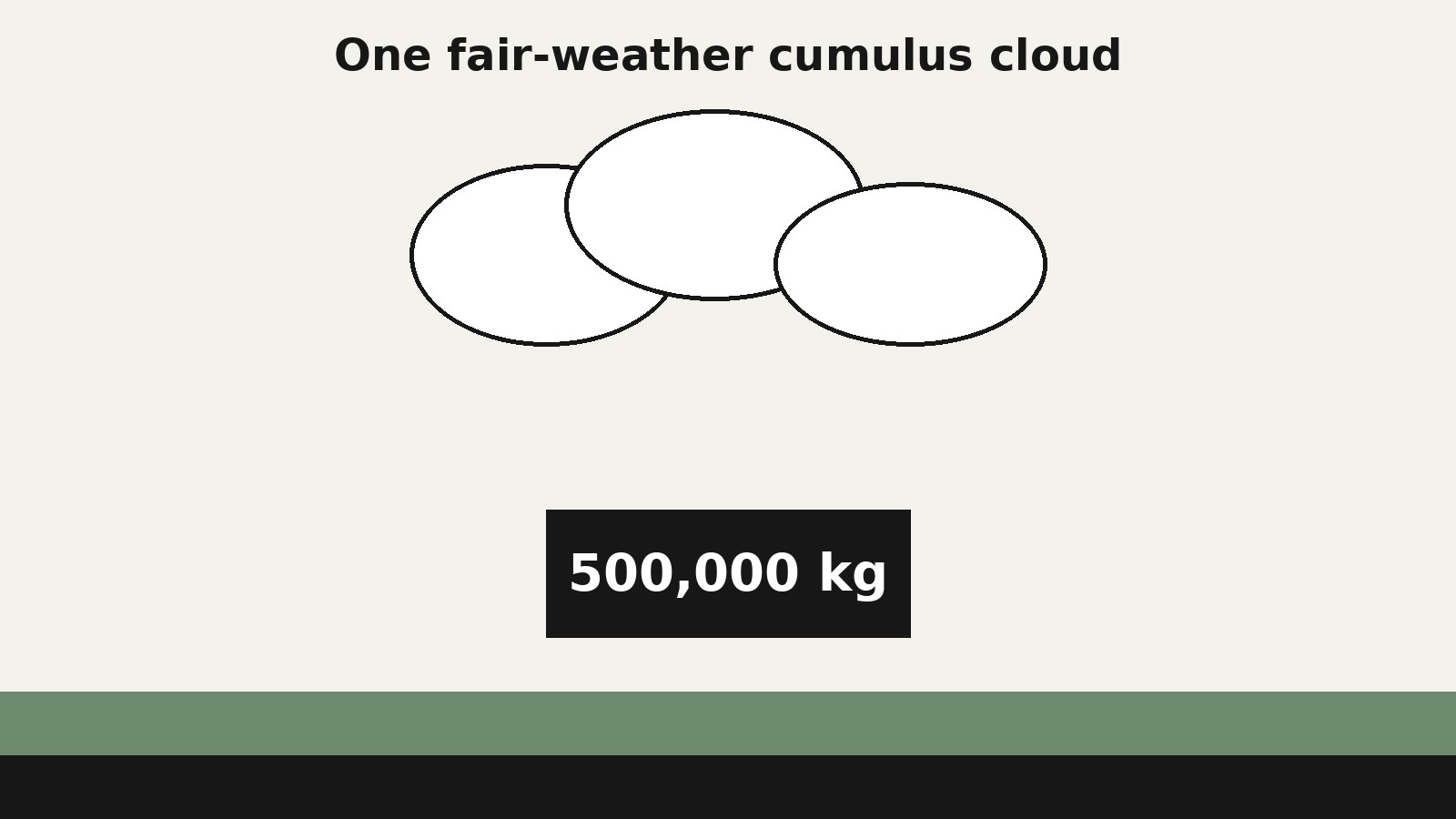
- A typical fair-weather cumulus cloud, roughly 1 kilometer on each side, holds about 500,000 kilograms of condensed water. That is 500 metric tons, about 550 US tons, or about 1.1 million pounds. The figure counts only the liquid water droplets in the cloud, not the air around them and not the invisible water vapor mixed into that air. There is no single weight for all clouds, because clouds vary enormously in size and in how much water each cubic meter contains, but the cumulus example shows why the common answer is so surprising: something that looks weightless can hold as much water as a small reservoir. ---
The Short Answer Is Not the Whole Story
Look up on a calm summer day and a cumulus cloud seems to defy common sense. It drifts slowly, changes shape, and casts a soft shadow, yet it never thuds to the ground. If you gathered all its water into one tank, you would have a serious load to move. The puzzle has two parts, and both matter. First, how do scientists arrive at a number like 500,000 kilograms when no one can put a cloud on a scale? Second, why does that much water stay in the sky instead of falling at once?
This article answers both questions in full. It shows the worked arithmetic step by step, explains what the headline figure includes and what it leaves out, compares cloud types, and explains the physics that keeps droplets aloft. Along the way it clears up three common misunderstandings: that clouds are made of water vapor, that clouds float because they are lighter than nothing, and that every cloud weighs about the same.
A note on words first, because it prevents confusion later. In everyday speech, people say a cloud “weighs” 500,000 kilograms. Strictly, kilograms measure mass, while weight is the force of gravity acting on that mass. Scientists who write for the public usually keep the everyday wording, and this article does the same, while using mass and weight in the everyday sense unless a distinction matters. The important quantity is the mass of condensed water in the cloud, and that is what the calculation below finds.
What Counts in a Cloud’s Weight
When researchers quote a cloud weight, they almost always mean the mass of the condensed water that makes the cloud visible: liquid droplets, ice crystals, or a mix of both. They do not add the mass of the air that fills the same space. That distinction is essential. A cubic kilometer of air itself has a mass of roughly a million metric tons, far more than the water droplets suspended in it. If the air were included, every cloud would appear vastly heavier, and the number would say more about the atmosphere than about the cloud.
Water vapor is also excluded, for a different reason. Water vapor is invisible water in its gas form, mixed into the air. It is present inside and around a cloud, and it matters for how clouds form, but it is not the visible cloud. A cloud is what you see: droplets or crystals that have condensed out of that vapor. So the standard answer, 500,000 kilograms for a typical cumulus cloud, is the mass of the visible water, not the mass of everything in that volume of sky.
The Worked Calculation, Step by Step
The classic calculation comes from atmospheric scientist Margaret LeMone of the National Center for Atmospheric Research, as presented in her book The Stories Clouds Tell and summarized in the GLOBE Program’s scientists’ blog. It uses a deliberately simple example: a typical fair-weather cumulus cloud about 1 kilometer on each side. The steps are as follows.
Step 1: Find the volume. A cube 1,000 meters long, 1,000 meters wide, and 1,000 meters tall has a volume of 1,000 meters times 1,000 meters times 1,000 meters, which is 1,000,000,000 cubic meters. That is 1 cubic kilometer. Real cumulus clouds are not cubes, and this article returns to that point below, but a cube makes the arithmetic transparent and gives a fair typical size.
Step 2: Find the liquid water content. Measurements from aircraft flying through cumulus clouds suggest that each cubic meter of cloudy air contains about 0.5 grams of liquid water. In other words, if you could collect all the droplets from a box 1 meter on each side, you would have about half a gram of water, roughly the water in a single small marble sized drop. Spread over a whole cloud, that tiny amount per cubic meter adds up fast.
Step 3: Multiply volume by liquid water content. The calculation is 1,000,000,000 cubic meters times 0.5 grams per cubic meter, which equals 500,000,000 grams of water.
Step 4: Convert to familiar units. There are 1,000 grams in a kilogram, so 500,000,000 grams equals 500,000 kilograms. A metric ton is 1,000 kilograms, so that is 500 metric tons. In US units, 500,000 kilograms is about 1,100,000 pounds, and since a US ton is 2,000 pounds, that is about 550 US tons. The GLOBE summary gives exactly those figures: 500,000 kilograms, 1,100,000 pounds, or 550 tons.
That is the whole method. There is no hidden step and no scale involved. The result is an estimate built from two measured or chosen inputs, volume and liquid water content, and its accuracy is only as good as those inputs. For a fair-weather cumulus cloud of about this size, it is a sound order of magnitude estimate, and it is widely repeated for exactly that reason.
Why the Answer Varies: Size and Water Content
No two clouds are identical, so no single weight can describe them all. The calculation above has two levers, and moving either one changes the answer proportionally. Double the volume and you double the water. Double the liquid water content and you double it again. The table below keeps the method identical and varies only those two inputs, so you can see the range for yourself. These are illustrative worked examples using the same method, not measurements of particular clouds observed on a particular day.
| Example cloud | Volume | Liquid water content used | Water mass |
|---|---|---|---|
| Small fair-weather cumulus, 500 meters on each side | 125,000,000 cubic meters | 0.5 grams per cubic meter | 62,500 kilograms, about 69 US tons |
| Typical fair-weather cumulus, 1 kilometer on each side | 1,000,000,000 cubic meters | 0.5 grams per cubic meter | 500,000 kilograms, about 550 US tons |
| Larger cumulus, 2 kilometers on each side | 8,000,000,000 cubic meters | 0.5 grams per cubic meter | 4,000,000 kilograms, about 4,400 US tons |
| Same 1 kilometer cloud, wetter air | 1,000,000,000 cubic meters | 1.0 grams per cubic meter | 1,000,000 kilograms, about 1,100 US tons |
Two lessons follow. First, size dominates. A cloud twice as wide, twice as deep, and twice as tall has eight times the volume, not twice, because volume grows with the cube of the linear size. That is why a towering storm cloud can hold vastly more water than a small puff on a fair day, even if both are called cumulus in casual speech. Second, liquid water content varies with cloud type, stage of development, temperature, and how much moisture was available when the cloud formed. Published typical values for liquid water content commonly fall in a range around 0.1 to 0.9 grams per cubic meter for many clouds, with wetter clouds reaching higher values. A thin, young, or dissipating cloud sits at the low end. A thick, actively growing cloud sits higher.
Real clouds also break the cube assumption in both directions. Many cumulus clouds are wider than they are tall, or taller than they are wide. Layered stratus clouds can stretch for tens of kilometers horizontally while staying only a few hundred meters thick. Their volume must be estimated from their actual shape, usually from satellite images, radar, and aircraft data, rather than from a single side length. The cube is a teaching model, not a claim about cloud geometry.
How Much Do Other Cloud Types Weigh?
Clouds are classified by height and shape, and the National Weather Service and the National Oceanic and Atmospheric Administration (NOAA) use the standard ten main types: cirrus, cirrocumulus, and cirrostratus at high levels; altocumulus, altostratus, and nimbostratus at middle levels; and cumulus, stratocumulus, stratus, and cumulonimbus at low levels, with cumulonimbus growing vertically through several levels. Their weights differ for the same reasons the examples above differ: different volumes and different water contents, with high clouds made largely of ice crystals rather than liquid droplets.
Cirrus clouds are the wispy, high streaks made of ice crystals. They are thin, often only a few hundred meters thick, and their ice content per cubic meter is low. A single small cirrus patch therefore holds far less water than a fair-weather cumulus cloud, even though a cirrus sheet can cover a huge area of sky. If you added up an entire continent spanning cirrus layer, the total would be large, but that is a different question from the weight of one distinct cloud, and it shows why “a cloud” needs a defined boundary before its weight means anything.
Stratus clouds are the flat gray layers that can cover the sky for hours. They are thin vertically but wide horizontally, so their total water depends mainly on how far they stretch and how thick they are. A stratus layer 100 kilometers long, 100 kilometers wide, and 300 meters thick has a volume of 3,000,000,000 cubic meters. At an illustrative liquid water content of 0.3 grams per cubic meter, that layer would hold 900,000 kilograms of water. The arithmetic is the same as before. The point is that a dull gray sheet can hold more water than a photogenic puff, simply because it covers more sky.
Nimbostratus, the steady rain bearing layer, is thicker and wetter than ordinary stratus, and cumulonimbus, the thunderstorm cloud, is in a different league. A cumulonimbus can rise 10 kilometers or more and spread several kilometers across, with both liquid water and ice. As an illustrative example only, a storm cloud 10 kilometers long, 10 kilometers wide, and 10 kilometers tall has a volume of 1,000,000,000,000 cubic meters. At an illustrative average of 1 gram per cubic meter of water and ice combined, that would be 1,000,000,000 kilograms, or 1 million metric tons. Real storm clouds are not uniform boxes, their water content varies strongly from base to top, and much of their water falls out as rain, so this figure should be read as a scale indicator, not as a measurement. It does, however, explain why thunderstorms can drop such large amounts of rain: the reservoir overhead is enormous.
The comparison often quoted for the fair-weather cumulus cloud, about 100 elephants, comes from the same LeMone calculation as reported in popular science writing. It is a vivid image, but it is only as precise as the weight of an “average elephant,” which varies by species, age, and sex. Treat it as a memorable scale marker, not as a measurement. The kilograms are the reliable part. The elephants are the illustration.
What a Cloud Is Actually Made Of
A cloud is a visible collection of tiny liquid water droplets, ice crystals, or both, suspended in the air. That definition, used in atmospheric science teaching, already answers the most common misconception: clouds are not made of water vapor. Water vapor is invisible. When you see a cloud, you are seeing light scattered by droplets and crystals that have condensed from that vapor. The same distinction explains steam from a kettle. The wispy white plume you see is not vapor itself, but tiny droplets formed as invisible vapor cools and condenses in the air.
Cloud droplets are remarkably small. A typical cloud droplet is about 10 micrometers in diameter, which is 10 millionths of a meter, or about one hundredth of a millimeter. A typical raindrop is about 1 millimeter in diameter, roughly 100 times wider. Because volume grows with the cube of the diameter, it takes about a million cloud droplets to make one raindrop, a figure that follows directly from the ratio of their sizes. If you use the 10 micrometer droplet size, each droplet has a volume of about 5.24 times 10 to the power of negative 16 cubic meters, and a mass of about 5.24 times 10 to the power of negative 13 kilograms. Dividing the 500,000 kilograms in the example cumulus cloud by that per droplet mass gives roughly 9.5 times 10 to the power of 17 droplets, an almost unimaginable number that makes the point more clearly than any adjective: the weight comes from sheer quantity, not from any single heavy drop.
Droplets do not form spontaneously in clean air. Water vapor needs a surface to condense onto, and the atmosphere provides it in the form of cloud condensation nuclei: microscopic particles of dust, sea salt, smoke, pollen, or pollution. The National Center for Atmospheric Research explains that cloud formation begins when air cools to saturation, the point where it holds as much water vapor as it can, and droplets form on these nuclei. Without nuclei, vapor would have a harder time condensing at ordinary atmospheric conditions, and clouds would look very different. Every droplet in a cloud therefore has a tiny particle at its heart, a fact that links cloud physics to air quality, because the number and type of particles affect how many droplets form and how large they grow.
How does the air cool enough to reach saturation in the first place? Most often by rising. As air rises, the pressure around it falls, the air expands, and expansion cools it. When it cools to its dew point, the temperature at which saturation is reached, vapor begins to condense. That is why cumulus clouds have flat bases: the base marks the lifting condensation level, the height where rising air in a given area first reaches saturation. Below that level the rising air is clear. Above it, droplets appear, and the cloud becomes visible. Because nearby thermals share similar temperature and humidity, their bases form at similar heights, giving a sky full of cumulus clouds their characteristic level bottoms and puffy tops.
Why a Heavy Cloud Does Not Fall Out of the Sky
If a cloud holds 500,000 kilograms of water, why does it not drop like a stone? The answer has three parts, and none of them requires the cloud to be weightless.
First, the water is not in one lump. It is spread through a billion cubic meters as droplets so small that air resistance almost balances gravity for each one. A cloud droplet falls, but very slowly. LeMone notes that a cloud droplet is about one hundredth the diameter of a typical raindrop, and therefore about one millionth of its volume, so its fall speed through still air is tiny, on the order of centimeters per second. In a quiet room, dust motes behave the same way: they sink, but so slowly that a faint air current keeps them up indefinitely. Cloud droplets are the atmospheric version of dust motes, only wetter.
Second, the air inside many clouds is rising. In a typical cumulus cloud, air can rise at several meters per second, far faster than the slow sinking speed of a small droplet. A droplet that would sink at a few centimeters per second in still air is carried upward by an updraft moving a hundred times faster. Even some small raindrops, which fall faster than cloud droplets, may never reach the ground from an actively rising cloud, because the updraft holds them up until they evaporate or the updraft weakens. The cloud is not a solid object floating like a balloon. It is a region where air is moving upward and droplets are forming, and the visible shape persists because new droplets keep condensing even as older ones sink or evaporate.
Third, the cloudy air itself is buoyant. In a cumulus cloud, the rising air is warmer than the surrounding air at the same height, and warmer air is less dense, so it rises until it reaches air that is warmer than it is. Latent heat helps: when water vapor condenses into droplets, it releases heat, warming the rising air further and strengthening the updraft. This is a self reinforcing process, which is why a cumulus cloud can grow taller on a warm, humid afternoon. The cloud as a whole is best thought of as a moving pattern, like a wave, rather than as a fixed object. Individual droplets come and go, but the pattern stays, as long as moist air keeps rising into it.
When those conditions change, the cloud does fall, in a sense. Droplets grow by colliding and merging, a process called collision and coalescence in warm clouds, or by the Bergeron process in colder clouds, where ice crystals grow at the expense of supercooled droplets and then fall, melting into rain on the way down. Once a drop is large enough that its fall speed exceeds the updraft speed, it descends. If it survives evaporation in the drier air below the cloud base, it reaches the ground as rain. If it evaporates completely on the way down, observers see virga, streaks of precipitation that fade before reaching the ground. Either way, the cloud is not failing. It is completing the water cycle it belongs to.
How Scientists Measure Cloud Weight in Practice
The cube calculation is a teaching estimate. Real research uses instruments, and it is worth knowing how those measurements work, because they explain both the confidence and the uncertainty in published figures.
Aircraft carry probes that fly through clouds and measure droplet sizes and numbers directly. From the size distribution, researchers calculate the liquid water content in grams per cubic meter, the same quantity used in the worked example. The GLOBE summary explicitly bases its 0.5 grams per cubic meter figure on such aircraft measurements. This is the most direct method, but it samples only the flight path, and a cloud varies from place to place, so researchers combine many flights and many clouds to build typical values.
Ground based radar measures reflected radio waves from droplets and precipitation particles, giving a picture of cloud structure, intensity, and movement over a wide area. Satellites observe clouds from above in visible and infrared light, estimating cloud top height, coverage, and optical thickness, which relates to how much water is present. Neither radar nor satellite data gives liquid water content directly without models and assumptions, so scientists calibrate those remote measurements against aircraft data and against physical models of how droplets scatter light and radio waves.
The result is a set of estimates with honest uncertainty. A fair-weather cumulus cloud is often quoted near 500,000 kilograms because the inputs are well constrained for that type. A large storm system is harder to bound, because its volume is irregular, its water content varies sharply, and water is constantly entering as vapor and leaving as rain. Any single number for a storm cloud should therefore be treated as an order of magnitude guide, with the method stated alongside it. When a popular article gives a precise sounding weight without stating its assumed size or water content, that precision is borrowed, not measured.
Common Questions and Misconceptions
Does a cloud get lighter when it rains? Yes, in the straightforward sense that water leaving as precipitation reduces the water remaining in the cloud, unless new moist air rises and condenses fast enough to replace it. A raining cloud is a system with inflow and outflow, not a sealed tank. That is why some clouds rain themselves out and vanish, while others persist for hours: the balance between condensation and precipitation decides.
Is fog a cloud? Yes, in physical terms. Fog is a cloud whose base is at ground level, formed when air near the surface cools to saturation, often overnight by radiational cooling. The same droplet physics applies, which is why fog drifts, thins, and burns off as the sun warms the air, just as a cloud dissipates when its updrafts stop.
Frequently Asked Questions
How much does a cloud weigh in simple terms? A typical fair-weather cumulus cloud about 1 kilometer on each side holds about 500,000 kilograms of water, which is 500 metric tons or about 1.1 million pounds. Smaller clouds weigh less, larger and wetter clouds weigh much more, and there is no single weight that fits every cloud.
How do scientists calculate the weight of a cloud? They estimate the cloud’s volume, measure or estimate its liquid water content in grams per cubic meter from aircraft probes and remote sensing, and multiply the two. Volume times liquid water content gives the mass of condensed water. The result is then converted to kilograms, metric tons, or pounds.
Why does a cloud float if it weighs 500,000 kilograms? It does not float like a balloon. Its water is spread as microscopic droplets that fall very slowly, the air inside the cloud is often rising faster than those droplets sink, and new droplets keep condensing as moist air rises. The cloud is a moving pattern of forming and evaporating droplets, not a solid object held up by a single force.
What is a cloud made of? A cloud is made of tiny liquid water droplets, ice crystals, or both, suspended in air. Each droplet forms when invisible water vapor condenses onto a microscopic particle such as dust, sea salt, or smoke, called a cloud condensation nucleus. Water vapor itself is invisible and is not what you see when you look at a cloud.
How much does a thunderstorm cloud weigh? A large cumulonimbus cloud can hold far more water than a fair-weather cumulus cloud, potentially on the order of hundreds of millions to a billion kilograms, depending on its size and water content. Such figures are scale estimates from the same volume times water content method, not precise measurements of one storm, because storm clouds are irregular and constantly gaining and losing water.
How much does a cirrus cloud weigh? A single small cirrus patch, being thin and made of sparse ice crystals, holds much less water than a cumulus cloud of similar width. A wide cirrus sheet covering a large area can hold a large total, but that total depends on the area and thickness chosen, so a meaningful answer must state the size assumed.
Do clouds weigh more before it rains? Generally, yes, in the sense that a cloud that is about to rain has usually grown thicker and wetter, with more condensed water, than the same cloud earlier in its life. Once rain begins, water leaves the cloud, and its remaining weight falls unless new condensation replaces the loss.
Can you weigh a cloud with a scale? No. Clouds cannot be placed on a scale, and their boundaries are fuzzy and changing. Scientists estimate cloud mass indirectly from volume and liquid water content, using aircraft measurements, radar, and satellite observations combined with physical models.
Sources & references
- GLOBE Program, Scientists' Blog, "Watching Clouds," (typical cumulus cloud about 1 kilometer on a side; volume 1,000,000,000 cubic meters; aircraft measurements suggesting about 0.5 grams of water per cubic meter; result 500,000 kilograms, 1,100,000 pounds, or 550 tons; cloud droplets about one hundredth the diameter and one millionth the volume of a typical raindrop; air in a typical cumulus cloud rising at several meters per second; source book LeMone, M.A., 2008, The Stories Clouds Tell, University Corporation for Atmospheric Research)
- National Center for Atmospheric Research, via Scientific American, Donald H. Lenschow, "How do water droplets in clouds cohere?" (clouds form when air holds more water than it can as vapor; cooling by lifting is the most effective cooling process; droplets form on cloud condensation nuclei; droplet number and size depend on oversaturation and nuclei characteristics)
- Pennsylvania State University, Meteorology 300, Lesson 5: Cloud Physics, (terminal velocity as the balance of drag and gravity; terminal velocity varying with drop radius; example values for drops of 50 micrometers and 500 micrometers radius)
- Brune, Fundamentals of Atmospheric Science, "Do you recognize these clouds, drops, and snowflakes?" (cloud drop typically 10 micrometers in diameter, raindrop typically 1 millimeter; about a million cloud drops per raindrop; typical liquid water content 0.1 to 0.9 grams per cubic meter)
- National Weather Service, JetStream, Cloud Classifications, archived at (three vertical levels; high, middle, and low cloud types)
- National Oceanic and Atmospheric Administration, JetStream, "Learning Lesson: A Hole Lot of Clouds," (cumulus as heap or pile, stratus as layer, cirrus as high level ice crystal cloud, nimbus as rain bearing)
- National Weather Service, Louisville, Cloud Classification, (standard cloud type chart including cirrus, cirrocumulus, cirrostratus, altostratus, altocumulus, stratus, stratocumulus, nimbostratus, cumulus, cumulus congestus, and cumulonimbus)
- ScienceAlert, 'This Is How Much a Cloud Weighs,' (LeMone/NCAR 500,000 kg figure reported as 100 elephants; reported illustration only, not a measurement).


