Short answer
- To find the number of neutrons in an atom, subtract its atomic number from its mass number: neutrons = mass number - atomic number. The atomic number tells you how many protons the atom has, and the mass number tells you the total of protons plus neutrons in its nucleus, so the difference left over must be neutrons. For example, carbon-12 has a mass number of 12 and an atomic number of 6, so it has 12 - 6 = 6 neutrons. The same method works for isotopes and for ions, because changing the number of electrons changes the charge but never changes the neutron count. # How to Find Neutrons Finding neutrons looks like a trick question the first time you meet it, because a periodic table does not usually print a neutron count in a neat box. It prints other numbers instead, and the neutron count hides inside them. Once you know which two numbers to use, the arithmetic takes about ten seconds. The rest of this article is about getting those two numbers right, reading them in the different forms they appear in, and avoiding the handful of mistakes that turn an easy calculation into a wrong answer. General method explainer: it teaches the atomic number and mass number method, with worked examples clearly labeled as examples, and explains isotopes and ions. It is not a shortcut for any particular assignment, and it does not cover nuclear reactions, where protons and neutrons themselves can change. For ordinary atoms and ions, the method below is all you need.
The Three Particles You Need to Keep Straight
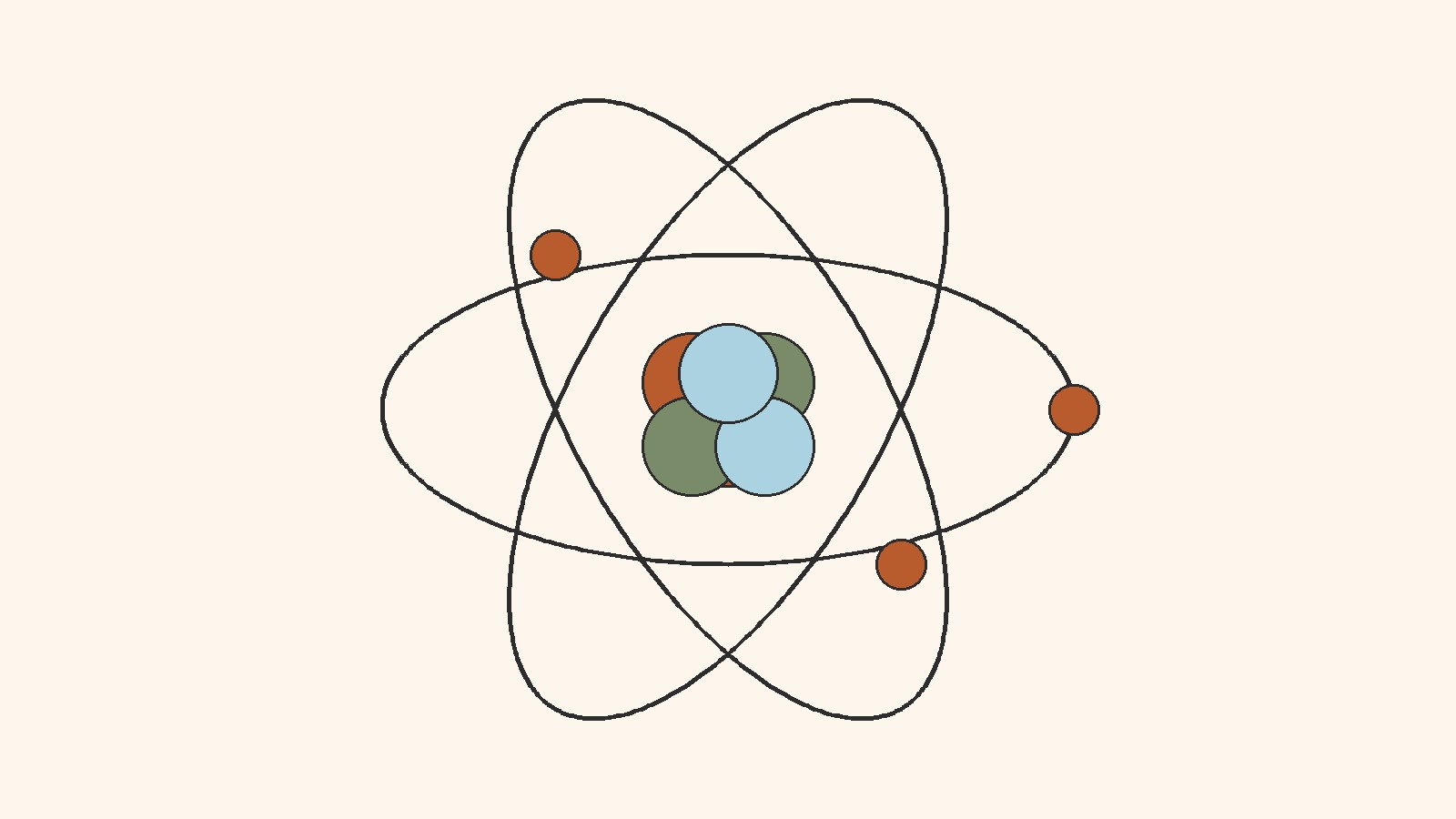
An atom has three kinds of subatomic particles. Protons carry a positive charge and sit in the nucleus. Neutrons carry no charge and sit in the nucleus beside the protons. Electrons carry a negative charge and occupy the space around the nucleus. Protons and neutrons together are called nucleons, and almost all of an atom’s mass sits in the nucleus with them.
Only two of these particles matter for counting neutrons directly. Protons matter because the proton count defines the element and appears in both numbers you will use. Electrons matter only for ions, and even then only for the charge and electron count, not the neutron count. That separation prevents the common error of letting a charge change the neutron answer.
The masses explain why the method works. A proton has a mass of about 1.0073 atomic mass units, and a neutron has a mass of about 1.0087 atomic mass units, while an electron has a mass of only about 0.00055 atomic mass units. For counting, protons and neutrons each count as about one mass unit, and electrons count as almost nothing. That is why the mass number is a whole number, and why adding or removing electrons does not change it.
The Two Numbers: Atomic Number and Mass Number
The atomic number, written as Z, is the number of protons in the nucleus. It defines the element. Every carbon atom has 6 protons, every oxygen atom has 8 protons, and every iron atom has 26 protons. Change the proton count and you have a different element. The atomic number is the whole number usually printed in the element’s periodic table box, and it is the same for every atom of a given element, no matter which isotope you are looking at.
The mass number, written as A, is the total number of protons plus neutrons in the nucleus. It is always a whole number, because it counts whole particles. An atom with 6 protons and 6 neutrons has a mass number of 12. An atom with 6 protons and 8 neutrons has a mass number of 14. Both are carbon, because both have 6 protons, but they are different isotopes of carbon, because their neutron counts differ.
Put those definitions together and the formula follows. If the mass number equals protons plus neutrons, and the atomic number equals protons, then neutrons must equal the mass number minus the atomic number. In symbols: Neutrons = mass number - atomic number, or N = A - Z. That is the whole method. Everything else in this article is about finding A and Z reliably, and checking that the answer makes sense.
Step by Step: How to Find Neutrons in Five Steps
Step 1: Identify the element. Read the element name or symbol. The element tells you where to look up the atomic number.
Step 2: Find the atomic number (Z). Look it up on a periodic table or use the number given in the problem. It is the count of protons. For a neutral atom, it is also the count of electrons, but for neutrons you only need the proton count.
Step 3: Find the mass number (A). This is where most errors happen, because the mass number can arrive in several forms, covered below. If the problem names an isotope, such as carbon-14, the number after the hyphen is the mass number. If it uses nuclide notation, the superscript number is the mass number. If it gives only a periodic table decimal, use the rounding method explained later, and treat the result as an estimate, not an exact count for a named isotope.
Step 4: Subtract. Compute mass number minus atomic number. Write both numbers down before you subtract, so a slip in reading one number does not hide inside mental arithmetic. The result should always be a whole number, zero or larger. A negative result, or a result with a decimal, means one of the input numbers is wrong.
Step 5: Check the answer. Add the neutron count back to the proton count. The sum should equal the mass number you started with. This one-line check catches most reading errors.
Worked Examples, Labeled as Examples
Every example in this section is a worked example chosen to show one feature of the method. None of them is presented as an answer to a reader’s own assignment. Check each result by adding protons and neutrons back together to recover the mass number.
Example 1: Carbon-12. Carbon has atomic number 6, so it has 6 protons. Carbon-12 has a mass number of 12. Neutrons = 12 - 6 = 6. Check: 6 + 6 = 12. Carbon-12 is the most common form of carbon, and it is the reference isotope that defines the atomic mass unit, which is one twelfth of the mass of a carbon-12 atom.
Example 2: Carbon-13. Carbon still has atomic number 6 and 6 protons. Carbon-13 has a mass number of 13. Neutrons = 13 - 6 = 7. Check: 6 + 7 = 13. It is still carbon, because the proton count has not changed. Only the neutron count has changed, which makes it a different isotope.
Example 3: Carbon-14. Carbon still has atomic number 6. Carbon-14 has a mass number of 14. Neutrons = 14 - 6 = 8. Check: 6 + 8 = 14. Together, the three carbon examples show the pattern: same element, same atomic number, different mass numbers, different neutron counts.
Example 4: Hydrogen-1, the most common form of hydrogen. Hydrogen has atomic number 1, so it has 1 proton. Hydrogen-1 has a mass number of 1. Neutrons = 1 - 1 = 0. Check: 1 + 0 = 1. Hydrogen-1 is the one ordinary atom with no neutrons at all. Its nucleus is a single proton, and zero is a valid neutron count.
Example 5: Oxygen-16. Oxygen has atomic number 8, so it has 8 protons. Oxygen-16 has a mass number of 16. Neutrons = 16 - 8 = 8. Check: 8 + 8 = 16. Equal protons and neutrons are common for lighter stable nuclei.
Example 6: Iron-56. Iron has atomic number 26, so it has 26 protons. Iron-56 has a mass number of 56. Neutrons = 56 - 26 = 30. Check: 26 + 30 = 56. Iron-56 illustrates a trend for heavier nuclei: stable heavier nuclei tend to have more neutrons than protons, because extra neutrons help hold a larger nucleus together against proton repulsion.
Further examples follow the same pattern, and they appear in the table below: sodium-23 has 23 - 11 = 12 neutrons, calcium-40 has 40 - 20 = 20 neutrons, lead-207 has 207 - 82 = 125 neutrons, and uranium-235 has 235 - 92 = 143 neutrons. Uranium-238 has 238 - 92 = 146 neutrons. The method does not get harder for heavy elements. The numbers get larger, but the subtraction stays the same.
A summary table collects the examples so you can compare them at a glance. In each row, protons plus neutrons equals the mass number.
| Example isotope | Atomic number (protons) | Mass number | Neutrons |
|---|---|---|---|
| Hydrogen-1 | 1 | 1 | 0 |
| Carbon-12 | 6 | 12 | 6 |
| Carbon-13 | 6 | 13 | 7 |
| Carbon-14 | 6 | 14 | 8 |
| Oxygen-16 | 8 | 16 | 8 |
| Sodium-23 | 11 | 23 | 12 |
| Calcium-40 | 20 | 40 | 20 |
| Iron-56 | 26 | 56 | 30 |
| Lead-207 | 82 | 207 | 125 |
| Uranium-235 | 92 | 235 | 143 |
Reading the Numbers in Different Formats
Problems do not always hand you the atomic number and mass number in plain words. They appear in at least four formats, and each one needs a slightly different reading skill. The calculation never changes. Only the way you extract A and Z changes.
Format 1: The hyphen name. Carbon-14, oxygen-16, iron-56, uranium-235. The number after the hyphen is the mass number. The element name gives you the atomic number from the periodic table. This is the clearest format, because the mass number is stated outright.
Format 2: Nuclide notation. A symbol may carry a superscript mass number and a subscript atomic number before the element symbol, for example the notation for carbon-14 with 14 above and 6 below before C. The upper number is always the mass number and the lower number is always the atomic number. The larger number goes on top, because the mass number counts protons plus neutrons, except for hydrogen-1, where both numbers are 1.
Format 3: The periodic table box. A typical box shows the element symbol, the atomic number as a whole number, and the atomic weight as a decimal. The atomic number is the number you need for Z. The decimal is not the mass number. It is the standard atomic weight, an average of the masses of the element’s naturally occurring isotopes, weighted by how common each isotope is. That averaging is why it has a decimal: carbon’s standard atomic weight is about 12.011 because most carbon is carbon-12 with a smaller share of carbon-13. The box alone does not tell you which isotope you have, so it cannot give you an exact neutron count for a specific atom.
Format 4: A problem statement with only the element name and no isotope. If a question asks only “how many neutrons does carbon have” without naming an isotope, there is no single exact answer, because carbon isotopes have 6, 7, or 8 neutrons. State the assumption: “For carbon-12, the most common isotope, the count is 6 neutrons.”
When You Only Have the Periodic Table Decimal
Sometimes the only number available is the decimal atomic weight from a periodic table. Rounding the decimal to the nearest whole number gives an estimate of the mass number of the most common isotope, and subtracting the atomic number gives an approximate neutron count. Label it as an estimate.
Work through chlorine as an example. Chlorine has atomic number 17. Its standard atomic weight is about 35.45. Rounded to the nearest whole number, that is 35. Subtracting gives 35 - 17 = 18 neutrons. That matches chlorine-35, the most common chlorine isotope. Chlorine also has a second common isotope, chlorine-37, with 20 neutrons, and the decimal average sits between the two because it blends them. The rounding method finds the dominant isotope, not every isotope.
Do not subtract the decimal directly and report a decimal neutron count. Neutrons are whole particles. A result such as 18.45 neutrons is a sign that you subtracted the atomic weight instead of a mass number. Round first, then subtract, and check that the answer is a whole number. For elements shown with a bracketed number rather than a decimal average, such as technetium, the bracketed value is the mass number of the most stable or best known isotope, not an average, and the isotope must be named for the count to be exact.
Isotopes: Same Element, Different Neutron Count
Isotopes are atoms of the same element that have the same number of protons but different numbers of neutrons. They occupy the same place on the periodic table, because the table is ordered by atomic number, and isotopes share an atomic number. Their mass numbers differ, so their neutron counts differ.
Carbon is the textbook case. Carbon-12, carbon-13, and carbon-14 all have 6 protons, so all are carbon. They have 6, 7, and 8 neutrons respectively. Their chemical behavior is essentially the same, because chemical behavior is governed by electrons, and all three have the same electron arrangement in a neutral atom. Their masses and nuclear stability differ, which is why distinguishing isotopes matters in fields such as archaeology and geology.
Hydrogen shows the same pattern in its most extreme form. Hydrogen-1 has 0 neutrons, hydrogen-2 has 1 neutron, and hydrogen-3 has 2 neutrons. All three have 1 proton, so all three are hydrogen. Hydrogen-2 and hydrogen-3 also have the special names deuterium and tritium, but those names do not change the counting method. Oxygen follows the same pattern: oxygen-16 has 8 neutrons, oxygen-17 has 9, and oxygen-18 has 10, all with 8 protons. If a problem gives you oxygen without a mass number, you cannot pick one of these three with certainty, which is exactly why naming the isotope matters.
Two confusions deserve a direct correction. First, changing the neutron count never creates a new element. A carbon atom with 8 neutrons is still carbon. Only a change in proton count creates a new element. Second, isotopes of an element are not ions. An isotope differs in neutrons, while an ion differs in electrons.
Ions Versus Neutral Atoms: Charge Changes Electrons, Not Neutrons
An ion is an atom that has gained or lost electrons, giving it a net electric charge. A neutral atom has equal numbers of protons and electrons, so its charges balance. A positive ion, called a cation, has lost electrons, so it has fewer electrons than protons. A negative ion, called an anion, has gained electrons, so it has more electrons than protons. In neither case has the nucleus changed. Protons and neutrons stay exactly where they were.
That single fact settles the neutron question for ions: find neutrons for an ion exactly as you would for a neutral atom of the same isotope. Use the same atomic number and the same mass number, and ignore the charge when you subtract. The charge only enters the calculation if you are also asked for the electron count, and then it enters a different formula: electrons = protons - charge, where a positive charge reduces the electron count and a negative charge increases it.
Worked ion examples, labeled as examples, make the point concrete. Sodium ion, +1, sodium-23: neutrons = 23 - 11 = 12, the same as neutral sodium-23, while electrons = 11 - (+1) = 10. Chloride ion, -1, chlorine-35: neutrons = 35 - 17 = 18, while electrons = 17 - (-1) = 18. Calcium ion, +2, calcium-40: neutrons = 40 - 20 = 20, while electrons = 20 - (+2) = 18. Oxide ion, -2, oxygen-16: neutrons = 16 - 8 = 8, while electrons = 8 - (-2) = 10.
A table summarizes the ion examples alongside their neutral counterparts, so the unchanged neutron column stands out.
| Species (example) | Protons | Mass number | Neutrons | Electrons |
|---|---|---|---|---|
| Neutral sodium-23 | 11 | 23 | 12 | 11 |
| Sodium ion, +1, sodium-23 | 11 | 23 | 12 | 10 |
| Neutral chlorine-35 | 17 | 35 | 18 | 17 |
| Chloride ion, -1, chlorine-35 | 17 | 35 | 18 | 18 |
| Neutral calcium-40 | 20 | 40 | 20 | 20 |
| Calcium ion, +2, calcium-40 | 20 | 40 | 20 | 18 |
The pattern to remember is a short sentence: isotopes change neutrons, ions change electrons, and neither change converts one into the other. A chlorine-37 atom is an isotope question. A chloride ion is an electron question. A chloride ion made from chlorine-37 combines both, but the neutron count still comes from the mass number alone.
Common Mistakes and How to Avoid Them
Mistake 1: Subtracting the atomic weight instead of the mass number. The periodic table decimal is an average, not a count, so subtracting it gives a decimal answer that cannot be a neutron count. Use a named mass number when one is given, and round the decimal only when estimating.
Mistake 2: Confusing the atomic number with the mass number. The atomic number counts protons only and is the smaller number. The mass number counts protons plus neutrons and is the larger number. Subtracting in the wrong order gives a negative number, which is impossible for a particle count.
Mistake 3: Using the electron count in place of the proton count. In a neutral atom the two counts are equal, so this mistake hides. In an ion it shows up at once, because the electron count has changed while the proton count has not. Always start from the atomic number for protons.
Mistake 4: Letting an ion charge change the neutron count. A charge describes electrons gained or lost and says nothing about the nucleus. Ignore the charge for the neutron subtraction, and use it only for the electron count.
Mistake 5: Treating isotopes as different elements. Carbon-14 is carbon, not a new element. The element is fixed by protons, and isotopes differ only in neutrons.
Mistake 6: Treating an element name alone as an exact neutron count. “Carbon” without an isotope can mean carbon-12, carbon-13, or carbon-14, with 6, 7, or 8 neutrons. State which isotope you mean, or give the most common isotope as an explicitly labeled assumption.
Mistake 7: Forgetting hydrogen-1. Hydrogen-1 has 1 proton and a mass number of 1, so it has 0 neutrons. Accept zero as a valid answer, and check it by adding 1 + 0 = 1.
Mistake 8: Reading the periodic table box backwards. Some tables place the atomic number above the symbol and the atomic weight below it, while others reverse the layout. Confirm which number is the small whole number matching the element’s position: hydrogen is 1, carbon is 6, oxygen is 8.
Mistake 9: Adding instead of subtracting. Adding the atomic number and the mass number double counts the protons. Check the answer by adding protons and neutrons together. The sum must equal the mass number, not exceed it.
Practice Set: Try the Method Yourself
The problems below are generic practice examples created for this article, not questions from any reader’s assignment. Answers follow immediately, so cover them and try each problem first if you want the practice to count.
Practice 1: Fluorine-19. Fluorine has atomic number 9. Neutrons = 19 - 9 = 10. Check: 9 + 10 = 19.
Practice 2: Magnesium-24. Magnesium has atomic number 12. Neutrons = 24 - 12 = 12. Check: 12 + 12 = 24.
Practice 3: Potassium-39. Potassium has atomic number 19. Neutrons = 39 - 19 = 20. Check: 19 + 20 = 39.
Practice 4: Copper-63. Copper has atomic number 29. Neutrons = 63 - 29 = 34. Check: 29 + 34 = 63.
Practice 5: An ion with a charge of -1, from sulfur-32. Sulfur has atomic number 16. Neutrons = 32 - 16 = 16. The charge does not change the neutron count. For completeness, electrons = 16 - (-1) = 17.
If any practice answer surprised you, retrace the steps and check by adding back. The error, when there is one, is almost always in reading an input number, not in the arithmetic.
Why the Neutron Count Matters
Counting neutrons is not just an exercise in subtraction. The neutron count determines which isotope you have, and the isotope determines nuclear stability. Lighter stable nuclei often have roughly equal protons and neutrons: nitrogen-14 has 7 and 7, oxygen-16 has 8 and 8, calcium-40 has 20 and 20. Heavier stable nuclei need proportionally more neutrons than protons, because extra neutrons add attractive nuclear force without adding electric repulsion: iron-56 has 26 protons and 30 neutrons, and lead-207 has 82 protons and 125 neutrons. Nuclei far from the stable balance tend to be unstable and to change over time through radioactive decay.
The neutron count also explains the decimal atomic weight on the periodic table. That decimal is a weighted average of the isotope masses, weighted by abundance. Carbon’s average of about 12.011 sits just above 12 because carbon-12 dominates, with a small share of carbon-13 pulling the average slightly upward.
One boundary is worth stating plainly. The method in this article applies to ordinary atoms and ions, where the nucleus stays intact. In a nuclear reaction, a nucleus can gain or lose protons or neutrons, or change one into the other, so the counts before and after the reaction differ. Counting neutrons in a reaction product still uses the same subtraction, but you must use the product’s atomic number and mass number, not the starting material’s.
Quick Checklist
Use this checklist every time you count neutrons, until the steps feel automatic.
- Name the element and confirm its atomic number (Z) from a reliable periodic table.
- Name the isotope, if one is given, and confirm its mass number (A) from the hyphen name or nuclide notation.
- If no isotope is given, state your assumption explicitly, usually the most common isotope, and label the result accordingly.
- If only a decimal atomic weight is available, round it first, label the result as an estimate, and do not report a decimal neutron count.
- Subtract: neutrons = mass number - atomic number.
- Check: protons + neutrons must equal the mass number.
- If the species is an ion, ignore the charge for neutrons and use it only for the electron count.
- If the result is negative or has a decimal, stop and recheck the input numbers. One of them is wrong.
Frequently Asked Questions
How do you find the number of neutrons in an atom?
Subtract the atomic number from the mass number. The atomic number is the number of protons, and the mass number is the total of protons plus neutrons, so the difference is the neutron count. For carbon-12, that is 12 - 6 = 6 neutrons.
What is the formula for finding neutrons?
Neutrons = mass number - atomic number, written as N = A - Z. A is the mass number, Z is the atomic number, and N is the neutron count.
How do you find neutrons on the periodic table?
Use the small whole number in the element’s periodic table box for Z. The mass number is not printed as a separate whole number in most boxes. If an isotope is named, use its mass number. If only the decimal atomic weight is shown, round it for an estimate and label it as such.
Do neutrons change in an ion?
No. An ion has gained or lost electrons, not neutrons. The neutron count of an ion is the same as the neutron count of the neutral atom of the same isotope. The charge affects only the electron count.
What is the difference between an isotope and an ion?
An isotope differs in neutron count: same protons, different neutrons, same element. An ion differs in electron count: same protons and neutrons, different electrons, net charge. Isotopes are named by mass number, such as carbon-14. Ions are named by charge, such as a sodium ion with a charge of +1.
Can an atom have zero neutrons?
Yes. Hydrogen-1, the most common hydrogen isotope, has 1 proton and 0 neutrons. It is the only ordinary atom with no neutrons.
Why do some elements have a decimal atomic mass on the periodic table?
The decimal is a weighted average of the masses of the element’s naturally occurring isotopes, weighted by their natural abundance. Individual atoms always have whole numbers of protons and neutrons, but the average across many atoms is usually not a whole number.
How many neutrons does carbon have?
It depends on the isotope. Carbon-12 has 6 neutrons, carbon-13 has 7 neutrons, and carbon-14 has 8 neutrons. All have 6 protons. If no isotope is named, the usual assumed answer is carbon-12, with 6 neutrons, but a careful answer states that assumption.
Sources & references
- Los Alamos National Laboratory, Periodic Table of Elements, "How to use the Periodic Table." Opened and read October 25, 2026. Atomic number defined as the number of protons, with carbon at 6 protons, hydrogen at 1, and oxygen at 8; standard atomic weight described as an average of isotope masses, with the average neutron count found by subtracting the atomic number from the atomic mass.
- OpenStax, Chemistry 2e, section 21.1 "Nuclear Structure and Stability." Opened and read October 25, 2026. Atomic number defined as proton count and mass number as protons plus neutrons; isotopes defined as same atomic number with different mass numbers; nuclide notation explained; iron-56 given with 26 protons and 30 neutrons; lead-207 given with 82 protons and 125 neutrons; nitrogen-14 given with 7 protons and 7 neutrons; helium-4, oxygen-16, calcium-40, and lead-208 listed as doubly magic nuclei; proton mass 1.0073 atomic mass units and neutron mass 1.0087 atomic mass units used in the helium binding energy example.
- OpenStax, Organic Chemistry, section 1.1 "Atomic Structure: The Nucleus." Opened and read October 25, 2026, via search result text. Atomic number and mass number defined as above; carbon isotopes with mass numbers 12, 13, and 14 listed, with natural abundances 98.89 percent for carbon-12 and 1.11 percent for carbon-13; atomic weight of carbon given as 12.011 unified atomic mass units.


