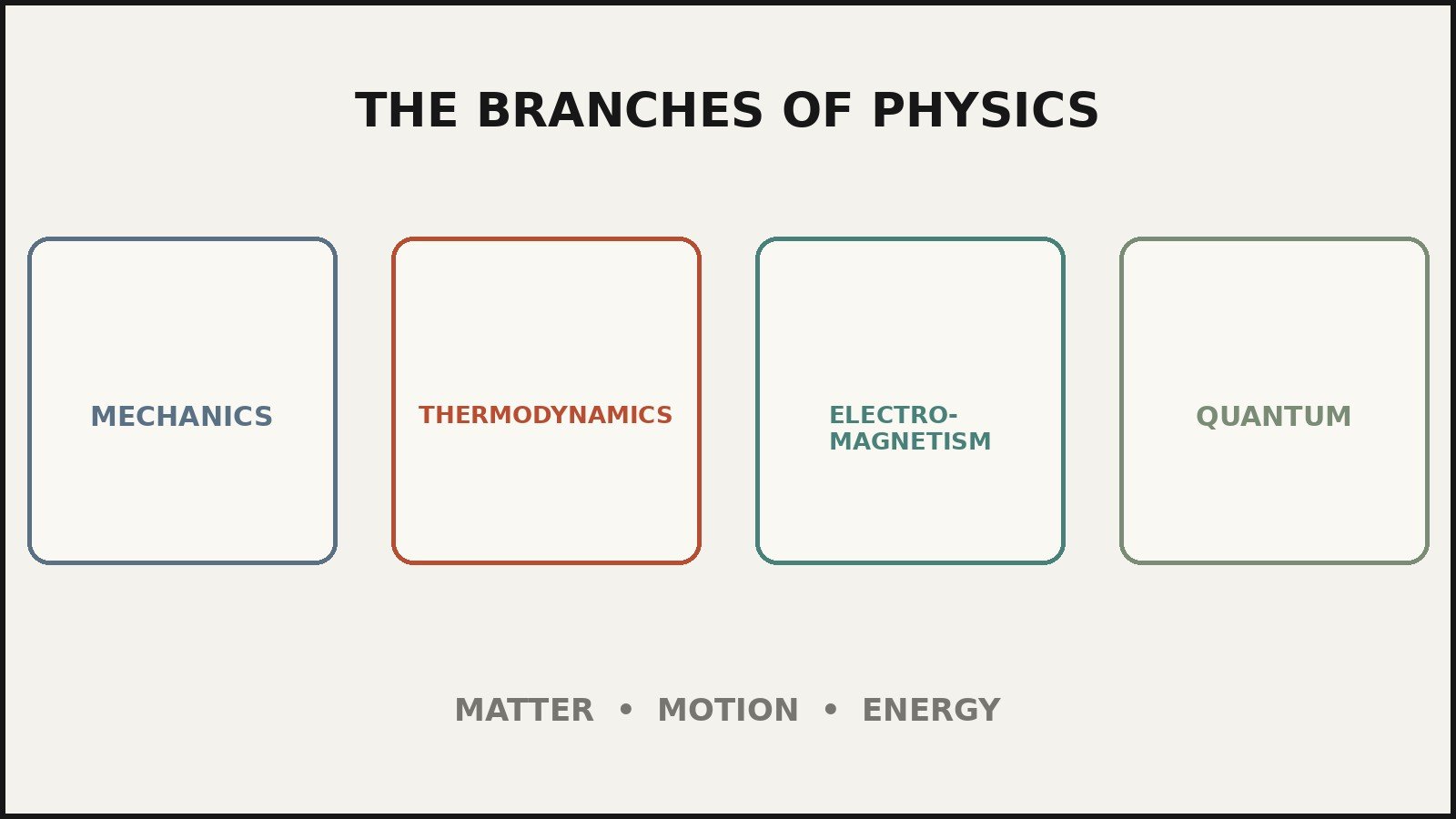
Short answer: Physics is the science of matter, motion, and energy. It studies how everything in the universe behaves, from the tiniest subatomic particles to the largest galaxies, and it looks for a small set of fundamental laws that explain it all. Its laws are tested by experiment and usually expressed in the language of mathematics.
Physics is one of the most fundamental sciences. It is the field that asks the biggest questions humans can ask about the natural world: What is matter made of? Why do objects move the way they do? Where does energy go, and what happens to it along the way? Everything from a falling apple to the light of a distant star falls within the scope of physics.
The word “physics” comes from the Greek physikos, which relates to nature. Encyclopaedia Britannica defines physics as the science that deals with the structure of matter and the interactions between the fundamental constituents of the observable universe. At base, it can be summed up even more simply: physics is the science of matter, motion, and energy.
Definition and Scope of Physics
Physics is a natural science, which means it studies the natural world through observation and experiment. Its subject is extraordinarily broad. In the broadest sense, physics is concerned with all aspects of nature on both the macroscopic level (the scale of everyday objects and beyond) and the submicroscopic level (the scale of atoms and particles far smaller than atoms).
The scope of physics includes not only how objects behave when forces act on them, but also the nature and origin of the fundamental force fields themselves. Physicists study three great kinds of interaction: the gravitational force that holds planets in orbit and keeps us anchored to the ground, the electromagnetic force behind electricity, magnetism, and light, and the nuclear forces that bind the cores of atoms together.
What makes physics distinctive is its ultimate objective. Rather than cataloguing nature detail by detail, physics seeks a few comprehensive principles that bring together and explain a wide range of seemingly unrelated phenomena. The laws of motion that describe a ball rolling down a hill, for example, are the same laws that describe the orbits of planets. That search for unifying laws is what gives physics its special place among the sciences.
Physics among the sciences
Until fairly recent times, the terms “physics” and “natural philosophy” were used interchangeably for the science whose aim is the discovery and formulation of the fundamental laws of nature. As the modern sciences developed and became more specialized, physics came to denote the part of physical science not included in astronomy, chemistry, geology, and engineering. Chemistry studies the composition and reactions of substances; biology studies living organisms; geology studies the Earth. Physics studies the underlying rules that all of these systems obey.
Even so, physics plays an important role in all the natural sciences, and every one of them has a branch where physical laws and measurements receive special emphasis. These go by familiar names: astrophysics applies physics to the universe, geophysics applies it to the Earth, biophysics applies it to living systems, and even psychophysics studies the relationship between physical stimuli and perception.
Another defining feature of physics is its relationship with mathematics. The laws of physics are typically expressed with economy and precision in the language of mathematics. Equations are not decorations in physics; they are the precise statements of how nature behaves, and they allow physicists to predict the outcomes of experiments before they are performed.
How Physics Works: The Scientific Method
Physics advances through the complementary partnership of experiment and theory. Both play essential roles, and neither can do the job alone.
An experiment is the observation of phenomena under conditions that are controlled as precisely as possible. When a physicist drops objects in a vacuum chamber, measures the light from a distant galaxy, or collides particles in an accelerator, the result is a set of measurements. Theory, by contrast, is the formulation of a unified conceptual framework: a set of ideas and equations that explains the measurements and connects them to other phenomena.
A theory that reliably predicts the results of experiments to which it applies is said to embody a law of physics. But here is something important that beginners sometimes miss: a law of physics is not a finished decree. A law is always subject to modification, replacement, or restriction to a more limited domain if a later experiment makes that necessary. This is a strength, not a weakness. The fact that physical laws are testable and revisable is exactly what makes physics a science rather than a set of dogmas.
The ultimate aim of physics is to find a unified set of laws governing matter, motion, and energy at small microscopic subatomic distances, at the human macroscopic scale of everyday life, and out to the largest distances on the extragalactic scale. A completely unified theory of all physical phenomena has not yet been achieved, and possibly never will be. Yet a remarkably small set of fundamental physical laws already appears able to account for all known phenomena.
One more thing about physics that newcomers often misunderstand: physics is not primarily about solving word problems or memorizing equations. Many school physics classes do focus on the equations, and that is fine, but the purpose of the subject is less about the problems and more about using equations, laws, and theories to understand the world we live in.
The Major Branches of Physics
Physics is traditionally divided into classical physics and modern physics. Classical physics is the body of knowledge developed up to about the turn of the 20th century. It can largely account for the motions of macroscopic objects that move slowly compared with the speed of light, and for phenomena such as heat, sound, electricity, magnetism, and light. The modern developments of relativity and quantum mechanics modify these laws when they apply to higher speeds, very massive objects, and the tiny elementary constituents of matter, such as electrons, protons, and neutrons.
Here are the major branches in detail.
Classical mechanics
Mechanics is generally taken to mean the study of the motion of objects (or their lack of motion) under the action of given forces. It is one of the oldest branches of physics, and its foundations were laid by Isaac Newton in the 17th century. Classical mechanics consists of kinematics, which describes motion, and dynamics, which studies the action of forces in producing motion or static equilibrium.
The three laws of motion set forth by Newton form the foundation of classical mechanics, together with the recognition that forces are directed quantities (called vectors) that combine accordingly. The first law, also called the law of inertia, states that, unless acted upon by an external force, an object at rest remains at rest, or if in motion, it continues to move in a straight line with constant speed. Uniform motion therefore does not require a cause, which is why a hockey puck glides across the ice until friction slows it down.
Newton’s second law equates the net force on an object to the rate of change of its momentum, the latter being the product of the mass of a body and its velocity. This is the familiar relationship often written as F = ma: a force applied to an object produces an acceleration proportional to the force and inversely proportional to the object’s mass. Newton’s third law, the law of action and reaction, states that when two particles interact, the forces each exerts on the other are equal in magnitude and opposite in direction. A rocket rises because it pushes exhaust downward, and the exhaust pushes the rocket upward.
Mechanics also includes the mechanics of deformable solids (elasticity), fluids at rest (hydrostatics), and fluids in motion (hydrodynamics). Classical mechanics remains the working physics of engineers: bridges, airplanes, car suspensions, and spacecraft trajectories are all designed using its principles.
Underlying the laws of mechanics are certain symmetry properties with deep consequences. Symmetry properties of the theory have as mathematical consequences basic principles known as conservation laws, which assert the constancy in time of certain physical quantities. The conserved quantities are among the most important ones in physics: mass and energy (in relativity theory, mass and energy are equivalent and are conserved together), momentum, angular momentum, and electric charge.
Electromagnetism
Electromagnetism is the branch of physics that studies electricity, magnetism, and the connection between them. What looks like two separate phenomena, the attraction of a magnet and the flow of current in a wire, turned out to be two aspects of a single electromagnetic force. This was one of the great unifications in the history of physics, achieved in the 19th century through the work of scientists such as Michael Faraday and James Clerk Maxwell.
Electromagnetism covers electric charges and fields, magnetic fields and their interaction with moving charges, and electromagnetic waves, including visible light. Light itself is an electromagnetic wave: coupled electric and magnetic fields travelling through space. Radio, microwaves, infrared, ultraviolet, X-rays, and gamma rays are all electromagnetic waves of different wavelengths.
Electromagnetism underlies the whole of modern electrical and electronic technology. Generators, electric motors, radios, telephones, computers, and medical imaging equipment all rely on electromagnetic principles. Maxwell’s equations, the compact mathematical description of electromagnetism, are still regarded as one of the crowning achievements of classical physics.
Thermodynamics
Thermodynamics is the field of physics that looks at heat transfer processes and how heat relates to other types of energy. It studies temperature, heat flow, and entropy, and it explains how matter transforms from one phase to another when heated or cooled: solid to liquid, liquid to gas, and so on.
The laws of thermodynamics are among the most general statements in all of science. The first law is a statement of energy conservation: energy can change form, but the total amount stays the same. The second law says that in any real process, the total entropy, a measure of disorder, tends to increase; this is why heat flows from hot to cold and not the other way around, and why no engine can be perfectly efficient.
Thermodynamics grew up alongside the Industrial Revolution, and advances in thermodynamics led directly to industrialization. Engines, refrigerators, air conditioners, and power plants are all applications of thermodynamic principles. The subject also reaches into cosmology, since the history of the universe itself can be described in thermodynamic terms.
Relativity
Relativity, formulated by Albert Einstein, is one of the two great pillars of modern physics. Special relativity describes the behavior of bodies moving at speeds close to that of light in the absence of the force of gravity. It leads to surprising conclusions: time itself runs at different rates for observers moving relative to one another, and lengths contract at very high speeds. One of its most famous results is the equivalence of mass and energy, expressed in the equation E = mc².
General relativity extends these ideas to gravity. In Einstein’s picture, gravity is not a force in the Newtonian sense but the curvature of spacetime caused by mass and energy. Massive objects like the Earth bend the fabric of spacetime, and other objects follow the curves. This theory explains phenomena such as the bending of starlight around the Sun and the existence of black holes, and its corrections are essential for the global positioning system (GPS) in our phones: the atomic clocks on GPS satellites tick at a slightly different rate than clocks on the ground because of their speed and altitude, and without relativistic corrections the navigation system would drift off by kilometers within a day.
Quantum mechanics
Quantum mechanics is the branch of physics that describes nature at the scale of atoms and subatomic particles. At that scale, the familiar rules of classical physics break down. Energy is exchanged in discrete packets called quanta, particles can behave like waves and waves like particles, and some quantities can only be known in terms of probabilities rather than certainties.
Quantum mechanics is crucial to understanding the structure of matter: it explains why atoms have the shapes they do, why materials conduct or insulate, and how the chemical elements are arranged. It underlies technologies that define the modern world, including semiconductors and transistors (the basis of all computers and smartphones), lasers, and magnetic resonance imaging (MRI). Quantum field theory, which combines quantum mechanics with special relativity, describes the fundamental particles and the forces between them, including the strong and weak nuclear forces alongside electromagnetism.
Other fields
Beyond these core branches, physics has many specialized and interdisciplinary fields. Particle physics studies the most fundamental constituents of matter using enormous accelerators such as the Large Hadron Collider. Nuclear physics studies atomic nuclei and their reactions, which powers the Sun and stars. Condensed matter physics studies solids and liquids, the basis of materials science. Atomic and molecular physics studies individual atoms and molecules. Optics studies light, acoustics studies sound, plasma physics studies ionized gases, and particle cosmology applies quantum ideas to the early universe.
A Brief History of Physics
Physics is one of the oldest academic disciplines. Through its inclusion of astronomy, it is perhaps the oldest of all. The earliest roots lie in ancient astronomy: the Sumerians, Babylonians, and ancient Egyptians watched the skies, built monuments that tracked the motions of celestial objects, and created star maps dating back to about 1200 BC. Their understanding was not scientific in the modern sense, but their observations influenced everything that followed.
For more than two thousand years, physics was part of a broader enterprise called natural philosophy, which also included what we now call chemistry and biology. Thinkers in ancient Greece, the medieval Islamic world, and later Europe debated the nature of matter and motion, but they generally lacked the systematic program of controlled experiment that defines modern science.
The Scientific Revolution of the 17th century changed that. During this period, the natural sciences emerged as unique research endeavors in their own right, and physics became a distinct field of knowledge. Isaac Newton’s laws of motion and his law of universal gravitation, published in 1687, gave the first unified mathematical description of how objects move on Earth and in the heavens.
The 18th and 19th centuries built the edifice of classical physics: the study of heat became thermodynamics, electricity and magnetism were unified into electromagnetism, and the atomic idea gained ground. By the end of the 19th century, some physicists thought the field was nearly complete.
They were wrong. Around the turn of the 20th century, experiments that classical physics could not explain led to the two revolutions of modern physics. Albert Einstein’s special relativity (1905) and general relativity (1915) transformed our understanding of space, time, and gravity, while quantum mechanics, built by a generation of physicists in the 1920s, transformed our understanding of the microscopic world. The 20th century also saw the development of nuclear physics, particle physics, and the first steps toward a unified picture of the fundamental forces.
What Do Physicists Do?
Physicists are scientists who study the nature of matter and energy and work on practical applications of that knowledge. They typically specialize: some are theoretical physicists who build mathematical models, others are experimentalists who design and carry out measurements, and many move between the two. Most physicists work in laboratories, universities, or offices, write scientific reports, and present their research findings at conferences.
According to the American Physical Society, studying physics opens up a wide range of career paths. Physicists find employment in a variety of settings after earning their degrees, including high schools, government-funded laboratories, Wall Street firms, medical physics facilities, and high-tech industries. Physics training develops quantitative reasoning and problem-solving skills that employers in many fields value, so physicists work not only in research but also as data scientists building predictive models, consultants combining data and analytics skills to find solutions for clients, and engineers developing new technologies.
Specific career routes include high school physics teaching for graduates with an undergraduate degree in physics or physics education; medical physics, which offers research and development work in industry or government, teaching and research in academia, or the clinical track working with imaging and radiation therapy; national laboratory research, which often involves managing resources and people in addition to doing research; university teaching and research; and postdoctoral research positions for PhD graduates in physics or related fields. Physicists in industry research and development spend most of their time conducting research and performing literature and patent searches. There is no single job called “physicist”: the field is a training ground for dozens of professions.
Physics in Everyday Life
Physics is all around us, all the time. The alarm clock that wakes you, the light bulb or LED that illuminates your room, the engine that powers your car, the refrigerator that keeps your food cold, the phone that connects you to the world: every one of these devices works because physicists discovered the principles behind it. Transportation, communication, medicine, and energy production all rest on physics.
This is why physicists argue that new ideas in physics often explain the fundamental mechanisms studied by other sciences and suggest new avenues of research in fields such as mathematics and philosophy. Advances in the understanding of electromagnetism, solid-state physics, and nuclear physics led directly to products that transformed modern society, from televisions and computers to domestic appliances. The computer itself is, in a real sense, an invention of physics: it runs on semiconductors whose behavior is explained by quantum mechanics and designed using the principles of electromagnetism and thermodynamics.
How to Start Learning Physics
If this introduction has sparked your interest, the path into physics is well marked. Start with algebra-based mechanics: motion, forces, energy, and momentum. Then move on to electricity and magnetism, waves, and thermodynamics. College and advanced-placement physics courses follow exactly this order, because each layer builds on the one before.
Two practical notes will save you frustration. First, scientists worldwide use the International System of Units (SI) so that results can be compared across laboratories and countries. Since 2019, the SI units have been defined in terms of fundamental physical constants, which means scientists anywhere using SI can agree on how they measure physical phenomena. Second, do not be discouraged by the mathematics. The equations are the tools of the trade, but the goal is understanding: how the world works, and why it works that way. As the physicists who teach the subject like to say, physics is about finding explanations that describe more than one phenomenon and offer a better understanding of how the universe works.
Frequently Asked Questions
What is physics in simple terms?
Physics is the science that studies matter, energy, and how they interact. It looks for the fundamental laws that explain how everything in the universe behaves, from the smallest particles to the largest galaxies.
What are the main branches of physics?
The traditionally organized branches are classical mechanics (motion and forces), electromagnetism (electricity, magnetism, and light), thermodynamics (heat and energy), relativity (space, time, and gravity at high speeds and large masses), and quantum mechanics (the behavior of atoms and subatomic particles). Specialized fields include particle physics, nuclear physics, condensed matter physics, astrophysics, and biophysics.
Is physics hard to learn?
Physics is demanding because it combines abstract reasoning with mathematics, but it is learnable by anyone willing to work through the ideas step by step. Many students find it easier once they see that the equations describe real phenomena they can observe, like falling objects and electric circuits.
What is the difference between physics and chemistry?
Physics studies the fundamental laws governing matter, motion, and energy; chemistry studies the composition, structure, properties, and reactions of substances. The two fields overlap heavily, and much of chemistry can be understood in terms of physics (physical chemistry and chemical physics study the boundary between them).
What jobs can you get with a physics degree?
Physics graduates work as teachers, medical physicists, data scientists, engineers, consultants, national laboratory researchers, and industry scientists, among many other roles. According to the American Physical Society, physicists find employment in settings ranging from high schools and government-funded labs to Wall Street and high-tech industries.
What is quantum physics?
Quantum physics is the branch of physics that describes nature at the scale of atoms and smaller. At this scale, energy comes in discrete packets and particles can behave like waves. It explains the structure of atoms and underlies technologies such as semiconductors, lasers, and MRI scanners.
Sources & references
- Encyclopaedia Britannica, "Physics | Definition, Types, Topics, Importance, & Facts" (updated 22 Oct 2026).
- LibreTexts, "1.3: Scope of Physics" (Fresno City College natural science course, updated 23 Oct 2024).
- American Physical Society, "Career options for physicists."


