Short answer
- When most people search for "earth's electromagnetic field," they mean Earth's magnetic field, also called the geomagnetic field. It is made mainly in the liquid outer core by the geodynamo: moving, electrically conducting iron and nickel generate electric currents, and those currents sustain the field.
- The field reaches far into space and forms the magnetosphere, which deflects much of the solar wind and traps charged particles in the Van Allen Belts. It is a strong shield, but not a perfect one: solar storms can disturb it, disrupt navigation and power systems, and produce auroras.
- The field is always changing. Its poles drift, its strength rises and falls, and over geologic time it has reversed many times. A reversal is not a sudden flip, and scientists have no reason to believe one is imminent.
- A different, much weaker phenomenon is the Schumann resonance: extremely low frequency waves, near 7.83 hertz at the fundamental frequency, ringing in the cavity between Earth's surface and the ionosphere and excited mainly by lightning. It is real physics, but it is not the geomagnetic field, and it does not control it.
- There is no established evidence that Earth's natural magnetic field directly affects human health at the surface. Radiation risks during space weather events come from increased particle radiation, not from the magnetic field itself.
What People Mean by “Earth’s Electromagnetic Field”
The phrase is ambiguous, and that ambiguity matters, because two different things get mixed up under one label. A literal phrase search for “earth’s electromagnetic field” returns pages mainly about the geomagnetic field: its origin in the core, its protective role against the solar wind, and its effects on navigation and animals. A smaller set of results turns to atmospheric electricity, Schumann resonances, and wellness claims about health effects. The dominant intent is therefore an explainer about the magnetic field and the geodynamo, with the secondary meaning addressed separately so readers are not misled.
Strictly speaking, “electromagnetic field” is a broad physics term covering electric and magnetic fields and the waves that travel through them, from radio waves to visible light. Earth has several electromagnetic features at once: a large, slowly changing magnetic field generated inside the planet, electric fields in the atmosphere, and electromagnetic waves of many kinds, including the extremely low frequency Schumann resonances. This article explains the dominant meaning first, then places the atmospheric phenomena in their proper, smaller role.
A useful distinction is between a steady field and a wave. A compass needle responds to Earth’s steady magnetic field. A radio receiver responds to waves. The geomagnetic field is the steady, planet scale structure. Schumann resonances are waves bouncing around the planet. Both are electromagnetic in the physics sense, but they differ enormously in strength, origin, and importance for daily life.
Inside Earth: Where the Field Comes From
To understand the field, it helps to picture Earth’s layered interior. NASA describes four main layers. The crust, where we live, averages about 19 miles (31 kilometers) deep on land and about 3 miles (5 kilometers) deep under the oceans. Beneath it lies the mantle, a hot, viscous mix of rock about 1,800 miles (2,900 kilometers) thick. Below the mantle is the outer core, about 1,400 miles (2,250 kilometers) thick and composed of molten iron and nickel. At the center is the inner core, a roughly 759 mile (1,221 kilometer) solid sphere of iron and nickel metals, about as hot as the Sun’s surface.
Nearly all of Earth’s geomagnetic field originates in the fluid outer core. NASA compares the motion there to boiling water on a stove: convective forces constantly churn the molten metals, which also swirl in whirlpools driven by Earth’s rotation. As this roiling mass of metal moves, it generates electric currents hundreds of miles wide and flowing at thousands of miles per hour as Earth rotates. This mechanism, which maintains Earth’s magnetic field, is known as the geodynamo.
The word “dynamo” is doing real work here, not serving as decoration. A dynamo converts motion into electric current, and electric current creates a magnetic field. In the outer core, the moving conductor is liquid metal rather than copper wire, and the motion is driven by heat escaping from the core and by compositional changes as the inner core grows, together with the organizing influence of rotation.
No one has visited the outer core. What scientists have instead is a combination of surface and satellite magnetic measurements, laboratory studies of materials at high pressure, seismic waves that reveal the core’s size and state, and computer models of fluid motion and magnetism. Those lines of evidence converge on the geodynamo picture, even though many details remain uncertain. Uncertainty about details is not the same as doubt about the mechanism.
The Shape of the Field: Dipole, Tilt, and the Magnetosphere
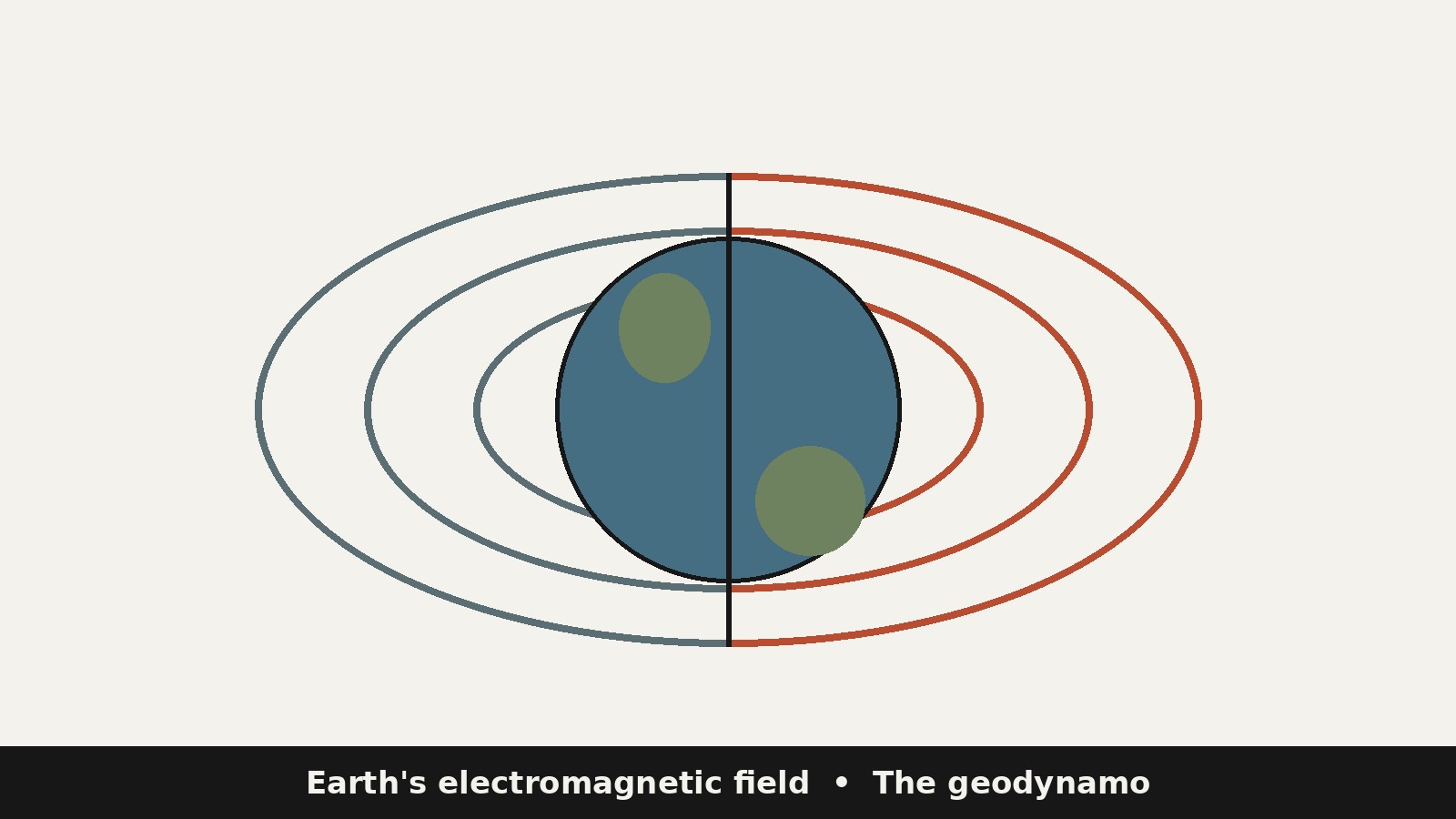
At Earth’s surface, the magnetic field forms two poles, a dipole, in NASA’s description. The north and south magnetic poles have opposite polarities, like a bar magnet. The invisible lines of the magnetic field travel in a closed, continuous loop, flowing into Earth at the north magnetic pole and out at the south magnetic pole. This dipole shape is an approximation: the real field has smaller, regional departures from a perfect dipole, and those departures matter for navigation and for features such as the South Atlantic Anomaly, discussed below. As a first picture, though, the tilted dipole is accurate and useful.
The dipole is tilted relative to Earth’s rotational axis, which is why magnetic north is not the same as geographic north, the direction of the rotational axis. A compass needle points toward magnetic north, not toward the geographic North Pole, and the angular difference between magnetic north and true north at any location is called declination or variation. Declination changes with location and over time, which is why printed maps and navigation systems use magnetic models that are updated regularly, rather than a single fixed correction.
Beyond the surface, the field extends into space and meets the solar wind, a stream of charged particles continually emitted by the Sun. The region of space controlled by Earth’s magnetic field is the magnetosphere. The solar wind compresses the field on the Sun facing side and stretches it into a long tail on the night facing side, the magnetotail. On the day side, the solar wind first meets a bow shock, a supersonic shock wave sunward of Earth, then flows around the planet through the magnetosheath. The outer boundary of the confined geomagnetic field is the magnetopause. NASA gives the day side compression as 6 to 10 times Earth’s radius, and notes that the night side tail may extend to possibly 1,000 times Earth’s radius, while adding that its exact length is not known.
Inside the magnetosphere sit trapped populations of charged particles, most famously the inner and outer Van Allen Radiation Belts, twin doughnut shaped zones that trap much of the unwanted energy at a safe distance from Earth’s surface. These structures are part of why the magnetosphere is described as a shield, but “shield” should not be read as “solid wall.” Charged particles do enter, especially during disturbed conditions. The shield picture captures the overall effect, reduced erosion of the atmosphere and reduced particle radiation at the surface, without implying total blockage.
What the Field Protects, and What It Does Not
NASA describes the magnetosphere as shielding Earth from erosion of the atmosphere by the solar wind, from erosion and particle radiation associated with coronal mass ejections, massive clouds of energetic and magnetized solar plasma and radiation, and from cosmic rays from deep space. The atmosphere itself does much of the remaining work: even particles that get past the magnetosphere must pass through kilometers of air, which absorbs and breaks up most of them before they reach the ground. Protection is therefore a partnership between the magnetic field and the atmosphere, not a job done by the field alone. Claims that credit the magnetic field alone with preventing the loss of the ozone layer, or with single handedly keeping the surface habitable, overstate the case.
The distinction matters again for health claims. Some popular pages suggest that Earth’s magnetic field, Schumann resonances, or changes in either one directly affect human health, mood, sleep, or disease risk. The evidence for direct health effects of Earth’s natural, surface level magnetic field is not established in the primary sources used for this article, and NASA is explicit that charged particles within the South Atlantic Anomaly can damage spacecraft electronics while not affecting life on Earth’s surface. Radiation risk during space weather events is a real concern for astronauts and for aircrew on high altitude polar routes, but the risk comes from increased particle radiation reaching those altitudes, not from the magnetic field acting on the body. Readers should treat claims that a “weakening field” is already harming human health, or that a device can “restore” a natural field for health benefit, as unproven unless a named, peer reviewed study says otherwise.
What the field does affect directly and measurably is technology and navigation. Compasses depend on it. Some animals that use magnetic cues for orientation, including certain birds and sea turtles, are studied for magnetoreception, though the exact sensory mechanism in many species is still an active research question. Power grids, pipelines, satellites, radio communication, and satellite navigation can all be disturbed during geomagnetic storms.
A Field in Motion: Drift, Weakening, and the South Atlantic Anomaly
The field is not fixed, and its changes are measurable on human timescales. NASA reports that since the magnetic north pole was first precisely located by British Royal Navy officer and polar explorer Sir James Clark Ross in 1831, its position has gradually drifted north northwest by more than 600 miles (1,100 kilometers), and its forward speed has increased from about 10 miles (16 kilometers) per year to about 34 miles (55 kilometers) per year. The pole does not move in a straight line at a constant speed, and recent model updates have shown changes in that speed, which is why navigation models are revised on a regular cycle rather than once and left alone.
Strength changes too. NASA reports that over the past 200 years, the magnetic field has weakened about 9 percent on a global average. That figure often appears in alarming headlines, so its context matters. Paleomagnetic studies cited by NASA show the field is actually about the strongest it has been in the past 100,000 years, and twice as intense as its million year average. A 9 percent decline from a historically strong level is not, by itself, evidence that a reversal is near or that protection is failing. Field strength has risen and fallen many times without a reversal, and it varies by location as well as by time.
The best known regional feature is the South Atlantic Anomaly, a well known weak spot present year round over South America and the southern Atlantic Ocean. NASA attributes it to the combined influences of the geodynamo and the tilt of Earth’s magnetic axis, and notes that the solar wind penetrates closer to Earth’s surface there. Charged solar particles and cosmic ray particles within the anomaly can damage spacecraft electronics, which is why satellite operators take precautions when spacecraft pass through it, but they do not affect life on Earth’s surface. Recent studies based on satellite data, including the European Space Agency’s Swarm mission, have found that the region is expanding and that its weakest point has continued to weaken since 2014. Those findings are consistent with a dynamic field, not with a sudden collapse: the anomaly is a regional dip in an otherwise planet wide field, and its growth is measured in fractions of Earth’s surface area over years, not in a disappearance of protection.
Navigation users feel these changes through the World Magnetic Model, the standard model of Earth’s magnetic field produced jointly by the United States and the United Kingdom, with the US version developed by NOAA’s National Centers for Environmental Information. The model is updated on a five year cycle, with out of cycle updates when the field moves faster than expected. The current epoch is 2025.0, published in December 2024.
Space Weather: Storms, Auroras, and Technology
When the solar wind strengthens or a coronal mass ejection arrives, the magnetosphere is disturbed, and the result is called a geomagnetic storm. NASA notes that solar wind variations can disturb the magnetosphere, leading to geomagnetic storms that can penetrate the atmosphere, threaten spacecraft and astronauts, disrupt navigation systems, and affect power grids, while also producing auroras. The storm does not mean the shield has failed. It means the interaction between the solar wind and the field has intensified, driving currents in the magnetosphere and ionosphere, heating the upper atmosphere, and inducing currents in long conductors on the ground.
Auroras are the visible side of that process. Charged particles guided along magnetic field lines into the upper atmosphere near the poles collide with gases there, which then emit light. The northern lights and southern lights are therefore not light from the magnetic field itself, but light from atmospheric gases excited by particles the field has channeled. During strong storms, the auroral oval expands toward the equator, so auroras can appear at mid latitudes where they are normally rare. That expansion is a useful, visible sign of a disturbed magnetosphere, and it is also why aurora forecasts are tied to space weather forecasts from NOAA’s Space Weather Prediction Center.
The technological risks scale with storm strength. Minor storms, rated G1 on NOAA’s five level geomagnetic storm scale, mainly cause weak power grid fluctuations at high latitudes and minor effects on satellite operations. Stronger storms can induce larger currents in power grids and pipelines, degrade high frequency radio communication, disturb satellite navigation accuracy, increase drag on low orbit satellites as the upper atmosphere expands, and raise radiation exposure for astronauts and high altitude aircrew. The Carrington Event of 1859, a severe geomagnetic storm that disrupted telegraph systems, is often cited as a warning about what a similar storm could do to modern infrastructure. It is a legitimate historical case, but it should not be turned into a prediction: a Carrington class storm is a low probability, high impact possibility, and modern infrastructure has never experienced one at full scale.
For ordinary readers on the ground, the practical advice is modest. A geomagnetic storm will not change your compass reading enough to matter for walking, will not affect household electronics directly, and does not require personal protective action. Its effects are felt mainly by operators of power grids, satellites, aviation, and navigation systems, who monitor NOAA forecasts and take precautions.
Reversals: What the Rock Record Shows
The most dramatic change in Earth’s magnetic history is a reversal, when the magnetic north and south poles swap locations. NASA states that pole reversals are common in Earth’s geologic history. Paleomagnetic records tell us Earth’s magnetic poles have reversed 183 times in the last 83 million years, and at least several hundred times in the past 160 million years. The time intervals between reversals have fluctuated widely, but average about 300,000 years, with the last reversal taking place about 780,000 years ago. That last reversal is the Brunhes Matuyama boundary, the end of the reversed Matuyama chron and the start of the current normal polarity Brunhes chron.
How do scientists know this? The study of Earth’s past magnetism is called paleomagnetism. Direct observations of the magnetic field extend back just a few centuries, so scientists rely on indirect evidence. NASA explains that magnetic minerals in ancient undisturbed volcanic and sedimentary rocks, lake and marine sediments, lava flows, and archeological artifacts can reveal the field’s strength and direction and when reversals occurred. Mid ocean ridges provide an especially clear record: as lava erupts at the ridges, spreads out, and cools, iron rich minerals align with the geomagnetic field, and once the lava cools to about 1,300 degrees Fahrenheit (700 degrees Celsius), the strength and direction of the field at that time become frozen into the rock. By sampling and radiometrically dating the rock, the record can be read. NASA notes that this ridge record stretches back about 160 million years.
During a reversal, the magnetic field weakens, but it does not completely disappear. NASA states that the magnetosphere, together with Earth’s atmosphere, still continues to protect the planet from cosmic rays and charged solar particles, though a small amount of particulate radiation may reach Earth’s surface. The magnetic field becomes jumbled, and multiple magnetic poles can emerge at unexpected latitudes. That picture contradicts the popular image of a switch flipping and protection vanishing overnight. A reversal is a messy, gradual reorganization, not a blackout.
How gradual? NASA states that no one knows exactly when the next pole reversal may occur, that reversals do not happen overnight, and that they take place over hundreds to thousands of years. Scientists have no reason to believe a flip is imminent. The fact that the last reversal was about 780,000 years ago, longer than the roughly 300,000 year average interval, does not mean one is “overdue” in any predictive sense. Reversal intervals vary widely, and there is no clock that counts down to the next one.
A related phenomenon is a geomagnetic excursion: a shorter lived but significant change in field intensity and direction that does not complete into a full reversal. NASA states that excursions happen about 10 times as frequently as pole reversals, last from a few centuries to a few tens of thousands of years, can reorient Earth’s magnetic poles as much as 45 degrees from their previous position, and can reduce field strength by up to 20 percent. NASA names three significant excursions in the past 70,000 years: the Norwegian Greenland Sea event about 64,500 years ago, the Laschamps event between 42,000 and 41,000 years ago, and the Mono Lake event about 34,500 years ago.
The honest answer to “what triggers a reversal?” is that scientists do not fully know. NASA notes that scientists do not know what drives reversal frequency, but suggests it may be due to convection processes in Earth’s mantle, since heat flow out of the core depends on the mantle above it. Core flow is turbulent and chaotic in the mathematical sense, which limits long range predictability. Computer models have reproduced reversals in general, but they cannot date the next one, because they are simplified and the initial conditions deep in the core cannot be measured directly.
The Secondary Meaning: Atmospheric Electricity and Schumann Resonances
Separate from the core generated field is Earth’s atmospheric electromagnetic environment. The ground conducts electricity, and so does the ionosphere, the charged layer of the upper atmosphere. Between them lies a cavity that can support standing electromagnetic waves. Lightning discharges, roughly 50 strikes per second globally and about 2,000 thunderstorms active at any moment, excite those waves. The cavity’s size, essentially Earth’s circumference, selects a set of resonant frequencies. The fundamental frequency is approximately 7.83 hertz, with further resonances near 14.3, 20.8, 27.3, and 33.8 hertz. These are the Schumann resonances, named after Winfried Otto Schumann, who described them in the 1950s.
Schumann resonances are genuinely useful to science. Because they are excited by global lightning, their amplitude tracks global thunderstorm activity, and their properties depend on the ionosphere, so they can be used to study lightning distribution and ionospheric conditions. They are also extremely weak: the magnetic signal is on the order of a picotesla, roughly tens of millions of times weaker than Earth’s static surface field.
Popular claims go well beyond that. The fundamental frequency is sometimes called Earth’s “heartbeat,” and changes in it are sometimes presented as signs of planetary shifts, consciousness changes, or health effects. The frequency itself barely moves: it wanders by a few tenths of a hertz with ionospheric conditions, while its amplitude varies much more with lightning activity and time of day. Charts that appear to show spikes to 40 hertz or higher usually show a spectrogram whose vertical axis ends at 40 hertz, not a measured resonance at that frequency, or they show local lightning signals near a single station rather than the global resonance.
There is also a fair weather atmospheric electric field, a vertical electric field between the ionosphere and the ground, maintained by the global electric circuit driven largely by thunderstorms. Its typical fair weather value near the surface is on the order of 100 volts per meter, though it varies with weather, pollution, and location. It does not power the geodynamo, it does not shield the planet from the solar wind, and it is not the field a compass responds to.
Frequently Asked Questions
Is Earth’s electromagnetic field the same as its magnetic field?
Mostly, yes, in everyday usage. People usually mean the geomagnetic field made by the geodynamo. In strict physics language, “electromagnetic field” is broader and also covers atmospheric electric fields and waves such as Schumann resonances.
What causes Earth’s magnetic field?
Moving, electrically conducting liquid iron and nickel in the outer core generate electric currents, and those currents sustain the field. The process is called the geodynamo. Heat escaping from the core and Earth’s rotation help drive and organize the motion.
How strong is Earth’s magnetic field at the surface?
It varies with location, generally in the range of tens of microteslas, stronger near the poles and weaker near the equator, with a regional minimum in the South Atlantic Anomaly. It is far weaker than a refrigerator magnet.
Is Earth’s magnetic field weakening, and does that mean a reversal is coming?
The field has weakened about 9 percent on a global average over the past 200 years, according to NASA, but it remains about the strongest it has been in the past 100,000 years and twice its million year average. Weakening alone does not signal an imminent reversal. Reversals are irregular, take hundreds to thousands of years, and cannot be dated in advance.
What happens during a magnetic pole reversal?
The field weakens and becomes complex, with multiple poles possibly appearing at unexpected latitudes, and then reestablishes itself with opposite polarity. It does not disappear. The magnetosphere and atmosphere continue to provide substantial protection, though a small amount of extra particulate radiation may reach the surface.
What is the South Atlantic Anomaly?
It is a region over South America and the southern Atlantic Ocean where Earth’s magnetic field is weaker than surrounding areas, allowing the inner Van Allen Belt to dip closer to Earth. Satellites passing through it face higher radiation exposure and may take precautions. It does not affect people on Earth’s surface.
Do Schumann resonances affect human health?
There is no established evidence that Schumann resonances, which are extremely weak, at about a picotesla in magnetic terms, directly affect human health. Radiation risks in space weather are about particle radiation at altitude, not about the magnetic field acting on the body.
Why do compasses not point to the true North Pole?
Because a compass responds to magnetic north, the direction of the local magnetic field, which differs from geographic north, the direction of Earth’s rotational axis. The difference, called declination, varies by location and changes over time. Navigation systems correct for it using models such as the World Magnetic Model.
Will Earth’s magnetic field disappear?
There is no evidence it will disappear in any foreseeable human timescale. It has persisted for billions of years, with large variations in strength and many reversals, but it has not vanished.
Sources & references
- NASA Science, Earth's Magnetosphere: Protecting Our Planet from Harmful Space Energy (science.nasa.gov): geodynamo origin in the fluid outer core, core layer thicknesses, dipole shape, solar wind compression and magnetotail, 9 percent weakening over 200 years, pole drift since 1831, 183 reversals in 83 million years, last reversal about 780,000 years ago, excursions including Laschamps and Mono Lake, South Atlantic Anomaly.
- NASA, Earth's Magnetosphere (nasa.gov): magnetosphere definition, bow shock, magnetosheath, magnetopause, and day side compression of 6 to 10 Earth radii.
- NOAA National Centers for Environmental Information, World Magnetic Model (ncei.noaa.gov): US/UK World Magnetic Model, epoch 2025.0, published December 2024, used for navigation.
- US Geological Survey, Publications Warehouse, Geomagnetic polarity epochs: a new polarity event and the age of the Brunhes-Matuyama boundary (usgs.gov): early dating of the last polarity change at about 0.7 million years ago, consistent with the modern figure of about 780,000 years.
- European Space Agency, Swarm mission reporting via Eos (American Geophysical Union): South Atlantic Anomaly expansion and weakening since 2014, weakest point and regional intensity changes.
- BBC Sky at Night Magazine, Schumann resonances explained: fundamental frequency approximately 7.83 hertz, further resonances near 14.3, 20.8, 27.3, and 33.8 hertz, lightning excitation, and ionospheric variation.


