Short answer
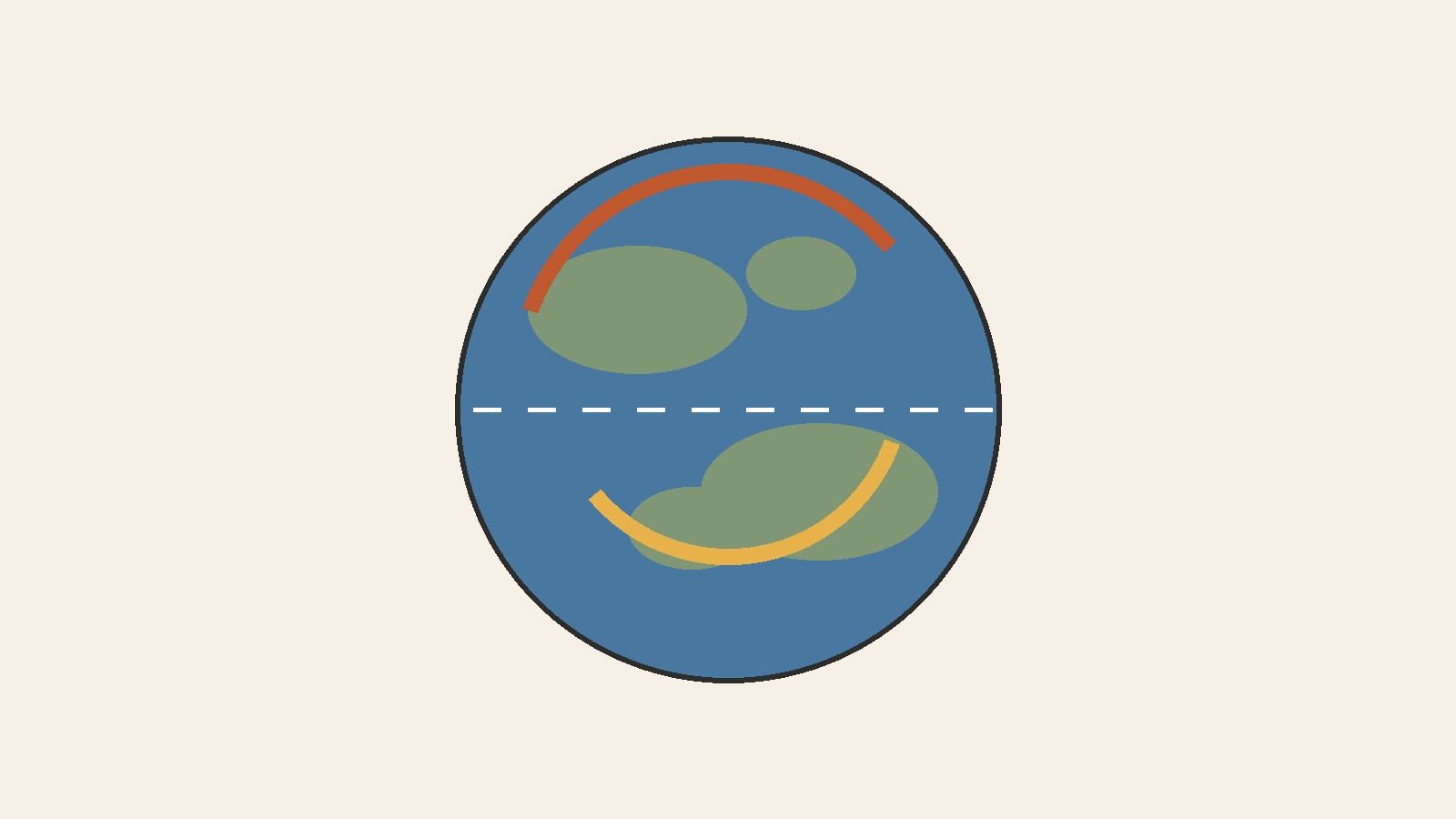
- The Coriolis effect is the apparent sideways deflection of something moving over Earth's surface, caused by Earth's rotation. Viewed from the ground, moving air and water seem to curve: to the right of their direction of motion in the Northern Hemisphere and to the left in the Southern Hemisphere. Nothing is actually pushing the moving air or water sideways. The curve appears because Earth is turning underneath it while it travels. The effect is strongest at the poles, absent at the equator, and grows with speed and distance traveled. That is why it shapes global winds, ocean currents, and the spin of large storms, but not water draining from an ordinary sink. --- Stand on a spinning playground roundabout and throw a ball straight toward a friend on the other side. To you, the ball seems to curve away from its target. To someone watching from the ground, the ball travels straight while you, and the roundabout, have turned underneath it. The Coriolis effect works the same way, only the roundabout is Earth itself, and the ball is a mass of air, a current of ocean water, or a projectile traveling a long way. This article explains what the Coriolis effect is, why it happens, how strong it is at different latitudes, and where it matters most. It also clears up a common misunderstanding: the idea that toilets and sinks drain in opposite directions in the two hemispheres. They do not, at least not because of the Coriolis effect.
What the Coriolis Effect Is
The Coriolis effect is the apparent deflection of the path of an object moving within a rotating frame of reference. On Earth, that rotating frame is the planet itself. The United Kingdom Met Office describes it in plain terms: Earth’s rotation means that we experience an apparent force known as the Coriolis force, which deflects wind to the right in the Northern Hemisphere and to the left in the Southern Hemisphere. The United States National Oceanic and Atmospheric Administration (NOAA) gives the same rule for circulating air: because Earth rotates on its axis, circulating air is deflected toward the right in the Northern Hemisphere and toward the left in the Southern Hemisphere, and that deflection is called the Coriolis effect.
Two words in that definition do most of the work: apparent and rotating. The effect is apparent because, from the viewpoint of someone standing outside the rotating system, the moving object is not being shoved sideways at all. It keeps going in the direction it was given, following its own inertia, while the ground beneath it turns. From the viewpoint of someone standing on the rotating Earth, however, the path looks curved. Physics handles this by adding a correction term, called an inertial force or a fictitious force, to the equations of motion used inside the rotating frame. The word fictitious does not mean unimportant. It means the force is not caused by a push, a pull, or contact with another object.
It helps to keep the Coriolis effect and the Coriolis force distinct, even though the two terms are often used interchangeably. The Coriolis force is the correction term in the equations. The Coriolis effect is what an observer on Earth actually sees: the curved path, the bent wind, the rotating storm.
The effect is named after the French mathematician and engineer Gaspard-Gustave de Coriolis, who lived from 1792 to 1843. In 1835 he described the mathematics of motion in rotating systems. NOAA notes that he had been studying the transfer of energy in rotating systems such as waterwheels, and the Met Office notes the same starting point: he formulated theories of fluid dynamics through studying waterwheels and realized the same theories could be applied to fluids on Earth’s surface.
Why Earth’s Rotation Deflects Moving Air and Water
The deflection follows from a single fact: Earth rotates eastward, and different latitudes move eastward at different speeds. A point on the equator travels a much larger circle in one day than a point near a pole, so the equator moves eastward faster than any other latitude, while the poles barely move at all, since they sit almost on the axis of rotation. Britannica puts it this way: the tangential velocity of a point on Earth is a function of latitude, essentially zero at the poles and at a maximum at the equator.
Now imagine a parcel of air moving northward from the equator. At the equator it is already moving eastward quickly, carried along by the ground beneath it. As it travels north, it passes over ground that is moving eastward more slowly. Because nothing has slowed its own eastward motion, it runs ahead of the ground below it, toward the east. To an observer on the ground, that eastward drift looks like a deflection to the right of the direction of travel. The same logic works in reverse for motion toward the equator. Air moving southward from the North Pole starts with almost no eastward speed, but it passes over ground that is moving eastward faster and faster. The ground runs ahead underneath it, so the air lags behind toward the west, which again appears, from the ground, as a deflection to the right of its direction of motion. In the Southern Hemisphere the geometry is mirrored, and the deflection is to the left.
The Met Office uses the merry-go-round example to make the same point. A person standing in the center of a spinning roundabout who throws a ball will see it appear to curve to the right, when in fact it is traveling in a straight line to anyone watching who is not on the roundabout. Scale that picture up to a planet, replace the ball with a wind, and you have the Coriolis effect.
The rule is always stated relative to the direction of motion, not relative to north. In the Northern Hemisphere, moving north deflects east, moving east deflects south, moving south deflects west, and moving west deflects north. In each case the deflection is to the right of where the object is heading. In the Southern Hemisphere, every one of those deflections is reversed, to the left.
How Strong Is the Effect? Latitude, Speed, and Distance
The Coriolis effect is not the same strength everywhere, and its variation with latitude is one of its most important features. At the equator, the Coriolis effect is zero for horizontal motion. At the poles, it is at its maximum. Between those extremes, it grows steadily with latitude. In the standard formula, the size of the effect is proportional to the sine of the latitude, which is zero at the equator (0 degrees) and one at the poles (90 degrees). Britannica gives the formula for the magnitude as 2 times the velocity of the object times Earth’s angular velocity times the sine of the latitude. Readers do not need to calculate with it, but it captures the three things that matter: the effect grows with the speed of the moving object, with Earth’s rate of rotation, and with latitude.
Speed matters because a faster object covers more ground in a given time, giving the rotating frame more chance to turn beneath it. Distance and time matter for the same reason. A deflection that builds up slowly needs a long path or a long travel time before it becomes noticeable. That is why the Coriolis effect is a large-scale phenomenon: it dominates winds that blow for days across thousands of kilometers and currents that circle whole ocean basins, but it is negligible for a ball thrown across a field or water swirling in a basin.
Note also what the Coriolis effect does not do. In standard textbook treatments, the Coriolis acceleration acts at right angles to the direction of motion, so it changes direction, not speed. The wind does not blow faster because of the Coriolis effect; it blows in a different direction than it otherwise would. A storm’s energy comes from heat and pressure differences. The Coriolis effect steers; it does not power.
The Coriolis Effect and Global Winds
If Earth did not rotate, the atmosphere would behave much more simply. Warm air would rise at the equator, travel toward the poles, cool, sink, and return toward the equator along the surface. NOAA describes exactly this simplified picture: if Earth did not rotate on its axis, the atmosphere would only circulate between the poles and the equator in a simple back-and-forth pattern. Rotation breaks that simple loop into a more complicated system of three circulation cells in each hemisphere.
The Hadley cell sits between the equator and about 30 degrees latitude in each hemisphere. Warm, moist air rises at the equator, travels poleward high in the atmosphere, cools, and sinks at around 30 degrees, creating belts of high pressure and dry conditions. The surface return flow moves back toward the equator, and the Coriolis effect deflects it into the northeast trade winds in the Northern Hemisphere and the southeast trade winds in the Southern Hemisphere. The name comes from the age of sailing ships, when these steady winds were valuable for trade routes.
The Ferrel cell occupies the middle latitudes, roughly from 30 to 60 degrees. Its surface winds blow toward the poles, and the Coriolis effect turns them into the prevailing westerlies, winds that blow from west to east. These are the winds that carry much of the day-to-day weather across the mid-latitudes, and they are one reason that weather systems in those regions generally move from west to east.
The polar cell covers the highest latitudes, from about 60 degrees to the poles. Cold, dense air sinks at the poles and flows toward lower latitudes at the surface, and the Coriolis effect deflects that flow into the polar easterlies, winds that blow from the east.
The boundaries between these cells shift with the seasons and with weather patterns, and the Ferrel cell is less steady than the other two. But the three-cell model remains the standard way to explain why the world’s surface winds blow in belts, and the Coriolis effect is the reason each belt blows at an angle instead of straight north or south.
The same deflection shapes circulation around high and low pressure systems. Air naturally flows from high pressure toward low pressure, but the Coriolis effect bends that flow sideways. Around a low pressure center in the Northern Hemisphere, air spiraling inward is deflected to the right at each step, producing counterclockwise rotation. Around a high pressure center, air spiraling outward is likewise deflected to the right, producing clockwise rotation. In the Southern Hemisphere both patterns are reversed, as the Met Office states. Without the Coriolis effect, air would simply flow straight from high pressure to low pressure, and these rotating systems would not form in the same way.
The Coriolis Effect and Ocean Currents
Winds drag on the ocean surface, so the wind belts push surface water in their direction, and the Coriolis effect then deflects that moving water as well. The result is a set of enormous, slowly rotating current systems called gyres, one in each major ocean basin. In the Northern Hemisphere, gyres rotate clockwise. In the Southern Hemisphere, they rotate counterclockwise. The five great subtropical gyres, the North Atlantic, South Atlantic, North Pacific, South Pacific, and Indian Ocean gyres, all follow this rule: the trade winds push equatorial water westward, the westerlies push mid-latitude water eastward, the continents block the flow and turn it, and the Coriolis effect deflects each current to the right in the north and to the left in the south, closing the loop into a circle.
One consequence is that western boundary currents, which run along the east coasts of continents, carry warm water from the tropics toward higher latitudes, while eastern boundary currents carry cooler water back toward the equator. This redistribution of heat is one way ocean circulation moderates climate.
Below the surface, the Coriolis effect produces a second structure called the Ekman spiral. When wind moves surface water, that layer drags the layer beneath it, which drags the layer beneath that, and so on. Each deeper layer is deflected a little further and moves a little more slowly, so the direction of flow rotates with depth, tracing a spiral. NOAA describes the Ekman spiral as a consequence of the Coriolis effect: deeper water is deflected to the right in the Northern Hemisphere and to the left in the Southern Hemisphere, and each successively deeper layer moves more slowly.
Storms, Spin, and the Equator
Large rotating storms are the most dramatic visible sign of the Coriolis effect. Tropical cyclones, known as hurricanes in the Atlantic and Caribbean, typhoons in the northwest Pacific, and cyclones in the Indian Ocean and South Pacific, are all the same kind of system with different regional names. They rotate counterclockwise in the Northern Hemisphere and clockwise in the Southern Hemisphere, following the same rule as any low pressure system. The Coriolis effect does not create the storm’s energy, which comes from warm ocean water and moist air, but it organizes the inflow into a rotating structure. That is why the organizing spin is weakest near the equator, where the Coriolis effect is zero, and grows stronger with latitude. A low pressure disturbance near the equator can still produce heavy rain and strong winds, but it lacks the deflection needed to organize into the tight, spinning structure of a tropical cyclone.
Smaller rotating systems behave differently, and the difference is a matter of scale. Tornadoes, which are far smaller and shorter-lived than tropical cyclones, are not organized by the Coriolis effect in the same way. Most tornadoes in the Northern Hemisphere do rotate counterclockwise, but that tendency comes from the larger weather system and the wind shear within it, not from the Coriolis deflection acting on the tornado itself, which is too small and too brief for that deflection to decide its spin.
Nothing here is a weather forecast, and no statement about storm rotation is a prediction for any particular storm. Individual storms are shaped by many factors at once, including temperature, moisture, terrain, and surrounding winds.
The Sink and Toilet Myth
Perhaps no idea about the Coriolis effect is more widely repeated, or more wrong, than the claim that water drains clockwise in one hemisphere and counterclockwise in the other, or that toilets flush in opposite directions on either side of the equator.
In a household sink, bathtub, or toilet, the Coriolis effect is far too weak to decide the direction of the swirl. Scientific American, drawing on physicists and ocean scientists, explains why: in an ordinary tub, small asymmetries in the shape of the drain, the way the water was poured in, and residual currents left over from filling all overwhelm the tiny Coriolis deflection. Even in a perfectly symmetric tub, the circulation direction would be set mainly by leftover motion from filling, which can take more than a day to die away completely. A senior scientist at the San Francisco Exploratorium quoted in the same article put the scale problem plainly: Coriolis acceleration at mid-latitudes is about one ten-millionth of the acceleration of gravity, so it needs a very long distance to produce an appreciable curvature, and a toilet or sink is just not large enough.
That does not mean the effect is zero in principle for small containers. Under carefully controlled laboratory conditions, with a large, symmetric tank and water left to settle for many hours, researchers have demonstrated hemisphere-dependent rotation in draining tanks. The difference between that experiment and a bathroom sink is the whole point: the Coriolis effect is real, but it only wins when everything louder than it has been silenced, and in a normal bathroom, almost everything is louder.
The equator demonstrations sometimes offered to tourists, in which water is shown draining one way a few steps north of the equator and the other way a few steps south, are stage tricks. The demonstrator controls the direction by how the water is poured or how the container is tilted, not by the hemisphere. At the equator itself, the Coriolis effect for horizontal motion is zero, so such a demonstration cannot work on its own terms in any case.
The lesson generalizes: whenever someone claims a small, everyday phenomenon is caused by the Coriolis effect, ask about scale. If the thing travels centimeters for seconds, the Coriolis effect is almost certainly not the explanation. If it travels hundreds of kilometers for days, it very likely is.
Coriolis and Centrifugal: Two Apparent Forces
Readers who meet the Coriolis force often meet a second apparent force at the same time: the centrifugal force. Both are inertial forces, meaning they appear in the equations of motion for an observer in a rotating frame, and neither is caused by a physical push or pull. The centrifugal force acts outward, away from the axis of rotation, and it is present whether or not the object is moving relative to the rotating frame. The Coriolis force, by contrast, acts only on objects that are moving relative to the rotating frame, and it acts sideways, at right angles to the direction of motion. In short: centrifugal pushes outward, Coriolis deflects sideways, and only Coriolis depends on the object’s own motion.
On Earth, the centrifugal effect of rotation is small compared with gravity. The Coriolis effect is the one that matters for winds, currents, and storms, because those are all cases of things moving over a rotating surface.
Other Places the Coriolis Effect Shows Up
Long-range ballistics is the classic example beyond weather and oceans. Britannica notes that the Coriolis force is an important consideration in ballistics, particularly in the launching and orbiting of space vehicles. A projectile fired over a long distance travels over ground that is moving at a different speed by the time it arrives, and its path must be corrected for that difference.
The Foucault pendulum is the most elegant demonstration. A pendulum swinging freely at the North Pole would appear, to an observer on the ground, to rotate its plane of swing completely over the course of a day, because Earth turns underneath it while the pendulum keeps swinging in the same plane in space. At lower latitudes the apparent rotation is slower, and at the equator it disappears, following the same latitude dependence as the Coriolis effect itself.
Common Mistakes
A few misunderstandings recur so often that they are worth listing plainly. The Coriolis effect is not a wind. It does not blow air anywhere by itself. It bends air that is already moving because of pressure differences and heating. Without a pressure difference to set air in motion, there is nothing for the Coriolis effect to deflect.
The Coriolis effect does not make the Northern Hemisphere spin one way and the Southern Hemisphere spin the other in any absolute sense. The deflection is always relative to the direction of motion. A northward wind and a southward wind in the same hemisphere are deflected in opposite compass directions, east and west respectively, but both are deflected to the same side, the right, relative to their own motion.
Finally, the Coriolis effect is not the reason Earth has seasons, tides, or day and night. Seasons come from Earth’s axial tilt, tides come mainly from the Moon’s gravity, and day and night come from rotation itself. The Coriolis effect is one consequence of rotation, not a synonym for it.
Why the Coriolis Effect Matters
It is tempting to treat the Coriolis effect as a curiosity for quizzes and classroom demonstrations. In reality it is one of the organizing principles of Earth’s climate system. Without it, winds would blow straight from high pressure to low pressure, ocean currents would not form their great circular gyres, and the familiar patterns of deserts, rain belts, and storm tracks would look very different. The trade winds, the westerlies, and the gyres are all, in part, the Coriolis effect made visible.
Understanding it also trains a useful habit: asking about frames of reference. How something looks depends on where you stand. The core idea fits in a sentence: Earth turns beneath moving things, so moving things appear to curve, to the right in the north and to the left in the south, and the bigger and longer-lived the motion, the more that curve matters.
Frequently Asked Questions
What is the Coriolis effect in simple terms?
It is the apparent curving of the path of something moving over Earth’s surface, caused by Earth’s rotation. Moving air and water seem to bend to the right in the Northern Hemisphere and to the left in the Southern Hemisphere, because Earth turns underneath them while they travel.
Is the Coriolis effect a real force?
It is an apparent or inertial force, sometimes called a fictitious force. It appears in the equations used by an observer rotating with Earth, but it is not caused by a push, a pull, or contact with another object. The moving object is not being shoved sideways; its path only looks curved from the rotating frame.
Which way does the Coriolis effect deflect objects in each hemisphere?
To the right of the direction of motion in the Northern Hemisphere and to the left in the Southern Hemisphere. The rule is always relative to the direction of travel, so a northward wind in the Northern Hemisphere deflects east, while a southward wind deflects west, and both are deflections to the right.
Why is there no Coriolis effect at the equator?
Because the effect grows with the sine of the latitude, which is zero at the equator and greatest at the poles. For horizontal motion, such as wind and ocean currents, the deflection vanishes at the equator and increases toward higher latitudes.
Does the Coriolis effect affect toilets and sinks?
No, not in any practical sense. In an ordinary sink, bathtub, or toilet, the direction of the swirl is set by the shape of the basin, the way the water enters, and leftover motion from filling. The Coriolis deflection is far too small over such short distances and times to decide the direction.
How does the Coriolis effect create the trade winds?
Warm air rises at the equator and its surface return flow moves back toward the equator. The Coriolis effect deflects that flow to the right in the Northern Hemisphere, producing the northeast trade winds, and to the left in the Southern Hemisphere, producing the southeast trade winds.
Why do hurricanes spin in opposite directions in the two hemispheres?
Because air flowing toward a low pressure center is deflected to the right in the Northern Hemisphere, turning the inflow into a counterclockwise swirl, and to the left in the Southern Hemisphere, turning it into a clockwise swirl. The same rule applies to any large low pressure system, not only to tropical cyclones.
Does the Coriolis effect change the speed of the wind?
No. In standard textbook treatments it acts at right angles to the direction of motion, so it changes direction, not speed. Wind speed is set by pressure differences, heating, and friction, while the Coriolis effect steers the flow.
What is the difference between the Coriolis effect and the centrifugal force?
Both are apparent forces that appear for observers in a rotating frame. The centrifugal force acts outward from the axis of rotation whether or not an object is moving relative to the frame. The Coriolis force acts only on objects moving relative to the frame, and it deflects them sideways rather than outward.
Who was Coriolis, and when did he describe the effect?
Gaspard-Gustave de Coriolis was a French mathematician and engineer who lived from 1792 to 1843. In 1835 he published the mathematical treatment of motion in rotating systems, building on studies of energy transfer in rotating machinery such as waterwheels.
Sources & references
- National Oceanic and Atmospheric Administration, National Ocean Service. "The Coriolis Effect." https://oceanservice.noaa.gov/education/tutorial_currents/04currents1.html
- United Kingdom Met Office. "Coriolis effect." https://weather.metoffice.gov.uk/learn-about/weather/how-weather-works/coriolis-effect
- Encyclopaedia Britannica. "Coriolis force." http://www.britannica.com/science/Coriolis-force
- National Oceanic and Atmospheric Administration, National Ocean Service. "Ekman spiral." https://oceanservice.noaa.gov/education/tutorial_currents/media/supp_cur04e.html
- Scientific American. "Does water flowing down a drain spin in different directions depending on which hemisphere you are in?" https://www.scientificamerican.com/article/can-somebody-finally-sett/


