Short answer
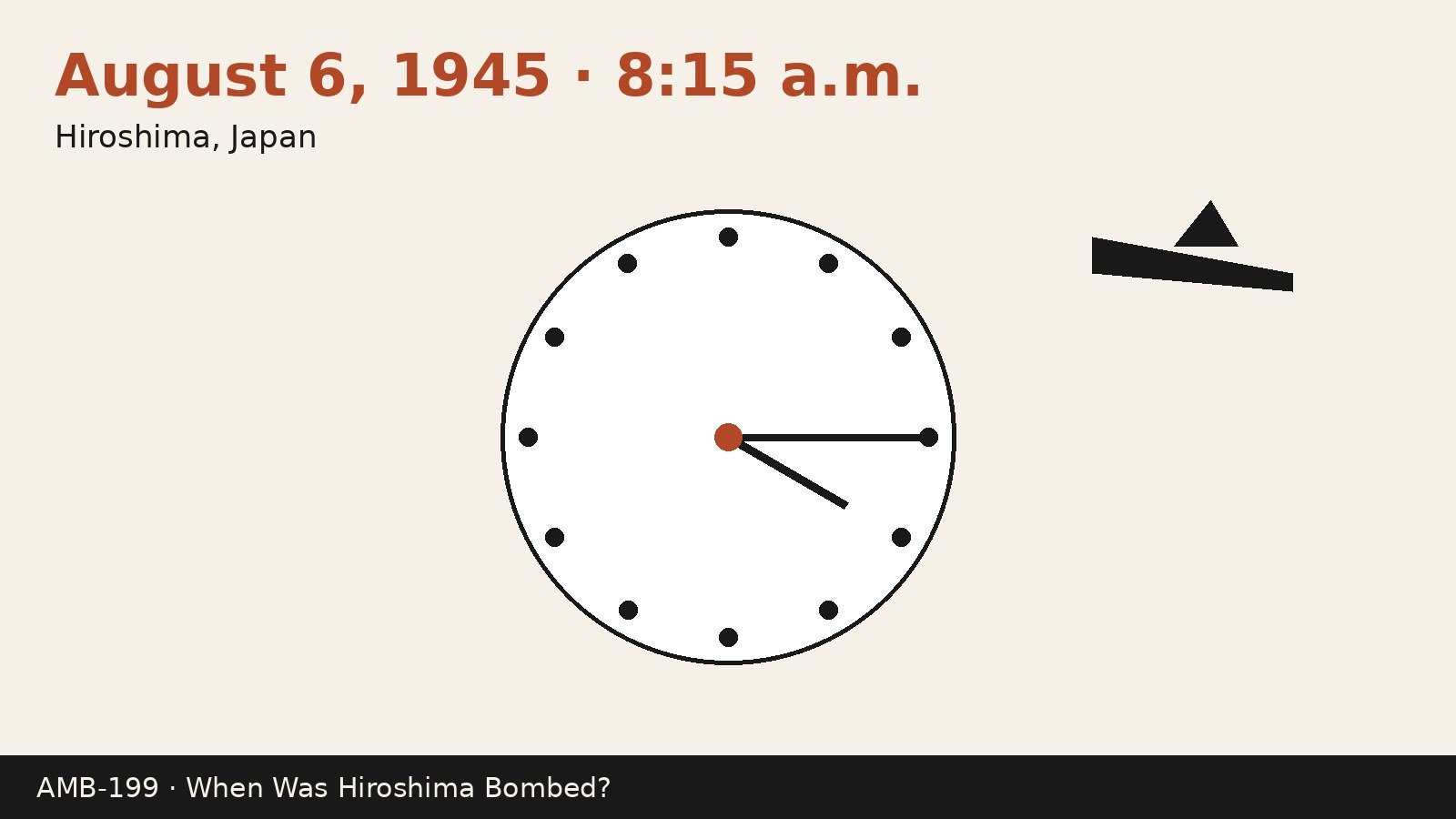
- Hiroshima was bombed on Monday, August 6, 1945, at about 8:15 a.m. local time in Japan. The American B-29 bomber Enola Gay released the atomic bomb known as Little Boy over the city that morning, and the bomb detonated shortly afterward, at about 8:16 a.m., high above the city center. It was the first time an atomic weapon was used in war. That one sentence answers the question, but it leaves out details readers want next: why the time is sometimes given as 8:15 and sometimes as 8:16, what kind of bomb it was, how much of the city was destroyed, how many people died, and what happened in the days that followed. This article answers those questions, using figures from the United States National Archives, the United States Department of Energy history of the Manhattan Project, the United States National Park Service, Encyclopaedia Britannica, and the Hiroshima Peace Memorial Museum. Where sources disagree, the disagreement is stated, and casualty figures are given as attributed ranges, because no single exact death toll exists.
The date and the time, precisely
The date is August 6, 1945. That is the date in Japan, where the bombing took place, and the date used by histories, museums, and official timelines. The time most often quoted is 8:15 a.m. Hiroshima time. The United States National Archives exhibit on the bombing states that on August 6, 1945, at approximately 8:15 a.m. locally, the Enola Gay dropped the bomb on Hiroshima.
A more precise timeline from the United States National Park Service splits that minute in two. The Park Service timeline records that Little Boy was released from the Enola Gay at 8:15 a.m. Hiroshima time, from an altitude of 31,060 feet, and that it detonated at 8:16:02 a.m. Hiroshima time, after falling for 43 seconds. The difference between 8:15 and 8:16 in different sources is not a contradiction. One figure marks the release of the bomb, and the other marks its detonation. Writers who give only one time mean the release time, which is the moment most often quoted in histories.
The height of the detonation is another figure where sources differ because of rounding. The Department of Energy history gives the detonation height as 1,900 feet above the city. The Park Service timeline gives 1,968 feet. Both describe the same event: an airburst well above the rooftops, chosen so that the blast would spread outward over a wide area rather than digging a crater in one spot. The Park Service places the detonation point 550 feet from the Aioi Bridge, the bridge that served as the aiming point for the bombing run.
One source of confusion is the clock on the other side of the world. The Enola Gay took off from Tinian in the Mariana Islands in the early hours of August 6, Tinian time, and Tinian time ran one hour ahead of Hiroshima time, according to the Park Service timeline. In Washington, the news of the bombing was announced later on August 6, American time. President Harry S. Truman’s statement was broadcast at 11:00 a.m. Washington time on August 6, according to the Department of Energy history, about 16 hours after the bombing in local terms. Readers who see an American date of August 5 attached to the event are usually seeing a time zone conversion of the Japanese morning into the previous American evening. The historical date of the bombing itself remains August 6, 1945.
The mission: the Enola Gay, Tinian, and Little Boy
The bombing was carried out by a single bomber, not a large formation. In the early morning hours of August 6, 1945, the B-29 bomber Enola Gay took off from the island of Tinian and headed toward Japan, according to the Department of Energy history. The aircraft was piloted by Colonel Paul W. Tibbets Jr., commander of the 509th Composite Group, and carried a crew of 12, according to the Park Service timeline. Two observation aircraft accompanied it. Tinian, in the Mariana Islands, was the staging base for the atomic missions, and the bomb components had been moved there after the first successful atomic test at Alamogordo, New Mexico, on July 16, 1945. Britannica records that within hours of that test, the United States began moving atomic bomb components to Tinian. The test, known as Trinity, proved that the weapon worked. Three weeks later, it was used in combat.
The bomb dropped on Hiroshima was nicknamed Little Boy. It was a uranium gun type bomb, weighing 9,700 pounds, according to the Department of Energy history. Its explosive yield was later estimated at 15 kilotons, meaning an explosive force equivalent to 15,000 tons of TNT. The design was different from the plutonium implosion bomb dropped on Nagasaki three days later, a distinction that matters because the two bombs worked differently and produced different patterns of damage.
On the morning of the mission, the Enola Gay flew at low altitude on automatic pilot before climbing to about 31,000 feet as it neared the target area, according to the Department of Energy history. An air raid alert in Hiroshima that morning, sounded at 7:09 a.m. Hiroshima time after a single aircraft, a weather plane, was seen, had been called off before the bombing run, and by 8:15 the city was busy with ordinary morning activity. Soldiers were doing morning exercises, commuters were on foot or on bicycles, and groups of women and children were working outside to clear firebreaks, the Department of Energy history records. The bombardier took control for the bombing run, the Aioi Bridge came into view, and at 8:15 a.m. the bomb was released. Forty-three seconds later it detonated above the city.
After releasing the bomb, Tibbets turned the aircraft sharply away to escape the shock wave. The Department of Energy history records that even when the Enola Gay was eleven and a half miles away, it was rocked by the blast, and the crew looked back to see the city hidden by a towering cloud. The aircraft landed back at Tinian after a mission lasting about twelve hours, according to the Park Service timeline.
Why Hiroshima was chosen
Hiroshima was not chosen at random, and understanding why it was on the target list helps explain the scale of what followed. The Department of Energy history describes Hiroshima as an important military center, located on the deltas of southwestern Honshu Island, facing the Inland Sea. It gives the city’s civilian population as almost 300,000, with about 43,000 soldiers stationed there. A separate official Hiroshima account puts the population present in the city on August 6 at about 350,000 people, including residents, military personnel, and people who commuted into the city for work. The two figures differ because they count different groups: one counts residents and soldiers separately, while the other counts everyone present that day. Both point to the same basic fact: Hiroshima was a large, working city with a major military presence, not an empty or purely military site.
The decision to use the bomb followed the Potsdam Declaration of July 26, 1945, in which the Allied powers called on Japan to surrender unconditionally. The National Archives exhibit records that President Truman warned Japan that if it did not surrender under those terms, it could expect further bombings. When Japan did not act on the declaration, the plans for using the new weapons went into effect, as Britannica puts it. The bombing of Hiroshima was therefore the first use of a weapon whose existence had been kept secret, deployed after a public demand for surrender had gone unanswered.
What happened in the city that morning
The explosion began with an intense flash of light, followed by a blast wave and intense heat. The Department of Energy history describes how dry, combustible materials such as paper ignited as far as 6,400 feet from ground zero, how the flash burned the dark patterns of clothing onto skin, and how the blast wave knocked people from their feet. People indoors were often spared the flash burns but faced flying glass from broken windows and collapsing buildings. The history records that within minutes, 9 out of 10 people half a mile or less from ground zero were dead, and that nearly every structure within one mile of ground zero was destroyed, while almost every building within three miles was damaged. Less than 10 percent of the buildings in the city survived without any damage, and the blast wave shattered glass in suburbs twelve miles away.
The many small fires that erupted at once merged into a single large firestorm. The Department of Energy history states that the firestorm eventually engulfed 4.4 square miles of the city, creating strong winds that blew toward the center of the fire. Britannica gives the same figure for the burned out area: 4.4 square miles almost completely burned out. The Hiroshima Peace Memorial Museum’s account of the bombing records that the area within a two kilometer radius of the hypocenter, the point on the ground directly below the explosion, was completely burned to ashes, and that the fires reached a peak between about 10 a.m. and 2 p.m. or 3 p.m. that day and continued to burn throughout the day.
For hours after the attack, the Japanese government did not know what had happened. The Department of Energy history records that radio and telegraph communications with Hiroshima ended suddenly at 8:16 a.m., and that a staff officer was sent by plane to survey the city from overhead, reporting a huge cloud of smoke while still nearly 100 miles away. The first confirmation of exactly what had happened came about sixteen hours later, with the announcement of the bombing by the United States.
Several days after the blast, medical staff began to recognize the first symptoms of radiation sickness among survivors. The Department of Energy history records that deaths from radiation sickness did not peak until three to four weeks after the attack and did not taper off until seven to eight weeks after it. That delayed wave of deaths is a central reason why casualty figures for Hiroshima are given for different end points: deaths on the day, deaths by the end of 1945, and deaths over the following years are different counts, not competing guesses about the same number.
How many people died: the figures, and why they vary
There is no single exact death toll for Hiroshima, and any article that gives one number without a source or a time frame should be treated with caution. The exact death toll is impossible to know, in the words of the National Archives exhibit, because records were destroyed, many victims could not be identified, and later deaths from injuries and radiation had to be counted over months and years. The honest way to report the toll is as attributed ranges, each tied to a time frame.
For the immediate deaths, the figures cluster around 70,000 to 80,000. The National Archives exhibit states that as many as 70,000 people were killed instantly. Britannica states that some 70,000 people were killed instantly, with between 70,000 and 80,000 more injured. The Department of Energy history states that some 70,000 people probably died as a result of the initial blast, heat, and radiation effects, and notes that this figure included about twenty American airmen held as prisoners in the city. The Park Service timeline gives a higher immediate figure of 80,000 people instantly killed or grievously wounded, a wording that counts the grievously wounded alongside the killed and therefore should not be read as a death toll on its own. Taken together, the sources support an immediate death range of roughly 70,000 to 80,000, with the higher Park Service figure reflecting its broader wording.
By the end of 1945, the toll was substantially higher, because many people who survived the blast itself later died from burns, injuries, and acute radiation effects. The Department of Energy history states that by the end of 1945, the Hiroshima death toll was probably over 100,000. The estimate most commonly associated with Hiroshima city surveys is about 140,000 deaths by the end of 1945, with a margin of about 10,000 either way, giving a range of roughly 130,000 to 150,000. That figure is consistent with the Department of Energy history’s statement that the toll was probably over 100,000, and it reflects later Japanese survey work rather than the first American estimates. The National Archives exhibit takes a different approach to the same problem: it states that at least 100,000 deaths directly resulted from the attacks on both cities combined in its exhibit text, and that a minimum of another 100,000 people died from illnesses caused by radiation exposure in the weeks, months, and decades that followed. Readers should therefore be careful to check whether a figure they see covers one city or both, and whether it stops at the end of 1945 or runs for decades.
Over a longer period, the figures rise further. The Department of Energy history states that the five year death total for Hiroshima may have reached or even exceeded 200,000, as cancer and other long term effects took hold. That is an estimate of cumulative deaths attributed to the bombing over five years, not a count of people killed on August 6. It shows why a single number, quoted without a date range, can mislead: 70,000, 140,000, and 200,000 can all be defensible figures, but they answer different questions.
The table below summarizes the figures used in this article. Each row states its time frame and its source, so that readers can see exactly what is being counted.
| Time frame | Figure | Source |
|---|---|---|
| Killed in the initial blast and its immediate effects | About 70,000, with other accounts reaching 80,000 | National Archives exhibit; Britannica; Department of Energy history |
| By the end of 1945 | Probably over 100,000; commonly cited city survey estimate about 140,000, plus or minus about 10,000 | Department of Energy history; Hiroshima city survey estimates |
| Over the first five years | May have reached or exceeded 200,000 | Department of Energy history |
| Later deaths from radiation related illness | At least 100,000 more across both bombed cities, over weeks, months, and decades | National Archives exhibit |
Nagasaki, three days later
Hiroshima was not the only city bombed with an atomic weapon. On the morning of August 9, 1945, the United States dropped a second atomic bomb, nicknamed Fat Man, over Nagasaki. Britannica records that the B-29 Bockscar first lingered over its primary target, Kokura, but the bombardier could not sight the aiming point through cloud cover, so the aircraft proceeded to Nagasaki, where it dropped a plutonium implosion bomb. The Park Service timeline gives the detonation time as 11:02 a.m. Nagasaki time, at a height of 1,650 feet above the city.
The National Archives exhibit states that another 35,000 to 40,000 people perished at Nagasaki in the immediate attack. Britannica gives a similar immediate figure of an estimated 40,000 killed, with an equal number injured, and notes that Nagasaki’s irregular terrain limited the spread of fire compared with Hiroshima, so that roughly 1.8 square miles were devastated rather than 4.4. By the end of 1945, commonly cited estimates put the Nagasaki toll at about 70,000, with a similar margin of about 10,000. As with Hiroshima, the immediate figure and the end of 1945 figure measure different things, and the longer term toll from radiation related illness continued to rise afterward.
The road to surrender
On August 8, 1945, the Soviet Union declared war on Japan and attacked Japanese forces in Manchuria, according to the Department of Energy history.
On August 10, 1945, one day after the Nagasaki bombing, the Japanese government issued a statement agreeing to surrender under the terms of the Potsdam Declaration, according to Britannica, on the understanding that the emperor’s position as sovereign ruler would not be prejudiced. The National Archives exhibit dates the emperor’s public announcement to August 15, when the Emperor of Japan issued an Imperial Rescript proclaiming acceptance of the Potsdam Declaration provisions. The gap between August 10 and August 15 reflects the time taken for the surrender terms to be settled and the announcement to be prepared and broadcast. The war itself formally ended when Japan formally surrendered on September 2, 1945, as the National Archives exhibit states.
It is worth being precise about these dates, because popular summaries sometimes say the war ended on August 15 or September 2 without explaining the difference. August 15 is the date of the emperor’s broadcast announcing acceptance of the surrender terms. September 2 is the date of the formal surrender document. Both are correct answers to different questions, and this article uses September 2 for the formal end of the war.
The debate about the decision
Historians continue to debate the American decision to use atomic weapons, and this article reports that debate rather than settling it. The National Archives exhibit summarizes the two broad positions. Supporters argue that the bombs were necessary to save American lives and bring a swift end to the war. Opponents contend that the bombs were unnecessary to defeat a severely weakened Japan. The exhibit also notes that in 1945, the American public overwhelmingly supported the decision.
The arguments made at the time are part of the historical record. President Truman’s statement on August 6, quoted in the National Archives exhibit, warned of “a rain of ruin from the air, the like of which has never been seen on this earth” if Japan did not surrender. Supporters of the decision have pointed to the prospect of a costly invasion of the Japanese mainland and the desire to end the war quickly. Critics have pointed to Japan’s weakened position by August 1945, the Soviet declaration of war, and to the argument that a demonstration of the weapon, or a modification of the surrender terms, might have ended the war without bombing a city. Some historians have also argued that demonstrating the weapon to the Soviet Union was a secondary motive. This article attributes that argument to historians who make it, rather than presenting it as an established fact, because the documentary record does not settle the question of motive in a single sentence.
The bombing was the first wartime use of an atomic weapon, and it remains the only wartime use to date, as the National Archives exhibit states. That fact is why August 6, 1945, remains a date of world historical importance, studied not only as a military event but as the beginning of the nuclear age.
Aftermath, survivors, and memory
The survivors of the Hiroshima bombing are known in Japanese as hibakusha, a term for people affected by the bomb. Their experiences include not only the immediate injuries of August 6 but the long term health effects documented in the decades that followed. The Department of Energy history notes that long range health dangers associated with radiation exposure, such as an increased danger of cancer, would linger for the rest of the victims’ lives, as would the psychological effects of the attack. Studies of survivors have informed much of what medicine knows about radiation exposure, because no other large population was exposed to a nuclear weapon in war.
The physical landscape of Hiroshima changed permanently. The building now known as the A-bomb Dome, the skeletal remains of the Hiroshima Prefectural Industrial Promotion Hall near the hypocenter, survived the blast while almost everything around it was destroyed. The Department of Energy history notes that the dome is now a World Heritage Site. It stands in the Hiroshima Peace Memorial Park, alongside the Hiroshima Peace Memorial Museum, whose virtual exhibits preserve photographs, artifacts, and accounts of the bombing and its aftermath, including the survey work carried out in the days after August 6 to confirm that the new weapon was an atomic bomb.
Why some sources give slightly different details
Readers who check several sources will notice small differences, most with straightforward explanations. The time is given as 8:15 a.m. when the source means the release of the bomb, and as 8:16 a.m. when it means the detonation. The detonation height is given as 1,900 feet in rounded form and as 1,968 feet in precise form. The population of Hiroshima is given as about 300,000 civilians plus 43,000 soldiers in one official history, and as about 350,000 people present in the city in another official account, because the two counts include different groups. Casualty figures differ because they stop at different dates and count different causes of death. None of these differences changes the central answer: Hiroshima was bombed on August 6, 1945, in the morning, by a single American bomber carrying the first atomic weapon used in war.
Frequently asked questions
When was Hiroshima bombed?
Hiroshima was bombed on August 6, 1945, at about 8:15 a.m. local time, when the Enola Gay released the atomic bomb Little Boy over the city. The bomb detonated at about 8:16 a.m., high above the city center.
What time was the Hiroshima bombing in Japan?
The bomb was released at about 8:15 a.m. Hiroshima time and detonated at 8:16:02 a.m. Hiroshima time, according to the United States National Park Service timeline. Most histories quote 8:15 a.m. as the time of the bombing.
What day of the week was August 6, 1945?
August 6, 1945, was a Monday. The Department of Energy history describes the morning of the bombing as a calm and sunny Monday morning.
Who dropped the bomb on Hiroshima?
The bomb was dropped by the United States, from the B-29 bomber Enola Gay, piloted by Colonel Paul W. Tibbets Jr. and flown from Tinian in the Mariana Islands. The bomb was nicknamed Little Boy, a uranium gun type weapon with an estimated yield of 15 kilotons.
How many people died in the Hiroshima bombing?
There is no single exact figure. About 70,000 to 80,000 people were killed in the immediate blast and its immediate effects, according to the National Archives, Britannica, and the Department of Energy history. By the end of 1945, the death toll was probably over 100,000, and the estimate commonly associated with Hiroshima city surveys is about 140,000, plus or minus about 10,000. Over five years, the cumulative toll may have reached or exceeded 200,000, according to the Department of Energy history.
Was Hiroshima bombed before or after Nagasaki?
Hiroshima was bombed first, on August 6, 1945. Nagasaki was bombed three days later, on August 9, 1945, with a plutonium bomb nicknamed Fat Man.
When did World War II end after Hiroshima?
Japan agreed to surrender under the Potsdam Declaration terms on August 10, 1945, the emperor announced acceptance of those terms on August 15, 1945, and Japan formally surrendered on September 2, 1945. September 2 is the date of the formal surrender.
Why is the Hiroshima bombing still remembered?
The bombing was the first wartime use of an atomic weapon, it destroyed much of a major city with a single bomb, and it killed tens of thousands of people at once and tens of thousands more in the months and years after. The A-bomb Dome survives as a World Heritage Site, and the Hiroshima Peace Memorial Museum preserves the record of the bombing and its aftermath.
Keep reading: When Did World War 2 End? The Two Surrenders and the Paperwork
Sources & references
- United States National Archives Museum, "The Atomic Bombing of Hiroshima and Nagasaki" exhibit page. Opened and read 24 October 2026.
- United States Department of Energy, OpenNet, "Manhattan Project: The Atomic Bombing of Hiroshima, August 6, 1945" (adapted from F. G. Gosling, The Manhattan Project: Making the Atomic Bomb, and the official Manhattan District History). Opened and read 24 October 2026.
- United States National Park Service, "Timeline of the Atomic Bombings of Hiroshima and Nagasaki." Opened and read 24 October 2026.
- Encyclopaedia Britannica, "History of the atomic bombings of Hiroshima and Nagasaki" (summary). Opened and read 24 October 2026.
- Hiroshima Peace Memorial Museum, virtual museum, "The Dropping of the A-bomb and Survey Activities." Opened and read 24 October 2026.


