Short answer
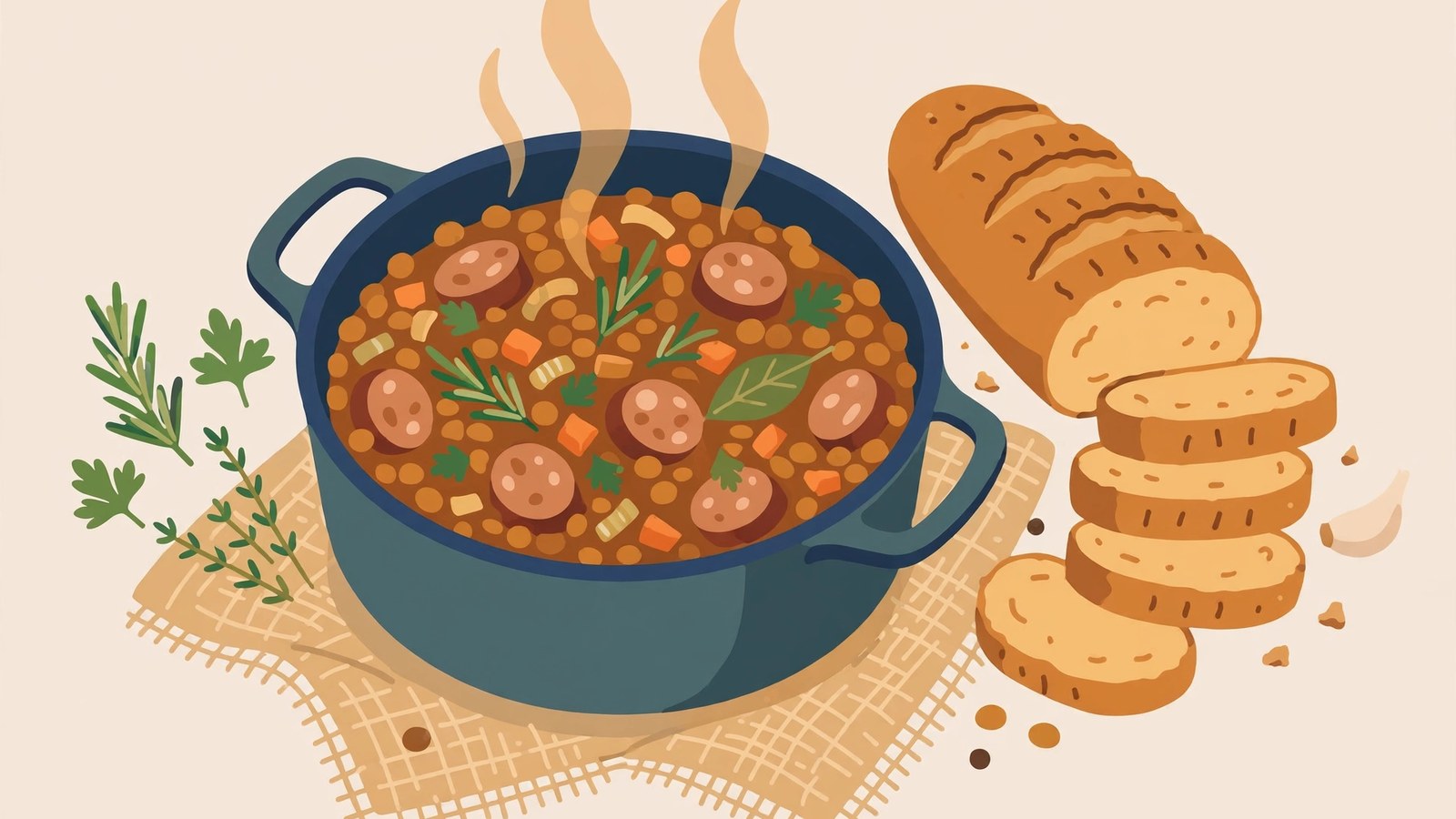
- Brown 1 pound of pork sausage, bulk or removed from casings, in a large heavy pot for about 8 to 10 minutes, then set it aside and leave about 2 tablespoons of fat in the pot. Soften diced onion, carrots, and celery in that fat for 8 to 10 minutes, stir in garlic, dried thyme, and smoked paprika for about a minute, then add 2 cups of rinsed brown or green lentils, 6 cups of broth, and 2 bay leaves. Simmer partly covered for 30 to 40 minutes, until the lentils are tender but still hold their shape. Return the sausage, add optional diced tomatoes only now, and simmer 10 to 15 minutes more. Ground pork sausage should reach 160 degrees Fahrenheit, measured with a food thermometer, as listed by FoodSafety.gov. Rest the stew for 10 minutes, stir in vinegar, season, and serve with parsley and crusty bread. Refrigerate leftovers at 40 degrees Fahrenheit or below, use them within 3 to 4 days, and reheat soups and stews to a rolling boil and to 165 degrees Fahrenheit throughout.
Introduction
New Year’s sausage and lentil stew is a one pot winter dish built from modest ingredients: pork sausage, brown or green lentils, onion, carrot, celery, garlic, broth, and herbs. It is served at New Year in many homes, and lentils carry a traditional association with the holiday. In traditions described in many cookbooks and family customs, lentils are eaten on New Year’s Day because their small, round, coin like shape is said to symbolize coins and plenty for the year ahead. That is a tradition and a piece of symbolism, not a fact about what eating lentils will do, and this article presents it only in those terms. The stew earns its place at the table on practical grounds as well: it is filling, it uses inexpensive ingredients, it simmers in under an hour, and its flavor improves after a night in the refrigerator.
The method depends on order. The sausage is browned first and set aside, so it develops browned flavor and does not turn rubbery from a long boil. The vegetables soften in the fat left in the pot. The lentils then simmer in broth until they are tender but still hold their shape. The sausage returns near the end to heat through, and vinegar and fresh parsley are added at the finish, because acid added too early can slow lentil softening and because a small amount of vinegar at the end brightens a rich stew without making it taste sour.
This article gives the full recipe, explains how to choose brown or green lentils and pork sausage, shows how to judge sausage doneness with the temperature federal food safety guidance gives for ground pork sausage, and covers troubleshooting, make ahead handling, storage, reheating, and allergen notes in plain factual terms. The food safety guidance was checked against FoodSafety.gov and the United States Department of Agriculture Food Safety and Inspection Service on 31 October 2026.
The New Year Tradition, and Why This Stew Works
The lentil tradition is worth stating carefully. In some Italian and other European and American family traditions, lentils are served at New Year, often with pork sausage or another pork dish, and the lentils are described as resembling coins. Eating them is presented in those traditions as a hopeful symbol for prosperity in the coming year. Different families tell the custom in different ways, and no food can guarantee luck or wealth. Readers who enjoy the custom can enjoy it as a tradition at the table, while readers who do not observe it lose nothing in the cooking: the dish works for flavor and texture alone.
Browning is the first reason it works. When crumbled sausage cooks in a hot pot, its surface browns and develops deep savory flavor that plain simmered sausage does not develop. Crumbles give more browned surface than whole links, and they distribute the sausage through the stew so every bowl contains some. Leaving the sausage in the broth for the whole simmer would give up that texture, so it is removed and returned late.
Lentils are the second reason. Brown and green lentils hold their shape, so a spoonful contains distinct lentils, pieces of sausage, and vegetables in broth. Red lentils break down into a thick puree, which suits a smooth soup but not this chunky stew.
Salt and acid timing is the third reason. Season the cooking liquid moderately from the start so the lentils are seasoned through, then adjust at the end. Keep tomatoes and vinegar until late, because acid can slow softening, especially with older lentils. Lentils also release starch as the stew rests, so a stew that looks a little thin at a boil may be right after 10 minutes off the heat.
Ingredients
This recipe makes about 4 servings as a main dish. Have the vegetables cut and the spices measured before the pot goes on the heat, because the first steps move steadily and garlic burns if it is left while other ingredients are prepared.
- 1 pound pork sausage, bulk or removed from casings
- 2 cups brown or green lentils, rinsed and picked over
- 2 tablespoons olive oil, only if needed
- 1 large onion, diced
- 2 carrots, diced
- 2 celery stalks, diced
- 4 cloves garlic, minced
- 1 can (14 ounces) diced tomatoes, optional
- 6 cups chicken broth or vegetable broth
- 2 bay leaves
- 1 teaspoon dried thyme
- 1 teaspoon smoked paprika
- 1 tablespoon red wine vinegar or apple cider vinegar
- Salt and black pepper, to taste
- Fresh parsley, chopped, for serving
- Crusty bread, for serving
Pick over the lentils before rinsing. Spread them on a plate and remove any small stones, debris, or shriveled grains, which can hide in dried lentils. Rinse the picked over lentils in a sieve under running water and drain them well. Tomatoes are optional and are an end of cooking ingredient here, not a starting one. If you use them, add them with the returned sausage in the last 10 to 15 minutes, after the lentils are already tender.
Choosing Sausage and Lentils Well
Sausage style shapes this stew more than any spice added later. A coarse, well seasoned pork sausage browns into flavorful crumbles and gives the broth a savory base. A very lean sausage can taste dry after simmering, and a heavily sweetened sausage can make the stew one note sweet once the carrots soften. Read the label for ingredients and allergens, and keep the package until the meal is over if guests may ask what was used.
If the sausage is sold in links, remove the meat from the casings before browning so it can crumble. If it is sold bulk, it is ready to brown as it is. Sliced links work, but they do not distribute as well. Whole links simmered in the stew are the weakest option, for the same reason.
Lentils from a shop with fast turnover, in a sealed bag, usually cook faster and more evenly than lentils from a bulk bin that has sat open for a long time. Brown and green lentils should look fairly uniform in color and size, without many broken or shriveled pieces. Older lentils are not described here as unsafe, but they commonly take longer to soften. Allow extra simmering time, add warm broth if the pot gets dry, and judge doneness by tasting a spoonful rather than by the clock alone.
Chicken broth gives a rounder, more savory base. Vegetable broth keeps the base lighter and is the right choice for the vegetarian variation below. Low sodium broth makes the final salt adjustment easier to control, because sausage brands vary widely in salt.
Method: Step by Step
Step 1: Brown the sausage
Heat a large, heavy pot over medium high heat. Add the sausage, breaking it into crumbles with a wooden spoon, and cook until well browned, about 8 to 10 minutes. Transfer the sausage to a clean plate with a slotted spoon, leaving the fat in the pot. If the pot is dry, add 1 tablespoon of olive oil. If there is a lot of fat, spoon off all but about 2 tablespoons. Do not return the plate, spoon, or other utensils that touched raw sausage to cooked food without washing them first.
Step 2: Soften the vegetables
Reduce the heat to medium and add the onion, carrots, and celery with a pinch of salt. Cook, stirring, for 8 to 10 minutes, until the vegetables have softened and are lightly golden at the edges. Scrape up the browned bits from the sausage as the vegetables release moisture. Those bits dissolve into the stew base and are part of its flavor.
Step 3: Add garlic and spices
Stir in the garlic, thyme, and smoked paprika and cook for about a minute, until fragrant. Garlic is added here rather than at the start because it would burn during the long vegetable cook, and burned garlic tastes bitter. Keep stirring during this short step.
Step 4: Add lentils, broth, and bay leaves
Add the rinsed lentils, the broth, and the bay leaves and stir well. Bring the pot to a boil, then reduce the heat to a gentle simmer, cover partly, and cook for 30 to 40 minutes, stirring occasionally. Brown and green lentils should be tender but still hold their shape. Test a spoonful rather than trusting the clock, because lentil age affects cooking time. If the lentils are not yet tender and the pot is getting dry, add warm broth a little at a time and continue simmering.
Step 5: Return the sausage and finish cooking
Stir the browned sausage back into the pot. If you are using the optional tomatoes, add them now and not earlier. Simmer for 10 to 15 minutes more, until everything is hot through and the flavors have combined. Remove the bay leaves. If you want certainty about the sausage, check the temperature as described in the next section: ground pork sausage should reach 160 degrees Fahrenheit.
Step 6: Rest, season, and serve
Remove the pot from the heat and rest it for 10 minutes. Stir in the vinegar, taste, and adjust salt and black pepper. The vinegar should brighten the stew without making it taste sour, so add half first, taste, and then add the rest if it is needed. Ladle the stew into warm bowls, scatter parsley over each bowl, and serve with crusty bread.
How to Tell When the Sausage Is Done
FoodSafety.gov publishes a safe minimum internal temperature chart, and that chart is the authority used in this recipe. For pork, the chart lists ground meat and sausage at 160 degrees Fahrenheit. That is the figure for the ground pork sausage in this stew. It differs from the figure for whole cuts of pork: the same chart lists pork steaks, roasts, and chops at 145 degrees Fahrenheit with a rest time of 3 minutes. Those two figures should not be swapped.
Always use a food thermometer to check whether food has reached a safe minimum internal temperature, and place it in the thickest part of the food. Browning alone is not a temperature check. Browned crumbles can look done on the surface before the center of a larger crumble is hot enough, and color in a mixed pot is hard to judge once broth is present. Check a larger piece taken from the center of the pot if you want certainty.
The same chart gives the other temperatures used here. All poultry, including poultry sausage, is listed at 165 degrees Fahrenheit, and leftovers of any type are also listed at 165 degrees Fahrenheit. Keeping the figures separate, 160 for ground pork sausage, 145 plus a 3 minute rest for whole cuts of pork, and 165 for poultry and for leftovers, avoids the common error of giving a single sausage temperature without naming the meat.
Troubleshooting: Lentils, Thickness, and Flat Flavor
If the lentils are still hard after 40 minutes, the most likely causes are old lentils, very hard water, or acid added too early. Keep simmering, add warm broth if the pot gets dry, and check every 10 minutes. Next time, buy lentils from a shop with fast turnover and add tomatoes and vinegar at the end, as this recipe directs.
If the stew is too thick, stir in warm broth a ladle at a time off the heat, rather than cold water, which drops the temperature and dulls the flavor. If it is too thin, simmer it uncovered for 5 to 10 minutes and then let it rest. Lentil starch thickens the stew noticeably as it cools slightly, so judge the final thickness after the rest, not at a rolling boil.
If the stew tastes flat despite enough salt, it usually needs acid, not more salt. Add vinegar half a tablespoon at a time and taste between additions. Fresh parsley and black pepper at serving often fix a rich but one note stew faster than another dried spice. If it tastes bitter, the garlic probably browned too far in Step 3.
If the sausage tastes rubbery, it was probably left in the pot for the full simmer. Brown it, remove it, and return it only for the final 10 to 15 minutes.
Variations That Keep the Method Intact
The method is a base you can vary, as long as the order stays the same: sausage first and out, lentils simmered without acid, sausage back late, vinegar at the end. For a greens version, stir in 2 large handfuls of chopped kale or chard in the last 10 minutes. Baby spinach needs only about a minute, added off the heat.
For a smokier version, use a smoked pork sausage product, following its package directions, or add a second teaspoon of smoked paprika. Check the temperature for the sausage type you actually use, and keep the ground pork and poultry figures separate as described above.
For a vegetarian version, omit the sausage and use vegetable broth. Brown sliced mushrooms in olive oil first for texture, and add a teaspoon of smoked paprika for depth. If you add soy sauce, note that it contains soy and commonly contains wheat, so read its label and tell guests what was used.
For a red lentil version, use red lentils and reduce the simmer to about 20 to 25 minutes. The result will be thicker and more soup like, with the lentils breaking down into the broth. Serve it as a soup, and do not expect distinct lentils in each spoonful.
For a poultry sausage version, use chicken or turkey sausage, add an extra tablespoon of olive oil because poultry sausage is usually leaner, and check that it reaches 165 degrees Fahrenheit, rather than the 160 degrees Fahrenheit for ground pork sausage.
Serving Ideas, Make Ahead, and Scaling
Serve this stew in deep bowls with crusty bread for the broth, and keep toppings simple: parsley, black pepper, and perhaps a drizzle of olive oil. For a New Year gathering, the stew can be the main dish with a green salad and a simple dessert. That plan suits the tradition described earlier without overstating it: the lentils are on the table because the custom is enjoyed, not because any outcome is promised.
The make ahead quality is practical. A pot that simmers for under an hour and improves the next day suits a holiday when the cook may also be hosting. Make the stew on New Year’s Eve if you like, cool it promptly as described below, and refrigerate it overnight. The lentils will absorb more broth, so add a ladle of warm broth when reheating, bring the stew to a rolling boil as a soup, check that it reaches 165 degrees Fahrenheit, and taste again for salt and vinegar.
Scaling works if the pot changes with the quantity. Double the recipe in a larger pot, keeping the same proportions, and extend the simmer only if the lentils need it. Halve it in a smaller pot and check the lentils a few minutes early. Season by taste at the end rather than doubling salt blindly, because sausage saltiness varies by brand.
The shopping, the picking over and rinsing of the lentils, and the cutting of the onion, carrots, and celery can be done ahead, with the cut vegetables refrigerated in a covered container. The browning, simmering, and finishing should stay close to serving time if the stew is to be eaten fresh, because that is where the browned flavor and the lentil texture are made.
Storage, Reheating, and Food Safety
FoodSafety.gov organizes home food safety into four steps: clean, separate, cook, and chill. Wash hands with plain soap and water for at least 20 seconds, wash boards, dishes, utensils, and countertops with hot soapy water after they have held raw meat, and use separate plates and utensils for raw and cooked foods. Do not wash meat, which can spread germs around the kitchen. Keep raw sausage separate from ready to eat foods during preparation.
Refrigerate perishable food within 2 hours of cooking, or within 1 hour if it has been exposed to temperatures above 90 degrees Fahrenheit. Bacteria that cause food poisoning multiply quickest between 40 degrees Fahrenheit and 140 degrees Fahrenheit, so do not leave the cooked stew sitting out while the kitchen is cleaned. Keep the refrigerator at 40 degrees Fahrenheit or below and the freezer at 0 degrees Fahrenheit or below.
Cool a large pot rapidly by dividing it into shallow, covered containers, rather than leaving the whole pot to cool slowly on the stove. The United States Department of Agriculture Food Safety and Inspection Service makes the same point with soup as its example: a big pot of soup will take a long time to cool, so divide it into smaller containers. Hot food can be placed directly in the refrigerator, or rapidly chilled in an ice or cold water bath before refrigerating.
Leftovers keep for 3 to 4 days in the refrigerator, or 3 to 4 months frozen, although frozen leftovers lose moisture and flavor over longer storage. The federal leftover guidance used here is 3 to 4 months frozen. Lentils continue to absorb liquid in storage, so add broth or water when reheating a thickened stew.
When reheating, be sure leftovers reach 165 degrees Fahrenheit as measured with a food thermometer. The Food Safety and Inspection Service adds that sauces, soups, and gravies should be reheated by bringing them to a rolling boil, and that covering leftovers helps them heat through. This stew counts as a soup for that purpose. In a microwave, cover and rotate the food and check the temperature in several places, because microwaves have cold spots. It is safe to reheat frozen leftovers without thawing, in a saucepan or microwave for a soup or stew, although it will take longer.
Thaw frozen leftovers safely in the refrigerator, in cold water in a leak proof package, or in the microwave, never on the counter. After refrigerator thawing, use the food within 3 to 4 days. If a leftover smells off or you are unsure how long it was left out, discard it.
Allergen and Dietary Notes
This section is factual information for planning and serving, not medical advice. The stew as written contains pork, in the form of pork sausage. Pork itself is not one of the nine major food allergens in the United States, but sausage is a manufactured product and its ingredient list varies by brand. Depending on the brand, sausage may contain ingredients that include milk, soy, or wheat, so check the label carefully each time you buy it. Broth varies by brand as well, so read that label too.
The Food and Drug Administration lists nine foods, and ingredients containing their proteins, as major food allergens: milk, egg, fish, crustacean shellfish, tree nuts, wheat, peanuts, soybeans, and sesame. Sesame became the ninth major food allergen under the Food Allergy Safety, Treatment, Education, and Research Act, with labeling required from 1 January 2023. The Administration advises reading the entire ingredient list every time a product is bought, because ingredients can be changed at any time.
Lentils are legumes and are not one of the nine major food allergens listed above, but that statement is about the federal list, not a guarantee for any individual reader. Lentils can be packed alongside other foods, so the package label is the reliable source for anyone with a diagnosed allergy, and readers on a clinician directed eating plan should follow their clinician guidance. Celery is likewise not on the United States list of nine, but it is still an ingredient to name plainly to guests, because guests may avoid it for reasons of their own.
If you are cooking for guests, ask about allergies before you plan the dish, not at the table. Do not assume that picking the sausage out of a shared pot makes the remaining lentils suitable for a guest who avoids an ingredient in that sausage, because the sausage cooked in the same pot as everything else. Cook a separate dish with clean utensils, or choose a different menu.
Frequently Asked Questions
Do I need to soak lentils?
No, not for brown, green, or red lentils in this recipe. Soaking is not required, and the recipe is timed for rinsed, unsoaked lentils. Just pick them over, rinse them, and drain them. Dried beans are different and do need soaking or a long cook, so do not treat lentils and dried beans as interchangeable here.
Can I use sausage links instead of bulk sausage?
Yes. Remove the meat from the casings before browning for the crumble version, or slice the links and brown the slices. Whole links do not distribute as well and the stew loses the browned crumble texture. Whichever form you use, the temperature follows the meat: 160 degrees Fahrenheit for ground pork sausage and 165 degrees Fahrenheit for poultry sausage.
Why do my lentils stay hard?
Age is the most common reason, followed by acid added too early and very hard water. Simmer longer, add warm broth if the pot gets dry, and test a spoonful before deciding the stew is finished. Lentils from an old pantry bag can take longer than the 30 to 40 minutes in the method.
Can I make this in a slow cooker?
Yes, with the browning done first. Brown the sausage and soften the vegetables on the stove, then combine everything except the vinegar and the optional tomatoes in the slow cooker and cook on low for 6 to 8 hours or on high for 3 to 4 hours, until the lentils are tender. Add tomatoes late if you use them, stir in the vinegar at the end, and check that the sausage reaches 160 degrees Fahrenheit for ground pork or 165 degrees Fahrenheit for poultry. Judge the lentils by tenderness, not by the clock alone.
Is this stew freezer friendly?
Yes. Lentils freeze well. Freeze in meal sized portions in covered containers, label them with the date, and use them within 3 to 4 months, with some loss of moisture and flavor over time. Thaw in the refrigerator, in cold water in a leak proof package, or in the microwave, rather than on the counter, and reheat to a rolling boil and 165 degrees Fahrenheit.
Can I use chicken or turkey sausage instead of pork sausage?
Yes, but adjust for leanness and temperature. Poultry sausage is leaner, so add an extra tablespoon of olive oil, and check that it reaches 165 degrees Fahrenheit, the safe temperature for all poultry, rather than the 160 degrees Fahrenheit for ground pork sausage. The flavor will be milder, so extra smoked paprika and the final vinegar help.
Are lentils eaten for luck at New Year?
That is how the custom is described in the traditions that observe it. Lentils are said in those traditions to resemble coins because they are small and round, and serving them at New Year is presented as a symbol of hoped for plenty. This article reports that tradition as a tradition. It does not claim that eating lentils brings luck, money, or any other outcome.
Sources & references
- FoodSafety.gov, Cook to a Safe Minimum Internal Temperature. Used for the safe minimum internal temperature chart, last updated 21 November 2024: pork ground meat and sausage at 160 degrees Fahrenheit, pork steaks, roasts, and chops at 145 degrees Fahrenheit with a rest time of 3 minutes, beef ground meat and sausage at 160 degrees Fahrenheit, all poultry, including sausage, at 165 degrees Fahrenheit, leftovers of any type at 165 degrees Fahrenheit, and the instruction to always use a food thermometer to check whether food has reached a safe minimum internal temperature.
- United States Department of Agriculture, Food Safety and Inspection Service, Leftovers and Food Safety. Used for bacteria growing rapidly between 40 degrees Fahrenheit and 140 degrees Fahrenheit, refrigerating leftovers within 2 hours of cooking or 1 hour above 90 degrees Fahrenheit, cooling food rapidly in shallow containers with a big pot of soup given as the example to divide into smaller containers, hot food being placed directly in the refrigerator or rapidly chilled in an ice or cold water bath, covering and sealing leftovers, keeping leftovers in the refrigerator for 3 to 4 days or frozen for 3 to 4 months with loss of moisture and flavor over longer freezer storage, safe thawing in the refrigerator, cold water, or the microwave and use within 3 to 4 days after thawing, reheating frozen leftovers without thawing in a saucepan or microwave for a soup or stew, and reheating leftovers to 165 degrees Fahrenheit as measured with a food thermometer, with sauces, soups, and gravies reheated by bringing them to a rolling boil and leftovers covered during reheating.
- FoodSafety.gov, 4 Steps to Food Safety. Used for the four steps clean, separate, cook, and chill, washing hands with plain soap and water for at least 20 seconds, washing surfaces and utensils with hot soapy water after raw meat, using separate cutting boards and plates for produce and for raw meat, poultry, and seafood and separate plates and utensils for cooked and raw foods, not washing meat, poultry, eggs, or seafood, cooking with a food thermometer placed in the thickest part of the food, keeping a refrigerator at 40 degrees Fahrenheit or below and a freezer at 0 degrees Fahrenheit or below, refrigerating perishable food within 2 hours or within 1 hour above 90 degrees Fahrenheit, placing leftovers in shallow containers and refrigerating promptly, and thawing or marinating meat, poultry, and seafood in the refrigerator rather than on the counter.
- Food and Drug Administration, Have Food Allergies? Read the Label. Used for the nine major food allergens accounting for the large majority of severe food allergic reactions: milk, egg, fish, crustacean shellfish, tree nuts, wheat, peanuts, soybeans, and sesame, for allergen food sources having to be identified on packaged food labels, for sesame becoming the ninth major food allergen under the Food Allergy Safety, Treatment, Education, and Research Act with labeling required from 1 January 2023, and for the advice to read the entire ingredient list every time a product is bought because ingredients can change at any time.


