Short answer
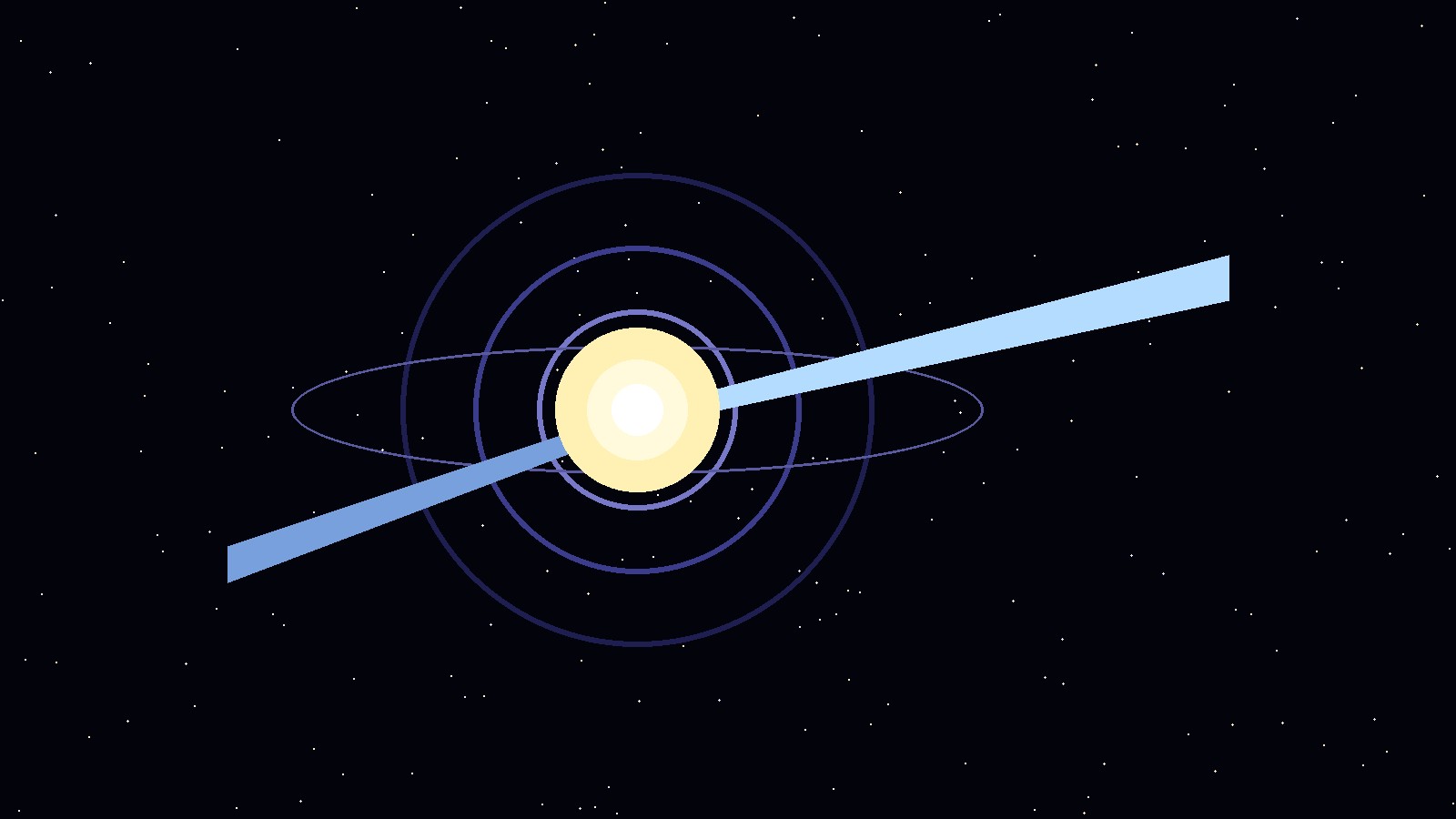
- A quasar is the extremely bright center of a distant galaxy. At its heart sits a supermassive black hole, millions to billions of times the mass of the Sun, surrounded by a swirling disk of gas and dust. As gas in that disk spirals toward the black hole, it heats up and glows so fiercely that the galactic center can outshine all the stars of its host galaxy put together. The word quasar is short for quasi-stellar radio source, meaning a starlike radio source. Early photographs showed these objects as faint points of light, like stars, but their strange spectra and enormous distances soon showed that they were the active cores of galaxies, seen across billions of light-years. Quasars belong to a larger family called active galactic nuclei, usually shortened to AGN. As the European Space Agency's Hubble site puts it, all quasars are AGNs, but not all AGNs are quasars. Quasars are the most luminous members of that family, distinguished from other AGNs mainly by their enormous luminosity and their enormous distances from Earth.
Why the Name Is Misleading
The name quasar survives from the early radio surveys, when astronomers were cataloging the sky at radio wavelengths. Some radio sources matched up with galaxies. A few, however, matched only faint points of light that looked like stars in optical photographs. Because these objects were found through radio telescopes and looked starlike, they were called quasi-stellar radio sources, soon shortened to quasar.
The name stuck even after it stopped being accurate in two ways. First, a quasar is not a star. Stars shine because nuclear reactions in their cores release energy. A quasar shines because matter falling toward a black hole releases energy as heat and light. Second, most quasars known today are not strong radio sources at all. The University of Tennessee’s teaching pages on active galaxies note that most of the first quasars discovered were radio sources, but that most quasars known now are not.
The related term quasi-stellar object, shortened to QSO, is still used for the same kind of object, especially for quasars that are faint at radio wavelengths.
The Engine at the Center
A quasar is not an object in the way a star or a planet is an object. It is a process happening in a very small region at the center of a galaxy. That process has three main parts: a supermassive black hole, an accretion disk, and, in some quasars, a pair of jets.
A supermassive black hole is a region of space where gravity is so strong that nothing, not even light, can escape from inside it. The black hole itself gives off no light; the light of a quasar comes from the material around it.
Gas and dust near the black hole do not fall straight in. Because that material is orbiting, it spreads out into a flattened, spinning disk called an accretion disk. As gas in the disk spirals inward, neighboring streams of gas rub against each other. Friction and gravitational forces heat the gas to extreme temperatures, and the hot gas radiates energy across the whole electromagnetic spectrum, from radio waves through visible light to X-rays. NASA describes this plainly: as a supermassive black hole devours material, it is surrounded by a swirling disk of gas, and when gas from this disk falls toward the black hole, it releases a tremendous amount of energy that creates a brilliant galactic core.
The disk is small by galactic standards. The bright region of a quasar can be comparable in size to our solar system, while its host galaxy spans tens of thousands of light-years. That contrast is the key to a quasar’s strangeness: an area far smaller than a galaxy can outshine the entire galaxy around it. Some quasars also launch jets: narrow beams of high energy particles shot outward in opposite directions, roughly perpendicular to the accretion disk, at speeds close to the speed of light, channeled by magnetic fields near the black hole. Not every quasar has strong jets, and jets matter a great deal for how a quasar is classified. Around the disk, many quasars also have a doughnut shaped ring of gas and dust called a torus, which can block our view of the inner disk from some angles and plays a central role in explaining why active galactic nuclei look so different from one another.
Why Quasars Are So Bright
Quasars are among the most luminous objects known. ESA/Hubble states that quasars are typically thousands of times more luminous than the entire Milky Way, our home galaxy. The Milky Way contains hundreds of billions of stars. A quasar’s central engine, far smaller than a galaxy, can still outshine them all.
The quasar 3C 273, the first quasar identified, shines at visual wavelengths with a luminosity about 3 trillion times that of the Sun, according to the University of Tennessee’s active galaxies pages. Summed over all wavelengths, its luminosity is about 20 trillion times that of the Sun. The same source notes that the average quasar is some 1,000 times more luminous than a bright normal galaxy.
How can so much light come from so small a region? Part of the answer is the sheer amount of material involved: a feeding supermassive black hole can swallow large quantities of gas every year, and a fraction of the mass of that infalling gas is converted into energy with high efficiency. Part of the answer is also visible in how quasars change. Quasars vary in brightness over days, months, and years. Because light takes time to travel, a source cannot brighten or fade all at once across a region larger than light can cross in the time of the change. Rapid changes therefore point to a compact source, not to a whole galaxy brightening at once.
Brightness alone, however, does not define a quasar. A quasar must be both extremely luminous and compact, with the broad, unusual spectrum. A bright galaxy full of young stars can be luminous, but it does not show the same compact, variable, high energy signature.
A Quasar Is Not a Galaxy, and Not a Star
A quasar is not a star. A star is a ball of hot gas held up by nuclear reactions, and its light comes from its own surface and interior. A quasar’s light comes from gas orbiting a black hole. Early telescopes could not tell them apart because both looked like points of light, but their spectra are completely different. Quasar spectra show very broad emission lines from gas moving at thousands of kilometers per second, plus a strong continuum of light across many wavelengths. No ordinary star looks like that.
A quasar is not a galaxy either. A galaxy is a vast system of stars, gas, dust, and dark matter, usually tens of thousands of light-years across. A quasar sits at the center of a galaxy, in a region far smaller than the galaxy itself. When astronomers say a quasar outshines its host galaxy, they mean the galactic center outshines the rest of that galaxy. The host galaxy is still there, with its stars and gas, but the quasar’s glare drowns it out in most images. Only careful observations that subtract the quasar’s light, or images from sharp telescopes like Hubble, reveal the host galaxy underneath.
A quasar is also not the black hole alone. The black hole is the engine, but the light we see comes from the accretion disk and jets around it. Without infalling gas, a supermassive black hole is dark. That is why present day galactic centers, which hold supermassive black holes that are currently starved of gas, do not shine as quasars.
| Object | What it is | Where its light comes from | Typical size of the light source |
|---|---|---|---|
| Star | A ball of gas powered by nuclear reactions | Its own hot surface and interior | One star |
| Galaxy | A system of stars, gas, dust, and dark matter | Its billions of stars combined | Tens of thousands of light-years |
| Quasar | The active center of a galaxy | Gas in an accretion disk around a supermassive black hole | A region far smaller than its host galaxy |
| Active galactic nucleus | Any actively feeding galactic center | An accretion disk, sometimes with jets | Compact, like a quasar |
Quasars and Other Active Galactic Nuclei
If quasars are the brightest active galactic nuclei, what are the rest? Astronomers group active galactic nuclei by luminosity, by radio brightness, and by what their spectra look like. The main types a reader will meet are Seyfert galaxies, radio galaxies, and blazars. The differences between them are partly real and partly a matter of viewing angle.
Seyfert galaxies are the lower luminosity cousins of quasars. The Open University’s introduction to active galaxies explains that radio-quiet quasars are similar to Seyfert galaxies but much more powerful, and that the evidence for this picture is strong. Seyfert galaxies are generally nearer and fainter than quasars, and their host galaxies are easier to see because the central glare does not swamp them.
Radio galaxies are active galaxies with strong jets and large radio emitting lobes. Seen from the side, with the jets pointing across our line of sight rather than toward us, the galaxy itself is visible, and the jets show up as huge radio lobes on either side.
Blazars are the opposite extreme. In a blazar, one of the jets points almost directly at Earth. The jet’s light is boosted toward us by relativistic effects, making the object appear extremely bright and rapidly variable. The Open University’s unified model summary puts it this way: as the viewing angle moves from side-on to the jets to end-on, the observer sees a radio galaxy, a quasar, or a blazar. A blazar is therefore not a different kind of engine. It is largely the same engine seen down the barrel of its own jet.
Two broad divisions cut across these types. The first is radio loud versus radio quiet. Radio loud active galactic nuclei, including radio galaxies and many quasars found in early radio surveys, are strong radio emitters with powerful jets. Radio quiet active galactic nuclei, including most quasars known today, are much fainter at radio wavelengths. Radio quiet does not mean radio silent. It means the radio output is weak compared with the light at other wavelengths.
The second division is obscured versus unobscured. If our line of sight to the center passes through the dusty torus, the inner disk and its broad emission lines are hidden, and the object looks dimmer and redder. If we have a clear view, we see the disk directly and its broad lines. This viewing angle idea is called the unified model of active galactic nuclei: many of the different types are the same kind of object seen from different directions, at different luminosities.
The unified model is a model, not a finished fact. The Open University notes that the radio-quiet unification, linking Seyfert galaxies and radio-quiet quasars by viewing angle, has strong evidence behind it, but that the radio-loud unification, linking radio galaxies, quasars, and blazars, remains controversial, with no consensus yet on whether it fully works. Real differences in black hole spin, fuel supply, and host galaxy may also matter.
Distance, Redshift, and Looking Back in Time
Quasars are far away, and that distance is part of their definition. ESA/Hubble notes that the nearest quasars to Earth are still several hundred million light-years away. There is no nearby quasar lighting up a neighboring galaxy. The brilliant quasar era belongs mostly to the younger universe.
Because light travels at a finite speed, looking at a distant quasar means looking into the past. The light we see from a quasar left it long ago, when the universe was younger. Astronomers measure this with redshift. As the universe expands, it stretches the light traveling through it toward longer, redder wavelengths. The redshift value, written as z, records how much the light has been stretched. A larger redshift generally means a more distant object and an earlier time.
This creates a quirk in how quasar distances are quoted. A quasar’s redshift can be measured directly from its spectrum. Its distance in light-years, by contrast, must be inferred using a model of how the universe has expanded. That is why careful sources give redshift first and treat light-year distances as model dependent. For 3C 273, the University of Tennessee pages give a redshift of 0.158, a distance of nearly 700 megaparsecs by the Hubble law, and a lookback time of about 2 billion years.
How Quasars Were Discovered
The discovery of quasars is one of the great detective stories of twentieth century astronomy, and it turned on a single insight about a strange spectrum.
In the 1950s, radio astronomers cataloged hundreds of radio sources. The Third Cambridge Catalogue listed them as 3C objects, numbered in order. Most matched galaxies or glowing gas clouds. A few matched starlike points of light, nicknamed radio stars. Their spectra were baffling: a strong, continuous glow across many wavelengths, topped by very broad emission lines that matched no known atom or molecule. In 1963, the Dutch astronomer Maarten Schmidt, working at Caltech, studied the spectrum of 3C 273, the 273rd object in the Third Cambridge Catalogue. He realized that the strange lines were in fact familiar lines of hydrogen, from the Balmer series, but shifted far toward the red end of the spectrum. The redshift corresponded to a recession speed of about 15 percent of the speed of light. Once that pattern was recognized for 3C 273, the spectrum of another radio star, 3C 48, fell into place with an even larger redshift.
The conclusion was startling. If the redshift meant distance, as the expansion of the universe suggested, then these starlike points were not nearby stars at all. They were enormously distant, and therefore enormously luminous, far brighter than any galaxy known at the time. Within a few years, astronomers found quasars at ever larger redshifts, opening a new window on the distant universe and forcing a new explanation: a compact, powerful engine at the center of a galaxy. That engine is now understood as a feeding supermassive black hole.
Later, sharper images confirmed the picture. Hubble and other telescopes showed faint host galaxies around quasars, with jets and fuzzy extensions that early pointlike images had hidden.
Three Quasars Worth Knowing
3C 273 is the original quasar and still the brightest quasar in apparent brightness as seen from Earth, according to the University of Tennessee pages. Its redshift is 0.158, its lookback time about 2 billion years, and its apparent visual magnitude is +12.9. That magnitude means it is far too faint to see with the unaided eye, but it is within reach of amateur telescopes under dark skies, and it is a favorite target for astronomers because it is bright, well studied, and shows a clear jet. ESA/Hubble’s word bank entry also features 3C 273, noting Hubble’s sharp image of this bright quasar.
Markarian 231, usually written Mrk 231, is the nearest galaxy to Earth that hosts a quasar, according to NASA. It lies 581 million light-years away. Hubble observations showed that its quasar is powered not by one black hole but by two: a central black hole estimated at 150 million times the mass of the Sun, with a smaller companion of 4 million solar masses orbiting it every 1.2 years. The pair is the remnant of a galaxy merger, and NASA notes that such binary black holes may be common in quasars, since galaxy mergers bring their central black holes together.
J0313-1806 shows the other end of the scale: a quasar from the universe’s first billion years. At its announcement in January 2021, it was the most distant quasar then known, with a redshift of 7.642, according to the National Radio Astronomy Observatory’s summary of the discovery. Its light left it about 670 million years after the Big Bang. Its black hole already weighed about 1.6 billion times the mass of the Sun, and its total luminosity was about 36 trillion times that of the Sun. Its spectrum also showed a powerful outflow moving at close to 20 percent of the speed of light, and its host galaxy was forming stars at roughly 200 solar masses per year. The existence of so massive a black hole so early remains a challenge for theories of black hole growth. Readers should note that distance records in this field change as new surveys report new objects, so the 2021 record status of J0313-1806 should be checked against current catalogs before being repeated as a present day record.
Why There Are No Quasars Next Door
If quasars are so bright, why is the night sky not full of them? The answer is that the quasar era has largely passed.
Quasars were most common when the universe was younger and galaxies were gas rich, with plenty of fuel falling toward their centers. Galaxy mergers were also more frequent, driving gas inward and feeding central black holes. Over billions of years, much of that fuel was consumed or blown away, and many central black holes quieted down.
That fading leaves traces. ESA/Hubble describes quasar ghosts: green, glowing structures orbiting host galaxies that mark where a quasar once shone and then faded. The gas in those structures still glows from the quasar’s past light, like an afterimage.
Quasars also shape their hosts while they shine. NASA’s account of the Webb telescope’s quasar program explains that quasar winds can push out the equivalent of hundreds of solar masses of material each year, sweeping away gas that would otherwise have formed new stars. Astronomers widely consider this feedback to be a main driver limiting the growth of massive galaxies.
How Astronomers Study Quasars Today
Modern quasar research uses telescopes across the spectrum, from radio dishes to X-ray observatories to the James Webb Space Telescope. Because quasars shine at many wavelengths, each wavelength reveals a different part of the system.
One current effort is NASA’s Q3D program, which uses Webb’s three dimensional imaging spectroscopy to study three carefully selected quasars and their host galaxies. Instead of taking a single spectrum for a whole galaxy, this technique records a spectrum at every point in the image, letting astronomers map how gas moves through the host galaxy and how quasar winds affect star formation.
Gravitational lensing gives astronomers another tool. When a massive galaxy sits between a quasar and Earth, its gravity bends and magnifies the quasar’s light, like a cosmic lens. ESA/Hubble reports a case announced in 2019 in which lensing made a distant quasar appear three times as large and 50 times as bright as it would otherwise, allowing Hubble to resolve a system from a time when the universe was less than a billion years old.
Quasar surveys also continue to find new examples, including quasars in the early universe whose black holes seem too massive for their age. Each new find tests ideas about how the first black holes formed: whether they grew from the collapsed cores of the first stars, or formed directly from collapsing gas clouds, or grew through rapid mergers. No single answer has settled the question yet.
Common Mistakes to Avoid
First, do not call a quasar a star or a galaxy. It is the active center of a galaxy, powered by a feeding supermassive black hole. The host galaxy is a separate, larger thing that contains it.
Second, do not assume every quasar is a strong radio source. Early quasars were found by radio telescopes, but most quasars known today are radio quiet, meaning their radio output is weak compared with their light at other wavelengths.
Third, do not confuse brightness as seen from Earth with total power. 3C 273 looks brightest among quasars because it is relatively nearby as quasars go, not because it is the most powerful quasar known. More distant quasars can be intrinsically more luminous yet appear fainter.
Fourth, do not treat a quasar’s distance in light-years as a directly measured number. Redshift is measured from the spectrum. Light-year distances are inferred from redshift using a model of cosmic expansion, so they carry model assumptions with them.
Fifth, do not assume that a quasar’s type is fixed forever. Viewing angle explains many differences between quasar types, but quasars also change over time as their fuel supply rises and falls, and the unified model itself is still debated for radio loud objects.
Frequently Asked Questions
Is a quasar a star?
No. A quasar looks like a point of light in early photographs, which is why it was named for its starlike appearance, but it is not a star. Its light comes from gas in an accretion disk around a supermassive black hole at the center of a distant galaxy, not from nuclear reactions inside a star.
Is a quasar a galaxy?
No, but it lives inside one. A quasar is the active center of a galaxy. The galaxy itself is a much larger system of stars, gas, and dust. The quasar’s glare often hides its host galaxy, but the host is there, and sharp telescopes can reveal it once the quasar’s light is accounted for.
How far away is the nearest quasar?
The nearest galaxy known to host a quasar is Markarian 231, at 581 million light-years away, according to NASA. ESA/Hubble puts the general point the same way: even the nearest quasars are several hundred million light-years away.
Why are quasars so bright?
Because matter falling into a supermassive black hole releases a huge amount of energy. Gas in the accretion disk is heated by friction and gravity until it glows across the electromagnetic spectrum. A quasar’s central region, far smaller than a galaxy, can radiate thousands of times more light than the entire Milky Way.
What is the difference between a quasar and a blazar?
Viewing angle is the main difference in the standard picture. Both are active galactic nuclei with a central black hole and an accretion disk. In a blazar, one of the jets points almost directly at Earth, so the jet’s light is boosted toward us and the object looks extremely bright and variable.
What is the difference between a quasar and a Seyfert galaxy?
Power, mainly. Seyfert galaxies are lower luminosity active galactic nuclei, generally nearer and fainter, with host galaxies that are easier to see. Radio-quiet quasars are similar to Seyfert galaxies but much more powerful, according to the Open University. Think of a Seyfert galaxy as a quasar running at lower power.
Can I see a quasar with a telescope?
The brightest quasar, 3C 273, has an apparent visual magnitude of +12.9, which is far too faint for the unaided eye but within reach of a telescope under dark skies. Most quasars are far fainter than 3C 273 and need large professional telescopes.
Do quasars still exist today?
A few do, including Markarian 231, but quasars were far more common in the younger universe, when galaxies held more gas to feed their central black holes. Many present day galactic centers hold supermassive black holes that are now quiet, because their fuel has run low.
Could the Milky Way become a quasar?
Only if a large amount of gas fell into its central black hole. The Milky Way’s center holds a supermassive black hole, but it is currently starved of fuel and shines only faintly compared with a quasar. A future galaxy merger could drive gas inward and reawaken it, but that is a possibility over cosmic timescales, not something happening now.
Sources & references
- European Space Agency, Hubble, Word Bank: Quasar. A quasar is an extremely active and luminous type of active galactic nucleus; all quasars are AGNs but not all AGNs are quasars; quasars are typically thousands of times more luminous than the Milky Way; the nearest quasars are several hundred million light-years away; a lensed quasar announced in 2019 appeared three times as large and 50 times as bright through gravitational lensing; quasar ghosts described as green structures marking faded quasars.
- National Aeronautics and Space Administration, Science, NASA's Webb to Study Quasars and Their Host Galaxies in Three Dimensions (published 2020, page updated 14 Oct 2026). Quasars described as accreting supermassive black holes and among the brightest objects in the universe; black holes of millions to billions of solar masses surrounded by swirling gas disks; energy from infalling gas creates a galactic core that can greatly outshine its host galaxy; quasar winds thought to push out hundreds of solar masses of material per year; Q3D program studying three quasars with three dimensional imaging spectroscopy.
- National Aeronautics and Space Administration, Science, Hubble Finds That the Nearest Quasar Is Powered by a Double Black Hole (published 27 Aug 2015, page updated 20 Mar 2025). Markarian 231 described as the nearest galaxy to Earth that hosts a quasar, at 581 million light-years; central black hole 150 million solar masses with a 4 million solar mass companion orbiting every 1.2 years.
- National Radio Astronomy Observatory, Science, The Most Distant Quasar and Its Host Galaxy (2021), summarizing Feige Wang and colleagues, A Luminous Quasar at Redshift 7.642, Astrophysical Journal Letters 907, L1 (20 Jan 2021). Quasar J0313-1806 at redshift 7.642, described at announcement as the most distant quasar then known; black hole mass (1.6 plus or minus 0.4) billion solar masses about 670 million years after the Big Bang; bolometric luminosity 3.6 times 10 to the power 13 solar luminosities; outflow maximum velocity close to 20 percent of the speed of light; host star formation rate about 200 solar masses per year.
- The Open University, OpenLearn, Introduction to active galaxies, section 7.4, Models of active galaxies. Standard AGN model of an accreting supermassive black hole surrounded by a broad-line region, a dusty torus, and a narrow-line region; unified models explained by luminosity and viewing angle; radio-quiet quasars similar to Seyfert galaxies but much more powerful, with strong evidence; radio-loud unification (radio galaxy, quasar, blazar by viewing angle) described as controversial with no consensus yet.
- University of Tennessee, Center for the Study of Extragalactic and Planetary Sciences teaching pages, Quasars: discovery and characteristics. 1950s radio catalogs and the Third Cambridge Catalogue; radio stars 3C 48 and 3C 273 identified in 1963; Maarten Schmidt's recognition of redshifted hydrogen Balmer lines in 3C 273 at about 15 percent of the speed of light; 3C 273 redshift 0.158, distance nearly 700 megaparsecs, lookback time about 2 billion years, apparent visual magnitude +12.9, visual luminosity about 3 trillion Suns, total luminosity about 20 trillion Suns, average quasar about 1,000 times more luminous than a bright normal galaxy; broad emission lines indicating gas motions around 10,000 kilometers per second; most quasars known now are not strong radio sources; 3C 273 described as the first quasar identified and the quasar with the greatest apparent brightness.


