Short answer
- Jupiter is made mostly of hydrogen and helium, in roughly the same light ingredients as the Sun, with only small amounts of everything else. In the upper atmosphere, rounded textbook figures put hydrogen at about 90 percent and helium at about 10 percent by molecules, with all other gases together a fraction of a percent inside the rounding of those two figures. Deeper down, pressure changes what those same ingredients do: hydrogen first becomes a liquid, then becomes an electrically conducting fluid called metallic hydrogen, and at the center the planet has a spread out, dilute core rich in heavier elements rather than a small, hard ball of rock. Two cautions apply to every number that follows. First, the percentages change when you change the question. Counting particles, weighing mass, and sampling one layer give different answers, so a single fixed figure for the whole planet would mislead you. Second, the deep interior has never been sampled directly. What we know about the center comes from gravity and magnetic measurements, laboratory work on hydrogen under pressure, and models that must fit those measurements. The outer layers are measured well. The center is modeled, with ranges that are still wide. This article keeps those levels of confidence separate, gives ranges instead of single fixed figures, and dates the key measurements.
By Emma Hudson
Why one number is not enough
The part we can see and sample directly is only the top of a planet about 11 times wider than Earth, with a radius given by NASA in October 2026 as 43,440.7 miles, or 69,911 kilometers. Beneath the clouds, hydrogen does not stay a gas. It is squeezed until it behaves like a liquid, and then like a metal. A gas percentage measured at the cloud tops therefore cannot describe the whole planet.
Counting changes the answer. Hydrogen in the upper atmosphere is mostly present as molecules made of two hydrogen atoms joined together, written as H2. Helium is present as single atoms. If you count molecules, helium looks larger than if you count atoms, because each hydrogen molecule already counts as two atoms. If you weigh the ingredients, helium looks larger still, because a helium atom is about twice as heavy as a hydrogen molecule. None of those ways of counting is wrong. They answer different questions, and a careful article must say which one it is using.
Depth changes the answer a third way. The cloud layers, the liquid hydrogen region, the metallic hydrogen region, and the core do not have the same mix. Some ingredients sink, some rise, and some freeze out as clouds at one level and return as vapor lower down. Juno, the NASA spacecraft that entered orbit around Jupiter on July 4, 2016, found that water and ammonia are not well mixed in the deep atmosphere, but vary with latitude. A composition figure that is right at the equator may therefore not be right everywhere, and a figure that is right near the top may not be right at depth. This article uses ranges throughout.
The headline composition, by layer
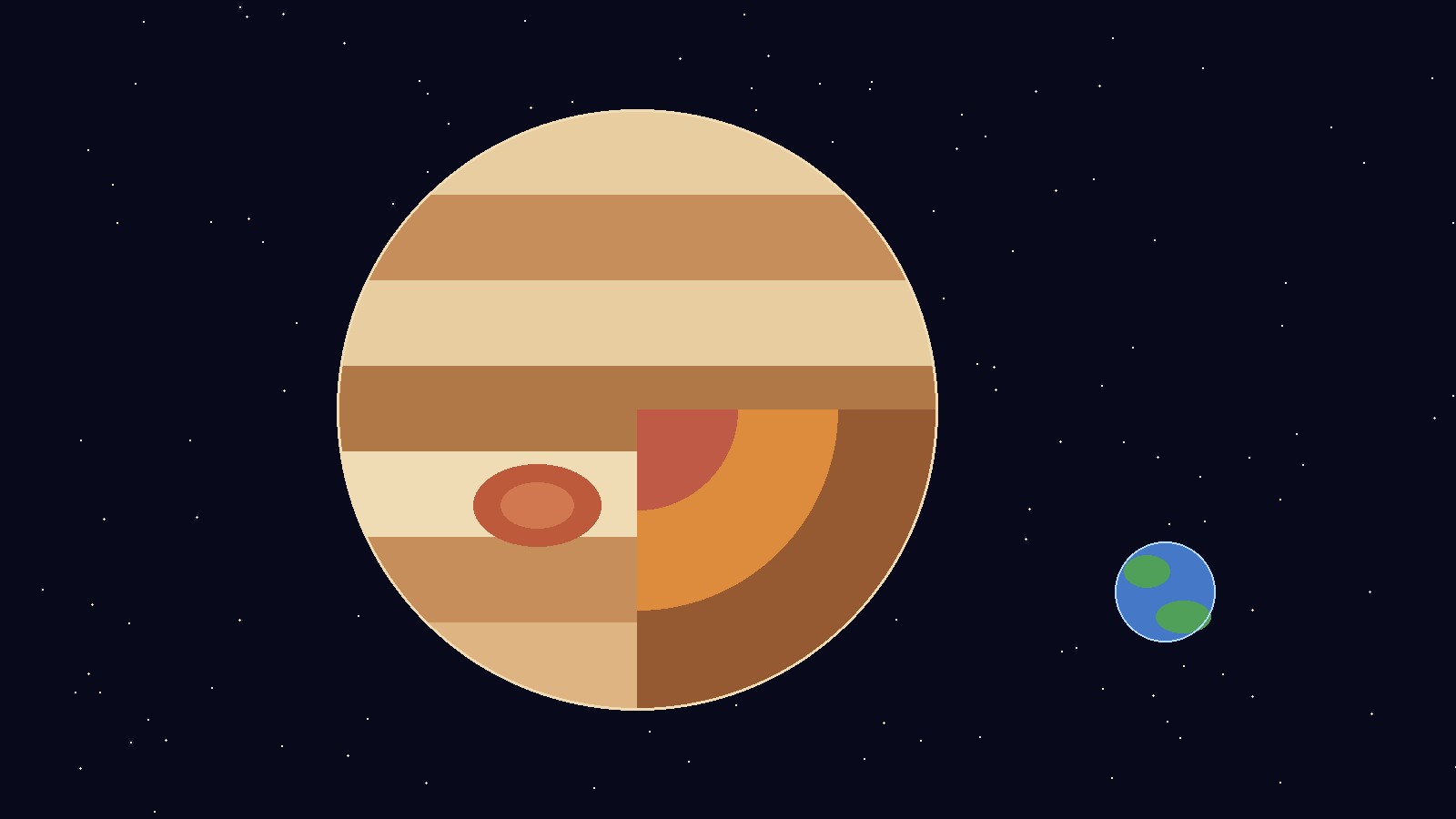
The table below is the whole article in miniature. Read it from the top down, from the part we can observe directly to the part we can only model. The percentages in the first row are rounded summaries for the upper atmosphere. The later rows describe states of matter and relative importance, not a second set of percentages that can be added to the first row, because the mix changes with depth.
| Layer, from top to center | What is there | How sure we are |
|---|---|---|
| Upper atmosphere and cloud tops | Mostly hydrogen and helium, with trace methane, ammonia, water vapor, hydrogen sulfide, and other gases | High for the two main gases; trace amounts vary with place and depth |
| Cloud layers | Ammonia ice at the top, ammonium hydrosulfide crystals in the middle, and water ice and vapor deeper down, all floating in hydrogen and helium | Moderate; NASA describes the layers as probable or likely |
| Molecular hydrogen region | Hydrogen gas gradually becoming liquid hydrogen, with helium mixed through it | High that the change is gradual, with no sharp surface |
| Metallic hydrogen region | Hydrogen squeezed until electrons move freely, so it conducts electricity like a metal; helium may separate out as droplets, called helium rain | High that a conducting region exists; helium separation details are modeled |
| Dilute core | Heavier elements mixed through hydrogen and helium over a wide central region, with no sharp boundary | Moderate; Juno gravity data favor a spread out core, but size and mix are model dependent |
That layered picture replaces the older textbook picture of gas on top, liquid in the middle, and a small solid rock at the center. The boundaries blur, the core spreads, and the atmosphere has no surface at all.
No surface, and why that matters
Jupiter has no solid surface to stand on, and that fact shapes every statement about what it is made of. NASA states this plainly in its Jupiter facts page, updated in October 2026: as a gas giant, Jupiter does not have a true surface, and the planet is mostly swirling gases and liquids. A spacecraft falling into Jupiter would not hit ground. It would sink through gas that grows denser and hotter, then through liquid, until pressure and temperature destroyed it. NASA puts it in those terms, warning that extreme pressures and temperatures deep inside crush, melt, and vaporize a spacecraft trying to fly into the planet.
Because there is no surface, astronomers use a pressure level as a reference point instead. The level where pressure reaches 1 bar, about the pressure at sea level on Earth, is often used as the nominal top of the planet for measuring size and comparing layers. Above it, the atmosphere thins into space. Below it, the same hydrogen and helium grow denser. There is no moment when gas stops and something else begins.
This matters for the common question of whether Jupiter is a failed star. NASA, in its student level explanation updated in March 2025, says Jupiter is made of the same things that stars are made of, and would have become a star if it were about 80 times bigger. The point is about mass and the temperature and pressure at the center, not about a missing ingredient. Jupiter has the right ingredients for a star, hydrogen above all, but far too little of them packed together to start the sustained hydrogen fusion that powers a star like the Sun. It radiates more heat than it receives from the Sun, NASA notes, because it is still contracting and releasing heat from its formation, but that internal heat is not starlight from fusion. It is leftover formation heat, still leaking out after about 4.6 billion years.
The outer atmosphere: hydrogen, helium, and traces
The best measured part of Jupiter is its outer atmosphere. NASA summarizes it in one sentence: the composition of Jupiter is similar to that of the Sun, mostly hydrogen and helium. The clouds we see are a thin decoration on top of that hydrogen and helium atmosphere, not the main ingredient. For detail about what those clouds look like, and why they show bands, see the companion article on the color of Jupiter. This article stays with composition, and mentions clouds only where their makeup helps explain the mix at each depth.
By molecules, the standard rounded summary for the upper atmosphere is about 90 percent hydrogen and about 10 percent helium, with everything else together a fraction of a percent inside the rounding of those two figures. That rounding is useful, but it hides real variation, so it helps to look at what a spacecraft measured. The Galileo probe, which dropped into Jupiter’s atmosphere in December 1995, carried a mass spectrometer that measured the mix from about 0.5 bar to about 21 bar of pressure. Its published result, in a 1996 Science paper, gave a helium to molecular hydrogen ratio of 0.156, close to the solar ratio. For every 100 hydrogen molecules, there were about 16 helium atoms in the sampled air. That ratio is not itself a percentage, and converting it to percentages depends on whether you count molecules, atoms, or mass, which is why different summaries round to slightly different figures.
The trace gases are where the chemistry gets interesting, though they are tiny by amount. The Galileo measurements and later work found methane, ammonia, water vapor, hydrogen sulfide, and other compounds, including noble gases such as argon, krypton, and xenon. A NASA technical summary of the Galileo probe results, published in 2003, reports that carbon, nitrogen, sulfur, argon, krypton, and xenon were all found at global abundances about 3 times their respective solar abundances. Relative to hydrogen, Jupiter carries about three times as much of those elements as the Sun does. That enrichment is a clue to formation, and it is one reason scientists do not call Jupiter a small Sun. It started with Sun like material, then added extra heavier material.
Two trace findings need care. Neon was found highly depleted, not enriched, which the NASA summary explains as neon being carried down with helium as helium settles inward. The Galileo probe did not give a global water abundance, because it entered an unusually dry hot spot where descending air had dried out condensable gases, and water was still increasing with depth when the probe stopped sending data. Quoting a Galileo water figure as Jupiter’s global figure would repeat local weather, not planetary composition.
The cloud layers and the hydrogen ocean
Beneath the thin upper haze, NASA describes three likely cloud layers, together spanning about 44 miles, or 71 kilometers. That total thickness sounds large, but it is a thin skin on a planet about 87,000 miles across on average, from NASA’s 2026 mean radius figure. The layers, from top to bottom, are probably ammonia ice, then ammonium hydrosulfide crystals, then water ice and vapor. NASA words each layer cautiously, as probably or likely, and this article keeps that caution.
Each layer forms where temperature and pressure let a particular compound condense. Below the water cloud level, water exists as vapor mixed through hydrogen and helium. Storms and updrafts move material up and down, so the mix at any one height changes with the weather, which is part of why Juno found latitude variation in water and ammonia deep below the cloud tops.
Go deeper, and the story stops being about clouds and starts being about pressure. NASA’s Jupiter facts page describes the change: deep in the atmosphere, pressure and temperature increase, compressing the hydrogen gas into a liquid. NASA calls the result the largest ocean in the solar system, an ocean made of hydrogen instead of water. This is not an ocean with a surface you could sail on. It is a region where hydrogen, squeezed by the weight of everything above it, stops behaving like a thin gas and starts behaving like a dense fluid, without ever crossing a sharp boundary.
An older NASA graphic, dated October 2003, makes the same point: beneath the cloud layers, the clear atmosphere slowly transforms from gas to liquid without a sharp boundary. On Jupiter, hydrogen is already far above its critical point in the deep atmosphere, so gas and liquid are one fluid that grows denser with depth, not two phases divided by a line.
Helium stays mixed through much of this region, but not necessarily evenly. Models propose that helium can separate out and fall as droplets, the helium rain in the table above. NASA’s 2021 interior graphic notes that most models include metallic hydrogen stabilized by exsolution of helium at the top of the metallic hydrogen region. That modeled process may help explain why neon is depleted in the outer atmosphere.
Metallic hydrogen: the conducting heart
Deeper still, perhaps about halfway to the planet’s center in NASA’s rounded description, pressure becomes so great that electrons are squeezed off the hydrogen atoms, making the liquid electrically conducting like metal. That is metallic hydrogen: not a metal made of iron or nickel, but hydrogen itself behaving like a metal because its electrons are no longer bound to individual atoms and can move freely through the fluid.
The 2003 NASA graphic puts the metallic hydrogen layer at a pressure of about 3 million bars. That figure is an older model estimate, and modern models give a range rather than a single pressure, because the transition depends on temperature as well as pressure and on how much helium and heavier material is mixed in. The article therefore treats 3 million bars as a historical order of magnitude, useful for scale, not as a current precise boundary. Three million times Earth’s sea level pressure is difficult to picture, but it conveys the essential point: this is matter under conditions no laboratory on Earth can sustain for long, and its behavior must be inferred from shock experiments, theory, and the planet’s own gravity and magnetic signals.
Metallic hydrogen matters because it is thought to generate Jupiter’s magnetic field. NASA’s facts page says Jupiter’s fast rotation drives electrical currents in this conducting region, acting like a dynamo. The Juno interior page puts it similarly: the churning conducting fluid is likely the engine behind Jupiter’s magnetic field, the largest and strongest in the solar system, except for the Sun’s. NASA gives the field strength as 16 to 54 times as powerful as Earth’s, depending on where it is measured.
The dilute core: what Juno changed
The center of Jupiter is where Juno changed the story most. Before Juno, the leading picture was a small, solid core of heavier elements, ice, rock, and metal, formed from debris in the early solar system, surrounded by mostly hydrogen and helium. NASA’s facts page still describes that older picture as the starting point, noting that scientists theorized a mostly homogeneous mix of hydrogen and helium gases surrounding a small, solid core of heavier elements. Juno’s gravity and magnetic measurements then suggested something different: the core is much larger than expected, and not solid. Instead, NASA says, it is partially dissolved, with no clear separation from the metallic hydrogen around it, leading researchers to describe the core as dilute, or fuzzy.
What does dilute mean? It means heavier elements are spread through a wide central region, mixed with hydrogen and helium, rather than concentrated in a compact ball with a sharp edge. A review of Juno era models notes that this fuzzy or diluted core could extend to a few tens of percent of Jupiter’s total radius, and that updated models fitting Juno data include a deep metallic envelope enriched in heavy elements compared with the upper molecular envelope. The center is not a pit of rock with hydrogen poured on top. It is a gradient, with the proportion of heavier elements rising gradually toward the center, over a large volume.
How much heavier material is there in total? That is still model dependent. Older estimates often put a compact core at about 10 to 20 times Earth’s mass. Juno era models that spread the heavy material out can hold a similar total, or a larger total, depending on where the model draws the core boundary. Because the boundary is fuzzy, the total depends on the definition, so readers should be wary of any article that gives a single core mass to one decimal place without stating its definition.
Why is the core dilute? Two explanations are debated. One is gradual: as Jupiter grew, it pulled in gas and solid material over a long period, and the heavy material never fully settled, or was stirred by convection. The other is dramatic: a giant impact early in Jupiter’s history, with an incoming body perhaps about 10 times Earth’s mass, shattered an early compact core. A 2025 study argued against the impact explanation, favoring gradual growth, but that debate is not settled by one paper, so this article presents both ideas as hypotheses.
Heavy elements and water: the formation clues
Astronomers use the phrase heavy elements for everything heavier than hydrogen and helium, including carbon, nitrogen, oxygen, sulfur, and the noble gases, as well as rock and metal forming elements. On Jupiter, heavy elements are a small fraction of the total by mass, but they carry most of the formation history. Hydrogen and helium were abundant everywhere in the early solar system. Heavy elements had to be delivered, by gas that already contained them, or by solid bodies that fell into the growing planet. Measuring how enriched Jupiter is in each heavy element, compared with the Sun, therefore tests how Jupiter formed.
Water, through its oxygen, is the most important heavy element test, and the hardest to measure, because water condenses, varies with weather, and was sampled by Galileo in a dry spot. Juno’s first equatorial water result, published in Nature Astronomy in 2020 and summarized by the Juno team in December 2020, changed the picture. Juno’s microwave radiometer, probing pressures from about 0.7 bar to about 30 bar in the equatorial region from 0 degrees to 4 degrees north latitude, inferred a water abundance of about 2.7 times solar, with a wide uncertainty range from about 1.0 times to about 5.1 times solar at one standard deviation. The Juno team summarized the headline as about 2.7 times solar at the equator, and stressed that the equatorial region was chosen because it appeared uniquely well mixed, and that the global water abundance may differ, because Juno found the deep atmosphere surprisingly variable with latitude. That is a careful result, and this article keeps its limits attached to it: equatorial, not yet proven global, with a wide range.
Several elements point to enrichment of about 2 to 4 times solar in the sampled atmosphere, water at the equator points to about 2.7 times solar with a wide range, and neon points to a removal process at depth. The deep interior may be more enriched than the outer atmosphere, but how much more is what Juno gravity models are still trying to pin down.
Comparisons, evidence, and what Jupiter is not
Comparisons help if they compare like with like. The Sun is dominated by hydrogen and helium, but it is a star, massive enough for sustained hydrogen fusion, while Jupiter is not. Saturn is mostly hydrogen and helium, but its mass, density, and enrichment pattern differ, so Jupiter’s rounded figures should not be copied onto Saturn, Uranus, or Neptune unchanged. Earth kept almost no primordial hydrogen and helium, because its gravity was too weak to hold such light gases, while Jupiter’s mass, about 318 times Earth’s in round terms, held them easily.
No one has drilled into Jupiter, so the story rests on four kinds of evidence. Remote sensing gives spectra for the upper atmosphere but cannot see the deep interior. The Galileo probe in 1995 gave direct composition down to about 21 bar, but only at one place and time, in a dry hot spot. Juno gravity and magnetic measurements since 2016 constrain the whole planet, but indirectly, so results come as families of models with ranges. Laboratory work on hydrogen under pressure gives the equations of state those models need, with their own uncertainties.
Three misconceptions are worth clearing up. Jupiter is not mostly rock with a gas coating; rock and metal forming elements are a minority by mass, spread toward the center. Jupiter has no water ocean in the Earth sense; its great fluid ocean is hydrogen, and water is present as vapor and as ice in clouds. Its rings, discovered by Voyager 1 in 1979 and made mostly of tiny dust particles, and its moons, are not part of Jupiter’s bulk composition.
Three uncertainties remain open, and none undermines the headline answer. The global water abundance is not yet proven, because Juno’s result is equatorial with a wide range. The dilute core’s size, total heavy element mass, and origin are definition dependent and debated. Helium rain is modeled, not observed directly.
Frequently asked questions
Is Jupiter made of gas or liquid?
Both, depending on depth. Near the top it is gas. Deeper down, pressure squeezes the same hydrogen into a dense fluid that behaves like a liquid, and deeper still into metallic hydrogen that conducts electricity. There is no sharp surface where gas stops and liquid starts.
What percentage of Jupiter is hydrogen?
It depends on how you count and where you sample. Rounded figures for the upper atmosphere put hydrogen at about 90 percent and helium at about 10 percent by molecules, with traces a fraction of a percent inside the rounding of those figures. By mass for the whole planet, hydrogen is roughly three quarters and helium roughly one quarter, before allowing a few percent for heavy elements, so the two rounded figures together account for nearly all the mass, in model dependent amounts. Galileo measured a helium to molecular hydrogen ratio of 0.156 in the sampled layer, which is why careful sources give ratios and ranges, not one universal percentage.
Does Jupiter have a solid core?
Probably not a small, solid, sharply bounded core in the old textbook sense. Juno gravity data favor a dilute, or fuzzy, core: heavier elements spread through a wide central region and mixed with hydrogen and helium, with no clear separation from the metallic hydrogen around it. Older estimates of a compact core at about 10 to 20 times Earth’s mass are still quoted as a historical comparison, but Juno era models spread that material out, so the total depends on how the core region is defined.
Is Jupiter made of the same stuff as the Sun?
Mostly, but not exactly. Both are dominated by hydrogen and helium. Jupiter’s sampled atmosphere is enriched in several heavy elements to about 3 times solar abundance relative to hydrogen, according to the Galileo results, and its equatorial water points to about 2.7 times solar with a wide range. Jupiter therefore started with Sun like material and added extra heavier material.
Why is Jupiter not a star if it is made of hydrogen and helium?
Because it is far too small. NASA’s student level explanation says Jupiter would have become a star if it were about 80 times bigger, meaning about 80 times its present mass. At its actual mass, the center never gets hot and dense enough for sustained hydrogen fusion, and its excess heat comes from contraction and leftover formation heat, not fusion.
How much water is on Jupiter?
Water is present as vapor and as ice in clouds. Its best measurement is Juno’s equatorial result, about 2.7 times solar, with a range from about 1.0 to about 5.1 times solar. That is an equatorial result, not yet a proven global value, because Juno found that water varies with latitude in the deep atmosphere. The earlier Galileo probe sampled a dry hot spot, so its lower local value should not be quoted as the planet’s water abundance.
What are the clouds on Jupiter made of?
In composition terms, the likely cloud layers from top to bottom are ammonia ice, ammonium hydrosulfide crystals, and water ice and vapor, all floating in a hydrogen and helium atmosphere, together spanning about 44 miles, or 71 kilometers, according to NASA. The clouds are a thin skin on the planet. For what gives those clouds their bands and colors, see the companion article on the color of Jupiter.
Could a spacecraft land on Jupiter?
No, because there is no solid surface to land on. A spacecraft would sink through gas into denser fluid, with pressure and temperature rising until it was crushed, melted, and vaporized, in NASA’s description. Galileo sampled the upper atmosphere for a limited time, and Juno stays in orbit, for the same reason.
Sources & references
- NASA Science, Jupiter Facts. https://science.nasa.gov/jupiter/facts/
- NASA, What Is Jupiter? (Grades K-4). https://www.nasa.gov/solar-system/what-is-jupiter-grades-k-4/
- Mission Juno, Southwest Research Institute, The Interior. https://www.missionjuno.swri.edu/jupiter?show=hs_jupiter_story_the-interior
- NASA Science, Jupiter Interior Graphic, PIA25062, 17 December 2021. https://science.nasa.gov/photojournal/jupiter-interior-graphic/
- NASA Science, Gas Giant Interiors: 2003. https://science.nasa.gov/resource/gas-giant-interiors-2003/
- Mission Juno, Southwest Research Institute, Juno Measures Deep Water Abundance at Jupiter's Equator, 3 December 2020. https://www.missionjuno.swri.edu/science-findings/juno-measures-deep-water-abundance-at-jupiters-equator
- NASA Technical Reports Server, The Galileo Probe: How it Has Changed Our Understanding of Jupiter, Richard E. Young, NASA Ames Research Center, publication date 1 January 2003. https://ntrs.nasa.gov/search.jsp?R=20030053065&hterms=Galileo&qs=Ntx%3Dmode%2Bmatchall%26Ntk%3DAll%26N%3D0%26No%3D30%26Ntt%3DGalileo
- Niemann, H. B., et al., The Galileo Probe Mass Spectrometer: Composition of Jupiter's Atmosphere, Science, 10 May 1996, volume 272, pages 846 to 849. The helium to molecular hydrogen ratio of 0.156 is from the paper abstract, opened directly at the DOI address above. https://www.science.org/doi/10.1126/science.272.5263.846
- Li, Cheng, et al., The water abundance in Jupiter's equatorial zone, Nature Astronomy, February 2020. DOI: 10.1038/s41550-020-1009-3. Equatorial water 2.7 -1.7 +2.4 times solar, 0 to 4 degrees north latitude, about 0.7 to 30 bar.
- Helled, Ravit, and David J. Stevenson, The fuzzy cores of Jupiter and Saturn, arXiv:2403.11657. Fuzzy/diluted core extending to a few tens of percent of Jupiter's total radius; deep metallic envelope enriched in heavy elements compared with the upper molecular envelope.
- Sandnes, T. D., et al., No dilute core produced in simulations of giant impacts on to Jupiter, Monthly Notices of the Royal Astronomical Society, September 2025. DOI: 10.1093/mnras/staf1105. Giant-impact simulations produce no stable dilute core; formation/evolution explanation favored; debate presented in the article as not settled by one paper.


