Short answer
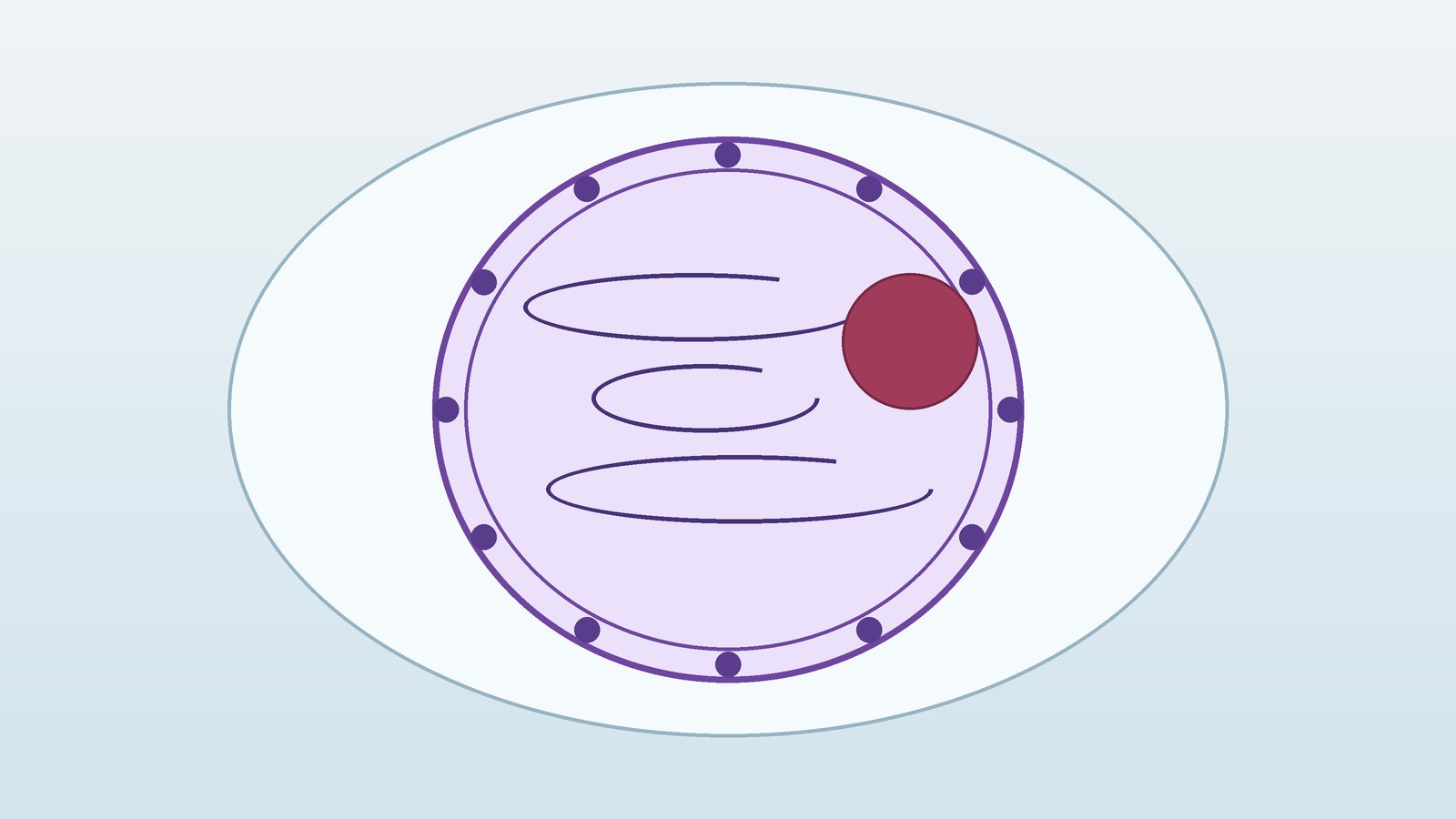
- The nucleus is the membrane bound organelle in a eukaryotic cell that holds most of the cell DNA and controls cell activity by regulating which genes are used. The DNA inside it carries the instructions for making proteins, and proteins carry out most of the work of the cell, from building structures to speeding up chemical reactions. The nucleus is separated from the rest of the cell by a double membrane called the nuclear envelope. Openings in that envelope, called nuclear pores, control what moves in and out. Inside are chromatin, which is DNA packaged with proteins, and the nucleolus, where ribosome parts are made. The nucleus does not make finished proteins itself. It copies selected genes into messenger RNA, and that RNA leaves the nucleus so ribosomes in the cytoplasm can read it and build the protein. Only eukaryotic cells have a true nucleus. Bacteria and other prokaryotic cells do not. Their DNA sits in a region of the cytoplasm instead, without a surrounding membrane. That contrast is one of the defining features of a eukaryotic cell.
What the Nucleus Is, in One Definition
In cell biology, the nucleus is a membrane enclosed organelle found in eukaryotic cells. Eukaryotic cells include animal cells, plant cells, fungal cells, and many single celled organisms such as yeasts and some algae. The nucleus contains nearly all of the cell genome, meaning nearly all of its DNA. A small amount of DNA can also sit outside it, in mitochondria and, in plant cells, in chloroplasts. Its main job is to protect DNA, keep its instructions intact, and control cell activity by regulating gene expression, the process by which a gene is switched on and used to make a functional product, usually a protein.
The word nucleus comes from Latin and means kernel or seed. Under a microscope, the nucleus often looks like a dark, round kernel inside the cell. It helps to separate three ideas. First, the nucleus is a structure, a compartment with a boundary and contents. Second, it is a store of information, because its DNA encodes genes. Third, it is a control point, because which genes are copied, when, and how much, shapes what the cell does. A definition that mentions only storage misses the control role. One that calls the nucleus the brain of the cell overstates it, since the nucleus has no awareness or plan and responds to signals through chemistry.
Why “Control Center” Needs Care
Textbooks commonly call the nucleus the control center of the cell, and the phrase works as a starting point. It captures the fact that instructions for cell products come from nuclear DNA, and that changing which genes are expressed changes cell behavior. A skin cell and a liver cell in the same human body carry the same DNA, yet they look and behave differently. The difference comes largely from which genes each type uses, not from having different instruction books.
The phrase misleads if taken literally. The nucleus does not issue orders like a manager, and it does not do the cell work on its own. Ribosomes build proteins, mitochondria release usable energy, membranes move materials, and the cytoskeleton organizes the interior, all outside the nucleus. The nucleus also depends on the rest of the cell for proteins, energy, and signals from the cell surface. A better picture is a library with strict borrowing rules. The books stay inside, copies of selected pages leave through controlled exits, and readers outside use those copies to build products. If a page is never copied, its product is never made.
The Parts of the Nucleus at a Glance
| Part | Where it is | Main job |
|---|---|---|
| Nuclear envelope | Outer boundary of the nucleus | Separates nuclear contents from cytoplasm and controls exchange through pores |
| Nuclear pores | Openings that span the envelope | Let selected molecules pass in and out under regulation |
| Nuclear lamina | Protein mesh just inside the envelope | Gives shape and support and helps organize chromatin |
| Nucleoplasm | Fluid interior of the nucleus | Suspends chromatin and the nucleolus and hosts nuclear reactions |
| Chromatin | Throughout the nucleoplasm | Packages DNA with proteins so it can be stored, read, and divided |
| Chromosomes | Condensed form of chromatin during division | Allow DNA to be moved safely to daughter cells |
| Nucleolus | Dense region inside the nucleus | Makes ribosomal RNA and assembles ribosome subunits |
Each part depends on the others. Remove the envelope and DNA would mix freely with the cytoplasm. Remove the pores and no copied instruction could leave. Remove the packaging proteins and long DNA molecules could not fit or be read in an orderly way.
The Nuclear Envelope: a Double Boundary
The nuclear envelope is the double membrane that encloses the nucleus. It consists of two lipid bilayers, an outer membrane and an inner membrane, with a narrow fluid filled gap between them called the perinuclear space. A lipid bilayer is a double layer of lipid molecules, so the envelope has four lipid layers in total, two per membrane. The outer membrane is continuous with the endoplasmic reticulum, the membrane network extending through the cytoplasm, which shows that the envelope belongs to the cell membrane system rather than standing apart from it.
The envelope must both protect DNA and allow constant traffic, and it meets both needs through pores, covered next, and through its inner lining. That lining is a protein mesh called the nuclear lamina. It gives the nucleus mechanical support, helps it keep its shape, and anchors regions of chromatin. During most of the cell life cycle the envelope stays intact. During division in most animal and plant cells it breaks down so condensed chromosomes can be separated, then it reforms around each set in the daughter cells. It is a working boundary, not a wall.
Nuclear Pores: Controlled Gates, Not Open Holes
If the envelope were solid, the nucleus would be a sealed vault and useless. If it were open, there would be no separation at all. Nuclear pores solve the problem. A nuclear pore is a large protein complex spanning both membranes of the envelope, forming a channel between nucleus and cytoplasm. Protein complexes lining the pore regulate what passes. Small molecules and ions move relatively freely, but larger molecules, such as proteins and RNA, must be recognized and actively transported by carrier proteins.
Traffic moves both ways. Outward traffic includes messenger RNA copies of genes, transfer RNA, and newly made ribosomal subunits, all headed for the cytoplasm. Inward traffic includes proteins that work inside the nucleus, such as enzymes that copy DNA and RNA, histone proteins that package DNA, and building blocks for new DNA and RNA. Selectivity protects the genome in a practical way. Keeping DNA inside while letting copies leave means the original instructions avoid the full chemistry of the cytoplasm, and a damaged copy can be discarded without damaging the original. It also lets the cell respond quickly by copying a needed gene rather than rebuilding its instruction store.
Nucleoplasm and the Nuclear Lamina
Inside the envelope is the nucleoplasm, sometimes called nuclear sap or karyolymph. It is the gel like fluid filling the nucleus, suspending chromatin and the nucleolus, and containing dissolved building blocks, enzymes, and other molecules needed for nuclear work. It is not empty filler. Copying DNA into RNA and the early steps of ribosome assembly take place in this interior, and chromatin moves and reorganizes within it as genes are switched on or off.
The nuclear lamina connects structure to function. This mesh of protein filaments lines the inner membrane and binds to chromatin and other nuclear components. It helps the nucleus resist deformation and helps organize which chromatin regions sit near the edge. Regions near the lamina are often less active, while interior regions are often more active, though the pattern is not a simple rule. Some descriptions also mention a broader nuclear matrix or nucleoskeleton. Sources differ on how to define that network, so this article treats the lamina as the well established structural mesh and does not present a separate matrix as a distinct labeled part.
Chromatin: How Long DNA Fits in a Tiny Space
The packaging problem is extreme. The National Human Genome Research Institute notes that if the DNA in a single human cell were unwound, it would stretch about 6 feet long. Florida State University Molecular Expressions gives a closely matching figure of nearly 6 feet of DNA packed into the nucleus of every human cell, divided into 46 individual molecules, one per chromosome. The small wording difference reflects rounding rather than disagreement, and this article uses about 6 feet as the working figure.
DNA does not sit in the nucleus as a loose ball of string. It is combined with proteins and organized into chromatin, a dense, string like fiber. The basic unit is the nucleosome, in which a length of DNA wraps around a set of histone proteins, like thread around a spool. A chain of nucleosomes looks like beads on a string, and further folding compacts that chain into the chromatin fiber, then into chromosomes. Two forms are commonly distinguished. Euchromatin is relatively loose and accessible and tends to hold genes in use or ready for use. Heterochromatin is more tightly packed, less accessible, and tends to hold switched off genes and structural regions. Packaging is therefore part of regulation, since a tightly packed gene is hard to copy and a loosened gene is available.
Chromosomes: DNA Packed for the Move
When a cell is about to divide, its chromatin condenses into chromosomes. A chromosome is the condensed, organized form of a DNA molecule with its associated proteins. Condensation shortens and thickens the material so each DNA molecule can move as a discrete package to a daughter cell without tangling. During division, chromosomes become visible as distinct bodies, which is why classic cell images show them only at that stage. Between divisions, the same material is present as chromatin, too spread out to see as separate chromosomes.
Human body cells normally contain 46 chromosomes, arranged as 23 pairs, one of each pair from each parent. Germ cells, the sperm and egg cells, contain 23 single chromosomes, so fertilization restores the number to 46. That count applies to humans and must not be generalized, since other species have different numbers and the number says nothing about complexity. OpenStax Anatomy and Physiology 2e estimates that humans have almost 22,000 genes distributed on 46 chromosomes. Gene counts are estimates, not exact tallies, because gene annotation changes as research improves, so this article reports that figure as a single authority estimate, not as a settled exact count. A chromosome is a package, a gene is a segment of DNA within it, and a genome is the complete set of DNA. Keeping those levels separate prevents many common errors.
The Nucleolus: the Ribosome Workshop
Inside the nucleus sits a dense region called the nucleolus, plural nucleoli. It has no membrane of its own. It is a region where particular DNA segments, proteins, and RNA gather to make ribosomal RNA and assemble ribosome subunits. Ribosomes are the machines that build proteins, so the nucleolus is best understood as the workshop that makes the protein building machines.
Genes encoding ribosomal RNA are copied inside the nucleolus. That RNA combines with proteins that entered the nucleus from the cytoplasm to form two ribosomal subunits, large and small. Those subunits leave through nuclear pores and join on a messenger RNA in the cytoplasm to form a complete, working ribosome. The nucleolus therefore does not finish ribosomes or make proteins. It makes the parts. Sources differ on how many nucleoli a nucleus typically contains, so this article states no single universal number. OpenStax describes one or more nucleoli. Florida State University Molecular Expressions states that a nucleus may contain up to four nucleoli and that the number within a species is fixed. The safe general statement is that the number varies by cell type and species, and cells making large amounts of protein tend to have prominent nucleoli. During division, the nucleolus disappears as chromosomes condense and reforms afterward.
From Gene to Protein: the Nucleus in Action
The flow from DNA to RNA to protein has three main stages, and the nucleus handles the first. First, transcription. Inside the nucleus, an enzyme called RNA polymerase copies a gene from DNA into messenger RNA. The DNA stays in the nucleus and only the copy leaves, carrying the same sequence information in RNA form, with the base uracil in place of thymine. Transcription is selective. Only a fraction of genes are copied at any time, depending on cell type, developmental stage, and signals. That selectivity is gene regulation in its simplest form.
Second, processing and export. In eukaryotic cells, the initial RNA copy is processed before it leaves, including steps that remove noncoding segments and add protective ends. The finished messenger RNA then passes through a nuclear pore into the cytoplasm, and transfer RNA and ribosomal RNA follow related routes. Third, translation. In the cytoplasm, a ribosome reads messenger RNA in groups of three bases, called codons. Each codon specifies an amino acid, and the ribosome links amino acids in order to build a protein chain, with transfer RNA bringing the correct amino acids. That flow explains why the nucleus is essential even though it builds no finished protein. Break transcription and no new messenger RNA appears. Block export and copies pile up inside. Damage the DNA and every copy carries the error.
What Happens to the Nucleus During Cell Division
Between divisions, the cell is in interphase and the nucleus is in reading mode: chromatin spread out, nucleolus visible, envelope intact, pores busy. Division changes that mode. First, the cell copies its DNA, so each chromosome consists of two identical sister copies joined together. Then chromatin condenses into visible chromosomes, the nuclear envelope breaks down, the nucleolus disperses, and condensed chromosomes separate to opposite sides of the cell. Finally, a new envelope reforms around each set, chromatin loosens, and a new nucleolus forms in each daughter nucleus.
That breakdown and reformation is the pattern in most animal and plant cells, known as open division. Some single celled eukaryotes divide with the envelope staying largely intact, called closed division. The purpose is the same in both: give each daughter cell a complete, undamaged copy of the genome. Errors matter here. If chromosomes fail to separate correctly, a daughter cell can gain or lose a chromosome. That kind of error underlies conditions such as Down syndrome, in which a person has an extra copy of chromosome 21. This article mentions that example only to show why faithful division matters and does not cover diagnosis, risk, or medical advice.
One Nucleus, Many Nuclei, or None
Most eukaryotic cells have a single nucleus, the default picture in diagrams. Real cells vary, and each variation has a reason. Some cells have many nuclei. Skeletal muscle fibers are the classic example. During development, many smaller cells fuse into one long fiber, and their nuclei are kept, so the mature fiber is multinucleated. OpenStax Anatomy and Physiology 2e describes that pattern directly. Bone breaking cells called osteoclasts also have many nuclei. Many nuclei in one large cell let it produce large amounts of RNA and protein across its length without waiting for copies to travel from a single center.
Some cells have no nucleus at maturity. Mature mammalian red blood cells are the best known example. OpenStax notes that their precursors eject their nuclei as they mature, making room for large numbers of hemoglobin molecules that carry oxygen. Without a nucleus, a red blood cell cannot make new proteins or divide, and its life span is short, so the body must constantly produce replacements. Plant sieve tube elements, which move sugars through phloem, also lose their nuclei at maturity and depend on neighboring companion cells. Losing a nucleus is a trade off, not a defect. The cell gains space or specialization and gives up self repair and division. Other variations include the lobed nucleus of a neutrophil, a type of white blood cell. Shape and number follow function.
Nucleus or Nucleoid: the Eukaryotic Difference
The nucleus defines eukaryotic cells. Prokaryotic cells, including bacteria and archaea, have no nucleus and no other membrane bound organelles. Their DNA sits in a region of the cytoplasm called the nucleoid. The nucleoid is not an organelle and has no membrane. It is a region where the DNA molecule is organized and compacted while remaining in direct contact with the cytoplasm.
That difference has wide consequences. In a prokaryotic cell, transcription and translation can happen at the same time and in the same compartment, since no barrier separates the DNA copy from the ribosome. In a eukaryotic cell, the envelope separates those steps in space and, through processing, in time, adding control points at chromatin state, transcription, processing, export, and translation. This article does not repeat the full comparison. That comparison, including cell size, organelles, and division, belongs to the companion article on prokaryotic versus eukaryotic cells. The narrow point here is the test: a membrane bound nucleus means eukaryotic, while DNA free in a nucleoid region means prokaryotic.
How the Nucleus Fits the Rest of the Cell
The nuclear envelope connects to the endoplasmic reticulum, and ribosomes on the rough endoplasmic reticulum are among the first readers of many exported messenger RNAs. The cytoplasm supplies the nucleus with proteins, building blocks, and signals. The cytoskeleton positions the nucleus and, during division, helps move chromosomes. Mitochondria supply much of the energy nuclear work consumes, and the cell membrane receives outside signals that eventually change gene expression inside the nucleus. Nuclear problems therefore have wide effects. A faulty envelope or lamina harms gene organization and transport, damaged DNA spreads errors to proteins, and failed division gives daughter cells the wrong genome.
For the wider map, the companion plant cell diagram article shows where the nucleus sits among the other plant cell parts, including the cell wall, chloroplasts, and large central vacuole. This article stays focused on the nucleus itself. A brief note on observation also helps readers. The nucleus is often the most prominent organelle in a stained cell because DNA binds strongly to many common dyes, appearing as a large, darkly stained oval with the nucleolus as an even darker spot inside. Light microscopy shows the nucleus, nucleolus, and condensed chromosomes during division, while electron microscopy reveals the double membrane, pores, lamina, and chromatin texture. No single image shows the whole nucleus, so a diagram combines findings from many methods.
Common Misunderstandings
First, the nucleus is not the whole cell. The cytoplasm, membranes, and other organelles sit outside it and do much of the work. Second, the nucleus does not make proteins. Ribosomes make proteins from messenger RNA copies that left the nucleus, while the nucleolus makes ribosome parts. Third, not every cell has a nucleus, and not every nucleus looks the same. Mature mammalian red blood cells have none, muscle fibers have many, and a plant cell nucleus is often pushed to the edge by a large central vacuole. Fourth, DNA is not a chromosome, and a chromosome is not a gene. DNA is the molecule, chromatin is DNA packaged with proteins, a chromosome is the condensed package seen during division, and a gene is a functional segment of DNA. Fifth, the nuclear envelope is not a single membrane and the pores are not holes. The envelope is double, and the pores are regulated protein gates. Sixth, the nucleolus is not a membrane bound organelle inside an organelle. It has no membrane of its own and is defined by what gathers there.
FAQ
What is the nucleus of a cell in simple terms?
The nucleus is the part of a eukaryotic cell that holds most of its DNA and controls the cell by deciding which genes are copied into messenger RNA. It is separated from the rest of the cell by the nuclear envelope, a double membrane with pores controlling traffic. It stores instructions and regulates their use, but it does not build finished proteins itself.
Is the nucleus the brain of the cell?
No, except as a loose metaphor. The comparison captures central instructions, but a nucleus has no awareness and no control over every cell process. Much work happens outside it, and it depends on the rest of the cell for proteins, energy, and signals. Control center is a better metaphor, and even that needs the limits explained above.
What is inside the nucleus?
Inside the nuclear envelope are nucleoplasm, chromatin, and the nucleolus. Chromatin is DNA packaged with histone proteins. The nucleolus is the dense region where ribosomal RNA is made and ribosome subunits are assembled. The inner membrane is lined by the nuclear lamina, and nuclear pores span the envelope and regulate transport.
Do all cells have a nucleus?
No. Only eukaryotic cells have a true nucleus. Prokaryotic cells, such as bacteria, have no nucleus, and their DNA sits in a nucleoid region without a membrane. Even among eukaryotes there are exceptions. Mature mammalian red blood cells have no nucleus, while skeletal muscle fibers have many. Most eukaryotic cells have one nucleus.
What is the difference between the nucleus and the nucleolus?
The nucleus is the whole membrane bound organelle that holds DNA. The nucleolus is a dense region inside it, with no membrane of its own, where ribosomal RNA is made and ribosome subunits are put together. Think of the nucleus as the library building and the nucleolus as a workshop inside it that makes the protein building machines.
What does the nuclear envelope do?
The nuclear envelope separates nuclear contents from the cytoplasm, protects DNA, and controls exchange through nuclear pores. It is a double membrane, with an outer membrane continuous with the endoplasmic reticulum and an inner membrane lined by the nuclear lamina. It breaks down during division in most animal and plant cells and reforms around each chromosome set in the daughter cells.
What is chromatin and how is it different from a chromosome?
Chromatin is DNA packaged with proteins in the working nucleus, spread through the nucleoplasm so genes can be read. A chromosome is the condensed form of that same material during division, packaged tightly so DNA can move safely to daughter cells. Chromatin is the reading form. A chromosome is the moving form.
Why does the nucleus need pores if it is supposed to protect DNA?
Protection without traffic would make the nucleus useless, because gene copies must reach the cytoplasm to be used. Nuclear pores act as regulated gates, letting messenger RNA, transfer RNA, and ribosomal subunits out and needed proteins and building blocks in, while keeping DNA itself inside. Selectivity, not sealing, is the protection strategy.
What happens to the nucleus when a cell divides?
The cell first copies its DNA. Chromatin condenses into chromosomes, the envelope breaks down in most animal and plant cells, and the nucleolus disperses. Chromosomes separate to opposite sides of the cell. A new envelope reforms around each set, chromatin loosens, and a new nucleolus forms in each daughter nucleus. The result is two nuclei, each with a complete copy of the genome.
Can a cell live without a nucleus?
Some specialized cells do, for a limited time. Mature mammalian red blood cells live without a nucleus, but they cannot divide or make new proteins, and they are replaced constantly. Most cells cannot live normally without a nucleus for long, because they need fresh messenger RNA to replace proteins as they wear out. A cell without a nucleus has a fixed protein supply and no way to respond to new instructions.
Sources & references
- Florida State University, Molecular Expressions, Cell Biology: The Cell Nucleus. A university microscopy and cell biology resource, maintained with the National High Magnetic Field Laboratory. Used for the definition, the envelope and pore description, the nucleoplasm and nucleolus description, and the DNA length figure. Page last modified 13 November 2015 as shown on the page.
- National Human Genome Research Institute, National Institutes of Health, Exploring Our Molecular Selves, online education transcript. Used for the 23 pairs of chromosomes in a human cell, the DNA length of about 6 feet in one cell, the statement that DNA stays inside the nucleus while messenger RNA travels out, and the role of ribosomes in reading messenger RNA to make protein.
- OpenStax Anatomy and Physiology 2e, Chapter 3.3, The Nucleus and DNA Replication, hosted by Oregon State University Open Educational Resources. Used for the nuclear envelope structure, the nucleolus and nucleoplasm, chromatin and histones, the estimate of almost 22,000 genes on 46 chromosomes, the multinucleated skeletal muscle fiber example, and the mature red blood cell example.


