Short answer
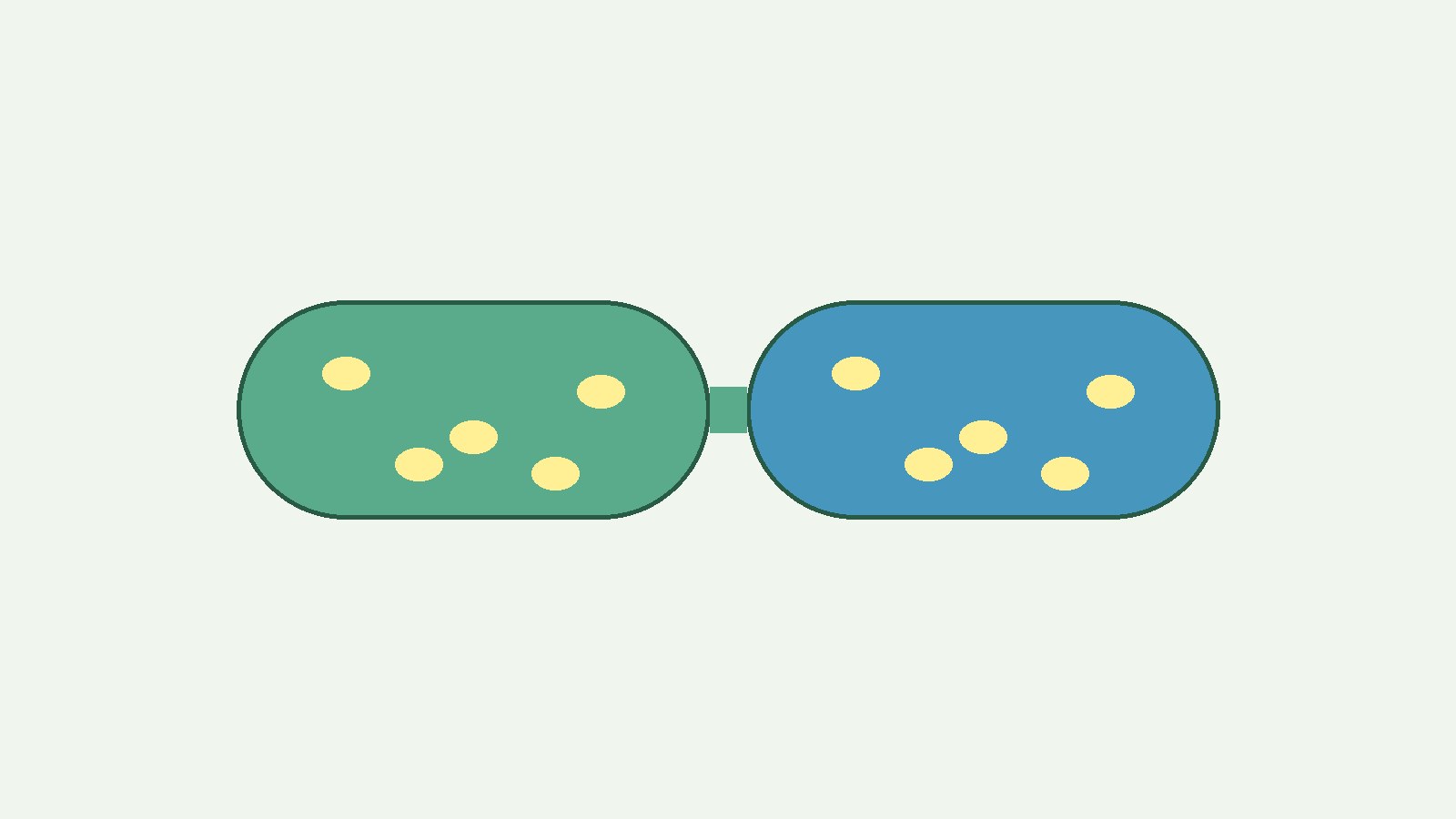
- Binary fission is a form of asexual reproduction in which a single parent cell copies its genetic material and then divides into two daughter cells. Each daughter cell normally receives one complete copy of the genetic material, so the two daughters are genetically identical to the parent cell and to each other, apart from any copying errors or later changes. Binary fission is the main way that prokaryotes reproduce. Prokaryotes are organisms whose cells have no nucleus, and the group includes bacteria and archaea. Some single-celled eukaryotes, organisms whose cells do have a nucleus, also divide by a process called binary fission, although the details inside the cell are different. Binary fission is not the same as mitosis. Mitosis is the division of a nucleus in a eukaryotic cell and is part of a larger and more complex cell division process. Binary fission is simpler, because a prokaryotic cell has no nucleus to divide and no spindle apparatus to organize. The basic sequence is worth learning exactly. First the cell copies its DNA. Then the cell grows and the two DNA copies move toward opposite ends of the cell. Next, a ring of protein marks the future division site and a dividing wall, called a septum, grows inward. Finally the septum is completed and the two daughter cells separate. Each daughter cell can then grow and divide again, which is why bacterial populations can increase so quickly when conditions are favorable.
What the name means
“Binary” means two, and “fission” means splitting. Binary fission is therefore splitting into two. That already separates it from several lookalike processes. In multiple fission, one parent cell produces many daughter cells at once rather than two. In budding, a small outgrowth grows on the parent and later separates, so the parent and the offspring are not equal halves. In fragmentation, a body breaks into pieces and each piece grows into a new individual. Only binary fission has the pattern of one cell becoming two roughly equal daughter cells in a single division event.
The word “binary” also explains the mathematics of bacterial growth. One cell becomes two, two become four, four become eight, and so on. After n rounds of division, one starting cell has produced 2 to the power n cells, provided every cell keeps dividing and none is lost. That simple doubling rule is why a small number of bacteria can become a very large population in a short time, and it is also why the rule must always be stated with its assumptions attached. Real populations run out of food, accumulate waste, and lose cells, so they do not double forever.
Who reproduces by binary fission
Bacteria are the classic example. When a textbook says that bacteria reproduce by binary fission, it means that the bacterial cell itself is the reproducing individual: the cell copies its chromosome, divides, and the two resulting cells are two bacteria. Archaea, the other major group of prokaryotes, also reproduce by binary fission, although some archaeal species use variations of the basic pattern, with division machinery that differs in detail from the bacterial version.
Some single-celled eukaryotes also reproduce by binary fission. The best known examples are Amoeba, Paramecium, and Euglena. In these organisms the whole single-celled body divides into two daughter organisms. That distinction matters. In a multicellular animal or plant, cell division produces new cells inside a body that stays one individual. In a single-celled organism, cell division produces two individuals.
Binary fission is not how multicellular organisms reproduce as whole organisms. Animals and plants reproduce through specialized reproductive cells and structures, not by splitting the adult body in half. It is also not the process that produces new cells in your body. When a skin cell or a liver cell divides, it uses mitosis.
Binary fission in bacteria, step by step
Bacterial binary fission is usually taught as a sequence of steps. The steps overlap in real cells, so the sequence below is a teaching model rather than a set of isolated events that start and stop in turn.
Step 1: DNA replication begins. Most bacteria carry a single, circular chromosome, a loop of DNA that sits in a region of the cytoplasm called the nucleoid. Bacteria have no nucleus, so the chromosome is not enclosed in a membrane bound compartment. Replication starts at a specific place on the loop called the origin of replication. From the origin, copying proceeds in both directions around the loop at the same time, a pattern called bidirectional replication.
Step 2: The cell grows and the chromosome copies separate. As replication proceeds, the cell elongates, growing longer so that there is room for two complete sets of genetic material. The two chromosome copies become organized toward opposite ends of the elongating cell. Textbooks describe this separation in general terms, and the molecular details differ between species. The key outcome is what matters: by the time division finishes, each end of the cell holds one chromosome copy.
Step 3: The division site is organized. A protein called FtsZ assembles into a ring at the future division site, usually near the middle of the cell. This structure is called the Z ring. The Z ring does not work alone. It recruits other division proteins, and together they form the division machinery known as the divisome. Do not confuse the Z ring with the spindle of mitosis. The spindle is a structure of microtubules that separates chromosomes in eukaryotic cells. The Z ring marks where the cell will divide and helps organize the building of the septum. It does not pull chromosomes apart in the way spindle fibers do.
Step 4: A septum forms. The cell membrane grows inward at the division site, and new cell wall material is built alongside it. In bacteria with a peptidoglycan cell wall, enzymes synthesize and remodel that wall material as the septum grows from the periphery of the cell toward the center. The septum divides the elongated cell into two compartments, each containing one chromosome copy and a share of the cytoplasm, ribosomes, and other cell contents.
Step 5: The daughter cells separate. When the septum is complete and the new cell walls are in place, the two compartments become two independent cells. In many species the daughters separate fully. In some species or under some growth conditions, daughter cells stay attached after division and form pairs or chains, even though each cell is a separate individual cell.
A short summary is worth memorizing: copy the chromosome, elongate and separate the copies, mark the middle with the Z ring, build the septum inward, and separate. If a description omits the copying step, it is incomplete, because division without copying would leave one daughter cell without genetic material. If it omits the septum step, it is also incomplete, because something must physically partition the cell into two.
Types of binary fission in single-celled eukaryotes
In single-celled eukaryotes, binary fission is classified by the plane of division, meaning the direction in which the cell body is cut into two. Four types are recognized in standard teaching.
Irregular binary fission has no fixed plane of division. The cell divides in any plane, typically perpendicular to the plane in which the nucleus divided. Amoeba is the standard example. Amoeba has no fixed shape, since it changes shape as it moves with temporary projections of cytoplasm called pseudopodia. The nucleus divides first and the cytoplasm follows, producing two daughter amoebae.
Transverse binary fission cuts across the long axis of the body. Paramecium is the standard example. Paramecium is a ciliated protozoan, covered in tiny hairlike structures called cilia, and its division plane runs across its body, producing a front half and a back half that each become a new individual.
Longitudinal binary fission cuts along the long axis of the body. Euglena is the standard example. Euglena is a flagellated organism, meaning it moves with a whiplike flagellum, and division begins at the front end of the cell and proceeds along its length, so each daughter receives part of the original structures.
Oblique binary fission cuts at an angle to the body axes, neither straight across nor straight along the body. Ceratium, a dinoflagellate, is the standard textbook example. Oblique fission is the least commonly met type in introductory courses, but it completes the classification and shows that the plane of division is a real variable, not a decorative detail.
Two cautions apply. First, the plane of division describes the geometry of the split, not a different molecular mechanism. A transverse split and a longitudinal split are both binary fission. Second, the examples are teaching examples, not claims that every member of a group divides in exactly the same way.
Binary fission compared with mitosis
Binary fission and mitosis are often confused because both end with two cells that carry the same genetic information as the starting cell. The comparison below keeps them distinct.
| Feature | Binary fission | Mitosis |
|---|---|---|
| Cell type | Mainly prokaryotic cells, plus division of some single-celled eukaryotes as whole organisms | Eukaryotic cells, as part of cell division in single-celled and multicellular eukaryotes |
| Nucleus | No nucleus in prokaryotes; the chromosome sits in the nucleoid | A nucleus is present, and its division is what mitosis means |
| Chromosomes | Usually one circular chromosome in bacteria, plus any plasmids | Multiple linear chromosomes packaged with histone proteins |
| Spindle | No spindle; the Z ring organizes the division site | A spindle of microtubules separates the chromosomes |
| Stages | Copy DNA, elongate, form septum, separate | Prophase, metaphase, anaphase, and telophase, followed by division of the cytoplasm |
| Outcome in a single-celled organism | Two new individual organisms | Two cells, which in a multicellular organism remain part of one individual |
| Complexity and speed | Simpler and generally faster | More complex, with more checkpoints and structures |
The most important row is the first one. Mitosis is defined by the nucleus. A bacterium has no nucleus, so it cannot undergo mitosis. Saying that bacteria divide by mitosis is therefore not a harmless simplification. It is wrong, because it assigns a nucleus and a spindle to a cell that has neither. Similarly, saying that binary fission is “just simple mitosis” hides the real differences in chromosome structure, division machinery, and cellular organization.
There is one overlap that causes genuine confusion and should be stated plainly. In single-celled eukaryotes such as Amoeba, the nucleus divides as part of reproduction, and school level descriptions sometimes describe that nuclear division as mitosis. That does not make bacterial binary fission the same as mitosis. When a question asks about bacteria, the answer is binary fission, not mitosis. When a question asks about the division of a nucleus in a eukaryotic cell, the answer is mitosis.
Binary fission compared with other forms of asexual reproduction
Asexual reproduction means reproduction from a single parent without the fusion of gametes. Binary fission is one form of it, but not the only form, and the distinctions are testable.
In budding, a new individual grows as a small outgrowth, or bud, on the parent. The bud enlarges and eventually separates. Yeast and Hydra are standard examples. The parent and the offspring are not equal halves at the start, which is the key difference from binary fission.
In multiple fission, one parent cell divides into many daughter cells at the same time, rather than two. The malarial parasite Plasmodium is the standard example, since it produces many offspring inside a host cell in one reproductive event. The difference from binary fission is the number of products, not the absence of sex.
In fragmentation, a parent body breaks into pieces, and each piece grows into a new individual. Spirogyra, a filamentous alga, is a standard example. Fragmentation starts with breakage of a multicellular or filamentous body, while binary fission starts with the division of a single cell.
Why bacterial populations grow so fast
The doubling pattern of binary fission explains why bacterial numbers can rise dramatically in a short time. The relevant measure is generation time, also called doubling time: the time it takes for a population to double in number under stated conditions. It is not a fixed property of a species in all circumstances, because temperature, nutrients, acidity, and other factors change how fast cells divide.
For many common bacteria, generation time is 20 to 60 minutes under optimum conditions. Escherichia coli, often shortened to E. coli, has a generation time of about 20 minutes under optimum conditions. That figure is frequently quoted, and it is worth understanding what it does and does not imply. It does not mean that every E. coli cell in every environment divides every 20 minutes. In the human body, for most common pathogens, generation time is probably closer to 5 to 10 hours, because conditions inside a host are very different from optimum laboratory conditions. A generation time without its conditions attached is an incomplete statement.
The arithmetic of doubling is simple, and a worked example shows both its power and its limits. The formula is: final number equals starting number multiplied by 2 to the power n, where n is the number of generations. Suppose one E. coli cell divides every 20 minutes under optimum conditions. After one hour, it has completed 3 generations, giving 8 cells. After 3 hours, it has completed 9 generations, giving 512 cells. After 6 hours, it has completed 18 generations, giving 262,144 cells from that single starting cell. Those numbers are exact only under the ideal assumptions of the model: every cell divides on schedule, every daughter survives, and conditions stay optimum throughout.
Real growth does not follow the ideal curve for long. A standard bacterial growth curve has four phases: a lag phase, in which cells adjust and divide slowly or not at all; a log phase, in which cells divide at their maximum rate and numbers rise by doubling; a stationary phase, in which new cells roughly balance dying cells as nutrients run low and waste accumulates; and a death phase, in which dying cells outnumber new cells. Binary fission explains the log phase. It does not explain the whole curve, because the whole curve is also a story about resources, waste, and survival.
That distinction matters outside the classroom as well. A doubling calculation on its own does not predict how severe an infection will become, how quickly food will spoil, or how fast a culture will grow, because host defenses, temperature, competition, and treatment all change the net result. The calculation is a starting model, not a prediction.
Are the daughter cells really identical
In the simple model, binary fission produces two genetically identical daughter cells, often called clones of the parent. That is true as a first approximation, but not in an absolute sense, and the exceptions are biologically important.
First, copying DNA is not perfect. Errors during replication, called mutations, can change the DNA sequence in one daughter cell but not the other. Most mutations are neutral or harmful, but a rare mutation can give a cell an advantage under new conditions, such as the ability to survive an antibiotic. Because a bacterial population can contain enormous numbers of cells, even rare events can matter at the population level.
Second, many bacteria carry plasmids, small separate circles of DNA in addition to the main chromosome. Plasmids often carry genes that are useful but not essential, such as genes for antibiotic resistance. Plasmids are copied during the cell cycle, but their distribution to daughter cells is not always as even as the distribution of the main chromosome. Two daughter cells can therefore differ in which plasmids they carry.
Third, bacteria can gain new DNA without reproducing. This is called horizontal gene transfer, and it is separate from binary fission. It happens in three main ways. In transformation, a cell takes up free DNA from its surroundings. In transduction, a virus that infects bacteria, called a bacteriophage, carries DNA from one cell to another. In conjugation, DNA passes directly from one living cell to another through cell to cell contact, often carried on a plasmid. None of these processes is binary fission, and none of them requires the cell to divide. They matter for this article because they explain how a population of asexual bacteria can still gain new traits quickly, including antibiotic resistance, without any sexual reproduction.
The balanced summary is this: binary fission itself does not create new combinations of genes, because each daughter receives a copy of the parent genome rather than a mixture of two parental genomes. Variation in a bacterial population comes from copying errors and from DNA gained through processes other than division.
What controls division, and binary fission inside your own cells
Binary fission is not automatic. A cell does not divide simply because time has passed. Division is coordinated with growth, DNA replication, and the state of the environment, and a cell that has not finished copying its chromosome should not divide, since one daughter would be left without a complete genome. With abundant nutrients and a suitable temperature, cells grow quickly, replicate quickly, and divide quickly. Without nutrients, growth slows and division slows or stops. The cell must also have enough material to build two cells, and the septum must not cut through unseparated DNA. Research continues into how cells measure these requirements, and a careful article does not present every detail as settled when textbooks still describe some steps in general terms.
One practical consequence follows. Anything that blocks DNA replication, blocks cell wall synthesis, or disrupts the division machinery can stop bacterial growth. Researchers also study FtsZ and the divisome as potential targets for new antibacterial strategies. That research is ongoing, and it should not be reported as if FtsZ blocking drugs were already standard treatments.
There is also a surprising place where a process very similar to binary fission still happens in the human body. Mitochondria, the structures that generate most of a cell energy in the form of ATP, and chloroplasts, the photosynthetic structures in plant cells, are thought to descend from ancient bacteria that entered a partnership with early eukaryotic cells. This is the endosymbiotic theory, and one piece of evidence for it is that mitochondria and chloroplasts divide by a process resembling binary fission, using some division proteins related to the bacterial machinery. That resemblance should not be overstated. Mitochondria and chloroplasts are organelles, not free living bacteria, and their division is controlled by the host cell as well as by their own machinery. Your body cells do not reproduce by binary fission. Only the mitochondria inside them divide in a fission like way, and they do so as part of the life of a eukaryotic cell that divides by mitosis.
Common mistakes and how to avoid them
Mistake 1: Saying bacteria divide by mitosis. Bacteria have no nucleus and no spindle, so they cannot undergo mitosis. The correct term is binary fission.
Mistake 2: Calling the Z ring a spindle. The Z ring organizes the division site and the septum. The spindle separates chromosomes in mitosis. They are different structures with different jobs.
Mistake 3: Describing binary fission as sexual reproduction. Binary fission involves one parent and no gametes. The daughters are clones of the parent apart from mutations and later DNA gains.
Mistake 4: Forgetting the DNA copying step. A description that says a cell “splits in half” without mentioning replication is incomplete. Each daughter must receive a complete copy of the genetic material.
Mistake 5: Treating the doubling calculation as a prediction. The formula final number equals starting number multiplied by 2 to the power n assumes every cell divides on schedule and none is lost. Real populations are limited by nutrients, waste, competition, and death.
Mistake 6: Confusing binary fission with budding or multiple fission. Budding produces an unequal outgrowth. Multiple fission produces many daughters at once. Binary fission produces two roughly equal daughters.
Mistake 7: Saying the parent cell dies during binary fission. The parent cell does not leave a corpse. It becomes the two daughter cells. In that sense there is no parent left over after division, but that is not the same as death by injury or aging.
Mistake 8: Applying binary fission to multicellular reproduction. Animals and plants do not reproduce by splitting in half.
Frequently Asked Questions
What is binary fission in simple words
Binary fission is the way a single cell splits into two identical cells. The cell first copies its DNA, then divides so that each new cell gets one copy. It is a form of asexual reproduction, meaning it needs only one parent.
What is an example of binary fission
Bacteria are the main example, including E. coli. Among single-celled eukaryotes, Amoeba divides by irregular binary fission, Paramecium divides by transverse binary fission, and Euglena divides by longitudinal binary fission.
What are the steps of binary fission
In bacteria the steps are: copy the circular chromosome, starting at the origin of replication and proceeding in both directions; grow and elongate the cell while the two chromosome copies move to opposite ends; assemble the FtsZ Z ring at the division site and recruit the divisome; build a septum inward from the periphery toward the center; and separate into two daughter cells, each with one chromosome copy.
Is binary fission mitosis
No. Mitosis is the division of a nucleus in a eukaryotic cell, using a spindle to separate linear chromosomes, and it proceeds through prophase, metaphase, anaphase, and telophase. Binary fission is the division of a prokaryotic cell, which has no nucleus and no spindle, and it uses the Z ring and septum instead.
Is binary fission asexual or sexual reproduction
Binary fission is asexual reproduction. It involves a single parent, no gametes, and no fusion of genetic material from two parents. The daughter cells are genetically identical to the parent, except for mutations that occur during copying and any DNA later gained through transformation, transduction, or conjugation, which are separate processes.
How fast is binary fission
Speed depends on the species and the conditions. Many common bacteria divide every 20 to 60 minutes under optimum conditions, and E. coli divides about every 20 minutes under optimum conditions. In the human body, generation times for most common pathogens are probably closer to 5 to 10 hours. Always state the conditions alongside a generation time.
What is the difference between binary fission and multiple fission
Binary fission produces two daughter cells from one parent cell in a single division. Multiple fission produces many daughter cells from one parent cell at the same time. Plasmodium, the malarial parasite, is the standard example of multiple fission. The difference is the number of offspring produced per division event.
Do daughter cells from binary fission ever differ
Yes, although the differences are usually small. Copying errors can introduce mutations into one daughter but not the other. Daughter cells can also differ in the plasmids they receive. Bacteria can additionally gain new DNA through horizontal gene transfer, which is separate from division itself.
Why is binary fission important
Binary fission explains how bacterial populations grow so quickly, how single-celled organisms reproduce, and how organelles such as mitochondria multiply inside eukaryotic cells. Controlling bacterial division is also essential for treating infections, preserving food, and growing bacterial cultures in the laboratory.
What is the difference between binary fission and budding
In binary fission, one cell divides into two roughly equal daughter cells. In budding, a small outgrowth grows on the parent and later separates as a new individual, so parent and offspring start out unequal in size. Yeast and Hydra are standard examples of budding, while bacteria and Amoeba are standard examples of binary fission.
Sources & references
- OpenStax, Biology 2e, Section 10.5, Prokaryotic Cell Division. Binary fission as the prokaryotic division process; the single circular chromosome in the nucleoid with no nucleus; bidirectional replication from the origin; chromosome copies moving to opposite ends as the cell elongates; the FtsZ ring; septum formation from the periphery toward the center; and separation of the daughter cells.
- OpenStax, Concepts of Biology, Section 6.4, Prokaryotic Cell Division. Binary fission as a less complicated and much quicker process than eukaryotic cell division; the nucleoid and its packaging proteins; the origin close to the plasma membrane binding site; bidirectional replication; elongation and chromosome separation; septum formation; and daughter cell separation.
- Encyclopaedia Britannica, "Binary fission." Binary fission defined as asexual reproduction by separation into two new bodies; duplication of genetic material followed by cytokinesis with one copy per daughter cell; binary fission as the primary method of reproduction of prokaryotic organisms; the FtsZ ring guiding septum formation; and transverse and longitudinal types in protists.
- LibreTexts, Microbiology, Generation Time (Kaiser). Bacteria increase by geometric progression with the population doubling every generation time; generation time of 20 to 60 minutes for many common bacteria under optimum conditions; generation time probably closer to 5 to 10 hours for most common pathogens in the body; the formula final number equals starting number multiplied by 2 to the power n; and the E. coli example of 20 minutes generation time under optimum conditions.
- LibreTexts, Microbiology (Boundless), Binary Fission. The bacterial chromosome attached to the plasma membrane near the midpoint; bidirectional replication from the origin; FtsZ ring formation directing the partition between nucleoids; recruitment of membrane and cell wall materials; septum formation from the periphery toward the center; and daughter cell separation.
- National Library of Medicine, PubMed Central, review of recombinant protein expression in Escherichia coli. E. coli doubling time of about 20 minutes in glucose salts media under optimal environmental conditions, cited to Sezonov and colleagues, 2007. Used only to corroborate the optimum conditions doubling figure, not as a claim about all environments.
- OpenStax Microbiology, Section 11.6, How Asexual Prokaryotes Achieve Genetic Diversity, via the Mt. Hood Community College Pressbooks edition. Horizontal gene transfer in prokaryotes by transformation (uptake of naked DNA from the environment), transduction (transfer by a virus), and conjugation (transfer through a conjugation pilus between cells). Used only for the three named mechanisms, which are presented as separate from binary fission.


