Short answer
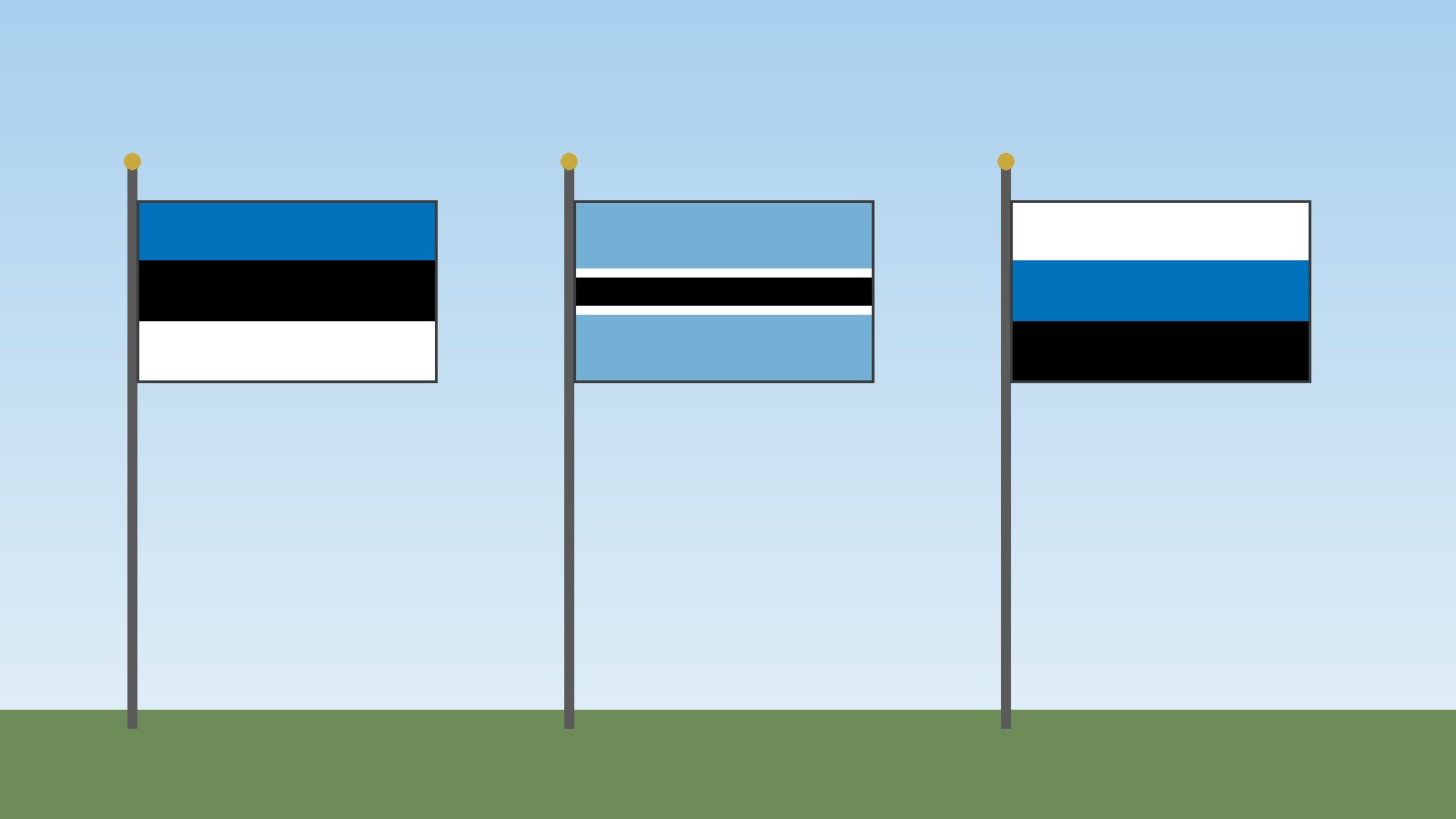
- If a flag uses only blue, black, and white, and no other color, the answer is usually Estonia or Botswana. Those are the two current national flags that match the phrase exactly on the lists checked for this article.
- Estonia has three equal horizontal bands: blue on top, black in the middle, and white at the bottom. In Estonian the flag is called sinimustvalge, which means blue black white.
- Botswana has a light blue field with a black horizontal band across the center, edged above and below by thin white stripes. It is not a three band tricolor, and its blue is much lighter than the blue on the Estonian flag.
- Other current national flags also contain blue, black, and white, but they add at least one more color. Saint Lucia adds gold. Lesotho adds green. South Africa adds red, green, and gold. Eswatini adds red and yellow. Those flags match a loose color search, but they do not pass the exact three color test.
- A different flag that often appears in this search is the Thin Blue Line flag. It is not a national flag. It is a black and white rendering of the United States flag with one blue stripe, linked to law enforcement, and its meaning is contested. It should not be confused with Estonia or Botswana.
- Count the colors first, then look at the layout. Three equal bands point to Estonia. A light blue field with a central black band points to Botswana. A fourth color points to a different flag.
How to Use This Guide
This article answers a color question, not a country question. A flag that contains the three colors is not the same as a flag made only from them.
Use three tests in order. First, the exact test. Does the flag use blue, black, and white, and no other color? Only Estonia and Botswana pass that test among current national flags covered here. Second, the contains test. Does the flag include blue, black, and white, plus one or more other colors? Saint Lucia, Lesotho, South Africa, and Eswatini pass that test. They matter when a reader remembers the three colors but has forgotten an extra color, or when a small image hides an extra color. Third, the lookalike test. Does the flag use two of the three colors, or a similar layout with a different third color? Somalia, Finland, Greece, Argentina, and Scotland use blue and white but no black. Russia uses white, blue, and red. Germany uses black, red, and gold. Checking for the missing color often settles the question faster than checking for the colors that are present.
This guide covers current national flags and the Thin Blue Line variant, which dominates many search results for this phrase. It does not list every city, province, sports, military, or historical flag that has used this trio.
Quick Identification Table
| Flag you see | Colors | Layout in one line | Best quick check |
|---|---|---|---|
| Estonia | Blue, black, white only | Three equal horizontal bands: blue on top, black in the middle, white at the bottom | Three solid bands and no emblem |
| Botswana | Light blue, black, white only | Light blue field with a central black band edged by thin white stripes | One central band, not three equal bands |
| Saint Lucia | Blue, black, white, plus gold | Blue field with a central triangle design in black, white, and gold | Triangles in the center, not bands |
| Lesotho | Blue, white, green, plus black | Blue, white, and green bands with a black hat in the center | A black hat shape on the white band |
| South Africa | Red, blue, green, black, white, plus gold | Red and blue bands with a green Y shape, a black triangle, and white and gold edging | A Y shape and a black triangle at the hoist side |
| Eswatini | Blue, red, yellow, plus black and white | Blue, red, and blue bands with a black and white shield in the center | A shield and spears in the center |
| Thin Blue Line flag | Black, white, and blue only, as a variant design | Black and white United States flag pattern with one blue stripe | Stars and stripes in black and white, not a plain tricolor |
The hoist side is the side nearest the pole. That detail matters for South Africa, because its black triangle sits at the hoist side and its Y shape opens toward the hoist side.
Estonia: The Blue Black White Tricolor
Estonia is the flag most search results point to for this phrase, and for good reason. It is the clearest match: three colors, three bands, and a name that literally describes the color order.
The design is simple. Three equal horizontal bands run across the flag: blue on top, black in the middle, and white at the bottom. There is no emblem, no star, and no coat of arms on the standard national flag. The width to length proportion is 7 to 11, with a nominal size of 105 centimeters by 165 centimeters on the standard form described in reference summaries of the flag law.
The Estonian name sinimustvalge is a useful memory aid. It joins the Estonian words for blue, black, and white in the same order as the bands, from top to bottom. The order matters, because a different order would be a different flag, or no current national flag at all.
The history helps explain why the flag carries so much meaning in Estonia. The combination began as a student symbol during the Estonian national awakening in the late 1800s. The flag was consecrated at Otepaa on 4 June 1884 as the flag of the Estonian Students Society. It was already in wide use as a national symbol when Estonia declared independence on 24 February 1918. The Provisional Government formally adopted it on 21 November 1918, and parliament confirmed its status in law in 1922. The flag was banned during the Soviet occupation that began in 1940. Public use was permitted again in October 1988, the tricolor was restored to the Pikk Hermann tower in Tallinn on 24 February 1989, and the authorities readopted it on 7 August 1990, about a year before Estonia regained full independence in August 1991.
What do the colors mean? Several interpretations are linked to the flag, and no single official meaning should be presented as a law of nature. The World Factbook records the common readings this way: blue is linked to faith, loyalty, and devotion, and to the sky, sea, and lakes of Estonia; black is linked to the soil of the country and to the dark past and suffering endured by the Estonian people; white is linked to the striving toward enlightenment and virtue, and to birch bark and snow, and to summer nights lit by the midnight sun. Those associations grew up with the flag over time. Treat them as traditional readings, while treating the design itself, three equal bands in blue, black, and white order, as the fixed fact. The blue is a medium to strong blue, given in official specifications as Pantone 285 C, with the hex value given in reference summaries as 0072CE. Do not identify the flag from one pixel of blue alone, because screens and fabric shift shade. Layout and color count are far more reliable.
Botswana: Light Blue, Black, and White
Botswana is the second exact match, and it is easy to confuse with Estonia if only the color names are remembered. The design, the shade of blue, and the history are different.
Britannica describes the Botswana flag as a light blue field with central white black white stripes, with a width to length ratio of 2 to 3. In plainer terms, the background is light blue. Across the center runs a black horizontal band, edged above and below by thin white stripes. The result looks like a light blue flag cut through the middle by a black stripe with white borders, not like three equal bands.
The flag was adopted in 1966, when Bechuanaland became independent as the Republic of Botswana. Britannica notes that Bechuanaland had no distinctive national symbols of its own before independence, and that the new flag was chosen in contrast to the flag of neighboring South Africa, where apartheid, the policy of racial segregation and the subjugation of nonwhite people, was then in effect. The central black stripe and its white borders proclaimed a belief in racial cooperation and equality. The light blue background is associated with the sky and with water, a scarce and precious resource in the Kalahari desert. That importance is also reflected in the national motto on the coat of arms, the single word Pula, which connotes rain, hope, and confidence in the future.
How to tell Botswana from Estonia at a glance? First, is the blue light or strong? Botswana uses light blue across the whole field. Estonia uses a stronger blue in one band only. Second, are the bands equal? Estonia has three equal bands. Botswana has a large light blue field with one central band. Third, where is the white? In Botswana, white appears as thin stripes hugging the central black band. In Estonia, white is the full bottom band.
Flags That Contain the Trio Plus Other Colors
Many readers who search for flags blue black white are actually remembering a flag that contains those colors plus another color that has slipped from memory. The four flags below each clearly contain blue, black, and white, and each has a distinctive shape that prevents confusion once it is seen.
Saint Lucia: Blue, Black, White, and Gold
Britannica describes the Saint Lucia flag as a blue field with a central triangular emblem of yellow, black, and white, with a width to length ratio of 1 to 2. The background blue reflects the Atlantic Ocean and the Caribbean Sea around the island. In the center, white and black indicate harmony between the races living on Saint Lucia, the yellow triangle represents constant sunshine, and the black triangle symbolizes the Pitons, the volcanic cones in the southwest of the island. The design was first hoisted in its original version on 1 March 1967, when Saint Lucia advanced to associated statehood, designed by local artist Dunstan St. Omer. At independence on 22 February 1979, the shade of blue and the sizes of the triangles were slightly altered. A reader who sees only the black and white triangle in a small image might forget the gold, but the gold is part of the central emblem, and it is what separates Saint Lucia from the exact matches.
Lesotho: Blue, White, Green, and Black
Lesotho contains blue, black, and white, but it also contains green, and its most distinctive feature is a hat, not a band. The World Factbook describes it as three horizontal stripes of blue on top, white in the middle, and green at the bottom, in proportions of 3 to 4 to 3, with a black Basotho hat, called a mokorotlo, centered in the white stripe. The colors represent rain, peace, and prosperity in that order, and the hat represents the indigenous people. The flag was unfurled in October 2006 to celebrate 40 years of independence. Lesotho runs blue, white, green from top to bottom. Estonia runs blue, black, white. Lesotho has green at the bottom where Estonia has white, and its black appears only as the hat, not as a full band. If a hat shape is visible, the flag is Lesotho.
South Africa: Six Colors, Including the Trio
South Africa is the most colorful flag in this guide, and the one most likely to be misremembered as a three color flag, because its black triangle and white edging stand out in a small image. The World Factbook describes it as two equal width bands of red on top and blue below, separated by a central green band that splits into a horizontal Y shape, with the arms ending at the corners of the hoist side. The Y embraces a black isosceles triangle, separated from the arms by narrow yellow bands. The red and blue bands are separated from the green band and its arms by narrow white stripes. The Factbook adds that the flag colors do not have any official symbolism, but the Y stands for the convergence of diverse elements within South African society, taking the road ahead in unity. In short, South Africa contains blue, black, and white, but it also contains red, green, and gold, for six colors in total. If a Y shape is present, the flag is South Africa, whatever colors the reader first noticed.
Eswatini: Blue, Red, Yellow, Black, and White
Eswatini also contains the trio, but its center is dominated by a shield, not by bands or triangles. The World Factbook describes it as three bands of blue on top, red in the middle at triple width, and blue at the bottom, with the red band edged in yellow. Centered in the red band is a large black and white shield covering two spears and a staff decorated with feather tassels, all placed horizontally. Blue stands for peace and stability, red represents past struggles, and yellow stands for mineral resources. The shield, spears, and staff symbolize protection, while the black and white of the shield are meant to portray black and white people living in peaceful coexistence. A reader who remembers a shield should look for Eswatini first, not for a tricolor.
The Thin Blue Line Flag: A Variant, Not a National Flag
Search results for flags blue black white often include the Thin Blue Line flag, and a reader who does not know what it is may mistake it for a country flag. It is not.
The common form is a black and white rendering of the United States flag, with its stars and stripes shown in black and white, and with one blue stripe running across it. Other forms use a plain black field with a single blue stripe. The design is linked to law enforcement. Supporters describe it as a sign of support for officers and as a tribute to officers who have died in service. Critics describe it as a divisive symbol, and its meaning has been contested in public debate, especially since the 2010s. This article does not settle that debate, because the debate is about what the symbol should mean, not about what the design looks like.
Three checks separate it from Estonia and Botswana. First, it keeps the United States flag pattern, with a field of stars in the upper hoist corner, while Estonia and Botswana have no stars. Second, its blue appears as a single thin line, not as a full band or a full field. Third, its black and white areas are broken into many stripes, not into one central band or three equal bands. Other thin line variants use other stripe colors for other services. None of them is a national flag.
Lookalikes That Fail the Three Color Test
Ruling out lookalikes is often faster than confirming a match, because the missing color is easier to spot than a subtle shade. Somalia uses a light blue field with a large white five pointed star in the center. The World Factbook notes that the blue field was originally influenced by the flag of the United Nations, and that the five points of the star represent the five regions inhabited by Somali people. There is no black in the design, so Somalia fails the three color test even though its light blue field can look like Botswana at a distance. The star is the giveaway. Botswana has no star.
Finland uses a white field with a blue Nordic cross. Greece uses blue and white stripes with a blue canton and a white cross. Argentina uses light blue, white, and light blue bands with a sun emblem in the center. Scotland uses a blue field with a white saltire, an X shaped cross. All four use blue and white only, with no black as a main color.
Russia uses three bands of white on top, blue in the middle, and red at the bottom. It shares the three band layout with Estonia and two colors, white and blue, but the third color is red, not black, and the order differs. Estonia runs blue, black, white. Russia runs white, blue, red. Germany uses black, red, and gold bands, with no blue and no white. Latvia uses maroon, white, and maroon bands, with no blue and dark maroon, not black. Austria uses red, white, and red bands. The flag of Cornwall, Saint Piran’s flag, is a black field with a white cross and no blue.
A simple rule covers most cases. If red, gold, green, or maroon is clearly present as a main color, the flag is not an exact blue black white flag. If black is absent, it is not an exact match either, even if the blue and white look right. The exact match needs all three colors and no fourth main color.
A Step by Step Identification Check
Use this check in order, and stop at the first line that fits.
Step 1: Count the main colors. If there are more than three, the flag is not an exact blue black white flag. Triangles point to Saint Lucia, a hat points to Lesotho, a Y shape points to South Africa, and a shield points to Eswatini.
Step 2: If there are exactly three colors, check whether they are blue, black, and white. If black is missing, or if red, gold, green, or maroon is present instead, the flag is a lookalike. No black and a star points to Somalia, no black and a cross points to Finland or Greece, red at the bottom points to Russia, and gold at the bottom points to Germany.
Step 3: If the three colors are blue, black, and white, check the layout. Three equal bands in blue, black, white order point to Estonia. A light blue field with a central black band edged in white points to Botswana.
Step 4: If stars and stripes are visible in black and white with one blue stripe, the flag is a Thin Blue Line variant, not a national flag.
Step 5: If none of the above fits, check the date and the source of the image. The flag may be historical, regional, or a sports or organization flag, rather than a current national flag. Do not force it into the Estonia or Botswana box because the colors are close.
Timeline
- 4 June 1884: The blue black white flag is consecrated at Otepaa as the flag of the Estonian Students Society.
- 21 November 1918: The Provisional Government of Estonia formally adopts the tricolor as the state flag.
- 7 August 1990: The Estonian authorities readopt the tricolor as the state flag.
- 30 September 1966: Botswana becomes independent, and its light blue, black, and white flag is adopted.
- 1 March 1967: The original version of the Saint Lucia flag is hoisted on associated statehood, designed by Dunstan St. Omer.
- 4 October 2006: Lesotho unfurls its current flag, with blue, white, and green bands and a black mokorotlo, to mark 40 years of independence.
Common Mistakes, and How to Avoid Them
Every blue black white flag is Estonia. Not every one. Botswana uses the same three colors in a different design, and several other flags contain the trio plus extra colors. Count colors, then check layout.
Botswana is a tricolor like Estonia. It is not. Estonia has three equal bands. Botswana has a light blue field with one central band edged in white.
Saint Lucia is an exact match. It is not, because gold is a main color in its central emblem.
Lesotho is Estonia with a hat added. It is not. Lesotho has green at the bottom where Estonia has white, and its black appears only as the hat, not as a full band.
South Africa is a three color flag. It is a six color flag. Red, green, and gold are also main colors, and the Y shape is the defining feature.
Somalia matches because it is light blue and white like Botswana. It fails on black, and its white star is a feature Botswana does not have.
Russia matches because it has three bands like Estonia. It fails on color and order. Russia runs white, blue, red. Estonia runs blue, black, white.
The Thin Blue Line flag is the flag of a country. It is not. It is a variant of the United States flag, and its meaning is contested.
Flag color meanings are fixed by law. In most cases they are not. The design is fixed. The meanings are traditional interpretations, and South Africa is the clearest case, because the World Factbook states that its flag colors have no official symbolism.
Shade alone identifies a flag. It does not. Screens, printing, fabric, and light all shift shade. Use color count and layout first.
Frequently Asked Questions
What flag is blue black and white? Most often Estonia, with three equal bands of blue on top, black in the middle, and white at the bottom, or Botswana, with a light blue field and a central black band edged in white. If a fourth color is present, the answer is a different flag, such as Saint Lucia, Lesotho, South Africa, or Eswatini.
Is there only one blue black white flag? No. Two current national flags use only blue, black, and white: Estonia and Botswana. Several others contain those colors plus extra colors, and the Thin Blue Line variant also uses black, white, and blue in a different design.
What is the difference between the Estonia flag and the Botswana flag? Estonia has three equal bands in blue, black, white order. Botswana has a light blue field with a central black band edged by thin white stripes. Estonia uses a stronger blue in one band. Botswana uses light blue across the whole field.
What does the blue black white flag mean? It depends on which flag is meant. For Estonia, traditional readings link blue to faith, loyalty, and the sky, sea, and lakes, black to soil and past suffering, and white to enlightenment, virtue, birch bark, and snow. For Botswana, Britannica links light blue to sky and water, and the black and white stripes to racial cooperation and equality. Those are traditional interpretations, not legal definitions.
Does Somalia have a blue black white flag? No. It has a light blue field with a white star and no black.
Is the Thin Blue Line flag a country flag? No. It is a black and white version of the United States flag with one blue stripe, linked to law enforcement, not a national flag.
Which flag is blue black white and gold? Saint Lucia, which contains blue, black, white, and gold, with a blue field and a central triangle emblem.
Which flag has blue, white, green, and a black hat? Lesotho. Its bands run blue, white, and green, with a black mokorotlo, a Basotho hat, centered on the white band.
How can I tell a flag apart in a small photo? Count the colors first, then look at the shape. Three equal bands point to Estonia. A light blue field with one central band points to Botswana. Triangles point to Saint Lucia. A hat points to Lesotho. A Y shape points to South Africa. A shield points to Eswatini. Stars in black and white point to a Thin Blue Line variant.
Are flag color meanings official? The design is usually official. The meanings are usually traditional, as the World Factbook shows for South Africa.
Sources & references
- United States Central Intelligence Agency, The World Factbook, flag descriptions, consulted 27 October 2026. Covers Estonia as three equal horizontal bands of blue on top, black, and white, with traditional color interpretations; Lesotho as blue, white, and green stripes in proportions 3 to 4 to 3 with a black Basotho hat centered in the white stripe, for rain, peace, and prosperity, unfurled in October 2006; South Africa as red and blue bands with a central green Y shape, a black triangle, narrow yellow bands, and narrow white stripes, with no official color symbolism stated; Eswatini as blue, red at triple width, and blue bands with a yellow edged red band and a large black and white shield in the center; and Somalia as a light blue field with a large white five pointed star in the center.
- Encyclopaedia Britannica, Flag of Botswana, opened 27 October 2026. Covers the flag as a light blue field with central white black white stripes, width to length ratio 2 to 3, adoption in 1966, contrast with apartheid South Africa, racial cooperation and equality in the central stripes, light blue for sky and water in the Kalahari desert, and the motto Pula connoting rain, hope, and confidence in the future.
- Encyclopaedia Britannica, Flag of Saint Lucia, opened 27 October 2026. Covers the flag as a blue field with a central triangular emblem of yellow, black, and white, width to length ratio 1 to 2, original version hoisted 1 March 1967 on associated statehood, designed by Dunstan St. Omer, blue for the Atlantic Ocean and Caribbean Sea, white and black for harmony, yellow for sunshine, black for the Pitons, and slight alteration of blue shade and triangle sizes at independence on 22 February 1979.
- Estonian Consulate General in Jakarta, Estonia's Blue Black White Tricolor Flag, consulted 27 October 2026 via search result text. Covers the origin of the color combination in the Vironia Society, now the Estonian Students Society, on 29 September 1881, the first flag made in spring 1884 and blessed on 4 June 1884 in Otepaa, independence on 24 February 1918, formal adoption on 21 November 1918, and first raising as a national symbol at Pikk Hermann Tower on 12 December 1918.
- Reference summaries of the Flag of Estonia, consulted 27 October 2026 via search result text, including the national symbols summary giving three equal horizontal bands of blue, black, and white at 7 to 11, consecration at Otepaa on 4 June 1884, formal adoption 21 November 1918, law in 1922, ban during Soviet occupation, public use permitted in October 1988, restoration to Pikk Hermann on 24 February 1989, and readoption on 7 August 1990, with Pantone 285 C given as the blue specification in related summaries.
- Search results for the literal phrase flags blue black white, consulted 27 October 2026. Covers the dominant search intent as a color combination question, with Estonia named as the prime candidate in the top result, and Botswana and Somalia discussed as related flags, plus Thin Blue Line results showing the variant design.
- General flag references, consulted 27 October 2026. Covers Finland as a white field with a blue Nordic cross; Greece as blue and white stripes with a blue canton and a white cross; Argentina as light blue, white and light blue bands with a sun emblem in the center; Scotland as a blue field with a white saltire; Russia as white, blue and red bands from top to bottom; Germany as black, red and gold bands from top to bottom; Latvia as maroon, white and maroon bands; Austria as red, white and red bands; and Cornwall Saint Piran's flag as a black field with a white cross and no blue.
- Thin Blue Line reporting, consulted 27 October 2026. Covers the Thin Blue Line flag as a black and white rendering of the United States flag with one blue stripe, linked to law enforcement, with supporter descriptions of support and tribute and critic descriptions of a divisive symbol, and with other thin line variants using other stripe colors for other services.


