Short-answer box
The San Onofre Power Plant, formally the San Onofre Nuclear Generating Station and often shortened to SONGS, is a permanently closed nuclear power plant on the California coast south of San Clemente. It no longer generates electricity. Its last two operating reactors shut down in January 2012 after unexpected wear was found in their replacement steam generators, and Southern California Edison announced in June 2013 that Units 2 and 3 would be permanently retired rather than restarted.
As of the date stamp at the end of this article, the site is in decommissioning: a long, regulated process of removing fuel, dismantling structures, cleaning the site, and checking the results. The used nuclear fuel remains stored on site in dry storage, because no permanent national repository is operating to receive it. The containment buildings that many drivers recognize from Interstate 5 are part of a site being taken apart, not a plant preparing to reopen.
What San Onofre was
San Onofre was a nuclear power station: it made electricity from the heat released by splitting uranium atoms. That heat made steam, and the steam spun turbines connected to generators. The equipment that failed at San Onofre sat in the middle of that chain: the steam generators.
The station had three units. Unit 1 was the smallest and oldest. Units 2 and 3 were larger twin units that did most of the station’s later generating. All three were pressurized water reactors. In that design, water under high pressure carries heat from the reactor core to the steam generators, but the pressure keeps that water from boiling. Inside each steam generator, the hot water passes through thousands of thin tubes. Heat moves through the tube walls into a separate water supply on the other side, and that second supply boils into steam. Keeping those two water systems separate is central to the design.
That separation is why steam generator tubes get so much attention. A tube is a barrier as well as a heat exchanger. If a tube wears thin or cracks, water from the reactor side can leak into the steam side. Plants monitor for that leak continuously, and procedures require a shutdown when a leak passes a set limit. At San Onofre in January 2012, that monitoring worked as designed in one unit, and the inspections that followed found a wider wear problem in both larger units. The story of San Onofre is therefore not about a reactor core failing. It is about an upgrade component wearing out far faster than expected.
By California standards, San Onofre was a large plant. The two larger units were each rated at 1,127 net megawatts electrical, giving the pair a combined rating of 2,254 net megawatts electrical in a licensee report filed with the Nuclear Regulatory Commission. A megawatt is one million watts. The former chair of the California Energy Commission described the station in a later interview as 2,246 megawatts that had supplied energy for 1.4 million homes. The small difference reflects gross versus net counting, not a disagreement about the basic scale.
Where the plant sits
San Onofre sits in San Diego County, California, on the Pacific coast between Interstate 5 and the ocean, within the boundary of Marine Corps Base Camp Pendleton. The Nuclear Regulatory Commission describes the site as about 100 kilometers (60 miles) south of Los Angeles and about 6.5 kilometers (4 miles) south of San Clemente, next to San Onofre State Beach. It is a coastal site beside a highway, a beach, and a military base, in one of the most populated parts of the United States.
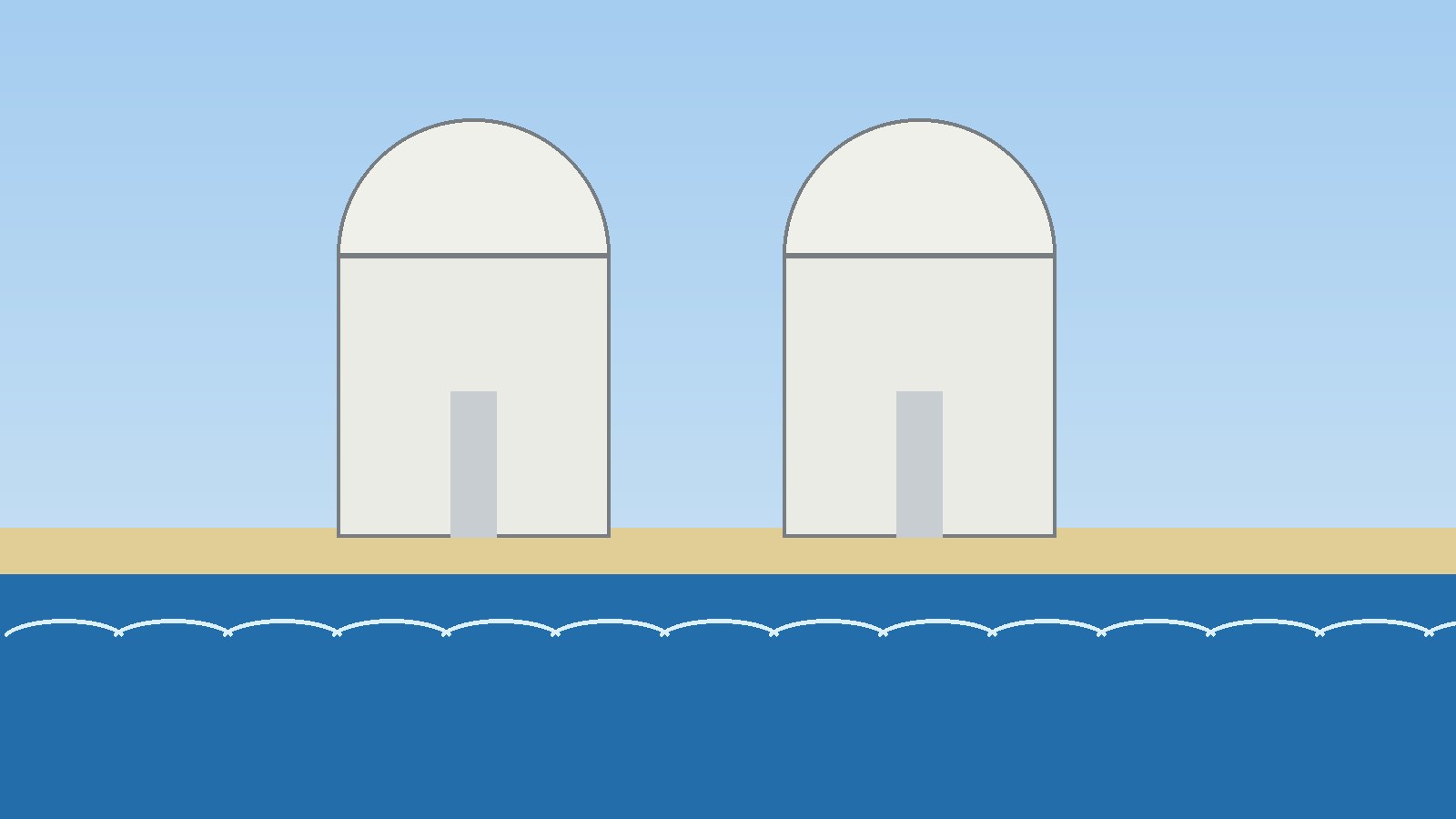
That setting explains why the plant was so visible. The twin containment buildings for Units 2 and 3 are hemispherical structures that stand out against the low coastal landscape. Containment structures are built to hold radioactive material inside if something goes wrong inside the reactor building. This article reports the regulated facts and the positions that official sources have stated. It does not take a position on whether any particular energy policy is right or wrong.
The three units, in brief
Unit 1 began commercial operation on January 1, 1968, and ceased operation on November 30, 1992. It was a Westinghouse pressurized water reactor, rated at 410 net megawatts electrical in a licensee filing, and it ran for about 25 years. After it closed, its dismantlement was largely completed, and its fuel was moved to dry storage on site. Its reactor pressure vessel was shipped to a disposal facility in Utah in 2020, arriving on July 14, 2020, after leaving San Onofre on May 24, 2020.
Unit 2 began commercial operation in August 1983, and Unit 3 began commercial operation on April 1, 1984. Both were supplied by Combustion Engineering as pressurized water reactors, each rated at 1,127 net megawatts electrical. The pair shared the same basic design, which is why a problem found in one unit immediately raised questions about the other. Southern California Edison operated the station. Ownership of Units 2 and 3 was shared: Southern California Edison held about 78.21 percent, San Diego Gas and Electric held 20 percent, and the City of Riverside held about 1.79 percent.
| Unit | Supplier and type | Commercial operation began | Operation ended | Rated output |
|---|---|---|---|---|
| Unit 1 | Westinghouse pressurized water reactor | January 1, 1968 | November 30, 1992 | 410 net megawatts electrical |
| Unit 2 | Combustion Engineering pressurized water reactor | August 1983 | Shut down January 2012; permanent retirement announced June 7, 2013 | 1,127 net megawatts electrical |
| Unit 3 | Combustion Engineering pressurized water reactor | April 1, 1984 | Shut down January 31, 2012; permanent retirement announced June 7, 2013 | 1,127 net megawatts electrical |
How a pressurized water reactor makes electricity
A pressurized water reactor starts with fuel assemblies in the reactor core. Those assemblies contain uranium pellets sealed inside metal rods. When uranium atoms split, a process called fission, they release heat. Control rods, made of material that absorbs neutrons, slide in and out of the core to control the rate of fission.
Water under high pressure flows through the core and carries the heat away. The pressure keeps the water liquid even though it is hot enough that it would boil at normal atmospheric pressure. That hot, pressurized water is called the primary coolant. It flows to the steam generators. Each steam generator is a large vessel filled with thousands of U-shaped tubes. Primary coolant flows inside the tubes. On the outside sits a second water supply, the secondary side. Heat passes through the tube walls, the secondary water boils, and the resulting steam drives a turbine. After spinning the turbine, the steam is condensed back into water and pumped back to repeat the cycle.
A replacement steam generator is therefore not a minor part. It is a large vessel containing nearly ten thousand tubes, each of which must hold pressure and keep the primary and secondary sides apart. At San Onofre, each steam generator had 9,727 tubes, according to the Nuclear Regulatory Commission’s confirmatory action letter. When hundreds of those tubes show unexpected wear, the question becomes whether the wear mechanism is understood well enough to guarantee that the remaining tubes will hold up through the next operating cycle.
The steam generator replacement
By the late 2000s, the original steam generators in Units 2 and 3 were aging. Southern California Edison replaced them, with Unit 2 receiving replacement steam generators in January 2010 and Unit 3 in January 2011, according to the Nuclear Regulatory Commission’s confirmatory action letter. The replacement units were made by Mitsubishi Heavy Industries. The project was presented as a modernization that would extend the plant’s useful life: the units had been licensed to operate until 2022, and new steam generators were meant to carry them reliably through that period.
The replacements were large. Because Units 2 and 3 used a two-loop design, meaning each unit had two main coolant loops rather than the three or four loops found in some other large reactors, each steam generator had to handle a large share of the unit’s heat. The later investigation focused on whether the flow pattern inside those large vessels set up vibrations that the design had not fully predicted. The plant did not close because its original 1980s steam generators finally wore out. It closed after the new steam generators developed a new wear problem in their first cycle of operation.
January 2012: the leak and the shutdown
On January 31, 2012, Unit 3 was operating at full rated thermal power when operators received an alarm indicating a primary to secondary coolant leak from steam generator 3E088. The alarm came from radiation monitors that sample air from the main condenser air ejector, a system designed to detect steam generator tube leaks quickly. The Nuclear Regulatory Commission’s event summary records that the leak rate was small but increased enough in a short period that the licensee performed a rapid shutdown when the estimated leak rate exceeded 75 gallons per day. The facility license allowed full power operation with a steady state leak rate of less than 150 gallons per day, so the shutdown was a conservative response to a rising trend, not a response to a leak already far beyond the limit.
Operators manually tripped the reactor from 35 percent power as directed by procedure, isolated the affected steam generator, and brought the unit to cold shutdown conditions by February 1, 2012. Cold shutdown means the reactor is shut down and the coolant system is cooled and depressurized to a stable, low temperature state. The licensee estimated the public dose from gaseous radioactivity released during the event at approximately 0.0000452 millirem, against an annual regulatory limit for a member of the public of 100 millirem per year. That places the size of the release in context: this was a small leak that triggered a shutdown, not a large release. Unit 2 was already shut down at the time for a regularly scheduled refueling outage, so both units could be inspected without waiting for another outage.
What the inspections found
Testing covered 100 percent of the steam generator tubes in both Unit 3 steam generators, and planned testing of 100 percent of the Unit 2 tubes was already in progress. In Unit 3, testing identified unexpected wear caused by tubes rubbing against each other, as well as against retainer bars, the structures that help hold tubes in place. Pressure testing was performed on 129 tubes that showed the most wear. Eight tubes in steam generator 3E088 failed that pressure test. Failing a pressure test means that, for certain design basis events such as a main steam line break, those tubes might not have maintained their structural integrity.
In Unit 2, testing showed unexpected wear at retainer bars similar to the Unit 3 results. The operator identified 6 tubes requiring plugging, and plugged 186 additional tubes as a precautionary measure. Later analysis identified two Unit 2 tubes with tube to tube wear similar to what was observed in Unit 3, according to the Nuclear Regulatory Commission’s later event summary. Plugging a tube means sealing it off so that water no longer flows through it. A steam generator can operate with a limited number of plugged tubes, because it has thousands of them, but a large number of plugged tubes can signal a deeper problem.
The Nuclear Regulatory Commission responded with an augmented inspection and, on March 27, 2012, issued a confirmatory action letter requiring Southern California Edison to take certain actions before restarting either unit. A confirmatory action letter is a formal regulatory tool: the licensee commits to specific actions, and the regulator confirms that the plant will not restart until those actions are complete and verified. Later analysis, summarized in trade press reporting of Nuclear Regulatory Commission statements, pointed to fluid elastic instability, a vibration phenomenon in which flowing fluid excites tubes into vibration, as the cause of the tube to tube wear. The regulator’s own modeling was reported to have found that the manufacturer’s simulation had underpredicted steam and water velocities by a factor of two to three. The official sequence is not in dispute: new steam generators, first cycle wear far beyond expectations, failed pressure tests in Unit 3, and a regulator imposed hold on restart until the cause was understood and fixed.
Readers sometimes confuse this event with a reactor accident. It was not one, in the sense used for the Three Mile Island accident, which is covered in a separate Amberaisle article, or for Chernobyl, which involved a reactor core accident of a very different kind. At San Onofre, the reactor was shut down in an orderly way, the leak was small, and the estimated public dose was far below the annual limit. The safety significance lay in what the wear implied for a future design basis event, not in a release that had already happened.
Why the plant never restarted
After January 2012, both Units 2 and 3 stayed shut down while the operator and the regulator worked through the steam generator problem. Southern California Edison proposed operating Unit 2 at reduced power as a step toward restart, arguing that lower power would reduce the vibration that caused the wear. That proposal became the subject of regulatory review and public proceedings, including a hearing process over whether the restart plan amounted to a license amendment requiring a formal hearing.
On June 7, 2013, Southern California Edison announced that it would permanently retire Units 2 and 3. The Nuclear Regulatory Commission’s status summary records that announcement date, and records that permanent cessation of operations and removal of fuel from the reactor vessels were certified in June and July 2013. Several factors are commonly cited in accounts of that decision: the wear mechanism itself, the hearing and licensing process, and the cost of further repairs measured against the remaining licensed life of the units, which ran to 2022. This article does not assign weights to those factors, because no single official source used here ranks them in that way. What the official record establishes is the outcome: a shutdown that began in January 2012 became a permanent retirement announced in June 2013.
What decommissioning means, and the timeline so far
Decommissioning is the process of safely closing a nuclear facility after it stops operating. It involves removing nuclear fuel, decontaminating and dismantling structures, disposing of radioactive waste under license, and surveying the site to show that residual radioactivity meets release criteria.
The approach chosen at San Onofre is DECON, which the Nuclear Regulatory Commission defines as the prompt removal or decontamination of equipment, structures, or portions of the facility and site that contain radioactive contaminants, to levels that permit termination of the license. The textbook alternative, SAFSTOR, keeps a plant in safe, monitored storage for a period before dismantlement begins. San Onofre did not choose the waiting route for Units 2 and 3.
Before major dismantlement, the operator must file a Post Shutdown Decommissioning Activities Report, known as a PSDAR. Southern California Edison filed its PSDAR on September 23, 2014, with the current version cited in inspection reports dated May 7, 2020. Southern California Edison retains the licenses and overall lead for decommissioning. Day to day dismantlement is managed by SONGS Decommissioning Solutions, a joint venture of EnergySolutions and AECOM, announced on December 20, 2016.
The timeline that followed runs as follows. Permanent cessation and fuel removal were certified in June and July 2013. In October 2015, the California Coastal Commission approved expansion of the dry storage facility, completed in November 2017. In January 2018, transfer of spent fuel from wet to dry storage began in earnest for Units 2 and 3. In March 2019, the California State Lands Commission approved the final environmental impact report, and in October 2019 the California Coastal Commission approved the coastal development permit for dismantlement. In January 2020, the operator issued a notice of deconstruction to residents within a five-mile radius, and in July 2020 the Unit 1 reactor pressure vessel reached its Utah disposal site.
A 2025 Nuclear Regulatory Commission inspection report describes open-air demolition continuing around the two containment buildings, including fuel handling, penetration, and safety buildings, with air monitoring and dust suppression in use. As of the most recent inspection reports available for this article, San Onofre is an active demolition site under inspection.
The Nuclear Regulatory Commission’s current status page, last reviewed on February 10, 2026, gives two forward looking markers. By the end of 2028, the licensee is expected to have completed all dismantlement and decontamination work necessary to demonstrate unrestricted future use for all final status survey units, not including the spent fuel storage installation. The licensee projects that all decommissioning activities will be completed by 2051. Those dates are projections, and the status summary itself warns that specific dates are subject to change.
Spent fuel: why it stays on site
Used nuclear fuel, often called spent fuel, remains radioactive and thermally hot after it leaves a reactor. At first it is stored in pools of water, called spent fuel pools, which cool it and shield radiation. After it has cooled enough, it can be moved into dry storage: sealed stainless steel canisters placed inside reinforced concrete structures. Dry storage does not need pumps or water circulation to cool the fuel; it relies on passive air flow and the shielding of the canister and concrete.
At San Onofre, the transfer of Unit 2 and Unit 3 fuel to the Holtec International Storage Module Underground Maximum Capacity system, known as HI-STORM UMAX, was completed on August 6, 2020, according to the Nuclear Regulatory Commission. An earlier storage system on site, the Orano Transnuclear NUHOMS horizontal modular storage system, already held fuel from all three reactors and greater than Class C waste from Unit 1 decommissioning. Together, those two systems form the site’s independent spent fuel storage installation, known as an ISFSI. The fuel from all three units is now in dry storage on site.
The reason the fuel stays on site is a national policy gap, not a San Onofre specific decision. The United States has no operating permanent geological repository for commercial spent fuel. A repository site at Yucca Mountain in Nevada was studied for decades but never opened. Because the federal government has not taken title to the fuel and moved it, every closed plant, and every operating plant, stores its used fuel on site in licensed dry storage. Southern California Edison has stated publicly that it will continue to store used fuel on site under Nuclear Regulatory Commission oversight.
That situation explains the 2051 date. The licensee’s projection assumes that the last spent fuel will be removed from the storage installation around 2049, followed by decommissioning of the installation itself. If no federal repository or consolidated interim storage site becomes available on that schedule, the fuel will remain on site longer. The Nuclear Regulatory Commission’s status page also notes special inspection activities following a cask loading misalignment incident on August 3, 2018, during fuel transfer operations.
What replaced the electricity, and why San Onofre still matters
Losing a plant of San Onofre’s size creates two problems at once. The first is energy: the electricity the plant would have generated must come from somewhere else. The second is grid support: a large generator connected at a particular point on the grid helps keep voltage stable and helps power flow where it is needed. The former California Energy Commission chair’s interview, quoted earlier, made exactly that second point, noting that San Onofre provided reactive power support that helped the transmission system.
California regulators responded through the California Public Utilities Commission, which directed Southern California Edison and San Diego Gas and Electric to procure replacement capacity, including a substantial share of preferred resources: energy efficiency, demand response, renewable energy, and energy storage. The precise mix changed over time. Replacement was a multi year procurement process, not a single swap of one plant for another. The scale of the loss, about 2.2 gigawatts, where a gigawatt is one thousand megawatts, is consistent across station summaries. This article does not adopt a single breakdown of that loss into gas and storage capacity as settled, because different summaries count different years and different project lists.
San Onofre still matters for three reasons. First, it shows how a single component can end a plant: an upgrade meant to extend life introduced a wear mechanism that ended life instead. Second, it is a large, twin unit decommissioning project in a populated coastal area, being dismantled while its fuel stays on site. Third, it shows the spent fuel problem: the site cooled fuel in pools and moved it to licensed dry storage, yet the fuel has nowhere else to go until a federal repository or consolidated storage site opens.
The public can follow the work through the operator’s SONGS Community site, Nuclear Regulatory Commission inspection reports, and California agency records, including storage radiation monitoring data published from March 2020. The site itself is not a public visitor attraction.
Frequently Asked Questions
Is the San Onofre power plant still operating?
No. Units 2 and 3 shut down in January 2012 and were permanently retired in June 2013. Unit 1 closed in 1992. The site generates no electricity and is being decommissioned.
Why did San Onofre close?
Unexpected wear was found in the replacement steam generators installed in 2010 and 2011. Inspections found tubes rubbing against each other and against retainer bars in Unit 3, with eight tubes failing pressure tests. Unit 2 showed similar retainer bar wear. After more than a year shut down, Southern California Edison announced permanent retirement on June 7, 2013, rather than pursuing restart.
Was there a radiation accident at San Onofre in 2012?
No large release occurred. The January 31, 2012, event was a small steam generator tube leak that triggered a rapid shutdown. The licensee estimated the public dose at approximately 0.0000452 millirem, far below the annual regulatory limit of 100 millirem for a member of the public.
Where is San Onofre located?
In San Diego County, California, on the Pacific coast south of San Clemente, between Interstate 5 and the ocean, within Marine Corps Base Camp Pendleton, next to San Onofre State Beach.
What does SONGS stand for?
San Onofre Nuclear Generating Station. That is the full formal name of the plant.
What is happening at San Onofre now?
Decommissioning under the DECON approach: prompt dismantlement and decontamination under Nuclear Regulatory Commission inspection. As of the date stamp below, open-air demolition around the containment buildings was under way according to recent inspection reports, and the site’s spent fuel is in dry storage on site.
When will decommissioning be finished?
The current Nuclear Regulatory Commission status summary expects dismantlement work needed to demonstrate unrestricted future use, excluding the spent fuel storage installation, to be complete by the end of 2028, and projects all decommissioning activities to be complete by 2051. Both dates are projections and depend on federal decisions about spent fuel.
Where is San Onofre’s spent fuel?
On site, in dry storage. Transfer of Unit 2 and Unit 3 fuel to the Holtec HI-STORM UMAX system was completed on August 6, 2020. An earlier NUHOMS system also holds fuel from all three units. No permanent national repository is operating to receive the fuel.
Can you visit San Onofre?
The decommissioning site is not a public visitor attraction. The public can follow the work through the operator’s SONGS Community site, Nuclear Regulatory Commission inspection reports, and California agency records and monitoring data.
Will San Onofre ever reopen?
No restart is planned. The units were permanently retired in 2013, fuel was removed from the reactor vessels, and the site is being dismantled.
Sources & references
- US Nuclear Regulatory Commission, San Onofre Units 2 and 3, site status summary, page last reviewed February 10, 2026, https://www.nrc.gov/info-finder/decommissioning/power-reactor/san-onofre-units-2-3 : June 7, 2013 retirement announcement; shutdown since January 2012; DECON method; SONGS Decommissioning Solutions joint venture; Holtec transfer completed August 6, 2020; end of 2028 unrestricted use demonstration excluding the storage installation; all activities projected complete by 2051; August 3, 2018 cask loading special inspection note.
- US Nuclear Regulatory Commission, San Onofre Unit 1, site status summary, https://www.nrc.gov/info-finder/decommissioning/power-reactor/san-onofre-unit-1 : location about 100 kilometers south of Los Angeles and 6.5 kilometers south of San Clemente; Unit 1 operation 1968 to 1992; Units 2 and 3 permanent cessation June 2013; Unit 1 vessel shipped to Utah, leaving May 24, 2020 and arriving July 14, 2020.
- US Nuclear Regulatory Commission, Summary of Event and Plant Conditions as of May 16, 2013, https://www.nrc.gov/reactors/operating/ops-experience/tube-degrade/event-plant-condition.html : January 31, 2012 tube leak in steam generator 3E088; rapid shutdown; cold shutdown February 1, 2012; estimated public dose approximately 0.0000452 millirem against a 100 millirem annual limit; leak limits of 75 gallons per day trend and 150 gallons per day steady state allowance as described in the summary.
- US Nuclear Regulatory Commission, Confirmatory Action Letter for San Onofre Units 2 and 3 steam generator tube degradation, March 27, 2012, archived copy, https://webarchive.library.unt.edu/web/20120913080307mp_/http://pbadupws.nrc.gov/docs/ML1208/ML120890550.pdf : January 31, 2012 rapid shutdown; 100 percent tube testing; tube to tube and retainer bar wear; 129 tubes pressure tested; eight tubes failed; Unit 2 already in refueling outage; 6 tubes requiring plugging plus 186 precautionary plugs; replacement steam generators installed January 2010 for Unit 2 and January 2011 for Unit 3; 9,727 tubes per steam generator.
- Southern California Edison, SONGS Community, Decommissioning Timeline, https://www.songscommunity.com/about-decommissioning/decommissioning-timeline : June 7, 2013 retirement; September 23, 2014 PSDAR filing; December 20, 2016 contractor selection; November 2017 dry storage expansion complete; January 2018 wet to dry transfer begins; March 2019 and October 2019 state approvals; January 2020 notice to residents within five miles; March 2020 first publication of storage radiation monitoring data.
- US Nuclear Regulatory Commission, San Onofre inspection reports 050-00361/2024-003 and 050-00362/2024-003, and 050-00361/2025-002 and 050-00362/2025-002, and 050-00361/2025-005 and 050-00362/2025-005: June 2013 permanent cessation notice; September 23, 2014 PSDAR and May 7, 2020 current version; DECON definition; open-air demolition around containment, fuel handling, penetration, safety buildings and tank farms in the 2025 inspection; material handling facility operational; air monitoring and dust suppression observed.
- Southern California Edison licensee reports filed with the Nuclear Regulatory Commission, Annual Radioactive Effluent Release Reports for San Onofre, prefaces: station next to San Onofre State Beach adjoining Camp Pendleton; Units 2 and 3 each rated 1,127 net megawatts electrical, combined 2,254 net megawatts electrical; Unit 1 rated 410 net megawatts electrical; Unit 2 commercial operation August 1983 and Unit 3 April 1, 1984; ownership Southern California Edison 78.21 percent, San Diego Gas and Electric 20 percent, City of Riverside 1.79 percent after the 2006 Anaheim transfer.
- California Energy Commission chair interview on Southern California power needs, published February 2014: station described as 2,246 megawatts, supplying energy for 1.4 million homes, providing reactive power support. Used in this article only for scale and grid support context, with the gross versus net counting difference noted.


