Short answer
- The fastest Halloween costume ideas start with clothes you already own plus one clear signal: a pointed hat for a witch, ears and whiskers for a cat, a cape for a vampire, or a white sheet for a ghost. Organize your choice by effort. Easy and simple costumes use one idea and no sewing. Funny costumes use a joke that reads at a glance. Cute costumes use color and one or two accessories. DIY costumes reuse a single color base from your wardrobe. Last-minute costumes use only what is at home and can be assembled in under thirty minutes. Whichever route you choose, check fit, clear vision, and visibility after dark before you leave, use makeup made for skin rather than a vision-blocking mask where you will be walking, and keep loose or trailing fabric away from open flames.
Introduction
Halloween is observed annually on October 31. The name derives from All Hallows’ Eve, the evening before All Saints’ Day, and Halloween is believed to have connections to the festival of Samhain among the Celts of ancient Ireland, when people sometimes wore masks and other disguises. Dressing up in costumes and masks remains a Halloween tradition. Today, for one night, you can be someone, or something, else entirely.
The trouble is choosing. There are thousands of Halloween costume ideas, and most guides repeat the same handful. This guide is organized by the decision you actually have to make: how much time you have, how much effort you want to spend, and what kind of impression you want to leave. Whether you need quick easy Halloween costumes for tonight, a funny Halloween costume for a party, or a cute Halloween costume that still reads clearly in a dark room, you will find something here that works with clothes you probably already own. Character names are used descriptively only, with generic look elements rather than instructions to copy protected designs, and no endorsement by any rights holder is claimed or implied.
How to Pick a Costume Fast
Start with three questions. First, where are you going? A house party, a college party, and a night walking around the neighborhood all demand different things from a costume. Second, how long will you wear it? Anything with a mask that fogs up, a tail that gets stepped on, or shoes you cannot walk in will stop being fun within an hour. Third, what do you already own? The best Halloween costume ideas usually start in your own wardrobe, not in a store.
A useful test is the doorway test: if someone opening the door cannot tell what you are within three seconds, the costume needs one clearer signal, such as a pointed hat, a cape, or a pair of ears. One bold element plus ordinary clothes beats a complicated outfit that reads as nothing in particular.
Comfort matters more than cleverness. If you will be dancing, choose something that lets you move. If you will be outside, build in a layer you can add without breaking the look: a black long-sleeved top under a costume, dark tights, or a coat that matches the theme. And check your visibility: face paint is usually a better choice than a full mask if you will be walking anywhere after dark, and reflective details help drivers see you.
Finally, think about the room. Dark parties swallow dark costumes. If the party will be dimly lit, pick a costume with a bright color, a white element, or something that catches light, such as a white sheet ghost, a bright wig, or pale face paint with strong dark features.
Easy Costumes
Easy Halloween costumes have one clear idea and no sewing. They are the backbone of this guide, because most people choose a costume days, or hours, before they need it.
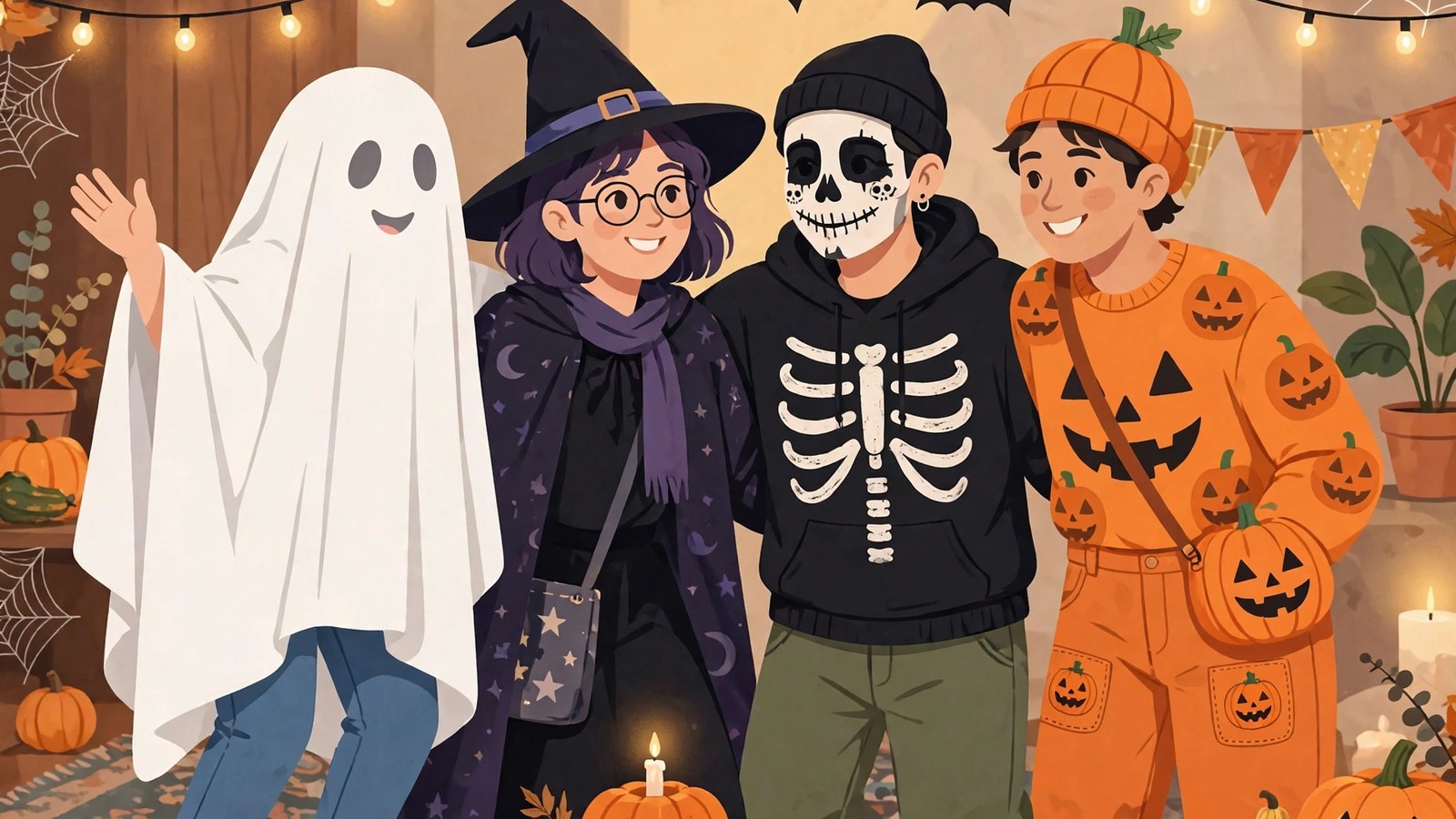
Ghost. A white sheet with eye holes is a classic easy costume, and it still works because it is instantly recognizable. Keep the eye holes large enough to see out of properly and the hem short enough that it does not trip you. Add dark circles around the eyes with makeup, or carry a small lantern.
Skeleton. Black clothes, plus white face paint or a skeleton top. A white base, dark eye sockets, and lines for teeth turn plain black clothing into a costume. A skeleton-print top or a skull mask does the same job if the mask leaves you with clear vision.
Cat. Black clothes, ears on a headband, whiskers drawn with eyeliner, and a tail from a stuffed sock or fabric tucked into a waistband. The same formula works for a dog, a fox, or a deer with small changes to color and ear shape.
Witch. A black dress or black clothes, a pointed hat, and dark lipstick. The hat does most of the work. Add a broom only if you can put it down at the party.
Vampire. Dark clothes, a cape or long dark coat, pale face paint, and a little fake blood at the corner of the mouth. A high collar sells the look. Keep fangs only if you can talk comfortably with them in, and do not add decorative contact lenses unless an eye care professional has examined you and given you a prescription and a proper fitting.
Zombie. Old clothes you do not mind ruining, torn at the hems, with gray-green face paint and dark eyes. Messy hair completes it. The messier it looks, the better it works.
Tourist. A loud shirt, shorts, a camera around your neck, socks with sandals, and a sun hat. It can be assembled entirely from a vacation wardrobe.
Funny Costumes
Funny Halloween costumes work when the joke is visible at a glance. Long explanations kill the humor, so pick an idea that reads in one look.
A couch potato. Brown clothes, a bag of chips in one hand, and a small cushion taped or pinned to your front. It is cheap, comfortable, and reliably gets a laugh.
A traffic cone. An orange outfit, or orange clothes with a white stripe, and a cone-shaped hat made from card. Simple, bright, and unmistakable.
An error message. A plain white T-shirt with “Error 404: Costume not found” written on it in marker. This is the classic last-minute joke costume, and it works best when it is clearly a deliberate choice rather than an accident. Write it neatly and wear it with confidence.
A bunch of grapes. A purple or green top with balloons of the same color pinned or taped to it, and a brown stem made from card on your head. Keep balloons away from flames. It is silly, cheerful, and a good group-adjacent option if several friends each pick a different fruit.
A tourist with a lost sign. Combine the tourist costume above with a cardboard sign saying “I am lost” or a map held upside down. The extra prop turns a plain outfit into a joke.
A human spam email. A white T-shirt reading “You have won! Click here” with a large arrow. Like the error message, it works because everyone recognizes it instantly.
The rule for funny costumes is commitment. A joke costume worn half-heartedly looks like you forgot to dress up. Wear it properly and carry the prop.
Cute Costumes
Cute Halloween costumes are about soft colors, friendly animals, and familiar characters rather than scares. They photograph beautifully in daylight and in party lighting.
Pumpkin. An orange dress or top, a green headband or hat for the stalk, and a friendly face painted on or pinned on. It works for adults as well as children and looks good in daylight as well as at night.
Bee. A yellow and black striped top, black leggings, wings made from net or card, and antennae on a headband. Stripes do most of the work, so this is a genuinely quick costume.
Bunny. White or pastel clothes, bunny ears on a headband, a painted nose and whiskers, and a fluffy tail pinned to the back. Comfortable enough to wear all evening.
Fairy. A light dress or skirt, wings, and a little shimmer makeup. Pastel colors read as sweet; darker colors with the same wings read as a dark fairy. Use only products made for skin, and keep glitter away from the eyes unless the label says it is approved for use near the eyes.
Strawberry. A red dress or top, a green collar or hat for the leaves, and small white dots for seeds. Bright, cheerful, and instantly recognizable.
Mouse. Gray clothes, round ears, a thin tail, and whiskers. A quiet, charming option that needs almost nothing bought specially.
Cute costumes suit people who want to look festive without face paint that takes an hour to remove. Most rely on color and one or two accessories rather than full makeup.
Simple Costumes
Simple Halloween costumes are the quiet heroes of the season: one idea, a few pieces, no fuss. They overlap with easy costumes, but the emphasis is on costumes that look deliberate and put together without much effort.
Wednesday-style school look. A black dress with a white collar, dark braids, and a deadpan expression, described in generic terms only. The collar is the key detail; without it, it is just a black dress.
Mummy. Old white or cream clothes wrapped with strips of bandage, gauze, or torn fabric. Leave gaps so you can move, keep the wrapping loose, and leave your face, neck, hands, and joints free. A little gray face paint adds to the effect.
Scarecrow. A checked shirt, jeans, a straw hat, and straw or raffia poking out of the cuffs and collar, with face paint for a stitched smile. Warm and sturdy for outdoor events. Keep loose straw away from candles and other open flames.
Pirate. A striped top, dark trousers or a skirt, a bandana or hat, and a sash. An eye patch and a short, soft prop sword are optional. Comfortable, adjustable, and suitable for almost any body type.
Angel. White or pale clothes, a halo made from a headband and wire or card, and wings. The halo makes it read as an angel rather than just a white outfit.
Devil. Red or black clothes, horns on a headband, and a tail. Red lipstick completes a look that is the natural counterpart to the angel.
Fortune teller. A long skirt, a headscarf, layered jewelry, and a crystal ball or deck of cards as a prop. The prop gives you something to do at a party: offer to read fortunes as a joke.
Simple costumes are also the best starting point for anyone who dislikes dressing up but still wants to join in. One or two deliberate details signal effort without a full transformation.
DIY Costumes From Your Wardrobe
DIY Halloween costumes built from clothes you already own are cheaper, more comfortable, and often more original than store-bought ones. The trick is to look at your wardrobe with fresh eyes and ask what each piece could represent.
A black dress plus a white collar is a school look; the same dress with a cape is a vampire; with a pointed hat it is a witch. A suit with a red tie and slicked hair is a business look by day and, with pale makeup and fake blood, a vampire or zombie by night. A white shirt with a tie and a name badge is an office worker. Add a briefcase and a vacant stare and you are a zombie office worker.
Denim is useful. Jeans, a checked shirt, and boots make a cowboy or a farmer; add a straw hat and you are a scarecrow. A denim jacket with patches and badges becomes a festival-goer or a biker. A leather jacket, dark jeans, and sunglasses are a rock star or a secret agent, depending on what you add.
Color is your shortcut. An all-red outfit is a devil, a ladybug, or a mailbox. All white is a ghost, an angel, or a snowman. All black is a cat, a witch, a ninja, or a vampire, and the accessory decides which. All green is a witch, a fairy, or a plant. Pick a color you own in quantity, then add the one accessory that names the character.
Props from around the house finish a wardrobe costume: a broom, an umbrella, a book, a basket, a hat, or a scarf. A single well-chosen prop can turn ordinary clothes into a costume at no cost. The best DIY costumes are the ones where every piece earns its place.
Last-Minute Costumes
Last-minute Halloween costumes are for the invitation that arrived today, the party you forgot about, or the costume that fell apart an hour before you left. Everything here can be assembled in under thirty minutes with things found at home. Timings are practical estimates for these simple builds, not guarantees for every wardrobe.
Sheet ghost. White sheet, eye holes, done. The fastest costume there is.
Black cat. Black clothes, eyeliner whiskers, ears improvised from card on a headband or clips. Five minutes if you already own something black.
Tourist. Loud shirt, shorts, sunglasses, camera or phone on a strap. Ten minutes, and it gets funnier the more committed you are.
Error message T-shirt. A plain T-shirt and a marker. Write the message, let it dry, wear it. Two minutes of actual work.
Mummy. Bandages or strips of old fabric wrapped over clothes. Ten minutes, and the worse it looks, the better it works.
Zombie. Old clothes, messy hair, dark eye makeup, and a bit of fake blood if you have it. Fifteen minutes.
Gardener with a plant. Ordinary clothes, a watering can or small potted plant as a prop, and a few leaves tucked into a hat. Absurd, easy, and memorable.
An “I am a” sign. Card on a string around your neck reading “I am a last-minute costume”. Honest, funny, and ready in thirty seconds.
Halloween costumes for women. Most ideas in this guide work for anyone, and several adapt especially well as last-minute costumes for women: a black dress with a pointed hat is a witch, the same dress with a cape is a vampire, and black clothes with ears and whiskers are a cat. A long skirt with a sash and a bandana makes a pirate, while a light dress with wings makes a fairy. The same rules apply: one clear signal, shoes you can walk in, and face paint rather than a mask if you will be out after dark.
The secret of a good last-minute costume is not to apologize for it. Wear it as if it were the plan all along, and it usually lands better than a rushed store-bought costume that does not fit.
Costumes for College Parties
Halloween costumes for college parties have their own rules. The party will be crowded, warm, and dark, and you will be dancing, so the costume needs to survive all three. Avoid anything trailing on the floor, anything with parts that stick out at face height, and anything you cannot sit down in.
Group-adjacent ideas work well at college parties even if you arrive alone: a pirate, a vampire, a cat, or a skeleton is easy to recognize and pairs naturally with friends’ costumes. Bright colors and white elements show up better in photos taken in dark rooms than an all-black outfit.
Comfort is practical. Shoes you can dance in, a costume that lets you use your phone, and face paint rather than a mask that steams up are choices you will be grateful for by midnight. If your costume has a prop, make sure you can put it down safely, and keep any prop short, soft, and flexible.
Budget matters too. College parties are where wardrobe DIY costumes shine: a black dress and a cape, jeans and a checked shirt, or a striped top and a bandana all cost little and look deliberate.
Niche Ideas Worth Trying
Niche Halloween costumes are for people who want something less common than a witch or a vampire, without committing to a full character costume.
A moth. Brown or gray clothes, large wings made from fabric or card, and feathery antennae. A gentler alternative to butterflies, best when the wings are big enough to read across a room.
A jellyfish. A clear umbrella as the dome, with ribbons or strips of fabric hanging from the edge as tentacles, over a plain outfit. Striking in a dark room if the ribbons catch the light. Keep tentacles short enough that they do not trail on the floor.
A garden gnome. A pointed hat, a beard made from cotton or fabric, a belt, and a tunic. Funny because it is so unexpected at a party, and warm and comfortable.
A deck of cards. A white outfit with a large card shape pinned front and back: a queen of hearts, an ace of spades, or a joker, drawn in generic form with numbers, letters, and suit symbols only.
A traffic light. A black outfit with three circles, red, amber, and green, pinned down the front. A visual joke that works at a glance, and it pairs well with a friend dressed as a pedestrian crossing in black and white stripes.
A storm cloud. Gray clothes, cotton or stuffing attached to a hat or shoulders, and lightning bolts cut from yellow card. Soft, funny, and comfortable. Keep loose stuffing away from open flames.
A book. A rectangular board worn front and back, decorated as a book cover in your own words and design, over plain clothes. Pick a comic title of your own: a cookbook, a dictionary, or a deliberately dull book. Do not copy a real book cover.
Niche costumes reward a little extra thought, but they do not need extra money. Most are built from card, fabric, and things already in the house.
Costume Safety: Visibility, Fit, Fire and Makeup
Safety is part of the costume, especially for children, for anyone walking after dark, and for parties with candles. The points below follow guidance from the U.S. Food and Drug Administration, issued with the Consumer Product Safety Commission and the Centers for Disease Control and Prevention, and the FDA page on novelty makeup. They are general guidance, not advice for a specific person.
Visibility and fit. Wear bright, reflective costumes or add strips of reflective tape, carry a flashlight or glow stick after dark, and make sure the costume is not so long that you are in danger of tripping. Pin or hem dragging fabric and wear well-fitting shoes. For children, choose the right size and walk in a group or with a trusted adult.
Masks and vision. Wear makeup and hats rather than costume masks that can obscure your vision. A mask can make it hard to see where you are going and to watch out for cars. If a mask is worn, make sure the eye holes are large enough for clear vision and that breathing is not restricted, and test the fit indoors first.
Fire and flammability. Wear costumes that say “flame resistant” on the label. If you make your costume, use flame-resistant fabrics such as polyester or nylon. Flame resistant does not mean fireproof, so keep every costume, wig, and loose or trailing piece away from lit candles, luminaries, fire pits, and heaters, and use battery lights or glow sticks in jack-o’-lanterns where costumes may brush past them.
Novelty makeup. Test makeup at least 24 to 48 hours in advance: put a small amount on the arm of the person who will wear it, and if a rash, redness, swelling, or other irritation develops, do not use it on the face. Follow all directions, do not use things that are not intended for skin, and throw away face paint with a very bad smell, which could be a sign of contamination. Check the FDA list of color additives for approval for the intended use, especially near the eyes: some colors are approved for skin but not near the eyes, and no fluorescent color is allowed near the eyes. If a label says a product is not for use near the eyes, believe the label even if a package picture shows it there. Do not go to bed with makeup on, and remove it as the label directs.
Decorative contact lenses and props. Do not wear decorative or colored lenses unless an eye care professional has given you a proper fitting and instructions. Lenses bought without a prescription can fit poorly and can lead to significant risks of eye injury, including blindness. Keep swords and similar props short, soft, and flexible, and for very young children remove small parts that could detach and become a choking hazard.
Putting It All Together
The best Halloween costume is the one you actually enjoy wearing. Pick the idea that fits your evening, your budget, and your patience, add one clear signal that names the character, and make sure you can move, see, and dance in it.
Start with what you own and add one strong accessory. The costume does not need to be perfect; it needs to be recognizable, comfortable, and fun.
Frequently Asked Questions
What are the easiest Halloween costume ideas?
The easiest ideas use one clear signal and clothes you already own: a sheet ghost, a black cat with ears and whiskers, a witch with a pointed hat, a vampire with a cape, and a skeleton with face paint on black clothes. Each needs no sewing. If someone cannot tell what you are within three seconds, add one stronger signal.
How can I make a Halloween costume from my wardrobe?
Pick a color base you own in quantity, such as all black, all white, all red, or all green, then add the one accessory that names the character. A black dress becomes a witch with a pointed hat or a vampire with a cape. Jeans and a checked shirt become a farmer, a cowboy, or a scarecrow with a straw hat. Finish with one household prop, such as a broom, a book, or a basket.
What is a good funny Halloween costume that reads at a glance?
Choose a visual joke with no explanation needed: an error message T-shirt reading “Error 404: Costume not found”, a traffic cone in orange with a white stripe, a couch potato with a cushion and a bag of chips, or a bunch of grapes made from balloons on a matching top. Wear the prop properly and do not apologize for the costume.
What are cute Halloween costumes without heavy makeup?
Pumpkin, bee, bunny, fairy, strawberry, and mouse costumes rely mainly on color and one or two accessories, such as a striped top and antennae for a bee or ears and a painted nose for a bunny. They suit people who want a festive look without heavy face paint, provided any makeup used is made for skin and patch tested first.
What can I wear as a last-minute Halloween costume?
A sheet ghost, a black cat, a tourist, an error message T-shirt, a mummy in bandages or fabric strips, a zombie in old clothes, or a simple sign costume. All can be assembled from things at home in under thirty minutes. Choose the base outfit first, add one focal point, then check fit, vision, and visibility.
What should I wear to a college Halloween party?
Choose a costume that survives a crowded, warm, dark room: nothing trailing, nothing you cannot sit or dance in, and shoes you can dance in. Pirate, vampire, cat, skeleton, and ghost costumes are easy to recognize and can be built cheaply from wardrobe basics.
How do I make a costume safer for walking after dark?
Add reflective tape to the costume and a bag, carry a flashlight or glow stick, and prefer bright colors where the character allows it. Use makeup rather than a mask that can obscure vision, hem fabric that could trip you, and wear well-fitting shoes. Children should walk in a group or with a trusted adult.
Is face paint safer than a mask?
For vision, makeup and hats are generally preferred to masks that can obscure your vision. Makeup has its own rules: use only products intended for skin, test a small amount on the arm at least 24 to 48 hours in advance, check that colors are approved for use near the eyes before using them there, follow the label, and remove makeup before bed.
What fabric should a homemade costume use?
Look for a “flame resistant” label on a bought costume. If you make your costume, the FDA advises flame-resistant fabrics such as polyester or nylon. No fabric makes a costume fireproof, so keep loose, billowing, or trailing fabric away from candles and other open flames.
Keep reading: Easy Last-Minute Halloween Costumes
Keep reading: Last Minute Halloween Costumes for Women: Easy Ideas From Clothes You Already Own
Keep reading: Last-Minute Halloween Costumes for Men
Keep reading: Last-Minute Halloween Costumes for Kids: Fast Ideas From Clothes You Already Own
Keep reading: Last-Minute Couples Halloween Costumes
Keep reading: Last-Minute Family and Group Halloween Costumes
Keep reading: Couples and Group Halloween Costumes: Ideas for Pairs, Duos and Whole Crews
Keep reading: Character and Pop-Culture Halloween Costumes: Storybook, Horror, TV and Music Looks
Sources & references
- Encyclopaedia Britannica, "Halloween". Page opened and read 29 October 2026. Supports the points that Halloween is observed annually on October 31, that the name derives from All Hallows' Eve, the evening before All Saints' Day, that Halloween is believed to have connections to the festival of Samhain among the Celts of ancient Ireland, that people sometimes wore masks and other disguises, and that dressing up in costumes and masks is a Halloween tradition.
- U.S. Food and Drug Administration, "Halloween Safety Tips: Costumes, Candy, and Colored Contact Lenses". Page opened and read 29 October 2026; the page states its tips are from the FDA, the Consumer Product Safety Commission, and the Centers for Disease Control and Prevention. Supports the points on flame resistant labels and flame-resistant fabrics such as polyester or nylon for homemade costumes, bright and reflective costumes and reflective tape, costume length and tripping, makeup and hats rather than masks that can obscure vision, testing makeup at least 24 to 48 hours in advance and signs of a possible allergy, checking FDA-approved color additives especially around the eyes, and not wearing decorative contact lenses without an eye care professional, a proper fitting, and instructions.
- U.S. Food and Drug Administration, "Novelty Makeup". Page opened and read 29 October 2026. Supports the points that face paint lets you see better than a mask can, following directions, not using things not intended for skin, discarding face paint with a very bad smell as a possible sign of contamination, believing a label that says a product is not for use near the eyes, testing a dab on the arm for a couple of days before face use, checking the Summary of Color Additives and whether a color is approved for use near the eyes, that none of the approved fluorescent colors are allowed for use near the eyes, that luminescent zinc sulfide is the only approved luminescent color and is not for use near the eyes, not going to bed with makeup on, and removing makeup as the label directs.
- National Fire Protection Association, Halloween fire safety tips, as reproduced in fire service and public safety releases checked 29 October 2026. Supports, in qualified form only, the general points to avoid billowing or long trailing fabric, to choose material that will not easily ignite if it comes into contact with heat or flame, to give children flashlights or glow sticks, and to use a glow stick or battery-operated candle in a jack-o'-lantern. The NFPA's own page was not opened directly in this pass, so QA should open it directly before publication if any NFPA-specific wording is to be relied on beyond these general points.


