Short answer
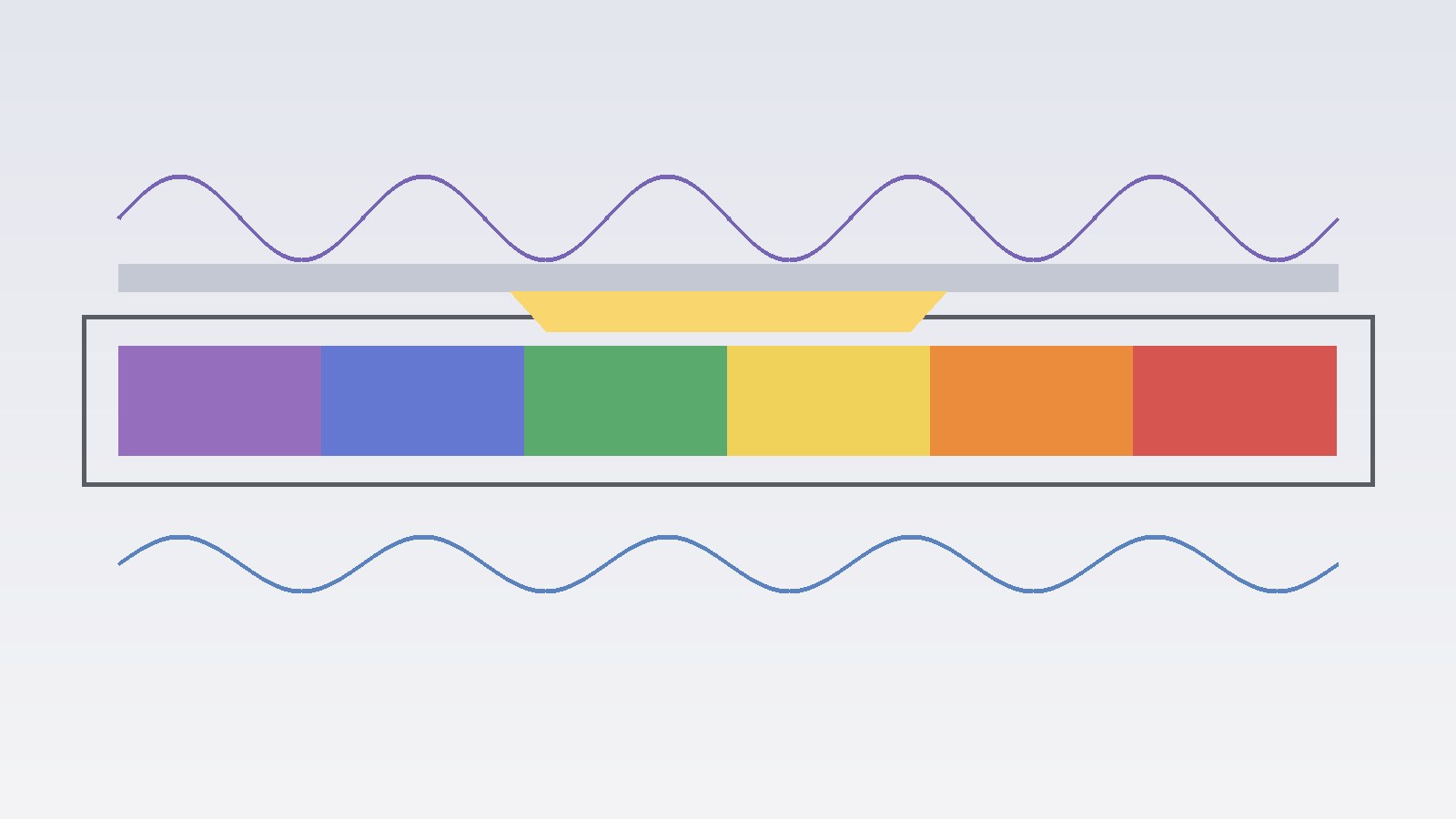
- Visible light is the part of the electromagnetic spectrum that the human eye can detect. Its wavelength is usually given as roughly 380 to 700 nanometers, following NASA, or roughly 400 to 700 nanometers, following the common textbook convention used by OpenStax. One nanometer is one billionth of a meter, so the whole visible range spans only about 320 nanometers from end to end. That is an extremely narrow slice of the full electromagnetic spectrum. Within that range, wavelength determines color in a systematic way. Violet has the shortest visible wavelength, around 380 to 400 nanometers. Red has the longest visible wavelength, around 700 nanometers. Between them, in order of increasing wavelength, come blue, green, yellow, and orange. Shorter wavelength means higher frequency and higher energy per photon. Longer wavelength means lower frequency and lower energy per photon. That ordering explains a surprising amount of everyday optics, including why the sky looks blue and why sunsets look red. Wavelength is not the same thing as brightness, and it is not the same thing as color as experienced in the mind. Brightness depends mainly on how much light arrives. Color as experienced depends on the mix of wavelengths reaching the eye, on the lighting, and on surrounding colors. Wavelength is the physical quantity that can be measured with an instrument. Color is the perceptual result that follows when that physical quantity meets a human visual system. Keeping those two levels apart prevents many common confusions about light.
Introduction
When white light passes through a prism, it spreads into a band of colors. That spread is not a trick of the prism. It displays a property present in the light all along. Each color corresponds to a different wavelength, and the prism separates the colors because it bends each wavelength by a slightly different amount. The same separation happens on a larger scale in a rainbow, where water drops in the air act like many small prisms.
This article answers a simple question with care: what is the wavelength of visible light? It explains the range, the color order, the relation to frequency and energy, and everyday effects that follow from wavelength, from the blue sky to the red of a sunset. It touches on photon energy only far enough to show how wavelength, frequency, and energy are linked, and on wave-particle duality only far enough to place wavelength in context. Fuller accounts of those two topics are separate, and they are named where the boundary matters so that this article does not duplicate them.
What Wavelength Means
A wave can be pictured as a repeating pattern moving through space. Wavelength is the distance between two matching points in that pattern, for example from one crest to the next crest. For a wave on water, wavelength is easy to see: it is the distance between neighboring crests. For light, the same definition applies, but the scale is smaller, and the wave is an electromagnetic wave, an oscillation of electric and magnetic fields that can travel through empty space without needing a material medium.
Frequency is the companion quantity to wavelength. Frequency counts how many wave cycles pass a fixed point in one second, and it is measured in hertz, where one hertz means one cycle per second. For light in a vacuum, wavelength and frequency are linked by the speed of light. The relation is written as c equals lambda times f, where c is the speed of light in a vacuum, lambda is wavelength, and f is frequency. Because c is fixed in a vacuum, wavelength and frequency move in opposite directions. A shorter wavelength therefore means a higher frequency, and a longer wavelength means a lower frequency.
Three units dominate discussion of visible light. The nanometer, abbreviated nm, is the most common, because visible wavelengths are hundreds of nanometers. The micrometer is also used: one micrometer equals 1,000 nanometers, so the visible range is about 0.38 to 0.70 micrometers. The meter is the base SI unit, and visible wavelengths in meters are written in scientific notation, for example 5.50 times 10 to the power of negative 7 meters for green light near 550 nanometers. All three units describe the same physical quantity. The choice is a matter of convenience, not a change in meaning.
The Wavelength Range, and Why Sources Differ
The most quoted answer to the question in the title is 400 to 700 nanometers. OpenStax Astronomy uses roughly 400 to 700 nanometers for visible light, and many school and university texts use the same round numbers. NASA Science, in its visible light explainer, gives a slightly wider typical range: the human eye can typically detect wavelengths from 380 to 700 nanometers, with violet at around 380 nanometers and red at around 700 nanometers. OpenStax College Physics gives yet another pair of endpoints, 400 to 750 nanometers, and adds a useful explanation: the retina can respond to some lower ultraviolet frequencies, but those wavelengths do not normally reach the retina because they are absorbed by the cornea and the lens of the eye.
These differences should not be read as disagreements about physics. They are differences in convention and in what is being described. The sensitivity of the human eye does not drop from full to zero at a single wavelength. It fades gradually at both ends of the range. Near the violet end, sensitivity falls off as wavelengths get shorter and pass into the ultraviolet. Near the red end, sensitivity falls off as wavelengths get longer and pass into the infrared. Any pair of endpoints is therefore a choice about where to draw a line on a gradual slope. A source that wants round numbers for teaching will choose 400 and 700. A source that wants to include the dim violet response that many people can detect under good conditions will extend the short end to 380. A source that emphasizes the long tail of red sensitivity will extend the long end toward 750.
For most practical purposes, the 400 to 700 nanometer range is the answer to give, and the 380 to 700 nanometer range is the safe answer when following NASA. If a reader sees 380 to 750 nanometers in another source, that source is not wrong in any important sense. It has chosen wider endpoints on the same gradual slope. What matters is that the reader understands three points: the visible range is narrow, it sits between ultraviolet on the short wavelength side and infrared on the long wavelength side, and its endpoints are approximate by nature. A claim that visible light ends at exactly 700.0 nanometers for every person in every condition would be too precise for the biology involved, and this article does not make that claim.
The Colors in Order, From Violet to Red
The visible spectrum is usually listed as seven named colors: violet, indigo, blue, green, yellow, orange, and red. That list is a teaching aid, not a law of nature. The spectrum itself is continuous, with no sharp lines between colors. A rainbow does not contain seven separate bands with gaps between them. It contains a smooth gradation, and the names are imposed on that gradation for convenience. Different languages divide the gradation differently, and even within English, the boundary between blue and green, or between orange and yellow, is a matter of judgment rather than physics.
With that caution, the order is fixed. From shortest wavelength to longest wavelength, the sequence runs violet, blue, green, yellow, orange, and red, with indigo placed between blue and violet in the traditional seven color list. The approximate wavelengths often quoted for the named colors are useful as landmarks, and they should be read as approximate centers of broad regions, not as exact values that define each color. Violet sits near 400 nanometers and below, in the NASA convention near 380 nanometers. Blue sits near 450 to 495 nanometers. Green sits near 495 to 570 nanometers. Yellow sits near 570 to 590 nanometers. Orange sits near 590 to 620 nanometers. Red sits near 620 to 700 nanometers and beyond, fading into infrared.
Two points about these landmarks deserve emphasis. First, the width of each named region is uneven. Green occupies a wide stretch of the visible range, while yellow occupies a narrow one. That unevenness reflects human color naming, not equal divisions of wavelength. Second, some colors that people see do not correspond to a single wavelength. Magenta, for example, is perceived when the eye receives a mix of short wavelength blue light and long wavelength red light, with little green in between. There is no single wavelength of magenta light, because magenta is not a spectral color. It is a perceptual color produced by a combination. The same is true of pink, brown, and white. White is the perception produced when the eye receives a broad mix of visible wavelengths, as in sunlight or in light from a lamp designed to mimic it.
| Color | Approximate wavelength | Direction of change | | Violet | Around 380 to 450 nanometers | Shortest visible wavelengths, highest frequency and energy per photon | | Blue | Around 450 to 495 nanometers | Shorter than green, longer than violet | | Green | Around 495 to 570 nanometers | Middle of the visible range | | Yellow | Around 570 to 590 nanometers | Narrow band between green and orange | | Orange | Around 590 to 620 nanometers | Longer than yellow, shorter than red | | Red | Around 620 to 700 nanometers | Longest visible wavelengths, lowest frequency and energy per photon |
Note: indigo is traditionally placed between violet and blue and is folded into that boundary here.
Wavelength, Frequency, and Energy
Wavelength, frequency, and energy are three ways of describing the same light, and they are linked by two relations that every student of the topic should be able to use. The first relation connects wavelength and frequency through the speed of light: c equals lambda times f. The second relation connects energy and frequency through the Planck constant: E equals h times f, where E is the energy of one photon, h is the Planck constant, and f is frequency. Combining the two relations gives a third form that is often the most useful for visible light: E equals h times c divided by lambda. In that form, energy is inversely proportional to wavelength. Shorter wavelength means higher energy per photon. Longer wavelength means lower energy per photon.
The constants in these relations are now exact in the SI system. The speed of light in a vacuum, c, is 299,792,458 meters per second, exactly, as stated by NIST. The Planck constant, h, is 6.62607015 times 10 to the power of negative 34 joule seconds, exactly, as stated by NIST. Because both constants are exact by definition, the calculated frequencies and energies in this article are arithmetic consequences of the chosen wavelengths, not new measurements. They are given to a sensible number of significant figures, and small differences in the last digit between sources reflect rounding, not disagreement about physics.
The worked examples below use the vacuum speed of light. In air, light travels slightly more slowly, and the wavelength in air is slightly shorter than the wavelength in a vacuum for the same frequency. For most everyday purposes, the difference is negligible, and textbooks commonly quote vacuum values or air values without distinguishing them. A reader doing precise laboratory work should check whether a quoted wavelength is a vacuum wavelength or an air wavelength. A reader learning the topic should not worry about the distinction, because it changes the numbers by far less than the width of a named color band.
| Light | Wavelength | Frequency, from c divided by wavelength | Energy per photon, from h times c divided by wavelength | | Violet, near 400 nanometers | 400 nanometers | About 7.49 times 10 to the power of 14 hertz, or about 749 terahertz | About 4.97 times 10 to the power of negative 19 joules, or about 3.10 electron volts | | Blue, near 450 nanometers | 450 nanometers | About 6.66 times 10 to the power of 14 hertz, or about 666 terahertz | About 4.41 times 10 to the power of negative 19 joules, or about 2.76 electron volts | | Green, near 550 nanometers | 550 nanometers | About 5.45 times 10 to the power of 14 hertz, or about 545 terahertz | About 3.61 times 10 to the power of negative 19 joules, or about 2.25 electron volts | | Red, near 650 nanometers | 650 nanometers | About 4.61 times 10 to the power of 14 hertz, or about 461 terahertz | About 3.06 times 10 to the power of negative 19 joules, or about 1.91 electron volts | | Deep red, near 700 nanometers | 700 nanometers | About 4.28 times 10 to the power of 14 hertz, or about 428 terahertz | About 2.84 times 10 to the power of negative 19 joules, or about 1.77 electron volts |
Two patterns in the table are worth noticing. First, the frequency range of visible light is roughly 4.3 to 7.5 times 10 to the power of 14 hertz, which is 430 to 750 terahertz. Second, the energy range is roughly 1.77 to 3.10 electron volts per photon across the 400 to 700 nanometer range. The electron volt is a convenient unit for photon energies at this scale, because the joule values are inconveniently small. One electron volt equals about 1.602 times 10 to the power of negative 19 joules.
The distinction between wavelength and energy is important for a common misunderstanding. A brighter light does not have a different wavelength from a dimmer light of the same color. Brightness is increased by sending more photons, not by changing the wavelength or the energy of each photon. A bright red light and a dim red light can have the same wavelength, around 650 nanometers, and the same energy per photon, around 1.91 electron volts. The bright light delivers more photons per second. Conversely, a dim violet light can have more energy per photon than a bright red light, because violet photons each carry more energy, even if fewer of them arrive. This distinction between how many photons arrive and how much energy each one carries is central to understanding both the photoelectric effect and everyday lighting, and it is treated in full in the separate account of photon energy.
Where Visible Light Sits in the Spectrum
The electromagnetic spectrum runs from gamma rays, with wavelengths shorter than about 0.01 nanometers, through X rays, ultraviolet, visible light, infrared, microwaves, and radio waves, with wavelengths longer than a meter and, for the longest radio waves, longer than a kilometer. Visible light occupies a tiny fraction of that span. OpenStax Physics notes that the visible frequencies, roughly 4.0 to 7.9 times 10 to the power of 14 hertz in its account, form a narrow range compared with a spectrum that spans about 20 orders of magnitude.
On the short wavelength side of visible light sits ultraviolet, from about 10 to 400 nanometers in the common textbook division. Ultraviolet has shorter wavelengths, higher frequencies, and higher energies per photon than visible light. That higher energy is why ultraviolet can cause sunburn and, with enough exposure, damage to skin and eyes, while visible light at ordinary intensities does not have the same effect through the same mechanism. The boundary is gradual, as noted above, and the cornea and lens absorb much of the near ultraviolet before it reaches the retina.
On the long wavelength side sits infrared, from about 700 nanometers to about 1 millimeter in the common division. Infrared has longer wavelengths, lower frequencies, and lower energies per photon than visible light. It is felt as heat when absorbed by skin, and it is used in remote controls, thermal imaging, and night vision devices. The discovery of infrared is a useful historical marker: in 1800, William Herschel placed a thermometer just beyond the red end of a spectrum produced by a prism and found that it still registered heating, even though no visible light fell there. That experiment showed that the spectrum extends beyond what the eye can see, and it opened the study of invisible radiation.
How the Eye Turns Wavelength Into Color
The human retina contains two main types of photoreceptor cells: rods and cones. Rods enable vision in low light, but they do not support color vision. Cones enable color vision in brighter light. Humans typically have three types of cones, sensitive to ranges of wavelengths perceived broadly as red, green, and blue. The National Eye Institute describes photoreceptors as cells in the retina that convert light into electrical signals sent to visual centers in the brain, with rods enabling low light vision and cones enabling color vision through three cone types. Color perception arises from the pattern of activity across those three cone types, combined with further processing in the retina and brain.
This three cone system explains why wavelength and perceived color are related but not identical. A single wavelength near 550 nanometers stimulates the green sensitive cones most strongly, and is perceived as green. A mix of wavelengths near 650 nanometers and near 450 nanometers, with little in between, stimulates the red sensitive and blue sensitive cones together, and is perceived as magenta, even though no single magenta wavelength exists. The eye does not measure wavelength directly, like a spectrometer does. It samples the light through three broad sensitivity curves, and the brain reconstructs a color experience from those samples. That reconstruction is reliable for everyday life, and it is the reason that color reproduction in photography, printing, and displays is possible.
Wavelength at Work: Prisms, Rainbows, Skies, and Sunsets
Wavelength becomes visible in everyday life whenever light is separated, scattered, or absorbed in a wavelength dependent way. The prism is the demonstration. When white light enters a prism, each wavelength is bent, or refracted, by a slightly different amount. Violet is bent more than red, so the colors spread out into a spectrum. NASA describes the same effect for visible light passing through a prism: the wavelengths separate into the colors of the rainbow because each color is a different wavelength. A diffraction grating separates wavelengths by a different mechanism, interference, but the result is similar: a spectrum ordered by wavelength.
The blue sky is a scattering effect, not a separation effect. Sunlight entering the atmosphere is scattered in all directions by air molecules. Shorter wavelengths are scattered more strongly than longer wavelengths. NOAA and NASA Space Place both give the everyday version: blue light is scattered more than other colors because it travels as shorter, smaller waves, and that is why the sky looks blue most of the time. Violet is scattered even more strongly than blue, but the sky does not look violet, for two reasons given: the Sun emits somewhat less violet light than blue light in the relevant range, and the human eye is less sensitive to violet than to blue. The perceived sky color is the result of scattering physics plus eye sensitivity, not scattering physics alone.
Sunsets show the same physics. When the Sun is low, its light travels through a longer path of atmosphere, much blue light is scattered away, and red and orange dominate the direct beam. That is why the Sun looks redder near the horizon. The wavelength at the source has not changed; the atmosphere has removed more short wavelengths than long ones.
Measuring Wavelength, and Common Confusions
One frequent question is whether wavelength changes when light enters a different medium, such as water or glass. The answer requires care, because frequency and wavelength behave differently at a boundary. When light passes from air into glass, its frequency stays the same, because frequency is set by the source. Its speed decreases in the denser medium, and because speed equals wavelength times frequency, its wavelength must decrease by the same factor. When light leaves the glass and returns to air, its speed and wavelength return to near their original values. Most wavelength quotations assume air or vacuum, where the difference is small.
Frequently Asked Questions
What is the wavelength of visible light in nanometers?
Usually roughly 380 to 700 nanometers, following NASA, or roughly 400 to 700 nanometers, following the common textbook convention. One nanometer is one billionth of a meter. The range is approximate because eye sensitivity fades gradually at both ends.
What is the wavelength of visible light in meters and micrometers?
Roughly 3.8 to 7.0 times 10 to the power of negative 7 meters in the NASA convention, or 4.0 to 7.0 times 10 to the power of negative 7 meters in the 400 to 700 nanometer convention. In micrometers, those ranges are 0.38 to 0.70 and 0.40 to 0.70 micrometers.
Which color has the longest wavelength, and which has the shortest?
Red has the longest visible wavelength, around 700 nanometers at the long end of the range. Violet has the shortest visible wavelength, around 380 to 400 nanometers at the short end. Between them, in order of increasing wavelength, come blue, green, yellow, and orange, with indigo traditionally placed between blue and violet.
What is the wavelength of red light, and what is the wavelength of blue light?
Red is usually around 620 to 700 nanometers, with a representative value near 650 nanometers. Blue is usually around 450 to 495 nanometers, with a representative value near 450 to 470 nanometers. These are approximate centers of broad regions, not exact definitions.
How are wavelength, frequency, and energy related?
For light in a vacuum, wavelength and frequency are related by c equals lambda times f, where c is the speed of light. Frequency and photon energy are related by E equals h times f, where h is the Planck constant. Together, these give E equals h times c divided by lambda. Shorter wavelength therefore means higher frequency and higher energy per photon, and longer wavelength means lower frequency and lower energy per photon.
What is the frequency of visible light?
Visible light frequencies are roughly 4.3 to 7.5 times 10 to the power of 14 hertz, or 430 to 750 terahertz, depending on the wavelength endpoints chosen. Red light near 700 nanometers has a frequency near 4.28 times 10 to the power of 14 hertz. Violet light near 400 nanometers has a frequency near 7.49 times 10 to the power of 14 hertz. Green light near 550 nanometers has a frequency near 5.45 times 10 to the power of 14 hertz.
What is the energy of a visible light photon?
Photon energies across the visible range are roughly 1.77 to 3.10 electron volts. A red photon near 700 nanometers carries about 1.77 electron volts. A green photon near 550 nanometers carries about 2.25 electron volts. A violet photon near 400 nanometers carries about 3.10 electron volts. One electron volt equals about 1.602 times 10 to the power of negative 19 joules.
Is the wavelength of visible light the same for everyone?
The wavelengths are the same, but the range a person can detect varies. Age, lens condition, eye health, and lighting affect how much short wavelength light reaches the retina. That is why sources give different endpoints, and why a single exact cutoff for every person would be misleading.
Why is the sky blue, and why are sunsets red?
Air molecules scatter shorter wavelengths more strongly. Blue is scattered more than red, so the daytime sky looks blue. At sunset, sunlight travels through more air, much blue light is scattered away, and red and orange dominate. Violet is scattered even more than blue, but the Sun emits less violet in the relevant range and the eye is less sensitive to violet than to blue.
Does wavelength change in water or glass?
Yes, wavelength changes when light enters a different medium, while frequency stays the same. In glass or water, light travels more slowly than in a vacuum, so its wavelength becomes shorter by the same factor as the speed reduction. When light returns to air, its wavelength returns to near its original value. Most wavelength quotations assume air or vacuum, where the difference is small.
What is the difference between wavelength and color?
Wavelength is a physical property measurable with an instrument. Color is the perceptual result when light reaches the eye and is processed by the retina and brain. Many perceived colors, including magenta, pink, brown, and white, are produced by mixes of wavelengths, not by a single wavelength.
How is wavelength different from brightness?
Brightness depends mainly on how much light arrives. Wavelength determines the color category and the energy per photon, not the total amount of light. A bright red light and a dim red light can share the same wavelength; the bright light delivers more photons per second.
Keep reading: Energy of Light Definition
Keep reading: The Wave-Particle Duality
Sources & references
- NASA Science, Visible Light. Page opened and read 29 October 2026. Covers the typical human detection range of 380 to 700 nanometers, violet at around 380 nanometers, red at around 700 nanometers, cone shaped cells as receivers tuned to that band, and separation of wavelengths into rainbow colors by a prism.
- OpenStax, Astronomy 2e, section 5.2, The Electromagnetic Spectrum. Page opened and read 29 October 2026. Covers visible light as electromagnetic radiation with wavelengths between roughly 400 and 700 nanometers, ultraviolet as intermediate between X rays and visible light, infrared beyond visible light, and the evolutionary fit between human vision and sunlight reaching Earth surface.
- OpenStax, College Physics 2e, section 24.3, The Electromagnetic Spectrum. Page opened and read 29 October 2026. Covers visible light as wavelengths between 400 and 750 nanometers, red as lowest frequency and longest wavelength, violet as highest frequency and shortest wavelength, retinal response to low ultraviolet frequencies, and absorption by the cornea and lens.
- OpenStax, Physics, section 15.1, The Electromagnetic Spectrum. Page opened and read 29 October 2026. Covers visible frequencies from about 4.0 times 10 to the power of 14 per second at the red end to about 7.9 times 10 to the power of 14 per second at the violet end, and the narrowness of the visible range compared with the full spectrum.
- National Institute of Standards and Technology, Meet the Constants. Page opened and read 29 October 2026. Covers the speed of light in a vacuum as 299,792,458 meters per second, and Planck constant as exactly 6.62607015 times 10 to the power of negative 34 joule seconds in the revised SI.
- National Eye Institute, National Institutes of Health, news report on retinal connectomics and color vision circuitry. Page opened and read 29 October 2026. Covers photoreceptors in the retina converting light into electrical signals sent to visual centers in the brain, rods enabling low light vision, cones enabling color vision, and three human cone types sensitive to wavelengths perceived as red, green, and blue.
- National Oceanic and Atmospheric Administration, National Environmental Satellite, Data, and Information Service, Why Is the Sky Blue? Page opened and read 29 October 2026. Covers scattering of sunlight in all directions by gases and particles in the atmosphere, and blue light scattered more than other colors because it travels as shorter, smaller waves.
- NASA Space Place, Why Is the Sky Blue? Page opened and read 29 October 2026. Covers white sunlight as a mix of rainbow colors, separation by a prism, scattering by air molecules, and blue scattered more than other colors because it travels as shorter waves.
- U.S. National Weather Service, Flagstaff, Why Is the Sky Blue? Corroborates the violet-sky explanation: the Sun emits more blue than violet, and the eye is more sensitive to blue than to violet (source identified in the QA record, QA section 2, claim 17).


