Short answer
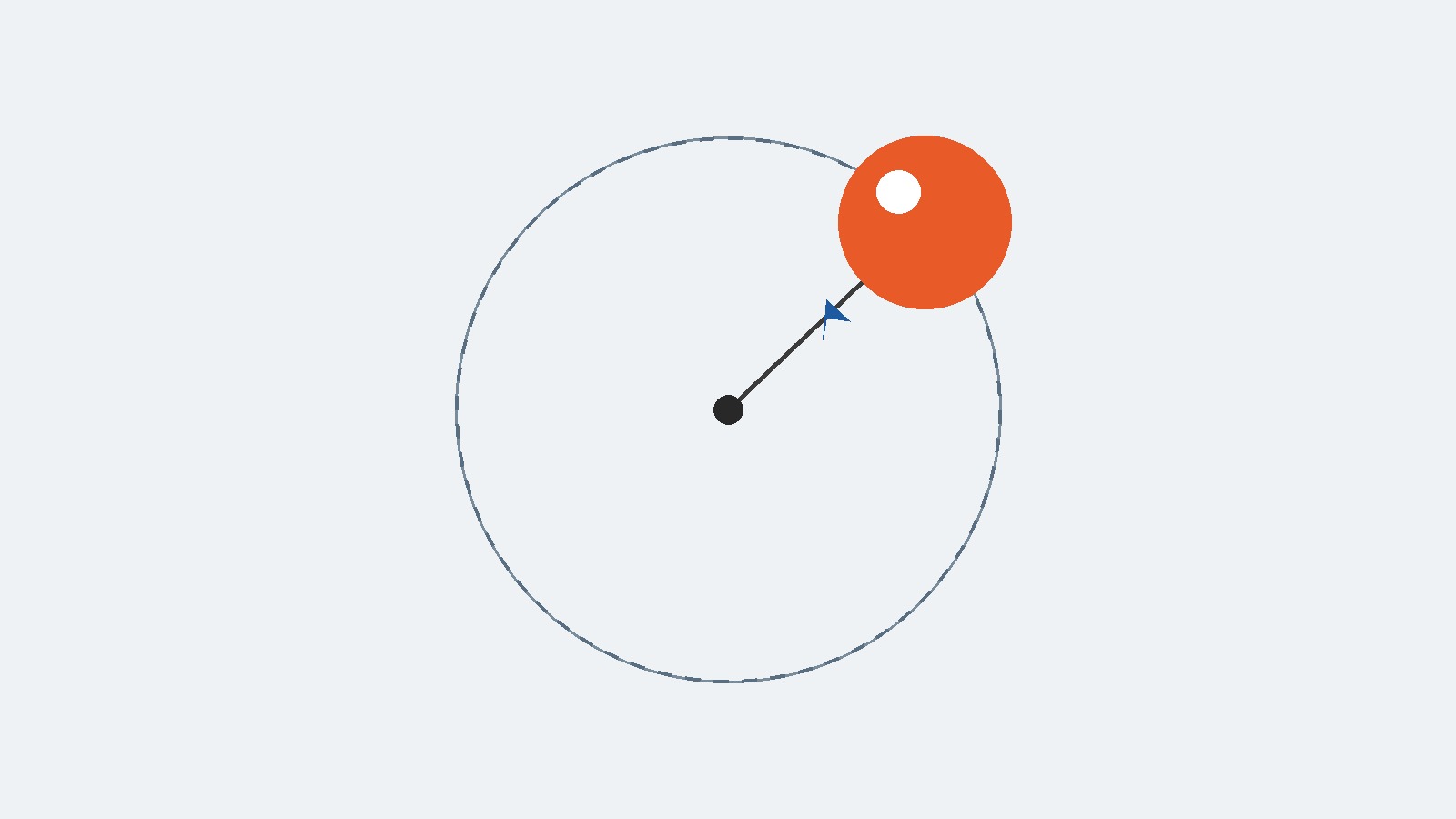
- Centripetal force is the net force directed toward the center of a curved path. It keeps an object turning. Without it, the object would continue in a straight line because of inertia.
- It is a role, not a new kind of force. Gravity, tension, friction, a normal force, or a combination of real forces can play the centripetal role.
- Its direction is always toward the center of curvature and at a right angle to the velocity in uniform circular motion. That is why it changes direction without changing speed in that special case.
- The centripetal force formula is Fc = m v squared / r. Here m is mass, v is speed, and r is the radius of the curved path. It can also be written as Fc = m r omega squared, where omega is angular speed.
- Centripetal acceleration is ac = v squared / r. From Newton's second law, Fc = m ac, so the two formulas describe the same requirement from two angles.
- A larger speed needs a much larger centripetal force, because speed is squared in the formula. Doubling the speed, with the same mass and radius, needs four times the force.
- A larger radius needs a smaller centripetal force for the same mass and speed, because radius is in the denominator. A gentle curve is easier to follow than a tight curve.
- Centripetal vs centrifugal force is the most common point of confusion. In an inertial frame, the real inward force is centripetal. The outward feeling in a turning car is inertia resisting the turn, not a separate outward force pulling you out.
- If the inward force disappears suddenly, the object does not fly straight outward. It moves in a straight line tangent to the circle at the point where the force stopped, following its velocity at that instant.
Introduction
A car turning a corner, a ball swung on a string, and the Moon moving around Earth look very different at first glance. The same question connects them: what keeps each object turning instead of going straight? The answer is centripetal force. It is not a mysterious extra push. It is the name for the inward net force that is already at work in a curved path, whether that force comes from tension, friction, gravity, or a normal force.
This guide explains the definition in plain language, shows where the familiar formula comes from, works through numbers step by step, and clears up the common mix-up with centrifugal force. It is written for a reader who wants to understand the idea and use it in a homework problem, not just memorize one sentence.
What Centripetal Force Means, in Plain Language
The word centripetal comes from ideas meaning center seeking. That etymology is a useful memory aid, but the physics definition is more precise. A centripetal force is any net force that causes uniform circular motion, and it points toward the center of rotation. OpenStax College Physics states this definition directly, and the same chapter explains that the force is perpendicular to linear velocity.
Think of direction as the key. Speed tells you how fast an object moves. Velocity adds direction. An object moving in a circle at constant speed still has changing velocity, because its direction changes at every point. A change in velocity is an acceleration, even when the speedometer reading does not change. That inward acceleration is centripetal acceleration, and the net force that produces it is centripetal force.
A helpful picture is a ball on a string swung in a horizontal circle. The string pulls the ball toward your hand, near the center of the circle, and that tension is the centripetal force. If you let go, the ball leaves along a straight tangent path, in the direction it was moving at release. It is not thrown outward by a radial force. It simply keeps the motion it already had.
The same logic applies to a car on a flat curve. Friction between tires and road points toward the center of the curve, and that friction is the centripetal force. If the road were icy and friction were too small, the car could not turn sharply enough and would run wide, because the inward force available is smaller than the force required.
Why an Object Needs an Inward Force to Turn
Newton’s first law says that an object keeps its state of motion unless a net force acts on it. An object at rest stays at rest, and an object moving in a straight line keeps moving in a straight line, unless a net force changes that motion. NASA education material makes the same point for circular motion: for an object to move in a circle, it needs to change direction, otherwise it would continue in a straight line tangent to the circle, so a force toward the center is required.
This is why a turning object is accelerating even at constant speed. Imagine walking around a roundabout and always facing the direction you are walking. Your speed may stay the same, but your heading changes continuously. Something must keep redirecting you. In physics terms, that redirection is the job of the inward net force.
It also explains why centripetal force does no work in uniform circular motion, in the technical sense of work. Because the force is at a right angle to velocity, it has no component along the motion, so it does not speed the object up or slow it down. It only turns the velocity vector. A separate tangential force can change speed, and then the motion is no longer uniform.
The Centripetal Force Formula, Piece by Piece
The two most useful forms of the formula are:
Fc = m v squared / r
and
Fc = m r omega squared
In these equations, Fc is the centripetal force, m is the mass of the object, v is its speed along the path, r is the radius of the curved path, and omega is its angular speed, meaning how quickly the angle around the center changes.
Centripetal acceleration follows the same pattern:
ac = v squared / r
and
ac = r omega squared
Newton’s second law links force and acceleration: net force equals mass times acceleration. For uniform circular motion, the relevant acceleration is centripetal acceleration, so Fc = m ac. Substituting the expression for ac gives the two force formulas above. OpenStax College Physics presents this derivation in exactly that order, starting from F = m a, then using ac, then giving both forms of Fc.
Units help check a calculation. Mass is in kilograms, speed in meters per second, and radius in meters. Squaring speed, dividing by radius, and multiplying by mass gives kilogram meters per second squared, which is the newton, the SI unit of force. If the answer looks wildly large or small, check whether speed was squared and whether radius is in meters rather than centimeters or kilometers.
Three patterns are worth memorizing. Mass matters in direct proportion: twice the mass needs twice the force at the same speed and radius. Speed matters by its square: twice the speed needs four times the force. Radius matters inversely: twice the radius needs half the force at the same mass and speed. A tight turn at speed therefore demands far more grip than a gentle curve, and a child on a short rope swing feels a stronger pull than on a longer rope at the same speed.
How to Calculate Centripetal Force: Worked Examples
Work through problems in the same order every time. Identify mass, speed, and radius, check the units, choose Fc = m v squared / r when speed is known, or Fc = m r omega squared when angular speed is known, then check whether the answer is sensible.
Example 1: A car on a flat curve
This example is taken from OpenStax College Physics. A 900 kilogram car negotiates a curve of radius 500 meters at 25.0 meters per second. What centripetal force is required?
First, square the speed: 25.0 times 25.0 equals 625. Next, multiply by the mass: 900 times 625 equals 562,500. Then divide by the radius: 562,500 divided by 500 equals 1,125. The required centripetal force is 1,125 newtons.
On a flat, unbanked road, friction supplies that force. OpenStax then finds a minimum coefficient of static friction of 0.13 from the same numbers. A typical dry road can usually supply much more grip than that, so this gentle curve at this speed is not close to the limit, but on a wet or icy road the safe speed falls with the available friction.
Example 2: A ball swung on a string
Suppose a 2 kilogram ball is swung in a horizontal circle of radius 1.5 meters at a speed of 3 meters per second. What tension must the string provide, ignoring the small vertical forces in this simplified horizontal case?
Square the speed: 3 times 3 equals 9. Multiply by the mass: 2 times 9 equals 18. Divide by the radius: 18 divided by 1.5 equals 12. The string must provide 12 newtons of inward force. The centripetal acceleration is speed squared divided by radius, which is 9 divided by 1.5, or 6 meters per second squared. Multiplying that acceleration by the 2 kilogram mass gives the same 12 newtons, which is a good cross check.
Now double the speed to 6 meters per second, keeping the same mass and radius. Speed squared becomes 36. Multiply by 2 to get 72, then divide by 1.5 to get 48 newtons. Doubling the speed quadrupled the force, from 12 newtons to 48 newtons. This is the squared speed effect in action, and it is why spinning an object much faster can snap a weak string even when a slower spin feels easy.
Example 3: An ideally banked curve
A banked road tilts the surface so that part of the normal force points toward the center of the curve. In the ideal case, with no friction needed, the banking angle theta satisfies tan theta = v squared / (r g), where g is the acceleration due to gravity, 9.80 meters per second squared in the OpenStax examples.
OpenStax gives a steeply banked curve of radius 100 meters banked at 65.0 degrees. Rearranging the relation gives 45.8 meters per second, about 165 kilometers per hour, a race track type of example. Without banking, friction alone would have to supply the whole inward force at that speed and radius. In real driving, friction still helps at speeds above or below the ideal speed.
What Supplies the Centripetal Force? Real Forces in Real Situations
A common exam trap is to draw centripetal force as if it were a separate arrow alongside gravity, tension, friction, and the normal force. That double counts the physics. The correct method is to draw the real forces first, then find their net component toward the center, and set that component equal to m v squared / r.
Here are the main suppliers, with the situation where each one usually does the job:
Tension. A string, rope, cable, or chain pulls along its own length toward the anchor. A ball on a string, a tetherball, a child on a swing at the bottom of the arc, and a satellite tethered by a cable all use tension as the inward force, at least in part.
Friction. Friction acts parallel to the surfaces in contact and opposes slipping. On a flat road, friction between tires and road points toward the center of the turn. On a spinning platform, friction between shoes and the surface can keep a rider moving in a circle. Without enough friction, the object cannot turn tightly enough and moves to a wider path.
Gravity. Gravity pulls masses toward each other. For the Moon around Earth, and for a satellite around Earth, gravity supplies the centripetal force. NASA Jet Propulsion Laboratory material describes orbit as a balance: a satellite must travel fast enough that it does not fall back to Earth, but not so fast that it escapes Earth’s gravity entirely. When the balance is right, the satellite keeps falling toward Earth while moving forward fast enough to keep missing it.
Normal force. A surface pushes perpendicular to itself. On a banked curve, part of the road’s push points horizontally toward the center. On a loop ride, the track pushes on the rider. At the top of a loop, gravity and the normal force can both point toward the center. At the bottom, the normal force must be larger, because it must both support the weight and supply the inward force.
A combination. Many real cases need more than one force. A car on a banked curve with friction uses both normal force and friction. A conical pendulum uses tension, whose horizontal component points toward the center while its vertical component balances weight. The rule is always the same: add the real forces as vectors, take the component toward the center, and that is the centripetal force.
Centripetal Force in Orbits
Orbits are the most dramatic example of centripetal force, and also the easiest to misunderstand. A satellite in a circular orbit is not held up by a shelf, and it is not beyond gravity. Gravity is still acting, and it is the centripetal force. NASA Jet Propulsion Laboratory material states that engineers can use Newton’s laws to predict gravitational and centripetal forces at any distance or speed, and that this prediction is what allows orbits to be designed.
For a circular orbit, setting the gravitational force equal to the required centripetal force gives a relationship between orbital speed and radius. Satellite mass cancels out, so a heavy and a light satellite at the same radius need the same orbital speed for a circular orbit, assuming no drag or thrust. Both the gravitational force and the inertia that resists turning scale with mass, so mass drops out of the speed requirement.
Real orbits are often elliptical rather than perfectly circular. Then distance and speed change, and the force is still toward the central body but not always at a right angle to velocity. At any instant, the component of net force toward the center of curvature is the part that turns the path.
If the balance is disturbed, the path changes. If a satellite slows down, gravity supplies more inward force than the circular path at that radius requires, and the orbit tightens. If it speeds up, the required force rises, and if gravity cannot supply it, the path opens out. Drag in very low orbit can slow a satellite over time, which is one reason low satellites need occasional boosts or eventually reenter.
Loops, Rides, and Spinning Machines
A vertical loop makes the changing role of forces easy to see. At the top, gravity and the track’s normal force both point toward the center and add together. At the bottom, gravity points away from the center while the normal force points toward it, so the normal force must be larger to supply the inward net force and support the weight. That is why riders feel heaviest at the bottom and lightest at the top. Ride design therefore sets a minimum speed for the top of a loop.
A centrifuge uses the same principle. A sample in a spinning container follows a circular path because the container wall pushes inward on it. That inward push is the centripetal force. Without that wall, the sample would travel in a straight tangent line.
A washing machine spin cycle is a familiar household version. The drum wall pushes clothes inward as the drum spins, keeping them on a circular path, while water can pass through holes in the drum. The clothes are not pushed outward by a force in the inertial frame. Their inertia resists the inward turn, which is why they press against the wall, and the wall then pushes back inward.
When Circular Motion Is Not Uniform
So far, this guide has focused on uniform circular motion, where speed is constant. Many real motions are nonuniform: a car speeds up while turning, or a pendulum swings through an arc. In those cases, the net force has two parts:
- A radial component, toward the center of curvature, which changes direction. This is the centripetal component, and its magnitude is m v squared / r at that instant.
- A tangential component, along the direction of motion, which changes speed. This component is zero in uniform circular motion and nonzero when the object speeds up or slows down.
The total net force is the vector sum of those two components, so it is not purely inward when speed is changing. A car accelerating out of a turn therefore needs grip for both turning and speeding up, from a limited total.
A swinging pendulum shows the same split. At the bottom of the swing, speed is greatest and tension is greatest, because tension must both balance part of the weight and supply the centripetal force. At the ends of the swing, speed is momentarily zero, so the centripetal requirement is zero at that instant, but gravity still pulls the bob back toward the bottom.
Centripetal Force vs Centrifugal Force
Centrifugal force is often described as an outward force, but that description needs a frame of reference to make sense. In physics, a frame of reference is the viewpoint from which motion is measured. In an inertial frame, which is a frame that is not accelerating, there is no real outward centrifugal force. The inward centripetal force is the real net force, and the outward sensation comes from inertia.
Stand in a car that turns left. Your body tends to continue straight, so you feel pressed against the right side of the car. From the road’s viewpoint, the car door pushes you left, toward the center of the turn, and that push is the centripetal force on you. From inside the turning car, which is an accelerating frame, it can feel as if something pushes you outward. Physicists call that apparent outward effect a fictitious force in a rotating frame, because it appears when the frame itself accelerates, not because another object pushes you outward.
This distinction matters for free body diagrams. In an inertial frame problem, do not add a centrifugal arrow. Draw the real forces, then set the inward component equal to m v squared / r. If a problem explicitly asks about a rotating frame, the centrifugal term is introduced as a bookkeeping device for that frame. Mixing the two frames in one diagram is where most errors happen. Centripetal and centrifugal descriptions are also not an action and reaction pair: Newton’s third law pairs act on two different objects, such as Earth pulling on the Moon and the Moon pulling on Earth.
Common Mistakes and How to Avoid Them
Mistake 1: Adding centripetal force as an extra force. Draw real forces only. Then find the inward sum. If you add both tension and a separate centripetal arrow for the same string, you have counted tension twice.
Mistake 2: Forgetting that speed is squared. A small speed change has a large force effect. Always square the speed before multiplying by mass and dividing by radius.
Mistake 3: Using diameter instead of radius. The formula uses radius, not diameter. If a problem gives a diameter, halve it first. If it gives a circumference, divide by two times pi to get radius.
Mistake 4: Mixing up angular speed and linear speed. Linear speed v equals r times omega. If a problem gives revolutions per minute, convert to radians per second before using Fc = m r omega squared, or convert to linear speed first and use Fc = m v squared / r. Do not insert revolutions per minute directly into either formula.
Mistake 5: Assuming the object flies outward when the force stops. It flies tangentially. The tangent direction is at a right angle to the radius at the release point, and it is the direction of velocity at that instant.
Mistake 6: Thinking heavier objects always need the same force. Heavier objects need more force at the same speed and radius, because Fc is proportional to mass. In orbit, the required speed at a given radius does not depend on satellite mass, because gravity also scales with mass.
Mistake 7: Treating centripetal force as constant when radius or speed changes. On a spiral path or an elliptical orbit, the required force changes from instant to instant. Use the values at the instant you are analyzing.
A Step by Step Method for Problems
Use this method for homework and exam questions:
- Sketch the path and mark the center of curvature.
- Draw a free body diagram with real forces only.
- Choose axes along the radial direction, toward the center, and the tangential direction, along the motion.
- Add the radial components, taking toward the center as positive, and set that sum equal to m v squared / r.
- If speed is changing, also add the tangential components and set that sum equal to m times tangential acceleration. If speed is constant, the tangential sum is zero.
- Check units, whether speed was squared, and whether radius was used rather than diameter.
- Ask whether the answer is sensible. A car on a gentle curve should not need millions of newtons.
This method works for flat curves, banked curves, vertical loops, pendulums, and orbits.
FAQ
What is centripetal force in simple words? Centripetal force is the inward net force that keeps an object on a curved path instead of going straight. It points toward the center of the curve and changes the direction of motion.
What is the centripetal force formula? The centripetal force formula is Fc = m v squared / r, where m is mass, v is speed, and r is radius. It can also be written as Fc = m r omega squared, where omega is angular speed. Centripetal acceleration is ac = v squared / r, and Fc = m ac.
How do you calculate centripetal force? Identify mass, speed, and radius in kilograms, meters per second, and meters, square the speed, multiply by mass, and divide by radius. For example, a 2 kilogram ball at 3 meters per second on a 1.5 meter radius needs 12 newtons.
Is centripetal force a real force? It is a real net force supplied by real forces, but not a separate kind of force. Gravity, tension, friction, or a normal force, or a combination, plays the centripetal role. Do not add it as an extra arrow on a free body diagram.
What causes centripetal force? Any real force or combination with a component toward the center of curvature can cause it: tension for a ball on a string, friction for a car on a flat curve, gravity for an orbiting satellite, and a normal force on a banked curve or a loop.
What is the difference between centripetal and centrifugal force? Centripetal force is the real inward net force in an inertial frame. Centrifugal force is the apparent outward effect felt in a rotating frame, explained by inertia. In an inertial frame problem, do not draw a centrifugal arrow.
What happens if centripetal force disappears? The object moves in a straight line tangent to the circle at the point where the force stopped. It does not fly straight outward along the radius.
Does centripetal force change speed? In uniform circular motion, no. The force is at a right angle to velocity, so it changes direction without changing speed. A tangential force along the motion changes speed, and then the motion is nonuniform.
Why does doubling speed quadruple centripetal force? Speed is squared in Fc = m v squared / r, so doubling speed multiplies speed squared by four, and the required force also multiplies by four when mass and radius stay the same.
What is centripetal acceleration? Centripetal acceleration is the inward acceleration of an object in circular motion, given by ac = v squared / r. Multiplying it by mass gives centripetal force.
Can centripetal force be zero in circular motion? No, not while the path stays curved. A curved path requires a change in direction, which requires a net inward force. If that force becomes zero, the path straightens into tangent motion.
Is gravity a centripetal force? Gravity can play the centripetal role, and for orbits it usually does. Earth’s gravity supplies the centripetal force for the Moon and for satellites in circular orbit.
Sources & references
- OpenStax College Physics, University of Central Florida Pressbooks edition, Chapter 6.3 Centripetal Force, for the definition of centripetal force as any net force causing uniform circular motion, the direction toward the center of curvature, the relations Fc = m ac, Fc = m v squared / r, and Fc = m r omega squared, the car on a flat curve example with a 900 kilogram car, a 500 meter radius, 25.0 meters per second, 1,125 newtons, and a minimum static friction coefficient of 0.13, and the ideally banked curve example with a 100 meter radius, 65.0 degrees, 45.8 meters per second, and about 165 kilometers per hour. This page was opened and read in this writer pass.
- LibreTexts, Madera Community College, Concepts of Physical Science, Section 3.5.5 Centripetal Force, for the same definition and formula summary, and for examples including tension on a tether ball, Earth's gravity on the Moon, friction on a flat curve, a banked roadway, and a spinning centrifuge. This page was opened and read in this writer pass.
- NASA Jet Propulsion Laboratory, Balancing Forces education lesson, for the description of orbit as a balance between gravitational pull and circular motion, the statement that a satellite must not travel so fast that it escapes Earth's gravity and not so slow that gravity pulls it back, and the statement that Newton's laws allow prediction of gravitational and centripetal forces at a given distance or speed. This page was opened and read in this writer pass.
- NASA Goddard Institute for Space Studies education material, Mass of a Planet activity, for Newton's first law applied to circular motion, namely that an object moving in a straight line continues in a straight line unless acted on by another force, and that a force toward the center is needed for circular motion. This page was opened and read in the QA pass on 29 October 2026 and the wording above was confirmed against its Theory section.


