Short answer
- The Standard Model of particle physics is the theory that describes all known elementary particles and three of the four fundamental forces: the electromagnetic force, the strong force, and the weak force. Gravity is not part of it.
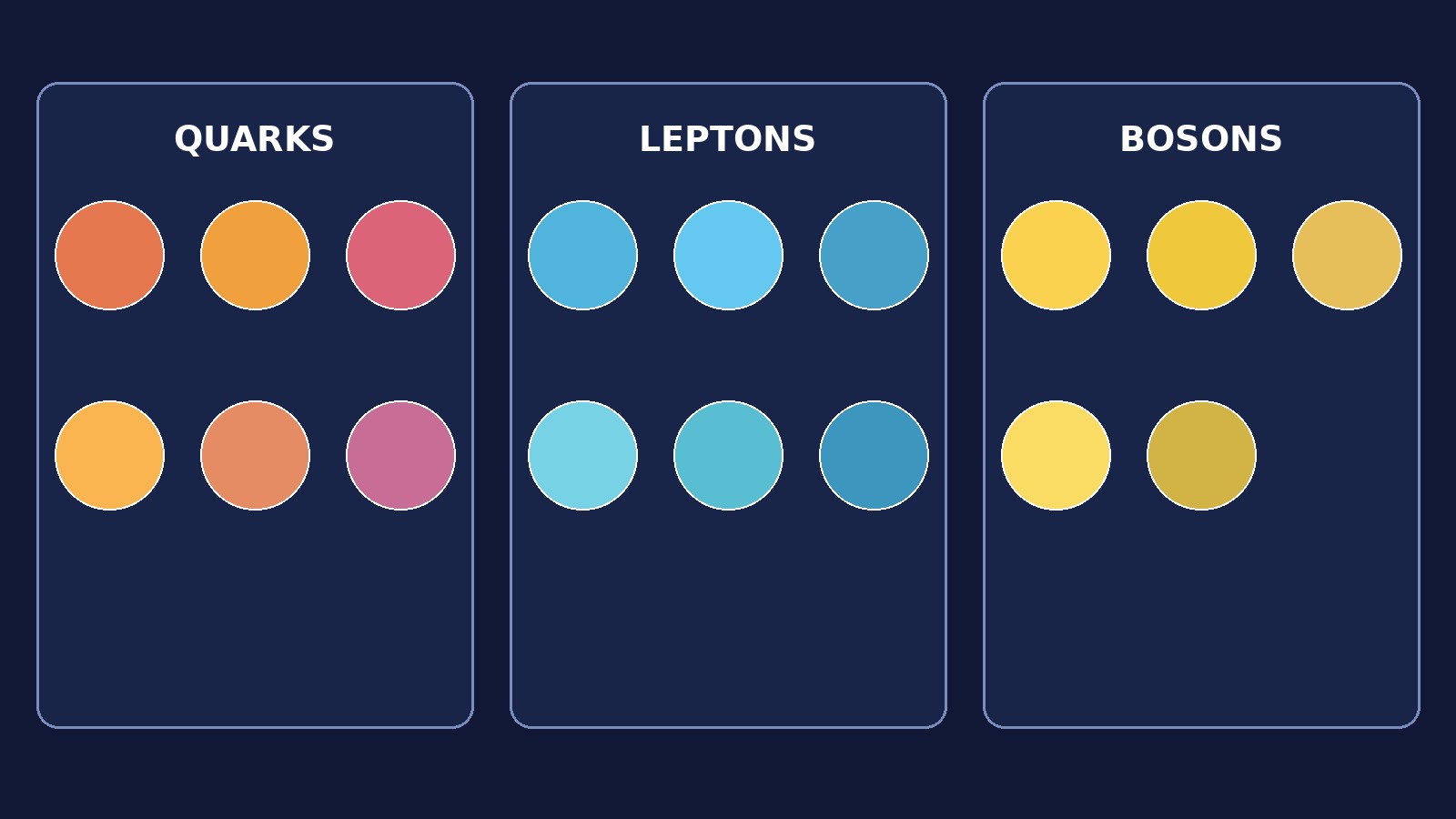
- It contains 17 fundamental particles: 6 quarks, 6 leptons, 4 gauge bosons (the photon, the gluon, and the W and Z bosons), and the Higgs boson.
- Quarks and leptons are fermions, the matter particles. Quarks combine to form protons, neutrons, and other composite particles. Leptons include the electron and three types of neutrino.
- Bosons carry forces. Photons carry electromagnetism, gluons carry the strong force, and W and Z bosons carry the weak force. The Higgs boson is a separate kind of boson, tied to how particles get mass.
- Ordinary matter needs only a small part of the list. Up quarks, down quarks, and electrons build every atom. The heavier particles are real but unstable, and they appear mainly in high energy collisions or cosmic rays.
- The model is tested, not just proposed. Its predictions have been checked to high precision, and its last predicted particle, the Higgs boson, was discovered at CERN in 2012.
- The model is incomplete. It does not explain gravity, dark matter, dark energy, neutrino mass in its original form, or the matter antimatter asymmetry of the universe. Those gaps are active research, not footnotes.
Introduction
If you could keep zooming in on anything, a stone, a star, your own hand, you would pass the same landmarks: molecules, then atoms, then the nucleus at the center of each atom, then protons and neutrons inside that nucleus. Most explanations stop there, as if protons and neutrons were the bottom of the story. They are not. They are themselves built from smaller particles, organized by one framework: the Standard Model of particle physics.
The Standard Model is the current best theory of the smallest known building blocks of matter and of three of the four known fundamental forces. It names 17 fundamental particles: 6 quarks, 6 leptons, 4 force carrying gauge bosons, and the Higgs boson. It has survived decades of precise experimental tests and predicted particles before they were found. It is also openly incomplete: it does not include gravity, it offers no particle for dark matter, and it does not explain why the universe contains far more matter than antimatter.
This guide works from the particle list outward: what “fundamental” means, the quarks and leptons that make up matter, the bosons that carry forces, the Higgs mechanism in plain language, how the list becomes ordinary atoms, how the model was tested, and the questions that keep physicists searching beyond it.
What “Fundamental” Means
A fundamental particle, also called an elementary particle, is a particle with no known smaller parts. That wording matters. Physicists do not claim that quarks or electrons can never turn out to have inner structure. They claim that no experiment so far has found any, even at the smallest distances probed by particle colliders. At the energies reached by the Large Hadron Collider at CERN, quarks and leptons still behave as pointlike objects with no measurable size.
Atoms are not fundamental: they contain electrons and nuclei. Nuclei are not fundamental: they contain protons and neutrons. Protons and neutrons are not fundamental either: each one contains three quarks held together by gluons. The Standard Model list begins where that splitting stops, at least for now.
Every particle also has an antiparticle, a partner with the same mass but opposite electric charge. The electron’s antiparticle is the positron, and the antiproton has negative charge where the proton has positive charge. A few neutral particles, including the photon, are their own antiparticles. When a particle meets its antiparticle, the pair can annihilate into energy.
Two properties organize the whole list. The first is spin, a particle’s intrinsic angular momentum. Fermions have spin 1/2, gauge bosons have spin 1, and the Higgs boson has spin 0. The second is electric charge, measured in units of the proton’s charge. Quarks carry plus 2/3 or minus 1/3, charged leptons carry minus 1, and neutrinos, photons, gluons, Z bosons, and Higgs bosons carry no charge. W bosons carry plus 1 or minus 1.
A Theory of Fields, Not Just a List of Balls
The name “Standard Model” can mislead. It sounds like a chart on a wall, but the model itself is a quantum field theory, a framework in which particles are understood as excitations, or ripples, in fields that fill all of space. An electron is a ripple in the electron field, and a photon is a ripple in the electromagnetic field. That explains why particles of the same type are exactly identical: every electron is an excitation of the same underlying field.
The model is built on symmetry, in the technical sense of transformations that leave the equations unchanged. Physicists write the combined symmetry as SU(3) times SU(2) times U(1), but a general reader needs only the idea: the pattern of forces follows from the symmetries, and those symmetries dictate which particles can interact with which. That structure is also why the model can predict. If the equations require a particle with certain properties, physicists can search for it, and the Higgs boson is the most famous case where that search succeeded.
The Matter Particles: Fermions
Fermions are the particles that make up matter, in the sense that they are the ingredients of composite particles and of atoms. There are 12 of them: 6 quarks and 6 leptons. They come in three generations, or families. Each generation contains two quarks and two leptons, and each later generation is a heavier copy of the first, with the same charges and the same interactions but larger mass.
The generation pattern is one of the model’s most striking and unexplained features. Nothing in the Standard Model explains why nature repeats the pattern three times, or why masses climb so steeply: the top quark is roughly 79,000 times as heavy as the up quark, and the tau lepton about 3,500 times as heavy as the electron.
Quarks: Six Flavors That Never Appear Alone
Quarks are the fermions that feel the strong force. There are six types, called flavors: up, down, charm, strange, top, and bottom. Up, charm, and top carry plus 2/3, and down, strange, and bottom carry minus 1/3. Each quark also carries color charge, in three varieties labeled red, green, and blue. Color charge has nothing to do with visible color. It is the charge of the strong force.
| Quark | Generation | Electric charge | Approximate mass |
|---|---|---|---|
| Up (u) | First | +2/3 | About 2.2 MeV/c2 |
| Down (d) | First | -1/3 | About 4.7 MeV/c2 |
| Charm (c) | Second | +2/3 | About 1.27 GeV/c2 |
| Strange (s) | Second | -1/3 | About 95 MeV/c2 |
| Top (t) | Third | +2/3 | About 173 GeV/c2 |
| Bottom (b) | Third | -1/3 | About 4.18 GeV/c2 |
Note on units: particle masses are quoted in MeV/c2 or GeV/c2, energy units divided by the speed of light squared, because mass and energy are interchangeable through E equals mc2. One GeV is 1,000 MeV.
Quarks are never found alone. The strong force between them does not weaken with distance the way gravity or electromagnetism does. Pull two quarks apart and the energy stored in the gluon field grows until it becomes cheaper to create a new quark antiquark pair than to keep pulling. The result is new composite particles, never a free quark. This behavior is called confinement.
Composite particles made of quarks are called hadrons. Baryons are made of three quarks, and mesons of one quark and one antiquark. The two baryons that matter most for everyday life are the proton and the neutron.
A proton is two up quarks and one down quark, written uud, for a total charge of plus 1. A neutron is one up quark and two down quarks, written udd, for a total charge of 0. That simple arithmetic is the bridge from the particle chart to the periodic table: the number of protons fixes which element an atom is, and the number of neutrons fixes which isotope it is.
Leptons: Electrons, Their Heavier Cousins, and Neutrinos
Leptons are the fermions that do not feel the strong force. There are six: the electron, the muon, the tau, and one neutrino for each. Charged leptons carry minus 1. Neutrinos carry no charge and interact only through the weak force, which makes them famously hard to detect.
| Lepton | Generation | Electric charge | Approximate mass |
|---|---|---|---|
| Electron (e) | First | -1 | About 0.511 MeV/c2 |
| Electron neutrino | First | 0 | Less than about 1 eV/c2 (upper limit; individual masses not yet measured) |
| Muon | Second | -1 | About 105.66 MeV/c2 |
| Muon neutrino | Second | 0 | Less than about 1 eV/c2 (upper limit; individual masses not yet measured) |
| Tau | Third | -1 | About 1,776.86 MeV/c2 |
| Tau neutrino | Third | 0 | Less than about 1 eV/c2 (upper limit; individual masses not yet measured) |
The electron is the only lepton in ordinary matter, and the first elementary particle identified, discovered by J. J. Thomson in 1897. The muon behaves like a heavy electron, about 207 times the mass, decaying after about 2.2 microseconds. The tau is heavier still and decays even faster. Muons and taus appear in cosmic ray showers and accelerators, not in atoms.
Neutrinos break the simple version of the story. In the original Standard Model, neutrinos were massless. Experiments on neutrinos from the Sun and from cosmic rays showed that neutrinos change flavor as they travel, a phenomenon called neutrino oscillation, which is only possible if neutrinos have mass. The masses are tiny, below about 1 eV/c2 for each type by current upper limits, but they are not zero. This is one confirmed place where the model as first written needs extension.
The Force Carriers: Bosons
If fermions are the ingredients, bosons are the messengers. In quantum field theory, a force between two fermions is described as the exchange of bosons: electrons repel by exchanging photons, quarks stick together by exchanging gluons, and a neutron decays into a proton by exchanging a W boson.
There are four gauge bosons, one set for each force the model describes, plus the Higgs boson, which is not a force carrier in the same sense.
| Boson | Force carried | Electric charge | Spin | Approximate mass |
|---|---|---|---|---|
| Photon | Electromagnetic | 0 | 1 | 0 (massless) |
| Gluon (8 types) | Strong | 0 | 1 | 0 (massless) |
| W boson (W+ and W-) | Weak | +1 or -1 | 1 | About 80.4 GeV/c2 |
| Z boson | Weak | 0 | 1 | About 91.2 GeV/c2 |
| Higgs boson | Not a force carrier; tied to mass | 0 | 0 | About 125 GeV/c2 |
Counting note: the familiar count of 17 treats the photon, the Z boson, and the Higgs boson as one particle each, counts the W boson as one type with two charge states, and counts gluons as one type with eight color states. Counting every state and antiparticle separately gives a larger number, but the physics is the same.
The Electromagnetic Force and the Photon
The electromagnetic force acts between electrically charged particles. It holds electrons in atoms, makes chemistry possible, and carries light. Its messenger, the photon, is massless and electrically neutral, so the force has unlimited range and photons do not interact directly with each other the way gluons do. Everyday electricity, magnetism, and light are all the same force seen at different scales.
The Strong Force and the Gluon
The strong force acts between quarks, and it is the strongest of the forces in the model at the distances inside a nucleus. Its messengers are gluons, and there are eight types, distinguished by their color charge combinations. Unlike photons, gluons themselves carry the charge of their force, so gluons interact with other gluons. That self interaction is what makes the strong force grow with distance and confines quarks inside hadrons, as described above.
The strong force has two faces. Inside a proton, at very short distances, quarks behave almost as if they were free, a property called asymptotic freedom. Try to pull a quark out, and the force grows. The theory of the strong force is called quantum chromodynamics, or QCD. The strong force also holds nuclei together indirectly: the residual strong force between protons and neutrons overcomes the electrical repulsion between protons at nuclear distances.
The Weak Force and the W and Z Bosons
The weak force is the force of change. It can turn one type of fermion into another: a down quark into an up quark, which is what happens when a neutron decays into a proton, emitting an electron and an antineutrino. It is the only force that can change a quark’s flavor or a lepton’s type. Without it, the Sun could not shine, because stellar nuclear reactions begin with weak force conversions of protons.
The weak force is carried by the W and Z bosons, discovered at CERN in 1983. They are heavy, about 80.4 GeV/c2 for the W and about 91.2 GeV/c2 for the Z, about 86 times the mass of a proton for the W and about 97 times for the Z. That heaviness explains why the weak force is weak and short ranged: creating a virtual W or Z boson costs a large amount of energy. At high energies, the suppression lifts, and the weak and electromagnetic forces reveal themselves as two aspects of a single electroweak force.
Radioactive decay is the weak force’s most familiar signature. Beta decay, in which a neutron becomes a proton, is a weak process, and every unstable heavier fermion decays toward the stable first generation through weak steps.
Gravity: The Force That Is Not in the Model
Gravity is the fourth fundamental force, and it is missing from the Standard Model. Gravity, as described by general relativity, is a theory of curved spacetime, and no one has yet built a quantum theory of gravity that fits consistently with the Standard Model and passes experimental tests. A hypothetical graviton is sometimes mentioned as the particle that would carry gravity in a quantum theory, but it has never been observed and is not part of the model. At particle scales, gravity is so much weaker than the other forces that leaving it out changes almost nothing in collider predictions, but at planetary scales it dominates, so the model is a theory of particle physics, not a theory of everything.
The Higgs Mechanism: Where Mass Comes From, and Where It Does Not
The Higgs boson is the particle most people have heard of and the one most often misunderstood. In the Standard Model’s equations without the Higgs mechanism, all the particles described would be massless, which contradicts observation. The Higgs mechanism resolves the tension: the Higgs field fills all of space, even in a vacuum, and particles that interact with it acquire mass in proportion to how strongly they couple to it. The photon and gluon do not couple in this way, so they stay massless. The W and Z bosons couple strongly, so they are heavy, and the top quark couples most strongly of all fermions, so it is the heaviest.
The Higgs boson itself is a ripple in the Higgs field. Finding it in 2012, announced by the ATLAS and CMS collaborations at CERN’s Large Hadron Collider on 4 July 2012, confirmed that the field exists. The particle’s mass is about 125 GeV/c2, and the 2013 Nobel Prize in Physics went to Francois Englert and Peter Higgs for the theoretical mechanism behind it.
Two qualifications keep this section honest. First, the Higgs mechanism explains the masses of elementary particles, not most of the mass of ordinary objects. A proton’s mass is about 938 MeV/c2, while its three valence quarks together contribute only about 9 MeV/c2 of intrinsic mass. The rest comes from the energy of quarks and gluons moving and interacting inside the proton, converted to mass through E equals mc2. Your body weight is mostly strong force energy, not Higgs mass. Second, the mechanism does not explain why the coupling strengths take the values they do.
From the Particle List to Ordinary Matter
Up quarks and down quarks combine into protons and neutrons. Protons and neutrons combine into nuclei. Nuclei attract electrons through the electromagnetic force, forming atoms, and atoms combine into molecules, materials, and living things. Gluons never leave the nucleus, and W and Z bosons appear only fleetingly, in decays and in high energy collisions. That is why the US Department of Energy summary is worth repeating: all ordinary matter, including every atom on the periodic table, consists of only three types of matter particles, up quarks, down quarks, and electrons.
The early universe is where the full list did matter. In the first fractions of a second after the Big Bang, the universe was hot and dense enough that all Standard Model particles could be produced freely. As it expanded and cooled, the heavier particles decayed away and the quarks became confined into hadrons, leaving the first generation matter that remains today.
How the Model Was Built and Tested
The Standard Model was not announced in a single paper. It was assembled in stages through the second half of the 20th century. The electromagnetic and weak forces were unified in the 1960s by Sheldon Glashow, Abdus Salam, and Steven Weinberg, quantum chromodynamics was developed in the early 1970s, and the current formulation was essentially complete by the mid 1970s.
The test record since then is remarkable. The W and Z bosons were discovered at CERN in 1983, with the masses the electroweak theory predicted. The Higgs boson was discovered in 2012, with a mass in the range the theory allowed. Fermilab notes that high precision experiments have repeatedly verified subtle effects predicted by the model. That is why physicists call it a theory, not a guess: it is the framework that survives contact with data. The Large Hadron Collider drives that testing by colliding protons at the highest laboratory energies, and its high luminosity upgrade will produce far more collisions for rarer processes to be studied. Research is also under way toward a future circular collider, a ring about 90 kilometers around now being designed.
What the Standard Model Does Not Explain
A model that explained everything would be the end of particle physics. The Standard Model is not that, and its gaps are the most active research areas in the field.
Gravity. As discussed above, gravity has no place in the model, and no quantum theory of gravity has been confirmed.
Dark matter. Astronomical observations show that galaxies rotate and cluster as if they contained far more mass than the visible stars and gas provide. The Standard Model contains no particle with the right properties to be that dark matter. Candidates such as weakly interacting massive particles, sometimes called WIMPs, have been proposed, but none has been directly detected.
Dark energy. The expansion of the universe is accelerating, driven by something physicists call dark energy, which the Standard Model does not explain. Cosmological estimates put ordinary matter at only a small fraction of the universe’s energy content, with dark matter and dark energy accounting for the rest.
Matter antimatter asymmetry. The Standard Model treats matter and antimatter almost symmetrically, yet the observable universe is made almost entirely of matter. The asymmetry built into the model, called CP violation, is far too small to explain that imbalance.
Neutrino mass. The original model gave neutrinos no mass, yet oscillation experiments prove they have mass. Extensions can accommodate that mass, but the mechanism and the absolute mass scale are not settled.
The pattern of masses and generations. Why three generations, and why those masses? The Standard Model takes about 19 free parameters, numbers that must be measured and put in by hand. A deeper theory might derive those numbers. The Standard Model does not.
None of this diminishes the model. A theory can be the most precisely tested framework in science and still be incomplete, and that combination tells physicists where to look next.
Beyond the Standard Model: Ideas Under Test, Not Answers
Physicists have proposed many extensions. Supersymmetry proposes a partner particle for every known particle, differing by half a unit of spin. Grand unified theories propose that the three forces in the model merge into one force at very high energies. String theory proposes that particles are vibrations of tiny strings rather than points.
None of these ideas has been confirmed by experiment, and popular coverage sometimes presents a candidate as if it were a discovery. Supersymmetry, in particular, predicted partner particles that the Large Hadron Collider has not found in the ranges searched so far, which rules out the simplest versions but not every version. What would change that status is a new particle observed in a collider, a dark matter particle caught in a detector, or a measurement that disagrees with a Standard Model prediction beyond experimental uncertainty. So far, with the neutrino mass exception noted above, the model has absorbed every test thrown at it, which is why it still stands.
Common Misconceptions
“The Standard Model is a theory of everything.” It is not. It excludes gravity, dark matter, and dark energy, and it leaves the pattern of particle masses unexplained. Physicists use the phrase “theory of almost everything” sometimes, and even that is generous.
“The Higgs boson gives everything its mass.” It gives elementary particles their intrinsic masses. Most of the mass of protons and neutrons comes from strong force energy inside them, not from the Higgs coupling of their quarks.
“Antimatter is science fiction.” Antimatter is routine in particle physics. Positrons are used in medical PET scans, and antihydrogen atoms have been created and studied. Antimatter is rare because it annihilates on contact with matter, not because it is imaginary.
“The model is finished because the Higgs was found.” The Higgs completed the predicted particle list, not the theory. The open questions listed above remain, and they are the reason colliders keep running.
Frequently Asked Questions
What is the Standard Model of particle physics in simple terms? It is the theory that lists the smallest known particles, 6 quarks, 6 leptons, and 5 types of boson including the Higgs, and explains how they interact through three forces: electromagnetism, the strong force, and the weak force. It is the best tested description of matter at the smallest scales, and it does not include gravity.
How many particles are in the Standard Model? Seventeen, by the standard count: 12 fermions (6 quarks and 6 leptons), 4 gauge bosons (photon, gluon, W, and Z), and the Higgs boson. Counting the eight gluon color states, the two W charge states, and antiparticles separately gives a larger total, so different sources quote different numbers without disagreeing about the physics.
What are the 6 quarks and 6 leptons? The quarks are up, down, charm, strange, top, and bottom. The leptons are the electron, muon, and tau, plus one neutrino for each. Only up quarks, down quarks, and electrons appear in ordinary matter.
Why is gravity not in the Standard Model? Because no quantum description of gravity has been built that fits consistently with the Standard Model and passes experimental tests. Gravity is described separately by general relativity, which works superbly at large scales. Uniting the two descriptions is an unsolved problem.
Sources & references
- Fermi National Accelerator Laboratory, "Science of Matter, Energy, Space and Time," Particle Physics 101. https://www.fnal.gov/pub/science/particle-physics-101/science-matter-energy-space-time.html
- Istituto Nazionale di Fisica Nucleare, "Standard model of elementary particles." https://www.infn.it/en/physics/particle-physics/standard-model-of-elementary-particles/
- US Department of Energy Office of Science material summarized in SciTechDaily, "Science Made Simple: What Is the Standard Model of Particle Physics?" https://scitechdaily.com/science-made-simple-what-is-the-standard-model-of-particle-physics/
- Particle Data Group 2022, "Table 1: The particles in the standard model of particle physics" (particle masses and charges used in the tables). https://www.helsinki.fi/~hkurkisu/cosmology/smpart22.pdf
- "The Discovery of a Higgs Particle at the Large Hadron Collider," European Review (Cambridge). https://www.cambridge.org/core/journals/european-review/article/abs/discovery-of-a-higgs-particle-at-the-large-hadron-collider/D6C71133EF80B4A6A8582BD1BCB82631
- Institute of Particle Physics and Accelerator Technologies, Riga Technical University, "Standard Model." https://www.rtu.lv/en/hep/particle-physics/standard-model


