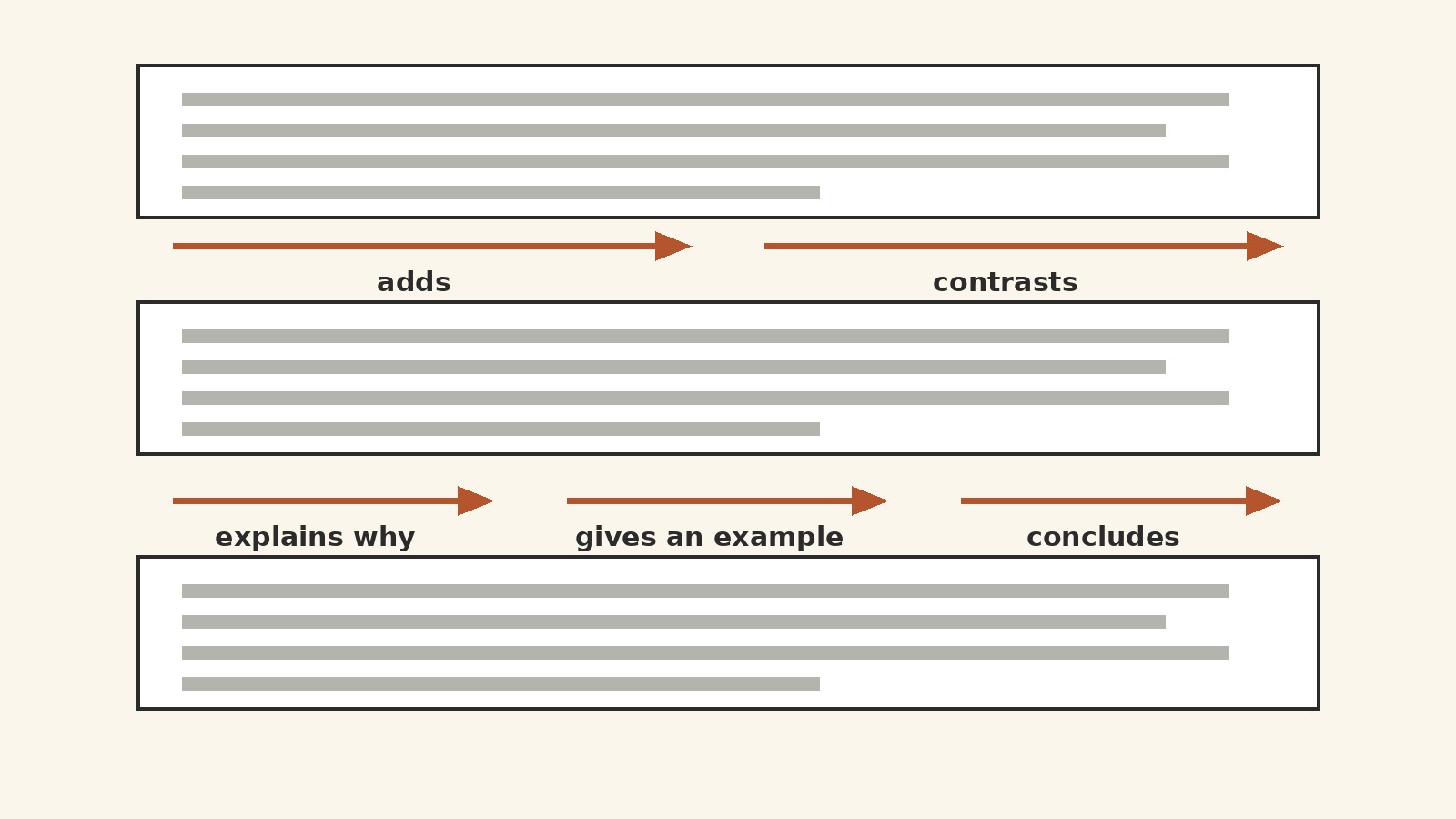
Short answer: Transition words for paragraphs are words and short phrases that show the reader how one idea relates to the next. They signal addition, contrast, cause and effect, sequence, example, emphasis, or conclusion, so the reader does not have to guess why a new paragraph follows the one before it. A good transition does more than start a paragraph. It looks back at what has just been said, names the relationship to what comes next, and keeps the argument moving in a clear direction.
What transition words are
A transition word is a small signpost inside a piece of writing. Like a road sign, it does not carry the main message itself. It tells the reader which way the argument is turning. Words such as “however,” “therefore,” “for example,” and “in addition” all do this work, as do short phrases such as “on the other hand,” “as a result,” and “in contrast.” Longer transitional sentences do the same job with more detail, for example by repeating a key idea from the previous paragraph before introducing the next one.
Kent State University’s Writing Commons describes transitional words in exactly this functional way: they help the reader understand the connections between ideas in sentences and paragraphs by showing relationships such as addition, contrast, or result. That definition corrects a common misunderstanding. Transition words are not decoration, and they are not a list of impressive words to sprinkle through an essay. They are tools for showing logic, and they only work when the logic they point to is really there.
Consider two versions of the same move. A writer finishes a paragraph about a school recycling program and begins the next with “Another important thing is that students sort paper from plastic.” The reader learns that a new point is coming, but not how it relates to the last one. In the stronger version, the writer begins with “That sorting step matters because clean paper and plastic are far easier to recycle than mixed waste.” Now the reader can see the link: the new paragraph explains why the step described before it is worth the effort. The second version works because the transition names a relationship, cause and effect, and repeats the key idea, sorting, so the reader stays oriented.
How transitions work between and within paragraphs
A useful way to think about a paragraph transition is the old to new pattern. A strong opening sentence for a new paragraph usually starts with something the reader already knows, the old information, and then moves toward something new. The transition word sits at the join and labels the move. Purdue University’s Online Writing Lab makes a similar point in stronger terms: instead of writing a transition that could connect any paragraph to any other paragraph, write one that could only connect one specific paragraph to another specific paragraph. Generic transitions are easy to write and easy to ignore. Specific transitions prove that the writer knows how the argument fits together.
Queen’s University’s Student Academic Success Services describes two further methods that work well between paragraphs. A writer can repeat a key word from the preceding paragraph, or begin a paragraph with a sentence that refers to an idea developed in the previous paragraph. Both methods give the reader a handhold: the reader recognizes a familiar term, follows it into new territory, and does not feel dropped into an unrelated discussion.
Choosing a transition by relationship, not by habit
The most common mistake with transition words is choosing by habit. A writer who always opens paragraphs with “furthermore” or “however” soon stops signaling anything at all, because the same word appears whether the new paragraph adds, contrasts, or concludes. The fix is to name the relationship first, then pick the word. Before writing the transition, ask: am I adding to the last point, challenging it, explaining its cause, giving an example, putting events in order, or wrapping up? The answer chooses the group.
| Relationship | What it signals | Common words and phrases |
|---|---|---|
| Addition | One more point in the same direction | also, in addition, furthermore, moreover, besides, additionally |
| Contrast and concession | A turn, limit, or objection | however, nevertheless, on the other hand, in contrast, although, despite this |
| Comparison | Similarity between two ideas | similarly, likewise, in the same way, just as |
| Cause and effect | A reason and its result | therefore, consequently, as a result, thus, because, for this reason |
| Sequence and time | Order, timing, or a next step | first, next, then, meanwhile, afterward, finally |
| Example and clarification | A case, detail, or restatement | for example, for instance, specifically, namely, in other words |
| Emphasis | A point that deserves weight | indeed, in fact, above all, especially, certainly |
| Summary and conclusion | A wrap up or final judgment | in conclusion, to sum up, overall, ultimately, in short |
Addition: building a point one layer at a time
Addition transitions tell the reader that another point is joining the last one and pushing in the same direction. The core group includes “also,” “in addition,” “furthermore,” “moreover,” “besides,” and “additionally.” Cleveland State University’s English 102 guide adds a useful warning about this group: addition words normally arrive as a second or third example, so they do not belong at the start of the first body paragraph of an essay, where there is not yet anything to add to.
Worked example, addition inside a paragraph:
A community garden gives residents fresh food within walking distance. In addition, it gives children a place to learn where food comes from, because planting, watering, and harvesting are visible in a way that a supermarket shelf is not. Moreover, the garden gives neighbors a shared project, and shared projects tend to build the kind of trust that makes a street feel safer.
Contrast and concession: turning without losing the reader
Contrast transitions warn the reader that the direction is about to change. “However,” “nevertheless,” “in contrast,” “on the contrary,” “on the other hand,” “instead,” and “conversely” all belong here. Concession transitions go one step further: they admit a point on the other side before answering it. “Although,” “even though,” “despite this,” and “granted” do that work. A concession does not surrender the argument. It shows the writer has heard the objection and still has a reply.
Worked example, contrast between paragraphs:
Solar panels on the school roof would cut electricity bills and give science classes a live example of renewable energy in action.
However, the upfront cost is real, and a school with a leaking roof cannot sensibly put panels on top of a surface that needs repair first. The honest sequence is roof first, panels second, even if that order delays the savings by a year.
The word “however” prepares the reader for a problem. The sentences that follow explain the problem in concrete terms, a leaking roof, rather than hiding behind a vague worry. That concreteness is what keeps a contrast paragraph persuasive instead of merely negative.
Comparison: showing that two things run parallel
Comparison transitions show similarity rather than difference. “Similarly,” “likewise,” “in the same way,” and “just as” tell the reader that the new idea works like the last one. This group is smaller than the addition and contrast groups, and it is easy to overuse. Not every second example is a comparison. A second example that merely adds another case belongs in the addition group. A comparison earns its label only when the writer is drawing a parallel between two cases, methods, or results.
Worked example, comparison between paragraphs:
A good map legend lets a reader decode symbols without hunting through the text for every meaning. Color, shape, and size each carry one job, and the legend states each job plainly.
Similarly, a good chart title and axis labels let a reader decode a graph without hunting through the surrounding paragraph. The title states the subject, the axes state the units, and the reader can then focus on the pattern instead of the puzzle of what the numbers mean.
Cause and effect: linking reasons to results
Cause and effect transitions are among the most misused, because writers often use them to dress up a sequence as a cause. “Therefore,” “consequently,” “as a result,” “thus,” “hence,” and “for this reason” all claim that one thing follows from another for a reason, not merely after it in time. If the earlier paragraph describes rain and the later paragraph describes a picnic being canceled, “therefore” is justified. If the earlier paragraph describes rain and the later paragraph describes a new library opening, “therefore” is false, however smooth it sounds.
Worked example, cause and effect between paragraphs:
The town council cut funding for the youth center’s evening program, and the center closed its doors at six o’clock instead of nine.
As a result, teenagers who once played basketball until eight now gather in the parking lot of a closed shopping center, where there is no adult supervision and no organized activity. The council saved money on staffing, but it moved the evening crowd to a place with fewer safeguards, even though the need for supervised evening space had not gone away.
“As a result” is earned here because the second paragraph describes a consequence of the closure, not just the next event in a story. The writer also names the mechanism, the loss of supervised evening space, which makes the causal claim testable. A reader who doubts the claim can ask whether teenagers really moved, and that is a strength of a clearly labeled causal transition.
Sequence and time: putting ideas and events in order
Sequence transitions order ideas, steps, or events. “First,” “second,” “next,” “then,” “meanwhile,” “afterward,” “subsequently,” and “finally” all belong here. Time transitions overlap with sequence but can also mark simultaneity: “at the same time,” “while,” and “meanwhile” say two things happen together, not one after the other. The distinction matters in instructions and narratives, where getting the order wrong changes the meaning.
Worked example, sequence in a process paragraph:
To start a small herb garden on a windowsill, first choose pots with drainage holes, because roots sitting in water will rot. Next, fill the pots with potting mix, not garden soil, which packs down too hard in a container. Then sow the seeds at the depth shown on the packet, water gently, and place the pots where they receive several hours of sunlight. Finally, check the soil each morning and water only when the top feels dry.
Each sequence word matches a real step, and the steps cannot be reordered without harm. Watering before sowing, for example, would make a mess of the seeds. That is the test for a sequence transition: if swapping two steps changes the outcome, the order is real and the transition is doing genuine work.
Example and clarification: narrowing from general to specific
Example transitions move from a general claim to a case that illustrates it. “For example,” “for instance,” “to illustrate,” “specifically,” and “namely” do this work. Clarification transitions restate an idea in clearer or more precise terms: “in other words,” “that is,” “in essence,” and “to put it another way.” Cleveland State’s guide notes that example words normally come only after a point has been introduced, because an example cannot illustrate a point the reader has not yet met. Opening an essay with “for example” leaves the reader asking: an example of what?
Worked example, example inside a paragraph:
Good study habits are less about long hours than about regular review. For example, a student who reviews notes for twenty minutes each evening will usually remember more than a student who studies for three hours only on the night before a test. The daily reviewer spreads the same effort across the week, and the spacing itself does much of the work.
“For example” works here because the general claim comes first, regular review beats long hours, and the case that follows tests it with a concrete contrast. A good example stays inside the paragraph’s topic while making it concrete.
Emphasis, restatement, and place
Emphasis transitions tell the reader to slow down, because the coming point matters more than the ones around it. “Indeed,” “in fact,” “above all,” “especially,” and “certainly” belong here. They are honest only when the writer really does rank the point higher. Using “above all” for every point in turn destroys the ranking and teaches the reader to ignore the signal. For example: “Regular exercise improves mood, sleep, and energy. Above all, it improves consistency: a person who walks each morning builds a daily anchor, and that anchor makes other healthy choices easier to keep.”
Place transitions guide the reader through space in the same way that sequence words guide the reader through time, and they matter in descriptions and reports about physical settings. “Above,” “below,” “nearby,” “beyond,” “opposite,” and “next to” anchor each new feature to the last one, so the reader can build a mental map in order. For example: “The visitor center sits at the entrance to the park. Beyond it, a gravel path leads to the picnic area, and nearby, a wooden boardwalk crosses the marsh.”
Summary and conclusion: closing a line of thought
Summary transitions signal that the writer is gathering the argument, not adding to it. “In conclusion,” “to sum up,” “in summary,” “overall,” “ultimately,” and “in short” belong here. They work at two scales. Inside a paragraph, a summary sentence can gather the paragraph’s points before the paragraph ends. Between paragraphs, a concluding paragraph can gather the whole piece. The scale changes the weight: a summary inside a paragraph is a pause, while a concluding paragraph is a final judgment.
Worked example, summary closing a paragraph:
The garden saves money on food, teaches children where food comes from, and gives neighbors a shared project. In short, it pays for itself in more than one currency: groceries saved, knowledge gained, and trust built.
“In short” tells the reader that the next clause will compress the three benefits just listed, and it names them again in shortened form so the reader can check that nothing has been smuggled in. A summary that introduces a brand new point has broken its promise. It claims to gather, but it actually adds.
Five ways to start a paragraph with a transition
Most paragraph openings use one of five moves. First, the single word opening: “However, the plan has a flaw.” It is fast and clear, but a string of paragraphs each opening this way soon feels mechanical. Second, the phrase opening: “In addition to the cost, the plan raises a safety question.” It carries more information than a single word, because it names the previous point while pointing to the new one. Third, the full transitional sentence: “That safety question becomes sharper once the route is examined at night.” This is the strongest move for sharp turns, because it can repeat a key term, name the relationship, and introduce the new focus in one sentence. Fourth, the echo opening, which repeats a key word from the previous paragraph and then adds the new point. Fifth, the question opening: “What happens to that evening crowd when the last bus leaves at nine?” A question works as a transition when it grows directly out of the previous paragraph, but it should be used sparingly, or the piece feels like an interrogation rather than an argument.
A worked passage: transitions inside and between paragraphs
The passage below about a school breakfast program is written first without transitions and then with them, so the effect can be judged directly. The content is the writer’s own construction for teaching purposes.
Without transitions:
The school introduced free breakfast in the cafeteria. Attendance in first period rose. Teachers reported that students concentrated better in morning lessons. Some parents worried about cost. The program used food that would otherwise go to waste.
With transitions:
The school introduced free breakfast in the cafeteria. As a result, attendance in first period rose, and teachers reported that students concentrated better in morning lessons. Granted, some parents worried about cost. In fact, the program used food that would otherwise go to waste, which kept the extra expense lower than critics had feared.
“As a result” links breakfast to attendance as a consequence, not a coincidence. “Granted” concedes the cost worry honestly. “In fact” answers that worry with a counterpoint about wasted food. None of the transitions adds a new fact. Each one shows how the facts relate, which is the entire job.
Mistakes that weaken transitions
Overuse is the most common fault. A paragraph that opens every sentence with a transition word feels like a list of signals with no road between them. Penn State’s guide makes this point directly: transition words should not be forced in where they do not belong, and a paragraph can require minimal use of them. If two sentences already show their relationship clearly, no transition word is needed.
The second fault is the wrong relationship. “Therefore” after a mere sequence, “however” after an agreement, and “for example” before any point has been made all mislead the reader. The reader trusts the label, follows it, and then finds the content going another way. That broken trust is worse than no transition at all, because the reader must reread to recover the real logic.
The third fault is the generic transition. Phrases such as “another important thing to note” could fit almost any paragraph. Purdue’s revision examples show why such phrases fail: they disconnect the following idea from the previous one instead of connecting them. A generic transition tells the reader that something new is coming, which the paragraph break already announced. It adds no information about how the new material relates to the old.
Punctuation and placement: the usual patterns in edited US prose
When a transition word opens a sentence, it is usually followed by a comma: “However, the cost remains a problem.” “For example, the market draws visitors from nearby villages.” “Therefore, the council should act.” The comma gives the reader a brief pause and marks the transition as an introduction rather than the main point of the sentence.
When “however” joins two independent clauses inside one sentence, the usual pattern is a semicolon before it and a comma after it: “The plan is popular; however, it is expensive.” The same pattern works for “therefore,” “consequently,” and “nevertheless” in that position. A comma alone before “however” in that position creates a comma splice in edited prose, so the semicolon matters.
When a transition word sits in the middle of a clause, it is usually set off by commas on both sides: “The plan, however, has a flaw.” Mid sentence placement softens the transition and keeps the emphasis on the main clause. Words such as “and,” “but,” and “so” can also act as transitions and are normal in all but the most formal writing, though a formal essay may prefer “however.” Match the register across the piece rather than mixing very formal and very casual transitions without reason. Finally, keep a transition close to the idea it modifies. A long interruption between “however” and its main clause leaves the reader waiting too long for the point.
Editing checklist and a practice exercise
A short checklist, applied to a finished draft, catches most transition problems faster than rewriting from scratch. Read only the first sentence of each paragraph. Can you name the relationship each opening signals: addition, contrast, cause, sequence, example, or conclusion? If you cannot, the transition is too vague. Check that each “therefore” really follows from a stated reason, not merely from the previous event in time, and that each “however” really turns against something, not merely introduces the next point. Check that no summary word appears before the summary, and no “finally” appears before the last point. Count how many paragraphs open with the same word. If one word opens three or more paragraphs, vary the sentence shape, not just the word. Delete each transition word in turn and read the passage without it. If the relationship is still obvious, the word may be unnecessary. If the relationship becomes unclear, the word has earned its place.
Practice exercise. The passage below is deliberately flat. Rewrite it using at least one addition, one contrast, and one cause and effect transition, and add a concluding sentence that gathers the points without adding a new one.
Original: “The library extended its hours. Students used the study rooms in the evening. Staff costs rose. The library asked volunteers to cover two evenings a week. Evening use stayed high.”
One possible revision: “The library extended its hours, and students soon filled the study rooms in the evening. However, staff costs rose with the longer day. As a result, the library asked volunteers to cover two evenings a week, which kept evening use high without raising the budget. In short, longer hours worked because the library shared the cost instead of carrying it alone.”
Frequently asked questions
What are transition words for paragraphs in simple terms?
Transition words for paragraphs are words and short phrases that show how one paragraph relates to the next, or how sentences inside a paragraph relate to each other. They signal addition, contrast, cause and effect, sequence, example, emphasis, or conclusion, so the reader can follow the argument without guessing at the connections.
What is the difference between a transition word and a transition sentence?
A transition word is a single word or short phrase, such as “however” or “in addition,” placed at or near the start of a sentence. A transition sentence is a full sentence that connects two paragraphs, often by repeating a key idea from the old paragraph and pointing to the new one. Transition sentences carry more information and suit sharper turns, while single words suit small steps.
Can I use “however” at the start of a sentence?
Yes. “However” at the start of a sentence, followed by a comma, is standard in edited US prose: “However, the cost remains a problem.” It can also sit mid sentence with commas on both sides, or join two clauses with a semicolon before it and a comma after it. The choice depends on how much emphasis the turn deserves.
Do transition words alone make writing coherent?
No. Transition words help the reader see connections, but they cannot create connections that are not there. If two paragraphs do not belong together, no transition word will fix the gap. The deeper work is logical order: putting ideas in an order where each step follows from the last. Transitions then make that order visible. Good transitions display good thinking. They do not substitute for it.
Sources & references
- Purdue University Online Writing Lab (OWL), "Transitions": good transitions connect paragraphs into a unified whole, transitions should fit one specific pair of paragraphs, and key phrases from the previous paragraph can create progression. https://OWL.Purdue.edu/owl/general_writing/mechanics/transitions_and_transitional_devices/index.html
- Kent State University Writing Commons, "Using Transitional Words": transitional words show relationships between ideas in sentences and paragraphs, including addition, contrast, result, comparison, concession, emphasis, example, generality, and summary. https://www.kent.edu/writingcommons/using-transitional-words
- Pennsylvania State University, Style for Students Online, "Transition Words": transition words should be placed where sentence or paragraph meaning shifts, the literal meaning of each word must be kept in mind, and transition words should not be forced in where they do not belong. https://courses.ems.psu.edu/styleforstudents/c1_p14.html
- Cleveland State University, English 102: Reading, Research, and Writing, "Transitions": transition words at the beginning of new paragraphs or within paragraphs help a reader follow writing, addition words normally follow an earlier example, and example words normally follow an introduced point. https://pressbooks.ulib.csuohio.edu/eng-102/chapter/transitions/
- Queen's University, Student Academic Success Services, "Transitions": moving between major points in different paragraphs contributes to flow and coherence, and methods include using a key word from the preceding paragraph or beginning a paragraph with a sentence that refers to a previous idea. http://sass.queensu.ca/resources/online/transitions


