Short answer
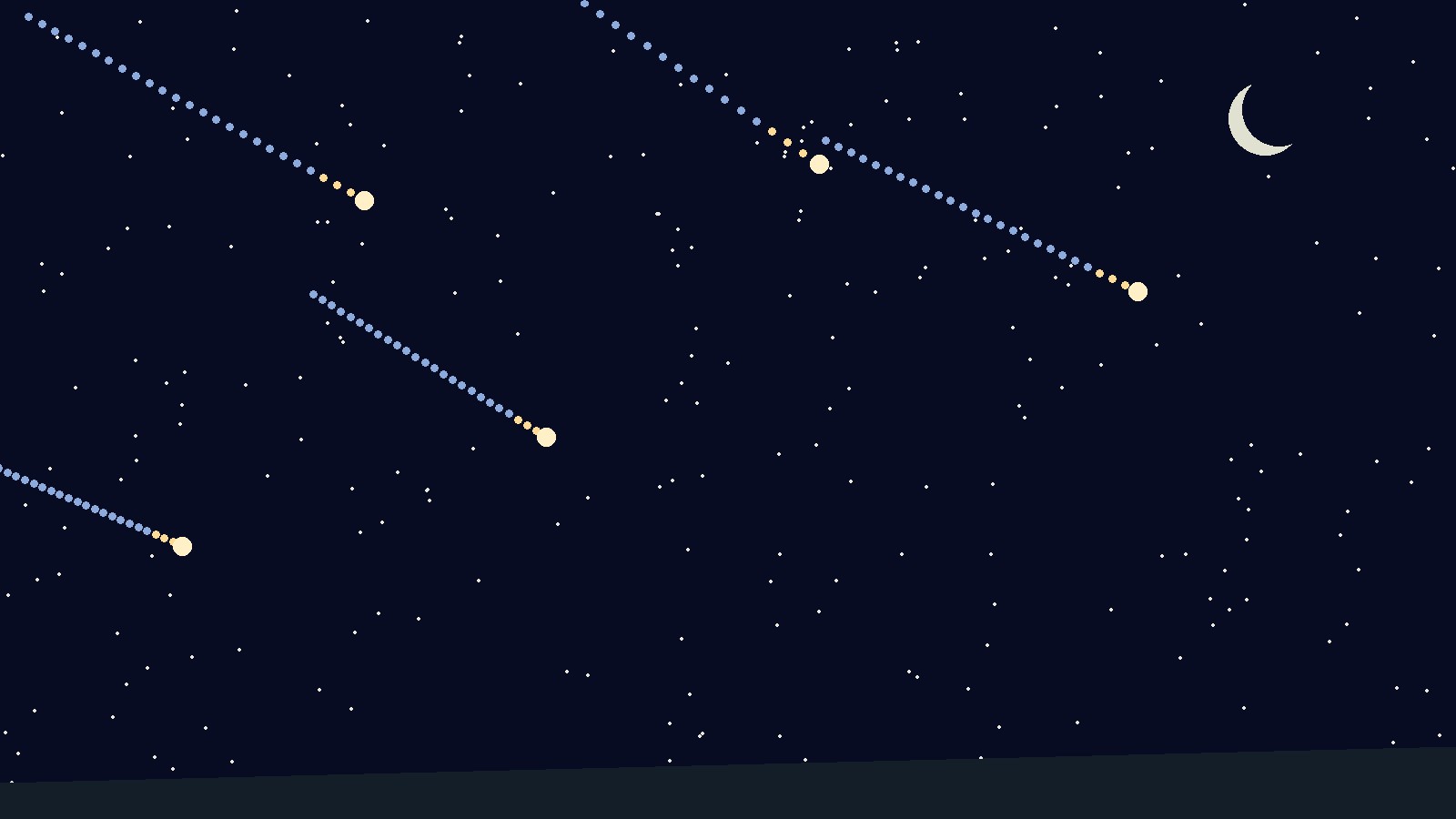
- A meteor is a streak of light in the sky. It is not a star, and it is not a rock sitting on the ground. It is what you see when a small piece of space debris, called a meteoroid, enters Earth's atmosphere at high speed and heats up so intensely that the air around it, and vaporized material from its surface, glow. That glow is the meteor. The same object gets a different name at each stage: a meteoroid while it is still in space, a meteor while it is glowing in the atmosphere, and a meteorite if any part of it survives and lands on Earth's surface. Most meteors last only a fraction of a second to a few seconds, and most are made by particles no bigger than a grain of sand.
Why one object has three names
NASA Science puts the rule plainly: the name depends on where the object is. A meteoroid is still in space. A meteor is in Earth’s atmosphere. A meteorite is on the ground. The Smithsonian National Museum of Natural History gives the same three part sequence, and NASA Space Place explains it the same way: a meteor is what happens when a meteoroid burns up upon entering Earth’s atmosphere, creating a streak of light in the sky.
Think of it as a journey with three chapters, not three different kinds of thing. Chapter one is a solid particle traveling through space. Chapter two is a brief, bright event in the sky. Chapter three, which happens only rarely, is a solid object that can be picked up, studied, and put in a museum. If the particle burns up completely, the story ends at chapter two, and there is no meteorite.
This is also why “shooting star” is misleading even though everyone uses it. A meteor is not a star falling or moving across the sky. Stars are distant suns that stay in their patterns from night to night. A meteor is nearby by astronomical standards, inside our own atmosphere, and it is gone in seconds. NASA Space Place states the point directly: meteors are sometimes called shooting stars, but meteors are not actually stars.
A meteor is also not a comet or an asteroid, although all three are connected. An asteroid is a small rocky body that orbits the Sun, larger than the pebble sized objects called meteoroids, and most asteroids in our solar system are found in the main asteroid belt between Mars and Jupiter, according to NASA Space Place. A comet also orbits the Sun, but it is made of ice and dust rather than rock, and as it nears the Sun its ice and dust vaporize to form a tail that can be seen from very far away. A meteor, by contrast, is visible only because it is in our atmosphere. You see a comet over many nights. You see a meteor for a few seconds, and then it is gone.
| Name | Where it is | What it is |
|---|---|---|
| Meteoroid | In space | A small solid particle, from a dust grain to a small asteroid |
| Meteor | In Earth’s atmosphere | The streak of light made as the particle heats up |
| Meteorite | On Earth’s surface | Any part of the particle that survives and lands |
What you are actually seeing
You are not watching a burning rock in the simple sense of a log catching fire. The physics is more violent, and it explains why something as small as a grain of sand can make a visible streak.
A meteoroid enters the atmosphere at very high speed. Britannica explains that meteoroids near Earth travel at speeds relative to Earth ranging from a few kilometers per second up to as high as 72 kilometers per second, and that Earth’s gravity accelerates them further as they approach. The minimum entry speed is Earth’s escape velocity, 11.2 kilometers per second. Even at that minimum, Britannica notes, the kinetic energy of a meteoroid of a given mass is about 15 times the energy produced by an equal mass of chemical explosives such as TNT. That comparison is not meant to frighten anyone watching a grain of sand sized meteor. It explains why speed matters so much more than size: energy grows with the square of speed, so a tiny object moving extremely fast carries a surprising amount of energy.
As the meteoroid is slowed by friction with atmospheric gas molecules, that kinetic energy becomes heat. Britannica describes the result in careful terms: even at the very low atmospheric density present at an altitude of 100 kilometers, the heat is sufficient to vaporize and ionize the surface material of the meteoroid and also to dissociate and ionize the surrounding atmospheric gas. The excitation of atmospheric and meteoroidal atoms produces a luminous region, which travels with the meteoroid and greatly exceeds its dimensions. In plain language, the glowing streak you see is much bigger than the particle itself. It is a moving pocket of heated, glowing gas and vapor, not a photograph of the rock.
Only a small share of the energy becomes visible light. Britannica states that about 0.1 percent to 1 percent of the original kinetic energy is transformed into visible light, with most of the remainder heating the air and the particle and pushing air aside. That is why a meteor can look so bright and yet leave nothing on the ground. The light is a side effect of a violent slowdown, and the particle itself is usually destroyed.
That destruction happens through ablation, the loss of mass from the surface by vaporization or as molten droplets, and fragmentation caused by aerodynamic pressure that exceeds the crushing strength of the meteoroid, both named by Britannica. For these reasons, numerous meteors end their observed flight at altitudes above 80 kilometers, and penetration to altitudes as low as 50 kilometers is unusual. At deeper levels, a shock wave may develop in the air ahead of the meteoroid, and that shock wave can travel all the way to the ground even when the meteoroid does not. Britannica notes that a meteoroid in the kilogram range penetrating to about 40 kilometers can produce sounds on the ground similar to sonic booms or thunder.
Where meteors come from
Most meteoroids come from asteroids and comets. NASA Space Place explains that sometimes one asteroid can smash into another, and small pieces that break off are called meteoroids, and that meteoroids can also come from comets. The Smithsonian adds a rarer source: a few meteorites come from the Moon and Mars, blasted off their surfaces when other objects crashed into them and blew pieces into space. Scientists can identify those rare cases because Moon rocks returned by the Apollo missions and Mars atmosphere data collected by the Viking missions give them material to compare against.
Size varies far more than “shooting star” suggests. NASA Science states that meteoroids range in size from dust grains to small asteroids. The Smithsonian says most meteorites that enter the atmosphere each day are the size of a grain of rice or smaller, while Britannica says a typical visible meteor is produced by an object the size of a grain of sand and may start at altitudes of 100 kilometers or higher. Meteoroids smaller than about 500 micrometers across are too faint for the naked eye, Britannica adds, but they can be detected by radar. Brighter meteors, from Venus brightness to brighter than the full Moon, come from meteoroids of several grams up to about one ton, described by Britannica as centimeter to meter sized objects. Size limits here are not sharp lines. What is consistent across the sources is the picture: a huge number of tiny particles, fewer visible streaks, and very few large, bright events.
Earth also receives a steady rain of material. NASA Science estimates that about 48.5 tons of meteoritic material falls on Earth each day, and that almost all of it is vaporized in Earth’s atmosphere, leaving a bright trail. The Smithsonian makes the same point from the other side: tens of thousands of meteorites enter the atmosphere each day, but most are the size of a grain of rice or smaller. Most of that daily total is dust too small to see.
On any clear night beyond city lights, Britannica says, one can see several meteors per hour with the naked eye. They last a fraction of a second to several seconds, often varying in brightness, emitting sparks or flares, and sometimes leaving a luminous train that lingers and then fades.
Sporadic meteors and meteor showers
On a random clear night, most meteors you see will be sporadic meteors: single particles arriving from no particular stream, in no particular direction. During a shower, the rate rises, and many meteors appear to come from one region of the sky. That apparent point of origin is called the radiant.
The radiant is a perspective effect. The meteors in a shower travel along roughly parallel paths, like rain falling straight down, but because you see them projected onto the dome of the sky, their paths appear to diverge from one point, just as parallel railway tracks appear to meet in the distance. The radiant is therefore a direction in the sky, not a physical object and not the source of the meteors. The source is a stream of debris in space, usually left behind by a comet, that Earth is passing through.
NASA Science explains the mechanism directly: meteor showers occur annually or at regular intervals as Earth passes through the trail of dusty debris left by a comet. Showers are usually named after a star or constellation that is close to where the meteors appear in the sky. The constellation is only a signpost near the radiant. The debris itself came from a comet, and the meteors are made when that debris hits our atmosphere.
The Perseids are NASA’s most famous example: NASA Science states that every Perseid meteor is a tiny piece of the comet Swift-Tuttle, which swings by the Sun every 135 years. This article deliberately gives no date specific forecast for any shower, and it names no peak night and no hourly rate for a specific shower. Annual showers recur, but the best night, the hourly rate, and the effect of moonlight change from year to year. Readers who want to plan a specific night should check a current NASA skywatching guide for that year rather than relying on a definitional article.
Fireballs and bolides
Most meteors are faint and brief. A small number are spectacular, and those have their own names. The American Meteor Society defines a fireball as another term for a very bright meteor, generally brighter than magnitude minus 4, about the same brightness as the planet Venus as seen in the morning or evening sky. NASA’s All Sky Fireball Network uses the same practical idea: it is a network of cameras set up to observe meteors brighter than the planet Venus, which are called fireballs, according to NASA Science.
A bolide is a special type of fireball, according to the American Meteor Society: one which explodes in a bright terminal flash at its end, often with visible fragmentation. Britannica uses the term in a compatible way, saying that the latter term is often applied to those meteoroids observed to explode in the sky.
A fireball does not have to be huge to be bright. Because brightness depends so strongly on speed, a stone that would fit in your hand can produce a fireball if it enters fast enough and fragments violently. Brightness is therefore a poor guide to size on its own. The American Meteor Society asks observers to report a fireball’s brightness, length, color, duration, and start and end points against the stars or compass direction, so researchers can reconstruct its trajectory. A very bright fireball may also be heard: a kilogram range meteoroid penetrating to about 40 kilometers can produce sounds similar to sonic booms or thunder, arriving later than the light because sound travels far more slowly.
When a meteor becomes a meteorite
Most meteoroids never become meteorites. They are destroyed high in the atmosphere, and their material disperses as vapor and fine dust. A meteoroid survives only if it loses its kinetic energy before it is completely destroyed. Britannica lists the conditions that help: the meteoroid is small with a relatively low entry velocity, less than 25 kilometers per second, or enters at a relatively shallow angle, or it has a large initial mass, greater than 100 grams, and fairly high crushing strength. Very small meteoroids, less than 50 to 100 micrometers across, are effectively stopped at considerable heights and may take weeks or months to settle out of the atmosphere.
When a larger meteoroid does survive, the end of its visible flight is not the end of its fall. Britannica describes what follows: even objects tens of meters across are effectively stopped by the atmosphere at altitudes of 5 to 25 kilometers, although they generally separate into fragments. Following this atmospheric braking, they begin to cool, their luminosity fades, and they fall to Earth at low velocities, 100 to 200 meters per second. This dark flight may last several minutes, in contrast to the few seconds of visible flight as a meteor. By the time a meteoroid hits the ground, Britannica adds, it has lost so much heat that the meteorite can be touched immediately with the bare hand. The most obvious sign of the fiery passage is often a dark, glassy crust, called a fusion crust, produced by melting of the surface.
Meteorites fall everywhere on Earth, the Smithsonian notes, but most plunge into the oceans that cover three quarters of the surface and are lost. Even those that fall on land can be difficult to recognize unless you see them hit the ground. That is why glaciers, deserts, and rock free plains are prime hunting grounds: they have little vegetation to camouflage a dark rock and few Earth rocks to confuse it with. More meteorites have been found in Antarctica than anywhere else, because they stand out against the ice and the deep freeze protects them from weathering.
If you think you have found a meteorite, do not assume the identification is certain. Photograph the object where you found it, note the location and the circumstances, and contact a local museum, university, or planetarium for advice rather than treating a guess as a discovery. The American Meteor Society makes a related point for fireballs: it does not pursue fireball reports with the intent of recovering meteorites, but it does notify relevant planetary scientists when promising events occur in their local areas, so that they can pursue them as they wish.
The three kinds of meteorite
The Natural History Museum in London states that there are three main types of meteorite: iron meteorites, which are almost completely made of metal; stony iron meteorites, which have nearly equal amounts of metal and silicate crystals; and stony meteorites, which mostly have silicate minerals. The Smithsonian gives the same three part list and adds that stony meteorites are the most common. Each group can be split into many more classes and types depending on minerals, structure, and chemistry.
Stony meteorites are the majority of meteorite finds, according to the Natural History Museum. There are two main types: chondrites, some of the oldest materials in the solar system, and achondrites, which include meteorites from asteroids, Mars, and the Moon. Chondrites are over 4.5 billion years old, the museum states, and are some of the most primitive and pristine rocks in the solar system, never melted. They are named for their millimeter sized granules called chondrules. The most basic types, carbonaceous chondrites, are rich in water, sulfur, and organic material, and the museum says they are thought to have brought volatile material to early Earth. That is presented as an interpretation, not as settled certainty.
Achondrites are igneous, meaning at some point they were melted into magma, and when that magma cools and crystallizes it creates a concentric layered structure, a process known as igneous differentiation, according to the museum. The rocky planets Mercury, Venus, Earth, and Mars were formed in this way, giving them crusts, mantles, and cores. An achondrite from Mars or the Moon is therefore a sample of a specific world, knocked off that world by an impact.
Iron meteorites are thought to be the cores of asteroids that melted early in their history, according to the museum. They consist mainly of iron nickel metal with small amounts of sulfide and carbide minerals. As asteroids melted, dense iron sank to the center, forming a metallic core. Iron meteorites can tell us a lot about how the metallic cores of planets formed, because a planet’s core cannot be sampled directly, while an asteroid core delivered as a meteorite can be cut, polished, and studied. When cut and etched with acid, an iron meteorite reveals a distinctive crystalline structure known as a Widmanstätten texture, caused by the iron and nickel cooling at a rate of about 1 degree Celsius every million years, according to the museum.
Stony iron meteorites consist of almost equal parts iron nickel metal and silicate minerals, according to the museum. There are two types: pallasites and mesosiderites. Pallasites contain big, olive green olivine crystals embedded entirely in metal. How pallasites formed is still disputed: some scientists see them as samples of a core mantle boundary, while others argue they may also form by impact melting. Mesosiderites are breccias, broken fragments cemented together, formed when collision debris mixes molten metal with solid silicate fragments.
Why scientists study them, and how to watch
Meteorites are samples of the early solar system that arrive free of charge. NASA Space Place notes that because asteroids formed nearly 4.6 billion years ago, meteorites can give scientists information about what the solar system was like way back then. The Smithsonian adds that some meteorites are actual pieces of the original matter from which the planets were assembled. Meteors themselves are also data: camera networks and public reports record trajectories and speeds that can be turned into orbits, and NASA monitors meteoroids because even small fragments can damage spacecraft, according to NASA’s Watch the Skies blog.
Britannica records the upper end of the scale: an explosion over Tunguska, Siberia, on June 30, 1908, whose shock wave, estimated at 15 megatons of TNT, flattened trees over an area almost 50 kilometers across. It was not an ordinary meteorite fall, and this article does not claim otherwise.
You do not need special equipment to see a meteor. NASA’s Watch the Skies blog states the point plainly: spotting one does not require special equipment, just your eyes and a good viewing spot away from as much ambient light as possible. Head to an open area away from city lights, trees, and buildings that may block the view, give your eyes a few minutes to adjust to the darkness, and remember that there is no need to look in any specific direction, because meteors can appear anywhere as they streak across the sky. Lie back or use a reclining chair, avoid bright phone screens while you wait, and be patient: meteors do not arrive at a steady rate. A telescope or binoculars will not help, because they narrow your field of view.
Frequently asked questions
Is a meteor a star?
No. A meteor is a streak of light in Earth’s atmosphere, made when a small piece of space debris heats up as it enters the atmosphere at high speed. A star is a distant sun. The name shooting star is a popular nickname, not a description of what it is.
What is the difference between a meteoroid, a meteor, and a meteorite?
A meteoroid is the object while it is still in space. A meteor is the streak of light it makes while it is in the atmosphere. A meteorite is the object if it survives the atmosphere and lands on the ground. NASA Science summarizes the rule as a matter of location: still in space, in Earth’s atmosphere, on the ground.
How big is a typical meteor?
The particle behind a typical visible meteor is about the size of a grain of sand, according to Britannica, and it may start glowing at altitudes of 100 kilometers or higher. Brighter meteors come from larger particles, from several grams up to about one ton, which Britannica describes as centimeter to meter sized objects. The glowing streak is much larger than the particle itself, because it is a region of heated gas and vapor traveling with the particle.
Why do meteors glow?
They glow because they enter the atmosphere at 11.2 kilometers per second at minimum, up to 72 kilometers per second relative to Earth, according to Britannica. Collisions with air molecules convert kinetic energy into heat, vaporizing and ionizing the particle’s surface and the surrounding air. Only about 0.1 percent to 1 percent of that energy becomes visible light.
What is a meteor shower?
A meteor shower is a period when the rate of meteors rises well above the normal sporadic background, because Earth is passing through a stream of debris, usually left behind by a comet. NASA Science states that showers occur annually or at regular intervals as Earth passes through the trail of dusty debris left by a comet, and that showers are usually named after a star or constellation close to where the meteors appear in the sky. The meteors in a shower appear to come from a point called the radiant, but that is a perspective effect: the debris travels along roughly parallel paths, and the radiant is the direction from which those paths appear to come.
What is a fireball, and what is a bolide?
A fireball is a very bright meteor, generally brighter than magnitude minus 4, about the same brightness as Venus, according to the American Meteor Society. A bolide is a special type of fireball which explodes in a bright terminal flash at its end, often with visible fragmentation, according to the same source. Not every bright meteor is a bolide, and not every fireball drops a meteorite.
If a meteorite lands near me, can I pick it up?
A meteorite that has completed dark flight has cooled on the outside, and Britannica states that by the time it hits the ground it has lost so much heat that it can be touched immediately with the bare hand. That does not mean an identification is certain. Many Earth rocks look dark and unusual, and the Smithsonian warns that a fallen rock can be difficult to recognize unless you see it hit the ground. Photograph it in place, note the location, and ask a local museum, university, or planetarium for advice before treating it as a confirmed meteorite.
Are meteors dangerous?
Ordinary meteors are not dangerous to people on the ground. They burn up tens of kilometers overhead, and the material that reaches the ground as dust is harmless. Large fireballs are rare, and the Tunguska explosion of 1908 shows that a very large object exploding in the atmosphere can flatten forest over a wide area. That scale of event is exceptional, and it is the reason space agencies track larger near Earth objects.
Why do some meteors leave a trail that lingers?
A meteoroid sometimes leaves a luminous train that lingers after its flight, according to Britannica: glowing material and disturbed air left along the path, fading as it cools and disperses, and sometimes blown sideways by high altitude winds.
Sources & references
- NASA Science, Meteors and Meteorites: https://science.nasa.gov/solar-system/meteors-meteorites/
- NASA Space Place, Asteroid or Meteor: What is the Difference?: https://spaceplace.nasa.gov/asteroid-or-meteor/en/
- NASA, Fireflies and Fireballs: Summer Stargazing with Meteor Watch Day, Asteroid Day (Watch the Skies blog): https://www.nasa.gov/blogs/watch-the-skies/2026/06/30/fireflies-and-fireballs-summer-stargazing-with-meteor-watch-day-asteroid-day/
- American Meteor Society, Fireballs: https://www.amsmeteors.org/fireballs/
- Britannica, Meteor and meteoroid, Basic features of meteors: https://www.britannica.com/science/meteor/Basic-features-of-meteors
- Natural History Museum, London, Types of meteorites: https://www.nhm.ac.uk/discover/types-of-meteorites.html
- Smithsonian National Museum of Natural History, Meteorites: Messengers From Outer Space: https://naturalhistory.si.edu/education/teaching-resources/earth-science/meteorites-messengers-outer-space


