Short answer
- The pair and group costumes that work best are built on one clear visual rule that every person can follow on their own. Pick the rule first: one color per person, characters from the same story, jobs from the same workplace, or halves of the same object. Then make sure each costume reads clearly when that person stands alone, agree on one effort level for everyone, and choose a theme that still works if one person arrives late or cannot come. For two people, the simplest shapes are two halves of one thing (salt and pepper, peanut butter and jelly), two opposites (angel and devil, sun and moon), or two roles in one small scene (burglar and police officer, detective and sidekick). For a group, the most flexible shapes are sets, such as a box of crayons, a deck of cards, a rainbow, or a haunted house crew, because a set can grow or shrink without breaking. Repetition does the work: one color rule, one label style, one accessory type, or one makeup pattern, repeated by everyone.
Introduction
Halloween is observed annually on October 31, and Encyclopaedia Britannica notes that it is celebrated with parties, spooky costumes, pumpkin carvings called jack-o’-lanterns, and trick or treat. The name Halloween derives from All Hallows’ Eve, meaning the evening before All Hallows’, or All Saints’, Day. Dressing up in costumes and masks is a Halloween tradition, and the range of costumes has expanded over time to include not only scary characters but also superheroes, celebrities, and more.
This guide is about one specific part of that tradition: dressing up together. A couples Halloween costume is a small piece of teamwork, with two people, one idea, and twice the recognition. A group Halloween costume is the same idea scaled up, with a whole crew dressed to one theme, where each person is recognizable alone and the group is unmistakable together. Pairs and groups solve the hardest part of choosing a costume, which is deciding, because you decide together. They also create a different problem, which is coordination. This guide covers that problem first, then easy couple ideas, duo ideas for two friends, group themes that scale, last-minute pairs, do it yourself tips, and the safety and comfort checks that keep a shared costume comfortable all evening. It is informational only, with no shopping links and no retailer recommendations.
How to Choose a Pair or Group Theme
Start with the group, not the idea. Count the people, check who is willing to wear face paint or a wig, and be honest about budget and time. A theme built on a color, a shared accessory, or a simple outfit stands a better chance than one needing four hired costumes, because each person can build their half from clothes they already own.
Pick a theme with a clear visual rule. “Things that are red” is a rule. “Characters from the same story” is a rule. “Jobs” is a rule. A rule lets each person build independently and still look like part of the group. Without one, you get five unrelated costumes standing near each other. Keep the rule short enough to send in one sentence, and specific enough that two people following it separately still arrive looking connected.
Make sure each costume works alone. At a party, people split up, get drinks, and get photographed separately. If a costume only makes sense when the whole group is lined up in order, half the photos will look confusing. Playing cards, crayons, and superheroes pass this test because each one is readable one person at a time. Ask of every role: if this person walked in alone, could a stranger name the theme, or at least the character, color, or object they are meant to be?
Agree on an effort level. Is everyone doing full face paint and a wig, or is everyone doing a T-shirt and a hat? Either is fine. Mixed effort is what looks odd, because one full outfit next to someone wearing only a badge makes both look unfinished. A group message with a photo of the intended look for each role prevents most mismatches and gives anyone with less time or money a smaller version of the same idea to aim for.
Think about logistics and setting too. Inflatable or wide costumes are hard in doorways, crowds, and cars, and a theme that needs everyone to arrive at once falls apart if one person is late. Choose a theme where five people still read clearly if the plan was for eight.
How Group Coordination Actually Works
Coordination is the difference between a group costume and several solo costumes that happen to match. Four small mechanics do most of the work.
Name one coordinator, even for a pair. One person sends the final decision, the reference photos, and the meeting time, and settles small questions such as which shade of red counts as red. This stops the drift where each person quietly builds a slightly different version of the theme.
Agree on one reference photo or description per role. “Wear something red” can mean five different reds. One photo per role fixes the color, the main garment, and the identifying accessory. Anyone who cannot match it exactly can match its color and accessory, which is usually enough.
Set a decision deadline earlier than the building deadline. Groups fail most often because choosing lasts until the last day and leaves no time to build. Decide the theme and assign every role first, and only then buy, borrow, or make anything. If a role is still unassigned at the deadline, pick a flexible theme, such as crayons, cards, or animals, instead of one where a missing role leaves a visible gap.
Plan for change. Sets handle dropouts, late joiners, and damage best, because removing one crayon or adding one card changes nothing about the rule. Keep a spare label or hat in the group style for repairs and late arrivals.
| Coordination job | What to agree | Why it matters |
|---|---|---|
| Theme rule | One sentence that defines the set | Everyone can build independently and still match |
| Roles | Who is which color, card, character, or half | Prevents duplicates and missing roles |
| Effort level | Full makeup, simple outfit, or labeled top | Stops one costume making the others look unfinished |
| Reference | One photo or description per role | Fixes color, garment, and identifying accessory |
| Timing | When to decide, meet, and photograph | Stops late choosing replacing building time |
| Backup | Spare label, hat, or accessory in the group style | Covers dropouts, late joiners, and damage |
Easy Couple Ideas
Easy couple costumes pair two simple ideas that belong together. Neither half should need much buying, and the connection should be obvious at a glance. Most ideas below use ordinary clothes plus one accessory, label, or makeup detail per person.
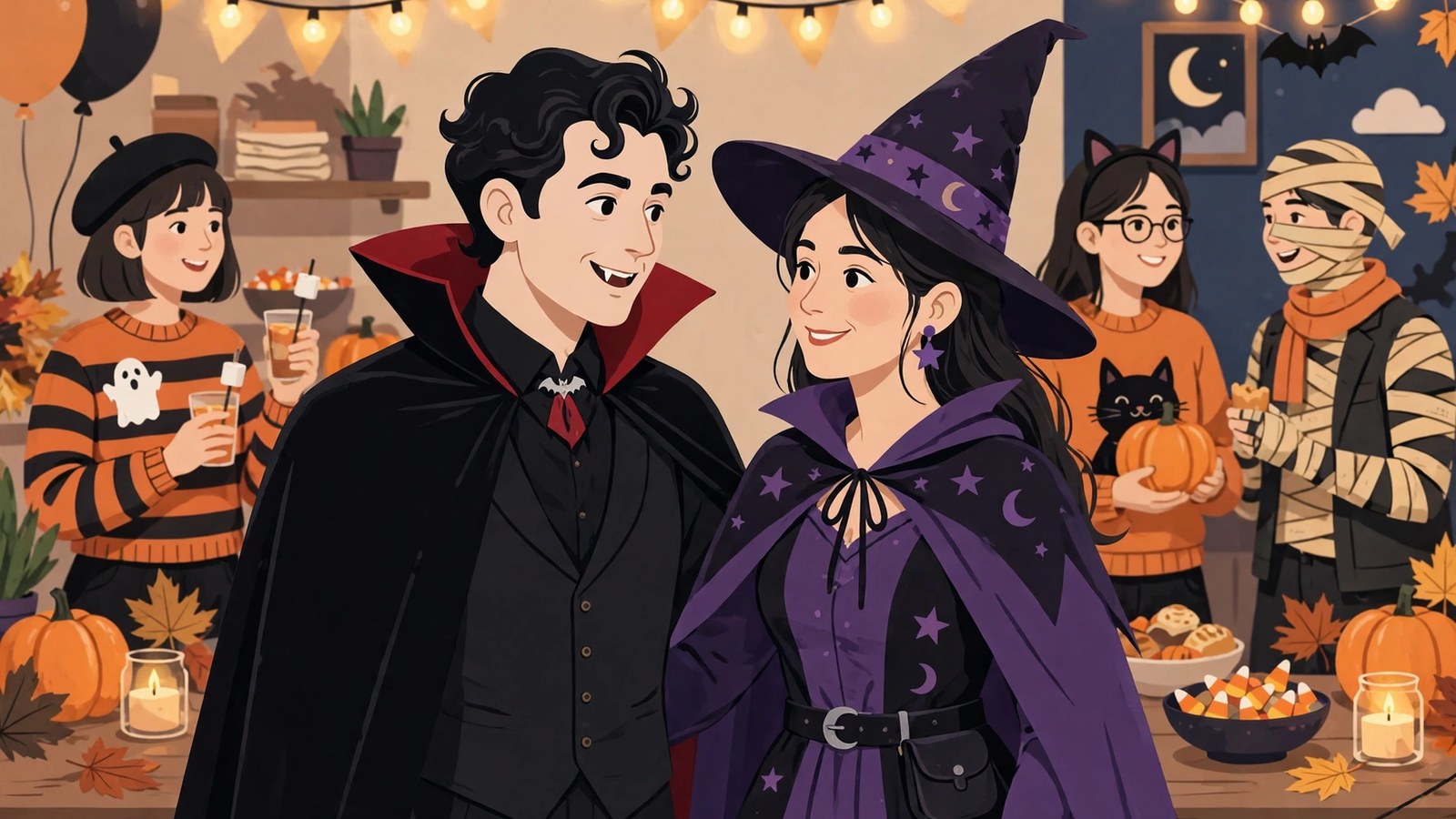
Vampire and witch. Dark clothes for both, a cape for one and a pointed hat for the other. Both work alone, and together they read as a matched supernatural pair.
Cat and mouse. Black clothes, cat ears, and whiskers for one; gray clothes, round ears, and a thin tail for the other. Simple, inexpensive, and funny, with a built-in chase joke for photos.
Salt and pepper. One person in white, one in black, each with a letter S or P on their top, or a shaker shaped hat made from card stock. A classic food pair that works because the joke is instant.
Peanut butter and jelly. One person in brown, one in purple or red, each labeled with their half of the sandwich. Nothing more than colored clothes and a label.
Sun and moon. Yellow or gold with card stock rays for one; dark blue or silver with a crescent shape for the other. An easy pair with strong color contrast.
Burglar and police officer. A striped top and a mask for one, a dark uniform style outfit and a cap for the other, both from ordinary clothes. Keep any mask clear of the eyes and easy to remove, and keep props soft.
Ghost and pumpkin. A white sheet ghost beside someone in orange with a green stalk hat. Two of the simplest solo costumes, combined into one Halloween scene.
The pattern: the best easy pairs are two halves of one idea. If you can describe the pair in three words, strangers will probably understand it too.
Duo Ideas for Two Friends
Duo costumes are for two friends rather than a romantic couple, and the best ones lean into friendship rather than romance. The roles work best when neither friend is clearly the main character.
Two halves of a whole. Salt and pepper, peanut butter and jelly, or a plug and a socket. The joke lands because the two people have to stand together to complete it, which also makes it a strong photo idea.
Opposites. Angel and devil, sun and moon, fire and ice, or a superhero and a villain. Each is a simple color and accessory job, and the contrast makes both halves stand out even when the pair is separated.
A double act. A magician and an assistant, a detective and a sidekick, or a chef and a waiter. Ordinary clothes plus one prop each, and the roles give you something to act out.
Matching animals. Two cats, two bees, two ladybugs, or a cat and a dog. Ears on a headband, a tail, and whiskers or a nose drawn with face paint do most of the work.
A before and after. A plain outfit beside a glamorous one, or a tidy outfit beside a zombie version of the same outfit. It tells a story in two people and costs almost nothing, because the second costume is a changed version of the first.
Two playing cards. A queen of hearts and a king of spades, or two jokers: white outfits with a large card shape pinned front and back. Cards also scale to a group if more friends join later.
Before you settle, check that both roles are equally fun to wear. If one is a full costume and the other is only holding a sign, give the second person the same base, label style, and an accessory of their own.
Group Costumes That Actually Work
Group costumes live or die on one question: can a stranger tell what the group is without an explanation? The themes below pass that test and tolerate different sizes, budgets, and craft skills in the same group.
A box of crayons. Each person wears one bright color with a pointed card stock hat in the same color, labeled with the color name. Inexpensive, unmistakable in photos, and one more or fewer crayon changes nothing.
A deck of cards. White outfits with a large card pinned front and back, each person a different card. Every member is recognizable alone, and late joiners need only a new card.
A rainbow. Each person wears a different color of the rainbow, in order if you can manage it for the photo. It needs no props, and out of order it still reads as a color set, which is why it survives a missing member.
A team of superheroes. Each person picks a different hero, built from colored clothes and a simple symbol, with agreed symbol size and placement so the team looks connected. Character names here are descriptive only, with no endorsement by any rights holder claimed or implied.
A pack of animals. Everyone picks a different animal and builds it from ears, face paint, and colored clothes. A cat, a dog, a fox, a deer, and a bunny together read as a menagerie, and variety is part of the theme, so effort levels do not need to match precisely.
A haunted house crew. A ghost, a witch, a vampire, a skeleton, and a zombie. Every member is a recognizable Halloween figure: Encyclopaedia Britannica lists ghosts, witches, and vampires among the scary beings incorporated into Halloween celebrations.
A set of emojis. Each person dresses as a different emoji, such as a smiley face, a ghost, a pumpkin, or a heart. Yellow clothes and a face painted on fabric or pinned on as a card stock circle do most of the work.
A sports team. Matching shirts in a team color, with numbers on the back. It works because it looks like a real team. Add face paint in the team colors to make it a Halloween costume rather than just a uniform, and use an invented team name rather than copying a real team’s branding.
Scaling a Pair Into a Group, and a Group Into a Pair
Many good pair ideas contain a set waiting to be opened up, and many good group themes contain a pair waiting to be taken out. Decide which direction you are scaling before anyone builds.
To scale a pair up, look for the set it belongs to. Salt and pepper becomes a spice rack or kitchen set when you add other labeled foods. Sun and moon becomes a sky set with stars, a cloud, and a rainbow. A king and queen of cards becomes a full deck. A cat and a mouse becomes an animal pack. The rule stays the same and the original pair keeps its place.
To scale a group down, take the two most contrasting roles and keep the shared marker. From a crayon box, take the two brightest colors and keep the pointed hats and labels. From a haunted house crew, take the ghost and the vampire and keep the shared pale makeup. Without the shared marker, a scaled down pair can look like two unrelated solo costumes.
Last-Minute Pairs
Last-minute pairs are for the party tonight and the idea you had this afternoon. Times below are planning estimates for two people working together with clothes and supplies already at home, not measured results. Everything here is intended to be assembled in under an hour.
Two ghosts. Two white sheets with eye holes, and you are done. Cut eye holes large enough for full vision and keep the fabric short enough that it does not drag.
Salt and pepper. A white top and a black top, with the letters pinned on. Allow about ten minutes, and the joke is complete.
Cat and mouse. Black clothes and eyeliner whiskers for one, gray clothes and round ears for the other. Allow about fifteen minutes if you own something in each color.
Zombie couple. Old clothes, messy hair, and dark eye makeup, done twice. Use nontoxic makeup and follow its package directions.
Error message and loading screen. One T-shirt reading Error 404 and one reading Loading. Two markers and two plain T-shirts, and the joke is complete.
A plug and a socket. One person in black with two prongs made from card stock on a hat, the other with a socket shape pinned to their top. Unmistakable when you stand together.
Do not apologize for a last-minute pair. Two people wearing the same simple idea with confidence look planned, not like a fallback. Spend the last five minutes on fit, vision, and a test photo rather than on one more decoration.
Do It Yourself Tips for Pairs and Groups
Do it yourself group costumes save money only if you plan the shared parts. The biggest saving comes from making or buying one thing in bulk: card stock hats, a roll of fabric in one color, or face paints shared by the group. One person handling the shared materials and splitting the cost is simpler than everyone buying their own version, and it guarantees the parts match. Treat prices as planning context only: agree on a spending limit per person in advance, rather than chasing a specific product.
Use the group chat for photos, not just descriptions, and stick to one agreed photo per role. If someone has to substitute, match the color and the identifying accessory first and the exact garment second. That order keeps the group readable even when wardrobes differ.
Build costumes that survive the evening. Card stock hats need tape reinforcement, pinned labels need safety pins rather than sticky tape, and face paint needs setting if it has to last for hours. Do a short wear test at home: sit, stand, raise your arms, and check that hats, labels, and capes stay in place.
Think about transport. Capes, hats, ears, and face paint travel well and can be put on at the venue, while rigid props and wide hats do not. For a pair, one shared bag stops one person arriving with only half a costume.
Finally, agree on the photo and take it early, before makeup fades and hats are lost: crayons in color order, cards fanned out, animals in a line, or a pair close enough that both labels can be read.
Safety, Comfort and Visibility for Pairs and Groups
Shared costumes raise shared safety questions, because a group tends to copy whatever the first person chose. Run these checks for every member, not only for the planner.
On fire safety, the U.S. Consumer Product Safety Commission advises people buying costumes, masks, beards, and wigs to look for flame resistant fabrics such as nylon or polyester, or for a Flame Resistant label, because flame resistant fabrics will resist burning and should extinguish quickly. It advises avoiding flimsy materials and outfits with big, baggy sleeves, large capes, or billowing skirts near fire sources, encourages inherently flame resistant fabrics for homemade costumes, and recommends flameless candles. For a group, check trailing capes, wide sleeves, and large card stock shapes for the whole set, and keep them away from candles and jack-o’-lanterns.
On visibility, the Commission advises costumes that are light colored, bright, and clearly visible to motorists, with reflective tape added for dusk and darkness. The National Safety Council gives the same direction: bright colored costumes, plus reflective tape, glow sticks, or flashlights. A dark themed group can add a reflective strip or a small light per person without breaking the theme.
On fit and vision, the Commission advises that costumes should fit well and not drag, shoes should be well fitting and sturdy, hats and scarves should be tied securely so they do not slip over the eyes, and a mask should fit securely, provide adequate ventilation, and have eye holes large enough for full vision. The National Safety Council recommends nontoxic face paint and well fitted hats instead of masks that may obstruct vision, and says costumes should be flame resistant and fit well to prevent tripping. The Commission also advises that swords, knives, and similar accessories should be made of soft, flexible material. Apply that to every prop, including wands, brooms, and card stock shapes with sharp corners.
Comfort matters too: a costume that is too hot or hard to sit in will be partly removed, and the theme breaks with it. Build in one removable layer and choose shoes each person can already walk in.
When Plans Change: Troubleshooting
| Problem | Practical fix |
|---|---|
| No one understands the pair or group | Enlarge the label, add a one word sign, or switch to a clearer theme |
| One costume looks much plainer than the rest | Give everyone the same label style, hat, color, or makeup detail |
| One person drops out | Remove that role from the set and reorder the rest for the photo |
| One person joins late | Give them the spare label or hat and the simplest role in the set |
| A label or hat keeps falling off | Use safety pins, reinforce card stock, and move the item to an outer layer |
| Makeup smudges or irritates skin | Simplify to one shared detail and switch to a nontoxic product used as its package directs |
| The group cannot travel together | Carry accessories in one bag and put costumes on at the venue |
A pair or group costume rarely fails for lack of detail. It fails when the rule is unclear, the effort is uneven, or one costume stops reading as part of the set. Fix those three first.
Frequently Asked Questions
What is the difference between a couples costume, a duo costume, and a group costume?
A couples costume is usually worn by a romantic couple. A duo costume is any two person costume, including friends, siblings, or coworkers. A group costume extends the same rule to three or more people, each holding one role in a set or scene. The method is the same at every size: one rule, one shared marker, and a costume that works alone.
How many people do you need for a group Halloween costume?
Three people are enough, and set themes such as crayons, cards, a rainbow, or animals can grow much larger without changing the rule. What matters more is that every role is assigned, the theme still reads if one person is missing, and everyone agreed on the same effort level.
How do you make a group costume look coordinated without buying matching outfits?
Use one shared marker and repeat it exactly: a color rule, a label in the same style and size, a hat in the same shape, or the same makeup pattern. Photograph one finished role as the reference for the group. Coordinated is about repetition, not identical clothes.
What are easy couples Halloween costumes that need almost no buying?
Salt and pepper, peanut butter and jelly, sun and moon, ghost and pumpkin, and cat and mouse all work from ordinary clothes plus a label, a hat, or a makeup detail. Vampire and witch also need little buying if you already own dark clothes. Choose the pair whose colors you already own.
How do you keep a group costume comfortable and safe all evening?
Check every costume for fit, vision, and visibility. Choose well fitting costumes that do not drag, sturdy shoes, and hats tied securely, and use masks with large eye holes and adequate ventilation, or nontoxic face paint instead. Prefer flame resistant fabrics, keep loose fabric and large props away from candles, keep props soft and flexible, and add reflective tape or a small light if the group will be outside at dusk or in darkness.
Can a last-minute pair costume still look planned?
Yes, if both people commit to the same simple idea and shared marker. Two ghosts, salt and pepper, or an error message and loading screen pair read as planned when labels are large and colors are clear. Spend the remaining time on a test photo and on fit and vision checks.
Keep reading: Easy Last-Minute Halloween Costumes
Keep reading: Last-Minute Couples Halloween Costumes
Keep reading: Last-Minute Family and Group Halloween Costumes
Keep reading: Last-Minute Halloween Costumes for Kids: Fast Ideas From Clothes You Already Own
Keep reading: Halloween Costume Ideas: Easy, Funny, Cute, Simple, DIY and Last-Minute
Keep reading: Character and Pop-Culture Halloween Costumes: Storybook, Horror, TV and Music Looks
Sources & references
- Encyclopaedia Britannica, "Halloween: Definition, Origin, History, Traditions, and Facts." Halloween is observed annually on October 31 and celebrated with parties, spooky costumes, pumpkin carvings called jack-o'-lanterns, and trick or treat; the name derives from All Hallows' Eve, the evening before All Hallows', or All Saints', Day; dressing up in costumes and masks is a Halloween tradition that may go back to ancient Irish and medieval practices, and costume options have expanded to include superheroes, celebrities, and scary beings such as ghosts, witches, and vampires. Opened and checked 29 Oct 2026.
- U.S. Consumer Product Safety Commission, "CPSC Provides Three Steps to a Safe Halloween Celebration." Look for flame resistant fabrics such as nylon or polyester or a Flame Resistant label; flame resistant fabrics will resist burning and should extinguish quickly; avoid flimsy materials and outfits with big, baggy sleeves, large capes, or billowing skirts near fire sources; buy or make costumes that are light colored, bright, and clearly visible to motorists; add reflective tape to costumes and bags for visibility at dusk and in darkness; costumes should fit well and not drag on the ground; shoes should be well fitting and sturdy; hats and scarves should be tied securely so they do not slip over the eyes; masks should fit securely, provide adequate ventilation, and have eye holes large enough for full vision; swords, knives, and similar accessories should be made of soft, flexible material; use flameless candles as a safer alternative and never leave a burning candle unattended. Opened and checked 29 Oct 2026.
- National Safety Council, "NSC Reminds Parents and Drivers to Avoid Halloween Hazards." Choose bright colored costumes and use reflective tape, glow sticks, or flashlights to boost visibility; use nontoxic face paint and well fitted hats instead of masks that may obstruct vision; costumes should be flame resistant and fit well to prevent tripping. Opened and checked 29 Oct 2026.
- Literal phrase SERP check, "Couples and Group Halloween Costumes: Ideas for Pairs, Duos and Whole Crews" and "couples halloween costumes," 29 Oct 2026. No exact match for the full title phrase was returned. Top results for the primary keyword were product listings, retailer collections, and list guides for pair and group ideas, covering themes such as peanut butter and jelly, plug and socket, and salt and pepper. This article serves the same inspiration intent with coordination mechanics, scaling guidance, and safety checks sourced from the Commission and the Council above, rather than with shopping links. Recorded in the writer ledger.


