Short answer
- The energy of light is the energy carried by electromagnetic radiation, delivered in discrete packets called photons. The energy of a single photon is given by the Planck relation E = hf, where E is the photon energy in joules, h is Planck's constant, and f is the frequency of the light in hertz. Because frequency and wavelength are linked by the speed of light, the same relation can be written as E = hc divided by lambda, where c is the speed of light in a vacuum and lambda is the wavelength in meters. Planck's constant has the exact value 6.62607015 times 10 to the power of negative 34 joule seconds, and the speed of light in a vacuum has the exact value 299,792,458 meters per second. A photon with a higher frequency, and therefore a shorter wavelength, carries more energy than a photon with a lower frequency and a longer wavelength. That is why an ultraviolet photon carries more energy than a visible light photon, which in turn carries more energy than an infrared or radio photon. The total energy in a beam depends on two things at once: the energy of each photon and the number of photons arriving each second. Light has no rest mass, yet it carries energy and momentum, and it can transfer that energy to matter by absorption, which can heat a surface, drive a chemical change such as photosynthesis, or free electrons in a solar cell.
Introduction
Light warms your skin on a sunny day, powers a solar panel, and lets a camera record a scene. In each case, something is being carried from one place to another and then put to work. That something is the energy of light. This guide defines it precisely, shows how to calculate it, and explains how it moves through the world around you.
The definition rests on two ideas that are easy to mix up. First, light is a form of electromagnetic radiation, which means it is made of oscillating electric and magnetic fields that travel through space. Second, that radiation arrives in discrete packets called photons, and each photon carries an amount of energy fixed by its frequency. Once you hold both ideas together, the formula E = hf stops being a symbol to memorize and becomes a tool you can use.
This article is a definition and calculation guide. It explains what the energy of light is, how it changes across the electromagnetic spectrum, and how it is transferred to matter. A separate article explains wave-particle duality in full, and another explains mechanical waves, which are a different kind of wave altogether. Those topics are mentioned here only where they help clarify this definition.
What Light Is: Electromagnetic Radiation in Packets
Light is the visible part of a much larger family called electromagnetic radiation. The family includes radio waves, microwaves, infrared radiation, visible light, ultraviolet radiation, X-rays, and gamma rays. All of these are the same kind of thing: oscillating electric and magnetic fields that travel through space and can carry energy from one place to another. What changes from one member of the family to another is the frequency of the oscillation, and with it the wavelength.
A wave description is useful because it explains reflection, refraction, and diffraction, the bending of light around obstacles and through narrow openings. But the wave description alone does not explain how light exchanges energy with matter. When light is absorbed or emitted by atoms, it behaves as if it arrives in separate packets. Each packet is called a photon. A photon is not a tiny ball in the everyday sense. It is the quantum, or smallest unit, of electromagnetic radiation of a given frequency. A beam of light can be thought of as a stream of these packets, and the energy of the beam is the sum of the energies of its photons.
One of the most useful facts about light is that it needs no material medium. Sound needs air, water, or a solid to travel through, but light travels through the vacuum of space. That is how sunlight reaches Earth across nearly empty space. In a vacuum, all electromagnetic radiation travels at the same speed, c, regardless of its frequency or wavelength. In a material such as glass or water, light travels more slowly.
The Formula: E = hf
The Planck relation is the core of this definition:
E = hf
Each symbol has a fixed meaning and a standard unit:
- E is the energy of one photon, measured in joules (J).
- h is Planck’s constant, equal to 6.62607015 times 10 to the power of negative 34 joule seconds (J s). Since 2019 this value has been exact by definition in the International System of Units, because the kilogram is now defined using this fixed value of h.
- f is the frequency of the light, measured in hertz (Hz). One hertz means one complete wave cycle per second.
The relation says that photon energy is directly proportional to frequency. Double the frequency and you double the energy of each photon. Halve the frequency and you halve the energy of each photon. The constant h is the conversion factor between the two, and it is extremely small, which is why the energy of a single photon is extremely small in everyday units even though huge numbers of photons together carry noticeable energy.
Planck introduced this relation in 1900 to explain the spectrum of radiation emitted by hot objects, a problem known as blackbody radiation. His proposal was that energy is exchanged in discrete steps rather than in any amount at all. That proposal became one of the starting points of quantum physics. The relation is sometimes called the Planck-Einstein relation, because Einstein later used the photon idea to explain the photoelectric effect, in which light falling on a material can eject electrons from it.
The Second Form: E = hc Divided by Lambda
Frequency and wavelength are not independent. For any wave, speed equals frequency multiplied by wavelength. For light in a vacuum, that gives:
c = f times lambda
where lambda, written with the Greek letter lambda, is the wavelength in meters. Rearranging gives f = c divided by lambda. Substituting that into E = hf gives the second form of the relation:
E = hc divided by lambda
This form is often more convenient, because many light sources and detectors are described by wavelength rather than frequency. It makes the inverse relationship plain: photon energy is inversely proportional to wavelength. Shorter wavelength means higher energy per photon, and longer wavelength means lower energy per photon. The product hc is a useful constant in its own right. Using the exact values of h and c, hc equals 1.98644586 times 10 to the power of negative 25 joule meters (J m). Dividing that number by a wavelength in meters gives the photon energy in joules directly.
A note on units matters here. The formula only works if the units match. Frequency must be in hertz, wavelength in meters, h in joule seconds, and c in meters per second. A common error is to insert a wavelength in nanometers without converting to meters first: 550 nanometers must be entered as 5.50 times 10 to the power of negative 7 meters.
How Energy Changes Across the Spectrum
Because photon energy depends only on frequency, the electromagnetic spectrum is also an energy scale. At the low energy end sit radio waves, with long wavelengths and low frequencies. Moving up in energy come microwaves, then infrared radiation, then visible light, then ultraviolet radiation, then X-rays, and finally gamma rays at the high energy end. The boundaries between these bands are conventional rather than sharp physical walls, but the ordering by energy is fixed.
The table below gives one representative example from each band, calculated with E = hc divided by lambda.
| Band | Representative wavelength | Representative frequency | Photon energy |
|---|---|---|---|
| Radio | 3.00 meters | 100 megahertz | 6.62 times 10 to the power of negative 26 joules |
| Microwave | 3.00 centimeters | 10 gigahertz | 6.62 times 10 to the power of negative 24 joules |
| Infrared | 10 micrometers | 30 terahertz | 1.99 times 10 to the power of negative 20 joules |
| Visible, green | 550 nanometers | 545 terahertz | 3.61 times 10 to the power of negative 19 joules |
| Ultraviolet | 300 nanometers | 999 terahertz | 6.62 times 10 to the power of negative 19 joules |
| X-ray | 0.10 nanometers | 3,000,000 terahertz | 1.99 times 10 to the power of negative 15 joules |
| Gamma ray | 1.0 picometers | 300,000,000 terahertz | 1.99 times 10 to the power of negative 13 joules |
The spread is enormous. A single gamma ray photon in this example carries about three trillion times the energy of a single radio photon. That spread explains why different bands interact with matter so differently. A radio photon does not carry enough energy to disturb an atom in any important way, while an X-ray photon carries enough to ionize atoms, which means to knock electrons out of them. Ultraviolet photons sit in between: they carry enough energy to damage molecules in skin, which is why ultraviolet exposure is linked to sunburn, while visible light photons do not.
Worked Examples With Units
Each example shows every step with units attached.
Example 1: A green photon at 550 nanometers
Green light near the middle of the visible band has a wavelength of about 550 nanometers. Convert to meters first:
lambda = 550 nanometers = 550 times 10 to the power of negative 9 meters = 5.50 times 10 to the power of negative 7 meters.
Now apply E = hc divided by lambda:
E = (6.62607015 times 10 to the power of negative 34 J s) times (299,792,458 m/s) divided by (5.50 times 10 to the power of negative 7 m).
The numerator, hc, equals 1.98644586 times 10 to the power of negative 25 J m. Dividing:
E = 1.98644586 times 10 to the power of negative 25 J m divided by 5.50 times 10 to the power of negative 7 m = 3.61 times 10 to the power of negative 19 J.
So one green photon carries about 3.61 times 10 to the power of negative 19 joules. Its frequency is f = c divided by lambda = 299,792,458 m/s divided by 5.50 times 10 to the power of negative 7 m = 5.45 times 10 to the power of 14 Hz, or 545 terahertz.
Small photon energies are often expressed in electron volts (eV) instead of joules. One electron volt equals 1.602176634 times 10 to the power of negative 19 joules. Dividing gives:
3.61 times 10 to the power of negative 19 J divided by 1.602176634 times 10 to the power of negative 19 J/eV = 2.25 eV.
So a green photon carries about 2.25 eV.
Example 2: Red light versus violet light
Take red light at 700 nanometers and violet light at 380 nanometers, the two ends of the visible range given by NASA.
Red: E = 1.98644586 times 10 to the power of negative 25 J m divided by 7.00 times 10 to the power of negative 7 m = 2.84 times 10 to the power of negative 19 J, which is 1.77 eV.
Violet: E = 1.98644586 times 10 to the power of negative 25 J m divided by 3.80 times 10 to the power of negative 7 m = 5.23 times 10 to the power of negative 19 J, which is 3.26 eV.
A violet photon therefore carries about 1.84 times the energy of a red photon. The ratio is just the inverse ratio of the wavelengths, 700 divided by 380, which equals 1.84. This is a useful shortcut: for any two photons, the ratio of their energies equals the inverse ratio of their wavelengths.
Example 3: An ultraviolet photon at 300 nanometers
Ultraviolet light at 300 nanometers gives:
E = 1.98644586 times 10 to the power of negative 25 J m divided by 3.00 times 10 to the power of negative 7 m = 6.62 times 10 to the power of negative 19 J, which is 4.13 eV.
That is nearly twice the energy of a green photon, which helps explain why ultraviolet light can drive chemical changes in skin that visible light cannot.
Example 4: A radio photon at 100 megahertz
For radio, frequency is usually the given quantity, so E = hf is the natural form:
E = (6.62607015 times 10 to the power of negative 34 J s) times (100 times 10 to the power of 6 Hz) = 6.63 times 10 to the power of negative 26 J.
That is roughly five million times less energy than a green photon. Radio communication works not because each photon is energetic but because transmitters emit enormous numbers of them. Its wavelength is c divided by f = 299,792,458 m/s divided by 100 times 10 to the power of 6 Hz = 3.00 meters, a typical FM radio wavelength.
Example 5: An X-ray photon at 0.10 nanometers
E = 1.98644586 times 10 to the power of negative 25 J m divided by 1.0 times 10 to the power of negative 10 m = 1.99 times 10 to the power of negative 15 J.
In electron volts, that is 1.99 times 10 to the power of negative 15 J divided by 1.602176634 times 10 to the power of negative 19 J/eV = 12,400 eV, or 12.4 kilo electron volts (keV). This is in the range used for medical imaging, where X-rays pass through soft tissue and are stopped more strongly by denser material such as bone.
Example 6: Counting photons in a beam
Suppose a green laser pointer emits 1.0 watt of light at 550 nanometers. One watt means one joule per second. Each photon carries 3.61 times 10 to the power of negative 19 joules, so the number of photons emitted per second is:
1.0 J/s divided by 3.61 times 10 to the power of negative 19 J = 2.77 times 10 to the power of 18 photons per second.
That is about 2.8 million trillion photons every second. This example shows why individual photon energies look tiny while beams carry useful amounts of energy: the photon count is immense.
Brightness Versus Photon Energy
One of the most common confusions about the energy of light is the difference between brightness and photon energy. Brightness, or more precisely intensity, is the total energy arriving per second on a given area. It equals the number of photons arriving per second multiplied by the energy of each photon. Either factor can raise it.
A bright red light can therefore deliver more total energy per second than a dim blue light, even though each blue photon carries more energy than each red photon. The red beam simply contains many more photons per second. Conversely, a dim ultraviolet lamp can damage a material that a bright visible lamp cannot, because damage often depends on whether a single photon carries enough energy to break a particular chemical bond, not on how many photons arrive in total. Sunburn works this way: it is driven by ultraviolet photons whose individual energy is high enough to damage skin molecules, and no amount of ordinary visible brightness substitutes for that per photon energy.
This distinction also explains the photoelectric effect. When light falls on certain materials, electrons are ejected only if each photon carries at least a threshold energy set by the material. Below that threshold, even a very bright beam ejects no electrons at all. The effect was key evidence that light energy arrives in packets rather than as a smooth flow.
How Light Energy Transfers to Matter
Light energy does not do anything until it interacts with matter. When a beam meets a surface, four things can happen, in varying proportions: reflection, transmission, scattering, and absorption. Only absorption transfers the light energy into the material. What happens next depends on what absorbed the photon and how much energy it carried.
Heating
The most familiar transfer is heating. When a dark surface absorbs sunlight, the photon energy becomes motion of the atoms and molecules in the material, which is what temperature measures. That is why a black car roof becomes hotter in the sun than a white one: it absorbs a larger fraction of the arriving photons instead of reflecting them. Any absorbed photon, of any band, can ultimately appear as heat if it is not used some other way.
Photosynthesis
In photosynthesis, plants, algae, and some bacteria capture light energy and use it to build energy rich molecules from water and carbon dioxide, releasing oxygen as a byproduct. The light absorbing pigments, chiefly chlorophyll, absorb mainly red and blue light and reflect green light, which is why most leaves look green. Photosynthesis is therefore a direct conversion of light energy into chemical energy, and it is the original source of nearly all the energy in food chains.
Solar cells
A solar cell uses the photovoltaic effect, a close relative of the photoelectric effect. When photons with enough energy strike a semiconductor material, usually silicon, they free electrons from their atoms. The structure of the cell separates the freed electrons from the positively charged regions left behind, and that separation drives an electric current through an external circuit. Only photons above a threshold energy set by the material contribute. No efficiency figure is claimed here, because efficiency varies by cell type, design, and operating conditions.
Vision
In vision, photons entering the eye are absorbed by light sensitive cells in the retina. A photon absorbed by a photoreceptor molecule changes that molecule’s shape, which triggers a signal to the brain. Color vision works because different receptor types respond most strongly to different wavelength ranges. This is light energy converted into an electrochemical signal: absorption, then conversion into another energy form.
Light Has No Rest Mass but Carries Energy and Momentum
It sounds contradictory to say that something with no mass carries energy and momentum, but the contradiction is only apparent. A photon has zero rest mass and is never at rest: it always travels at the speed of light in a vacuum. Its energy is given by E = hf, and its momentum by a related relation:
p = E divided by c = h divided by lambda
where p is momentum in kilogram meters per second. For a green photon at 550 nanometers, p = 6.62607015 times 10 to the power of negative 34 J s divided by 5.50 times 10 to the power of negative 7 m = 1.20 times 10 to the power of negative 27 kilogram meters per second. That is a tiny momentum per photon, but with enough photons it becomes measurable. Sunlight exerts a real pressure on surfaces, called radiation pressure, and engineers have proposed using large reflective sails pushed by sunlight for spacecraft propulsion.
This also clarifies a common point of confusion: a box full of light would weigh slightly more than the same empty box, because the energy inside contributes to the total mass of the system. What is zero is the rest mass of each individual photon, not the contribution of light energy to the mass of a system that contains it.
Common Misconceptions
Misconception 1: Brighter light always means more energetic light
As shown above, brightness measures total energy per second, which depends on photon count as well as photon energy. A bright beam of low energy photons can carry more total energy than a dim beam of high energy photons. What brightness cannot change is the energy of each individual photon, which is set by its frequency.
Misconception 2: Light energy and luminous energy are the same thing
They are related but different. Radiant energy is the objective physical energy carried by electromagnetic radiation, measured in joules. Luminous energy is a photometric quantity that weights radiant energy by how sensitive the human eye is to each wavelength. Light well outside the visible band has zero luminous energy no matter how much radiant energy it carries, because the eye cannot see it. When physicists say “energy of light” without qualification, they usually mean radiant energy, the quantity defined by E = hf.
Misconception 3: Light needs something to travel through
Light needs no material medium. It is a traveling disturbance of electric and magnetic fields, not a vibration of a material substance. That is the key difference from sound and from water waves, which do need a medium. The companion topic on mechanical waves explains those waves in full.
Misconception 4: All light travels at the same speed everywhere
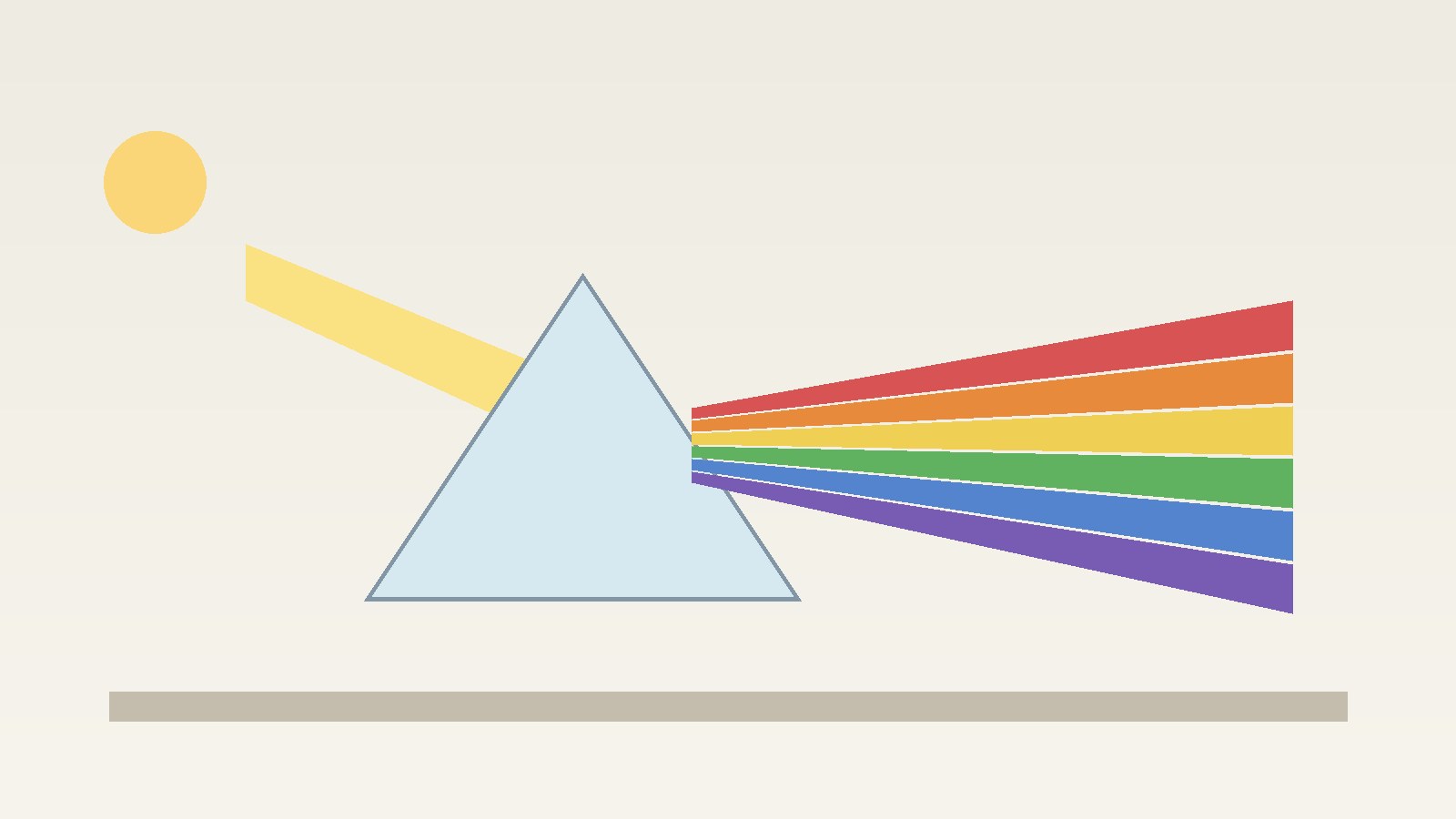
All light travels at c in a vacuum, but in a material it travels more slowly, and the slowing depends on the material and slightly on the wavelength. That wavelength dependence is why a prism spreads white light into a spectrum. The frequency of light does not change when it enters a new material, but its wavelength and speed do, in step.
Misconception 5: A photon is a tiny particle like a grain of sand
A photon is not a small solid object. It is a quantum of electromagnetic radiation. It shows particle like behavior when it is emitted or absorbed, because energy is exchanged in whole photons, and wave like behavior when it travels and interferes. A full account of that dual behavior belongs to the separate article on wave-particle duality; this definition article uses the photon only as the unit in which light energy is exchanged.
Frequently Asked Questions
What is the definition of the energy of light?
The energy of light is the energy carried by electromagnetic radiation, delivered in photons. The energy of one photon is E = hf, where h is Planck’s constant and f is the frequency. Equivalently, E = hc divided by lambda, where lambda is the wavelength. Higher frequency and shorter wavelength mean higher energy per photon.
What is the formula for the energy of light?
The two standard forms are E = hf and E = hc divided by lambda. In these formulas, E is in joules, h is 6.62607015 times 10 to the power of negative 34 joule seconds, f is in hertz, c is 299,792,458 meters per second, and lambda is in meters. Convert wavelengths to meters before calculating.
Does higher frequency light have more energy?
Yes. Photon energy is directly proportional to frequency, so doubling the frequency doubles the energy of each photon. That is why ultraviolet photons are more energetic than visible photons, and visible photons are more energetic than infrared photons. A beam’s total energy also depends on how many photons it contains.
Is light energy the same as heat?
No, although the two are closely connected. Light energy is energy carried by electromagnetic radiation. Heat is energy transferred because of a temperature difference, and it is also the form in which absorbed light energy often ends up. When a surface absorbs light and warms up, light energy has been converted into thermal energy in the material.
Can light travel through a vacuum?
Yes. Light is an electromagnetic wave, not a vibration of a material, so it travels through empty space at 299,792,458 meters per second. That is how sunlight crosses the space between the Sun and Earth.
Does light have mass?
A photon has zero rest mass, but it carries energy and momentum, and its energy contributes to the mass of any system that contains it. The relation p = h divided by lambda gives a photon’s momentum, which is why light exerts a small pressure, known as radiation pressure, on surfaces it strikes.
Why does ultraviolet light cause sunburn but visible light does not?
Sunburn is caused by damage to molecules in skin cells, and that damage requires a photon to carry enough energy to break or alter chemical bonds. Ultraviolet photons carry enough energy per photon to do that, while visible light photons do not, regardless of brightness.
How is light energy measured?
For a single photon, the energy is calculated from its frequency or wavelength using E = hf or E = hc divided by lambda, and the result is expressed in joules or electron volts. For a beam, the total power is measured in watts, where one watt equals one joule per second, and the photon count per second can then be found by dividing the power by the energy per photon.
What is the difference between light energy and light intensity?
Light energy is the energy carried by photons, measured in joules for a given amount of light. Light intensity is the rate at which that energy arrives, usually per unit area, measured in watts per square meter. Intensity depends on both the energy of each photon and the number of photons arriving each second.
Keep reading: What Are Mechanical Waves?
Keep reading: The Wave-Particle Duality
Sources & references
- National Institute of Standards and Technology, CODATA recommended values: Planck constant h = 6.62607015 times 10 to the power of negative 34 joule seconds (exact), and speed of light in vacuum c = 299,792,458 meters per second (exact).
- National Aeronautics and Space Administration, NASA Science, Visible Light: the human eye typically detects wavelengths from 380 to 700 nanometers, with violet near 380 nanometers and red near 700 nanometers.
- National Aeronautics and Space Administration, NASA Science, PACE Light Properties: as wavelength shrinks, energy and frequency increase.
- OpenStax, University Physics Volume 3, chapter on photons and matter waves: the Planck relation, the photoelectric effect threshold, and photon momentum.
- OpenStax, Biology 2e, chapter on photosynthesis: light energy captured by pigments, chiefly chlorophyll, drives the conversion of water and carbon dioxide into energy rich molecules with oxygen released.


