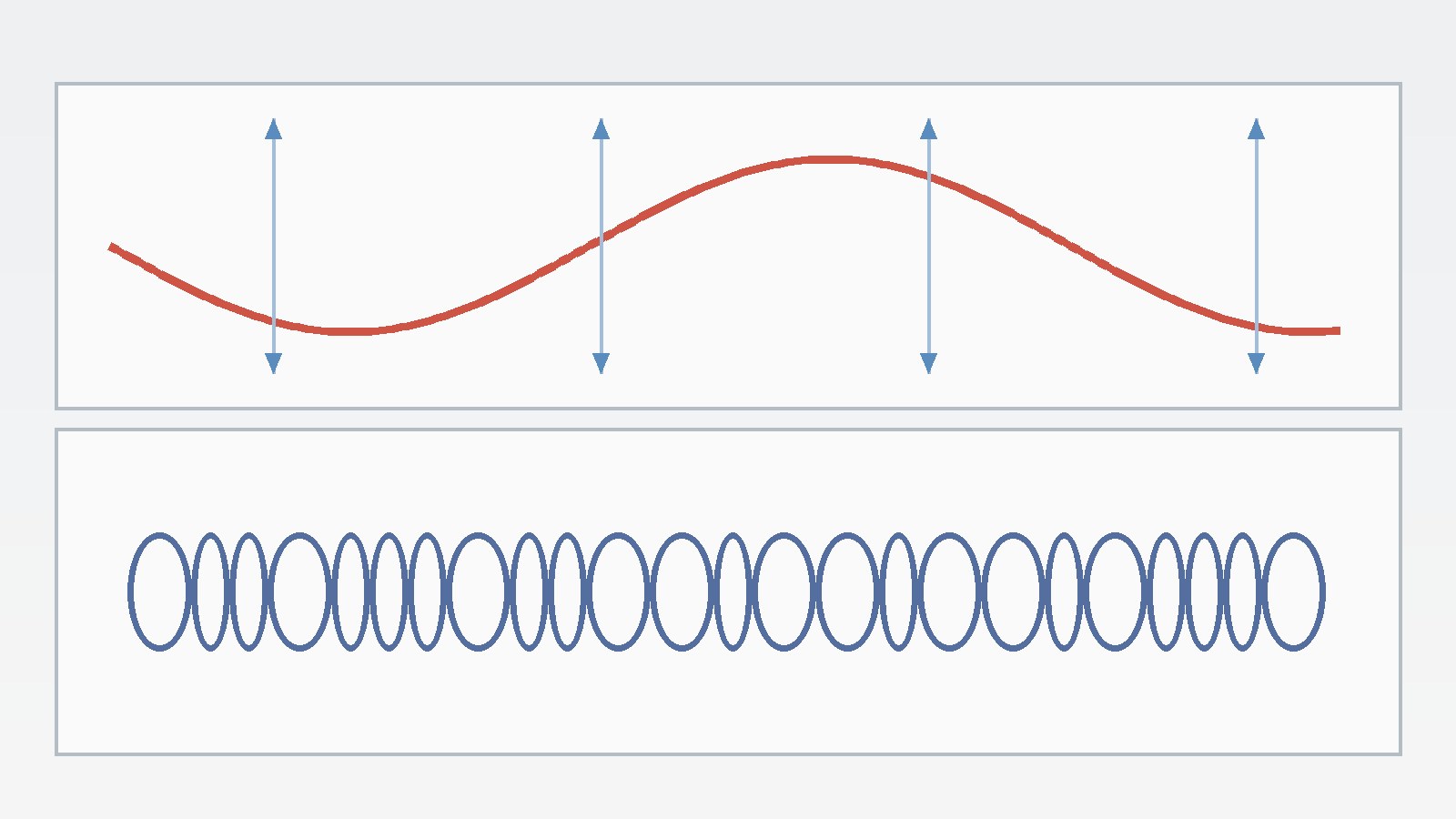
Short answer
- The transverse wave vs longitudinal wave difference is the direction of the disturbance compared with the direction the wave travels.
- In a transverse wave, the disturbance is perpendicular, or at a right angle, to the direction the wave travels. A rope shaken up and down while the wave moves sideways is the classic picture.
- In a longitudinal wave, the disturbance is parallel to, or along the same line as, the direction the wave travels. Sound in air is the classic picture: air is squeezed and stretched along the path of the sound.
- Transverse waves show crests and troughs. Longitudinal waves show compressions and rarefactions instead.
- Light is transverse. Sound in air is longitudinal.
- Only transverse waves can be polarized. Sound cannot be polarized.
- A wave carries energy forward without carrying the medium forward with it. Each part of the medium moves back and forth around its resting position while the pattern travels on.
The One Idea That Separates the Two Types
A wave is a disturbance that travels from one place to another. The classification of a wave does not depend on what it looks like in a photograph. It depends on geometry: compare two directions, the direction the wave travels and the direction in which the medium is disturbed.
Picture a long rope tied at one end. Shake the free end up and down. A hump travels along the rope toward the tied end. The wave travels horizontally, but each part of the rope moves vertically. The two directions are at a right angle, so this is a transverse wave.
Now picture a stretched spring, the kind often called a slinky, laid out on a table. Push one end forward and pull it back, along the length of the spring. A crowded region travels along the spring, followed by a stretched out region. The wave travels along the spring, and each coil also moves back and forth along the spring. The two directions are on the same line, so this is a longitudinal wave.
That comparison is the whole classification in one test. If you can answer the question “which way does the medium move, compared with which way does the wave travel?” you can classify almost any wave you meet in an introductory physics course.
One caution saves many students from a common error. The medium does not travel with the wave. No piece of rope ends up at the tied end because a wave passed through it, and no coil ends up at the far end because a compression passed through it. What travels is the pattern, and with the pattern, energy.
What Is a Transverse Wave?
A transverse wave is a wave in which the disturbance of the medium is perpendicular to the direction of propagation. The word transverse itself points to this idea: across, rather than along. University physics teaching uses exactly this definition, and it is worth memorizing in that form, because it works for every transverse wave, whether the wave is on a string, on the surface of water, or traveling through empty space as light.
The most familiar transverse wave is a wave on a string or rope. Pluck a guitar string and the string moves sideways while the wave travels along the string. Shake a jump rope and the rope rises and falls while the wave travels from your hands toward the other end. In both cases, the sideways motion is the disturbance, and the motion along the string is the travel of the wave.
Transverse waves have their own vocabulary. A crest is the highest point of the wave, measured from the resting position. A trough is the lowest point. The resting position is the level the medium would have if no wave were passing through it, often shown as a dashed line in textbook diagrams. Amplitude is the maximum displacement of the medium from that resting position: the height of a crest above the line, or the depth of a trough below it. Wavelength is the distance between two matching points on the wave, most often measured from one crest to the next crest, or from one trough to the next trough.
A transverse wave can travel in any direction, and its disturbance can point in any direction perpendicular to that travel. A rope wave can move up and down, or it can move side to side, while still traveling along the rope. The key point is that “up and down” is only one example of transverse motion, not the definition of it.
Transverse waves come in two broad families, and confusing them is a common source of mistakes. Mechanical transverse waves need a medium that can support a sideways restoring force. A string can do this because tension pulls a displaced section back toward its resting position. Electromagnetic transverse waves need no medium at all. Visible light, radio waves, microwaves, X-rays, and the other members of the electromagnetic family are oscillations of electric and magnetic fields, and they travel through a vacuum.
What Is a Longitudinal Wave?
A longitudinal wave is a wave in which the disturbance is parallel to the direction of propagation. The word longitudinal points along the length of the travel, and the definition is the exact mirror image of the transverse definition. Swap the word perpendicular for the word parallel, and you have moved from one type to the other.
The most familiar longitudinal wave is sound in air. A speaker cone moves back and forth, and that motion squeezes the air in front of it and then lets it stretch out again. The crowded regions are called compressions, where the pressure is higher than normal. The stretched out regions are called rarefactions, where the pressure is lower than normal. The pattern of compressions and rarefactions travels outward from the speaker, and each small region of air moves back and forth along that same path, around its resting position. Your ear detects the arriving pattern of pressure changes as sound.
Longitudinal waves have their own vocabulary, matching the transverse vocabulary point for point. Where a transverse wave has crests and troughs, a longitudinal wave has compressions and rarefactions. Where transverse amplitude is the height of a crest, longitudinal amplitude can be described as the maximum displacement of the medium from its resting position, or, for a sound wave, as the maximum change in pressure. Wavelength is still the distance between two matching points, but for a longitudinal wave it is most often measured from one compression to the next compression, or from one rarefaction to the next rarefaction.
A stretched spring gives the clearest hands-on picture of a longitudinal wave. Push the end of the spring forward and a crowded group of coils moves along the spring. Pull the end back and a spread-out group follows it. A single marked coil does not travel to the far end. It moves forward and back around its resting place while the crowded pattern passes through. The same idea applies to sound, except that the moving parts are tiny regions of air rather than visible coils.
Longitudinal waves are also called compressional waves, and that second name is worth knowing because textbooks and exam questions use both terms. A compressional wave is not a third type of wave. It is the same thing as a longitudinal wave, named for the compressions that mark its passage. Likewise, a transverse wave is sometimes called a shear wave, named for the shearing motion involved.
Unlike electromagnetic transverse waves, longitudinal waves always need a medium. A sound wave cannot cross empty space because there is nothing to compress and stretch. Longitudinal waves can travel through solids, liquids, and gases, because all of these materials can be compressed.
Transverse vs Longitudinal at a Glance
| Feature | Transverse wave | Longitudinal wave |
|---|---|---|
| Disturbance direction | Perpendicular to the direction the wave travels | Parallel to the direction the wave travels |
| Also called | Shear wave | Compressional wave, compression wave |
| Pattern you see | Crests and troughs | Compressions and rarefactions |
| Wavelength measured from | Crest to crest, or trough to trough | Compression to compression, or rarefaction to rarefaction |
| Amplitude means | Maximum displacement from the resting position | Maximum displacement from the resting position, or maximum pressure change for sound |
| Needs a medium? | Mechanical types need a medium; electromagnetic types do not | Always needs a medium |
| Can it be polarized? | Yes | No |
| Classic example | Light, a wave on a string | Sound in air, a pushed spring |
| Medium moves | Back and forth across the path of the wave | Back and forth along the path of the wave |
| Medium travels with the wave? | No, it oscillates around its resting position | No, it oscillates around its resting position |
The Wave Vocabulary Both Types Share
Wavelength, written with the Greek letter lambda, is the distance between two matching points on a wave, such as crest to crest. Amplitude is the maximum displacement from the resting position. Period, written as T, is the time for one complete oscillation, or equivalently the time for one full wavelength to pass a fixed point. Frequency, written as f, is the number of oscillations that pass a fixed point per unit time, and it is the inverse of the period, so f equals 1 divided by T. Frequency is usually measured in hertz, where one hertz means one cycle per second.
Wave speed, written as v, is linked to wavelength and frequency by the relation v equals wavelength times frequency, or v equals wavelength divided by period. This relation holds for all types of waves, transverse and longitudinal alike. It is also the reason a wave can change speed when it enters a new medium while keeping its frequency fixed: if the speed changes and the frequency stays the same, the wavelength must change to keep the relation true.
Examples of Transverse Waves
Waves on stringed instruments are transverse. When a guitar string is plucked, the string vibrates across its length while the wave travels along the string, and the vibrating string then disturbs the surrounding air to produce sound. Note the two-step process here, because it is a favorite exam trap. The wave on the string is transverse. The sound wave that leaves the guitar and reaches your ear is longitudinal. One instrument produces both types in sequence.
Electromagnetic waves are transverse. Visible light is the example most students meet first, but the same classification covers radio waves, microwaves, infrared waves, ultraviolet waves, and X-rays. In each case, electric and magnetic fields oscillate perpendicular to the direction the wave travels, and perpendicular to each other. Because these waves need no medium, light from the Sun and from distant stars reaches Earth through the vacuum of space.
Ripples on the surface of a pond are often listed as transverse waves in simplified teaching, and that is a reasonable first description: the water surface rises and falls while the ripple travels outward. A fuller account, given in university physics, adds that ocean waves have both transverse and longitudinal components, so a real water wave is not a pure example of either type. For a first test answer, “ripples are transverse” is usually accepted. For a fuller understanding, “surface water waves combine both motions” is more accurate.
Seismic S-waves, also called secondary waves or shear waves, are transverse. During an earthquake, S-waves shake the ground sideways or up and down, perpendicular to the direction the waves travel through Earth. Because they need a material that can resist shearing, S-waves travel only through solids. They cannot travel through liquids or gases, which is why they do not pass through the liquid outer core of Earth.
Examples of Longitudinal Waves
Sound waves in air and water are longitudinal. This is the single most important longitudinal example, and it appears in almost every comparison question. A tuning fork, a speaker cone, a voice, and a musical instrument all produce sound by disturbing a medium back and forth along the direction the sound travels, creating traveling compressions and rarefactions. The pressure pattern is the wave. The air itself does not flow from the speaker to your ear in a stream. It oscillates in place while the pattern moves.
A pushed spring is the standard classroom longitudinal wave. Push and pull one end of a stretched spring along its length and compressions travel along it. Ultrasound imaging uses the same physics at frequencies too high for human hearing: it is still sound, traveling as a longitudinal pressure wave through body tissue, and its reflections build up an image.
Seismic P-waves, also called primary waves or compressional waves, are longitudinal. During an earthquake, P-waves alternately compress and stretch the rock along the direction the waves travel. They travel fastest among the seismic waves and are the first to arrive at a distant recording station, which is why they are called primary. Because any material can be compressed, P-waves can travel through solids, liquids, and gases. The United States Geological Survey notes that sound waves are P-waves at a high enough frequency to hear with your ear.
Seismic Waves: Where Both Types Appear Together
Earthquakes provide the best real-world case study of the comparison, because a single event produces both types at once. P-waves are longitudinal and travel fastest, so they arrive first. S-waves are transverse and travel more slowly, so they arrive second. The United States Geological Survey states that in rock, S-waves generally travel at about 60 percent of the speed of P-waves, and that the S-wave always arrives after the P-wave. Seismologists use the time gap between the two arrivals to estimate how far away an earthquake occurred: the wider the gap, the farther the waves have traveled.
The medium rules also show up clearly in seismology. P-waves pass through the whole Earth, including its liquid parts, because compression works in any material. S-waves do not pass through liquids, because liquids cannot support the shearing motion that a transverse wave needs. The absence of S-waves arriving through certain paths was therefore early evidence that part of Earth’s interior is liquid.
Water Waves and Other Combined Waves
Not every wave fits neatly into one column, and honest teaching says so. University physics states plainly that waves may be transverse, longitudinal, or a combination of the two, and it gives ocean waves as the example of a combined wave: they have both transverse and longitudinal components.
The lesson for classification questions is practical. If a question asks about a simplified ripple diagram, answer transverse, because the diagram shows only the up and down motion. If a question asks about a real ocean wave in full, answer that it combines both motions. If a question asks for a pure example of each type, choose light for transverse and sound for longitudinal, not water, because water is the example most likely to carry this qualification.
Do Transverse and Longitudinal Waves Need a Medium?
Mechanical waves, whether transverse or longitudinal, need a medium. A mechanical wave is a disturbance of a material, and without the material there is nothing to disturb. A rope wave needs the rope. A sound wave needs air, water, or a solid. A seismic wave needs Earth. Remove the medium and the mechanical wave cannot exist.
Electromagnetic waves are the exception, and they are all transverse. They need no medium, because the oscillating quantities are electric and magnetic fields, not particles of a material. Light crosses the vacuum between the Sun and Earth for exactly this reason. So the correct summary is: mechanical transverse waves need a medium that can support shear, while electromagnetic transverse waves need no medium at all.
Longitudinal waves have a simpler answer. Every longitudinal wave is a mechanical wave, because a longitudinal disturbance is a compression of something, and compression needs a material to compress. So longitudinal waves always need a medium, and they can use any of the three ordinary states of matter: solid, liquid, or gas.
Polarization: The Test Only Transverse Waves Pass
Polarization is the one property that belongs to transverse waves alone, and it is the most decisive test for telling the types apart when a diagram is not available.
A transverse oscillation can point in many directions perpendicular to the travel direction. Light from an ordinary bulb contains waves oscillating in many different planes, all perpendicular to the direction of travel. A polarizing filter passes only the waves whose oscillation lines up with its transmission direction and blocks the rest. The result is polarized light, whose oscillation is restricted to a single plane. A longitudinal wave cannot be polarized, because its oscillation has only one direction available: along the path of travel. There is no choice of plane to filter, so there is nothing for a polarizer to select between. The University of Tennessee physics teaching resource states this directly: polarization is a phenomenon peculiar to transverse waves, and longitudinal waves such as sound cannot be polarized.
How to Tell Them Apart: Four Practical Tests
First, check the directions. Draw an arrow for the direction the wave travels and an arrow for the direction the medium moves. If the arrows are at a right angle, the wave is transverse. If the arrows point along the same line, the wave is longitudinal. This is the definition, so it overrides every other clue.
Second, name the pattern. Crests and troughs mean transverse. Compressions and rarefactions mean longitudinal. Be careful with one trap: a graph of a longitudinal sound wave is often drawn as a wavy line showing pressure against position, and that wavy line has peaks and valleys. Those peaks are pressure peaks, not physical crests of moving material. The wave is still longitudinal, because the air moves along the path, even though the pressure graph looks wavy. Always ask what the graph is plotting before you classify from its shape.
Third, check the medium and the vacuum question. If the wave travels through empty space, it cannot be a mechanical longitudinal wave, and it must be an electromagnetic transverse wave. If the wave is sound in air or water, it must be longitudinal, because a fluid cannot support a bulk transverse sound wave (it has almost no shear strength). If the wave travels only through solids and is blocked by liquids, suspect a transverse wave, as with S-waves.
Fourth, check polarization. If the wave can be polarized, it is transverse. If a question states that a wave cannot be polarized, or asks which wave cannot be polarized, the longitudinal wave is the answer.
Common Mistakes and How to Avoid Them
Classifying by appearance instead of by motion is the first mistake. A sound wave drawn as a wavy pressure graph looks like a transverse wave, but it is longitudinal. Always compare the two arrows, not the overall shape of the picture.
Saying that the medium travels with the wave is the second mistake. It does not, in either type. A cork bobbing on a pond stays near where it started while ripples pass under it. Air molecules near a speaker stay near the speaker while sound passes through them.
Calling water waves purely transverse without qualification is the third mistake. The simplified classroom picture is transverse, but the fuller account is that ocean waves combine both motions.
Saying that sound in a solid is purely longitudinal in every case is the fourth mistake. Sound in air and water is longitudinal, but sound in a solid can have both longitudinal and transverse components.
Swapping the seismic waves is the fifth mistake. P-waves are longitudinal, primary, fastest, and first. S-waves are transverse, secondary, slower, and second. A simple memory aid is that P stands for both primary and push-pull, the back and forth compression motion, while S stands for both secondary and shear, the sideways motion.
FAQ
What is a transverse wave in simple terms?
A transverse wave is a wave in which the medium moves at a right angle to the direction the wave travels. Shake a rope up and down and the wave travels along the rope: that is a transverse wave. Light is also transverse, with electric and magnetic fields oscillating perpendicular to the direction the light travels.
What is the difference between a transverse wave and a longitudinal wave?
The difference is the direction of the disturbance compared with the direction of travel. In a transverse wave, the disturbance is perpendicular to the travel direction, and the wave shows crests and troughs. In a longitudinal wave, the disturbance is parallel to the travel direction, and the wave shows compressions and rarefactions.
Is sound a transverse or longitudinal wave?
Sound in air and water is a longitudinal wave. The air or water is compressed and stretched along the path the sound travels, creating traveling compressions and rarefactions. Sound in a solid can have both longitudinal and transverse components, so the full answer names the material as well as the wave.
Is light a transverse or longitudinal wave?
Light is a transverse electromagnetic wave. Its electric and magnetic fields oscillate perpendicular to the direction it travels. Light needs no medium and travels through a vacuum, which is a property of electromagnetic waves, not of all transverse waves.
Are water waves transverse or longitudinal?
In simplified classroom diagrams, surface water waves are shown as transverse, with the surface rising and falling. In a fuller account, ocean waves have both transverse and longitudinal components, so they are a combination wave. For a pure example of each type, use light for transverse and sound for longitudinal.
What are compressions and rarefactions?
Compressions are regions in a longitudinal wave where the medium is crowded together and the pressure is higher than normal. Rarefactions are regions where the medium is spread out and the pressure is lower than normal. Together they form the traveling pattern of a longitudinal wave, matching the role that crests and troughs play in a transverse wave.
Can longitudinal waves be polarized?
No. Polarization is a property of transverse waves only, because it requires an oscillation direction that can be restricted to a single plane perpendicular to the travel direction. A longitudinal wave oscillates only along its travel direction, so there is no plane to select. Sound cannot be polarized.
What is the difference between P-waves and S-waves?
P-waves are longitudinal, primary, fastest, and first to arrive. They compress and stretch rock along the direction they travel, and they can pass through solids, liquids, and gases. S-waves are transverse, secondary, slower, and second to arrive. They shake rock perpendicular to their travel direction, and they can pass only through solids.
Do transverse waves need a medium?
Mechanical transverse waves need a medium that can support a sideways restoring force, such as a string or a solid. Electromagnetic transverse waves, including light, need no medium and travel through a vacuum. Longitudinal waves always need a medium, because compression requires material to compress.
How can you tell a transverse wave from a longitudinal wave in a diagram?
Compare the direction the medium moves with the direction the wave travels. A right angle means transverse, and the diagram will usually show crests and troughs. The same line means longitudinal, and the diagram will usually show compressions and rarefactions.
Sources & references
- OpenStax, University Physics Volume 1, Section 16.1 Traveling Waves: definitions of transverse and longitudinal waves, crests, troughs, amplitude, wavelength, frequency, period, and the relation between wave speed, wavelength, and frequency; examples including string waves, surface water waves, sound, and seismic waves; and the statement that waves may be transverse, longitudinal, or a combination of the two. https://openstax.org/books/university-physics-volume-1/pages/16-1-traveling-waves
- OpenStax, University Physics Volume 1, Section 17.1 Sound Waves: sound as a longitudinal pressure wave with compressions and rarefactions; sound in air and most fluids is longitudinal because fluids have almost no shear strength; sound in solids can be both transverse and longitudinal. https://openstax.org/books/university-physics-volume-1/pages/17-1-sound-waves
- OpenStax, College Physics for AP Courses 2e, Section 16.9 Waves: transverse and shear wave naming, longitudinal and compressional wave naming, and the same classification and examples as the University Physics treatment. https://openstax.org/books/college-physics-ap-courses-2e/pages/16-9-waves
- United States Geological Survey, Body waves inside the earth: P-waves as compressional waves vibrating in the direction of propagation and arriving first; S-waves as shear waves oscillating perpendicular to propagation and generally traveling at about 60 percent of the speed of P-waves; sound waves described as P-waves at a high enough frequency to hear. https://earthquake.usgs.gov/earthquakes/events/1906calif/18april/earthwaves.php
- University of Tennessee, Department of Physics and Astronomy, Polarization teaching resource: polarization as a phenomenon peculiar to transverse waves; longitudinal waves such as sound cannot be polarized; light and other electromagnetic waves are transverse waves of mutually perpendicular electric and magnetic fields. http://labman.phys.utk.edu/phys136core/modules/m9/polarization.html


