Short answer
- If Earth stopped spinning, what happened next would depend entirely on how it stopped, and that distinction is the whole story. If the solid Earth stopped turning all at once while the air, oceans, and loose objects kept their rotational motion, physicists describe a catastrophe: winds above 1,000 miles per hour near the equator, oceans surging across land, and the ground itself buckling. If Earth instead slowed down gradually over an immense span of time, there would be no violent jolt, but life would still face a transformed planet: each day and each night would last about six months, weather patterns would reorganize without the Coriolis effect, and oceans and air would redistribute toward the poles. Neither outcome is a prediction. No known mechanism could stop Earth suddenly, and the gradual slowing measured today is far too small to bring rotation to a halt on any human timescale. This article is a thought experiment, not a forecast.
By Emma Hudson
Two different questions hiding in one phrase
The phrase “what will happen if Earth stopped spinning” sounds like one question, but it contains at least two, and they have opposite answers. The first asks what would happen if rotation vanished in an instant. The second asks what a world would look like if rotation faded away slowly until it was gone. Presenting a picture of instant global destruction and a picture of long, hot days and long, cold nights as if both described the same event is the most common confusion about this topic. They do not.
A third distinction matters too. Stopping rotation is not the same as stopping orbit. In this thought experiment, Earth stops turning on its axis while still traveling around the Sun once a year. That is the version used here for the gradual case. If Earth stopped both rotating and orbiting, the planet would fall toward the Sun, which is a different and still more extreme hypothetical.
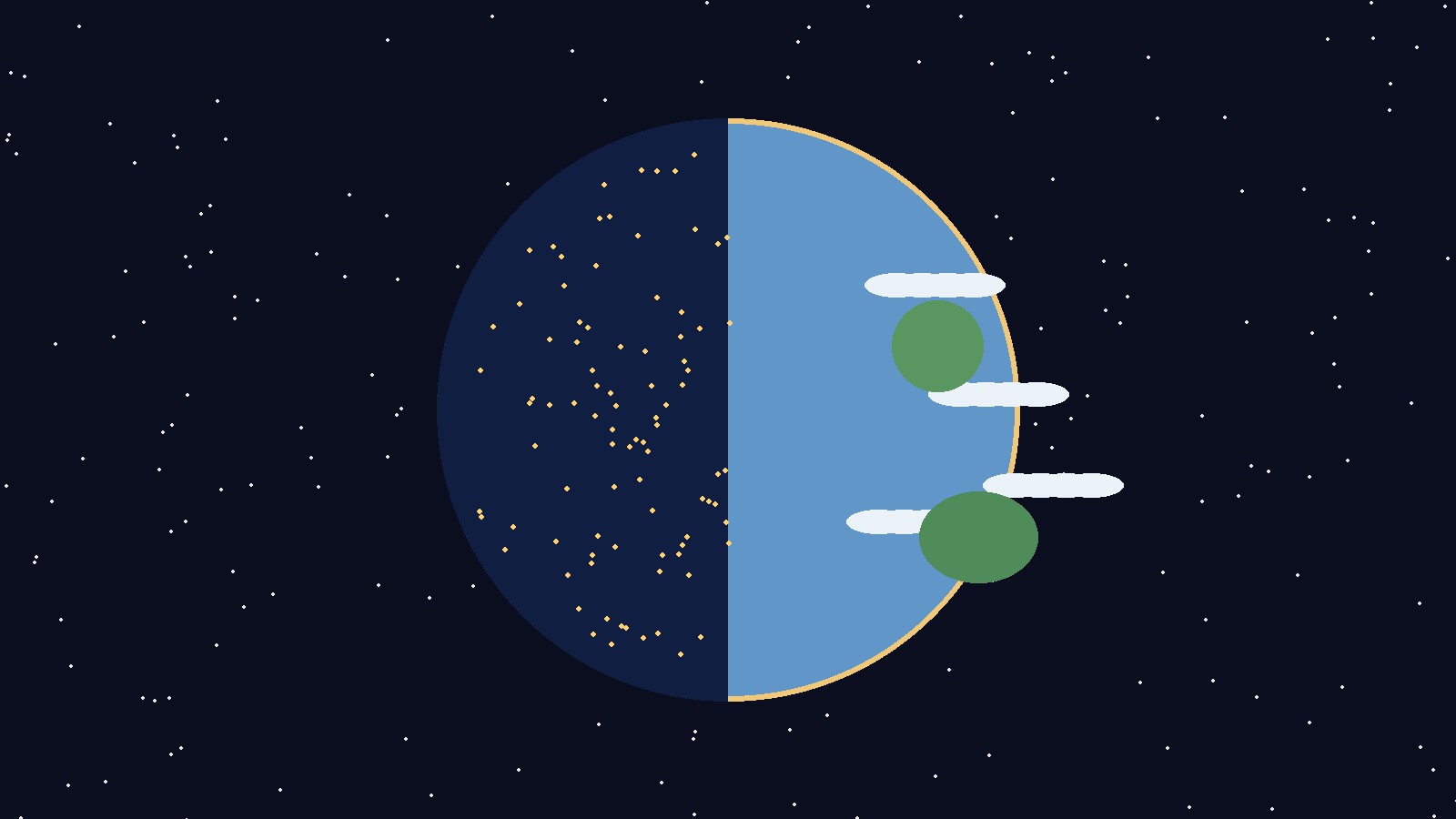
Finally, “stopped spinning” needs a reference point. In the gradual case, one solar day would equal one year, so Earth would show the same face to the Sun for half the year and then the opposite face for the other half. The planet would still turn once per year relative to the stars as it orbited, but it would no longer spin on its axis in the familiar daily sense.
How fast Earth spins, and why we do not feel it
Earth turns once on its axis in about a day. A point on the equator moves at approximately 1,037 miles per hour, according to Astronomy magazine. The speed falls with latitude because points nearer the poles travel smaller circles in the same time. Astronomy magazine gives about 794 miles per hour for New York City, and zero at the poles, where a point turns in place rather than traveling around a circle. A rough rule given in the same account is that speed in miles per hour equals about 1,036 times the cosine of the latitude, which reproduces the same pattern: fastest at the equator, slower at mid latitudes, and zero at the poles.
We do not feel this motion for the same reason a passenger in a smoothly moving vehicle does not feel steady speed. Astronomy magazine uses a car comparison: a body moving at 70 miles per hour in a car keeps moving at 70 miles per hour if the car stops suddenly, which is why a seat belt matters. Constant velocity is not felt. A sharp change in velocity is felt. Earth, the air, the oceans, and everything on the surface currently share the same steady rotation, so there is no relative motion to notice. The moment that shared motion changed abruptly, the parts of the system not bolted to the solid Earth would try to keep moving.
Gravity is a separate force from rotation. Stopping rotation would not switch gravity off, and people would not float away into space simply because the spin stopped. The sudden stop scenario is destructive because of momentum, not because of weightlessness.
If Earth stopped all at once: the inertial catastrophe
Imagine, purely as a thought experiment, that the solid Earth stopped turning in an instant while everything not firmly attached to it kept the speed it had a moment before. At the equator, that speed is above 1,000 miles per hour. Astronomy magazine describes winds in excess of 1,000 miles per hour at the equator in this scenario, with almost all structures collapsing at once and everything not firmly anchored to the ground violently displaced. The comparison is deliberate: ordinary experience of a strong gust gives almost no scale for a wind of that speed sustained across a continent.
Andrew Layden, a professor of physics and astronomy at Bowling Green State University, is quoted by Space.com making the same point in terms of momentum: the water, the air, the buildings, and all other normally rotating material would keep going. In Layden’s quoted description, loose material would split off the surface and keep moving around the planet, in effect in a low orbit around Earth. That stresses how much motion is stored in rotation; the practical meaning is simpler: nothing unanchored would stay where it was.
The oceans would behave the same way, with still greater consequences because of their mass. Astronomy magazine notes that ocean water would continue to move at a speed corresponding to its latitude, inundating coastal and possibly inland regions. Space.com likewise reports that the extreme force would likely trigger tsunamis and earthquakes, so even regions far from the equator would be badly affected. The result would be not a large wave but a redistribution of the sea itself.
The solid Earth would not escape either. Astronomy magazine states that even the ground itself would buckle, split, and tear in response to a sudden stop. Readers should treat worldwide volcanic eruption claims in popular accounts as dramatic illustration rather than as a measured prediction: no one has measured a planetary sudden stop, because none has happened. What can be said on firmer ground is that a sudden change in rotation would impose stresses far beyond anything plate tectonics normally produces in a single moment, and that earthquakes would be an expected part of such a shock, as Space.com reports.
The poles would be less violent, but not safe
Latitude decides how violent the sudden stop would feel. At the poles, rotational speed is effectively zero, so there is no stored eastward motion to be released. Space.com notes that the only parts of the planet likely to be less affected would be at or near the poles, which rotate little or not at all.
Less affected does not mean unaffected. Tsunamis, earthquakes, and a disrupted atmosphere would not respect latitude: ocean surges set in motion at lower latitudes would travel, and seismic shocks would propagate through the crust. The poles would also face the slower consequences described below, including the redistribution of oceans and air as Earth changed shape. They are the least violent places in an otherwise violent scenario, not refuges.
What would not happen in a sudden stop
Three misconceptions deserve direct correction. First, people would not be thrown off the planet into space: gravity would still hold them to the surface, and the hazard is sideways motion and impact, not escape from Earth. Second, the atmosphere would not instantly vanish: it would keep moving, scouring the surface, and only later settle into a new pattern. Third, the Sun would not stop shining, and the planet would not stop orbiting. A sudden stop is a momentum disaster, not a switch that turns the planet off.
If Earth slowed down gradually: the six month day
Now change the scenario. Suppose rotation faded slowly, over geological time, until Earth no longer spun on its axis in the daily sense, while still orbiting the Sun once a year. There would be no inertial catastrophe, because at every stage the air, oceans, and surface would slow down together. The changes would instead be climatic and geographic, unfolding gradually enough that each generation would experience a slightly longer day than the last, until the day itself became unrecognizable.
Space.com reports Layden’s account of this gradual case: the length of days and nights would become longer until each lasted six months. That figure follows directly from the orbit. If one solar day equals one year, and a year is divided into one period of sunlight and one period of darkness, each period lasts about half a year. The Sun would crawl across the sky, linger near the horizon for long stretches, and then disappear for months. Plants, animals, and any human society would face a light cycle utterly unlike the 24 hour rhythm that organizes sleep, photosynthesis, and weather today.
Temperature extremes would follow the light cycle. The sunlit side would warm for months without a night to cool it, while the dark side would cool for months without a day to warm it. Space.com’s account notes that a large temperature difference between day and night would cause strong winds, moving warm air toward the cooler nighttime side, and that winds would also blow from warm equatorial regions toward the cold polar regions. In the gradual scenario, wind is driven by sustained temperature contrast rather than by a sudden release of momentum.
Weather without the Coriolis effect
Rotation does more than set the length of the day. It bends the paths of moving air and water, an effect called the Coriolis effect. The National Oceanic and Atmospheric Administration (NOAA) explains it plainly: because Earth rotates, circulating air is deflected toward the right in the Northern Hemisphere and toward the left in the Southern Hemisphere. NOAA adds that if Earth did not rotate and remained stationary, the atmosphere would circulate between the poles and the equator in a simple back and forth pattern, rather than in the curved paths seen today.
Remove rotation, and that deflection disappears. Air would tend to flow directly from warm regions toward cold regions: rising near the equator, traveling toward the poles, cooling and sinking, and returning along the surface. The trade winds, the westerlies, and the jet streams would lose the mechanism that organizes them, and large rotating storm systems that depend on the Coriolis effect to spin, including hurricanes, would lose a key ingredient for their formation. Weather would not become calm: strong temperature contrasts would still drive powerful winds. But its large scale organization would be different, simpler in broad pattern and possibly more extreme in temperature driven flows.
Ocean currents would change for the same reason, since surface currents are driven by winds and deflected by rotation. Deep circulation driven by temperature and salinity differences would not simply vanish, but its paths would change as the wind system changed. Climate models for a non rotating Earth point to a simpler circulation pattern and a different distribution of wet and dry regions, but the details depend on assumptions no single explainer can settle, so this article draws no precise new world map.
A different shape, and oceans moving toward the poles
Earth is not a perfect sphere. Astronomy magazine describes it as an oblate spheroid, meaning the distance across the equator is slightly greater than the distance separating the poles, and attributes that bulge to the centrifugal force of rotation. Remove the centrifugal force, and the planet would tend toward a more spherical shape. The solid Earth would adjust slowly, but the oceans, being fluid, would respond much faster. Astronomy magazine states that without that centrifugal force, the planet would quickly become more spherical, causing ocean waters to migrate rapidly toward the poles in the sudden stop version of the story.
In the gradual version, the same redistribution would happen slowly. Water that today bulges outward at the equator would settle toward the poles, leaving equatorial regions drier and polar regions deeper under water. The atmosphere would shift in a similar direction, becoming relatively thicker at the poles and thinner at the equator, because air, like water, responds to the changing shape and to gravity. The size of these shifts would be significant for coastlines and for habitable land, even though the change in the planet’s overall shape is small compared with its diameter. Coastlines would move, low lying equatorial land could emerge from the sea, and polar land could be submerged, all without any change in total ocean volume.
Ocean migration toward the poles therefore belongs to both versions, because it follows from the loss of the equatorial bulge, while violent winds and surges belong mainly to the sudden version, because they follow from momentum.
The magnetic field: a slower, less certain consequence
Earth’s magnetic field is generated inside the planet, not by a permanent bar magnet. The U.S. Geological Survey (USGS) explains that the outer core is in turbulent convection, driven by radioactive heating and chemical differentiation, and that the motion of electrically conducting iron in that convection converts kinetic energy into electrical and magnetic energy in a self sustaining feedback, so long as there is an energy source sufficient to maintain convection. Rotation helps organize that core motion, which is why the field is described as linked to rotation, but convection and heat are also essential ingredients. The field is therefore not a simple on off switch controlled by spin alone.
Space.com reports that some researchers think the loss of Mars’s magnetic field in the distant past contributed to that planet becoming uninhabitable, and that Earth’s magnetic field protects the surface from harmful radiation from space. That comparison is suggestive, not conclusive. If Earth’s rotation stopped, the organization of core flow could change, and the field could weaken over a long timescale, but how much, and how fast, cannot be stated precisely, because the core would still contain heat and conducting fluid, and convection would not necessarily stop just because surface rotation stopped. A weaker field is therefore a plausible long term consequence, with more radiation reaching the upper atmosphere over geological time, but it is not an immediate effect of a sudden stop, and it should not be presented as a certainty.
Seasons, the sky, and the calendar would change too
Stopping rotation would not stop the seasons, because seasons are caused mainly by the tilt of Earth’s axis relative to its orbit, not by rotation. If the axis stayed tilted and the orbit continued, the pattern of seasons would persist, but each season would be overlaid on a months long day or a months long night: months of continuous daylight at high temperatures on the sunlit side, and months of continuous darkness and cold on the dark side.
The night sky would change as well. Today, stars appear to rise and set because Earth turns beneath them. On a non rotating Earth that still orbited, the stars would still change slowly over the year as the planet moved, but the nightly wheeling of the sky would be gone, and the Sun would cross the sky only as fast as the orbit carried the observer around it. Timekeeping would need reinvention: societies would more likely count time by years or by the long light and dark periods.
Could Earth actually stop spinning?
Short answer: no known mechanism could do it, and the evidence points the other way. Space.com reports that scientists say it is very unlikely Earth will ever stop rotating, and quotes Layden saying the scenario is vanishingly unlikely in the modern solar system, where planetary orbits are regular and unlikely to cross paths with massive objects. The only route Layden identifies to a sudden stop or a dramatic slowing is a collision with a very large, planet sized object, comparable to the ancient collision that formed the Moon. In that case, the collision itself would be the catastrophe, and the change in rotation would be a secondary detail.
The gradual slowing that actually occurs is a different matter entirely. Astronomy magazine notes that after atomic clocks were introduced, scientists found that Earth’s rotation rate fluctuates, sometimes speeding up and sometimes slowing down, but that the general trend was toward diminishing speed by only fractions of milliseconds per year, with negligible short term ramifications beyond the occasional addition of leap seconds. Between 1972 and 2020, 28 leap seconds were added to atomic time, according to the same account. That is a measure of how tiny the real changes are: milliseconds per year, not hours per year. The trend is not even steady, since recent measurements have shown a tendency toward faster rotation. A slowing trend is real, but a stopped Earth is not its destination on any timescale relevant to human civilization.
Venus is sometimes offered as a counterexample, because it rotates very slowly and backward compared with Earth. Space.com reports Layden’s view that this may result from an ancient collision, and that similar disruptions may have affected Uranus. Venus shows that planetary rotation can be unusual, but it does not show that Earth is heading the same way: Venus has a massive atmosphere and a different history, and its rotation is slow, not stopped.
Would anything survive, and where?
Popular accounts sometimes describe a narrow habitable band between permanent day and permanent night, sometimes called a twilight zone, where temperatures might be moderate. That idea is best treated as a speculative sketch, not as a mapped refuge. In the gradual scenario described here, there is no permanent day side and permanent night side, because Earth still orbits the Sun: every place gets about six months of light and six months of darkness over the year. A twilight band makes more sense for a planet locked so that one side always faces its star, which is a different scenario from the one in this article.
A more careful way to frame survival is to ask what would be hardest to survive, rather than where survivors would live. Months of darkness would end photosynthesis as it currently works for most plants, because plants need light in a daily cycle, not light banked for half a year. Months of heat would stress water supplies, because evaporation would continue without nightly cooling. Ocean redistribution would flood some coasts and expose others, disrupting ports, fisheries, and freshwater systems. Human technology could in principle sustain small groups through long nights, as it does in polar winters, but polar winters occur within a global system that still provides food, fuel, and trade from sunlit regions. On a non rotating Earth, every region would face the same long night in turn, so there would be no sunlit breadbasket to trade with during the dark months.
Frequently asked questions
What would happen first if Earth stopped spinning suddenly?
The first effect would be inertial, not gravitational. Everything not firmly attached to the solid Earth, including air, ocean water, vehicles, and loose objects, would keep moving eastward at the rotational speed of its latitude, which is above 1,000 miles per hour at the equator. Winds, surging water, collapsing structures, and earthquakes would follow within moments, according to the explainer accounts cited in this article. Gravity itself would not switch off.
Would people be thrown into space if Earth stopped spinning?
No. Gravity would still hold people to the surface. The danger in a sudden stop would be sideways motion, impact with moving objects and water, and structural collapse, not being launched off the planet. At the poles, where rotational speed is effectively zero, that sideways danger would be much smaller, though tsunamis and earthquakes could still reach polar regions.
How long would a day last if Earth stopped spinning gradually?
If Earth stopped rotating on its axis but kept orbiting the Sun, one solar day would last about a year, so each period of daylight and each period of darkness would last about six months. This follows from the definitions: a solar day is the time between one noon and the next, and without axial rotation, noon returns only after Earth has traveled around the Sun.
Would the oceans really move toward the poles?
In the long term, yes, in direction if not in exact amount. Earth currently bulges at the equator because of rotation. Without that bulge, the planet would tend toward a more spherical shape, and fluid oceans would redistribute toward the poles, leaving equatorial regions drier and polar regions deeper. The atmosphere would shift in a similar direction. The precise new coastlines cannot be stated without detailed modeling, so this article gives the direction of change, not a new map.
Would Earth lose its magnetic field if it stopped spinning?
Not necessarily, and not immediately. The magnetic field is generated by convection of electrically conducting iron in the outer core, as the U.S. Geological Survey explains, and rotation helps organize that motion but is not its only driver. A stopped rotation could plausibly weaken or reorganize the field over a long timescale, but convection driven by heat would not automatically stop. Any claim of a total or immediate loss of the field goes beyond the evidence.
Would seasons still exist on a non rotating Earth?
Yes, if the axial tilt and the orbit remained. Seasons come mainly from tilt, not from rotation. They would feel very different, however, because each season would play out across months of continuous daylight or continuous darkness, rather than across many days and nights. The warmest and coldest extremes would be far greater than those of a normal summer day or winter night.
Is Earth actually slowing down right now?
Earth’s rotation rate does fluctuate, and the long term trend includes a very gradual slowing, measured in fractions of milliseconds per year, according to Astronomy magazine. That slowing is far too small to matter on human timescales, and recent measurements have even shown a tendency toward faster rotation. It is not evidence that Earth is approaching a stop, and it should not be read as a countdown.
Could a collision stop Earth spinning?
A collision with a planet sized object could in principle change rotation dramatically, as Space.com reports, but such an event would itself destroy the world as we know it long before the change in spin became the main concern. No such collision is expected, and scientists describe a sudden stop as vanishingly unlikely in the modern solar system. The stopped Earth remains a thought experiment, not a risk to plan for.
Sources & references
- National Oceanic and Atmospheric Administration, National Ocean Service. The Coriolis Effect. https://oceanservice.noaa.gov/education/tutorial_currents/04currents1.html
- U.S. Geological Survey. How does the Earth's core generate a magnetic field? https://www.usgs.gov/faqs/how-does-earths-core-generate-a-magnetic-field?items_per_page=6&page=1
- Space.com. What would happen if Earth stopped spinning? https://www.space.com/what-would-happen-if-earth-stopped-spinning
- Astronomy magazine. What happens if Earth stops rotating? https://www.astronomy.com/science/what-happens-if-earth-stops-rotating/


