Short answer
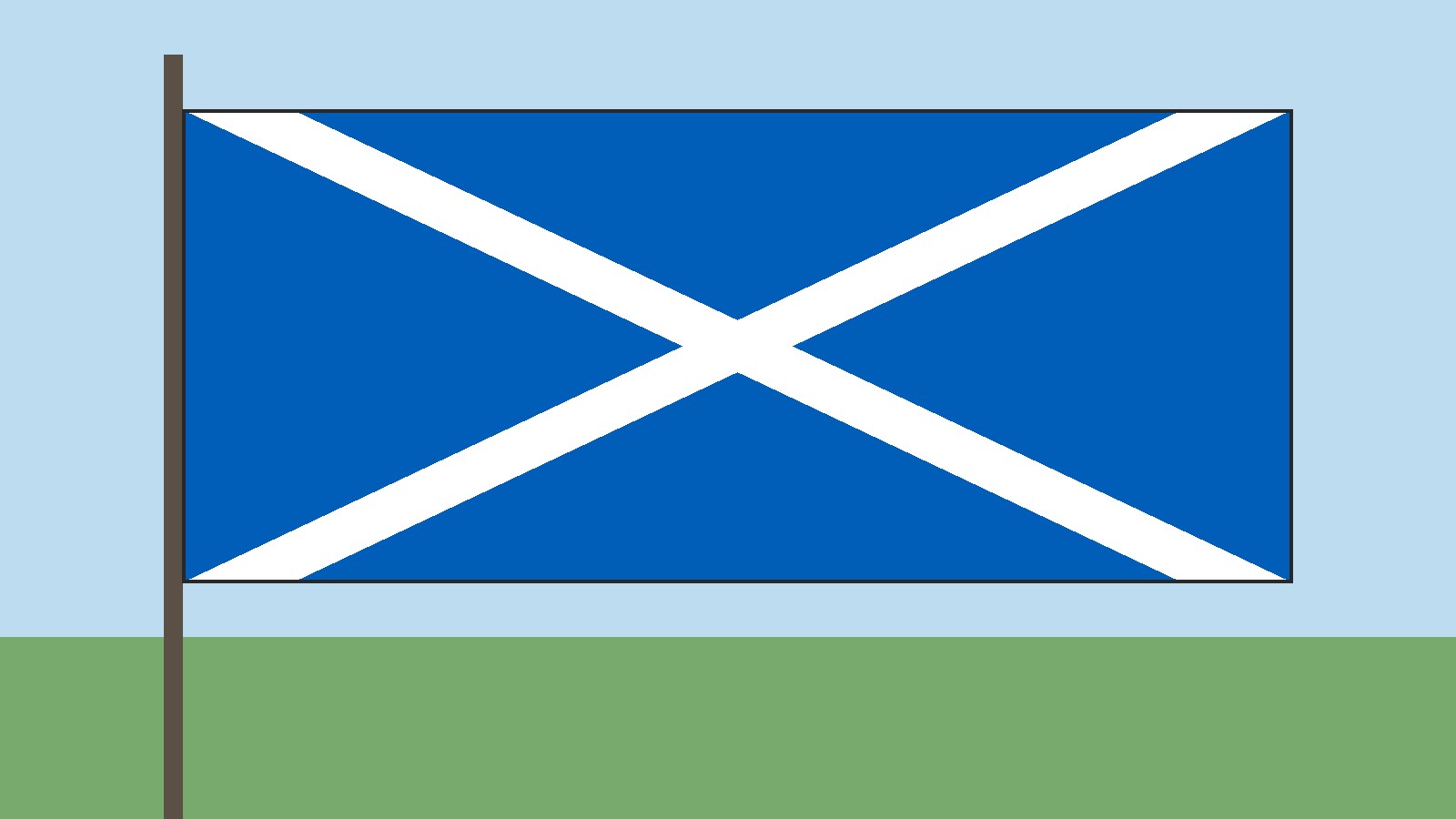
- A plain blue flag with a white X that reaches into all four corners is, in almost every everyday setting, the flag of Scotland. Its proper name is the Saltire, also called St Andrew's Cross.
- The X is a diagonal cross, known in heraldry as a saltire. It stands for St Andrew, the patron saint of Scotland, who tradition says was put to death on a cross of that shape.
- In heraldic language the design is azure, a saltire argent: a blue field with a white, or silver, diagonal cross. The recommended modern shade of blue is Pantone 300.
- Do not stop at the colors. The same design is also maritime signal flag Mike, and it is also used as racing signal flag M. On land or at a sports event, the flag is the Saltire. At sea or on a race course, context decides the meaning.
- An upright cross, with one arm vertical and one arm horizontal, belongs to a different family of flags. A white field with a blue cross is the reverse of this flag, not the same flag.
- Scotland has a second, very different flag, the Royal Banner or Lion Rampant, a red lion on yellow. It is reserved for the monarch and authorized representatives, not the flag ordinary people fly for Scotland. The Saltire is.
How to Identify It in Seconds
Ask three questions, in this order. First, does the cross run diagonally, from corner to corner, or straight up and down and side to side? Diagonal means a saltire. Upright means a different family: the flags of England, Denmark, Finland, and the other Nordic cross flags all use upright crosses, even when their colors are similar.
Second, which color is the field, and which color is the cross? Here the field is blue and the cross is white, with the white arms reaching the corners. Reverse the two colors and you have a different flag, a white field with a blue diagonal cross. An identification that records only the colors, blue and white, without saying which one is the background, will fail.
Third, where are you seeing it? On a Scottish Government building, a stadium, a school, or a home in Scotland, it is the Saltire. Hoisted alone on a ship, it is a signal. Displayed by a race committee boat, it is a racing signal. Context is the difference between a national symbol and a working message. One more check helps at small sizes: on the Saltire the white arms are continuous, of even width, and touch all four corners. Any emblem, star, disc, or lettering means a different flag, and that extra detail is usually the clue to follow.
What the Flag Is Called, and Why
“Saltire” is the heraldic name for the shape, an X shaped cross also called a decussate cross. The word comes through Old French from a Latin word for a cross shaped stile or stirrup cord. “St Andrew’s Cross” is the name that explains the shape: tradition holds that St Andrew was crucified on a diagonal cross because he considered himself unworthy of the same upright cross as Christ. In Scottish Gaelic the flag is bratach na h-Alba, the flag of Scotland. In Scots it is the Banner o Scotland. Reference works use all of these names, so a reader who knows only one may miss the others.
The heraldic description, azure, a saltire argent, is precise in a useful way. Azure means blue, but it does not fix one exact shade. Argent means silver, shown as white in flag making. The description therefore fixes the pattern exactly, a blue field and a white diagonal cross, while leaving the shade open. That openness explains why Saltires in sky blue, royal blue, and navy blue were all recognizably the same flag for centuries.
The Legend: Athelstaneford, 832
The usual story begins on the eve of a battle at Athelstaneford, in East Lothian, in 832. According to the legend, King Angus, or Oengus, leading the Picts and Scots against the Angles, prayed for help and saw, or was promised, a white diagonal cross against a blue sky. The Scots won, and in gratitude Angus made St Andrew the patron saint of Scotland and adopted the white cross on blue as the emblem.
Tell this as legend, not documented fact. The earliest material evidence for the saltire as a Scottish symbol comes from seals, not flags: St Andrew on a diagonal cross appears on Scottish seals from the late twelfth century onward, including a seal of the Guardians of Scotland dated 1286, centuries after 832. The legend in its usual form appears later still. The village of Athelstaneford is still associated with the story, and its Scottish Flag Heritage Centre tells it. Keep two sentences apart: the legend dates the flag to 832, and the surviving records show the design in use much later. Confusing them is the most common error in popular accounts of the Saltire. Note too that St Andrew mattered to Scottish identity before the flag existed: the 1320 Declaration of Arbroath already cites Scotland’s conversion through St Andrew, described as the first to be an apostle. The flag gave an existing devotion a simple, portable shape.
From Badge to National Flag: 1385, 1507, and 1542
The saltire began as a badge, not a flag. In the medieval period a diagonal cross was used as a field sign, a mark by which soldiers recognized their own side, with no necessary connection to St Andrew. That connection appears to have developed in Scotland in the late fourteenth century. In 1385, the Parliament of Scotland decreed that every Scottish and French soldier fighting against the English under Richard II should wear a sign before and behind, namely a white St Andrew’s Cross. That is the first recorded official use of the white saltire as a Scottish distinguishing mark.
Note what the decree does not establish. A badge worn on clothing does not need a field color, so the decree does not by itself establish a blue flag. Accounts that compress badge and flag produce the false impression that the modern flag was decreed in 1385. It was not. The badge came first, and the flag followed. Use of the white “Sanct Androis cors,” St Andrew’s cross, on blue as a naval flag is recorded for 1507, for the carrack Great Michael. As a heraldic flag, the white saltire on blue is first shown in 1542, in the armorial of Sir David Lyndsay of the Mount, where the royal arms are supported by two unicorns, each holding the saltire banner. The year 1542 is therefore the conventional adoption date in standard references, best read as the date of the first surviving heraldic depiction, not a single founding act. A possible late fifteenth century precedent, a white saltire in the canton of a blue flag reputedly made by Queen Margaret, wife of James III, is sometimes cited, but there the saltire is only one element of a larger flag.
Why the Blue Kept Changing, and What 2003 Settled
Old Saltires are not all the same shade of blue. Some are pale sky blue, some royal blue, some dark navy. That follows from how flags were made: blue dye came from natural sources, including indigo and woad, and the shade varied with dye, cloth, and fading from sun and sea. When the Saltire was combined into the Union Flag in the seventeenth century, a darker blue was used for sea flags, possibly because darker dyes lasted better, and that shade became standard for the Union Flag itself. Some makers then used the same navy blue for the Saltire alone, adding another shade to the range. The pattern stayed stable while the color did not.
In 2003, a committee of the Scottish Parliament examined a petition that the Scottish Executive adopt Pantone 300 as the standard shade, after advice from sources including the office of the Lord Lyon King of Arms, Scotland’s heraldic authority. The committee recommended Pantone 300, a medium blue lighter than the Pantone 280 blue of the Union Flag. Recent Saltires have largely converged on that recommendation. That is what “standardized in 2003” means: a recommended shade adopted after a formal process, not a new flag invented in 2003, and not a rule that invalidates older Saltires in other shades. An older flag in sky blue or navy blue is still a Saltire.
Proportions are similarly flexible. They are not fixed: 3:5 is most commonly used, as with other flags of the countries of the United Kingdom, while makers also use 1:2 or 2:3, and the Lord Lyon King of Arms has stated that 4:5 is suitable. Do not judge a Saltire by proportions alone.
The Saltire Inside the Union Flag
The Saltire is one of three crosses in the Union Flag. In 1603, James VI of Scotland inherited the English throne as James I, uniting the crowns. On 12 April 1606, a royal decree joined the red cross of St George, the flag of England, with the white saltire of St Andrew. That combined flag was used mainly at sea at first. After the Acts of Union in 1707 created the Kingdom of Great Britain, it gained regular status, and in 1801 the red saltire of St Patrick was added for Ireland, producing the Union Flag used today.
Inside the modern Union Flag the Saltire is not symmetric. The white diagonal stripes are broader on one side of the red diagonal stripes than the other, deliberately preserving the seniority of St Andrew’s white saltire over St Patrick’s red saltire on the hoist side at the top. The Scottish Government flag-flying guidance gives the practical rule: the broader diagonal white stripe should be at the top, on the side nearest the flagpole. A Union Flag flown upside down puts that stripe in the wrong place, which is how an upside down Union Flag can be recognized. The Saltire alone has no such trap, because its arms are symmetric.
For long periods the Union Flag was the flag of official Britain, and the Saltire alone was used less in official settings. Its revival as a widely flown flag in its own right is modern, associated with the return of a Scottish Parliament in 1999 and with Scottish sport. The Saltire is both a component of the Union Flag and a flag in its own right, without contradiction.
The Saltire and the Lion Rampant
Scotland is often said to have two flags, and the second causes more confusion than any foreign lookalike. The Royal Banner of Scotland, commonly called the Lion Rampant, is a yellow field with a red lion rearing up, inside a red decorative border. It is the monarch’s official banner in Scotland. Scottish Government guidance is explicit: it may not be flown without permission from the monarch, and it is used by the sovereign or by great officers of state acting in that capacity, with a specific provision for the First Minister as Keeper of the Great Seal. The restriction is widely ignored at sports events, where both flags appear in the crowd, but feeling does not change status. The Saltire, not the Lion Rampant, is the correct flag for private individuals and corporate bodies to fly for Scotland. The two flags share no color, shape, or pattern. They are confused only because both are loosely called “the Scottish flag.” Fix the names, Saltire for the white X on blue, Lion Rampant for the red lion on yellow, and the confusion ends.
Where You Will See the Saltire Today
The Saltire is flown every day from St Andrew’s House, the principal Scottish Government building in Edinburgh, and from Victoria Quay, under the Scottish Government’s flag flying guidance for 2026, which lists the Saltire among the only flags that should be flown from Scottish Government buildings in Scotland. At the Scottish Parliament, on a daily basis, it flies in the superior position, with the Union Flag second; when the Royal Arms of Scotland are flown, they take the superior position, with the Saltire second and the Union Flag third.
Beyond official buildings, the Saltire is the flag of Scottish national teams, supporters abroad, Scottish societies worldwide, and local authorities, schools, hospitals, and businesses in Scotland. In Scotland it can be flown at any time by any individual, company, local authority, hospital, or school without obtaining express consent. Vehicle owners in Great Britain may display it on a registration plate with the letters SCO or the word Scotland. St Andrew’s Day, 30 November, is its most widely observed display, including by United Kingdom embassies abroad in recent years. No single political reading follows: the Saltire is used by supporters of independence, by supporters of the Union, by government bodies, and by sports fans with no political message. A flag belonging to a whole country will be carried by people who disagree about its future.
The Same Design at Sea: Signal Flag Mike
The international maritime signal flag Mike, by its radio name, is blazoned azure, a saltire argent: exactly the same description as the Saltire. Flown alone, it means “My vessel is stopped and making no way through the water.” The ship is not moving forward through the water, whether anchored, adrift, or otherwise stopped.
This is not a copy of the Scottish flag. Signal flags were designed as a code needing flags distinct at a distance, and a plain blue flag with a white diagonal cross was available as a letter flag and assigned to M. The two systems, national heraldry and maritime signaling, happened to choose the same simple pattern, and they are kept apart by context: a flag on a pole on land is read as a national flag, while a flag hoisted as a signal on a ship is read as a signal. The consequence is real for Scottish seafarers: a vessel flying the Saltire as a jack or courtesy flag at sea can be misread as signaling that it is stopped. A 2007 campaign sought official recognition for the historic Scottish Red Ensign as an alternative for Scottish vessels, to avoid that confusion and a possible fine. It did not change the Saltire’s status on land. A flag’s meaning is never carried by its cloth alone; the system in use is part of the identification.
The Same Design on a Race Course: Racing Flag M
Sailing races add a third system using the same design. Under the Racing Rules of Sailing published by World Sailing, flag M is a blue flag with a white X. When a mark of the course is missing or out of position while boats are racing, the race committee may substitute an object displaying flag M, with repetitive sound signals, and that object then serves as the missing mark. In plain terms, a boat displaying flag M tells competitors: round me instead of the mark that should be here. Sailing guides phrase it as “The mark is missing. Round me instead of the missing mark.” It is an instruction for that race, on that day, and it expires when the race ends. It has nothing to do with Scotland or with a stopped vessel, even though the flag looks the same as both. Three systems, one design, three meanings. Ask where the flag is and who hoisted it: a national flag on land, a signal flag on a ship, or a race committee signal on a course.
Lookalikes, Separated One by One
If the cross is upright, not diagonal, it is not the Saltire, whatever the colors. Finland’s flag is a blue upright cross on white. England’s is a red upright cross on white. Denmark’s is a white upright cross, shifted toward the hoist, on red. Sweden, Norway, and Iceland use the same upright Nordic pattern in different colors. Diagonal versus upright is the first split, and it should be checked before color.
If the field is white and the cross is blue and diagonal, it is the reverse of the Saltire, not a Saltire in another shade. That is the design met in the related search for a flag with a blue cross on white, a companion problem with its own candidates. Keep the two apart: blue field with a white X is this flag, white field with a blue cross is the other.
If the field is white and the cross is red and diagonal, it is St Patrick’s saltire, added to the Union Flag in 1801. On its own it is sometimes used for Ireland or Northern Ireland in particular contexts, but it is not an official national flag in the way the Saltire is. Inside the Union Flag, the red saltire sits over the white saltire, with white given the broader portion on the hoist side at the top.
If the field is red and the cross is blue and diagonal, outlined in white, it is the battle flag of the Confederate States of America, often called the Southern Cross. Up close it is unmistakable: red field, blue cross, white border. Its history is entirely separate from Scotland’s; the shared diagonal shape is geometry, not origin or meaning. Do not call it a version of the Saltire.
Alabama’s flag is a red saltire on white, and Florida’s is a red saltire on white with the state seal in the center. If the flag before you is white with a red X, check those two first. Finally, Quebec’s flag, the Fleurdelise, has a blue field, a white upright cross, and four white fleurs-de-lis. The upright cross gives it away: it belongs to the upright cross family, not the saltire family.
Frequently Asked Questions
What flag is blue with a white X? In most everyday settings, the flag of Scotland, the Saltire or St Andrew’s Cross: a white diagonal cross on blue. The same design is also signal flag Mike and racing flag M, so at sea or on a race course the meaning depends on context.
What does the blue flag with a white X mean? As the Saltire, Scotland, with the cross standing for St Andrew. As signal flag Mike, the vessel is stopped and making no way through the water. As racing flag M, the object displaying it replaces a missing mark. The design alone does not fix the meaning. The system in use does.
Is the blue flag with a white X the Scottish flag? Yes, if the cross is diagonal, reaches the corners, and sits on a blue field with nothing else on the flag. A white field with a blue cross, or an upright cross in either color, is a different flag.
Why is it called the Saltire? Saltire is the heraldic name for a diagonal, X shaped cross. It is also called St Andrew’s Cross because tradition says St Andrew was put to death on a cross of that shape.
What is the story behind the Saltire? Legend places its origin at Athelstaneford in 832, when King Angus is said to have seen a white diagonal cross against a blue sky before a victory over the Angles. Careful accounts tell it as legend, because records show the saltire as a Scottish badge in 1385, as a naval flag in 1507, and as a heraldic flag in 1542, all later than 832.
What shade of blue is the Scottish flag? The recommended modern shade is Pantone 300, adopted after a Scottish Parliament committee process in 2003. Older Saltires in sky blue, royal blue, or navy blue are still Saltires; standardization does not retroactively disqualify them.
What is the difference between the Saltire and the Union Flag? The Saltire is one component of the Union Flag, which combines it with the red upright cross of St George for England and, since 1801, the red diagonal cross of St Patrick for Ireland. Inside the Union Flag the white diagonal stripes are broader on one side than the other, which is how an upside down Union Flag can be recognized. The Saltire alone is symmetric.
What is the difference between the Saltire and the Lion Rampant? The Saltire, a white diagonal cross on blue, is the national flag anyone may fly for Scotland. The Lion Rampant, a red lion on yellow, is the monarch’s official banner in Scotland, restricted to the sovereign and authorized representatives.
What is the difference between a blue flag with a white X and a flag with a blue cross on white? The field and cross are reversed. Blue field with a white X is the Saltire, subject to the sailing signal exceptions. White field with a blue cross is a separate identification problem, covered in a companion guide. The reversal changes the answer, so do not treat the two searches as one question.
Can anyone fly the Saltire? Yes. In Scotland it can be flown at any time by any individual, company, local authority, hospital, or school without obtaining express consent, and it is the correct flag for private individuals and corporate bodies to fly for Scotland. The restriction sometimes confused with it applies to the Royal Banner, not the Saltire.
Why does the same flag mean “stopped” on a ship? Because maritime signaling reuses simple patterns as letter flags. Signal flag Mike shares the Saltire’s design, and in that code it means the vessel is stopped and making no way. Two separate systems chose the same pattern; that does not make “stopped” a meaning of the Scottish flag on land.
How can I tell the Saltire from the Confederate battle flag? Check the field first. The Saltire has a blue field and a white cross. The Confederate battle flag has a red field and a blue cross outlined in white. The diagonal shape is shared, but colors, field, and histories are entirely separate.
Sources & references
- Scottish Government, Flag flying on government buildings: 2026, guidance pages: the Saltire flown every day from St Andrew's House and Victoria Quay, the list of flags permitted on Scottish Government buildings in Scotland, and the status of the Royal Banner of Scotland (the Lion Rampant) as restricted to the monarch and authorized representatives.
- Scottish Parliament, flag flying policy (daily order at Holyrood): the Saltire in the superior position, the Union Flag second; when the Royal Arms of Scotland are flown, they take the superior position, with the Saltire second and the Union Flag third.
- Scottish Government, Flag flying on government buildings: 2026, guidance section 7: the broader diagonal white stripe of the Union Flag should be at the top, on the side nearest the flagpole.
- World Sailing, Racing Rules of Sailing 2025 to 2028, Race Signals and Rule 34 (Mark Missing): racing flag M as the signal by which an object replaces a missing or out of position mark, with repetitive sound signals.
- International Code of Signals, letter flag Mike, as summarized in the standard maritime signal flag tables: blazon azure, a saltire argent, flown alone meaning "My vessel is stopped and making no way through the water."
- Flag of Scotland, standard reference summary: design as a white saltire on a blue field, blazon azure, a saltire argent, first heraldic depiction in Sir David Lyndsay's armorial of about 1542, the 1385 Parliament of Scotland decree on the white St Andrew's Cross as a badge, naval use recorded for the Great Michael in 1507, the 1606 union of the Saltire with St George's Cross, and the 2003 Scottish Parliament committee recommendation of Pantone 300 as the standard shade, with advice from the office of the Lord Lyon King of Arms. Historical dates and the Athelstaneford account are presented in the article as legend or as reported record where the underlying evidence is later than the event, as noted in the claim ledger.


