Short answer
- A system of organs, usually called an organ system, is a group of organs that work together to carry out a major job for the body. The digestive system processes food, and the respiratory system handles gas exchange. Textbooks commonly describe eleven organ systems in the human body. No system works alone. Breathing, circulation, digestion, movement, control, and balance all depend on cooperation among systems, and that cooperation keeps internal conditions relatively stable.
What Is a System of Organs?
A system of organs is not a single body part, and it is not a loose collection of parts that happen to sit near one another. It is a working group. Its member organs each contribute a related task, and together they complete a larger function that no single organ could complete on its own.
It helps to place an organ system in the levels of organization used in anatomy teaching. The body is often described in six main levels, from simplest to most complex: chemical, cellular, tissue, organ, organ system, and organism. A cell is the smallest independently functioning unit of a living organism. A tissue is a group of many similar cells that work together to perform a specific function. An organ is an anatomically distinct structure made of two or more tissue types, and each organ performs one or more specific physiological functions. An organ system sits above the organ level: it is a group of organs that work together to perform major functions or meet physiological needs of the body. The organism level is the whole living being, in which all cells, tissues, organs, and organ systems work together.
That ladder prevents a common mixup. Skin is an organ. The integumentary system is the larger system to which skin belongs, together with hair and nails. A heart is an organ. The cardiovascular system is the larger system that includes the heart, blood vessels, and blood. A part makes sense only when you also see the job it shares with its partners and with other systems.
Boundaries between systems are useful for teaching, but they are not walls in the body. Textbooks note that assigning organs to systems can be imprecise, because an organ that belongs mainly to one system can also have functions that matter to another system. In fact, most organs contribute to more than one system. The pancreas is a helpful example at system level: it has roles connected with digestion and roles connected with hormone signaling. That does not make the system map wrong. It means the map organizes functions; it does not claim that each organ has only one job.
How Many Systems Are There, and Why Do Counts Differ?
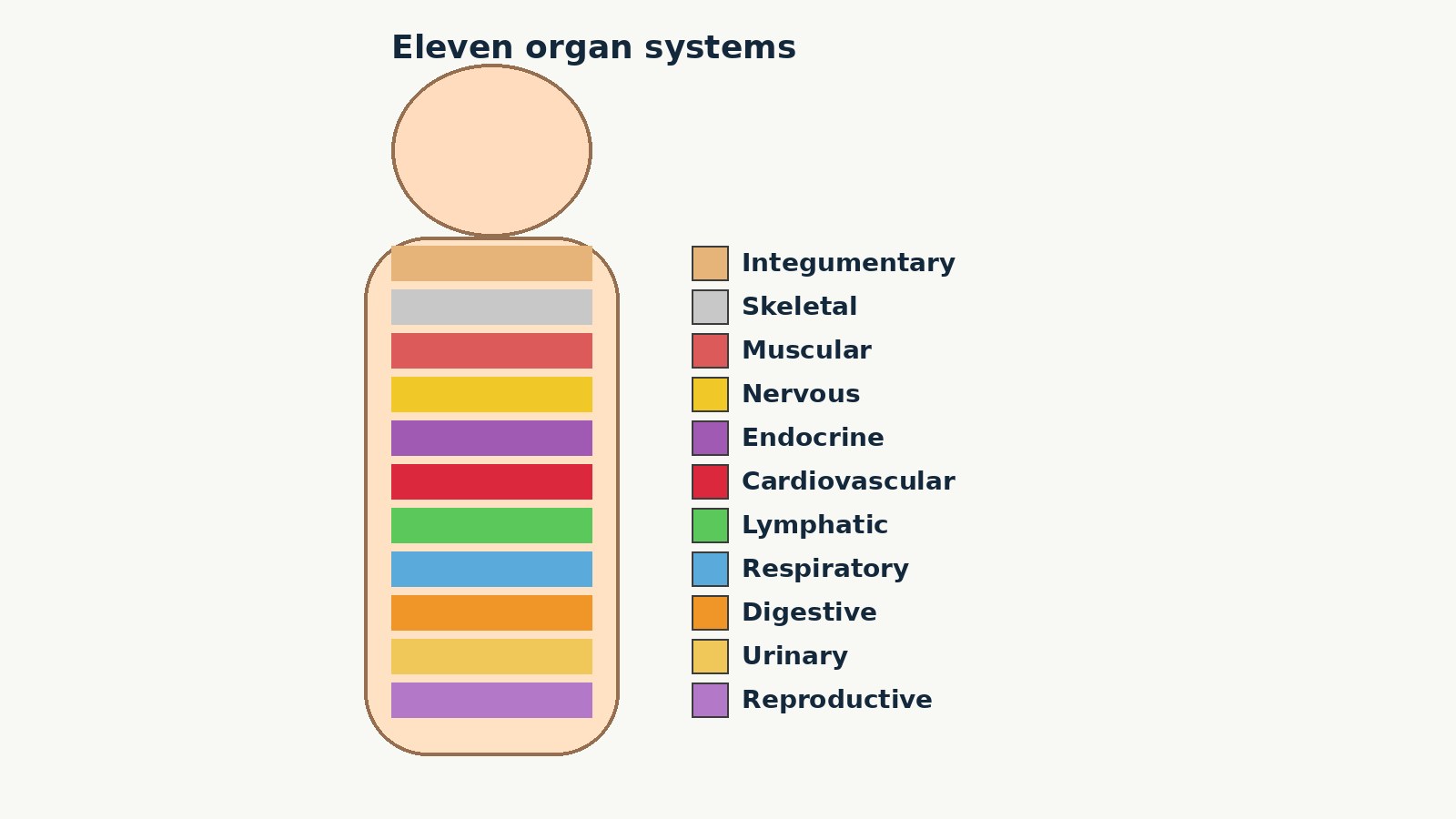
Readers often meet different numbers in different books. The difference is usually grouping, not a disagreement about the body itself. The OpenStax textbook Anatomy and Physiology covers eleven distinct organ systems: integumentary, skeletal, muscular, nervous, endocrine, cardiovascular, lymphatic, respiratory, digestive, urinary, and reproductive.
Other sources reach twelve by counting two groups separately that the eleven system list keeps together, or by splitting one combined group into two. The most common variation involves the lymphatic system and immune functions. Some lists present lymphatic and immune as separate systems, which adds one to the total. Another variation combines skeletal and muscular into a single musculoskeletal system, which reduces the total by one if the rest of the list stays the same. A third variation uses different names for the same group, such as circulatory for cardiovascular, or gastrointestinal for digestive. None of these variations means that a new set of body parts has been found. They are different ways of drawing lines around overlapping jobs.
For this article, the eleven system list is used because it matches the OpenStax organization and keeps immune functions in the lymphatic discussion, where they are linked to fluid movement and immune cells. When you meet a twelve system list elsewhere, check whether immune and lymphatic are listed separately.
| Organ system | Main job | Main members in brief | | Integumentary | Protect the body and help regulate temperature and fluid balance | Skin, hair, nails | | Skeletal | Support the body, protect internal structures, and work with muscles for movement | Bones, cartilage, joints | | Muscular | Produce movement and help maintain posture and temperature | Skeletal muscles and related connective structures | | Nervous | Detect change, process information, and coordinate rapid responses | Brain, spinal cord, nerves | | Endocrine | Coordinate longer lasting regulation through chemical messengers | Hormone producing glands and hormone producing tissues | | Cardiovascular | Transport blood, oxygen, nutrients, hormones, and wastes | Heart, blood vessels, blood | | Lymphatic | Move lymph fluid, support fluid balance, and support immune defense | Lymph vessels, lymph nodes, and related lymphoid tissues | | Respiratory | Bring in oxygen and remove carbon dioxide through gas exchange | Airways and lungs | | Digestive | Break down food, absorb nutrients, and remove undigested material | Digestive tract and accessory digestive organs | | Urinary | Filter blood, remove wastes, and regulate fluid and related balance | Kidneys, ureters, bladder, urethra | | Reproductive | Produce reproductive cells and support reproduction | Reproductive organs and associated glands |
Read the table as a set of jobs, not as eleven sealed boxes. The next sections group the systems by the kind of work they do together.
Boundary, Support, and Movement Systems
The integumentary, skeletal, and muscular systems form the outer boundary and the moving frame of the body. The integumentary system encloses internal structures. Skin acts as a barrier, and it also contains sensory receptors that report touch, temperature, and other stimuli, which links it to the nervous system. Skin also helps with temperature regulation through changes in blood flow near the surface and through sweating.
The skeletal system gives the body shape and support. Bones protect structures such as the brain, heart, and lungs, and they provide attachment points for muscles. Cartilage and joints allow parts of the frame to move in controlled ways rather than as one rigid block. The skeletal system also has a role in blood cell production in bone marrow, which links support to transport.
The muscular system produces movement by contracting. Skeletal muscles pull on bones, so the skeletal and muscular systems must be understood together for actions such as walking or lifting. Muscles also help maintain posture, and muscle activity produces heat, which links movement to temperature regulation. When you exercise, you also use the nervous system to coordinate the action, the cardiovascular and respiratory systems to supply oxygen and remove carbon dioxide, and the integumentary system to help release heat. Movement is a whole body event even when it looks like a single action.
Transport and Exchange Systems
The cardiovascular, respiratory, and lymphatic systems handle movement of materials and exchange with the outside world. The cardiovascular system is the transport network. The heart pumps blood through vessels, and blood carries oxygen, nutrients, hormones, and other materials to tissues while carrying wastes away from tissues. It also helps regulate temperature, because changes in blood flow can move heat toward the surface or keep it closer to the core.
The respiratory system handles gas exchange. Air enters through the airways and reaches the lungs, where oxygen moves into the blood and carbon dioxide moves out into air that is then breathed out. That exchange only becomes useful when the cardiovascular system carries oxygen onward to cells and brings carbon dioxide back for removal. Breathing and circulation are thus a pair: one brings gases to and from an exchange surface, and the other distributes the results.
The lymphatic system moves lymph fluid through vessels and nodes and helps maintain fluid balance. Fluid that leaves blood vessels into surrounding tissues needs a route back, and the lymphatic system provides part of that return route. The system is also closely tied to immune defense. Lymphoid tissues produce and house immune cells, and lymph nodes act as meeting points where immune responses can be organized. This is why some lists separate immune functions into their own system while others keep them with lymphatic. The functions are linked by shared tissues and by the movement of fluid and cells, even when the labels differ.
To remember this group, follow a breath and a heartbeat together. Air alone does not feed a muscle cell. Blood alone does not create oxygen. The three systems form a loop of intake, distribution, and return, repeated continuously at rest and during activity.
Intake, Processing, and Balance Systems
The digestive and urinary systems handle intake, breakdown, absorption, and removal in ways that keep the internal environment usable. The digestive system breaks down food into forms that can be absorbed and used. The digestive tract carries food through stages of mechanical and chemical breakdown, and accessory organs contribute substances that support that process. Nutrients absorbed from the digestive tract enter blood and lymph pathways, which links digestion directly to transport. Undigested material leaves the body through the digestive tract. Digestion is therefore not an isolated process in the abdomen. It is the entry point for materials that every other system will use, and its output depends on circulation to reach tissues.
The urinary system filters blood and removes wastes while regulating fluid and related balance. The kidneys filter blood, reclaim materials the body still needs, and form urine, which is then carried to the bladder and leaves the body through the urethra. Its effects are wide. Fluid volume affects blood pressure and circulation. The balance of salts and other materials in body fluids affects nerve signaling, muscle function, and many other processes. The urinary system thus acts as a regulator as well as a waste removal route. It depends on blood flow from the cardiovascular system, and its output helps set conditions for the nervous, muscular, and cardiovascular systems in turn.
Seen together, digestion and urinary function show a useful pattern. One system brings materials in and makes them available. Another adjusts what stays, what is reclaimed, and what leaves. Both are tied to transport, and both help maintain the stable internal conditions other systems need. That stable internal state is called homeostasis in physiology.
Control and Coordination Systems
The nervous and endocrine systems coordinate the body, but they do so on different timescales and through different messengers. The nervous system uses electrical signals along nerves and chemical signals at junctions between nerve cells to send fast, targeted messages. It detects change through sensory receptors, processes information in the brain and spinal cord, and sends responses to muscles and glands. That speed matters for actions such as adjusting posture or changing breathing rate during activity. The nervous system also coordinates other systems continuously, even when no obvious action is happening. Heart rate, breathing pattern, and digestive activity all shift under nervous control as conditions change.
The endocrine system uses hormones, which are chemical messengers released into blood and carried to target tissues. Hormonal effects often build more slowly than nerve signals and can last longer. Glands such as the pituitary, thyroid, and adrenal glands release hormones that help regulate growth, metabolism, reproduction, and responses to stress, among other functions. Other organs also contain hormone producing tissue, which is another example of shared membership across systems. Hormones do not replace nerve signals. They complement them by adjusting many tissues at once and by sustaining a response after a fast signal has started it.
The two control systems also talk to each other. The brain can influence hormone release, and hormones can influence brain activity and behavior. That partnership is sometimes described with the combined term neuroendocrine, which simply names the overlap. A change in activity can involve rapid nerve signals to heart and breathing muscles and hormonal adjustments that support energy use over a longer period.
Control systems also depend on feedback. In a feedback loop, a change is detected, a control center compares the change with a target range, and a response pushes conditions back toward that range. Temperature regulation is a clear example. When internal temperature rises, sensors report the change and control centers coordinate increased blood flow to the skin and sweating, which help bring temperature back down. When temperature falls, reduced surface blood flow and muscle shivering help conserve and produce heat. No single system owns temperature. The loop involves sensors, nerves, hormones, blood vessels, skin, and muscles working together.
Defense, Continuity, and the Whole Organism
Defense and continuity complete the map, and they show why a systems list must not be read as a ranking of importance. The lymphatic system, introduced under transport, also carries much of the defense story. Immune cells and lymphoid tissues help the body recognize and respond to harmful invaders and damaged cells. The skin contributes a first barrier, mucous membranes trap materials, and blood carries immune cells to sites where they are needed. Defense is therefore distributed. It has centers and pathways, but it also depends on barriers, fluid movement, and circulation. A reader who looks only for a single defense organ will miss how defense actually works as a network.
The reproductive system has a different kind of purpose from the other ten. Its main job is reproduction: the production of reproductive cells and support for the processes by which a new organism can develop. That purpose concerns continuity across generations rather than the day to day maintenance of a single body. This difference explains why reproductive structures and functions vary with biological sex in ways that other systems do not, and why reproductive function can change across the lifespan while other systems continue their maintenance work. It does not make the system separate from the whole. Reproductive function still depends on nervous and endocrine control, on blood supply, and on the general health of other systems.
At the organism level, all of these jobs merge into one living person. The organism is not an extra system added on top of the list. It is what the systems together compose. Textbooks stress that cells, tissues, organs, and organ systems work together to maintain the life and health of the organism. The list is useful for study, but the living reality is integration.
Three Everyday Examples of Systems Working Together
Abstract cooperation becomes clearer through ordinary actions. The examples below stay at system level. They do not describe individual organs in detail, and they do not offer health guidance. They trace jobs across systems so that a reader can practice seeing connections.
First, consider climbing a flight of stairs. The nervous system coordinates muscle actions and balance. The skeletal system provides levers and support, while the muscular system produces the force for each step. The cardiovascular system increases delivery of oxygen and nutrients to active muscles, and the respiratory system increases gas exchange to match that demand. The integumentary system helps manage heat from muscle activity, and the endocrine system supports longer lasting adjustments in energy use.
Second, consider eating a meal. The digestive system breaks down food and absorbs nutrients. The cardiovascular and lymphatic systems carry absorbed materials onward. The nervous system coordinates chewing, swallowing, and digestive activity. The endocrine system releases hormones that help regulate nutrient handling after eating, and the urinary system later helps adjust fluid and waste balance. A meal is thus a systems event from intake through distribution, use, storage, and removal.
Third, consider stepping outside on a hot day and then resting in the shade. The integumentary system senses temperature change and, with the cardiovascular system, adjusts blood flow near the skin. Sweating helps release heat. The nervous system coordinates those responses, and the urinary system helps maintain fluid balance as water is lost through sweat. When conditions stabilize, feedback loops reduce the intensity of the responses. Many systems shift together, and the shifts reverse as conditions return toward their usual range.
These examples also show a study method. Pick an action and list every system that must change for it to succeed, then ask what each system contributes. That turns a list into a model, which is much easier to remember than eleven isolated definitions.
Common Confusions About Body Systems
Several confusions recur for students, and each one is easier to resolve once the definition is clear. The first is between an organ and a system. An organ performs one or more specific functions, but a system performs a major function through cooperation among organs. The stomach digests food, but digestion as a whole requires the mouth, stomach, intestines, and accessory organs together, plus transport to distribute nutrients. Naming the organ is not the same as naming the system.
The second is between tissue and system. Four main tissue types are commonly taught: epithelial, connective, muscle, and nervous tissue. Tissues build organs, organs build systems, and systems build the organism. Skipping a level causes errors, such as calling blood a system on its own. Blood is a tissue in this classification, and it functions within the cardiovascular system alongside the heart and vessels.
The third is about the lymphatic and immune labels. If a source lists immune as a separate system, it is usually highlighting immune functions that the eleven system list places within the lymphatic system and related tissues. Both approaches describe the same defense network. The choice is about emphasis, not about a hidden extra set of organs. When comparing sources, always check the grouping before counting.
The fourth is about names for the same system. Cardiovascular and circulatory often name the same transport system. Digestive and gastrointestinal often name the same food processing system. Urinary and excretory overlap, although excretory can be used more broadly to include other routes of waste removal, such as through the lungs, skin, and digestive tract. The overlap is a sign that systems share waste removal work, not a sign that textbooks disagree about basic anatomy.
The fifth is the idea that one system is the most important. Importance depends on the question being asked. For rapid coordination, the nervous system is central. For transport, the cardiovascular system is central. For gas exchange, the respiratory system is central. A systems view replaces ranking with roles: each system is central to its own job, and the organism depends on all of them together.
How to Learn the Systems Without Memorizing a List
Start with jobs, not names. For each system, learn one sentence: what major job does it do for the whole body. Then learn one connection: which other system must it work with to complete that job. Then add main members. That order prevents memorizing parts without understanding work. A student who knows that the respiratory system exchanges gases and needs circulation to distribute oxygen already understands more than a student who can name airways but cannot explain why breathing and heartbeat must change together during activity.
Next, use journeys as memory tools. Follow oxygen from air into blood, to tissues, and follow carbon dioxide back out. Follow food from intake through breakdown and absorption, into transport, and follow wastes toward removal. Follow a signal from a sensor through nerves or hormones to a response, and back through feedback to a stable state. Each journey crosses several systems, which is why it works: it forces the learner to cross the boundaries that a list keeps apart.
Finally, test understanding with changes, not just definitions. Ask what changes in other systems when breathing rate rises, when food is eaten, or when body temperature rises. If the answer touches only one system, the model is still incomplete. A complete systems answer names the trigger, the main responding systems, and the feedback that returns conditions toward balance.
For any personal health concern, speak with a qualified health professional.
Frequently Asked Questions
What is the definition of a system of organs?
A system of organs, or organ system, is a group of organs that work together to perform a major function or meet a physiological need of the body. A tissue is a group of similar cells, an organ is made of two or more tissue types, and an organ system is the next level up: several organs cooperating for a shared job.
How many systems of the body are there?
The OpenStax textbook Anatomy and Physiology covers eleven distinct organ systems: integumentary, skeletal, muscular, nervous, endocrine, cardiovascular, lymphatic, respiratory, digestive, urinary, and reproductive. Some sources list twelve, usually by counting immune functions separately from lymphatic. A list can also combine skeletal and muscular into musculoskeletal, which reduces the total by one. The count therefore depends on grouping and naming, not on different body parts.
Why do some lists show eleven systems and others show twelve?
The difference is usually grouping. A twelve system list often separates lymphatic and immune into two entries, while an eleven system list keeps immune functions within the lymphatic system and related tissues. A list can also combine skeletal and muscular into musculoskeletal. To compare lists fairly, check which groups are combined or split.
Can an organ belong to more than one system?
Yes, in functional terms. Textbooks note that assigning organs to systems can be imprecise because an organ that belongs mainly to one system can also have functions that matter to another system, and most organs contribute to more than one system. The label names the main grouping for study, not the only role of the organ.
What is the difference between an organ and an organ system?
An organ is an anatomically distinct structure made of two or more tissue types that performs one or more specific functions. An organ system is a group of organs that work together to perform a major function. The heart is an organ. The cardiovascular system, which includes the heart, blood vessels, and blood, is a system.
How do the systems of the body work together?
Systems work together through shared transport, shared signals, and feedback loops. The respiratory system exchanges gases, but the cardiovascular system must carry those gases to and from tissues. The digestive system supplies nutrients, but transport systems must distribute them. The nervous and endocrine systems coordinate timing and intensity, and the urinary and integumentary systems help adjust fluid and temperature balance. Homeostasis, the maintenance of relatively stable internal conditions, is the shared outcome.
Which body system is the most important?
There is no single answer, because each system is central to its own job. The nervous system is central to fast coordination, the cardiovascular system to transport, the respiratory system to gas exchange, and the endocrine system to longer lasting regulation. A systems view asks which systems must cooperate for a job, rather than ranking systems in isolation.
What is homeostasis in simple terms?
Homeostasis is the maintenance of relatively stable internal conditions in the body, even as outside conditions change. It is achieved through feedback loops in which change is detected, compared with a target range, and corrected by responses from one or more systems. Temperature regulation, fluid balance, and nutrient handling all require cooperation among systems rather than action by a single system alone.
Sources & references
- OpenStax, Anatomy and Physiology 2e, Section 1.2 Structural Organization of the Human Body. Verified 27 October 2026. Used for the levels of organization, the definition of an organ system, the eleven system count, and the point that organ assignment can be imprecise and most organs contribute to more than one system.
- NIH MedlinePlus, Immune System and Disorders, and NIH MedlinePlus Magazine, Autoimmune diseases: What you need to know. Verified 27 October 2026. Used for the general description of the immune system as a network of cells, tissues, and organs that work together, and for the lymphatic tissues involved in immune defense.


