Short answer
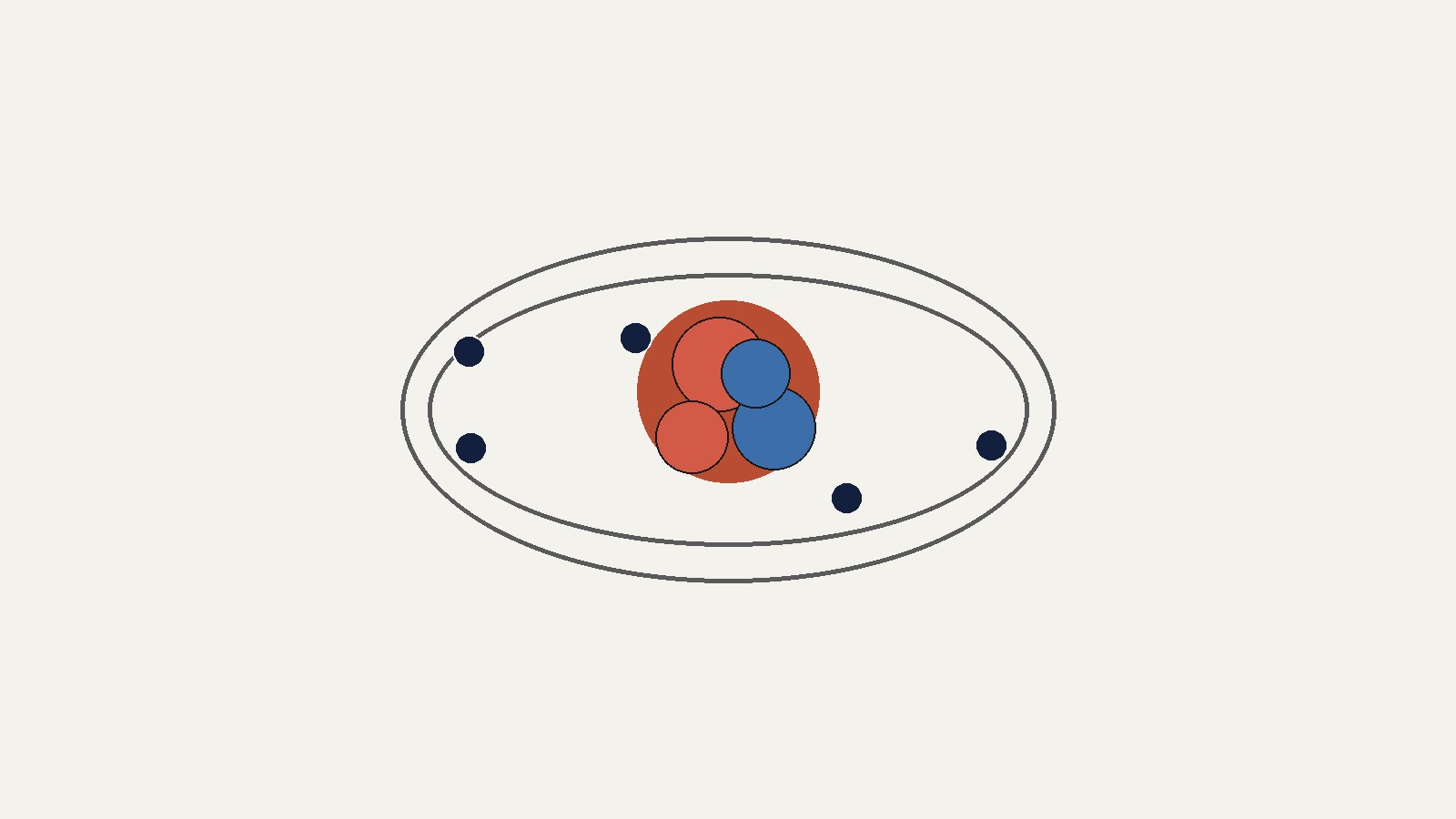
- An atom is the smallest unit of an element that still keeps that element's chemical properties. The International Atomic Energy Agency (IAEA) defines it exactly that way: an atom is the smallest unit of an element that retains its chemical properties, and it is made of protons, neutrons, and electrons. Everything around us, from air and water to rocks, plants, and animals, as well as everything within our bodies, is made up of atoms, in the agency's words. An atom has a tiny, dense center called the nucleus, which holds protons and neutrons. Around the nucleus is a cloud of electrons. Protons carry a positive charge, electrons carry a negative charge, and neutrons carry no charge. The number of protons decides which element an atom is: one proton means hydrogen, eight protons mean oxygen. Change the proton count and you change the element. Change the neutron count and you get a different isotope of the same element. Change the electron count and you get an ion, an atom with an electric charge.
What an atom is
Start with the word itself, because it is misleading. The word atom comes from a Greek word meaning indivisible, and the ancient Greeks believed atoms were the smallest particles in existence, as the IAEA notes. It turned out to be wrong in an interesting way: atoms can be divided into protons, neutrons, and electrons. But for chemistry, the atom is still the right stopping point.
That is why the definition is worded so carefully. Divide a piece of an element down to a single atom and you still have that element, chemically speaking. Divide it further, into protons, neutrons, and electrons, and you no longer have the element at all. Chemistry is mostly about electrons. Nuclear physics is mostly about what happens inside the nucleus. Both start from the atom.
The three particles inside every atom
Every atom is built from three kinds of particle. Two live in the nucleus and one lives around it. Their charges and masses, on the relative scale used in textbooks, are:
| Particle | Charge | Relative mass | Where it is |
|---|---|---|---|
| Proton | +1 | 1 | In the nucleus |
| Neutron | 0 (no charge) | 1 | In the nucleus |
| Electron | -1 | Very small, about 1/1840 of a proton | Around the nucleus, in an electron cloud |
OpenStax, the open textbook publisher whose Chemistry 2e text is used for this article, gives more precise masses: a proton has a mass of 1.0073 atomic mass units, a neutron 1.0087 atomic mass units, and an electron 0.00055 atomic mass units. On the relative scale, that is why textbooks round the proton and neutron to 1 each and call the electron’s mass negligible. Almost all of an atom’s mass sits in its nucleus, because the electrons contribute almost nothing to the total.
Charges work by a simple rule that the NRC states directly: particles with the same charge repel each other, while particles with opposite charges attract each other. Protons, all positively charged, repel one another. Electrons, all negatively charged, repel one another. Protons and electrons attract each other. That attraction is what holds the electron cloud around the nucleus. It is also what makes chemistry possible, because atoms can gain, lose, or share electrons, and those transfers and sharings are chemical bonds.
There is one famous exception to the three particle picture: an ordinary hydrogen atom has one proton and one electron and no neutron at all. It is the only atom that breaks the pattern of protons plus neutrons in the nucleus.
The nucleus: small, dense, and mostly empty space
The nucleus is the center of the atom, and it is astonishingly small compared with the whole atom. OpenStax Chemistry 2e states that the nucleus is about 100,000 times smaller in diameter than the atom itself. The IAEA gives a vivid comparison: if the nucleus of an atom were the size of a marble, the atom would be the size of a sports stadium. Most of an atom, in other words, is empty space, or more precisely, space occupied only by the electron cloud, which is far less dense than the nucleus.
That emptiness was discovered, not guessed. In the gold foil experiment, Ernest Rutherford and his colleagues fired fast, positively charged alpha particles at a very thin sheet of gold foil. Most particles passed straight through, undeflected. A few were deflected slightly, and a very small number bounced almost straight back. Rutherford concluded that the atom must consist largely of empty space, with a small, relatively heavy, positively charged body at its center: the nucleus.
The nucleus stays together because of the nuclear force. The IAEA describes it as the force that binds protons and neutrons together at distances close to the size of the nucleus, where it is much stronger than the electrical repulsion between the protons. At larger distances it rapidly becomes insignificantly small, which is why it holds nuclei together but does not glue whole atoms to one another.
Protons decide the element: the atomic number
The single most important number in this article is the number of protons in the nucleus. It is called the atomic number, written with the symbol Z, and it is the property that defines an atom’s elemental identity, in the words of OpenStax Chemistry 2e. The NRC makes the same point: the number of protons primarily determines where an atom fits on the periodic table, and two atoms with an identical number of protons belong to the same element.
Examples make the rule concrete. An atom with one proton is hydrogen. An atom with eight protons is oxygen. Uranium, the element with the highest atomic number of all naturally occurring elements on Earth, has 92 protons, a figure the IAEA gives in its atom explainer. Give an atom a different number of protons and it is simply a different element. That is why the periodic table is arranged in order of increasing atomic number.
A neutral atom has the same number of electrons as protons, so its positive and negative charges cancel out and its net charge is zero. That is the normal, uncharged state of an atom. When the electron count differs from the proton count, the atom is no longer neutral. It is an ion, covered in its own section below.
Counting an atom: mass number and chemical symbols
If the atomic number counts protons, the mass number counts protons plus neutrons together. OpenStax Chemistry 2e defines it plainly: the sum of the numbers of protons and neutrons in the nucleus is called the mass number, and expressed in atomic mass units it is approximately equal to the mass of the atom. The approximation works because protons and neutrons each weigh about one atomic mass unit and electrons weigh almost nothing.
That gives a simple counting recipe for any atom:
- Protons = atomic number (Z).
- Neutrons = mass number (A) minus atomic number (Z).
- Electrons = protons, if the atom is neutral.
Worked examples, all from the OpenStax Chemistry 2e answer key, show the recipe in action. A neutral carbon-12 atom contains six protons and six neutrons, and therefore six electrons, with a mass number of 12. A lithium-6 atom contains three protons, three neutrons, and three electrons. The recipe also runs backward: if you are told an atom has a given number of protons and neutrons, you can name its mass number by adding them.
Chemical symbols pack the same information into a compact notation, written in plain text here as carbon-12 or lithium-6. The periodic table’s atomic mass for an element, such as about 12.01 for carbon, is not the mass of any single atom: when a naturally occurring element is composed of several isotopes, OpenStax explains, its atomic mass represents the average of the masses of the isotopes involved, weighted by how common each one is.
Isotopes: same element, different neutron count
Atoms of the same element always have the same number of protons, but they do not always have the same number of neutrons. Atoms of the same element that differ in mass because they have different numbers of neutrons are called isotopes. OpenStax Chemistry 2e defines them exactly that way: isotopes of an element are atoms with the same atomic number but different mass numbers, and they differ from each other only in the number of neutrons within the nucleus.
The discovery came from radioactive ores in the early 1900s. Scientists isolated substances that looked like new elements but turned out to be chemically identical to known elements while having a different atomic mass. The English chemist Frederick Soddy realized that an element could have types of atoms with different masses that were chemically indistinguishable, and those types are isotopes. Soddy was awarded the Nobel Prize in Chemistry in 1921 for this work, according to OpenStax.
Isotopes matter for two reasons. First, because chemical behavior is governed mainly by electrons, and isotopes of one element have the same electron arrangement in their neutral state, isotopes behave almost identically in chemical reactions. Second, isotopes can differ greatly in nuclear stability. The NRC explains that the number of neutrons relative to the protons determines the stability of the nucleus, with certain isotopes undergoing radioactive decay, the process by which unstable atoms break down, releasing particles and energy. Most atoms on Earth are stable, the IAEA notes, mainly thanks to a balanced composition of neutrons and protons in their nucleus.
A practical example comes from uranium. Uranium has 92 protons, but not all uranium atoms have the same neutron count. The IAEA notes that uranium-235 is easier to split by fission than other uranium isotopes because its nucleus is relatively unstable and readily absorbs a neutron, and that only 0.7 percent of uranium found on Earth is this fissile type. Same element, different isotope, very different nuclear behavior, while the chemistry stays essentially the same.
Ions: when the electron count changes
An atom becomes an ion when it gains or loses electrons. The IAEA states the rule simply: atoms with the same number of electrons and protons are neutral, as the charges cancel each other out, and if an atom gains or loses electrons it becomes an ion. The NRC adds the practical consequence: electrons may be transferred from one atom to another or even shared between atoms, and those transfers and sharings allow atoms to bind together.
Losing electrons leaves an atom with more protons than electrons, so it carries a positive charge. Gaining electrons leaves it with more electrons than protons, so it carries a negative charge. OpenStax Chemistry 2e gives the standard names: positively charged ions are called cations, and negatively charged ions are called anions. Metals, particularly those in groups 1 and 2 of the periodic table, tend to lose electrons and form cations. Nonmetals, especially those in groups 16 and 17, tend to gain electrons and form anions.
In short: change protons and you change the element; change neutrons and you get a new isotope; change electrons and you get an ion.
Electrons: shells, energy levels, and the quantum cloud
Electrons do not orbit the nucleus the way planets orbit the sun, even though textbook diagrams often draw them that way for simplicity. The modern picture is a cloud: the nucleus is surrounded by a cloud of electrons, in the NRC’s phrase, and an electron’s position is described by probability, by where it is most likely to be found, rather than by a fixed path. Older models are still useful as stepping stones, and the most famous stepping stone is the Bohr model.
Niels Bohr proposed his model of the hydrogen atom in 1913. OpenStax University Physics Volume 3 calls it the very first model of atomic structure that correctly explained the radiation spectra of atomic hydrogen, and notes that it introduced an early quantum theory that later culminated in quantum mechanics. Bohr’s postulates were: the electron moves around the nucleus in a circular orbit, but only certain orbits are allowed, with angular momentum taking only discrete values; and an electron changes orbit by absorbing or emitting a photon whose energy equals the difference between the two orbit energies. That explained why hydrogen emits light only at specific wavelengths, its characteristic spectral lines, rather than at every wavelength.
Bohr’s model also gives a concrete number still used today. The ground state energy of the hydrogen atom, the energy of its electron in the lowest allowed orbit, is -13.6 electron volts, and removing that electron entirely, the ionization energy of hydrogen, takes 13.6 electron volts. Bohr’s model works beautifully for hydrogen but fails for larger atoms, which is why it was replaced by the quantum mechanical model, in which electrons occupy orbitals, three dimensional regions of probability, rather than fixed orbits. Two ideas carry over and are worth keeping: electrons can only occupy certain energy states, not any energy at all; and electrons move between states by absorbing or emitting fixed amounts of energy, which is why each element has its own characteristic spectrum, its own fingerprint in light.
How atoms join: molecules and compounds
Single atoms are the exception in everyday life, not the rule. Atoms join together, and the NRC explains the two basic mechanisms: electrons may be transferred from one atom to another or shared between atoms, and these bonds allow for the formation of molecules, combinations of atoms, including those of different elements. Many molecules then make up a chemical, in the NRC’s broad sense of the word.
A molecule is two or more atoms held together by chemical bonds and behaving as a single unit. An oxygen molecule, written O2, is two oxygen atoms bonded together. A water molecule is two hydrogen atoms and one oxygen atom. A compound is a substance made of two or more different elements chemically combined in fixed proportions. Water is both a molecule and a compound. Oxygen gas is a molecule but not a compound, because it contains only one element. Table salt is a compound but not a molecule in the usual sense, because it is a repeating lattice of sodium and chloride ions rather than separate small units.
OpenStax Chemistry 2e draws the two main bond types from the electron behavior. Compounds that contain ions, formed when metals and nonmetals transfer electrons, are called ionic compounds. Compounds that do not contain ions but instead consist of atoms bonded tightly together in molecules are called covalent compounds, and they usually form from two nonmetals sharing electrons. The distinction is a spectrum rather than a sharp wall, since sharing can be more or less equal, but the two mechanisms, transfer and sharing, explain most of the substances a reader will meet.
A short history of the atom
The idea of the atom is more than two thousand years old, but the evidence for it is only about two hundred years old. The ancient Greeks proposed that matter consists of extremely small particles called atoms. John Dalton, in the early 1800s, turned that philosophy into a scientific theory with testable claims, summarized by OpenStax: each element has a characteristic type of atom; atoms of different elements combine in fixed, small, whole number ratios to form compounds; and during any chemical change, atoms are neither created nor destroyed. Dalton treated atoms as solid, indivisible spheres, and for a century that picture worked well enough to build modern chemistry on.
Then the atom started to come apart. In the late 1800s, J. J. Thomson used a cathode ray tube to show that atoms contain small, negatively charged particles, now called electrons, and in 1904 he proposed the plum pudding model: a positively charged mass with electrons embedded in it. Rutherford’s gold foil experiment replaced that model with the nuclear model in 1911, and Rutherford named the proton, the hydrogen nucleus found in the nuclei of other elements. In 1917, the IAEA notes, Rutherford found that blasting nitrogen gas with radioactive alpha particles could transmute nitrogen into oxygen while ejecting a hydrogen nucleus, the particle later renamed the proton. Changing one element into another had moved from alchemy to laboratory fact, though only through nuclear reactions, not chemical ones.
Two discoveries completed the classical picture. In 1932, James Chadwick found evidence of neutrons, uncharged particles in the nucleus with a mass approximately the same as that of protons, which explained isotopes. Bohr’s 1913 quantum model explained hydrogen’s spectrum and introduced energy levels into atomic theory. The modern quantum mechanical model replaced Bohr’s fixed orbits with orbitals, but it kept his central insight: electron energy is quantized, available only in steps.
How big is an atom, and can we see one?
Atoms are far too small to see with the naked eye, and the IAEA is blunt about the limits: atoms cannot be seen with the naked eye, or even under a standard microscope, because an atom is too small to deflect visible light waves, meaning it will not show up under light focusing microscopes. Atoms can be viewed under an electron microscope, which generates electron waves that can interact with atoms. The scale is hard to grasp, so the IAEA offers a concrete comparison: a single strand of human hair is as thick as 500,000 carbon atoms stacked on top of each other.
That does not mean atoms are purely theoretical. The IAEA’s explainer includes a photograph of a single strontium atom, visible because it has absorbed and re-emitted the light of a laser, with electrodes two millimeters apart in the picture. The atom is not seen the way a coin is seen. It is detected because it interacts with light in a controlled experiment. The honest summary is that scientists do not see atoms with their eyes, but they measure them, count them, and manipulate them individually with instruments whose results agree across independent methods.
What happens when nuclei change: fission and fusion
Most of this article is about electrons, because chemistry is about electrons. But atoms also change at the nuclear level, and those changes release far more energy than chemical reactions. Two processes dominate.
Nuclear fission is the splitting of a heavy nucleus into two lighter nuclei. The IAEA describes the classic case: in the 1930s, scientists found that if a neutron is fired into certain uranium atoms, they could split into two and emit a certain number of neutrons, releasing a huge amount of energy. Every time a uranium-235 atom is split, it releases on average 2.5 neutrons, which can go on to split further fissile nuclei, producing a chain reaction when the neutrons are slowed by a moderator such as water or graphite.
Nuclear fusion is the reverse: two light atomic nuclei combine to form a single heavier one while releasing massive amounts of energy. The sun, along with all other stars, is powered by this reaction, according to the IAEA. Fusion needs extreme conditions, because nuclei repel each other electrically and must collide at extremely high temperatures, around one hundred million degrees Celsius in the IAEA’s figure, before the attractive nuclear force can take over at very close range. In the sun, immense gravity provides the pressure that creates those conditions. Chemistry never changes one element into another. Nuclear reactions do, and that distinction is why fission and fusion belong to physics and nuclear engineering rather than to chemistry, even though both start from atoms.
Atoms, molecules, elements, and compounds: keep them straight
Four words cause most of the confusion in this topic, so here they are side by side:
| Term | Meaning | Example |
|---|---|---|
| Atom | The smallest unit of an element with that element’s chemical properties | One oxygen atom |
| Element | A substance made of only one kind of atom | Oxygen, hydrogen, iron |
| Molecule | Two or more atoms bonded together as a unit | O2, water |
| Compound | A substance of two or more different elements chemically combined | Water, table salt |
An element is defined by its atoms, a molecule by bonding, and a compound by containing more than one element. Water is a molecule and a compound. Oxygen gas is a molecule but not a compound. A lone oxygen atom is neither. It is simply an atom.
Frequently asked questions
What is an atom in simple terms?
An atom is the smallest piece of an element that still behaves chemically like that element. It has a nucleus of protons and neutrons at its center and a cloud of electrons around it. Break it down further and you no longer have the element, only its parts.
What are the three parts of an atom?
Protons, neutrons, and electrons. Protons are positively charged and sit in the nucleus. Neutrons have no charge and sit in the nucleus too. Electrons are negatively charged, weigh almost nothing compared with protons and neutrons, and form a cloud around the nucleus. The one exception is ordinary hydrogen, which has one proton and one electron and no neutron.
What determines what element an atom is?
The number of protons in its nucleus, called the atomic number. One proton means hydrogen, eight protons mean oxygen, and 92 protons mean uranium. Change the proton count and you change the element entirely.
What is the difference between an atom and a molecule?
An atom is a single unit of an element. A molecule is two or more atoms bonded together into a single unit. A molecule can contain atoms of the same element, like O2, or of different elements, like water. A lone atom is not a molecule.
What is an isotope?
An isotope is a version of an element with a particular number of neutrons. Isotopes of one element have the same number of protons and therefore the same atomic number, but different mass numbers because their neutron counts differ. They behave almost identically in chemical reactions but can differ greatly in nuclear stability, and some are radioactive.
What is an ion?
An ion is an atom that has gained or lost electrons, so it carries an electric charge. A neutral atom has equal numbers of protons and electrons. Lose electrons and the atom becomes positively charged. Gain electrons and it becomes negatively charged.
Why are most atoms mostly empty space?
Because the nucleus is about 100,000 times smaller in diameter than the atom as a whole, in the OpenStax figure, while the electrons occupy a cloud around it. Rutherford’s gold foil experiment showed this directly: most alpha particles passed straight through gold foil, while only a few were deflected by the tiny, dense nucleus.
Are atoms indivisible?
No, despite the name. The Greek word behind atom means indivisible, and the ancient Greeks believed atoms were the smallest particles in existence. Experiments since the late 1800s have shown that atoms consist of protons, neutrons, and electrons. Atoms are indivisible only in the chemical sense: divide an atom and you lose the element’s chemical identity.
Can we see atoms?
Not with the naked eye or a standard light microscope, because atoms are too small to deflect visible light waves. Scientists image atoms with electron microscopes and detect single atoms in experiments such as the laser illuminated strontium atom described by the IAEA. Those images are maps of interactions rather than everyday photographs, but they confirm the atomic picture from independent directions.
Sources & references
- International Atomic Energy Agency, "What is an Atom?", Nuclear Explained, 5 January 2026. Definition of the atom, the three particles, the nucleus and the nuclear force, ions, fission, fusion, and the strontium atom photograph. https://www.iaea.org/newscenter/news/what-is-an-atom
- United States Nuclear Regulatory Commission, Science 101, "What is an Atom?". Building block definition, charges and attraction, atomic number and the periodic table, isotopes and stability, ions, and molecules. https://www.nrc.gov/reading-rm/basic-ref/students/science-101/what-is-an-atom
- LibreTexts, Biology for Non-Majors I, Section 2.2, "Atoms and Elements". The hydrogen exception (one proton, one electron, no neutron), particle charges and relative masses, and the carbon-12 isotope example. https://bio.libretexts.org/Courses/Lumen_Learning/Biology_for_Non-Majors_I_(Lumen)/02%3A_Chemistry_of_Life/2.02%3A_Atoms_and_Elements
- OpenStax, Chemistry 2e, Chapter 2 Summary and Section 2.2, "Evolution of Atomic Theory". Dalton's postulates, Thomson's cathode ray work, Millikan's charge measurement, Rutherford's gold foil experiment, Soddy and isotopes, Chadwick and the neutron, atomic number, mass number, and particle masses. https://openstax.org/books/chemistry-2e/pages/2-summary and https://openstax.org/books/chemistry-2e/pages/2-2-evolution-of-atomic-theory
- OpenStax, University Physics Volume 3, Section 6.4, "Bohr's Model of the Hydrogen Atom". Bohr's 1913 model, its three postulates, hydrogen's ground state energy of -13.6 electron volts, and its ionization energy. https://openstax.org/books/university-physics-volume-3/pages/6-4-bohrs-model-of-the-hydrogen-atom


