Short answer
- The calm way to handle Christmas gifts is to work from lists, not from last minute inspiration. Write your own list early, with specific christmas gift ideas across several price bands, and share it before anyone starts shopping. When you give, start from what you know about the person: what they mentioned during the year, what they use, and what would make ordinary days easier or pleasanter. Fill stockings with a small mix of something tasty, something useful, something fun, and something personal, inside an agreed total band. For Secret Santa, agree the spending band, the draw method, the wish hints, and the exchange date before names are drawn. Keep the whole season inside a total budget set in advance and divided by person, and treat experiences, help, and handmade gifts as full value options rather than fallbacks. A wishlist only works if it is current, specific, and marked when items are bought, so duplicates do not happen.
Introduction
Choosing Christmas presents is easy when you know what someone wants and hard when you do not. The difference is rarely money or imagination. It is usually the absence of a system. A good list, ideas organized by recipient, a simple stocking strategy, and clear Secret Santa rules agreed before anyone spends anything will remove most of the panic from December.
This guide covers christmas gift ideas in that practical sense. It explains how to build a Christmas list that actually helps the people giving to you, how to think about christmas present ideas for different people, how to fill a stocking without filling it with clutter, and how Secret Santa exchanges work well when the rules are set early. It also covers budget planning in broad bands, wishlist habits that prevent duplicates, and a simple timeline that spreads the work across the fall instead of compressing it into the last two weeks.
People search for this topic in different ways, including christmas list ideas 2026, xmas list ideas, and xmas wishlist, but the system underneath is the same. Nothing in this guide depends on a particular product, store, or season, so the method stays useful from one year to the next. Prices appear only as general planning bands, such as under $25, to help with budgeting. They are not the price of any specific item, and no seller is recommended anywhere in this article.
How to Build a Christmas List
A Christmas list is not a shopping list. It is a short document that tells the people giving to you what you would genuinely like, in enough detail that they can choose with confidence. The best lists are written early, in late October or November, and shared before anyone starts shopping. A list written in mid December helps no one, because most decisions have already been made.
A useful list has four qualities.
It is specific. A single word such as books is not helpful. A useful entry names the kind of thing and the details that matter: a paperback novel in historical fiction, ideally by an author you have mentioned this year, plus a note about authors you already own. Include sizes, colors, and preferences where they matter, and note anything you already have. Specificity is a kindness: it removes guesswork without removing choice, because a good entry still leaves the giver room to pick the exact version.
It covers a range of price bands. Include ideas in a lower band (under $25), a middle band (around $25 to $50), and a higher band (over $50), so every giver, whatever their budget, has a genuine option. These bands are guidance for planning, not prices of specific products. A list with only higher band ideas puts quiet pressure on people with less to spend. A list with only lower band ideas leaves a generous giver with nowhere to go.
It includes ideas that are not objects. Experiences, a meal out together, a donation to a cause you support, or an offer of help, such as a day of childcare or help with a project, are often more welcome than another object. Non object ideas also solve the hardest giving problem, the person who genuinely needs nothing. If that is you, say so on the list and name the experience or cause instead.
It is easy to share and easy to update. A shared note, a simple document, or a wishlist tool all work. What matters is that the list lives in one place, is updated when you receive something, and lets givers signal what they have chosen, so nobody duplicates a gift.
Two variations are worth handling separately. If you are building a list for children, ask them to rank their top three wishes, then add one or two practical items yourself, such as clothes they need, books, or craft supplies. That gives grandparents and relatives sensible options alongside the exciting ones, and it teaches children that a list is a guide, not a guarantee. For couples or households, a joint list works well: shared items, such as things for the home or a meal out together, plus individual items, clearly marked, avoids two people giving the same household item twice.
Finally, keep a running note through the year. The best lists are not invented in November. They are collected, one line at a time, whenever someone mentions wanting, needing, or admiring something. That habit, more than any single idea here, is what makes December feel easy.
Gift Ideas by Recipient
Different recipients need different thinking. The ideas below are starting points, organized by relationship rather than by product. Adapt them to the person.
For parents and grandparents. Think about what makes daily life easier or more comfortable. Warm accessories, good food to share, a framed family photograph, a subscription to something they already enjoy, or a planned day out together all fit that test. Older relatives often value time more than objects: a regular visit, a standing phone call, or a shared activity arranged for the new year continues after Christmas Day. If you give food, check dietary needs first.
For partners. The best partner gifts show that you have been paying attention. A book by an author they mentioned in passing, tickets to something they talked about, a replacement for something worn out, or a small luxury they would not buy for themselves all say the same thing: I listened. This is where the year round note earns its keep. Without it, partner giving becomes a test of memory under time pressure, which is why so many partner gifts are expensive and generic at the same time.
For friends. Match the friendship, not the occasion. A thoughtful small gift, such as a candle, a book, something they like to eat or drink, or the promise of a coffee together, beats an expensive generic present. For close friends, a shared experience, such as a meal or a day out, often means more than an object. Keep friendship gifts proportionate: overspending can create an obligation neither of you wanted.
For children. Balance the exciting with the lasting. One larger wish, a creative or outdoor gift that will be used beyond Christmas week, and a book or game for quieter days make a good mix. Think about where the gift will live, because a large toy needs a home, and parents will thank you for considering that first. Safety is part of choosing well here. The U.S. Consumer Product Safety Commission (CPSC) advises givers to choose age appropriate toys and to always read and heed the label to check age appropriateness. The CPSC notes that the majority of toy injuries and deaths are associated with choking on small parts, and it advises keeping small balls and toys with small parts away from children younger than age 3, keeping balloons away from children younger than age 8 (especially latex balloons), and keeping high powered magnets and button cell or coin batteries away from young children because they pose ingestion hazards. The CPSC also advises considering the ages of all children in the household, since a toy safe for an older child can harm a younger sibling, providing properly fitted helmets for scooters and other riding toys, and checking whether a toy has been recalled. None of that requires expertise, only reading the label and thinking about the whole household.
For colleagues and neighbors. Keep it simple and appropriate. Food gifts, a plant, a candle, or a small selection of treats are safe choices. Avoid anything personal, expensive, or jokey in a work context, where humor that lands well among friends can land badly among colleagues. A card with a genuine, specific message is often as welcome as the gift itself, because it is the part people keep.
For teachers, coaches, and other helpers. A short, specific thank you note, paired with something small and consumable if you give an object at all, is usually the right scale. Group gifts from a class or team can work well, provided one person coordinates so the recipient does not receive twenty versions of the same small item. When in doubt, the note matters more than the object.
For someone who has everything. Go consumable or experiential. Good food and drink, a subscription, a donation in their name, or an offer of your time and skills will be used and enjoyed without adding clutter to a home that already has enough. The test for this recipient is not what they lack. It is what they would enjoy this month: something to eat, somewhere to go, or something taken off their to do list.
Stocking Fillers
Stocking fillers, called stocking stuffers in many American households, are the small gifts that make Christmas morning feel generous. The best stockings mix a few categories: something tasty, something useful, something fun, and something small and personal. Variety, not volume, is what creates the effect.
Ideas that work across ages include chocolate and other treats, lip balm or hand cream, socks, a small notebook, a pen, a puzzle or card game, a key ring, a bath product, a packet of seeds for a gardener, and a small flashlight. For children, add stickers, crayons, a small toy, or a hair accessory, subject to the same age and small parts care described above.
A few practical stocking tips make the tradition work better.
Set a stocking budget band. Agree a rough total band per stocking, for example under $25 or under $30 in total, so one stocking does not dwarf another. Again, these are planning bands, not prices. Children in particular compare stockings, and a shared band keeps the morning fair without anyone counting items.
Wrap the small things. A stocking full of unwrapped items is over in seconds. Individually wrapped fillers stretch out the fun and make five items feel like an event rather than a handful. Wrapping takes time, so do it across a few evenings rather than all on Christmas Eve.
Avoid the filler trap. Buying ten tiny things nobody wants, just to fill the stocking, wastes money and creates clutter to store or throw away in January. Five things the person will actually use beat fifteen novelties. If an item only makes sense as filler, it does not make sense at all.
Think about the stocking itself. A good quality stocking, personalized with a name, becomes part of the tradition and can be reused for years, which is better value and less waste than a novelty stocking replaced each December.
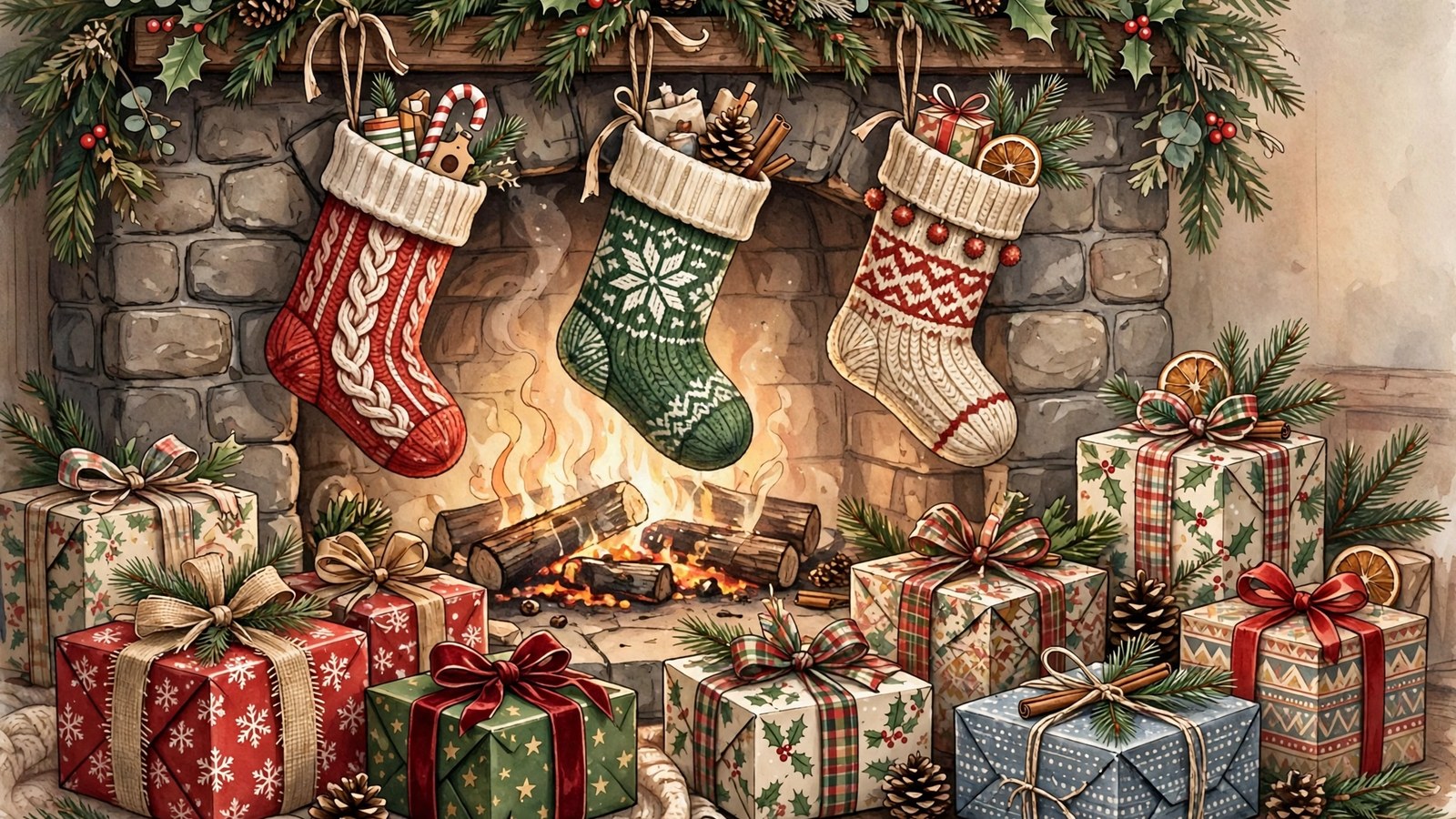
One safety point belongs here, because stockings are traditionally hung by a fireplace. The National Fire Protection Association (NFPA) advises choosing decorations that are flame resistant or flame retardant, keeping lit candles away from decorations and other things that can burn, and notes that more than two in five decoration fires happen because decorations are placed too close to a heat source. The practical translation is simple: move stockings and other hanging decorations well away from the firebox before a fire is lit, never hang anything flammable directly above open flames, and blow out lit candles when you leave the room or go to bed, as the NFPA also advises. The illustration with this article shows the classic fireplace scene. Enjoy the look, and clear the mantel before the fire is lit.
Secret Santa Rules and Ideas
Secret Santa is a gift exchange in which each person in a group is randomly assigned one other person to give to, keeping the recipient secret until the gifts are opened. It works brilliantly when the rules are clear, and causes friction when they are not. Agree the rules before names are drawn.
- Set a spending band. A clear band, for example $10 to $20, prevents embarrassment on both sides. Everyone spends roughly the same, and nobody feels they have over spent or under spent. State whether the band is a target or a firm cap, because confusion on that point is common.
- Draw names fairly. Use a hat, a random generator, or a dedicated tool. Make sure nobody draws themselves, and agree in advance what happens if someone draws their partner or someone they gave to last year.
- Collect wish hints. Each person should provide three or four ideas or interests, so the giver is not guessing blindly. Likes, dislikes, and sizes help enormously, and they protect people with allergies or strong dislikes from the standard fallback gift.
- Set a date and a reveal plan. Agree when and where gifts will be exchanged, and whether the giver identity is revealed at the opening or kept secret. If gifts are mailed, agree a mailing date with time to spare.
- Keep it kind. Avoid joke gifts that could embarrass someone, especially at work. A gift that is funny and thoughtful is fine. One that singles someone out for a habit or an appearance is not.
- Have a plan for dropouts. If someone cannot take part, agree early whether the group adjusts the draw or one person covers two recipients. A plan makes a dropout a minor adjustment instead of a missing gift.
Good Secret Santa christmas gift ideas are small, personal, and easy to obtain: a book, a food gift, a plant, a mug with good coffee or tea, a puzzle, or something related to a hobby the recipient has mentioned. The best ones show that the giver paid attention to the hints, even on a small budget. Attention, not spending, is the skill being tested.
Two cautions complete the picture. First, if a gift card is your gift, keep your copy of the card and the store receipt. The Federal Trade Commission (FTC) advises keeping both, and warns that only scammers will tell you to buy a gift card and give them the numbers off the back of the card, and that no real business or government agency will ever tell you to buy a gift card to pay them. A gift card is for giving, never for paying a caller or a supposed official. Second, for work Secret Santa, keep gifts professional and inclusive. Avoid alcohol unless you know the recipient drinks and would welcome it, avoid strongly scented products in shared offices, and remember that not everyone celebrates Christmas in the same way. A workplace exchange should be opt in, never compulsory.
Budget Friendly Gift Planning
Christmas does not need to be expensive to feel generous. A few principles keep spending under control without making gifts feel cheap.
Start with a total budget, then divide it. Decide what you can afford overall, list everyone you are giving to, and assign a band to each person. Adjust before you shop, not after. A total that exists only in your head will expand to fit December. A total written down, divided by name, will hold. Include the easily forgotten costs: wrapping, cards, postage, stockings, and any group exchange, because those small costs are where budgets quietly break.
Start early and spread the cost. Starting in October or November means you can obtain a few gifts each month rather than facing one large bill in December. It also improves the gifts, because you can act on a good idea when you hear it instead of reconstructing it under pressure.
Make something. Home baked cookies, a jar of preserves, a handwritten letter, a photo album, or a knitted item costs little in money and a great deal in thought. Handmade gifts work best when they are genuinely useful or personal, not when they are a last minute substitute. If you make food, label it with ingredients, because allergies are common and a label is a small courtesy that matters. Start early: a knitted item started in November is a gift, while the same item started in mid December is a stress.
Give experiences and help. A home cooked meal, a day out together, childcare for an evening, or help with a move or a project often costs less than an object and is remembered longer. Put the promise in writing, with a date or a clear way to claim it, because an experience gift with no date often never happens.
Use what you already have. A book you have finished and loved, a plant cutting, or a skill you can offer can all become gifts with a little presentation. A loved book passed on with a note about why you chose it is more personal than most new objects.
If money is tight, be honest with family and friends early. Most people would rather agree a lower spending band, or a no gifts, just time together arrangement, than watch someone struggle in silence. Suggesting a Secret Santa instead of individual gifts lowers every participant total at once and turns restraint into a shared game rather than a private embarrassment.
Wishlist Tips
A wishlist is only useful if people can actually use it. Whether you are writing one or giving from one, a few habits help.
Keep it current. Remove items you have obtained yourself or already received, and update the list through the year, not just in December. A stale wishlist produces duplicates and disappointments, and givers stop trusting it, which defeats its purpose.
Include exact details. A title, an author, a size, or a color removes guesswork and reduces the chance of a duplicate or the wrong version. Where versions look alike, name the difference that matters to you. Vagueness feels polite and behaves badly.
Add a range of options. A wishlist with only expensive items puts pressure on givers. One with only inexpensive items leaves generous givers stuck. Mix the bands, as described above, and include a few non object options for the giver who prefers to give time.
Mark what is bought. If your wishlist tool allows it, let givers mark items as purchased. If it does not, ask givers to tell one coordinating person, so two people do not give the same thing. Duplicates are rarely anyone fault. They are a coordination failure, and marking is what prevents them.
Say thank you properly. A short, specific message that mentions the gift itself matters more than a generic thanks, and it encourages people to keep using your list next year. It also closes the loop for the giver, who otherwise never learns whether the choice landed well.
For a christmas wishlist 2026, the same principles apply: write it early, share it with the people who ask, and keep it realistic. A list that reflects what you actually want, at a range of price bands, removes guesswork and makes Christmas morning better for giver and recipient alike. The best gifts, in the end, are not the most expensive ones. They are the ones that show the giver was paying attention: the right book, the useful tool, the small luxury, the shared day out. Build a good list, agree the rules, set a budget you can live with, and the gift side of Christmas largely takes care of itself.
A Simple Planning Timeline
Systems work best on a schedule. This timeline is a starting point. Move it earlier if you mail gifts, make gifts, or host as well.
In October, write or update your own list, collect family lists, and set the total budget divided by person. Agree group arrangements while agreement is still easy: Secret Santa draws, stocking bands, and any decision to scale back. Start handmade gifts now.
In November, obtain the larger and most important gifts first, while pressure is lowest. Fill in stocking items gradually, wrapping across a few evenings. Confirm sizes, dietary needs, and delivery addresses before you need them.
In early December, finish the main list, mail anything that needs to travel with time to spare, and check specific deadlines with the carrier or service you are using rather than assuming a standard date. Write cards, including experience notes with dates.
In the final week, limit yourself to small, low risk additions: food, flowers, or a handwritten note. Resist rebuilding finished decisions under deadline pressure. Wrap what remains, clear stockings and decorations away from any fire before it is lit, and stop. A finished, calm Christmas beats a marginally improved, exhausted one.
Frequently Asked Questions
What are good christmas gift ideas for someone who has everything?
Choose something consumable or experiential rather than another object. Good food and drink, a subscription to something they already enjoy, a donation in their name, or an offer of your time and skills will be used and enjoyed without adding clutter. Name a date or a clear way to claim an experience, so the gift actually happens.
How do I build a Christmas list that is actually helpful?
Make it specific, varied, and current. Name the kind of item plus the details that matter, such as title, author, size, or color, note what you already own, include ideas across lower, middle, and higher price bands (for example under $25, $25 to $50, and over $50 as planning bands), add non object options such as experiences or help, and keep the list in one shareable place you update when something is received.
What are stocking fillers, and how many should I include?
Stocking fillers, also called stocking stuffers, are the small gifts placed in a Christmas stocking. Quality matters more than count. A small mix across four kinds, something tasty, something useful, something fun, and something personal, inside an agreed total band such as under $25 to $30 per stocking, feels generous without waste.
What are the basic Secret Santa rules?
Agree them before names are drawn: a spending band everyone follows, a fair draw in which nobody draws themselves, three or four wish hints from each person, a fixed exchange date and reveal plan, a kindness rule that rules out embarrassing joke gifts, and a plan for dropouts. At work, keep the exchange opt in and gifts professional and inclusive.
How can I keep Christmas giving affordable without it feeling cheap?
Set a total budget first and divide it by person, start early so costs spread across the fall, and treat handmade gifts, experiences, and offers of help as full value options. A home cooked meal or an evening of childcare often costs less than an object and is remembered longer. If money is tight, say so early and suggest a shared arrangement, such as a Secret Santa, that lowers costs for everyone.
What should I check before giving a toy to a child?
Read the label and follow it. The CPSC advises choosing age appropriate toys and heeding the label, keeping small balls and toys with small parts away from children younger than age 3, keeping balloons away from children younger than age 8, and keeping high powered magnets and button cell or coin batteries away from young children. Consider every child in the household, add a fitted helmet with riding toys, and check for recalls before you give it.
Is a gift card a good Christmas gift?
It can be, especially for a recipient who prefers to choose, provided you keep your copy of the card and the receipt, as the FTC advises. Never treat a gift card as a payment method: the FTC warns that only scammers tell you to buy a gift card and share the numbers on the back, and no real business or agency will ask you to pay them with one.
When should I start planning Christmas gifts?
Late October or November is early enough for most households, when lists, budgets, and group rules can still be agreed calmly. Start earlier if you make gifts by hand, mail gifts a long distance, or need wish hints from a large group. Starting early spreads both the cost and the work, which is most of the benefit.
How do I stop two people giving the same gift?
Use one shared list with a marking system. Either let givers mark items as purchased in the wishlist tool itself, or ask givers to tell one coordinating person what they have chosen. Duplicates are usually a coordination failure, and a single marked list prevents them.
Keep reading: What Is a Budget?
Keep reading: Christmas Food Ideas: Cake, Cocktails and Hosting Without the Stress
Keep reading: Christmas Decor Ideas: Trees, Wreaths, Tables, Windows and Crafts for a Festive Home
Sources & references
- U.S. Consumer Product Safety Commission (CPSC), "CPSC Reminds Early Holiday Shoppers to Follow These Top Safety Tips" (cpsc.gov). Page opened and read 29 October 2026. Supports the toy giving guidance in this article: choose age appropriate toys and read and heed the label, the majority of toy injuries and deaths are associated with choking on small parts, keep small balls and toys with small parts away from children younger than age 3, keep balloons away from children younger than age 8 (especially latex balloons), keep high powered magnets and button cell or coin batteries away from young children, consider the ages of all children in the household, provide properly fitted helmets for scooters and other riding toys, and check for recalls before giving.
- National Fire Protection Association (NFPA), "Winter Holiday Safety" tip sheet (nfpa.org). Document opened and read 29 October 2026. Supports the fireplace and decoration guidance in this article: choose decorations that are flame resistant or flame retardant, keep lit candles away from decorations and other things that can burn, blow out lit candles when leaving the room or going to bed, turn off light strings and decorations before leaving home or going to bed, more than one third of home decoration fires are started by candles, and more than two in five decoration fires happen because decorations are placed too close to a heat source.
- Federal Trade Commission (FTC), Consumer Advice guidance on gift cards, including "Avoiding and Reporting Gift Card Scams" (consumer.ftc.gov). Page opened and read 29 October 2026. Supports the gift card guidance in this article: only scammers will tell you to buy a gift card and give them the numbers off the back of the card, no real business or government agency will ever tell you to buy a gift card to pay them, and you should always keep a copy of your gift card and store receipt.
- External package ARTICLE-0023 research dossier and sources file (Amberaisle external library). Read in full 29 October 2026. The dossier records that the underlying guide is advisory and organizational, with no product recommendations, no retailer claims, and no current prices, and that all monetary figures are planning price bands for budgeting guidance only. That framing is retained in this adaptation, converted to U.S. dollar bands. No Secret Santa origin history is asserted, because the dossier notes that origins are disputed and were not verified.


