Short answer
- Winter nails work best when you choose one color family and one finish, then plan the design around your calendar. Deep shades such as burgundy, forest green, navy and plum suit a busy December because they are forgiving, dressy and easy to pair with one accent nail. Pale, frosty shades such as icy blue, silver, pearl white and pale gray suit a quieter winter look, especially with shimmer or a chrome style finish. For December, choose shorter nails, darker colors and flat designs that hold up through wrapping, cooking and washing up. For New Year's Eve, choose the bolder version of the same idea: black and gold, jewel tones, confetti dots or a firework burst on one or two accent nails. Paint party nails the day before the party where you can, so the polish has time to harden fully. For nail health in winter, the American Academy of Dermatology advises keeping nails clean and dry, cutting them straight across and slightly rounding the tips, and never biting nails or removing the cuticle. Shorter nails stay cleaner and break less often, one more reason a practical length suits the season.
Introduction
Winter is the one season when nails can carry the whole look. Between December gatherings, cozy weekends and the countdown to New Year’s Eve, a well-chosen manicure adds polish, quite literally, without requiring a new outfit. This guide gathers winter nail ideas for every mood, whether you are browsing for winter nail inspo or planning a specific look, from quiet icy neutrals to full firework sparkle.
It also separates two jobs that are often mixed together. December nails need to last through wrapping, cooking and repeated handwashing, so durability matters as much as design. New Year’s Eve nails have one night to shine, so they can be bolder, darker and more glittering. The guide closes with nail care for the cold months, based on guidance from the American Academy of Dermatology, so the design you choose sits on nails that are looked after as well as decorated.
Winter Colors and Finishes
Winter color palettes tend to split into two camps: deep and dramatic, or pale and frosty. Both work, and the finish you choose changes the feel completely.
Deep shades, burgundy, forest green, navy and plum, suit shorter nails and busy December schedules because chips are less obvious than on very pale polish. A matte top coat makes these colors feel modern and soft, while a glossy finish keeps them classic. Deep colors also give a useful base for metallic detail: a thin gold stripe or one glitter accent nail stands out clearly against burgundy or navy, so a little detail goes a long way.
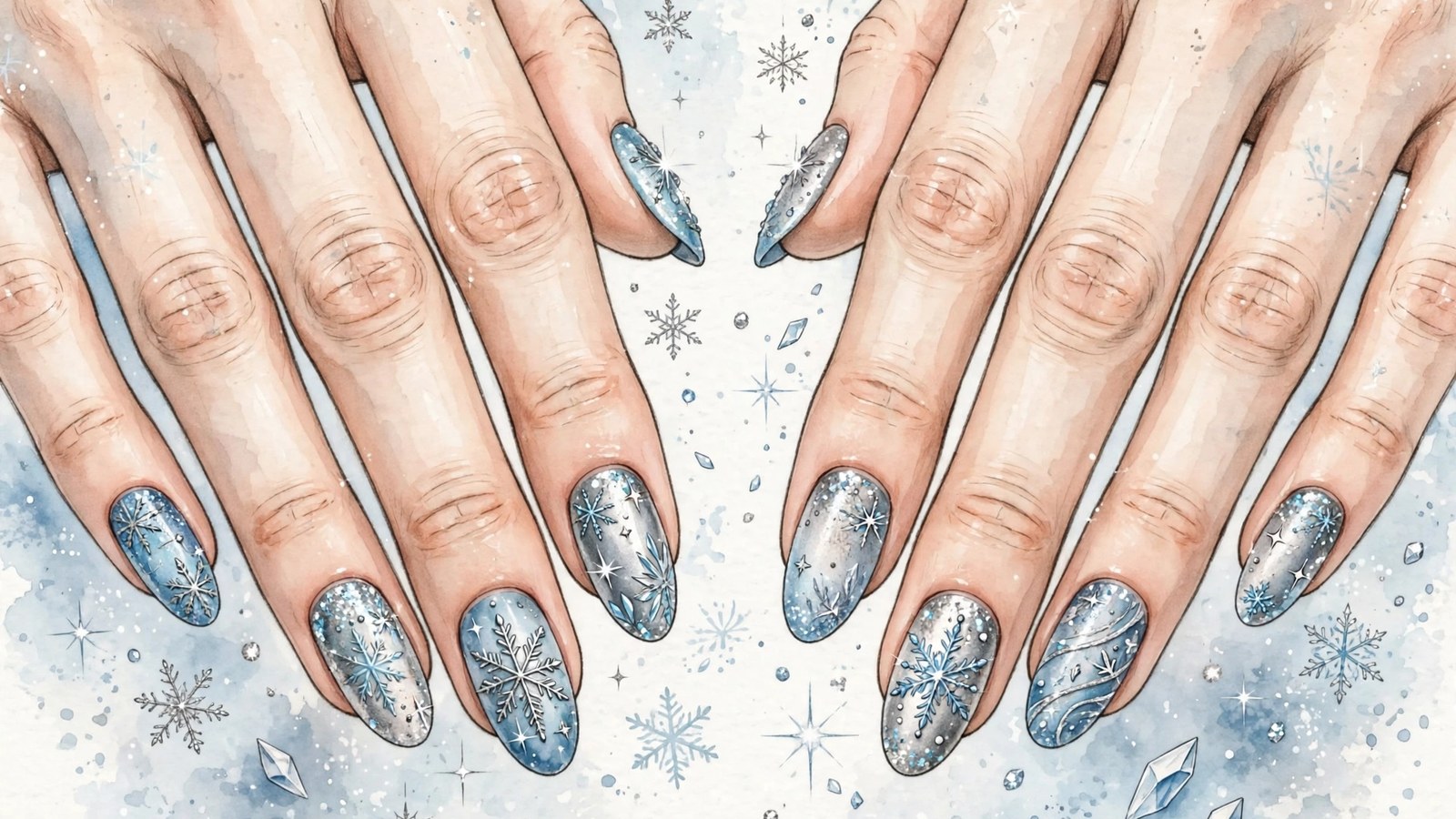
At the other end of the scale, icy blue, silver, pearl white and pale gray capture the frosty side of the season. These shades look especially good with a subtle shimmer or a chrome style finish, which catches the light without needing glitter on every nail. Pale shades show chips and tip wear sooner than deep shades, so they suit a quieter week or a manicure done close to the event itself.
Sheer, milky finishes deserve a mention too. A translucent pink or white gives a clean, groomed look that works for work, weekends and parties alike, and it grows out gracefully if you cannot get to a salon before the new year. A sheer set is also the easiest design to change later: one glitter accent nail over a milky base turns an everyday set into a party set, and removing that nail returns it to a quiet look for January.
If you are unsure where to start, pick one color family and one finish, then vary it across your nails. A deep burgundy with a single glitter accent nail feels festive without being fussy. Alternatively, paint all ten nails in the same icy shade and let the finish do the talking. Keeping the color family tight is what makes a mixed set look planned rather than random.
A simple way to think about finishes is this. Glossy is the classic choice and makes any color look deeper. Matte softens a color. Shimmer adds light movement without loose glitter pieces. Glitter adds the most sparkle and texture, so it works best on accent nails or tips. Chrome style and holographic finishes shift in the light, a good shortcut to a party look on a plain dark base.
Choosing a Shape and Length for Winter
Shape and length decide how practical a winter design will be, so choose them before you choose the art. Short nails are the practical winter default. They are easier to keep clean, catch less on gloves, scarves and wrapping paper, and suit December tasks, from cooking to carrying bags. The dermatology guidance in the care section below gives a health reason to match: shorter nails stay cleaner and break less often.
A short nail can still carry most winter designs. Solid deep color, a French tip in a winter shade, a glitter gradient, a snowflake accent and a confetti design all fit if the detail is kept small and placed on one or two nails. A large motif that needs space, such as a detailed firework burst, does not fit well. On a short nail, simplify the burst to a small cluster of short lines and keep the rest plain.
Medium length nails give more room for gradients, French tips and firework lines, and suit the party end of the season. They also need more care, because a longer free edge bends and catches more easily. If you choose length for New Year’s Eve, consider filing back to a practical length in January rather than making one set serve the whole winter.
Keep all ten nails at a similar length and shape, with a rounded or softly squared edge if you want to avoid corners catching. A set looks finished when the nails match each other, even if the design is simple.
December Nails
December nails are really about pacing. Many people want something that lasts from the first festive gathering right through to Christmas Day, so durability matters as much as design. Think in stages: an early December set can be quiet and practical, a mid December refresh can add the festive accent, and a set done close to Christmas Day itself can carry the most detail, because it has the fewest days of wear ahead of it.
Simple December ideas that hold up well include:
- Deep red with a gold accent. Paint most nails a classic red and add gold foil or a thin gold stripe to one or two nails. It reads as festive without depending on novelty motifs.
- Forest green with a glossy top coat. A rich green suits both casual sweaters and smarter evening outfits, and it pairs naturally with gold jewelry.
- Snowflake accents on a pale base. A pale blue or milky white base with a single hand-painted or stamped snowflake on the ring finger keeps the design wearable after the holidays.
- Burgundy French tips. Swap the traditional white tip for burgundy on a nude base for a December twist on a timeless look.
- Subtle glitter gradients. A fine glitter that fades from the tip toward the cuticle gives sparkle that does not overwhelm, and it hides tip wear better than a solid glitter coat.
When choosing a December design, think about what your hands will actually be doing. If you will be wrapping presents, cooking and washing up, shorter nails and darker shades are the lower maintenance choice. Longer nails and pale colors look beautiful but show wear sooner, so they suit a manicure booked closer to the big day itself.
Two more pacing tips help a December set last. First, keep the design flat. Raised decorations and thick glitter catch on paper, fabric and gloves, and a caught decoration can lift the polish under it. Flat art, such as a painted stripe, a stamped snowflake or a thin foil accent, gives the festive effect without the snagging. Second, plan a small refresh rather than a full repaint. A fresh top coat halfway through the wear period can make a simple set look newly done.
A Simple Winter Manicure at Home
Most of the designs in this guide can be done at home with regular polish, and the method matters more than the number of products. Start with clean, dry nails and remove any old polish fully. Shape the nails before polish goes on, and check both hands side by side so the lengths match.
Apply a base coat and let it dry. Then apply color in thin coats rather than one thick coat. Thin coats dry more evenly and are less likely to bubble or peel at the edge. Two thin coats suit most deep winter shades, and a pale or sheer shade may need a third. Run the brush lightly across the tip of the nail as you finish each coat, a step often called capping the edge, so the color wraps the part of the nail that chips first.
Add art only when the color coats are dry to the touch. Work on one accent nail at a time, keep the design small, and accept that a simple stripe, dot or snowflake reads more clearly than a detailed picture on a small surface. Finish with a top coat over the whole nail, including the art, and let the set dry fully before using your hands for anything involving water, heat or pressure.
Timing is part of the technique. Evening is a good time to paint nails, because the set can harden for hours afterward undisturbed. Polish painted the day before a party holds better than polish painted an hour before you leave.
New Year’s Eve Nails
New Year’s Eve is the night to go bolder. The lighting is low, the outfits are dressier, and sparkle that might feel too much on a Tuesday afternoon fits perfectly at midnight.
Black and gold is the classic New Year’s Eve combination. A black base with gold foil, gold glitter or a gold French tip looks striking and matches almost any party outfit. Silver on black works just as well if your jewelry leans cool toned.
If you prefer color, deep jewel tones, emerald, sapphire and ruby shades, photograph beautifully in party light and pair well with both black dresses and metallic fabrics. A single statement nail in glitter or chrome keeps the overall look balanced. A midnight version uses navy or deep plum as the base, with tiny silver or white dots scattered like stars, made with a dotting tool or the end of a hairpin dipped in polish.
For something more playful, try a confetti design: tiny dots of gold, silver and white scattered over a dark or nude base, like the moment the clock strikes twelve. Confetti nails are forgiving to apply at home because the scattered placement is meant to look random.
A champagne toned set is the softer party option. Pale gold, warm nude and a fine gold glitter gradient give a celebratory feel without a dark base, and the same pale set still looks appropriate in the first week of January, when a black and glitter set may feel finished.
Practical tip: if you are doing your own nails for New Year’s Eve, paint them the day before rather than on the day. That gives the polish time to harden fully, and leaves the day itself free for everything else. A fresh top coat on the morning of the party revives shine without a full repaint. If you are booking a salon instead, say the base color, the finish and how many accent nails you want, in that order, and bring a reference picture as well as a description in words.
Firework-Inspired Designs
Firework nails are the most eye-catching of all winter designs, and they are easier than they look. The idea is to suggest bursts of light rather than draw a literal firework on every nail.
Start with a dark base, black, navy or deep plum, so the bursts stand out. Then, using a thin brush, a dotting tool or even a toothpick, draw short lines radiating from a central point on one or two accent nails. Gold and silver work best, with a touch of red or blue for variety. Keep the lines short and uneven: a slightly uneven set of lines looks more like light and less like a diagram. Add one small dot at the center to anchor it, and stop earlier than you think you should. A sparse burst on a dark base reads clearly at arm’s length, which is how party nails are mostly seen.
Other firework-inspired approaches include:
- Glitter bursts. Place a cluster of fine glitter at the center of the nail and drag a few strands outward while the polish is still wet.
- Chrome and holographic finishes. A holographic top coat over a dark base mimics the shifting colors of fireworks without any detailed painting.
- Negative space bursts. Leave part of the nail bare and paint the burst design on the rest. This modern take suits people who find full glitter overwhelming.
- One firework nail per hand. Keep eight nails simple, solid dark polish or a subtle shimmer, and make the ring fingers the firework feature. The contrast makes the design stand out more than ten busy nails would.
If freehand painting feels daunting, nail stickers and stamping plates offer a shortcut. Apply them over a fully dry base coat, seal with top coat, and the result looks far more polished than the effort suggests. Firework designs are also the easiest winter design to limit to one night. Because the burst usually sits on one or two accent nails, you can remove and repaint just those nails after the party and keep the dark base for the rest of the week.
Matching Your Nails to Your Outfit and Jewelry
A winter set looks most finished when it answers the outfit rather than competing with it. The simplest method is to take one color or one metal from what you are wearing and repeat it on the nails, in a smaller dose. Gold jewelry pairs naturally with gold foil, gold stripes and champagne glitter, and with warm deep shades such as burgundy, forest green and classic red. Silver jewelry pairs with the cool side of the palette, icy blue, silver glitter, pearl white and pale gray, and with black bases finished in silver rather than gold.
If the outfit is patterned, sequined or metallic already, choose the quieter nail: a solid deep shade, a sheer milky set or a French tip in a winter color, where glitter on every nail can fight with a busy fabric. If the outfit is plain, such as a simple black dress or a plain sweater, the nails can carry the detail instead, and that is where confetti, firework bursts and chrome finishes earn their place. This is a starting order, not a rule: outfit first, metal second, nail color third, detail last.
After the Party: January Nails and Toning a Design Down
January nails are usually the same party manicure, edited. There are three easy ways to tone a set down without starting again. First, remove and repaint only the accent nails, replacing a firework or confetti nail with the plain base color, and the whole set becomes an everyday dark manicure. Second, change the finish: a matte top coat over a glitter or chrome set softens the shine without any removal. Third, shorten and tidy, filing back to a practical length and refreshing the top coat.
If you would rather start January fresh, a sheer milky set, a pale gray or a deep shade with no art are all good reset designs. They grow out gracefully, suit short nails, and give nails a quieter few weeks after a month of color changes. That is also a sensible time for the polish free breaks described in the care section below, if your nails have been peeling or feeling brittle.
Keeping Nails Healthy in Winter
Cold air, central heating and frequent handwashing can leave nails dry and prone to splitting, so winter is worth a little extra care. Start with the advice that comes directly from dermatologists, and keep it separate from the general tips that follow it.
Dermatologists at the American Academy of Dermatology advise keeping nails clean and dry, cutting them straight across with sharp scissors or clippers, and slightly rounding the tips for maximum strength. They also advise against biting nails or removing the cuticle, as both can damage the nail and increase the risk of infection. The same guidance says to keep nails shaped and free of snags by filing with an emery board, and not to use your nails as a tool, such as opening pop cans.
The Academy also gives a reason to favor shorter nails. In its guidance on injured nails, a board-certified dermatologist advises keeping nails short so they do not bend or catch on objects, and notes that short nails stay cleaner and break less often, and are less likely to harbor dirt and bacteria, which can lead to an infection.
If you notice persistent changes in your nails, swelling or pain, see a board-certified dermatologist, as these can be signs of problems that need professional attention. This is especially important for people with diabetes or poor circulation.
Beyond the dermatologists’ advice above, a few general care tips that help through winter:
- Moisturize hands and cuticles regularly, especially after washing your hands. Hand cream applied to the nail area helps prevent the dryness that leads to peeling.
- Wear gloves for washing up and cleaning. Prolonged contact with water and detergents weakens nails, so rubber gloves are a simple protective step.
- File gently in one direction rather than sawing back and forth, which can weaken the nail edge.
- Give nails occasional polish free breaks so they can rehydrate, particularly if you notice peeling or brittleness.
- Keep nails at a practical length. Shorter nails are less likely to catch, bend or break during everyday winter tasks.
These general tips are presented as general care, not as dermatologist advice. The dermatologist guidance in this section is only the part attributed to the American Academy of Dermatology above.
If a nail does break or get injured during the winter rush, the Academy’s injured nail guidance gives simple first steps. If part of the nail is hanging off, gently trim away the part that is not connected to the skin. Clean the wound gently with soap and water. Apply petroleum jelly to keep the wound moist, then cover it with gauze or a bandage, and repeat those steps each day while it heals. Keep sticky products, such as an adhesive bandage or medical tape, on the skin around the nail rather than on the nail itself. A cool, damp washcloth can help reduce swelling, and resting the hand raised, so the nail sits higher than the heart, can also help. A nail injury can take several weeks to feel completely better, and persistent pain, swelling or changes are a reason to seek professional care rather than to cover the nail with a new set.
Choosing Your Winter Look
The best winter nail design is the one that fits your life as well as your party plans. Deep colors and shorter lengths are the practical choice for a busy December; icy pastels suit a quieter, frosty aesthetic; and firework designs are made for New Year’s Eve itself. Sheer milky sets suit readers who want one design to carry the whole season, and a January edit turns a party set into an everyday one. Whatever you choose, a good base coat, a careful top coat and a little winter nail care will keep the result looking its best until the new year is well under way.
Frequently Asked Questions
What are the best winter nail colors?
The strongest winter choices fall into two groups. Deep shades, burgundy, forest green, navy, plum and classic red, suit busy December schedules and shorter nails. Frosty shades, icy blue, silver, pearl white and pale gray, suit a quieter look and work well with shimmer or chrome style finishes. A sheer milky pink or white sits between the two groups and suits readers who want one set for work, weekends and parties.
What is the difference between December nails and New Year’s Eve nails?
December nails are planned for durability across weeks of wrapping, cooking and gatherings, so they tend to be shorter, darker, flatter and simpler. New Year’s Eve nails are planned for one night, so they can be bolder: black and gold, jewel tones, confetti dots, chrome finishes and firework bursts. Planning the two separately is the easiest way to get a December set that lasts and a party set that shines.
How can I make a December manicure last longer?
Choose a shorter length and a deep color, keep the design flat, apply color in thin coats, cap the free edge with polish, and finish with a top coat. Refresh the top coat halfway through the wear period rather than repainting the whole set. Wear gloves for washing up and cleaning, and avoid using your nails as tools, a habit dermatologists specifically warn against.
How do I do firework nails at home?
Start with a dark base, such as black, navy or deep plum, and let it dry. On one or two accent nails, use a thin brush, a dotting tool or a toothpick to draw short lines radiating from a central point, in gold and silver. Add a small dot at the center, keep the lines short and slightly uneven, and seal with top coat. Stickers and stamping plates give the same effect without freehand painting.
What are confetti nails?
Confetti nails are tiny dots of gold, silver and white scattered over a dark or nude base, like the moment the clock strikes twelve on New Year’s Eve. They are one of the easiest party designs to do at home, because the placement is meant to look random. Vary the dot sizes slightly and leave space between them, so the design reads as confetti rather than solid glitter.
Are short nails better in winter?
For most winter tasks, yes. Shorter nails are easier to keep clean, catch less on gloves and fabric, and suit cooking and wrapping. Dermatology guidance from the American Academy of Dermatology also notes that short nails stay cleaner and break less often. Longer nails can still work for the party period, but they need more care and suit a set done close to the event.
How do I look after my nails in winter?
Follow the dermatologist guidance first: keep nails clean and dry, cut them straight across and slightly round the tips, file with an emery board, do not bite nails or remove the cuticle, and do not use nails as tools. As general care, moisturize hands and cuticles after washing, wear gloves for washing up and cleaning, file gently in one direction, keep a practical length, and give nails occasional polish free breaks if they are peeling or brittle. See a board-certified dermatologist for persistent changes, swelling or pain, especially if you have diabetes or poor circulation.
What should I do if a nail breaks before a party?
File the broken edge smooth so it does not catch, and file the other nails to a similar length if the break is obvious, so the set still looks even. Repaint that nail in the base color, or make it the accent nail, so the repair looks planned. If the nail is injured rather than simply broken, follow the injured nail steps in the care section above and do not cover a painful or swollen nail with a new set.
Can one winter manicure work for both December and New Year’s Eve?
Yes, if you choose it for editing rather than for one fixed look. A deep base color with no art works through December. Add a glitter, confetti or firework accent nail for New Year’s Eve, then remove and repaint only the accent nails in January. A sheer milky set works the same way in reverse: quiet all month, with one glitter nail added for the party night.
Keep reading: Fall Thanksgiving Nail Designs: Simple, Short, Square, and Almond Ideas for the Season
Keep reading: Fall and Autumn Nail Ideas: Colors, Designs and Easy Looks to Try
Keep reading: Christmas and Holiday Nail Ideas: Classic Colors, Cute Designs and Easy Festive Looks
Keep reading: Spring and Summer Nail Ideas
Keep reading: Winter Party Outfits: Warm, Stylish Ideas for Nights Out, Birthdays and New Year’s Eve
Sources & references
- American Academy of Dermatology, "Keep Your Nails Looking Healthy with These Tips from Dermatologists" (reported by Newswise, 10 September 2013): https://www.newswise.com/articles/keep-your-nails-looking-healthy-with-these-tips-from-dermatologists. Guidance on keeping nails clean and dry, cutting straight across and slightly rounding the tips, filing with an emery board, not biting nails or removing the cuticle, not using nails as tools, and seeing a board-certified dermatologist for changes, swelling or pain, especially with diabetes or poor circulation. Page opened and checked in this adaptation pass.
- American Academy of Dermatology, "How to Care for an Injured Nail" (25 July 2023): https://www.aad.org/news/how-to-care-for-an-injured-nail. Guidance on keeping nails short so they do not bend or catch, short nails staying cleaner and breaking less often, and first steps for an injured nail, including trimming a hanging part, cleaning with soap and water, petroleum jelly and a bandage, and reducing swelling. Page opened and checked in this adaptation pass.


