Short answer
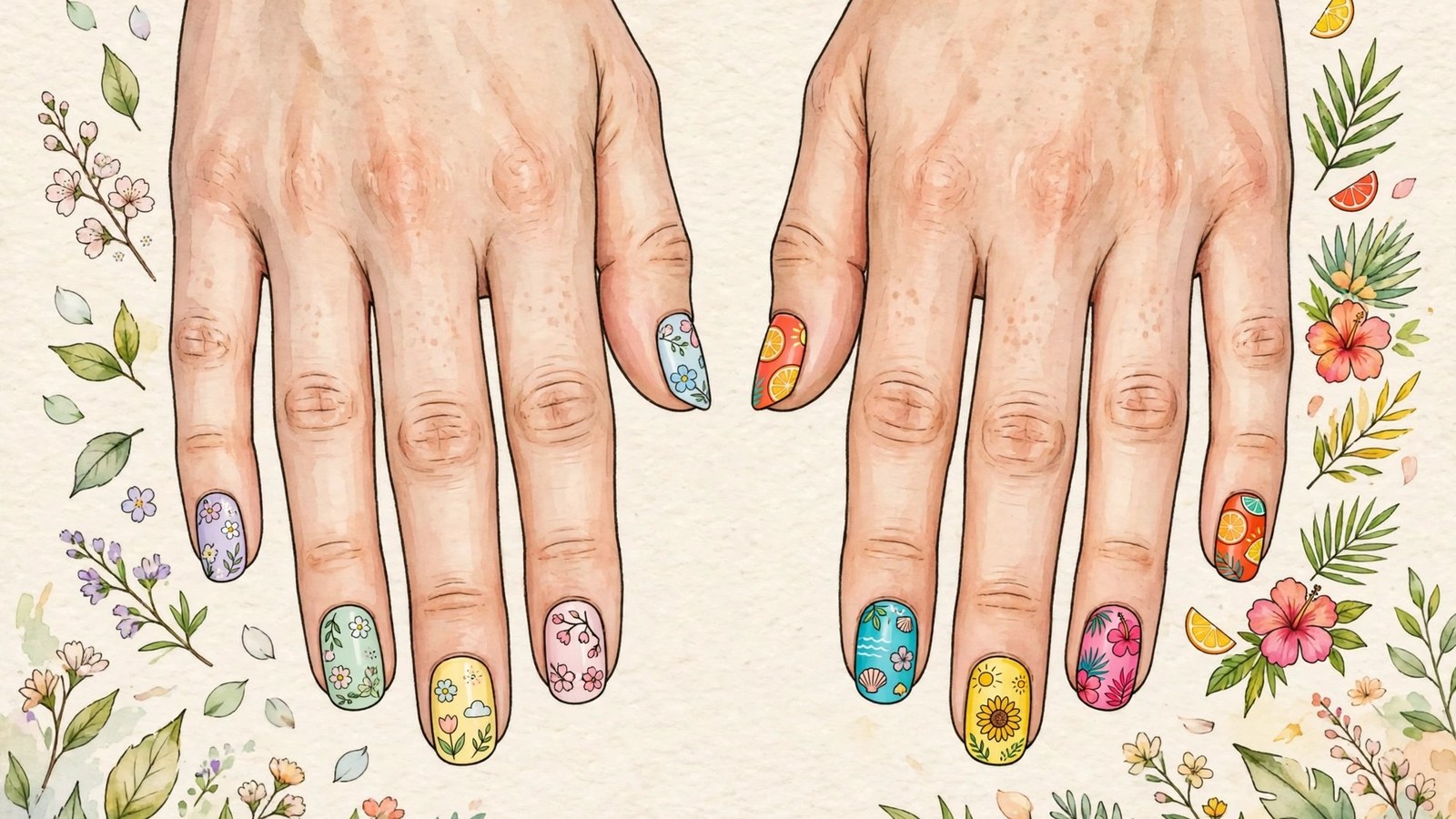
- Spring nails work best in soft pastels such as lilac, mint, baby blue, blush pink, and butter yellow, worn as a single color, as pastel French tips, with small floral accents, or in a milky sheer finish. Summer nails work best in confident brights such as coral, hot pink, tangerine, turquoise, and sunny yellow, worn as one bold color, as bright French tips, in color blocking, with fruit inspired accents, or with fine glitter for evenings. The simplest designs in both seasons rely on placement and finish rather than painting skill: ombre gradients, half-moon nails, negative space, matte versus gloss finishes, and minimal dots and lines. To transition from spring to summer, keep the same color family and deepen it, swap a matte finish for gloss, add one bright accent nail, or shorten the length for swimming, gardening, and travel. Basic care supports every look: keep nails clean and dry, cut them straight across, file gently, do not bite nails or remove the cuticle, and moisturize nails after polish removal.
Introduction
As the days lengthen, nails get lighter, brighter, and a little more playful. Spring calls for soft pastels and fresh, clean finishes. Summer turns up the color with brights that suit vacations, weddings, and long evenings outdoors. Many seasonal guides cover one season or the other. This guide covers both, because the practical question for most readers is not only what to wear in spring or in summer, but how to move from one to the other without starting again every few weeks.
The article follows the order most people actually decide in: the spring palette and its designs, the summer palette and its bolder designs, the simple designs that work in both seasons, the choice between regular polish, gel, and press-on nails, and the basic nail care that keeps any of these looks in good condition. A final section explains how to deepen a spring manicure into a summer one, step by step. The seasonal framing covers spring and summer 2026 as a calendar reference only. No claim is made here about what is trending in a particular year, because color choice is a matter of taste, plans, and what suits your hands, not a ranking to follow.
Spring Colors: The Pastel Palette
Spring nails are defined by softness. The classic spring palette of lilac, mint, baby blue, blush pink, and butter yellow feels fresh after the darker shades of winter, and these colors sit close to natural, muted tones, so they are a forgiving starting point for a wide range of skin tones. Forgiving does not mean identical on every hand. Hold the bottle or a painted swatch next to your hand in daylight and see whether the shade looks clear against your skin or washed out. Daylight matters because indoor light can warm a cool pastel and change how it looks.
Each pastel does slightly different work. Lilac is the most versatile: it reads as color without reading as bright. Mint is the freshest and looks cleanest on shorter nails. Baby blue is the coolest option and suits a simple, polished everyday look. Blush pink is the closest to a neutral, so choose it when color should not compete with patterned clothing. Butter yellow is the warmest and most playful, and needs the daylight test most.
Pastel polish works best on neat, medium length nails, but it is forgiving on shorter nails too. A single pastel shade across all ten nails is the easiest spring look and one of the most wearable: it reads as polished without demanding attention. Pale shades can show streaks more readily than deep shades, so apply thin coats, let each coat dry before the next, and finish with a glossy top coat, which evens out minor streaks visually. If one color feels too plain, the variations in the next section add interest without much difficulty. The principle behind all of them is restraint: one idea per manicure, on all ten nails or on one or two accent nails, looks intentional. Three ideas at once usually looks busy.
Spring Designs: Gentle Variations on a Soft Base
A different pastel on each nail. Keep the shades in the same soft family, all cool pastels, for example, so the result looks intentional rather than random. If five shades feels like too much, alternate two pastels instead. This look suits shorter and medium nails because the color change, not the length, provides the interest.
Pastel French tips. A nude or sheer pink base with pastel tips updates the classic French manicure for spring. Keep the tip thin on short nails and a little wider on longer nails, in proportion to the nail itself. If a steady hand is a problem, paint the tip in two short strokes from each side toward the center, and clean mistakes with a small brush dipped in remover before the top coat goes on.
Floral accents. A tiny daisy or dot flower on one or two nails adds a spring touch without turning the manicure into a novelty design. Dotting tools make this easy at home: five small dots in a circle for petals and one contrasting dot in the center reads clearly as a flower even at a very small size. Place it near the tip or near one corner, so the rest of the nail stays clean.
Milky sheer finishes. A translucent pastel gives a clean effect that is often described as your nails but better, and it grows out gracefully because the line between new growth and polish is soft. Sheer finishes are forgiving if your nails are uneven in length, and a small chip in a sheer shade is far less visible than a chip in an opaque one.
Spring is also a good time to reset nail health after winter. The care section later in this article covers that reset in full, using dermatology guidance. In brief: trim nails straight across, file gently, keep nails clean and dry, and moisturize the nails as a regular habit, especially after removing polish.
Summer Brights: The Confident Palette
Summer is when color gets confident. Coral, hot pink, tangerine, turquoise, and sunny yellow all come into their own, and brighter shades suit the season and its outdoor light and vacation mood. Bright color behaves differently from pastel in two ways. First, it draws the eye, so shape and tidiness matter more: a bright manicure on neat, even nails looks deliberate, while the same color on ragged edges looks unfinished. Second, bright pigments can discolor the nail if they sit directly on it. Dermatology guidance addresses this point for bright red and orange polish: apply an extra layer of base coat to help prevent discoloration, and if nails become yellowed, the normal color should return over several weeks if the same color is not reapplied.
Within the palette, each bright has a natural role. Coral is the most adaptable summer shade because it sits between pink, orange, and red, so it works with outfits from swimwear to wedding guest clothing. Hot pink and fuchsia are the highest impact choices, for an evening or event look. Tangerine is the warmest bright and pairs naturally with white, cream, and tan summer clothing. Turquoise provides strong contrast against coral or orange clothing, which is why turquoise nails with a coral outfit, or the reverse, is such a reliable combination. Sunny yellow is the lightest bright and the closest to a pastel in feel, so it is the bright to choose if you are moving up from spring shades for the first time.
Bright polish shows chips more readily than paler shades, because the contrast between the polish and the bare nail underneath is greater. A good base coat and a top coat refreshed every couple of days will keep the color looking fresh for longer. That refresh means one thin layer of clear top coat over the existing color, concentrated on the tip, where wear starts. If you swim regularly, note that prolonged time in water can soften polish, so shorter nails and a strong top coat are the practical choice for a beach vacation.
Summer Designs: Bold Color, Placed Well
One bold color, done well. A vivid coral or fuchsia across all nails is the simplest statement summer manicure. It needs no art and no tools beyond polish and top coat, and it survives a busy week well because there is no design to spoil when one nail chips: you repair the color, not a pattern.
Bright French tips. Swap white tips for neon or coral tips on a nude base for a modern, summery twist. This is also a practical way to wear a very bright shade if a full nail of it feels like too much, because most of the nail stays neutral and only the edge carries the color.
Color blocking. Paint two contrasting brights on alternate nails, or split a single nail diagonally into two colors, for a playful graphic look. Alternate nails are the easier version. For the diagonal split, let the first color dry fully before adding the second, or the two will drag into each other. Choose pairs that share a temperature, such as coral with sunny yellow for a warm look, or turquoise with hot pink for a cooler, higher contrast look.
Fruit inspired accents. Watermelon, citrus, or cherry motifs on an accent nail are a fun nod to summer without covering every nail in detail. Keep the motif graphic rather than realistic: a pink half circle with a green edge reads as watermelon, three small red dots with a green stem reads as cherries, and a yellow semicircle with white segments reads as citrus. Graphic shapes survive at small sizes. Realistic painting usually does not.
Glitter for evenings. A fine gold or holographic glitter over a bright base carries a daytime manicure into a summer evening. Fine glitter is easier to remove than large glitter pieces, and one coat over the ring fingers only is enough if a full glitter set feels like too much. Because glitter catches light unevenly, it also disguises small chips in the color underneath.
Simple Designs That Work in Both Seasons
Not every seasonal manicure needs detailed nail art. Some of the most wearable spring and summer designs rely on finish and placement rather than painting skill, and the same five designs serve both seasons if you change the palette.
Ombre gradients. Blend two shades from the same family, pale pink into coral, for example, using a sponge. Apply the lighter shade first, paint both shades in stripes on a sponge, and dab it over the nail so the colors merge in the middle. The gradient hides regrowth and looks more complex than it is. In spring, blend within pastels. In summer, blend from a pastel into its deeper partner, such as mint into turquoise.
Half-moon nails. Paint the base of the nail in one color and the rest in another. A metallic half-moon on a pastel base suits spring, while a bright half-moon on a nude base suits summer. The shape follows the natural curve at the base of the nail, so it looks neat even when it is not perfectly symmetrical.
Negative space. Leave part of the nail bare and paint the rest. A single stripe or a diagonal block of color on a bare nail looks modern and grows out well, because the unpainted area near the base disguises new growth. This design needs a clean, well prepared nail, since the bare nail is part of the design.
Matte versus gloss. The same pastel in a matte finish feels completely different from its glossy version. Matte pastels suit spring because they soften pale color further. Glossy brights suit summer because gloss deepens bright color. Finish is the cheapest change in this guide: one matte top coat turns an existing glossy manicure into a different look.
Minimal dots and lines. A single dot at the base of each nail, or one thin stripe across the tip, adds interest in seconds. Dots are the easiest design in this article: dip a dotting tool or a toothpick in polish and touch it once to the nail. Lines need a striping brush or a steady hand.
These designs work with regular polish, gel, or press-on nails, and most need only a dotting tool or a striping brush. On press-on nails, you can paint the design before applying the nails.
Choosing a Format: Regular Polish, Gel, and Press-On Nails
The design matters less than the format if the format does not fit your week. Regular polish is the easiest to apply, remove, and change. Its weakness is wear: it chips sooner, especially in bright shades and with frequent hand washing, swimming, or gardening. Gel polish lasts longer without chipping and holds bright color and glitter well, which suits a vacation or an event week. Press-on nails give length and a finished design instantly and can be painted in advance, but they depend on a good fit and on adhesive used according to its instructions.
Two cautions belong with the longer lasting formats, both from the sources at the end of this article. First, gel manicures can cause nail brittleness, peeling, and cracking, according to the American Academy of Dermatology, and the ultraviolet radiation used to cure gel polish is why the Academy advises protecting the hands: apply a broad spectrum, water resistant sunscreen with an SPF of 30 or higher before the manicure, or wear dark, opaque gloves with the fingertips cut off. Second, the United States Food and Drug Administration advises readers to read labels carefully, follow warnings, and use nail products with good ventilation, because infections and allergic reactions can occur with some nail products, and to report a reaction if one happens.
Removal is where format choice shows its cost. Regular polish comes off with remover in minutes. Gel and press-on nails need patient removal according to the product instructions or professional removal, and peeling or prying a coating off can take layers of the natural nail with it. Never cover a nail problem with a new set to hide it. Dermatology guidance warns that doing so may make problems worse, and that artificial nails are not recommended for people prone to fungal infections or who have brittle nails. For people with healthy nails, the same guidance says artificial nails can be fine as long as they are not worn continuously.
| Format | Best for | Main trade-off to plan for |
|---|---|---|
| Regular polish | Frequent color changes and easy at home transitions between seasons | Chips sooner, especially in bright shades |
| Gel polish | A vacation, a wedding, or a week when you cannot repair chips | Harder removal and hands need protection from curing light |
| Press-on nails | Instant length and designs painted in advance | Fit and adhesive decide how well they wear |
Shapes and Lengths for Warmer Months
Shape changes how a color reads. A pastel on a short, rounded nail looks soft and neat, while the same pastel on a longer, tapered nail looks more deliberate. A bright on a short nail looks sporty and practical. A bright on a long nail is a statement. The choice should follow your week first and your taste second.
For spring, short to medium lengths suit the pastel palette well, because pale color does not need length to be seen and shorter nails are easier to keep tidy. Rounded and gently squared shapes both work. A rounded shape follows the fingertip and is the least likely to catch. A gently squared shape, often called squoval when the corners are softened, gives pastel French tips a cleaner edge.
For summer, many people prefer slightly shorter nails for swimming, gardening, and travel. A shorter shape also makes bright colors feel more practical, because a chip is easier to repair and less likely to happen. If you prefer length in summer, keep the detail simple: one bold color or bright tips wear better than detailed art.
Whatever shape you choose, keep all ten nails at a similar length and file any snag promptly. Dermatology guidance makes the same point in health terms: keep nails shaped and free of snags by filing with an emery board. A snag left alone usually becomes a tear, and a tear usually means redoing the whole set to match.
Nail Care for Spring and Summer
Color sits on top of care. The following habits come from the American Academy of Dermatology guidance cited in the Sources section, and they apply in both seasons.
Keep nails clean and dry. Cut nails straight across using sharp nail scissors or clippers, and slightly round the tips for maximum strength. Keep nails shaped and free of snags by filing with an emery board. Do not use your nails as a tool, such as opening cans. Never bite your nails or remove the cuticle, because these actions damage the nail and increase the risk of infection. Trim toenails regularly, keeping them short to minimize the risk of trauma and injury. Wear flip flops at the pool and in public showers, because this reduces the risk of infections caused by a fungus that can get into toenails. If you notice changes in your nails or experience swelling or pain, see a board certified dermatologist, and seek that advice promptly if you have diabetes or poor circulation.
Manicure specific guidance from dermatologists adds four more points. Apply a cream to moisturize your nails, especially after removing nail polish, since most removers contain chemicals that dry the nails. To prevent infection, never cut or forcefully push back your cuticles. If you must push them back, do so only gently after a shower or a bath. In a salon, check the basics before you sit down: whether the technician has the necessary experience or license if one is required, whether the stations are clean, whether the technician washes her hands between clients, and whether dirty tools are lying around. Ask how the salon cleans its tools, and if the salon does not appear clean, move on.
For summer pedicures, the same guidance includes one timing point that is easy to miss: shave your lower legs after a pedicure, not before, and do not shave them for at least 24 hours before a pedicure, because a nick from shaving can put you at risk of infection. Check that pedicure footbaths and filters are thoroughly disinfected before use, because improperly cleaned footbaths can harbor bacteria and fungus.
Finally, follow the FDA guidance for the products themselves. Read labels carefully and follow warnings. Keep nail products away from heat sources and flames, because some can catch fire easily. Keep them out of eyes, do not swallow them, and use them with good ventilation.
Transitioning Between Seasons
The shift from spring to summer does not require a complete manicure overhaul. A few small changes carry a look across the boundary, because most summer brights are deeper versions of spring pastels.
Deepen the palette gradually. Move from lilac to violet, mint to emerald or turquoise, or baby blue to a stronger blue as the weather warms. The color family stays familiar while the intensity rises. Deepen through design first if you prefer, by adding the brighter shade as tips or dots over the pastel base.
Swap the finish. A pastel that felt right in matte for spring can feel summery with a glossy top coat, or with a glitter accent nail added. Finish changes are the fastest transition of all because they need no remover and no new color.
Shorten the length for summer. Many people prefer slightly shorter nails in summer for swimming, gardening, and travel. A shorter shape also makes bright colors feel more practical. Shorten gradually if you are attached to length.
Keep one neutral in rotation. A sheer pink or a milky white works in both seasons and is the ideal choice for weeks when you want a break from color.
Refresh rather than replace. If a spring manicure is still in good condition, adding a bright accent nail or a fresh top coat can update it for a summer event without starting again. Try the summer shade on the accent nail first: if you love it, the next full manicure uses it everywhere.
| Spring starting point | Mid step | Summer version |
|---|---|---|
| Lilac pastel | Violet tips or a violet accent nail | Violet or fuchsia as a full color |
| Mint pastel | Mint with turquoise color blocking | Turquoise as a full color |
| Baby blue | Stronger blue French tips | Bright blue or turquoise as a full color |
| Blush pink | Coral tips or a coral accent nail | Coral as a full color |
| Butter yellow | Sunny yellow with a glossy finish | Sunny yellow or tangerine as a full color |
| Milky sheer finish | Sheer base with one bright accent nail | Bright tips on the same sheer base |
The same principle works in reverse at the end of summer: coral toward rust, turquoise toward teal, and hot pink toward berry. Keeping the color family steady, and changing only the intensity, makes every seasonal transition easier.
A simple two season plan ties the sections together. In early spring, reset nail health and start with a milky sheer or a single pastel. In mid spring, add one gentle design. In late spring, test a summer bright on an accent nail or as tips. In early summer, move to the full bright, and shorten the length for swimming or travel. In mid summer, favor solid color sets, so chips are quick repairs. In late summer, soften one step, back to a sheer base with bright tips.
Frequently Asked Questions
What colors are best for spring nails?
The classic spring palette is lilac, mint, baby blue, blush pink, and butter yellow. These pastels sit close to natural, muted tones, so they suit a wide range of skin tones. Test a shade next to your hand in daylight before committing, because individual pastels vary. Blush pink behaves almost like a neutral, and lilac is the most versatile pastel.
What colors are best for summer nails?
Coral, hot pink, tangerine, turquoise, and sunny yellow are the core summer brights. Coral is the most adaptable, because it sits between pink, orange, and red. Turquoise gives strong contrast and pairs reliably with coral. Sunny yellow is the gentlest bright and a good first step up from pastels. For bright red or orange polish, dermatology guidance advises an extra layer of base coat to help prevent discoloration.
How do I move from spring nails to summer nails without redoing everything?
Deepen the same color family one step at a time, swap a matte finish for gloss, or add one bright accent nail to a spring manicure that is still in good condition. A pastel set can gain bright tips at the next appointment, and a sheer base can carry bright tips with no change to the base at all. Shortening the length slightly also shifts a look toward summer.
What are the easiest spring and summer designs for beginners?
Start with a single dot at the base of each nail, pastel or bright French tips, or a sponge ombre gradient. Dots need only a dotting tool or a toothpick. French tips can be painted in two short strokes from each side toward the center. Ombre hides its own blending, because the sponge softens the join between colors. Detailed painting is the hardest option and works best kept small and graphic.
How can I make bright summer polish last longer?
Use a base coat, keep coats even, and refresh the top coat every couple of days with one thin layer concentrated on the tip, where wear starts. Choose solid color over detailed art if your week is busy, because a chip in solid color is a quick repair. If you swim regularly, keep nails shorter and use a strong top coat, because prolonged time in water can soften polish.
Can I wear the same design in spring and summer?
Yes. Ombre gradients, half-moon nails, negative space, minimal dots and lines, and French tips all work in both seasons. Change the palette and the finish rather than the design: pastels and matte finishes for spring, brights and glossy finishes for summer.
What nail care matters most in spring and summer?
Keep nails clean and dry, cut them straight across with sharp clippers, file gently with an emery board, and never bite your nails or remove the cuticle. Moisturize your nails after removing polish, because most removers contain chemicals that dry the nails. In summer, wear flip flops at the pool and in public showers to reduce the risk of fungal infection in toenails, and do not shave your lower legs in the 24 hours before a pedicure. See a dermatologist if you notice nail changes, swelling, or pain.
Keep reading: Fall Thanksgiving Nail Designs: Simple, Short, Square, and Almond Ideas for the Season
Keep reading: Fall and Autumn Nail Ideas: Colors, Designs and Easy Looks to Try
Keep reading: Winter and New Year Nail Ideas
Sources & references
- American Academy of Dermatology, "Keep Your Nails Looking Healthy with These Tips from Dermatologists" (Newswise, 10 September 2013). Page opened and read 29 October 2026. Supports the points on keeping nails clean and dry, cutting straight across with sharp clippers and slightly rounding the tips, filing with an emery board to keep nails shaped and free of snags, not using nails as a tool, never biting nails or removing the cuticle, trimming toenails regularly, wearing flip flops at the pool and in public showers, and seeing a dermatologist for nail changes, swelling, or pain, with added urgency for people with diabetes or poor circulation.
- American Academy of Dermatology, "Manicure and Pedicure Safety" (dermatologists' tips, reproduced in full by McLean and Potomac Dermatology from aad.org). Page opened and read 29 October 2026. Supports the points on moisturizing nails after removing polish, never cutting or forcefully pushing back cuticles, the salon hygiene checklist, disinfected pedicure footbaths and filters, not shaving lower legs for at least 24 hours before a pedicure, an extra layer of base coat under bright red or orange polish to prevent discoloration, and not using artificial nails to cover up nail problems or wearing them continuously.
- American Academy of Dermatology, "Gel Manicures: Tips for Healthy Nails" (aad.org). Cited for the points that gel manicures can cause brittleness, peeling, and cracking and that hands should be protected from the ultraviolet radiation used to cure gel polish with broad spectrum, water resistant sunscreen at SPF 30 or higher or with dark, opaque gloves with the fingertips cut off. The Academy page itself returned navigation content only when fetched for this pass, so these two points are recorded as qualified in the writer ledger and should be rechecked by QA against the live Academy page.
- United States Food and Drug Administration, "Nail Care Products" (fda.gov). Page opened and read 29 October 2026. Supports the points on reading labels and following warnings, using nail products with good ventilation, keeping products away from flames and heat sources, the possibility of infection and allergic reactions with some nail products, and reporting a reaction to the FDA.


