Short answer
- Easy dinner ideas work best as formulas, not as a new recipe search every night. Keep five patterns in rotation: a grain bowl, a traybake, pasta with a simple sauce, a pot of soup with bread, and a slow cooker meal set up earlier in the day. For crockpot meals, choose high moisture dishes such as chili, soup, stew, or curry, thaw meat and poultry before they go in, fill the cooker between half and two thirds full, put vegetables in first, and start cooking right after preparation. Check doneness with a food thermometer: whole cuts of beef and pork to 145°F (63°C) with a three minute rest, ground meats to 160°F (71°C), all poultry to 165°F (74°C), and soups, stews, and sauces to 165°F (74°C). Refrigerate leftovers within two hours in shallow covered containers, use refrigerated soups and stews within three to four days, and reheat leftovers to 165°F (74°C) on the stovetop or in the microwave rather than in the slow cooker. A sample week built from these formulas is set out later in this article.
Introduction
Deciding what to cook every evening is often harder than the cooking itself. This guide is built around simple, repeatable formulas: crockpot meals that look after themselves, soup recipes that suit cold days, and a sample week of dinners you can adapt to whatever is already in your pantry. Nothing here requires specialist equipment beyond a slow cooker and a large pot, and every idea can be scaled up, swapped around, or made ahead.
The approach is deliberately practical. Instead of a long list of separate recipes that each need their own shopping trip, you will find five dinner formulas you can reuse, six slow cooker dishes that follow the same basic method, five soups built on one forgiving pattern, and a set of make-ahead habits that turn one cooking session into several calmer evenings. Because slow cooking and leftovers involve real food safety questions, the safety guidance in this article follows United States Department of Agriculture (USDA) and FoodSafety.gov guidance, with temperatures given in Fahrenheit first. Where a figure matters for safety, check it with a food thermometer rather than guessing from color or cooking time alone.
Weeknight Dinner Formulas
Instead of searching for a new recipe every night, keep a handful of formulas in mind. A formula is a pattern you can fill with different ingredients, so dinner stays varied without a new shopping list each time. Formulas also make shopping simpler, because the same core ingredients serve several different meals across a week.
The grain bowl formula: a grain (rice, couscous, or quinoa) plus a protein (chicken, beans, tofu, or eggs) plus roasted or raw vegetables plus a sauce (tahini and lemon, soy and ginger, or yogurt and herbs). Change one element and the meal feels new. Cooked grains give leftovers a second life: extra rice from Monday becomes the base of a bowl on Wednesday, and each person at the table can choose their own sauce and toppings.
The traybake formula: chopped vegetables and a protein tossed in oil and seasoning, roasted on one tray until cooked through. Sausages with peppers and potatoes, chicken thighs with carrots and onions, or chickpeas with sweet potato and spices all follow the same pattern. Cut firmer vegetables, such as potatoes and carrots, smaller than softer ones, such as peppers and zucchini, so everything finishes together, and spread the tray in a single layer so pieces brown instead of steaming.
The pasta formula: pasta plus a sauce made from canned tomatoes, garlic, and herbs plus something green (spinach, peas, or broccoli) plus a topping (grated cheese, toasted seeds, or breadcrumbs). It comes together in about the time the pasta takes to cook. Change the meal by changing the green vegetable, the protein, or the topping, and stir a spoonful of the starchy pasta cooking water into the sauce at the end so it coats the pasta.
The soup and bread formula: one pot of soup plus good bread plus a simple topping such as grated cheese, a swirl of cream, or fresh herbs. Soup is forgiving, inexpensive, and easy to double for another night. It is also the formula that best absorbs odds and ends: half an onion, two carrots, and the last potato in the bag all have a home in a soup pot, which makes soup night a practical way to use food before it spoils.
The slow cooker formula: ingredients into the pot in the morning, a finished meal in the evening. Details for this one are below, because slow cooking has its own food safety rules worth knowing.
Keep a short list of these formulas where you plan meals. On a tired evening, pick a formula first and only then decide the ingredients: choosing the pattern first removes the hardest decision of the day. Keep a running list of versions your household actually liked, one line each, and after a few weeks you will have a personal rotation that needs no searching at all.
Crockpot Meals That Work
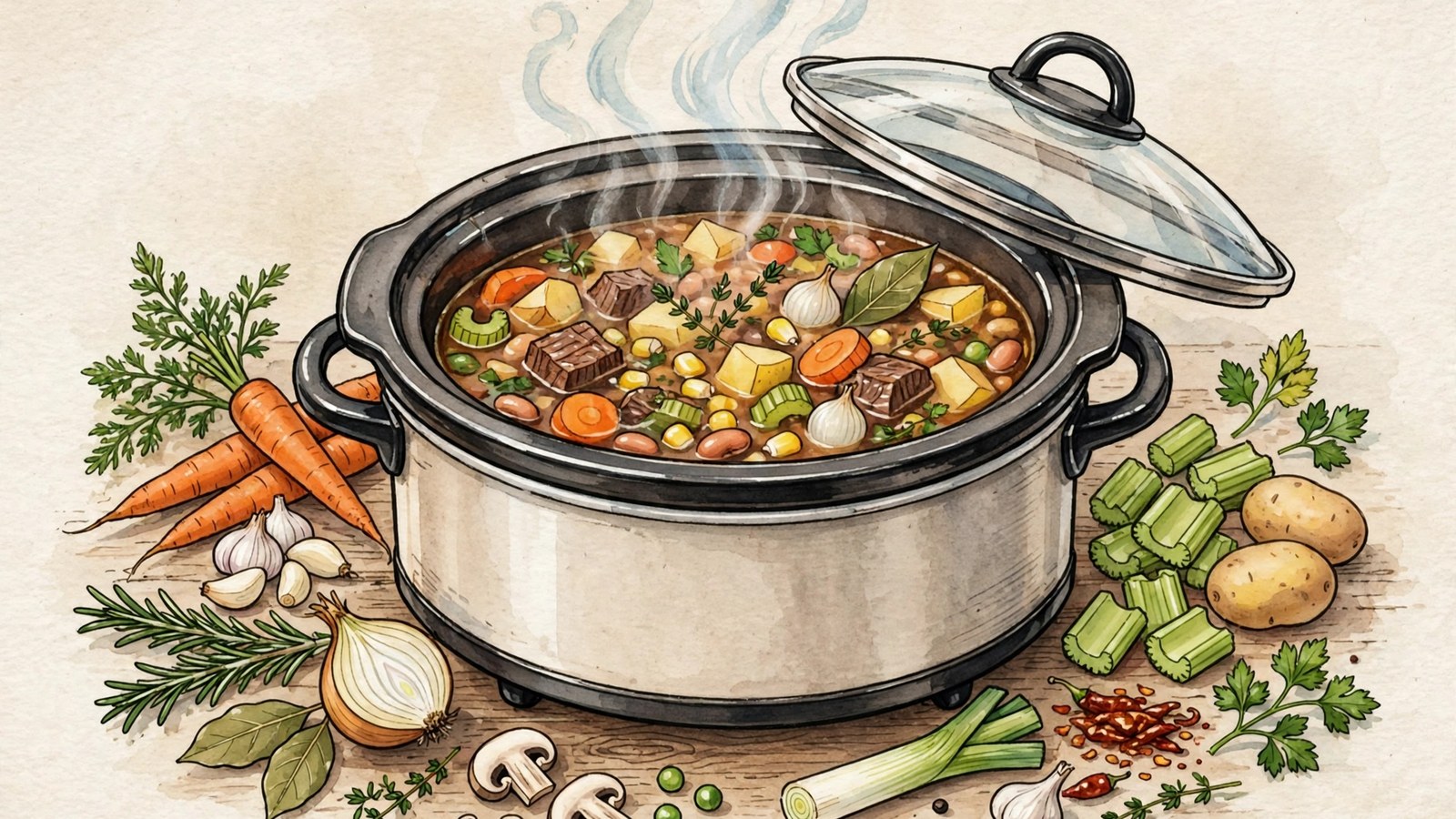
A slow cooker, often called a crockpot, is at its best with dishes that benefit from long, gentle cooking: stews, curries, chili, pulled meats, and bean dishes. High moisture dishes are particularly well suited, and USDA guidance advises choosing foods with a high moisture content such as chili, soup, stew, or spaghetti sauce. Slow cookers generally cook at between 170°F (77°C) and 280°F (138°C), and the direct heat, long cooking time, and steam inside a tightly covered container combine to cook food safely when the handling rules below are followed.
What works well:
- Beef or lamb stew: diced meat, carrots, onions, potatoes, stock, and herbs, cooked on low until tender. Cut meat and vegetables into chunks or small pieces, which helps the food cook thoroughly and evenly.
- Chicken curry: chicken thighs, canned tomatoes, coconut milk or yogurt, curry paste, and lentils for body. Whichever cut you use, the poultry must reach 165°F (74°C).
- Chili: ground beef or mixed beans, canned tomatoes, peppers, onion, garlic, and chili powder, served with rice or bread. A bean only chili follows the same method and freezes just as well.
- Pulled pork: a pork shoulder with a simple vinegar based sauce, shredded with two forks once tender and served in rolls with slaw. FoodSafety.gov publishes a pulled pork recipe that cooks half a pork shoulder on low for eight hours, then checks that the pork reached 145°F (63°C) before a three minute rest and shredding. Treat that as one recipe for one cooker and cut size, not a guarantee for every cooker: check your own pot with a thermometer.
- Vegetable and bean soup: carrots, celery, onions, canned tomatoes, beans, and stock, blended or left chunky.
- Lentil dahl: red lentils, onion, garlic, ginger, spices, and canned tomatoes, finished with lemon and fresh cilantro.
Most slow cookers have two or more settings, and food cooks faster on high than on low. USDA guidance notes that, if possible, you can turn the cooker to its highest setting for the first hour and then to low or to the setting your recipe calls for, but that it is also safe to cook on low for the entire time. While the cooker is operating, food stays safe; the risks come from handling before cooking starts and after it finishes, which is why the next section matters.
Slow Cooker Food Safety: The Essentials
Slow cooking is safe when a few habits are followed consistently. The guidance below is drawn from FoodSafety.gov, the USDA Food Safety and Inspection Service (FSIS), and the Clemson Cooperative Extension fact sheet that republishes FSIS guidance.
- Start clean, and keep raw foods separate. Begin with a clean cooker, clean utensils, and a clean work area. Wash your hands for 20 seconds with soap and water before preparation, and again after touching raw meat, poultry, or seafood. Keep raw meat, poultry, and seafood separate from foods you plan to eat raw, and use separate cutting boards, plates, and utensils for them. Rinse fresh fruits and vegetables under running water before cutting them.
- Keep perishable food refrigerated until preparation time. If you cut up meat and vegetables in advance, store them separately in the refrigerator. Bacteria grow rapidly between 40°F (4°C) and 140°F (60°C), often called the danger zone, and refrigeration stops bacteria getting a head start during the first hours of cooking.
- Thaw meat, poultry, and seafood before adding them to the slow cooker. Do not thaw frozen food on the counter. Thaw it in the refrigerator, in cold water, or in the microwave, and start cooking straight after thawing in cold water or the microwave. Always thaw meat or poultry before it goes into a slow cooker.
- Fill the cooker between half and two thirds full. If it is too full, food may be undercooked and unsafe; if it is not full enough, food may overcook.
- Put vegetables in first, at the bottom and around the sides, because they cook more slowly than meat and poultry. Add meat on top and cover the food with liquid such as broth, water, or sauce.
- Keep the lid on. Lift it only to stir or check doneness, since every lift lets heat and steam escape.
- Start cooking straight after preparation. Do not set a timer to start cooking later in the day, because bacteria can multiply quickly in the parts of the food that reach room temperature before cooking begins. Make sure the cooker is plugged in and switched on: a simple point, and the one most easily missed on a busy morning.
- Check temperatures with a food thermometer. Color and cooking time cannot tell you whether food is done. Put the thermometer in the thickest part of the food, avoiding bone, fat, and gristle. The safe minimum internal temperatures are: whole cuts of beef, pork, veal, and lamb to 145°F (63°C), then rest for three minutes; fish with fins to 145°F (63°C) or until the flesh is opaque; ground meats to 160°F (71°C); egg dishes to 160°F (71°C); all poultry, including ground chicken and turkey, to 165°F (74°C); and soups, stews, and sauces to 165°F (74°C).
- Refrigerate leftovers within two hours of cooking, or within one hour if the food has been exposed to temperatures above 90°F (32°C), as in a hot car. Store leftovers in shallow covered containers so they cool quickly: a large pot of soup cools slowly in the middle, so divide it before refrigerating. Keep the refrigerator at 40°F (4°C) or below.
- Do not reheat leftovers in a slow cooker. Reheating in a slow cooker is not recommended, because the food warms too slowly. Reheat leftovers on the stovetop, in a microwave, or in a conventional oven until they reach 165°F (74°C), and bring sauces, soups, and gravies to a rolling boil. Only then, to keep hot food hot for serving, place it in a preheated slow cooker, kept at 140°F (60°C) or above.
- If the power goes out while you are away, discard the food, even if it looks done. If you are home, finish cooking the ingredients immediately by another means, such as on a gas stove or an outdoor grill. If you are home and the food was fully cooked before the outage, it should remain safe for up to two hours in the cooker with the power off.
These are conservative, standard guidelines. Slow cookers vary in size and in how their settings behave, so if your cooker manual gives different instructions for its size or settings, follow the manual, and check USDA or FoodSafety.gov guidance for the figures that apply to your situation.
Soup Recipes for Cold Days
Soup is one of the most forgiving things you can cook. Exact quantities matter less than balance: something savory, something starchy, something fresh at the end. These five soups cover most cold weather moods, and all five follow the same underlying method: soften the aromatic vegetables in oil, add the main ingredients and stock, simmer until tender, then finish with something fresh, acidic, or creamy.
1. Classic vegetable soup. Soften onion, carrot, and celery in oil, add garlic, potatoes, canned tomatoes, and stock, and simmer until everything is tender. Blend half and return it to the pot for a thick texture, then finish with herbs and a squeeze of lemon. Almost any firm vegetable can join the potatoes, added in order of how long it takes to soften.
2. Lentil and tomato soup. Red lentils cook down quickly and thicken the soup on their own. Add onion, garlic, cumin, canned tomatoes, and stock, simmer until the lentils collapse, and season well. It freezes beautifully, and it is the soup to make when the pantry is nearly empty, because lentils need no soaking.
3. Chicken noodle soup. Simmer chicken with carrots, celery, onion, and stock, lift the chicken out to shred it, return it to the pot with noodles, and cook until the noodles are tender. Add fresh parsley or dill at the end. Leftover noodles keep absorbing liquid and soften in the refrigerator, so many cooks simmer noodles separately and add them to each bowl. The chicken must reach 165°F (74°C): check the thickest piece with a thermometer if you are in any doubt.
4. Butternut squash soup. Roast squash with onion and garlic until soft and caramelized at the edges, then blend with stock until smooth. Roasting first is what gives this soup its deeper flavor. A swirl of cream or yogurt and toasted seeds on top turns it into a proper meal with bread.
5. Bean and greens soup. Canned beans, chopped greens such as kale or spinach, garlic, onion, carrot, and stock, finished with lemon zest and a drizzle of good oil. Hearty, inexpensive, and ready in well under an hour. Add sturdy greens such as kale earlier, so they soften, and tender greens such as spinach in the last few minutes.
Soup tips that make a difference:
- Season at the end as well as the beginning. Long cooking dulls salt and acidity, so a final squeeze of lemon or splash of vinegar wakes a soup up.
- Toast spices in the oil for about a minute before adding liquid. It deepens their flavor noticeably.
- Build texture on purpose. Blend part of a soup and leave the rest chunky, or mash some of the beans against the side of the pot. One texture throughout makes a soup feel thin even when the flavor is right.
- Freeze soup in portions without cream or noodles added, and stir those in when reheating, so the texture stays right.
- A soup that tastes flat usually needs salt, acid, or heat: add them one at a time, tasting as you go.
- Bread matters more than you might expect. Soup served with warm, crusty bread or a buttered roll feels like a complete meal, while the same soup with nothing to dip into can feel unfinished.
Make-Ahead and Freezer Tips
A little advance preparation turns weeknights from a scramble into a calm half hour. The goal is not to cook everything on Sunday, but to remove one or two jobs from each evening.
Batch cook the base, not the whole meal. A large pot of tomato sauce, a tray of roasted vegetables, or a batch of cooked grains can become three different dinners across the week: pasta one night, grain bowls the next, soup the night after. Bases stay flexible in a way finished meals do not, so a batch cooked base rarely feels like eating the same dinner twice.
Freeze in flat, labeled portions. Soups, stews, curries, and chili freeze well for future meals. Cool food quickly, pack it in shallow containers or freezer bags laid flat, and label each one with the contents and the date. Flat bags stack neatly and thaw faster than a deep block. Reheat leftovers to 165°F (74°C), with soups and sauces brought to a rolling boil.
Know how long frozen and refrigerated food keeps. The federal Cold Food Storage Chart gives clear figures. Soups and stews with vegetables or meat added keep for three to four days in a refrigerator at 40°F (4°C) or below, and for two to three months in a freezer at 0°F (minus 18°C) or below for best quality. Cooked meat or poultry leftovers keep for three to four days refrigerated and two to six months frozen. FSIS also notes that food stored continuously frozen at 0°F (minus 18°C) or below can be kept indefinitely for safety, although it loses moisture and flavor over time. Label everything with its date and plan to eat frozen dinners within about two to three months, while they still taste good.
Thaw frozen leftovers safely. Thaw leftovers in the refrigerator, in cold water, or in the microwave. Refrigerator thawing takes longest but keeps food safe throughout. Food thawed in cold water should be in a leak proof package, and food thawed in the microwave should be heated until it reaches 165°F (74°C). You can also reheat frozen leftovers without thawing, in a saucepan or microwave for a soup or stew; it simply takes longer.
Prep ingredients, not just meals. Washed and chopped vegetables, cooked rice, and a jar of dressing in the refrigerator can cut an evening cooking time in half. Keep prepped raw meat and vegetables stored separately, and keep perishable foods refrigerated until you are ready to cook.
Keep a freezer inventory. A short list on the freezer door, showing what is in there and when it went in, stops good food being forgotten at the back. Use the oldest portions first.
Plan for the nights you will not cook. Keep two genuinely easy fallbacks in the house at all times: eggs and bread for a quick meal, or a frozen portion of soup. A planned fallback beats an unplanned takeaway, both for your budget and for your evening.
A Sample Week of Dinners
Here is one week built from the formulas above. Swap days around, repeat favorites, and adjust for what your household actually eats. The structure matters more than the specific dishes.
| Day | Dinner | Why it works |
|---|---|---|
| Monday | Lentil and tomato soup with bread | Inexpensive, quick, uses pantry staples after the weekend |
| Tuesday | Chicken traybake with carrots and potatoes | One tray, minimal cleanup |
| Wednesday | Slow cooker chili with rice | Set up in the morning, ready when you get home |
| Thursday | Pasta with tomato sauce, spinach, and cheese | Fast, and uses leftover sauce if you batch cooked |
| Friday | Grain bowls with roasted vegetables and tahini | Uses up vegetables before the weekend shopping trip |
| Saturday | Slow cooker pulled pork in rolls with slaw | A slower, more sociable meal with time to enjoy it |
| Sunday | Chicken noodle soup or a roast style traybake | Comforting, and leftovers can seed Monday lunch |
Notice how the week is balanced as a whole. Two nights use the slow cooker, on the days when evening time is tightest, and two nights are meatless. Thursday deliberately depends on an earlier batch cooking session, and the soup nights produce leftovers worth having: soup for lunch, or a portion for the freezer. Copy those balances rather than the exact menu.
If a week like this feels too rigid, use it as a template rather than a rule: pick five dinners, leave two nights flexible, and let the slow cooker cover the busiest day. Dinner planning works best when it bends around real life rather than fighting it.
Getting Started Tonight
Choose one formula from this guide and cook it this week: a slow cooker stew, a pot of lentil soup, or a traybake. Write down what worked and what you would change, and keep that note with the recipe. The tools this guide depends on are few: a slow cooker with a lid that fits well, a large pot, and, most important for safety, a food thermometer you actually use. After a few weeks you will have a personal collection of reliable dinners, and the daily question of what is for dinner will start answering itself.
Frequently Asked Questions
What are the easiest dinner ideas for busy weeknights?
Start with formulas rather than individual recipes: a grain bowl, a one tray roast, pasta with a canned tomato sauce and greens, a pot of soup with bread, and a slow cooker chili or stew. Each formula uses ordinary ingredients, tolerates substitutions, and can be repeated with different fillings. The sample week in this article shows one way to combine all five.
What are the best crockpot meals for beginners?
Choose high moisture dishes, which suit slow cooking best: chili, vegetable and bean soup, beef stew, chicken curry, and lentil dahl are all forgiving starting points. Follow the safety basics: thaw meat and poultry first, fill the cooker between half and two thirds full, put vegetables in first, keep the lid on, start cooking right after preparation, and check the finished temperature with a food thermometer.
What temperature should slow cooker food reach?
Use a food thermometer in the thickest part of the food. Whole cuts of beef, pork, veal, and lamb should reach 145°F (63°C) and rest for three minutes. Ground meats should reach 160°F (71°C). All poultry should reach 165°F (74°C), and soups, stews, and sauces should reach 165°F (74°C). Slow cookers themselves generally cook at between 170°F (77°C) and 280°F (138°C), but the cooker setting is not a substitute for checking the food itself.
Can you put frozen meat in a slow cooker?
No. Meat and poultry should be thawed before they go into a slow cooker. Thaw frozen food in the refrigerator, in cold water, or in the microwave, never on the counter, and begin cooking immediately after thawing in cold water or the microwave. Starting from thawed also helps the food cook evenly and within the time your recipe expects.
How long do soup and stew leftovers keep?
In a refrigerator at 40°F (4°C) or below, soups and stews with vegetables or meat added keep for three to four days. In a freezer at 0°F (minus 18°C) or below, they keep for two to three months for best quality. Refrigerate leftovers within two hours of cooking, in shallow covered containers, and label frozen portions with the contents and date so the oldest food gets used first.
Can you reheat leftovers in a slow cooker?
Reheating leftovers in a slow cooker is not recommended, because the food warms too slowly. Reheat leftovers on the stovetop, in a microwave, or in a conventional oven until they reach 165°F (74°C), and bring soups, sauces, and gravies to a rolling boil. Once food is hot, you can place it in a preheated slow cooker to keep it hot for serving, at 140°F (60°C) or above.
How do you plan a week of dinners without repeating meals?
Plan by formula, not by recipe. Assign each night a pattern, such as soup, traybake, slow cooker, pasta, and grain bowls, then fill each pattern with different ingredients. Batch cook one base early in the week and let one night depend on it. Keep two nights flexible and one fallback meal in reserve, and write down the versions your household liked.
What should you do if the power goes out during slow cooking?
If you were away from home and the power went out during cooking, discard the food, even if it looks done, because you cannot know how long it sat at an unsafe temperature. If you are home, finish cooking the ingredients immediately by another means, such as a gas stove or outdoor grill. If the food was fully cooked before the outage, it should remain safe for up to two hours in the cooker with the power off.
Keep reading: Roasted Pumpkin Seeds Recipe: Crispy, Salty, and Easy
Keep reading: Christmas Food Ideas: Cake, Cocktails and Hosting Without the Stress
Sources & references
- FoodSafety.gov (US Department of Health and Human Services, with USDA and FDA), Warm Up with a Safely Slow-Cooked Meal. Published 24 January 2022, updated 21 September 2023. Opened and read 29 October 2026. Covers thawing meat, poultry, and seafood before slow cooking and never on the counter, vegetables first, filling the cooker between half and two thirds full, starting cooking right after preparation, handwashing for 20 seconds, keeping raw foods separate, safe internal temperatures (whole cuts 145°F with a three minute rest, ground meats 160°F, egg dishes 160°F, all poultry 165°F), refrigerating leftovers within two hours (one hour above 90°F), and a pulled pork recipe cooked on low for eight hours with a 145°F check.
- USDA Food Safety and Inspection Service, Slow Cookers and Food Safety. Opened and read 29 October 2026. Covers slow cookers cooking generally between 170°F and 280°F, thawing meat or poultry before slow cooking, choosing high moisture foods such as chili, soup, stew, or spaghetti sauce, vegetables first, keeping the lid in place, cooking on low for the full time or on high for the first hour, power outage guidance (discard if away, finish cooking immediately by other means if home, fully cooked food safe for up to two hours with power off), storing leftovers in shallow covered containers within two hours, reheating leftovers to 165°F (not in a slow cooker), and keeping hot food in a preheated slow cooker at 140°F or above.
- USDA Food Safety and Inspection Service, Leftovers and Food Safety. Opened and read 29 October 2026. Covers bacteria growing rapidly between 40°F and 140°F, refrigerating leftovers within two hours (one hour above 90°F), cooling food rapidly in shallow containers, leftovers keeping for three to four days refrigerated or three to four months frozen, safe thawing in the refrigerator, cold water, or microwave, reheating frozen leftovers without thawing, and reheating leftovers to 165°F with sauces, soups, and gravies brought to a rolling boil.
- FoodSafety.gov, Cold Food Storage Chart. Last reviewed 19 September 2023. Opened and read 29 October 2026. Covers refrigerator storage at 40°F (4°C) or below and freezer storage at 0°F (minus 18°C) or below, soups and stews with vegetable or meat added at three to four days refrigerated and two to three months frozen, cooked meat or poultry leftovers at three to four days refrigerated and two to six months frozen, and the note that foods stored continuously frozen at 0°F or below can be kept indefinitely for safety, with freezer times given for quality.
- Clemson Cooperative Extension, Home and Garden Information Center, Slow Cooker Food Safety. Last updated August 2022, sourced from USDA FSIS (November 2021). Opened and read 29 October 2026. Covers the 170°F to 280°F slow cooker range, the 40°F to 140°F danger zone, the water test figure of 185°F for checking a cooker, cutting food into chunks, filling the cooker no less than half and no more than two thirds full, vegetables first at the bottom and sides, internal temperatures including soups, stews, and sauces at 165°F, shallow container storage within two hours, not reheating leftovers in a slow cooker, keeping hot food at 165°F or above before placing it in a preheated cooker at 140°F or above, and power outage guidance.


