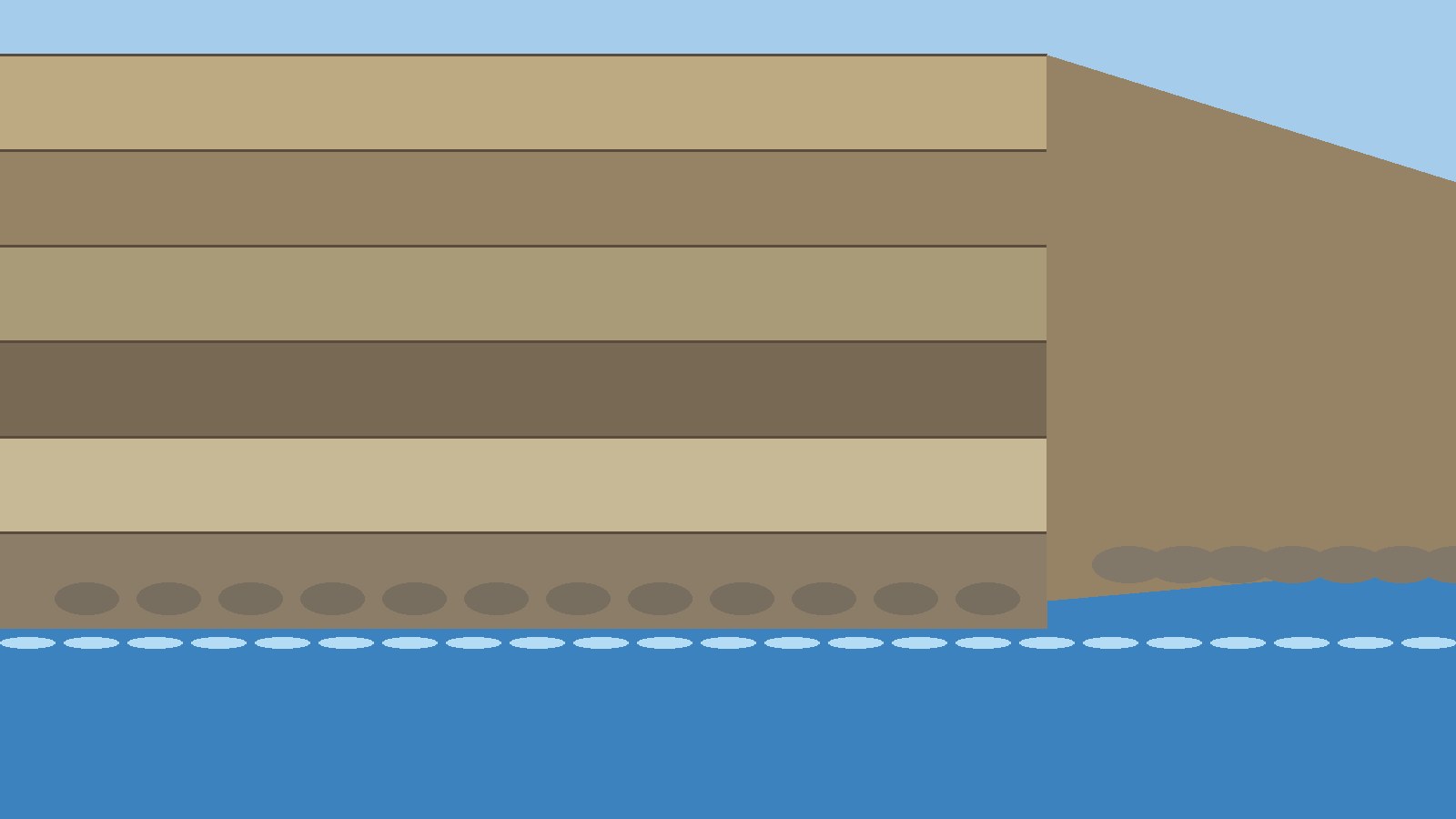
Short answer
- The rock cycle is the continuous set of natural processes that changes rock material among the three main rock types: igneous, sedimentary, and metamorphic.
- Igneous rock forms when magma or lava cools and crystallizes. Rock that cools slowly underground forms large crystals, while rock that cools quickly at the surface forms small crystals or glass.
- Sedimentary rock forms when weathered fragments are eroded, transported, deposited as sediment, and then compacted and cemented together, or when minerals precipitate from water.
- Metamorphic rock forms when an existing rock is changed by heat, pressure, or hot fluids deep in the Earth, without melting completely. If it does melt, the cycle starts again with magma.
- The cycle has no single starting point and no fixed length. A geologist can start describing it anywhere, and different paths take very different amounts of time.
- The main processes that move material between rock types are melting, cooling and crystallization, weathering, erosion, deposition, compaction, cementation, burial, uplift, and metamorphism driven by heat and pressure.
Pick up almost any rock and you are holding a record of a journey. It may have cooled from molten rock deep underground, been broken apart at the surface, carried away by a river, buried under layer after layer of sediment, squeezed and heated until its minerals changed, and then lifted back to the surface again. The rock cycle is the name geologists give to that whole system of changes.
What Is the Rock Cycle, in Plain Terms?
The rock cycle is a model, not a machine with a fixed route. It describes how rock material is transformed over geologic time among igneous, sedimentary, and metamorphic rock. Each rock type is defined by how it forms, and each one can change into another when its conditions change. An igneous rock exposed at the surface can weather into sediment and eventually become a sedimentary rock. A sedimentary rock buried deeply can be heated and squeezed into a metamorphic rock. A metamorphic rock heated still further can melt into magma, which can cool into a new igneous rock. Any of those steps can be skipped, repeated, or taken in a different order, depending on what happens to that particular piece of crust.
That flexibility is the most important thing to understand about the diagrams in textbooks. Arrows on a rock cycle diagram show possible transformations, not a timetable and not a single loop that every rock must follow. A rock can also change into a different rock of the same type. Sandstone, for example, can weather back into sand and then be cemented into sandstone again, without ever becoming igneous or metamorphic. The United States Geological Survey (USGS) makes the same point in plain language: any rock can become another rock, and like the water cycle, there is no one starting point, so a reader can follow many possible pathways from one rock type to another.
Two forces drive the whole system, according to Pennsylvania State University physical geology course material. The first is Earth’s internal heat, which moves material in the core and mantle, drives plate movement, and produces magma. The second is the hydrological cycle at the surface, the movement of water, ice, and air powered by the Sun, which weathers rock, moves sediment, and deposits it in new places. The cycle stays active on Earth, that material notes, because the core is still hot enough to keep the mantle moving, the atmosphere is relatively thick, and liquid water exists at the surface. On a body without those conditions, such as the Moon, the rock cycle is virtually dead.
Before going further, it helps to separate rock from mineral. A rock is a naturally formed, solid material made of mineral grains held together in a firm mass. A mineral is a single naturally occurring substance with an organized internal structure and a distinct chemical composition or range of composition. Most rocks contain a mixture of minerals. Rocks are identified mainly by the minerals they contain and by their texture, meaning the size, shape, and arrangement of their mineral grains. Texture records how fast the rock cooled, how its grains were transported, or how hard it was squeezed.
Igneous Rocks: Born From Cooling Magma and Lava
Igneous rocks form from cooling magma. Magma is molten rock below Earth’s surface. When magma erupts onto the surface, it is called lava. As the molten material cools, minerals crystallize out of it and lock together into solid rock. The chemical composition of the magma and the rate at which it cools decide what rock forms and what it looks like.
Cooling rate is the key variable. Magma that cools slowly underground gives crystals plenty of time to grow, so the resulting rock has large crystals that are easy to see with the naked eye. The USGS describes this as coarse grained, or phaneritic, texture, and gives granite as the classic example: look at a granite countertop and you can pick out the individual minerals. Magma that cools quickly at the surface gives crystals little time to grow, so the rock has small crystals that are hard to see without a microscope. The USGS calls this fine grained, or aphanitic, texture, and gives basalt and pumice as examples of extrusive igneous rocks formed from lava. When lava cools so fast that crystals barely form at all, it can create volcanic glass, known as obsidian.
Geologists divide igneous rocks by where they cooled. Intrusive igneous rocks, also called plutonic rocks, crystallize deep underground. Extrusive igneous rocks, also called volcanic rocks, form from lava at or just above the surface. The Penn State material gives a sense of the time difference: magma that erupts onto the surface can cool quickly, within seconds to years, forming extrusive igneous rock, while magma that cools slowly within the crust can take centuries to millions of years, forming intrusive igneous rock at depths of hundreds of meters to tens of kilometers below the surface.
Granite and basalt are the examples to keep in mind. Granite is an intrusive igneous rock with large, visible crystals, commonly used as a building and countertop stone. Basalt is an extrusive igneous rock with small crystals, and it forms much of the ocean floor and many lava flows. The Penn State material illustrates extrusive formation with pahoehoe basalt forming at Kilauea Volcano in Hawaii, where molten lava at the surface cools into new rock.
One more igneous detail matters for the cycle. For an intrusive igneous rock to move on, it first has to be uplifted and exposed by the erosion of the rocks above it. Deep rocks do not weather while they are still buried. Mountain building, driven by plate tectonics, lifts rocks of all types toward the surface, where weathering and erosion can finally reach them.
Sedimentary Rocks: Built From Fragments, Layer by Layer
Sedimentary rocks form at or near Earth’s surface from material that has been weathered, transported, and laid down again. The USGS defines them as rocks formed by the compaction and cementation of sediments, such as clay, silt, and sand, or from the remains of once living organisms. They are usually layered, in strata, and they are the rocks most likely to contain fossils. Fossils are almost never found in igneous or metamorphic rocks, because the heat involved in forming those rocks would destroy them, while the gentle burial that forms sedimentary rock can preserve them.
The sedimentary story has five steps, and each one is a named process in the rock cycle.
First comes weathering. Weathering breaks down rock at or near Earth’s surface into smaller pieces, without moving them. Physical weathering breaks rock apart mechanically, for example when water seeps into cracks, freezes, and expands. Chemical weathering changes the minerals themselves, for example when rainwater dissolves minerals in limestone. Weathering is not the same as erosion. Weathering breaks rock down in place. Erosion moves the broken material away.
Second comes erosion and transportation. Running water, ice, gravity, wind, and waves carry sediments from one place to another. The Penn State material lists glaciers, streams, waves, wind, and other agents, and notes that sediments are deposited in rivers, lakes, deserts, and the ocean. During transport, fragments are knocked against each other and rounded, which is why river gravel looks rounded while freshly broken rock looks angular.
Third comes deposition, also called sedimentation. When the transporting agent slows down or stops, it drops its load. A river deposits sand on its bed and silt on its floodplain when it floods. A glacier deposits a jumble of unsorted material when its ice melts. Wind deposits sand in dunes. Sediments settle in layers, with coarser material usually settling first.
Fourth and fifth come compaction and cementation, together called lithification, the process that turns loose sediment into solid rock. As more sediment piles on top, the weight squeezes the layers below, pressing grains together and forcing out water. That is compaction. Meanwhile, minerals carried in groundwater precipitate in the spaces between grains and glue them together. That is cementation. The LibreTexts geology material puts it plainly: in order to form a sedimentary rock, accumulated sediment must become compacted and cemented together. Sand cemented together becomes sandstone, the example that material uses.
Sedimentary rocks fall into a few broad families. Clastic sedimentary rocks are made of fragments of other rocks: conglomerate from rounded gravel, sandstone from sand, siltstone from silt, and shale or mudstone from mud and clay. Chemical sedimentary rocks precipitate from water: limestone can form this way, and so can rock salt left behind when water evaporates. Organic sedimentary rocks contain the remains of organisms: coal from plant material, and chalk from the tiny shells of marine organisms. Some limestone is made of shell fragments while other limestone precipitates chemically, and it will matter again later, when it is buried and metamorphosed into marble.
Metamorphic Rocks: Changed by Heat and Pressure, Without Melting
Metamorphic rocks form when an existing rock, called the protolith, is changed by heat, pressure, or hot mineral rich fluids, without melting completely. The USGS describes metamorphic rocks as sedimentary or igneous rocks that have changed when exposed to high heat, high pressure, or hot fluids, deep within the Earth or where tectonic plates meet, and notes that this can change the texture, chemistry, and appearance of the rock. The LibreTexts material adds the crucial qualifier: when a rock is exposed to extreme heat and pressure within the Earth but does not melt, the rock becomes metamorphosed, and metamorphism may change its mineral composition, its texture, or both.
The distinction between metamorphism and melting is the whole point. Melt the rock completely and you get magma, which belongs to the igneous part of the cycle. Heat and squeeze it short of melting and you get a metamorphic rock, which keeps a solid form but gains a new mineral makeup, a new texture, or both. That is why metamorphic rocks are so useful to geologists: they record the temperature and pressure conditions they experienced.
One of the most visible effects of metamorphism is foliation. When minerals are squeezed, they can line up in parallel layers or bands, giving the rock a layered or banded appearance that is often wavy or folded. The USGS notes that metamorphic rocks are first classified by whether or not they are foliated. Slate is a foliated metamorphic rock, formed when shale is heated and compressed so that its clay minerals realign into thin, flat sheets that split cleanly, which is why slate has been used for roofing. Schist is a more strongly metamorphosed foliated rock, with larger, visible mica crystals. Gneiss is still more intensely metamorphosed, with minerals separated into distinct light and dark bands.
Not all metamorphic rocks are foliated. When the parent rock is made of a single mineral, or when heat dominates over directed pressure, the result can be a non foliated rock with a uniform, interlocking texture. Marble is the classic example: limestone metamorphosed by heat and pressure recrystallizes into marble, a harder, denser rock prized as a building and sculpture stone. Quartzite is the parallel example, and the LibreTexts material uses it explicitly: quartzite is a metamorphic rock formed when quartz sandstone is exposed to heat and pressure within the Earth. Its sand grains fuse into an interlocking mass that breaks through the grains rather than around them.
Metamorphism happens in two main settings, both driven by plate tectonics. Regional metamorphism affects large areas, typically where plates collide and build mountains. Contact metamorphism happens on a smaller scale, where hot magma intrudes into surrounding rock and bakes it. The deeper the burial and the stronger the squeezing, the higher the metamorphic grade, meaning the more intense the change. A shale buried shallowly might become slate, while the same shale buried deeper and heated more might become schist and then gneiss.
The Processes That Move Material Between Rock Types
With the three rock types defined, the cycle itself comes into focus. The following processes are the arrows on the diagram, and each one moves material from one box to another.
Melting turns any rock type into magma. When rock is carried deep enough, or heated strongly enough, for example by burial, by nearby magma, or by subduction, where one plate sinks beneath another into the hot interior, it melts. The USGS states this directly: even more heat can melt any kind of rock, creating magma which cools to an igneous rock. Melting is therefore the reset button of the cycle, the process that erases a rock’s previous texture and returns its material to a molten state.
Cooling and crystallization turn magma into igneous rock, either underground, slowly, or at the surface, quickly.
Weathering breaks rock down at the surface into sediment. Erosion transports that sediment. Deposition lays it down in a new place. Compaction squeezes it, and cementation glues it, turning it into sedimentary rock. Those five steps, taken together, are the surface half of the cycle, driven by the Sun, water, wind, and ice.
Burial and metamorphism turn sedimentary or igneous rock into metamorphic rock. The Penn State material describes the sequence plainly: sediments buried by more sediments become compressed and cemented into sedimentary rock, and then, through plate tectonic forces, different kinds of rocks are either uplifted, to be re-eroded, or buried deeper within the crust where they are heated up, squeezed, and changed into metamorphic rock.
Uplift and exposure bring buried rocks back to the surface, where weathering can attack them again. Without uplift, deep rocks would never re-enter the surface part of the cycle. Subduction carries crustal rocks back into the interior, where they may melt, a slow, large scale version of the same melting step.
Not every arrow on the diagram is equally likely for every rock. A granite exposed at the surface is far more likely to weather into sediment than to be metamorphosed directly, because metamorphism requires burial first. A sandstone at the bottom of a thick sedimentary basin is more likely to be compacted further, or metamorphosed, than to be erupted as lava. The diagram shows what is possible, given the right conditions.
Following One Piece of Rock Around the Cycle
An example makes the abstract cycle concrete. Start with a granite mountain. Rain, ice, and plant roots weather the granite at the surface, breaking it into sand sized grains of quartz and feldspar. A stream erodes that sand downstream and deposits it on a river delta, where layer after layer of sediment accumulates. Buried under later deposits, the sand is compacted and cemented into sandstone.
Now suppose plate movement buries that sandstone deeper, or a mountain building collision squeezes the region. Heat and pressure recrystallize the sandstone into quartzite, a metamorphic rock. If burial continues and temperatures rise further, the quartzite may eventually melt into magma. That magma may rise and cool slowly underground into a new granite, or erupt and cool quickly at the surface into a fine grained volcanic rock. Either way, the material has returned to the igneous box, but it is not the same rock it started as.
Now change one step and the path changes. If the sandstone is uplifted and eroded instead of buried, it weathers back into sand and the sedimentary loop repeats. If the quartzite is uplifted and exposed, it weathers into sediment directly, skipping the melting step. If the original granite is buried deeply without ever reaching the surface, it may metamorphose directly into a gneiss, skipping the sedimentary stage. All of these are valid rock cycle paths. None of them is the one true route, and that is exactly the point the USGS makes when it says there is no one starting point and many possible pathways.
A worked example like this is a teaching model, not a record of one observed rock followed for millions of years. No geologist has watched a single grain complete the whole loop. What geologists do observe is each step happening today, in different places: lava cooling at Kilauea, sand accumulating on a delta, shale splitting in a quarry. The cycle is the synthesis of those observed steps.
Why There Is No Fixed Starting Point and No Single Cycle Length
Two misunderstandings about the rock cycle come up again and again. The first is the idea that the cycle must start with igneous rock. Textbooks often start their diagrams with magma, because magma is a convenient place to begin an explanation. But the Penn State material is explicit that a description can start anywhere, even though it is convenient to start with magma. The USGS says the same thing in simpler terms: like the water cycle, there is no one starting point. Starting with magma is a teaching choice, not a geological fact.
The second misunderstanding is the idea that the cycle takes a fixed amount of time, as if every rock needed, say, one hundred million years to go around once. No such figure exists, and any article that states one as fact is inventing it. Different steps operate on wildly different timescales, and different paths combine different steps. The Penn State material illustrates this with a deliberately cautious estimate: in one textbook exercise, it offers a conservative estimate of approximately 20 million years for each of the steps in a particular sedimentary to metamorphic to sedimentary sequence, while stressing that some steps may be less, others would be more, and some could be much more. That is an exercise estimate for one path, not a measured length for the cycle as a whole, and it should be read that way.
The individual steps themselves show the range. Lava erupted at the surface can cool within seconds to years, according to the Penn State material, while magma cooling slowly underground can take centuries to millions of years. A sand grain may sit in a riverbed for a season or be buried for tens of millions of years before it becomes sandstone. The honest summary is the one the LibreTexts material gives: the processes involved in the rock cycle often take place over millions of years, so on the scale of a human lifetime rocks appear solid and unchanging, but in the longer term change is always taking place.
How Geologists Read a Rock’s History
If the rock cycle is a model of change, then a rock is the evidence that change happened. Texture is often the first clue. Large, interlocking crystals point to slow cooling underground, and therefore to an intrusive igneous origin. Small crystals or glass point to fast cooling at the surface. Rounded, sorted grains cemented together point to transport and deposition, and therefore to a sedimentary origin. Aligned, banded minerals point to squeezing under directed pressure, and therefore to a metamorphic origin. Layering adds a second clue: sedimentary strata record successive episodes of deposition, while folds and faults record later deformation. Fossils in sedimentary layers record the organisms alive when the sediment was deposited. Mineral composition adds a third line of evidence, since certain minerals form only at high temperatures or high pressures. The LibreTexts material notes that olivine crystallizes from magma at much higher temperatures than quartz, so the order in which minerals crystallize is itself a record of falling temperature.
Common Mistakes and Misunderstandings
First, do not confuse weathering with erosion. Weathering breaks rock down in place. Erosion moves the broken material. A rock cracked by freezing water has been weathered, not eroded. Fragments carried away by a stream have been eroded.
Second, metamorphic rock must not have melted. Melting produces magma and therefore igneous rock. Metamorphism is change without complete melting. A sentence that says a rock was metamorphosed by melting has mixed up two different processes.
Third, do not treat the rock cycle as a circle that every rock travels in the same order: igneous to sedimentary to metamorphic and back to igneous. Real paths skip steps, repeat steps, and reverse direction. A sedimentary rock can become another sedimentary rock. A metamorphic rock can weather directly into sediment.
Fourth, do not assume that rocks change quickly enough to notice in daily life. Most rock cycle processes are slow on human timescales, and many happen underground. The exceptions, a lava flow cooling or a cliff collapsing, are dramatic precisely because they are unusual.
Fifth, do not confuse a rock with a mineral. A mineral is a single substance with a defined composition and structure. A rock is an aggregate of minerals, and most rocks contain more than one mineral.
Frequently Asked Questions
What is the rock cycle in simple terms?
The rock cycle is the continuous process by which rock material changes among igneous, sedimentary, and metamorphic rock. Heat and pressure inside the Earth, and weathering, erosion, and deposition at the surface, move material from one rock type to another, with no fixed starting point.
What are the three types of rocks in the rock cycle?
The three types are igneous, sedimentary, and metamorphic. Igneous rock forms from cooling magma or lava. Sedimentary rock forms from compacted and cemented sediments or precipitated minerals. Metamorphic rock forms when an existing rock is changed by heat and pressure without melting completely.
How does an igneous rock become a sedimentary rock?
An igneous rock exposed at the surface is weathered into fragments. Those fragments are eroded and transported by water, wind, or ice, deposited as sediment, and then compacted and cemented into sedimentary rock. Uplift and erosion of overlying rock are usually needed first to expose a buried igneous rock to weathering.
How does a sedimentary rock become a metamorphic rock?
A sedimentary rock buried deeply, or caught in a mountain building collision, is heated and squeezed. Its minerals recrystallize and its texture changes, without the rock melting. Shale can become slate, and then, with more heat and pressure, schist and gneiss. Limestone can become marble, and sandstone can become quartzite.
How does a metamorphic rock become an igneous rock?
A metamorphic rock heated enough to melt becomes magma. When that magma cools and crystallizes, either slowly underground or quickly at the surface, it becomes a new igneous rock. Heating short of melting produces only a more strongly metamorphosed rock, not an igneous one.
How long does the rock cycle take?
There is no single answer, and no single cycle length should be stated as fact. Lava can cool within seconds to years, magma underground can take centuries to millions of years to cool, and a particular multi step path in a Penn State textbook exercise is given a conservative estimate of approximately 20 million years per step, with some steps less, others more, and some much more. Different paths combine different steps, so total times vary enormously.
Can a rock skip a step in the cycle?
Yes. A sedimentary rock can weather back into sediment and become sedimentary rock again. A metamorphic rock can be uplifted and weathered directly into sediment. An igneous rock can be buried and metamorphosed without ever becoming sedimentary. The diagram shows possible transformations, not a mandatory sequence.
Why do sedimentary rocks often contain fossils while other rocks do not?
Sedimentary rocks form by gentle burial at or near the surface, which can preserve organisms. Igneous rocks form from molten material that would destroy organic remains, and metamorphic rocks form under heat and pressure that would also destroy them.
Sources & references
- United States Geological Survey (USGS), educational resources on rocks and minerals, including the rock cycle, igneous, sedimentary, and metamorphic rock formation.
- Lumen Learning, Fundamentals of Geology, "The Rock Cycle," via Geosciences LibreTexts.
- Pennsylvania State University, Physical Geology, "The Rock Cycle."


