Short answer
- A functional group is a specific group of atoms within a molecule that gives the molecule its characteristic chemical behavior. The same group behaves in nearly the same way in every molecule that contains it.
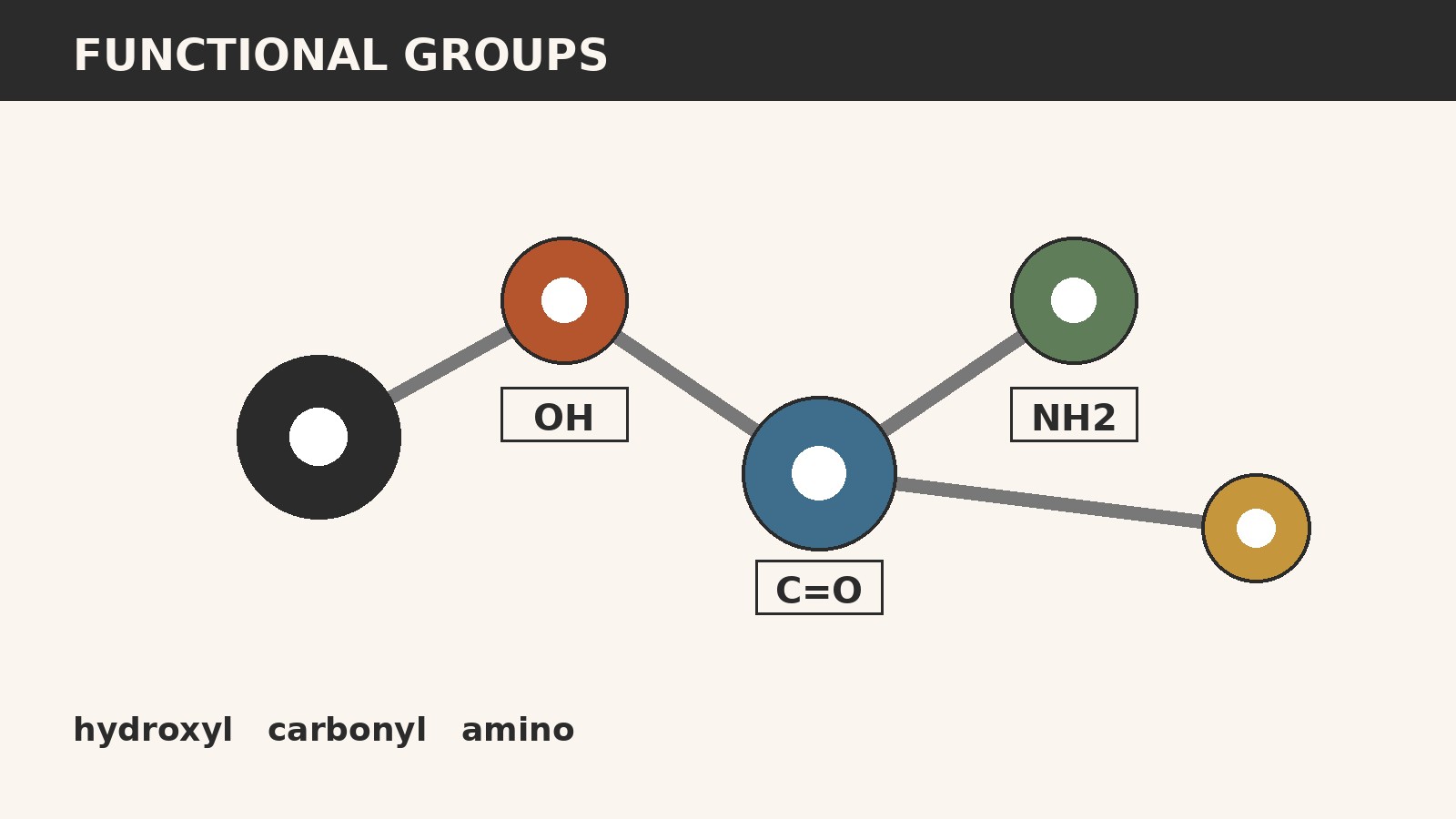
- The major groups to learn first are hydroxyl (-OH), carbonyl (C=O), carboxyl (-COOH), amino (-NH2), sulfhydryl (-SH), phosphate (-OPO3 with a 2 minus charge), and methyl (-CH3), plus carbon-carbon double and triple bonds, ethers, esters, amides, and halides.
- A functional group is not a compound class. Hydroxyl is a group, while alcohol is the class of compounds that contain it. Carbonyl is a group, while aldehyde and ketone are two different classes that both contain it.
- Groups shape behavior through polarity, hydrogen bonding, acidity or basicity, and the availability of electrons for reaction.
- In naming, the highest priority group supplies the suffix, and lower priority groups are named as prefixes. A carboxylic acid outranks an alcohol, so a molecule with both groups ends in "oic acid" and the hydroxyl group becomes "hydroxy".
What a Functional Group Actually Is
Organic chemistry studies an enormous number of compounds, and learning them one molecule at a time would be hopeless. Functional groups are what make the subject manageable. OpenStax defines the idea plainly: the structural features that make it possible to classify compounds into families are called functional groups, and a functional group is a group of atoms within a molecule that has a characteristic chemical behavior. A given functional group behaves in nearly the same way in every molecule it is a part of.
OpenStax illustrates this with ethene, a plant hormone that causes fruit to ripen, and menthene, a much more complicated molecule found in peppermint oil. Both contain a carbon-carbon double bond, and both react with bromine in the same way, adding one bromine atom to each carbon of the double bond. That is the central promise of functional groups: learn the group once, and you can predict the characteristic chemistry of every molecule that carries it.
Two cautions complete the definition. First, a functional group is an arrangement of atoms and bonds, not a single atom and not a whole molecule: oxygen double bonded to carbon is a carbonyl group, while oxygen bonded to carbon and hydrogen is a hydroxyl group. The bonding pattern is the information. Second, the carbon skeleton around the group still affects size, shape, and solubility, but it does not normally change the molecule’s family or the kind of reaction the group undergoes.
Chemists often write R to stand for the rest of the molecule. R-OH therefore means any alcohol, and R-COOH means any carboxylic acid.
Do Not Confuse a Group With a Class
One distinction is worth fixing early: a functional group is not a compound class, although the two are closely related. A compound class is a family of compounds defined by sharing a functional group. The group is the structural feature. The class is the family it defines.
Hydroxyl (-OH) is a functional group. Alcohol is the compound class of molecules that contain a hydroxyl group bonded to a carbon atom. Every alcohol contains a hydroxyl group, but a hydroxyl group also appears inside other groups, most notably the carboxyl group, where it is bonded to a carbonyl carbon. Calling every -OH an alcohol would therefore be wrong.
Carbonyl (C=O) is a functional group. Aldehyde and ketone are two compound classes that both contain a carbonyl group, and they differ in what else is bonded to the carbonyl carbon: an aldehyde has at least one hydrogen bonded to it, while a ketone has two carbons bonded to it. Carboxylic acids, esters, and amides also contain a carbonyl group, but each adds a different partner atom, oxygen or nitrogen, and each forms its own class with its own behavior. The shared carbonyl explains their family resemblance. The partner atom explains their differences.
The same logic applies to nitrogen. Amino (-NH2) is a group. Amine is the class of compounds containing it. Amide is a different class, in which nitrogen is bonded to a carbonyl carbon, and its behavior is very different from that of an amine, even though both contain nitrogen. Name the full arrangement, not just the atom.
Methyl (-CH3) needs a special note, because biology lists and chemistry lists treat it differently. In biology teaching, methyl is routinely listed among the important functional groups, because adding or removing it changes how a biological molecule behaves. In strict organic chemistry naming, methyl is an alkyl substituent rather than a reactive group like hydroxyl or amino. When this article calls methyl a group, it follows the biology convention and flags the distinction.
The Master Table
The table below gathers the groups this article covers, with structure, class, naming ending, and a simple example drawn from the OpenStax and LibreTexts tables checked for this article.
| Functional group | Structure | Compound class | Name ending | Simple example |
|---|---|---|---|---|
| Alkene | C=C | Alkene | -ene | Ethene, H2C=CH2 |
| Alkyne | C triple bond C | Alkyne | -yne | Ethyne, HC triple bond CH |
| Arene | Six membered aromatic ring | Aromatic compound | None, -benzene | Benzene |
| Halide | C-X, where X is F, Cl, Br, or I | Alkyl halide | None as suffix, halo- as prefix | Chloromethane, CH3Cl |
| Hydroxyl | -OH | Alcohol | -ol, hydroxy- as prefix | Methanol, CH3OH |
| Ether | C-O-C | Ether | ether, alkoxy- as prefix | Dimethyl ether, CH3OCH3 |
| Thiol, also called sulfhydryl | -SH | Thiol | -thiol, sulfanyl- as prefix | Methanethiol, CH3SH |
| Sulfide | C-S-C | Sulfide | sulfide | Dimethyl sulfide, CH3SCH3 |
| Disulfide | C-S-S-C | Disulfide | disulfide | Dimethyl disulfide, CH3SSCH3 |
| Amine, amino group | -NH2 | Amine | -amine, amino- as prefix | Methylamine, CH3NH2 |
| Nitrile | C triple bond N | Nitrile | -nitrile, cyano- as prefix | Ethanenitrile, CH3C triple bond N |
| Carbonyl, aldehyde form | -CHO | Aldehyde | -al, oxo- or formyl- as prefix | Ethanal |
| Carbonyl, ketone form | C=O with two carbons attached | Ketone | -one, oxo- as prefix | Propanone |
| Carboxyl | -COOH | Carboxylic acid | -oic acid, carboxy- as prefix | Ethanoic acid |
| Ester | -COOR | Ester | -oate | Methyl ethanoate |
| Amide | -CONH2 | Amide | -amide, carbamoyl- as prefix | Ethanamide |
| Acid chloride | -COCl | Acid chloride | -oyl chloride | Ethanoyl chloride |
| Phosphate | -OPO3 with a 2 minus charge | Organophosphate | phosphate | Methyl phosphate, CH3OPO3 with a 2 minus charge |
| Methyl | -CH3 | Alkyl substituent | -yl in substituent names | Part of methanol, CH3OH |
The groups fall into three natural families, and each family behaves in a recognizable way. The next three sections take those families in turn.
Family 1: Carbon-Carbon Multiple Bonds
Alkenes contain a carbon-carbon double bond, alkynes contain a carbon-carbon triple bond, and arenes contain a six membered ring of carbon atoms with alternating double and single bonds, the arrangement found in benzene. OpenStax groups these three together because their structural similarities give them chemical similarities.
The key feature of a double or triple bond is its extra electron density: a single bond holds two electrons between two carbons, a double bond holds four, and a triple bond holds six, with the extra electrons held in bonds that are more exposed and more easily attacked than a single bond. That is why alkenes and alkynes typically undergo addition reactions, in which something adds across the multiple bond and the bond order falls. The bromine reaction described earlier is one example.
Arenes behave differently. The six electrons in the benzene ring are delocalized, meaning they are spread over the whole ring rather than fixed in three separate double bonds. That delocalization gives benzene unusual stability, so arenes typically undergo substitution, in which a hydrogen on the ring is replaced, rather than addition, which would destroy the delocalized arrangement.
Family 2: Carbon Singly Bonded to an Electronegative Atom
The second family covers groups in which a carbon atom is singly bonded to an electronegative atom: a halogen, oxygen, nitrogen, or sulfur. OpenStax states the consequence directly: in all these cases the bonds are polar, with the carbon atom bearing a partial positive charge and the electronegative atom bearing a partial negative charge. A partially positive carbon is open to attack by electron rich species, and a partially negative heteroatom can attract protons or form hydrogen bonds.
Hydroxyl and alcohols
The hydroxyl group (-OH) is an oxygen bonded to a hydrogen, with the oxygen also bonded to a carbon. The compound class is alcohol. Methanol (CH3OH) is the simplest alcohol, and ethanol (CH3CH2OH) is the familiar alcohol in beverages, a formula given in LibreTexts. Because oxygen is much more electronegative than hydrogen or carbon, the O-H bond is polar, and the oxygen carries lone pairs that can accept hydrogen bonds from water. That is why small alcohols mix well with water.
Do not confuse the neutral hydroxyl group (-OH) with the hydroxide ion (OH with a 1 minus charge), a separate charged species as in sodium hydroxide.
Ethers
An ether has an oxygen bonded to two carbons (C-O-C). Dimethyl ether (CH3OCH3) is the simplest example. Ethers are much less reactive than alcohols, because the oxygen has no hydrogen to lose or donate for hydrogen bonding. They are only modestly polar, and they are often used as solvents because they dissolve many organic compounds without reacting with them.
Amines and the amino group
The amino group (-NH2) is a nitrogen bonded to hydrogens, with the nitrogen also bonded to a carbon. The class is amine, and methylamine (CH3NH2) is the simplest example in the OpenStax table. Nitrogen is electronegative and carries a lone pair, but it is less electronegative than oxygen, and that lone pair is more available. That availability makes amines basic: they can accept a proton (H+) to form a positively charged ammonium ion, such as -NH3 with a 1 plus charge. LibreTexts states this directly: amino groups accept H+ to form NH3+, and since they remove H+ from solution they are considered basic.
Amines are also good nucleophiles, meaning they use their lone pair to attack partially positive carbons. That dual role, base and nucleophile, explains why amino groups appear at the heart of so much chemistry.
Thiols, sulfides, and disulfides
Sulfur sits below oxygen in the periodic table, so sulfur groups resemble oxygen groups in shape but differ in behavior. A thiol, also called a sulfhydryl group, is -SH: sulfur bonded to hydrogen and to carbon, as in methanethiol (CH3SH). A sulfide has sulfur bonded to two carbons (C-S-C), as in dimethyl sulfide (CH3SCH3). A disulfide has two sulfurs joined together, each bonded to a carbon (C-S-S-C), as in dimethyl disulfide (CH3SSCH3).
Thiols are more acidic than alcohols and more easily oxidized, and disulfide bonds hold folded proteins in shape by linking two cysteine side chains. Replace oxygen with sulfur and the group becomes larger, more polarizable, and more easily oxidized.
Halides
An alkyl halide has a carbon bonded to a halogen: fluorine, chlorine, bromine, or iodine (C-X). Chloromethane (CH3Cl) is the simplest example. The carbon-halogen bond is polar, with carbon partially positive, and the halogen is a good leaving group, meaning it can depart with the bonding electrons when a nucleophile attacks the carbon. That makes alkyl halides excellent starting materials for substitution reactions. Halides are named with prefixes rather than suffixes: fluoro-, chloro-, bromo-, or iodo-, as in chloroethane.
Phosphate
The phosphate group centers on a phosphorus atom bonded to oxygens, commonly written as -OPO3 with a 2 minus charge when attached through oxygen to a carbon, as in methyl phosphate. LibreTexts classifies phosphate as charged and acidic, because it ionizes to release H+ ions into solution. That charge matters enormously in biology: the backbone of DNA and RNA is built from phosphate groups linking sugar units, and phosphate transfer is a central way cells store and release energy.
Family 3: The Carbonyl Group and Its Many Classes
The carbonyl group is a carbon double bonded to oxygen (C=O). OpenStax notes that carbonyl groups are present in a majority of organic compounds and in practically all biological molecules. The carbonyl carbon bears a partial positive charge and the oxygen bears a partial negative charge, so the group is polar and open to attack at carbon by nucleophiles. What makes the carbonyl family rich is that the identity of the other atoms bonded to the carbonyl carbon changes the chemistry completely.
An aldehyde has at least one hydrogen bonded to the carbonyl carbon, a ketone has two carbons bonded to it, a carboxylic acid has a hydroxyl group bonded to it, an ester has an oxygen bonded to it, an amide has a nitrogen bonded to it, an acid chloride has a chlorine bonded to it, and a thioester has a sulfur bonded to it. The carbonyl is the same in every case. The class, reactivity, and name all follow from the partner.
Aldehydes and ketones
Aldehydes end in -al and ketones in -one. Ethanal is a simple aldehyde, and propanone is a simple ketone. Both undergo nucleophilic addition at the carbonyl carbon, because a nucleophile is drawn to the partial positive charge there. Aldehydes are generally more reactive than ketones: an aldehyde has only one carbon group donating electrons to the carbonyl carbon, while a ketone has two, and an aldehyde has a small hydrogen where a ketone has a bulkier carbon group blocking access. Aldehydes are also more easily oxidized than ketones, and that difference is the basis of several classic tests that distinguish the two classes.
Carboxylic acids and the carboxyl group
The carboxyl group (-COOH) combines a carbonyl group and a hydroxyl group on the same carbon. LibreTexts states the key property directly: the carboxyl group ionizes to release hydrogen ions (H+) from the -COOH group, giving the negatively charged -COO- group, and since carboxyl groups can release H+ ions into a solution, they are considered acidic. The negative charge left behind is stabilized because it is shared between the two oxygens, which is why carboxylic acids are far more acidic than alcohols, whose single oxygen must bear the whole charge alone.
Ethanoic acid is the acid in vinegar, and its sour taste is a direct consequence of this acidity. Carboxylic acids also form strong hydrogen bonds, which raises their boiling points. They react with bases to form salts, with alcohols to form esters, and with amines to form amides, which makes them one of the most versatile starting points in organic synthesis.
Esters
An ester (-COOR) is what you get when the hydroxyl hydrogen of a carboxylic acid is replaced by a carbon group. Methyl ethanoate is a simple example. Esters are less acidic than carboxylic acids, because they have no O-H hydrogen to lose, and less reactive than acid chlorides, because the alkoxy oxygen donates electrons into the carbonyl. Their most famous property is smell: many esters have sweet, fruity odors, and they are responsible for the scents of many fruits and for many artificial flavorings. Fats are esters of glycerol with fatty acids.
Amides
An amide (-CONH2) replaces the hydroxyl group of a carboxylic acid with a nitrogen group. Ethanamide is a simple example. Amides are much less reactive than esters, and far less reactive than acid chlorides, because the nitrogen lone pair is strongly shared with the carbonyl group. That sharing makes amides unusually stable, which is biologically essential: the peptide bond linking amino acids into proteins is an amide bond, and proteins depend on amide bonds surviving in water at body temperature.
Acid chlorides, anhydrides, and nitriles
Acid chlorides (-COCl) and acid anhydrides (-CO-O-CO-) are the most reactive members of the carbonyl family, because chlorine and carboxylate are good leaving groups. They are used to make esters and amides under controlled conditions, react vigorously with water and alcohols, and are rarely found in biological systems. Nitriles (-C triple bond N), such as ethanenitrile, are named with the -nitrile suffix or the cyano- prefix, and they can be converted into carboxylic acids, amides, and amines. For a first pass, the key point is recognition: if you see -COCl, expect high reactivity, and if you see -C triple bond N, expect a nitrile, not an amine.
How Functional Groups Determine Chemical Behavior
Four mechanisms explain most of what a functional group does.
First, polarity. Electronegative atoms such as oxygen, nitrogen, and halogens pull electrons toward themselves, creating partial charges. Polar groups attract water and other polar molecules and raise boiling points. Nonpolar groups, such as methyl and other alkyl groups, do the opposite: they do not mix well with water, and they contribute mainly weak attractions that grow with molecular size.
Second, hydrogen bonding. Groups with hydrogen bonded to oxygen or nitrogen can donate hydrogen bonds, and groups with lone pairs on oxygen or nitrogen can accept them. Alcohols and carboxylic acids both donate and accept, which is why they have high boiling points and good water solubility for their size. Ethers and ketones can accept but cannot donate, because they have no O-H or N-H hydrogen. Amines can both donate and accept, though their hydrogen bonds are weaker than those of alcohols.
Third, acidity and basicity. A group that can lose a proton easily is acidic, and a group that can gain a proton easily is basic. Carboxylic acids and phosphate groups are acidic. Amines are basic. Alcohols and thiols are weakly acidic, with thiols more acidic than alcohols. As a first approximation, the group predicts whether a molecule will be charged at a given pH, which predicts its solubility and its interactions with proteins and membranes.
Fourth, electron availability for reaction. Groups with lone pairs, such as amines and alcohols, can act as nucleophiles. Groups with partially positive carbons, such as carbonyl carbons and alkyl halide carbons, can be attacked by nucleophiles. Groups with multiple bonds, such as alkenes and alkynes, are electron rich and can be attacked by electrophiles, meaning electron seeking species. A reaction is, in most cases, a meeting between an electron rich site and an electron poor site.
Two molecules of similar size make the point concrete. Ethanol (CH3CH2OH) and dimethyl ether (CH3OCH3) have the same molecular formula, but ethanol has a hydroxyl group and dimethyl ether has an ether oxygen. Ethanol can donate hydrogen bonds, boils at a much higher temperature, and mixes with water. Dimethyl ether cannot donate hydrogen bonds. The atoms are the same, but the arrangement, and therefore the functional group, is different.
Naming: How the Suffix Is Chosen
Naming an organic compound is largely a matter of finding the functional groups, ranking them, and letting the winner supply the suffix. The International Union of Pure and Applied Chemistry (IUPAC) seniority order, as summarized in the IUPAC Brief Guide, runs from carboxylic acids at the top, through esters, acid halides, amides, nitriles, aldehydes, ketones, alcohols and thiols, and amines. Only the most senior group in a molecule is cited as the suffix. Every other group is cited as a prefix.
Consider a molecule with a carboxyl group and a hydroxyl group, such as 2-hydroxypropanoic acid, commonly known as lactic acid. The carboxyl group outranks the hydroxyl group, so the name ends in “oic acid” and the hydroxyl group is named as the prefix “hydroxy”, with the number 2 showing its position on the chain.
When only one functional group is present, naming is simpler: find the longest chain containing the group, number it to give the group the lowest possible number, and add the group’s suffix. Ethanol is a two carbon chain with a hydroxyl group, and ethanoic acid is a two carbon chain with a carboxyl group, where the carboxyl carbon counts as carbon 1. When a group is not senior enough to supply a suffix, it becomes a prefix: hydroxy- for hydroxyl, amino- for amino, oxo- for a ketone carbonyl, alkoxy- for an ether oxygen, halo- for a halogen.
Polyfunctional molecules, which contain several different groups, are where this system earns its keep. An amino acid is the classic case: it contains an amino group, a carboxyl group, and a side chain that may contain a hydroxyl group, a thiol group, or another group entirely. The carboxyl group wins the suffix in systematic naming, and the amino group becomes a prefix. The carboxyl group loses a proton first, and the amino group gains one, so the molecule can carry both charges at once.
Functional Groups in Biology and Everyday Life
Biology teaching often narrows the full organic list to seven groups that dominate living systems: hydroxyl, methyl, carbonyl, carboxyl, amino, sulfhydryl, and phosphate. LibreTexts presents exactly this set: hydroxyl is polar and hydrophilic, methyl is nonpolar, carbonyl is polar, carboxyl is charged and acidic, amino is charged and basic, sulfhydryl is polar, and phosphate is charged and acidic. That short table summarizes biochemistry: proteins are built from amino and carboxyl groups, carbohydrates are rich in hydroxyl groups, lipids are dominated by nonpolar groups and ester linkages, and nucleic acids are built on phosphate groups.
Everyday examples reinforce the same groups: ethanol is an alcohol, vinegar contains ethanoic acid, soaps are salts of carboxylic acids, fats and oils are esters, proteins are polyamides, and the smells of many fruits are often esters.
Frequently Asked Questions
What is a functional group in organic chemistry?
A functional group is a specific arrangement of atoms and bonds within a molecule that gives the molecule its characteristic chemical behavior. The same group behaves in nearly the same way in every molecule that contains it, which is why chemists can classify compounds into families.
Is hydroxyl a functional group or an alcohol?
Hydroxyl (-OH) is the functional group. Alcohol is the compound class of molecules that contain a hydroxyl group bonded to a carbon atom. The distinction matters because a hydroxyl group also appears inside the carboxyl group, where it is bonded to a carbonyl carbon.
What is the difference between an aldehyde and a ketone?
Both contain a carbonyl group (C=O), but an aldehyde has at least one hydrogen bonded to the carbonyl carbon, while a ketone has two carbons bonded to it. That difference makes aldehydes generally more reactive and more easily oxidized than ketones, and it gives them different name endings: -al for aldehydes and -one for ketones.
Why is a carboxylic acid more acidic than an alcohol?
A carboxylic acid loses a proton from its carboxyl group (-COOH) to give a negatively charged carboxylate ion (-COO-), and that negative charge is shared between two oxygens, which stabilizes it. An alcohol loses a proton to give an alkoxide ion in which a single oxygen bears the whole charge. The shared charge makes the carboxylic acid far more acidic.
How do I tell an amine from an amide?
Check what the nitrogen is bonded to. In an amine, nitrogen is bonded to carbons and hydrogens. In an amide, nitrogen is bonded to a carbonyl carbon. Amides are much less basic and less reactive than amines, because the nitrogen lone pair is shared with the carbonyl group.
Which functional group has the highest priority in naming?
Carboxylic acids have the highest priority among the common groups, so a molecule containing a carboxyl group ends in “oic acid” and other groups are named as prefixes. Esters, acid halides, amides, nitriles, aldehydes, ketones, alcohols, and amines follow in decreasing seniority.
Sources & references
- OpenStax, Organic Chemistry, section 3.1, Functional Groups. Definition of a functional group, the ethene and menthene bromine example, Table 3.1 of common functional groups with examples including ethene, ethyne, chloromethane, methanol, dimethyl ether, methyl phosphate, methylamine, methanethiol, dimethyl sulfide, and dimethyl disulfide, and the three families of groups: carbon-carbon multiple bonds, carbon singly bonded to an electronegative atom, and carbonyl groups.
- LibreTexts, Chemistry, Fresno City College Environmental Chemistry, section 7.3, Functional groups. Table of classes, groups, prefixes, suffixes, and examples including ethanol, ethoxyethane, and the carboxyl group, used for naming endings and for the distinction between group and class.
- LibreTexts, Biology for Majors I, Lumen Learning, section 4.11, Functional Groups. The seven biological groups, hydroxyl, sulfhydryl, methyl, carbonyl, carboxyl, amino, and phosphate, with their polar, nonpolar, charged, acidic, and basic properties, and the ionization of carboxyl and phosphate groups.
- International Union of Pure and Applied Chemistry (IUPAC), Brief Guide to Organic Nomenclature, characteristic groups seniority table. Seniority order from carboxylic acids through esters, acid halides, amides, nitriles, aldehydes, ketones, alcohols, thiols, and amines, used for the naming priority section and for prefix and suffix pairs.


