Short answer
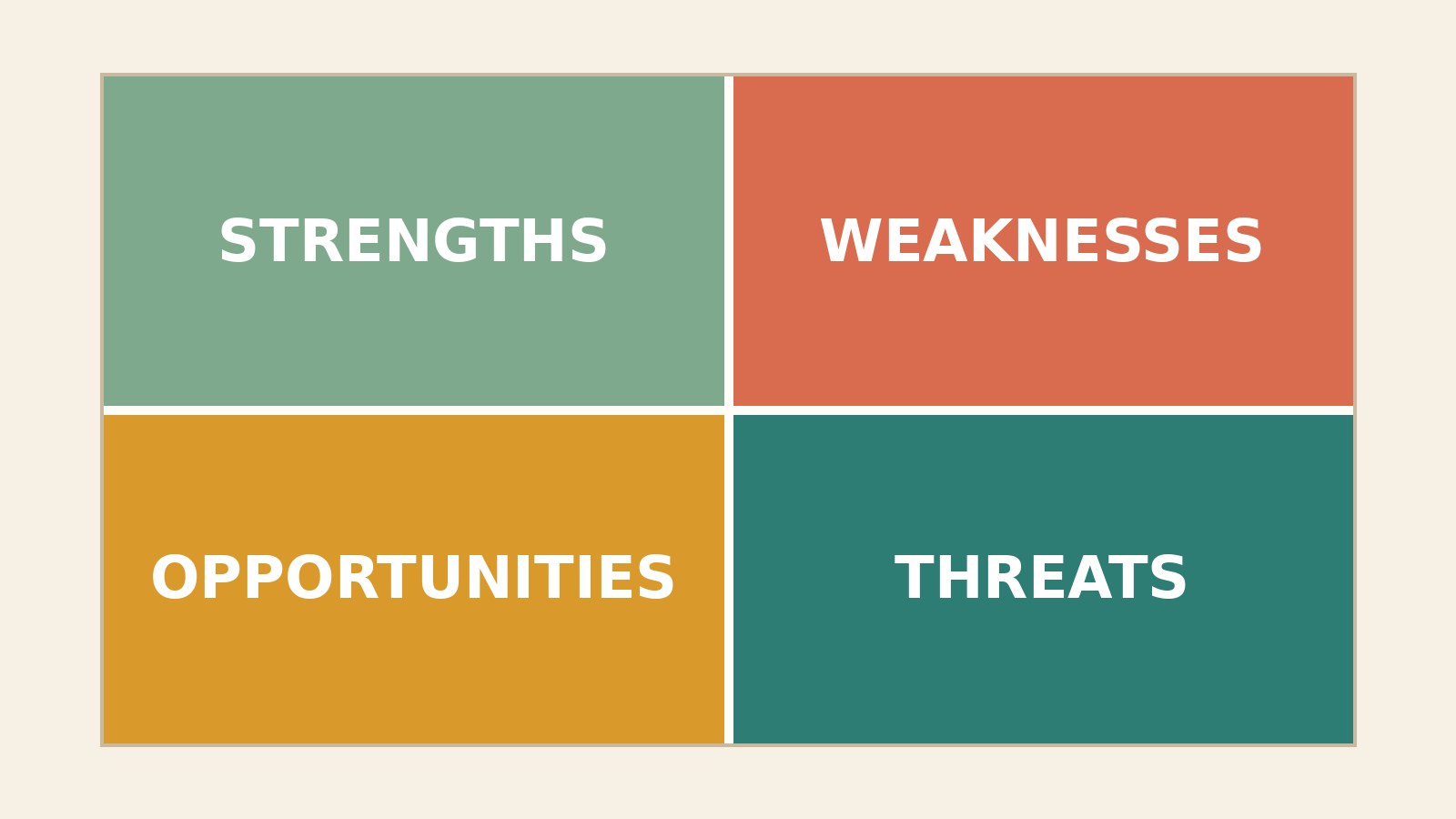
- A SWOT analysis is a strategic planning tool that sorts the factors affecting an organization, project, or decision into four groups: strengths, weaknesses, opportunities, and threats. Strengths and weaknesses are internal, meaning they describe what the organization itself controls or lacks. Opportunities and threats are external, meaning they come from the world outside the organization, such as customers, competitors, regulation, technology, and the wider economy. The four groups are usually drawn as a two by two matrix, with internal factors in one dimension and helpful or harmful factors in the other. The point is not the grid itself. The point is the clearer decision that follows, once a team can see what it does well, where it is exposed, what it could pursue, and what could get in the way.
Introduction
SWOT analysis appears in business courses, charity planning days, startup pitch decks, and team workshops for one simple reason: it is easy to start. Anyone can draw four boxes and begin listing ideas. That ease is also its danger. A SWOT analysis done in a hurry often produces four lists of vague adjectives that change nothing. A SWOT analysis done well produces a shared, honest picture of a situation and a short list of actions worth taking. This guide explains the framework, walks through the process step by step, works through a fully invented example, and explains its limits and related tools. It is a business explainer only. It does not advise any specific firm or guarantee any outcome.
1. What a SWOT Analysis Is
At its core, a SWOT analysis is a situation review. It asks a group to pause before deciding and to answer four questions about one defined objective: what internal strengths help us reach it, what internal weaknesses hold us back, what external opportunities could help us, and what external threats could prevent us from reaching it?
The objective matters more than the grid. A SWOT analysis of a whole company will look very different from one about a single product launch, a campus society, or a career decision. The University of Missouri Libraries guide puts the same point in general terms: a SWOT analysis evaluates the strengths, weaknesses, opportunities, and threats involved in a project or business venture, with strengths and weaknesses internal to an organization and opportunities and threats originating outside it. If the objective is vague, the lists will be vague too. A SWOT analysis is also a snapshot, not a forecast and not a plan. Markets move and internal capacity changes, so a grid that was accurate last year may mislead today. It does not rank factors or choose between options by itself.
2. The Four Quadrants at a Glance
The name SWOT is an acronym for the four groups. They are usually arranged as a matrix with two dimensions: internal versus external, and helpful versus harmful.
| Helpful | Harmful | |
|---|---|---|
| Internal | Strengths | Weaknesses |
| External | Opportunities | Threats |
The Minnesota Department of Health guide uses the same structure, with columns titled Helpful and Harmful and rows titled Internal and External. It advises teams to look at the organization from an outside perspective even when assessing internal factors, and to verify or quantify statements where possible rather than relying on general claims. That advice captures the spirit of a good SWOT analysis: honest, specific, and checked against evidence where evidence exists.
3. Strengths: What Helps From Inside
Strengths are internal attributes that help an organization achieve its objective: skilled people, a trusted reputation with a defined audience, efficient processes, strong finances, useful technology, good locations, and products or services that customers return to.
A useful strength is specific and comparative. “We are good at customer service” is hard to argue with and hard to act on, because it names no evidence and no comparison. “Customers return because our repair service usually completes work within two days, while the nearest alternatives quote a week” is a strength a team can protect, promote, and measure. Strengths should also be relevant to the objective: a talented design team is a strength for a product redesign and may be irrelevant to a warehouse decision. Finally, test strengths for dependence. A strength that depends on one person, one supplier, or one client is real, but it is also fragile, and naming that dependence is better than discovering it later.
4. Weaknesses: What Holds Back From Inside
Weaknesses are internal attributes that harm an organization or hold it back: missing skills, outdated equipment, slow processes, weak cash reserves, unclear roles, poor internal communication, and products that no longer match what customers want.
The Minnesota guide notes that weaknesses can include absences of strengths and the flip sides of strengths. If a team is proud of its personal, hands on service, the flip side may be that the service does not scale, or that it depends heavily on a few experienced staff members. Looking for flip sides prevents a strengths list from hiding its costs. Weaknesses are the quadrant teams most often soften, because people do not enjoy writing down their own shortcomings in a group. Frame them as facts to fix, not faults to blame: what limits us, what evidence shows it, and what would change if we addressed it? Specificity matters here too. “Limited resources” explains almost nothing, while “only two staff members know how to operate the booking system, and neither has documented the process” points toward a concrete fix.
5. Opportunities: What Could Help From Outside
Opportunities are external conditions that could help an organization achieve its objective: a growing or underserved market, a regulation change that favors a particular approach, a new technology that lowers a cost, a competitor leaving a market, a shift in customer habits, or a partnership that opens a new audience.
The key word is external. An opportunity is not something the organization already does well. That is a strength. The University of Kansas Community Tool Box prompts teams to ask whether a social change or demographic pattern is favorable, whether a new funding source is available, whether policy changes have made something easier, and whether changes in technology hold new promise. Those questions all point outward. Opportunities also need a fit test. A growing market that every competitor can enter just as easily may be context, not advantage. A new technology that requires skills the organization lacks may be an opportunity only after investment and training. Timing matters as well: a funding round ends or a customer need gets met by someone else, so an opportunity recorded without its likely window is a wish list rather than a plan.
6. Threats: What Could Harm From Outside
Threats are external conditions that could harm an organization or prevent it from achieving its objective: new competitors, changing customer preferences, rising costs, supply problems, unfavorable regulation, economic downturns, technological change that makes an existing offer less relevant, and reputational risks driven by events outside the organization.
As with opportunities, the test is external origin. A threat is not a weakness restated. “Our staff lack training” is a weakness. “A new regulation will require a qualification our staff do not yet hold” is a threat, and it becomes actionable when paired with the weakness: training becomes urgent because an external deadline now exists. Threats should be assessed for likelihood and impact, even informally. A threat that is possible but distant and minor is different from one that is likely, near, and capable of serious damage. Specificity helps here as well: “the economy” is too broad to act on, while “rising rent when the lease renews next year, with few comparable spaces nearby” is a threat a team can investigate, budget for, or negotiate around.
7. Internal Versus External: The Sorting Test
The internal and external boundary is the one rule that holds the framework together, and it is the rule most often broken. The test is simple: could this factor exist without this organization? If a factor describes what the organization is, has, or does, it is internal. If it describes the market, the environment, or other actors, and would exist whether or not this organization existed, it is external.
Two examples show why the test matters. A loyal customer base is often listed as an opportunity, but loyalty to this organization is an internal asset, so it belongs with strengths. A growing market is often listed as a strength, but market growth would happen with or without any single firm, so it belongs with opportunities. Misplacing factors confuses what the team controls with what it must respond to. Some factors sit near the boundary, such as reputation, which is built internally but lives in other people’s minds. In such cases, split the factor and say so in the discussion.
8. Where SWOT Came From: An Honest History
The history of SWOT analysis is less settled than many guides suggest. The widely repeated story credits one man, Albert Humphrey, with inventing SWOT analysis at the Stanford Research Institute in the 1960s. Archival research published in 2023 challenges that simple attribution, and this guide follows the more careful account.
According to a summary of that 2023 archival study by Puyt, Lie, and Wilderom in the journal Long Range Planning, the work at the Stanford Research Institute in the mid 1960s was led by Robert Franklin Stewart, with Humphrey as one member of the team rather than the sole inventor. The early framework was called SOFT, standing for Satisfactory, Opportunities, Faults, and Threats. The acronym SWOT, with weakness replacing fault, appears in print in 1972 in a paper by the British consultant Norman Stait, as reported in the same summary. The familiar pairing step, the TOWS matrix, came later, from Heinz Weihrich in 1982. The same summary rejects the attribution to the 1965 Harvard textbook Business Policy: Text and Cases, which discusses the underlying ideas but contains neither the SWOT acronym nor the four box matrix.
Two cautions apply. First, this guide relies on a published summary of the 2023 study, not on the original institute reports, so the history is reported as that study’s finding. Second, the path from SOFT to SWOT involved years of practical use, not a single moment of invention. Readers who need a citable origin should consult the 2023 paper directly.
9. How to Run a SWOT Analysis Step by Step
A good SWOT analysis is a process, not just a template. The steps below work for a team workshop, a small organization review, or an individual thinking through a project. Allow enough time for evidence and discussion, because a rushed session produces rushed lists.
Step 1. Define the objective in one sentence
Write the objective as a single sentence naming the decision or aim, for example “decide whether to open a second location next year.” If the group cannot agree on one sentence, it is not ready to list factors yet. Any factor that does not bear on the objective is left out.
Step 2. Gather the right people and the right evidence
Include people who know the internal reality and people who know the external environment. Bring available evidence: customer feedback, basic financial figures, service data, competitor observations, and relevant policy or market information. A SWOT analysis with no evidence is a SWOT analysis of opinions.
Step 3. Brainstorm each quadrant separately
Work through the four quadrants one at a time, starting with strengths. Ask what the organization does well and what customers value; then what could improve and what customers complain about; then what trends could help; then what obstacles could harm. Working separately prevents every quadrant filling with the same few ideas in different words.
Step 4. Apply the sorting test and remove duplicates
Apply the test from Section 7. Move misplaced factors to the correct quadrant, or split them where a factor has both parts. Remove duplicates. Keep specific, evidenced entries. Rewrite or drop vague ones.
Step 5. Prioritize, but do not pretend the grid does the prioritizing
SWOT analysis itself provides no ranking method, so the group must supply one. Vote for the three factors in each quadrant that matter most for the stated objective, then discuss why those factors won. The output should be a short list of priority factors, not four long lists of equal weight.
Step 6. Pair the quadrants to generate options
This is the step most teams skip, and it is the step that turns description into strategy. For each priority strength, ask which opportunity it could help capture and which threat it could help resist. For each priority weakness, ask which opportunity is blocked by it and which threat it leaves the organization exposed to. Write the resulting options as full sentences with a verb. “Use our experienced repair team to serve customers affected by the competitor closure” is an option. “Strength plus opportunity” is not.
Step 7. Choose, assign owners, and set review dates
Choose a small number of actions, name an owner for each one, and set a review date. An action without an owner and a date is a wish. Record what evidence would show it is working. If an option needs research first, assign that research as its own action.
Step 8. Revisit when conditions change
A SWOT analysis ages. Set a review point tied to real triggers: a major market change, a new competitor, a regulation change, or the end of a planning period. At review, ask what has changed in each quadrant and whether the objective still stands.
10. A Worked Example: A Neighborhood Bakery
The example below is entirely invented for teaching. It describes no real business, and its entries are illustrative, not findings about any actual bakery.
Imagine a small neighborhood bakery with one shop and a loyal local customer base, asking whether it should open a second location in a nearby district next year. The objective sentence is: decide whether a second location in the nearby district is a sound next step within the next twelve months.
Strengths might include experienced bakers who can train new staff, recipes that customers travel for, and a reputation for consistent quality. Weaknesses might include a small cash reserve, no documented training process, and a delivery setup built around one shop. Opportunities might include a new housing development in the nearby district, the closure of a competing bakery there, and growing demand for bread made with locally milled flour. Threats might include rising rent in the target district, higher flour and energy costs, and a national chain planning a store nearby.
Notice the sorting. The loyal customer base is a strength, not an opportunity, because it was built by this bakery. The new housing development is an opportunity, not a strength, because it would exist whether or not this bakery opened there. Pairing makes the risk concrete: a thin cash reserve plus rising rent could strain the business even if sales are reasonable. Pairing also produces options: experienced bakers plus the competitor closure suggests an opening offer built around the products the closed bakery no longer supplies; undocumented training plus the new housing development suggests documenting training before expansion; and a small cash reserve plus rising costs suggests testing demand with a market stall before committing to a full second shop. None of these is a recommendation for a real business. They show how a grid becomes choices to investigate, not a verdict.
11. From Four Lists to Decisions: The TOWS Pairing
The pairing step in Step 6 deserves emphasis because it is where most SWOT exercises stop short. The TOWS matrix, associated with Weihrich in 1982, arranges the pairing systematically: strengths with opportunities, strengths with threats, weaknesses with opportunities, and weaknesses with threats. Strengths with opportunities asks how an advantage can capture an opening. Strengths with threats asks how an advantage can defend against a risk. Weaknesses with opportunities asks what must improve before an opening can be used. Weaknesses with threats asks where the organization is most exposed.
Pairing does not guarantee good strategy. A pairing can be plausible but unwise, for example when capturing an opportunity would stretch a strength too thin. Pairings are candidates for judgment, evidence, and costing, not conclusions. Their value is that they force the team to connect the boxes instead of admiring them separately.
12. Strengths and Limits of the Framework
SWOT analysis has real strengths. It is quick to learn, easy to explain, and accessible without formal strategy training. It brings internal and external factors into one view, preventing the error of planning from inside knowledge alone. It works well as a shared starting point: a group that has built one together usually shares a vocabulary for the discussion that follows. It is also flexible, applying to organizations, projects, teams, products, and personal decisions, as long as the objective is clearly defined.
Its limits are equally real. It has no built in method for gathering evidence, ranking factors, or weighing trade offs, so it inherits the quality of the evidence brought to it. It is static, capturing a moment that passes. It is subjective: different groups can produce different grids from the same situation. And it can oversimplify, hiding connections such as a factor that is both a strength and a weakness depending on context. It is therefore a starting point that needs companions: evidence gathering before the session, prioritization and pairing during it, and costing, testing, and review after it.
13. SWOT Versus Related Tools
SWOT analysis is often confused with tools that do adjacent jobs. PESTLE analysis examines only the external environment, through political, economic, social, technological, legal, and environmental factors. It is a deeper external scan than the opportunities and threats boxes alone, and teams often run it first and feed its findings into those quadrants.
Porter Five Forces analysis examines industry structure: competitive rivalry, the threat of new entrants, the bargaining power of suppliers, the bargaining power of buyers, and the threat of substitutes. It answers a narrower question than SWOT analysis, about how attractive an industry is and where competitive pressure comes from. It is more rigorous about competition and less useful as a general situation review.
VRIO analysis tests whether a resource or capability can provide a lasting advantage, by asking whether it is valuable, rare, hard to imitate, and well organized. It separates a genuine, defensible strength from a nice feature any competitor could copy. TOWS analysis is not a rival to SWOT analysis. It is the pairing step from Sections 9 and 11. Other tools, such as scenario planning and financial modeling, answer questions SWOT analysis cannot answer at all: what happens under different futures, and what an option costs. A plan that rests only on a grid should be treated as unfinished.
14. Common Mistakes and How to Avoid Them
First, listing adjectives instead of evidence. “Strong brand” and “tough competition” fill boxes without informing decisions. The remedy is the test used throughout this guide: could this entry be false, compared with whom, and measured how? If it cannot be tested, rewrite it or remove it.
Second, confusing internal and external factors. The remedy is the sorting test from Section 7, applied factor by factor, because a box can contain a mix of correctly and incorrectly placed entries.
Third, filling the grid to look balanced. Real situations are lopsided, and padding the strengths box to match a long threats list hides what the team has learned. Let the grid be uneven. Unevenness is information.
Fourth, stopping at the grid. A completed matrix with no pairing, no choices, no owners, and no dates is a poster, not a plan. Schedule the pairing and decision steps as part of the same session, not as a vague follow up.
Fifth, building the grid from memory alone. Customers, front line staff, and suppliers see parts of the situation that a planning group cannot see from inside a meeting room. Gather outside evidence before the session, and invite people who disagree.
Sixth, treating the grid as permanent. Markets and internal capacity change, so set a review date and a review trigger, as in Step 8. A grid nobody revisits will eventually mislead.
Seventh, using SWOT analysis to judge people rather than situations. A weakness box that becomes a list of named individuals destroys candor. Describe roles, processes, and capacity, not blame, and keep the discussion focused on what can change.
15. When to Use a SWOT Analysis, and When Not To
SWOT analysis works best at the start of a planning process, when a team needs a shared picture quickly, before deeper analysis. It suits annual planning, project kickoffs, product or market entry discussions, team reviews, and personal career or study decisions where the objective is clear. It also suits situations where alignment matters as much as analysis, because building the grid together surfaces disagreements early.
It works poorly as a substitute for detailed analysis. If a decision needs financial modeling, a rigorous industry study, or a legal assessment, a SWOT analysis can frame the question but cannot supply the answer. It also works poorly when the objective is undefined, when participants have no evidence, or when the outcome is already decided and the grid is being built to justify it. Use SWOT analysis to decide what to investigate next, not to decide finally.
Frequently Asked Questions
What does SWOT stand for?
SWOT stands for strengths, weaknesses, opportunities, and threats. Strengths and weaknesses are internal; opportunities and threats are external. The framework is usually drawn as a two by two matrix.
Is a SWOT analysis only for businesses?
No. It is used for organizations, projects, teams, products, and personal decisions, including career and study choices. The structure stays the same, but the objective must be defined for the case. A personal SWOT analysis might examine skills as internal factors and job market conditions as external factors.
How long should a SWOT analysis take?
A focused session can produce a useful first grid in one to two hours, but a grid built on real evidence takes longer, because evidence gathering happens before the session. The pairing and decision steps add further time.
How many items should go in each quadrant?
There is no correct number, and balance is not a goal. A useful grid has a small number of specific, evidenced entries per quadrant rather than a long list of vague ones. If a quadrant grows long, prioritize it down to the factors that matter most.
What is the difference between a SWOT analysis and a TOWS analysis?
A SWOT analysis sorts factors into the four quadrants. A TOWS analysis pairs those quadrants to generate candidate strategies. TOWS is the step that turns a SWOT grid into options. Most teams need both, in that order.
Who invented SWOT analysis?
No single inventor can be stated as settled fact on the current evidence. Archival research published in 2023 traces the early framework, then called SOFT, to work at the Stanford Research Institute in the mid 1960s led by Robert Franklin Stewart, with Albert Humphrey as a team member. The acronym SWOT appears in print in 1972.
Can a SWOT analysis be wrong?
Yes, in two ways. Its entries can be wrong, if they rest on outdated evidence or wishful thinking. Its use can also be wrong, if a team treats the grid as a decision rather than as a starting point, or if it never revisits the grid after conditions change.
Should opportunities and threats be things we control?
No. Opportunities and threats are external by definition. If a factor is fully within the organization’s control, it belongs in strengths or weaknesses. The sorting test is whether the factor would exist without this organization.
Sources & references
- University of Kansas, Community Tool Box, Chapter 3, Section 14, SWOT Analysis: Strengths, Weaknesses, Opportunities, and Threats, tools page. Opened and read 26 Oct 2026. Used for the internal versus external structure and the quadrant prompts.
- Minnesota Department of Health, Tools and Training: SWOT Analysis. Opened and read 26 Oct 2026. Used for the helpful versus harmful and internal versus external layout, and for the advice to verify or quantify statements where possible and to prioritize when lists grow long.
- University of Missouri Libraries, Finding Business Information Online, SWOT Analysis guide. Opened and read 26 Oct 2026. Used for the definition of strengths and weaknesses as internal and opportunities and threats as external, and for the helpful versus harmful framing.
- Open University, OpenLearn, Strategic Planning for Online Learning, Session 1, Section 4.3, SWOT Analysis. Opened and read 26 Oct 2026. Used for the presentation of SWOT analysis as a grid-like matrix with four quadrants.
- WhichFramework, SWOT Analysis: How to Do One Properly, and Where It Came From. Opened and read 26 Oct 2026. Used as a secondary summary of Puyt, Lie, and Wilderom, The origins of SWOT analysis, Long Range Planning, 2023, for the SOFT origin, the Stewart leadership account, the 1972 first print appearance of the SWOT acronym, the Harvard attribution question, and the 1982 TOWS matrix. The original 2023 paper and the original institute reports were not opened directly, so the history is reported in this article as that study's finding, not as direct archival fact.


