Short answer
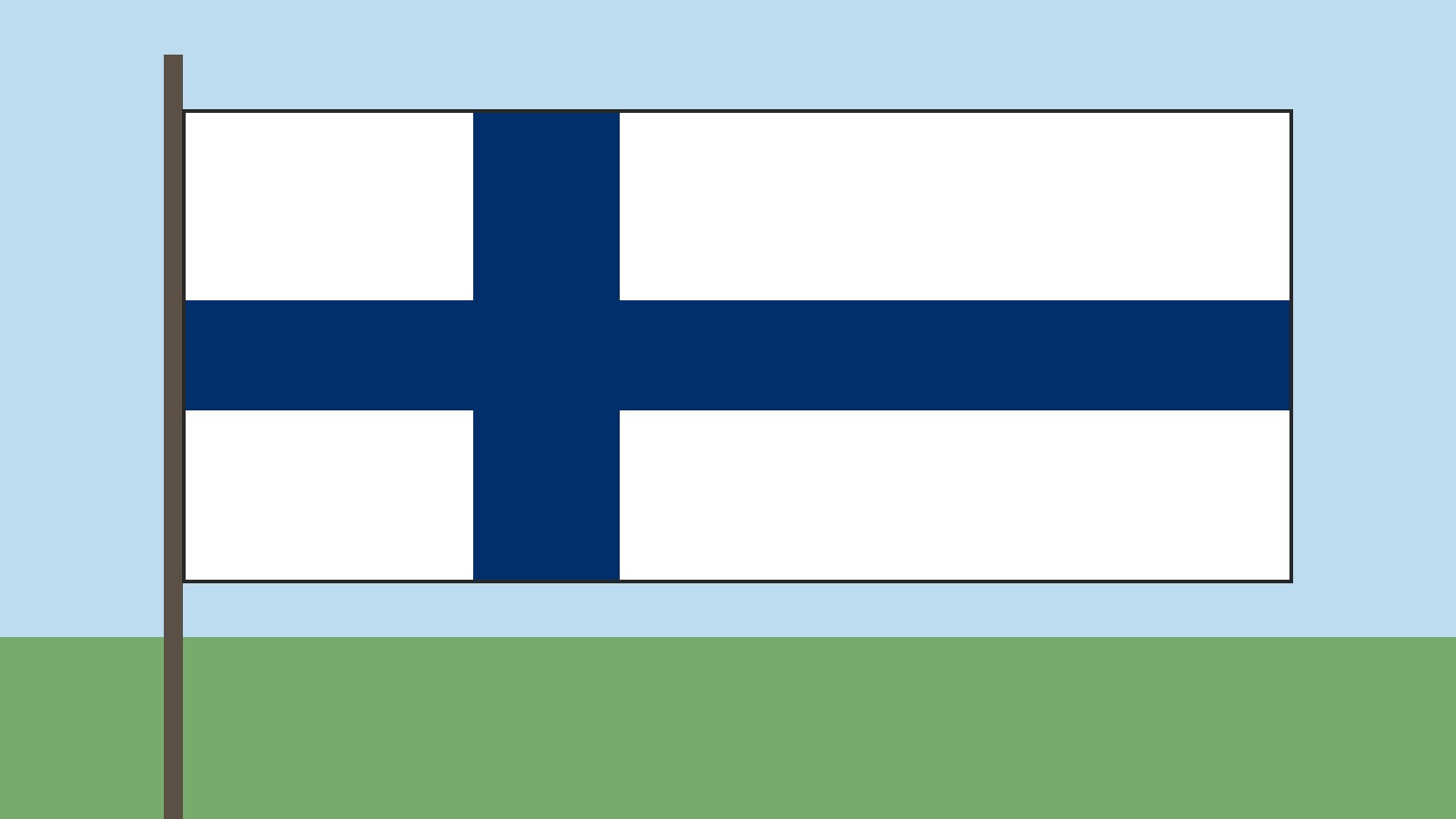
- A flag with a blue cross on white is, in most cases, the flag of Finland. Its Finnish name is Siniristilippu, which means Blue Cross Flag.
- The design is a blue Nordic cross on a white field. The cross reaches all four edges, and its vertical arm sits closer to the hoist, the edge nearest the flagpole, than to the outer edge.
- The plain version, with no emblem, is the national flag used by the public. A version with the Finnish coat of arms at the center of the cross is the state flag.
- The flag was adopted in May 1918, shortly after Finland became independent. Its present legal form is set out in the Act on the Flag of Finland, dated 26 May 1978.
- Do not confuse it with Scotland, Greece, or the Church in Wales. Scotland has a white diagonal cross on a blue field, Greece has a white cross on a blue square in one corner plus stripes, and the Church in Wales flag adds a gold Celtic cross at the center.
- The colors have no meaning stated in the flag law itself. The familiar reading of blue for lakes and sky and white for snow is a popular interpretation, not a legal definition.
The Answer in One Picture
Picture a plain white rectangle. Draw a blue cross on it, but do not center the cross. Move the vertical arm toward the flagpole, so the white rectangle on the hoist side is shorter than on the outer side, and let both arms run to the edges. That is the flag most searchers mean by this phrase.
Three details matter. First, the field is white and the cross is blue, not the other way around. Second, the cross is upright, not diagonal. A diagonal cross, forming an X, belongs to a different identification, kept separate in this publication. Third, the vertical arm is off center, the signature of the Nordic cross shared by Denmark, Sweden, Norway, Iceland, and Finland, each in its own colors.
Use this checklist before reading further. Is the field white? Is the cross blue and upright? Does it reach all four edges? Is the vertical arm closer to the hoist? Is there an emblem at the center? If the answers are yes, yes, yes, yes, and no, the flag is the Finnish national flag. If there is a coat of arms at the center, it is a Finnish state flag. If any earlier answer is no, see the lookalikes below.
How to Read the Design
The flag has only two colors and one shape. The white field is the background. The blue cross is the only figure on the national flag. There are no stars, no stripes, no lettering, and no border. That restraint is itself a clue, because many flags add a second device to a cross design and Finland, in its national flag, does not.
The cross is called a Nordic cross, sometimes also called a Scandinavian cross. The name describes the family, not one country. Denmark is usually credited with the earliest flag of this form. Sweden uses a yellow cross on blue, Norway and Iceland use red crosses outlined in white on blue in different proportions, and Denmark uses a white cross on red. None is a blue cross on white, but the family resemblance explains why the Finnish flag can look familiar before its country is known.
The proportions are fixed by law. Under the Act on the Flag of Finland, the national flag is 11 units high and 18 units long. The cross is 3 units wide. The white fields above and below the horizontal arm are each 4 units high. The hoist side white fields are 5 units long and the outer white fields are 10 units long. The arithmetic checks: 5 plus 3 plus 10 equals 18, and 4 plus 3 plus 4 equals 11. In a concrete example, a flag 110 centimeters high would be 180 centimeters long, with a cross 30 centimeters wide. The law states ratios in units, so the same ratios apply at any size. A picture with a centered cross, or a cross that stops short of the edges, is not an accurate drawing of the Finnish flag, even if the colors are right.
The state flag keeps the same cross and proportions in its rectangular form, but adds the coat of arms of Finland in the square where the cross arms meet. That square has a yellow border, one fortieth of the width of the cross. For identification, the rule is simple: plain blue cross on white means the national flag, and the same cross with the coat of arms at the center means a state flag.
Lookalikes, Disambiguated
Most errors come from four confusions: inverted colors, a diagonal cross, a cross confined to one corner, or an added emblem. Each has a name, and naming it is faster than guessing.
Scotland is the most common confusion, and it fails on two counts at once. The Scottish flag, the Saltire, has a white diagonal cross on a blue field: diagonal, forming an X, with colors reversed. A blue flag with a white X is therefore a different identification from a white flag with a blue upright cross, and this publication keeps the two in separate articles. If the cross you remember is diagonal, use the diagonal cross identification instead. In heraldry, a diagonal cross is called a saltire, while the off center upright cross of the Nordic layout is a Nordic cross.
Greece is the second common confusion. The Greek national flag has nine horizontal stripes, blue and white in turn, and a blue square in the upper hoist corner containing a white cross. A viewer who remembers “a cross, blue and white” may be remembering Greece, but the cross arrangement is reversed: Greece has a white cross on blue, confined to a corner, plus stripes. Finland has a blue cross on white, covering the whole flag, with no stripes. Greece once used a plain blue flag with a white cross on land, which explains why older pictures can confuse, but for the current national flag the test is clear. Stripes mean Greece, not Finland. A cross confined to a corner means Greece, not Finland.
A third lookalike is the flag of the Church in Wales. It does have a blue cross on white, but it adds a gold Celtic cross at the center. It is a church flag, not a national flag, and it was given official status in 1954 after negotiation with the College of Arms, according to standard flag references. Plain blue cross on white, with no center emblem, points to Finland. Blue cross on white with a gold Celtic cross at the center points to the Church in Wales.
The remaining near misses come from the Nordic family and from England. Sweden, Norway, Iceland, and Denmark all use the Nordic layout, but none uses a blue cross on white. England uses a red upright cross, centered, on white, so it differs in color and placement: red, not blue, and centered, not shifted toward the hoist. A separate article covers red and white flags.
| Flag you may mean | Field | Cross | Deciding detail |
|---|---|---|---|
| Finland, national flag | White | Blue, upright, Nordic | Reaches all edges, arm toward hoist, no emblem |
| Finland, state flag | White | Blue, upright, Nordic | Coat of arms at the center |
| Scotland | Blue | White, diagonal | Cross forms an X, colors reversed |
| Greece, national flag | Striped blue and white | White, in a blue corner square | Stripes plus a corner cross |
| Church in Wales | White | Blue, upright | Gold Celtic cross at the center |
| England | White | Red, upright, centered | Red cross, centered |
| Sweden | Blue | Yellow, upright, Nordic | Yellow cross, blue field |
| Denmark | Red | White, upright, Nordic | White cross, red field |
| Norway | Blue | Red, upright, Nordic, outlined in white | Red cross outlined in white, different proportions |
| Iceland | Blue | Red, upright, Nordic, outlined in white | Red cross outlined in white, different proportions and shade |
Use the table from the top down; the first row matching every detail is the answer.
History: From Yacht Clubs to a National Flag
The Finnish flag did not appear fully formed on independence day. Its story begins in the mid nineteenth century, when Finland was a Grand Duchy under the Russian emperor, and runs through yacht clubs, a failed proposal, a provisional lion flag, and a civil war, following the official history published by the President of the Republic of Finland.
The first step was practical. Finnish merchant ships were being attacked by enemies of Russia, and a separate ensign was wanted to distinguish them from Russian vessels. In 1861, Emperor Alexander II approved the rules of the Nyland Yacht Club, allowing members to sail under a white flag with an upright blue cross and the coat of arms of the Province of Nyland in the upper corner. In 1862, similar flags, each with the relevant local coat of arms, were decreed for other yacht clubs. Those flags already held the core idea, a white flag with a blue cross, but they were club flags, not a national flag.
The next step was political, and it failed. In 1863, a proposal for a flag for the whole Grand Duchy was made to the Finnish Diet. It was not taken up, and open efforts for a national flag stopped for a time, although proposals kept appearing in the press. The episode shows the blue and white idea was already in circulation decades before independence, and the obstacle was recognition, not a lack of designs.
During the period of Russification, from 1899 to 1917 in the official account, the question returned, producing the so-called lion flag, based on the coat of arms. Two color combinations were debated: red and yellow from the coat of arms, and blue and white, with most proposals using a cross motif.
Finland declared independence in late 1917. With no consensus on a flag, the lion flag was used provisionally. After the civil war in 1918, a white flag with a blue cross was adopted. The official account stresses that the design matched the other Nordic flags in form, while its colors made it distinct. That is the whole compromise: Nordic in layout, Finnish in color, plain enough for everyone to fly, and free of the lion emblem that had divided opinion.
The 1918 law was later replaced. The present Act on the Flag of Finland is dated 26 May 1978, took effect on 1 June 1978, and revoked the 1918 law. It does not invent a new design. It codifies the flag, states its proportions, defines the state flag and its swallow-tailed form, lists who may use each version, and provides penalties for misuse. In design, the flag has been stable since 1918. A government decision in 1993 slightly darkened the shade of blue in commonly used flags, bringing it closer to the original shade described in flag histories.
One popular claim needs caution. Several secondary sources name Eero Snellman and Bruno Tuukkanen as designers of the winning design, but that claim is not in the official presidential history checked here, and secondary sources disagree on the second name. It is therefore recorded as qualified in the writer ledger, not presented as verified fact. The same applies to any exact shade code: the law defines the design by proportion, not by a commercial code, and this article asserts no code it has not verified from a primary source.
Meaning: What the Colors Do and Do Not Mean
It is tempting to give a flag a neat meaning, one color for one idea, and present it as official. With the Finnish flag, resist that temptation, because the law is precise about shape and use and silent about symbolism. The act defines the flag as a blue cross on a white field. It does not state that blue means lakes, that white means snow, or that the cross means a particular creed. An article presenting those readings as the legal meaning would add something the law does not contain.
The popular reading is still worth explaining, because it is what most visitors will hear. In that reading, blue stands for lakes and sky, and white stands for snow in winter. The pairing is old, used as Finnish colors long before independence. Present it in exactly those terms: a familiar popular interpretation, not a definition in the flag law.
The cross needs the same care. The Nordic cross form comes from a Christian tradition in northern Europe, and the family shares that form. It is reasonable to say the cross places Finland visually within the Nordic community, with historical Christian associations for the form. It is not reasonable to claim the law defines the cross as a religious statement, or that flying the flag today is a religious act. The flag functions as a national symbol, flown by citizens of many beliefs and of none. Its meaning in use is national and civic first, and any religious association belongs to the history of the form.
A quieter meaning comes from use. Because anyone may fly the national flag, it is a flag of ordinary citizenship, not only of the state, seen at summer cottages, on Midsummer Eve, and on Independence Day as well as on parliament and embassies. That shared ownership helps explain why the design has lasted without major change.
Note also what the flag does not claim: no widely accepted legend of a flag falling from the sky. Its origin is documented and debated.
The Variants: National, State, Military, and Presidential
Finland has a family of flags from one design, each with a defined user. The national flag is the plain blue cross on white, 11 to 18 in proportion. Everyone has the right to fly it. It is the nationality mark of Finnish vessels, with exceptions for pleasure craft, and the flag seen at public events and in most photographs. When this article says “the flag of Finland” without qualification, it means this flag.
The rectangular state flag has the same proportions, but bears the coat of arms in the square formed by the crossbars, with a yellow border one fortieth of the cross width. It is used by parliament, ministries, agencies, courts, diplomatic missions, and comparable bodies listed in the act, not by private citizens as a matter of course.
The swallow-tailed state flag is one unit longer, so its proportions are 11 to 19, with outer fields 6 units long and tongues 5 units long. The middle tongue is isosceles, with the crossbar as its base. This tailed form is the war flag and naval ensign, used by the Defence Forces, and it is the flag most likely to be seen on a warship or at a military ceremony. Its forked end marks it out at a distance.
The presidential standard is derived from the tailed state flag, with the Cross of Liberty, also called the Cross of Freedom, added in the upper hoist corner. A tailed flag with an extra cross in the corner is therefore the presidential standard, not a damaged national flag. The coat of arms, a crowned lion on red holding a sword and trampling a sabre, is defined in a separate arms act dated the same day as the flag act. The lion belongs to the arms, not to the national flag, which is why the plain flag has no lion and no red.
Flag Days and How the Flag Is Used
Finland has official flag days, on which the flag is flown from public buildings and, by recommendation, by private citizens as well. The University of Helsinki Almanac Office gives seven each year, plus election days and the day the President takes office: Kalevala Day on 28 February; May Day on 1 May; Mother’s Day on the second Sunday in May; Defence Forces Flag Day on 4 June; Midsummer Day, the Day of the Finnish Flag, on the Saturday between 20 and 26 June; Father’s Day on the second Sunday in November; and Independence Day on 6 December.
Midsummer is both a seasonal festival and the Day of the Finnish Flag, and the flag is flown through Midsummer night. Independence Day marks the declaration adopted on 6 December 1917. Together they frame the flag year: one celebrating land and light, the other celebrating the state.
Beyond official days, customary flag days are entered in the State Calendar after flag flying has become established, often following Ministry of the Interior recommendations. The customary list changes over time, so no fixed customary list is presented here as permanent. Official days are set by decree, customary days grow by practice, and both are real parts of Finnish flag culture.
The Ministry of the Interior states the basic right plainly: citizens may fly the national flag when they have a reason to do so, even on dates not in the calendar. That right is balanced by respectful use rules. The act provides fines for damaging the flag, treating it disrespectfully, taking down an openly displayed flag without permission, using a presidential or other state flag without permission, or selling a flag with prohibited extra signs. Raising and lowering times and half mast use are set in separate decrees and Ministry guidance, so anyone flying the flag for an official occasion should check current guidance. For ordinary use, three habits suffice: fly the national flag, not a state flag, unless entitled to the state flag; fly it whole, clean, and undamaged; and take it down rather than leaving it to fray. A pennant on a pole is also commonly replaced by the flag on flag days.
How to Draw It and Check a Picture
To draw the flag, start with a rectangle 11 units high and 18 units long. Mark the horizontal arm 3 units high, with 4 units above and below it, and the vertical arm 3 units wide, with 5 units on the hoist side and 10 units on the outer side. Color the cross blue and leave the rest white. Add the coat of arms for the state flag, or extend the outer side into three tongues for the tailed flag.
To check a photograph, remember that a flag in wind rarely shows its full rectangle, and an angled photograph can make the cross look centered or hide the hoist side. Look for a second view or for context: a building, a uniform, a ship, or a caption. A ship most likely flies the national flag, unless it is a state vessel. A military ceremony most likely uses a tailed flag.
Name the common mistakes together and they are easier to avoid. Do not call the flag Swedish, Norwegian, or Danish because it has a Nordic cross; color decides the country. Do not call it Scottish because it is blue and white; the Scottish cross is diagonal and white on blue. Do not add stripes in memory; stripes belong to Greece and other flags, not Finland. Do not assume any blue cross on white with an emblem must be Finland with something added; the emblem decides. Do not treat popular color meanings as law; history explains the form, law defines the design, and popular culture supplies the landscape reading.
FAQ
Is a flag with a blue cross on white the flag of Finland?
In most cases, yes. If the cross is upright, reaches all four edges, sits closer to the hoist, and has no emblem at the center, it is the Finnish national flag. With a coat of arms at the center, it is a Finnish state flag. Check the lookalike table first if any detail differs.
What is the Finnish flag called in Finnish?
It is called Siniristilippu, which means Blue Cross Flag.
When was the Finnish flag adopted?
The design was adopted in May 1918, after independence in late 1917 and after the civil war of 1918. The present act is dated 26 May 1978 and took effect on 1 June 1978, replacing the 1918 law while keeping the same design.
What are the proportions of the Finnish flag?
The national flag is 11 units high and 18 units long. The cross is 3 units wide. White fields above and below the horizontal arm are each 4 units high. Hoist side fields are 5 units long and outer fields are 10 units long. The tailed state flag is 11 units high and 19 units long.
What is the difference between the national flag and the state flag?
The national flag is the plain blue cross on white, and anyone may fly it. The state flag adds the coat of arms at the center, with a yellow border around that square, and is used by parliament, ministries, courts, diplomatic missions, and comparable state bodies. The tailed state flag is longer and is used by the Defence Forces.
What do the blue and white colors mean?
The law states no meaning for the colors. The popular interpretation links blue with lakes and sky and white with snow in winter. That is a memory aid, not a legal definition. The cross form places Finland in the Nordic family, with historical Christian associations for the form, but the law defines the design, not a religious meaning for flying the flag today.
Is the Finnish flag the same as the Scottish flag?
No. Scotland has a white diagonal cross on a blue field. Finland has a blue upright cross on a white field. A blue flag with a white X is a different identification, kept in a separate article.
Is the Finnish flag the same as the Greek flag?
No. Greece has nine blue and white stripes and a white cross on a blue square in the upper hoist corner. Finland has no stripes and a blue cross covering the whole white field.
What is the flag with a blue cross on white and a gold cross in the middle?
That is most likely the flag of the Church in Wales, with a blue cross on white and a gold Celtic cross at the center, given official status in 1954. A Finnish state flag has the coat of arms at the center, not a gold Celtic cross.
When is the Finnish flag flown?
On official flag days: 28 February, 1 May, the second Sunday in May, 4 June, the Saturday between 20 and 26 June, the second Sunday in November, and 6 December, plus election days and the day the President takes office. Citizens may also fly it when they have a reason to do so.
Can anyone fly the Finnish flag?
Yes, for the national flag. The act states everyone has the right to fly it. State flags, the presidential standard, and military flags are restricted to their defined users.
What shade of blue is the Finnish flag?
The law describes it as blue, commonly called sea blue in secondary sources. A 1993 decision slightly darkened the shade in commonly made flags. This article asserts no single commercial color code, because the primary sources checked define the design by proportion, not by a commercial code.
Sources & references
- President of the Republic of Finland, official symbols pages. History from yacht club flags through the lion flag to adoption of the white flag with a blue cross after the civil war in 1918; current flag family including the basic flag, the military banner, and the presidential standard with the Cross of Freedom in the upper corner.
- Act on the Flag of Finland, 380/1978. Blue cross on a white field; national flag 11 to 18, cross width 3 units, fields 4 units high, hoist fields 5 units long, outer fields 10 units long; state flag coat of arms with a yellow border one fortieth of the cross width; tailed flag one unit longer; right of everyone to fly the national flag; state flag users; dated 26 May 1978, in effect from 1 June 1978, revoking the 1918 law.
- Ministry of the Interior, Finland. Citizens may fly the national flag when they have a reason to do so, including on dates not in the calendar, subject to prescribed flying times and rules.
- University of Helsinki, Almanac Office. Seven official flag days plus election days and the presidential inauguration day; Midsummer Day as the Day of the Finnish Flag on the Saturday between 20 and 26 June; official versus customary flag days and the role of the State Calendar.


