Short answer
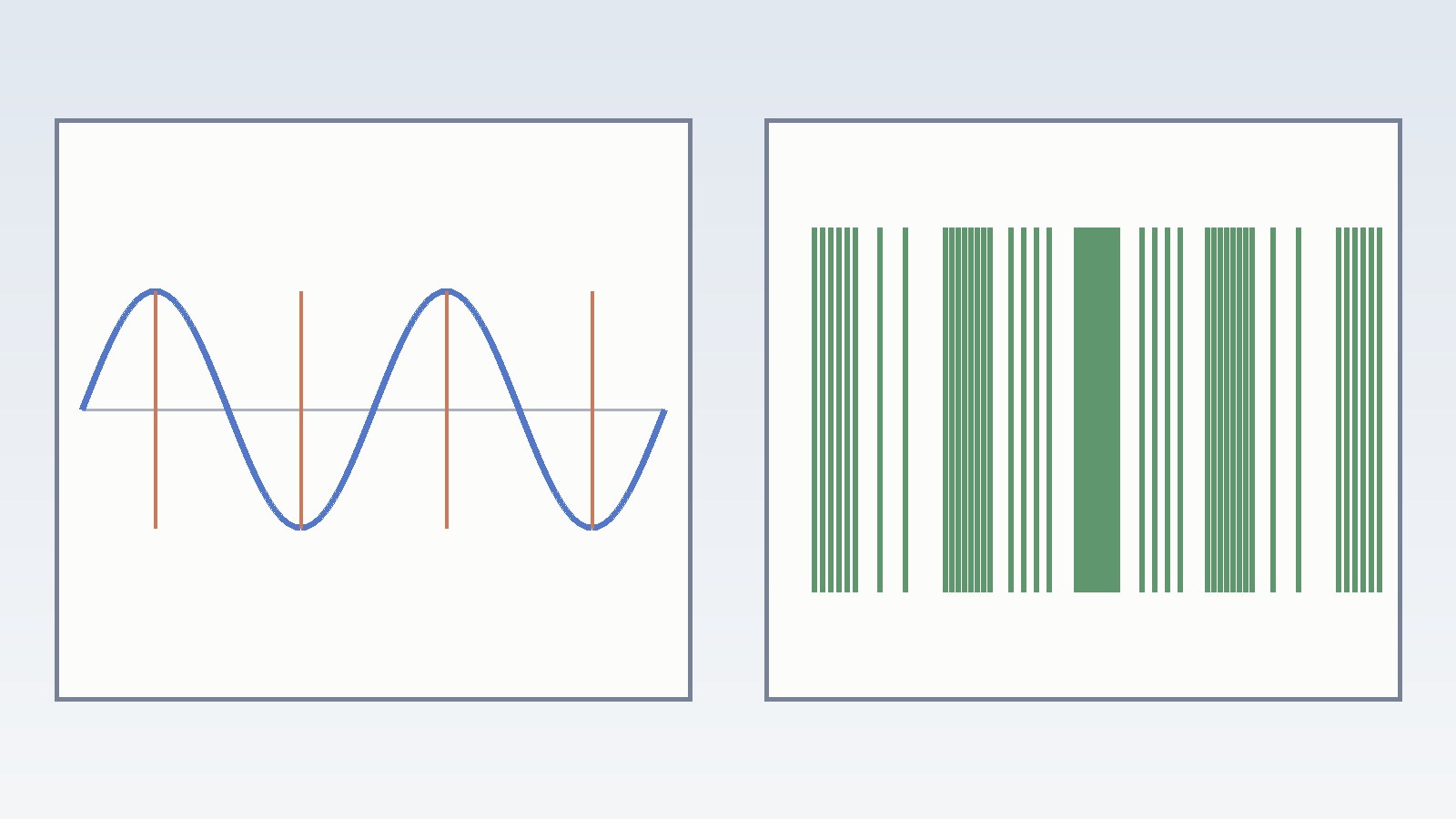
- A mechanical wave is a disturbance that travels through a medium, which is a material such as a solid, a liquid, or a gas, and transfers energy from one place to another without carrying the medium itself along with it. The particles of the medium oscillate, or move back and forth, around their resting positions while the pattern of the disturbance moves on. Because the wave is a disturbance of matter, it cannot travel through a vacuum, where there is no matter to disturb. There are three types of mechanical waves. In a transverse wave, the particles of the medium move at a right angle to the direction the wave travels. In a longitudinal wave, the particles move back and forth along the same line as the direction the wave travels, forming compressions, where the medium is crowded together, and rarefactions, where it is spread out. In a surface wave, the particles move in a combination of both directions, in roughly circular paths, as the wave travels along a boundary such as the surface of water. Every mechanical wave can be described by its amplitude, which is the maximum displacement of the medium from its resting position; its wavelength, which is the distance between two matching points on the wave; its frequency, which is the number of complete cycles passing a point each second, measured in hertz; its period, which is the time for one complete cycle; and its speed, which follows the relation speed equals wavelength times frequency. Sound, water waves, seismic waves, and waves on a string are all mechanical waves. Light is not: light is an electromagnetic wave, and it can travel through a vacuum.
Introduction
Drop a stone into a still pond and rings spread outward across the surface. Speak across a room and someone on the other side hears you. Shake one end of a rope and a hump travels along it. Each of these events is a mechanical wave at work: a disturbance that moves through a material and carries energy from one place to another.
Mechanical waves are easy to confuse with the things that carry them. The water in the pond does not rush across the pond with the rings. The air in the room does not stream from the speaker to the listener. The rope does not slide along its own length. In each case, the material stays roughly where it was, and the pattern of disturbance is what travels. That distinction is the key to the whole topic, and it explains why mechanical waves behave so differently from light and other electromagnetic waves.
This guide defines mechanical waves in plain language, explains the three types, and works through the properties physicists use to describe any wave: amplitude, wavelength, frequency, period, and speed. It also looks at familiar examples, including sound, water waves, waves on a string, and seismic waves, and it explains why a mechanical wave cannot cross empty space. A fuller side by side comparison of transverse and longitudinal motion is covered in the companion article on transverse waves compared with longitudinal waves, so this article keeps that comparison brief and focuses on the category as a whole.
What Is a Mechanical Wave?
In physics, a wave is a disturbance that moves from its point of origin to another location. A mechanical wave is the kind of wave that is a disturbance of matter itself. The medium can be a solid, such as rock or a stretched string; a liquid, such as water; or a gas, such as air. The Georgia Tech Physics Book states the definition directly: mechanical waves propagate through matter, in the form of a gas, a liquid, or a solid, and they require a medium in order to transport energy. The same source adds the consequence that matters most for this article: inherently, these waves cannot travel through a vacuum.
That requirement sets up a simple test for any wave you meet. Ask whether the wave could exist with the material removed. If removing the material removes the wave, the wave is mechanical. Sound fails the vacuum test. A bell rung inside a sealed container from which the air has been pumped out cannot be heard outside, because there is no air left to carry the compressions and rarefactions to the wall of the container and onward. A wave on a string fails the test in the same way: take away the string and there is nothing left to oscillate. Light passes the test in the opposite direction. Sunlight crosses the near vacuum of space to reach Earth, which is possible precisely because light is not a mechanical wave.
A mechanical wave also needs an initial input of energy. Nothing starts oscillating on its own. A hand shakes the rope, a stone strikes the water, vocal cords vibrate the air, or a sudden slip of rock releases energy into the ground. Once started, the disturbance spreads because each part of the medium passes the disturbance to its neighbor. That neighbor to neighbor handoff is what makes the wave travel, and it is why the properties of the medium, rather than only the strength of the original push, help decide how fast the wave moves.
For a medium to carry a mechanical wave, it must be able to be displaced from its resting position and then pulled back toward it. Physicists describe this using two ideas: elasticity, which provides the restoring force that pulls a displaced part of the medium back, and inertia, which is the tendency of matter to keep moving once set in motion and therefore to overshoot the resting position. The interplay of those two properties produces the repeating back and forth motion of a wave, and the Georgia Tech Physics Book notes that wave speed depends on the elastic and inertial properties of the medium.
How a Wave Carries Energy Without Carrying Matter
The most common misunderstanding about mechanical waves is the idea that the medium travels with the wave. It does not, except for a small local oscillation. OpenStax University Physics makes the point clearly for a wave on a string: the particles of the medium oscillate around an equilibrium position as the wave propagates, and the wave speed is not the speed of the particles. The wave moves steadily forward, but any single piece of the medium only moves back and forth around its own resting place.
A floating leaf on a pond shows this well. When ripples pass, the leaf bobs up and down but does not surf across the pond on the wave. The energy of the falling stone has still traveled outward, because the ripples reach the far edge of the pond and disturb the water there.
Sound works the same way. When a speaker cone moves forward, it squeezes the air in front of it into a compression, a region of slightly higher pressure. When the cone moves back, it leaves a rarefaction, a region of slightly lower pressure. Each small region of air passes that squeeze and stretch to the next region, so the pattern travels across the room while no individual pocket of air makes the whole journey. Your ear detects the arriving pattern of pressure changes and you hear the sound.
This is also why a wave can do work at a distance from its source. A water wave can move sand on a beach, a sound wave can vibrate an eardrum, and a seismic wave can shake a building far from the earthquake that produced it. In each case, energy that started at the source arrives at the destination carried by the pattern of disturbance, not by a stream of material flowing from the source.
The Three Types of Mechanical Waves
Physicists classify mechanical waves by comparing two directions: the direction the wave travels and the direction in which the particles of the medium move. That single comparison gives three types: transverse, longitudinal, and surface.
A fuller treatment of the first two types, with diagrams described in words, worked comparisons, and common exam traps, is given in the companion article comparing transverse and longitudinal waves. The summaries below give enough detail to understand the category, and they point to that comparison rather than repeating it.
Transverse Waves
In a transverse wave, the particles of the medium oscillate at a right angle to the direction the wave travels. Shake a rope up and down and a hump travels along the rope. The wave travels along the rope, but each part of the rope moves up and down. The same geometry applies to a wave on a guitar string and to the sideways shaking of ground in a seismic shear wave.
Transverse waves show crests, the highest points above the resting position, and troughs, the lowest points below it. Not every transverse wave is mechanical: light is also transverse, yet it needs no medium. A mechanical transverse wave needs a medium that can support a sideways restoring force, as tension does in a string.
Longitudinal Waves
In a longitudinal wave, also called a compressional wave, the particles of the medium oscillate back and forth along the same line as the direction the wave travels. Sound in air is the classic example. A vibrating source alternately squeezes and stretches the air, and the resulting pattern of compressions and rarefactions travels outward. A stretched spring pushed and pulled along its own length shows the same pattern in visible form: crowded coils and spread out coils travel along the spring while each individual coil stays near its own resting place.
Longitudinal waves do not have crests and troughs. Their landmarks are compressions, where the medium is crowded together and the pressure is higher, and rarefactions, where it is spread out and the pressure is lower. Because compression is possible in solids, liquids, and gases alike, longitudinal waves can travel through all three states of matter.
Surface Waves
Surface waves travel along the boundary between two media, most familiarly the surface of water where water meets air. Their particle motion combines both patterns described above: particles move partly along the direction of travel and partly at a right angle to it, tracing roughly circular paths. That is why a floating object bobs in a circle-like motion as a water wave passes, rising and falling while also moving slightly forward and back.
Seismic surface waves are the other major example. The United States Geological Survey notes that surface waves are generally the largest waves recorded from an earthquake, and that they are the slowest to arrive on seismograms.
The Properties of a Mechanical Wave
Five quantities describe almost any mechanical wave you will meet in an introductory course. They are amplitude, wavelength, frequency, period, and speed. Learning what each one measures, and how the last three are linked, makes every wave diagram and every worked problem much easier to read.
Amplitude, given the symbol A, is the maximum displacement of the medium from its resting position. For a transverse wave, it is the height of a crest above the resting line or the depth of a trough below it. For a longitudinal sound wave, amplitude can be described either as the maximum displacement of the air or as the maximum change in pressure in a compression. A larger amplitude means a larger disturbance, and in general it means the wave carries more energy. This article states that link qualitatively only, because the exact energy relation depends on the type of wave and the medium.
Wavelength, given the Greek letter lambda, is the distance between two matching points on successive cycles of the wave. For a transverse wave, it is most often measured from one crest to the next crest, or from one trough to the next trough. For a longitudinal wave, it is most often measured from one compression to the next compression, or from one rarefaction to the next rarefaction. Wavelength is a distance, so it is measured in meters in the metric system.
Frequency, given the symbol f, is the number of complete cycles that pass a fixed point each second. Its unit is the hertz, where one hertz means one cycle per second. For sound, frequency is closely tied to pitch: a higher frequency sound is heard as higher pitched. Frequency is set by the source, and it stays the same as the wave travels, even if its speed and wavelength change when it enters a new medium.
Period, given the symbol T, is the time taken for one complete cycle to pass a fixed point. It is measured in seconds. Frequency and period are reciprocals of each other, which means that if you know one, you can find the other. The relations are frequency equals one divided by the period, and period equals one divided by the frequency. A wave with a frequency of 10 hertz has a period of one tenth of a second, because ten cycles fit into each second.
Speed, given the symbol v, is how fast the pattern of disturbance travels through the medium. It is measured in meters per second. Speed is not the same as the speed of any particle of the medium. The particles oscillate back and forth, sometimes quickly, but their motion is local. The wave speed is the speed of the pattern itself.
The Wave Speed Relation, With a Worked Example
The three quantities speed, wavelength, and frequency are linked by a single relation that holds for all types of waves. OpenStax University Physics states it in the form speed equals wavelength divided by period, which is the same as speed equals wavelength times frequency, because frequency is one divided by the period. Written with symbols, the relation is v equals lambda times f. The Georgia Tech Physics Book gives the same relation for mechanical waves.
The relation is easy to picture. In one period, the wave advances by exactly one wavelength, because one full cycle has passed. So the distance traveled in one second, which is the speed, equals the distance per cycle multiplied by the number of cycles per second.
A worked example makes the arithmetic concrete. Suppose a sound wave travels through air at about 343 meters per second, and its frequency is 100 hertz. Rearranging the relation to wavelength equals speed divided by frequency gives 343 divided by 100, which is 3.43 meters. That is the distance between one compression and the next compression in that sound wave. If the frequency doubled to 200 hertz while the speed stayed the same, the wavelength would halve to about 1.72 meters, because the same speed must now fit twice as many cycles into each second.
Two cautions keep this relation honest. First, changing the frequency at the source does not change the wave speed in a given medium under fixed conditions; it changes the wavelength instead. Second, when a wave enters a different medium, its speed and wavelength change while its frequency, set by the source, stays the same.
What Sets the Speed of a Mechanical Wave?
Wave speed is mainly a property of the medium, not of the wave itself. As noted above, it depends on the elastic and inertial properties of the material: how strongly the medium resists being deformed and springs back, and how much mass must be moved. A stiffer medium generally transmits a disturbance faster, because the restoring force is stronger. A denser medium generally transmits it more slowly, because more mass must be set in motion, although in practice stiffness and density often change together, so the result depends on the balance between them.
Temperature also matters, especially for sound in gases. OpenStax based tables list the speed of sound in air as 331 meters per second at 0 degrees Celsius and 343 meters per second at 20 degrees Celsius, and the speed of sound in fresh water as 1,480 meters per second at 20 degrees Celsius. The comparison is instructive: sound travels more than four times faster in water than in air at the same temperature, because water is far less compressible than air even though it is denser. A solid such as steel transmits sound faster still, because its stiffness is very high.
For seismic waves, the same principle explains an observation that matters in earthquake science. The United States Geological Survey explains that P waves, the compressional waves from an earthquake, travel fastest and arrive first, while S waves, the shear waves, generally travel at about 60 percent of the speed of P waves in rock and always arrive after them. Seismologists use the time gap between the two arrivals to estimate how far away an earthquake occurred, because the gap grows as the waves travel farther.
Examples of Mechanical Waves in Everyday Life
Sound is the mechanical wave most people meet first. It is a longitudinal wave in air, water, or solid material, produced by a vibrating source such as vocal cords, a speaker cone, a musical instrument, or a slamming door. Sound cannot travel through a vacuum, which is why space is silent in the everyday sense even though energetic events happen there. Sound can be reflected, producing an echo, and it can be absorbed by soft materials, which is why a furnished room sounds quieter than an empty one.
Water waves are the most visible mechanical waves. Wind, a dropped stone, or a moving boat can all create surface waves. In deep water, particle motion is roughly circular. Near the shore, the water becomes shallow, the waves slow, steepen, and break.
Waves on a string or rope are the classroom standard because they are slow enough to see. Shaking a rope or plucking a guitar string produces transverse waves whose crests and troughs are visible, and these waves also show reflection clearly at a fixed or free end.
Seismic waves are mechanical waves traveling through Earth itself. Earthquakes generate body waves that travel through the interior, P waves that compress and stretch rock along their path and S waves that shake rock from side to side, plus surface waves that travel along the ground surface. The United States Geological Survey notes that P waves can pass through solids, liquids, and gases, since all can be compressed, while S waves, which need a material that resists shear, travel only through solids. That difference is one line of evidence for the liquid outer core of Earth, since S waves from distant earthquakes do not arrive through regions that would require them to cross a liquid layer.
How Mechanical Waves Differ From Electromagnetic Waves
The contrast with electromagnetic waves is the cleanest way to fix the definition of a mechanical wave in memory. Electromagnetic waves, including visible light, radio waves, microwaves, infrared radiation, ultraviolet radiation, X-rays, and gamma rays, are oscillations of electric and magnetic fields. They do not need a material medium, and they travel through a vacuum. Mechanical waves are oscillations of matter, and they need a medium.
That single difference explains a set of everyday facts. You can see the Sun even though space between the Sun and Earth is close to a vacuum, because light crosses it. You cannot hear an explosion on the Moon from Earth, because there is no air bridging the gap to carry a sound wave. A radio signal can reach a spacecraft in deep space, while a shout cannot.
The two families also differ in their transverse and longitudinal possibilities. All electromagnetic waves in free space are transverse. Mechanical waves can be transverse, longitudinal, or surface waves, depending on the medium and the source. Sound in air is longitudinal, while light is transverse, so the two familiar waves differ in geometry as well as in their need for a medium.
Speed is another difference, stated here without a precise figure for light, because the point is qualitative: electromagnetic waves in a vacuum travel far faster than sound travels in air, which is why you see lightning before you hear thunder from the same storm. The delay between flash and thunder grows with the distance to the storm, and it is a direct everyday demonstration that two waves from one event can travel at very different speeds.
Common Misconceptions, Corrected
The first misconception is that the medium moves with the wave. It does not. A wave transports energy and a pattern, while the medium oscillates locally. If you watch a single marked point on a rope, it moves up and down in place. It never rides the wave to the far end.
The second misconception is that sound can travel through space because movies show noisy explosions in space. In reality, sound needs a medium, and the near vacuum of space provides almost none. A spacecraft crew would hear sounds transmitted through the solid structure of their own craft, because that structure is a medium, but they would not hear a distant explosion across empty space.
The third misconception is that a bigger wave always travels faster. Amplitude and speed are separate properties: shaking a rope end harder makes a larger disturbance, but the wave speed is set by the tension and mass of the rope, not by how hard it was shaken.
The fourth misconception is that all waves need a medium. That is true of mechanical waves only. Electromagnetic waves are the exception, and they are the reason the vacuum test is a useful classifier rather than a universal rule for all waves.
The fifth misconception is that transverse and longitudinal are just two names for the same thing. They are not. They describe different geometries of motion, they appear in different media, and they behave differently at boundaries and in instruments. Keeping the geometry test in mind, which way does the medium move compared with which way does the wave travels, prevents most classification errors.
Frequently Asked Questions
What is a mechanical wave in simple terms?
A mechanical wave is a moving disturbance in a material, such as air, water, or rock, that carries energy from one place to another. The material itself only wiggles back and forth around its resting position. The energy and the pattern move on, but the material stays behind.
What are the three types of mechanical waves?
The three types are transverse waves, in which the medium moves at a right angle to the direction of travel; longitudinal waves, in which the medium moves back and forth along the direction of travel, forming compressions and rarefactions; and surface waves, in which the medium moves in a combination of both directions along a boundary, such as the surface of water.
Can mechanical waves travel through a vacuum?
No. A mechanical wave is a disturbance of matter, so it needs matter to disturb. In a vacuum, there is no medium, and the wave cannot propagate. This is the defining difference between mechanical waves and electromagnetic waves, which can travel through a vacuum.
What is the difference between a mechanical wave and an electromagnetic wave?
A mechanical wave needs a medium and is an oscillation of matter. An electromagnetic wave needs no medium and is an oscillation of electric and magnetic fields. Sound, water waves, and seismic waves are mechanical. Light and radio waves are electromagnetic.
What is the formula for wave speed?
Wave speed equals wavelength times frequency, written as v equals lambda times f. It can also be written as speed equals wavelength divided by period, because frequency is one divided by the period. If you know any two of speed, wavelength, and frequency, you can calculate the third.
Is sound a mechanical wave?
Yes. Sound is a longitudinal mechanical wave. A vibrating source creates alternating compressions and rarefactions in a medium such as air, water, or a solid, and that pattern travels outward. Because it needs a medium, sound cannot travel through a vacuum.
Why do P waves arrive before S waves after an earthquake?
P waves are compressional waves that travel faster through rock than S waves. The United States Geological Survey states that S waves in rock generally travel at about 60 percent of the speed of P waves, so P waves reach a distant seismograph first, and the growing time gap helps seismologists estimate the distance to the earthquake.
What is an example of a mechanical wave that is not sound?
A wave on a rope or a guitar string is a transverse mechanical wave. Ripples on the surface of water are surface mechanical waves. Seismic waves include longitudinal, transverse, and surface types in one event.
Keep reading: Transverse Wave vs Longitudinal Wave: How Each One Moves, and How to Tell Them Apart
Sources & references
- OpenStax, University Physics Volume 1, section 16.2 Mathematics of Waves. Page opened and read 29 October 2026. Covers the wave function, amplitude, wavelength, period, and the relations speed equals wavelength divided by period and speed equals wavelength times frequency, and states that particles of the medium oscillate around an equilibrium position while the wave propagates.
- Georgia Tech Physics Book, Mechanical Waves. Page opened and read 29 October 2026. Covers the definition of mechanical waves as waves that propagate through matter in the form of a gas, a liquid, or a solid, the requirement of a medium, the impossibility of travel through a vacuum, the three types transverse, longitudinal, and surface, the relation speed equals wavelength times frequency, and the dependence of speed on elastic and inertial properties of the medium.
- United States Geological Survey, Body waves inside the earth. Page opened and read 29 October 2026. Covers P waves as compressional waves vibrating in the direction of propagation, S waves as shear waves oscillating perpendicular to propagation, S waves in rock generally traveling at about 60 percent of the speed of P waves, surface waves as the largest recorded waves and the slowest to arrive, and sound waves as P waves at audible frequencies.
- OpenStax based Speed of Sound table, via LibreTexts, section 17.3 Speed of Sound. Page opened and read 29 October 2026. Lists the speed of sound in air as 331 meters per second at 0 degrees Celsius and 343 meters per second at 20 degrees Celsius, and the speed of sound in fresh water as 1,480 meters per second at 20 degrees Celsius.


