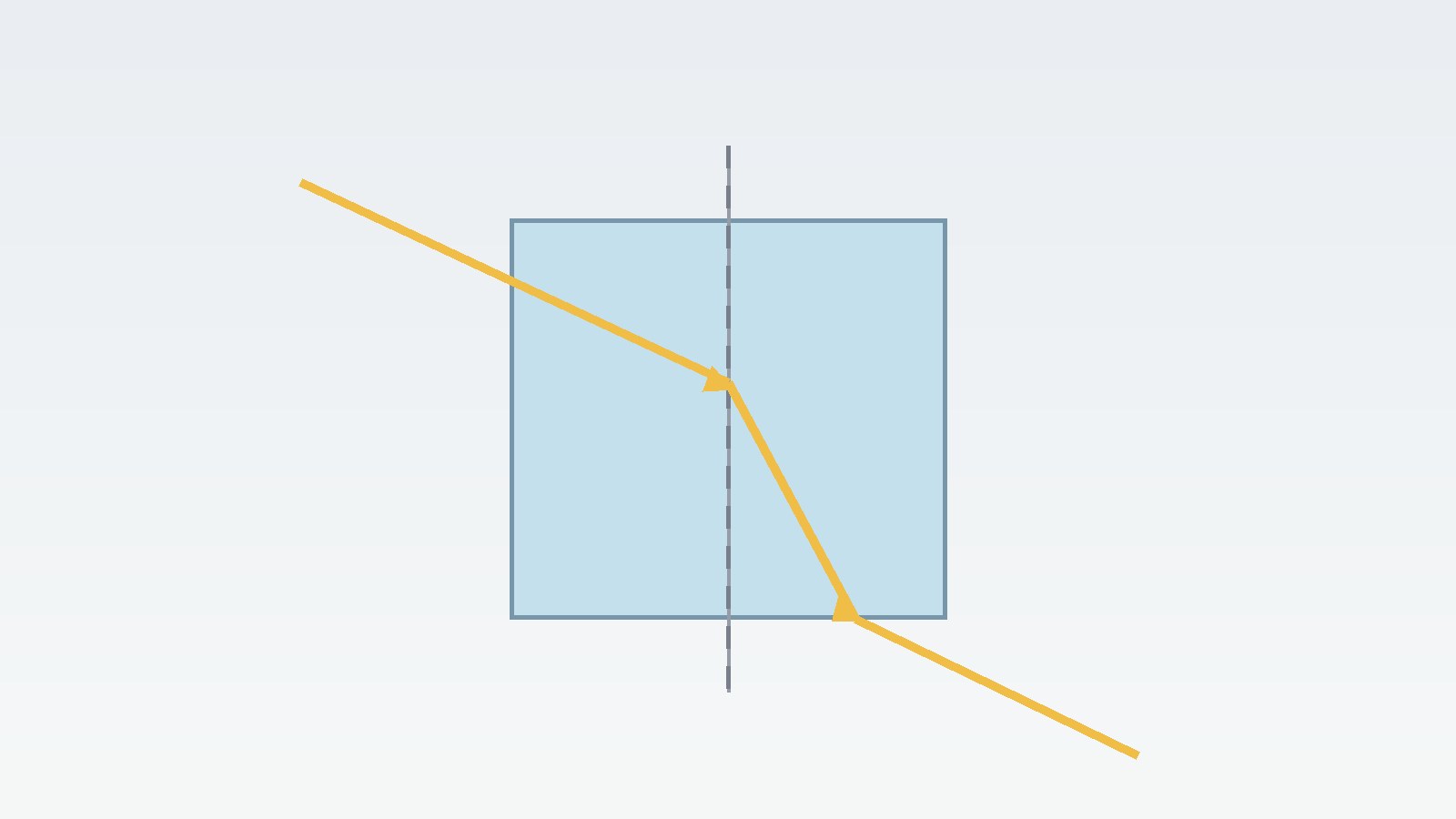
Short answer
- Refraction is the change in direction of a wave when it passes from one medium into another and its speed changes. For light, this happens at the boundary between two transparent materials, such as air and water or air and glass. Light travels at different speeds in different materials, and when a ray crosses the boundary at an angle, one side of the wavefront changes speed before the other side does, which turns the direction of travel. The amount of bending is described by the refractive index, written as n, which is the speed of light in a vacuum divided by the speed of light in the material. Snell's law relates the angles and the indices on the two sides of the boundary: n1 times sin theta1 equals n2 times sin theta2, where theta1 is the angle of incidence and theta2 is the angle of refraction, both measured from the normal. When light enters a material with a higher refractive index, it bends toward the normal. When it enters a material with a lower refractive index, it bends away from the normal. When it strikes the boundary head on, at zero degrees to the normal, it does not bend at all, although it still changes speed. Refraction is different from reflection, in which light bounces off a surface and stays in the same medium. It is also different from total internal reflection, in which light traveling toward a lower index medium at a steep enough angle cannot cross the boundary at all and is reflected entirely back into the original medium. Total internal reflection is a limiting case that arises from the same law, not a separate kind of bending.
Introduction
Put a pencil in a glass of water and look at it from the side. The pencil looks broken at the surface, even though you know it is straight. Look into a swimming pool and the bottom looks closer than it really is. All these effects, and rainbows too, come from the same physical process: refraction.
Refraction is the bending of a wave when it passes from one medium into another and changes speed. It is most familiar with light, because light is what we see with, but it is not limited to light. Sound waves refract when they travel through air layers of different temperatures. Ocean waves refract as they approach a beach. Seismic waves refract inside the Earth. Wherever a wave crosses into a region where it travels at a different speed, and wherever it crosses at an angle, its direction changes.
This article explains what refraction is, why it happens, and how to predict it, with worked examples, the difference between ordinary refraction and total internal reflection, and everyday cases from lenses to rainbows and mirages.
What Refraction Is, in Plain Terms
A wave can be pictured as a series of wavefronts, like the ripples spreading from a stone dropped in a pond. A ray is a line drawn perpendicular to the wavefronts that shows the direction the wave is traveling. In the ray picture, refraction is a change in the direction of the ray at a boundary.
The key idea is speed. Light travels fastest in a vacuum, at exactly 299,792,458 meters per second. In air it travels almost as fast. In water it travels at roughly three quarters of its vacuum speed. In ordinary glass it travels at roughly two thirds of its vacuum speed. In diamond it travels at roughly two fifths of its vacuum speed. Whenever light moves from one of these materials into another, its speed changes at the boundary.
The Normal, the Angle of Incidence, and the Angle of Refraction
To describe refraction precisely, physicists use the normal and two angles. The normal is an imaginary line drawn perpendicular to the surface at the exact point where the ray strikes it. It is a measuring reference, like the zero mark on a protractor.
The incident ray arrives at the boundary, and the angle of incidence, theta1, is the angle between the incident ray and the normal. The refracted ray continues into the second medium, and the angle of refraction, theta2, is the angle between the refracted ray and the normal. Both angles are measured from the normal, not from the surface.
Two rules of direction follow from the speed change. When light passes into a medium where it travels more slowly, the ray bends toward the normal, so the angle of refraction is smaller than the angle of incidence. When light passes into a medium where it travels faster, the ray bends away from the normal, so the angle of refraction is larger. These rules describe the transmitted ray. At most boundaries part of the light is also reflected, following the law of reflection instead.
The Refractive Index
The refractive index, written as n, is a single number that summarizes how much a material slows light down. It is defined as the speed of light in a vacuum, written as c, divided by the speed of light in the material, written as v. In symbols, n equals c divided by v. Because the speed of light in a vacuum is the fastest speed light can travel, the refractive index of any material is always 1 or greater. A vacuum itself has an index of exactly 1. Air has an index of about 1.0003, so close to 1 that it is usually taken as 1.00 in textbook calculations. Water has an index of about 1.33. Crown glass has an index of about 1.52. Diamond has an index of about 2.42.
The refractive index is sometimes described as optical density, which is not the same as mass density. Optical density means how strongly a material slows light, and it is optical density, not weight, that controls the bending.
The refractive index also varies slightly with wavelength, an effect called dispersion. Blue light is slowed slightly more than red light in glass, so it bends slightly more. The differences are small but large enough to produce rainbows and colored fringes at the edges of cheap lenses.
Snell’s Law
Snell’s law is the quantitative rule for refraction. It is named after the Dutch mathematician Willebrord Snellius, who formulated the sine relationship in 1621. It states that for a given pair of media, the product of the refractive index and the sine of the angle, measured from the normal, is the same on both sides of the boundary. In symbols, n1 times sin theta1 equals n2 times sin theta2, where n1 and theta1 describe the first medium and the angle of incidence, and n2 and theta2 describe the second medium and the angle of refraction.
Snell’s law can also be written as a ratio: the sine of the angle of incidence divided by the sine of the angle of refraction equals the refractive index of the second medium divided by the refractive index of the first medium. The law applies to the transmitted ray, and it assumes the boundary is sharp and the media are uniform on each side. Real boundaries, such as the gradual change of air temperature above a hot road, bend light continuously rather than in one sharp step.
Worked Example 1: Air to Water
Suppose a ray of light travels from air into water, striking the surface at an angle of incidence of 45 degrees to the normal. Take the refractive index of air as 1.00 and the refractive index of water as 1.33. Snell’s law gives 1.00 times sin 45 degrees equals 1.33 times sin theta2. The sine of 45 degrees is about 0.707. Dividing by 1.33 gives sin theta2 equals about 0.532. The angle whose sine is 0.532 is about 32 degrees. So the ray bends toward the normal, from 45 degrees to about 32 degrees.
This example shows the first direction rule in numbers. The ray entered a slower medium, so it bent toward the normal, and the angle got smaller. It also shows why a straw in a glass of water looks bent. Light from the submerged part of the straw is refracted at the water surface as it leaves the water, and your eye traces the arriving rays back in straight lines. The straight line tracing does not match the true position of the straw, so the straw appears displaced at the surface. The straw itself has not bent.
Worked Example 2: Air to Glass
Suppose a ray of light travels from air into crown glass, striking the surface at an angle of incidence of 60 degrees to the normal. Take the refractive index of air as 1.00 and the refractive index of crown glass as 1.52. Snell’s law gives 1.00 times sin 60 degrees equals 1.52 times sin theta2. The sine of 60 degrees is about 0.866. Dividing by 1.52 gives sin theta2 equals about 0.570. The angle whose sine is 0.570 is about 35 degrees. So the ray bends toward the normal, from 60 degrees to about 35 degrees.
Notice that the bending is stronger than in the water example, because glass has a higher refractive index than water, so the speed change is larger. If the same ray entered diamond, with an index of about 2.42, the angle of refraction would be about 21 degrees.
Worked Example 3: The Speed of Light in Water and Glass
Snell’s law uses refractive indices, but the refractive index itself comes from speeds. The speed of light in a material is the vacuum speed divided by the refractive index. Using the exact vacuum speed of 299,792,458 meters per second, the speed in water, with an index of 1.33, is about 225,000,000 meters per second. The speed in crown glass, with an index of 1.52, is about 197,000,000 meters per second. The speed in diamond, with an index of 2.42, is about 124,000,000 meters per second.
These numbers explain the direction rules. Light travels fastest in air, slower in water, slower still in glass, and slowest of the three in diamond. Moving into a slower medium bends the ray toward the normal. Moving into a faster medium bends it away from the normal.
What Changes and What Stays the Same
When light crosses into a new medium, three quantities are worth tracking: speed, wavelength, and frequency. Speed changes, because that is what the refractive index measures. Frequency stays the same, because frequency is set by the source and by the number of wave crests arriving per second, and crests cannot pile up or disappear at a boundary. Wavelength changes in proportion to speed, because wavelength equals speed divided by frequency, and frequency is fixed.
This point corrects a common confusion. A red laser pointer shone into water still looks red, even though its wavelength inside the water is shorter. Color is determined by frequency, not by wavelength alone. When the light leaves the water again, its wavelength returns to its air value. The colors of the spectrum are separated because different frequencies are slowed by slightly different amounts, not because the light changes its frequency at the boundary.
Energy is also conserved in the full account. At a boundary, the incoming energy is divided between the reflected part and the transmitted part. A clean glass surface reflects only a small fraction of the light, roughly 4 percent at normal incidence for ordinary glass, and transmits the rest.
Dispersion: Why Prisms Make Rainbows
Dispersion is the variation of refractive index with wavelength, and it is the reason refraction can separate colors. In most transparent materials, shorter wavelengths are slowed slightly more than longer wavelengths. Blue and violet light therefore have slightly higher refractive indices in glass than red light does, and they bend slightly more when they enter or leave a prism.
A triangular prism makes the effect visible because its two refracting faces are not parallel. Light bends toward the normal on entering and away from the normal on leaving, and because the faces are angled, the two bendings add rather than cancel. Each color bends by a slightly different amount, so white light spreads into a spectrum. The same physics, with a different geometry, makes rainbows: sunlight enters a raindrop, refracts and disperses, reflects once inside the drop, and refracts again on leaving. Millions of drops each contribute one color, and the observer sees the familiar arc.
Total Internal Reflection: Clearly Distinguished from Ordinary Refraction
Ordinary refraction is what happens when a ray crosses a boundary and continues into the second medium at a changed angle. Total internal reflection is what happens when a ray cannot cross the boundary at all.
Total internal reflection can only happen when light travels from a medium with a higher refractive index toward a medium with a lower refractive index, for example from water toward air. In that direction, Snell’s law says the angle of refraction is larger than the angle of incidence. As the angle of incidence grows, the angle of refraction reaches 90 degrees, which means the refracted ray would have to travel along the boundary itself. That angle of incidence is called the critical angle. Beyond it, Snell’s law has no solution for a transmitted ray, because the sine of an angle cannot exceed 1, so all the light is reflected back into the original medium.
The critical angle is calculated from Snell’s law by setting the angle of refraction to 90 degrees. Since the sine of 90 degrees is 1, the formula becomes sin theta c equals n2 divided by n1, where n1 is the index of the medium the light starts in and n2 is the index of the medium it is trying to enter, and n1 must be greater than n2. For water to air, the critical angle is about 48.8 degrees. For diamond to air, it is about 24.4 degrees. For crown glass to air, it is about 41 degrees. A ray in water striking the surface at an angle smaller than 48.8 degrees to the normal will partly refract out and partly reflect. A ray striking at a larger angle will be totally internally reflected, with no transmitted ray at all.
Total internal reflection has practical uses precisely because it loses no light at the reflecting surface. Optical fibers carry signals by total internal reflection inside a thin glass or plastic core, even around bends, as long as the bends are not so sharp that the angle condition fails. Prisms in binoculars use it to fold the light path without silvered mirrors, and the sparkle of a cut diamond depends in part on it, because diamond has a small critical angle of about 24.4 degrees.
Apparent Depth
Apparent depth is the most testable everyday consequence of refraction. When you look straight down into water, an object on the bottom appears closer to the surface than it really is. Light from the object bends away from the normal as it leaves the water into the air, because it is moving into a faster medium. Your eye receives rays that arrive at a wider angle, and your visual system traces those rays backward in straight lines. The straight line tracing meets at a shallower point than the true position. The object is not actually shallower. Only its apparent position has shifted.
For viewing straight down, the apparent depth is approximately the real depth divided by the refractive index of the water. A coin lying 2.0 meters deep in a pool appears to be about 1.5 meters deep, because 2.0 divided by 1.33 is about 1.50. At larger viewing angles the apparent position shifts sideways as well as upward, which is why a fish seen from the bank is not exactly where it appears to be.
Lenses, the Eye, and Eyeglasses
A lens is a piece of transparent material shaped so that refraction brings light to a focus. A convex lens, thicker in the middle than at the edges, bends parallel rays toward a focal point. A concave lens, thinner in the middle than at the edges, spreads parallel rays apart. Eyeglasses, camera lenses, microscopes, and telescopes all use these two building blocks, often in combination.
The human eye is itself a refracting instrument. Light is refracted first at the cornea, the curved front surface of the eye, and then again by the crystalline lens inside the eye, focusing an image onto the retina. Most of the focusing power comes from the cornea, because the index change from air to the eye is large. The lens fine tunes the focus by changing its shape. When the eye is too long or too short for its focusing power, the image focuses in front of or behind the retina, and the person is nearsighted or farsighted. Eyeglasses correct this by adding a lens that shifts the focus onto the retina: a concave lens for nearsightedness, a convex lens for farsightedness.
Mirages: Refraction in Air Itself
A mirage is often mistaken for a reflection from water, but it is refraction, not reflection. On a hot day, the air just above a road surface is much hotter than the air a meter above it. Hot air is less dense, and light travels slightly faster in it, so its refractive index is slightly lower. Light from the sky traveling downward toward the road passes through layers of air with gradually changing index, and it bends upward in a continuous curve. When that bent light reaches the eye, the eye traces it backward in a straight line and places its source below the horizon, on the road surface. The observer sees a shimmering patch that looks like water, because the light really did come from the sky.
The same physics works in reverse over cold water or cold land, where a layer of warm air sits above cold air. Light bends downward, and distant objects can appear lifted above their true position, or even duplicated.
Refraction Beyond Light: Sound, Water Waves, and Seismic Waves
Refraction is a wave phenomenon, not a light only phenomenon. Any wave that changes speed across a boundary will refract, provided it crosses at an angle.
Sound refracts in air when temperature changes with height. On a calm evening, air near the ground cools faster than the air above it. Sound travels more slowly in the cooler air near the ground and faster in the warmer air above, so sound waves traveling upward bend back downward toward the ground. That is why sounds can carry surprisingly far across a lake at night.
Ocean waves refract as they approach a shore. In deep water, waves travel faster than in shallow water, because their speed depends on depth when the depth is less than about half the wavelength. As a wave approaches a beach at an angle, the part of the wavefront in shallower water slows down first, and the wavefront turns until it is nearly parallel to the shoreline.
Common Misconceptions, Corrected
First, refraction is not the same as reflection. Reflection bounces light off a surface, and the light stays in the same medium. Refraction carries light across a boundary into a new medium, at a changed angle. Both can happen at the same boundary at the same time: a window both reflects a faint image of the room and transmits the view outside.
Second, light does not bend because the material pushes it or grabs it. Light bends because the wavefront changes speed at the boundary. A useful check is the head on case: a ray striking a surface at zero degrees to the normal does not bend.
Third, a mirage is not a reflection from water on the road. A dry road mirage is light from the sky bent upward through layers of hot air. No water is present, and no surface reflection is involved.
Fourth, total internal reflection is not a stronger kind of refraction. It is the absence of refraction. When the angle of incidence exceeds the critical angle, there is no transmitted ray to bend. All the light is reflected.
Frequently Asked Questions
What is refraction in simple terms?
Refraction is the bending of a wave when it passes from one medium into another and changes speed. For light, the classic example is a ray bending as it passes from air into water or glass. The bending happens because one side of the wavefront changes speed before the other side when the wave crosses the boundary at an angle. When light enters a slower medium, it bends toward the normal. When it enters a faster medium, it bends away from the normal.
What is the difference between refraction and reflection?
Reflection is light bouncing off a surface and staying in the same medium, like light bouncing off a mirror. Refraction is light crossing a boundary into a different medium and changing direction because its speed changes, like light bending as it enters water. Both can happen at the same surface at the same time. Reflection follows the law of reflection, in which the angle of reflection equals the angle of incidence. Refraction follows Snell’s law.
What is Snell’s law?
Snell’s law is the equation that predicts the angle of refraction. It states that n1 times sin theta1 equals n2 times sin theta2, where n1 and n2 are the refractive indices of the two media, theta1 is the angle of incidence, and theta2 is the angle of refraction, both measured from the normal to the surface. Given any three of the four quantities, the fourth can be calculated. The law is named after Willebrord Snellius, who formulated the sine relationship in 1621.
Why does a straw in water look bent?
A straw in water looks bent because light from the submerged part of the straw is refracted at the water surface as it travels into the air. Your eye receives the refracted rays and traces them backward in straight lines. The straight line tracing does not match the true position of the straw below the surface, so the submerged part appears shifted relative to the part above the water. The straw itself is straight. The apparent kink appears exactly at the surface, where the light path bent.
What is total internal reflection, and how is it different from refraction?
Total internal reflection happens when light traveling from a higher refractive index medium toward a lower refractive index medium strikes the boundary at an angle greater than the critical angle. In that case there is no transmitted ray at all, and all the light is reflected back into the original medium. It differs from ordinary refraction in that the ray does not cross the boundary, and it can only happen in the higher to lower index direction. It is used in optical fibers, binocular prisms, and the sparkle of cut diamonds.
What is the critical angle?
The critical angle is the angle of incidence for which the angle of refraction would be 90 degrees, meaning the refracted ray would travel along the boundary itself. It is calculated as sin theta c equals n2 divided by n1, where n1 is the index of the medium the light starts in and n2 is the index of the medium it is trying to enter, with n1 greater than n2. For water to air the critical angle is about 48.8 degrees. For crown glass to air it is about 41 degrees. For diamond to air it is about 24.4 degrees.
Does light speed up or slow down when it refracts?
It depends on the direction. Light slows down when it enters a medium with a higher refractive index, such as going from air into water or glass. It speeds up when it enters a medium with a lower refractive index, such as going from water into air, although it never exceeds its vacuum speed. Frequency stays the same in both directions, and wavelength changes in proportion to speed.
How does refraction create a rainbow?
A rainbow is created by refraction, dispersion, and one internal reflection inside raindrops. Sunlight enters a raindrop and refracts, and because the refractive index varies slightly with wavelength, the colors separate. The light reflects once inside the back of the drop, then refracts again on leaving. Each drop sends one color toward a given observer. Millions of drops together form the arc, and a rainbow has no fixed location: two observers standing apart see rainbows formed by different drops.
Do all waves refract, or only light?
All waves refract when they change speed across a boundary and cross at an angle. Sound waves refract in air layers of different temperatures, which is why sounds carry farther across a lake at night. Ocean waves refract as they move into shallower water near a beach, turning until they arrive nearly parallel to the shore. Seismic waves refract inside the Earth, and geophysicists use those bending patterns to map the Earth’s interior.
Keep reading: The Wave-Particle Duality
Keep reading: Energy of Light Definition
Keep reading: What Are Mechanical Waves?
Sources & references
- OpenStax, Physics, section 16.2, Refraction. Page opened and read 29 October 2026. Covers Snell's law as n1 sin theta1 equals n2 sin theta2, total internal reflection when the incident angle exceeds the critical angle, and the critical angle as the angle for which the angle of refraction is 90 degrees.
- OpenStax, University Physics Volume 3, section 1.4, Total Internal Reflection. Page opened and read 29 October 2026. Covers the critical angle formula theta c equals arcsine of n2 divided by n1 for n1 greater than n2, the polystyrene to air example giving 42.2 degrees, and the critical angles for water to air at 48.6 degrees and diamond to air at 24.4 degrees.
- OpenStax, College Physics, section 25.4, Total Internal Reflection. Page opened and read 29 October 2026. Covers partial reflection and refraction at a boundary, the critical angle definition, and the condition that total internal reflection can only occur when the second medium has a lower index of refraction than the first.
- National Institute of Standards and Technology, reprinted reference on the speed of light. Page opened and read 29 October 2026. Covers the speed of light in vacuum as 299,792,458 meters per second, used for the vacuum speed and the derived speeds in water, glass, and diamond.
- Florida State University, Molecular Expressions Microscopy Primer, Refraction of Light. Page opened and read 29 October 2026. Covers refraction as a change in direction when light passes between substances with different indices of refraction, the bent appearance of partly submerged objects, mirages, and the role of refraction in lenses focusing light.
- Physics LibreTexts, Conceptual Physics, section 13.4, Refraction. Page opened and read 29 October 2026. Covers refraction as bending caused by a change in wave speed at a boundary, the eye as a refracting instrument, and the point that refraction occurs with all waves, not only light waves.


