Short-answer box
Convergent evolution is the independent evolution of similar features in species that are not closely related. Two lineages arrive at a similar solution, such as wings for flight or a streamlined body for fast swimming, because they face similar problems, not because they inherited that feature from a shared ancestor that already had it.
The similar features produced this way are called analogous structures. They may look alike and do the same job, but their underlying anatomy, development, or genetic route can differ. That is the key contrast with homologous structures, which are inherited from a common ancestor even when they now do different jobs.
Convergent evolution does not mean that two species are becoming the same species, that evolution has a goal, or that nature copies a design on purpose. It means that natural selection, acting separately in separate lineages, can favor similar answers to similar challenges again and again.
What convergent evolution means
Start with the family tree, because the family tree is what makes the idea work. Every species sits on a branch of the tree of life, and branches join at common ancestors as you trace them back in time. If two species share a trait because their common ancestor had it, that trait is inherited. If two species share a similar trait but their common ancestor did not have it, and each lineage evolved it on its own, that is convergence.
The Natural History Museum, London explains the point in plain terms: in convergent evolution, two organisms look or behave in a very similar way even though they are only distantly related, because they have independently evolved those similarities rather than inheriting them from a common ancestor. The museum also notes that the pattern appears across the tree of life, from mammals and invertebrates to plants and microorganisms. Convergence is therefore not a rare curiosity in one group. It is a recurring pattern wherever similar ways of life create similar pressures.
A useful test is the ancestor test. Ask whether the most recent common ancestor of the two species already had the trait in a comparable form. If yes, the shared trait is more likely to be homology, meaning shared inheritance. If no, and the trait appears separately on two branches, convergence is the better explanation. Scientists do not settle that question from appearance alone. They compare fossils, anatomy, development, and DNA.
That test explains why convergence can mislead. The Natural History Museum gives a striking bird example. Falcons, hawks, and eagles look like similar birds of prey, yet genetic evidence places falcons closer to parrots than to hawks and eagles. Appearance alone would group the hunters together. The family tree, checked against DNA, tells a different story. Convergence can involve body shape, color pattern, behavior, physiology, or molecular details, but what unites every case is the same logic: separate histories, similar problems, similar outcomes.
How convergent evolution happens
Convergent evolution needs no special force. It follows from the ordinary machinery of evolution: variation, inheritance, and natural selection, repeated over many generations in different lineages.
First, variation appears. Mutations change DNA, and those changes can alter body form, timing of development, behavior, or chemistry. Most changes have little effect, and some are harmful. A few help an organism survive or reproduce in its particular environment.
Second, selection favors the helpful variants. In a desert, a plant that loses less water is more likely to survive a dry season and leave offspring. In open water, a swimmer with less drag can chase prey or escape predators more efficiently. In dim light, an animal that gathers more visual information can hunt or navigate better. Over generations, the helpful variants become more common, and the population shifts toward the trait.
Third, the same logic can operate independently in another lineage facing a comparable challenge. The two lineages do not need to share genes for the trait, and they do not need to be in contact. They only need similar selection pressures: similar predators, similar food, similar climate, similar physics, or similar ways of moving, feeding, or defending themselves.
The Natural History Museum describes this process as starting at the level of DNA. A mutation can produce a trait that suits its bearer better to its environment, so bearers of that trait tend to survive more often and pass it on. The museum adds that sometimes species reach the same solution by different genetic routes, and sometimes convergence happens at the molecular level, with the same genetic changes appearing in different species. Physics often explains why the same answer keeps winning. Water resists motion, so a tapered body reduces drag for a fast swimmer. Air rewards lift and low drag, so wings take broadly similar aerodynamic forms even when their structures differ. Dry air punishes water loss, so fleshy water storing stems and reduced leaves help unrelated desert plants. When the problem is set by physics or chemistry, the range of good solutions is narrow, and separate lineages are more likely to land on similar ones.
Convergent evolution vs divergent evolution
Convergent and divergent evolution point in opposite directions on the family tree, and confusing them is one of the most common mistakes in this topic.
In convergent evolution, separate branches move toward similarity. The lineages start apart, face similar pressures, and end up more alike in the trait in question than their common ancestor was.
In divergent evolution, one branch splits and its descendants move apart. Related species inherit a shared starting point, then adapt to different environments, foods, or ways of life, and become less alike in the traits under selection. The Natural History Museum uses elephants and woolly mammoths as an illustration: the two forms share a common ancestor, then experienced different environments, with mammoths adapting to cold conditions. The shared ancestry is the starting point. The differences are the result.
A classic divergent example is the vertebrate forelimb. The same basic bone pattern appears in a human arm, a bat wing, a whale flipper, and a horse leg, but each version now does a different job. That shared pattern, inherited and then modified, is homology. The bat wing is therefore an instructive double example. As a wing, it is analogous to a bird wing, because flight evolved separately in birds and bats. As a forelimb, it is homologous to a human arm, because both are modified versions of a mammalian forelimb inherited from a common ancestor. Whether a structure counts as homologous or analogous depends on which trait and which level you are comparing, not on a single label for the whole animal.
Homology vs analogy: the words that do the real work
Homology and analogy are the two terms that let biologists say precisely what kind of similarity they mean.
A homologous structure is shared because of common descent. The structures may look different and do different jobs now, but they trace back to the same structure in a common ancestor. The vertebrate forelimb is the standard example.
An analogous structure is similar in function, and often in outward form, but not shared by descent. Analogies arise through convergent evolution. Bird wings and bat wings are analogous as wings. Insect wings are analogous to both, and their origin is different again. Camera eyes in vertebrates and cephalopods, such as octopuses and squids, are analogous as image forming eyes, even though they work in broadly similar ways.
The University of California Museum of Paleontology, through its Understanding Evolution resource, states the bird and bat case directly: bird and bat wings are analogous, meaning they have separate evolutionary origins but are superficially similar because they evolved to serve the same function, and analogies are the result of convergent evolution. Looking closely shows the difference. A bird wing is built around feathers attached along the arm. A bat wing is a membrane of skin stretched between elongated finger bones and the body. Both produce lift, but they are built differently, and neither was inherited from a winged common ancestor of birds and bats.
A related term is homoplasy. In cladistics, the study of branching relationships, homoplasy is the general term for a similar trait that appears in different lineages without being present in their common ancestor. For a general reader, it is enough to know that when a textbook calls a similarity homoplasious, it is warning you not to read it as evidence of close relationship. Homology is evidence about relationships, while analogy is evidence about function and environment. If you mistake an analogy for a homology, you may group unrelated species together and misread their history.
Parallel evolution and other near neighbors
Convergent evolution has several near neighbors, and keeping them apart prevents overclaiming.
Parallel evolution is the closest neighbor. In parallel evolution, related lineages that already share a similar starting point evolve in the same direction after they split, often through similar genetic routes. The boundary between parallel and convergent evolution is fuzzy, and researchers differ on where to draw it. A practical rule is that parallel evolution emphasizes shared ancestry and similar starting material, while convergent evolution emphasizes distant ancestry and independent origins.
Coevolution is different again. Coevolution happens when two or more species influence each other’s evolution through their interaction, such as a predator and its prey, a flower and its pollinator, or a host and a parasite. The species change in response to each other, not merely in response to similar environments.
Mimicry also deserves a brief note. In mimicry, one species evolves to resemble another, often to gain protection from predators or to deceive prey, and the resemblance is to a specific model species rather than to a shared environmental problem in general. Finally, convergence does not require that the two species live at the same time or in the same place. Extinct and living species can converge, and species on different continents can converge, as long as the problems they face are comparable.
Wings: flight evolved more than once
Flight is the most famous convergent story, because it is so visible and because it happened in groups with very different body plans.
Birds, bats, and the extinct pterosaurs each evolved powered flight with wings built from forelimbs, but their wings are built differently. Bird wings use feathers. Bat wings use a skin membrane supported by elongated fingers. Pterosaur wings used a skin membrane. The forelimbs underneath are homologous as tetrapod limbs, because all three groups descend from four limbed vertebrates, but the wings themselves, as flight surfaces, are analogous. That split, homologous limbs and analogous wings, is the detail that makes this example so useful for teaching.
Insects add a further, deeper case. Insect wings evolved independently of vertebrate wings. An insect, a bird, and a bat therefore show three independent routes to the same function: powered flight. The Natural History Museum notes that many creatures developed the ability to move through the air, possibly first by hopping, jumping, and gliding, then developing flight from there, and that bats and birds converged on flapping flight while building their wings very differently. Gliding is a related but separate story. Flying squirrels and sugar gliders, a marsupial group, each evolved flaps of skin attached to their limbs for gliding between trees, and the museum notes that certain frogs, lizards, snakes, fish, and squids can also glide.
Camera eyes: similar images, different wiring
Camera eyes are the second classic example, and they are valuable because they show convergence in a sensory system, not just in body outline.
A camera eye gathers light through an opening, focuses it with a lens onto a layer of light detecting cells called the retina, and produces an image in a way that is broadly comparable to a camera. Vertebrates, including humans and other mammals, have camera eyes. Cephalopods, including octopuses and squids, also have camera eyes, and the Natural History Museum states that camera eyes evolved independently in cephalopods. The two eye types look and work similarly at the level of image formation, but they differ in construction and development.
One well documented difference is the blind spot. In vertebrate eyes, the optic nerve connects through the retina at a point where there are no light detecting cells, creating a blind spot. In cephalopod eyes, the wiring is arranged differently, and the museum notes that cephalopod camera eyes lack a blind spot. That single difference is a fingerprint of separate origins. If the two eye types had been inherited from one camera eyed ancestor, you would expect the same wiring quirk. Instead, each lineage built an image forming eye its own way. Similar complexity therefore does not prove shared design. The differences in wiring are often more revealing than the similarity in function.
Streamlined marine body plans: sharks, dolphins, and ichthyosaurs
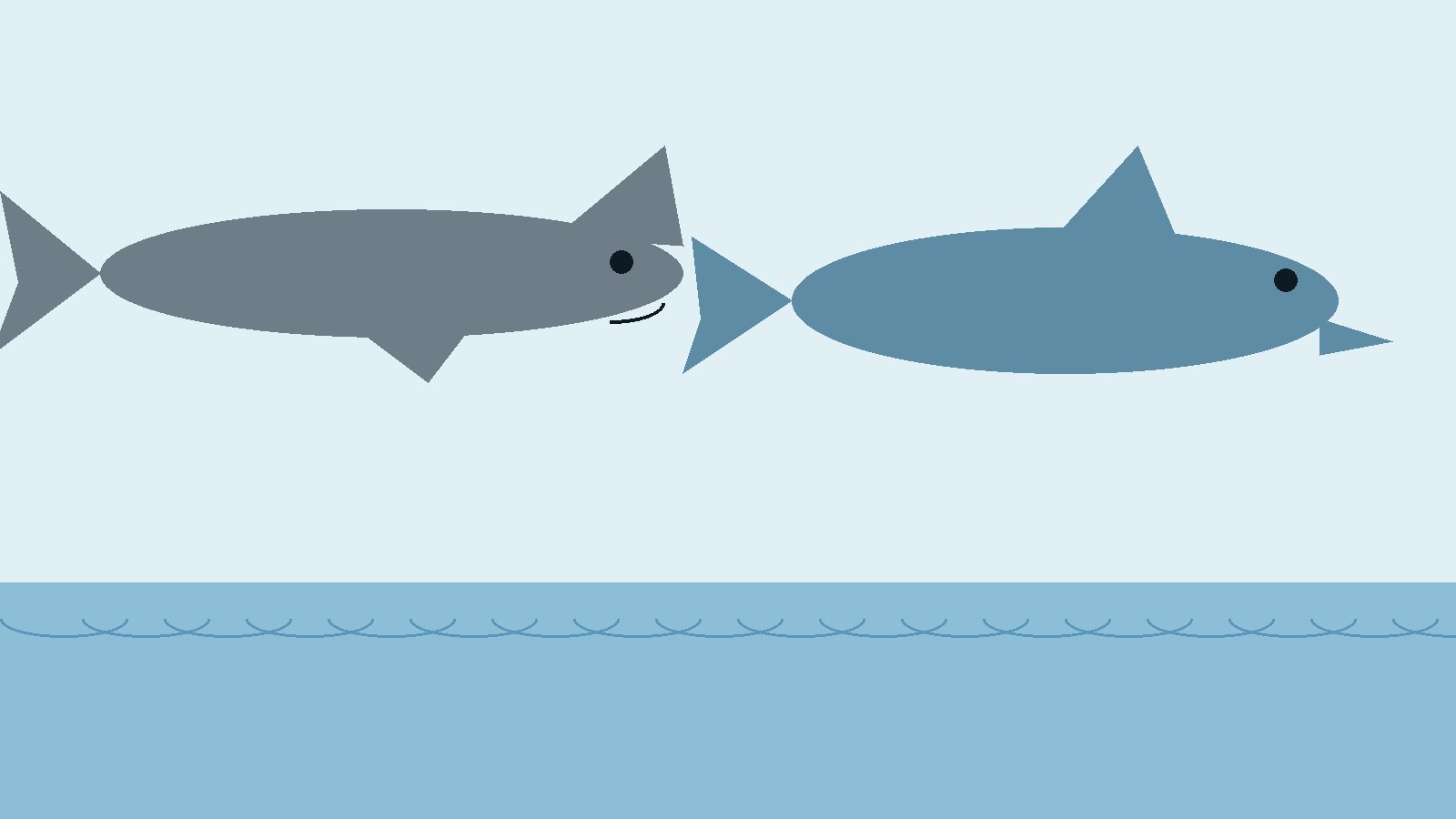
Few images teach convergence faster than a shark, a dolphin, and an ichthyosaur drawn side by side. All three are fast marine swimmers with tapered bodies, fins in similar positions, and tails built for thrust. Yet they belong to very different branches of the tree of life.
Sharks are fish. Dolphins are mammals that returned to the sea from land dwelling ancestors. Ichthyosaurs were extinct marine reptiles. The Natural History Museum states that fishes such as sharks, cetaceans including dolphins, and ichthyosaurs all converged on the same streamlined shape to help them thrive in the marine environment. The museum also notes that ichthyosaurs looked a lot like dolphins, and that ichthyosaurs lived in the oceans long before dolphins appeared. The time gap strengthens the case. The similarity cannot be explained by dolphins inheriting a dolphin shaped body from ichthyosaurs, because the lineages are separate and the time separation is vast.
Why does the same shape keep winning in water? Because water is dense and drag is costly. A blunt body wastes energy pushing water aside. A tapered body, with a pointed front, a smooth midsection, and a narrow tail stock, lets water flow past with less turbulence. Different lineages can build those parts from different materials, fish fins, mammalian flippers, and reptile paddles, but the hydrodynamic problem is the same, so the outlines converge. The differences remain instructive. Dolphins breathe air and nurse their young, as mammals do. Sharks breathe through gills and have skeletons made largely of cartilage rather than bone. The streamlined outline is shared. The rest of the animal is not.
Echolocation, desert plants, spines, and other repeated solutions
Convergence is not limited to wings, eyes, and swimmers. Each further example below shows a different kind of problem being solved.
Echolocation uses sound echoes to navigate, hunt, and communicate in poor light. The Natural History Museum notes that whales and bats both use echolocation, and that the same mutations in hearing related genes help both groups find prey in low light conditions, whether in deep water or at night. That molecular detail shows convergence can happen at the level of genes as well as bodies.
Desert plants show convergence in water management. Cacti of the Americas and euphorbs of Africa and nearby regions have evolved fleshy, water storing stems, deep roots, and spines instead of leaves, as the Natural History Museum explains. The museum notes that in Africa, everything that looks like a cactus is actually a euphorb. The visual similarity is so strong that a casual observer may mistake one family for the other. The family trees, flowers, and sap chemistry tell them apart.
Protective spines also appear in mammals that are not close relatives. Hedgehogs, echidnas, and some tenrecs have all evolved spiky coverings that repel predators. The Natural History Museum notes that tenrecs last shared a common ancestor with hedgehogs around 160 million years ago, and that tenrecs are in fact more closely related to elephants than to their hedgehog lookalikes. That is a memorable warning against judging relationships by coats.
Carnivorous plants show convergence in nutrition. Venus flytraps and pitcher plants both trap and digest animals, and the Natural History Museum notes that multiple plant species have acquired the ability to devour prey, probably to capture nitrogen and phosphorus lacking from the soil. The traps differ, a snapping trap in one case and a cup shaped pitfall in another, but the ecological logic is shared: in nutrient poor soil, eating animals supplements what roots cannot provide. The museum also records antifreeze proteins in polar fishes, limbless bodies in snakes and caecilians, crab like body plans in several crustacean groups, and a thumb like wrist bone structure in giant pandas, which the University of California Museum of Paleontology likewise calls analogous rather than homologous to a human thumb.
How scientists test whether similarity is convergence
A claim of convergence is a historical claim, and historical claims need evidence. Scientists do not declare convergence just because two species look alike. They test it, and the tests often change the answer.
Fossils provide the time dimension. If a trait appears late on two separate branches, and earlier fossils on those branches lack it, that supports independent origin. If a trait appears in a common ancestor and persists in descendants, that supports homology. Fossils are incomplete, so absence of evidence is not always proof of absence, and researchers state that uncertainty plainly rather than hiding it.
Anatomy and development provide the construction dimension. If two structures are built from different embryonic tissues, develop through different sequences, or use different bones, that points to separate origins. The panda thumb is a textbook case, because its wrist bone origin separates it from a true thumb. The bird and bat wing comparison works the same way: feathers versus skin membrane, with different bone proportions, point to separate construction.
DNA and protein sequences provide the relationship dimension. Molecular trees, built from many genes, estimate how species are related independently of the trait in question. If the molecular tree places two similar species far apart, and the trait is absent in their common ancestor as reconstructed from relatives, convergence becomes the favored explanation. The falcon and parrot case shows why this matters. Outward hunting shape suggested one grouping. DNA suggested another. None of these tests alone is decisive in every case. The strength comes from agreement across lines of evidence. When fossils, anatomy, development, and DNA all point to separate origins for a similar trait, the convergence claim is strong. When they disagree, researchers keep the question open and look for more data.
Common misconceptions
Several misconceptions recur in classrooms and online explanations, and each one distorts the idea in a specific way.
First, convergent evolution is not directed toward a goal. Species do not try to become like another species, and evolution does not plan a shark shape or a camera eye in advance. Variation arises without foresight, and selection favors what works in the current environment. If the environment changes, the favored trait can change too.
Second, convergent species do not become identical, and they do not merge into one species. A dolphin remains a mammal, with lungs and live birth, even though its outline resembles a shark. A bat remains a mammal, with fur and milk production, even though its wings resemble a bird wing in function. Convergence affects the traits under similar selection. It does not erase the rest of the organism’s history.
Third, convergence is not evidence that a trait was designed by copying another species. No copying takes place. Each lineage builds its version from its own inherited materials. Mimicry, where one species does evolve to resemble a specific model, is a separate pattern with its own evidence.
Fourth, not every similarity is convergence. Some similarities are homology, inherited from a common ancestor. The label alone is not an explanation. The explanation is the problem, the history, and the construction. Fifth, convergence does not mean a trait is perfect. Streamlined swimmers still face drag. Camera eyes still have tradeoffs, including the vertebrate blind spot. Selection favors better variants relative to available alternatives, not perfect engineering.
Why convergent evolution matters
Convergent evolution matters for classification, for understanding selection, and for reading biodiversity itself. When researchers recognize an analogy, they avoid grouping unrelated species by appearance and instead group them by shared ancestry. That cleaner tree improves downstream studies, because relatedness predicts shared biology in ways that appearance alone does not.
Repeated outcomes are also natural experiments, letting researchers compare lineages to separate the effects of environment from the effects of history. For students, the most useful habit is the ancestor test combined with the construction check: did the common ancestor have the trait, and are the structures built the same way?
FAQ
What is convergent evolution in simple terms?
Convergent evolution is when distantly related species independently evolve similar traits because they face similar challenges. The traits look alike and often do the same job, but they were not inherited from a shared ancestor that already had them.
What is the difference between convergent and divergent evolution?
Convergent evolution moves separate lineages toward similarity in a trait. Divergent evolution moves descendants of a shared ancestor toward difference, as they adapt to different environments.
What are analogous structures?
Analogous structures are traits with similar functions that evolved separately, rather than being inherited from a common ancestor. Bird wings and bat wings are analogous as wings. Camera eyes in vertebrates and cephalopods are analogous as image forming eyes.
What are homologous structures?
Homologous structures are traits inherited from a common ancestor, even if they now look different or do different jobs. The forelimbs of humans, bats, whales, and horses are homologous, because they are modified versions of the same ancestral limb pattern.
What are the best examples of convergent evolution?
The most widely taught examples are wings in birds, bats, insects, and pterosaurs; camera eyes in vertebrates and cephalopods; streamlined body plans in sharks, dolphins, and ichthyosaurs; echolocation in bats and toothed whales; fleshy stems and spines in cacti and euphorbs; and protective spines in hedgehogs, tenrecs, and echidnas. Each example is attributed in the main text to the institution that documents it.
Does convergent evolution mean two species are closely related?
No. Convergence often explains why unrelated species look related. Close relationship is judged by shared ancestry, using fossils, anatomy, development, and DNA, not by a single similar trait.
Can convergent evolution happen in plants as well as animals?
Yes. Cacti and euphorbs are a clear plant example, with fleshy water storing stems and spines evolving separately in different families. Carnivorous plants, including Venus flytraps and pitcher plants, are another example.
Is convergent evolution the same as parallel evolution?
Not exactly, although the boundary is debated. Parallel evolution usually refers to related lineages evolving in the same direction from a similar starting point after they split. Convergent evolution usually refers to more distantly related lineages arriving at similar traits independently.
How do scientists know a similarity is convergent rather than inherited?
They combine fossil timing, anatomy, development, and DNA based family trees. If the trait appears separately on different branches, is built differently, and is absent in the reconstructed common ancestor, convergence is favored. If the evidence disagrees, the question stays open until more data arrive.
Does convergent evolution prove that evolution has a goal or a plan?
No. Convergence arises from variation and natural selection acting separately in separate lineages, without foresight. Similar environments and physics favor similar solutions, but the process has no target species or final design in mind.
Sources & references
- Natural History Museum, London. Convergent evolution explained with 13 examples. Verified 27 October 2026 from the museum's published article at https://www.nhm.ac.uk/discover/convergent-evolution.html
- University of California Museum of Paleontology, Understanding Evolution. Analogy: bird and bat wing phylogeny. Verified 27 October 2026 from https://evolution.berkeley.edu/teach-resources/analogy-2-of-2-bird-and-bat-wing-phylogeny/
- University of California Museum of Paleontology, Understanding Evolution. When is a thumb a thumb? Verified 27 October 2026 from https://evolution.berkeley.edu/evolibrary/article/analogy_06


