Short answer
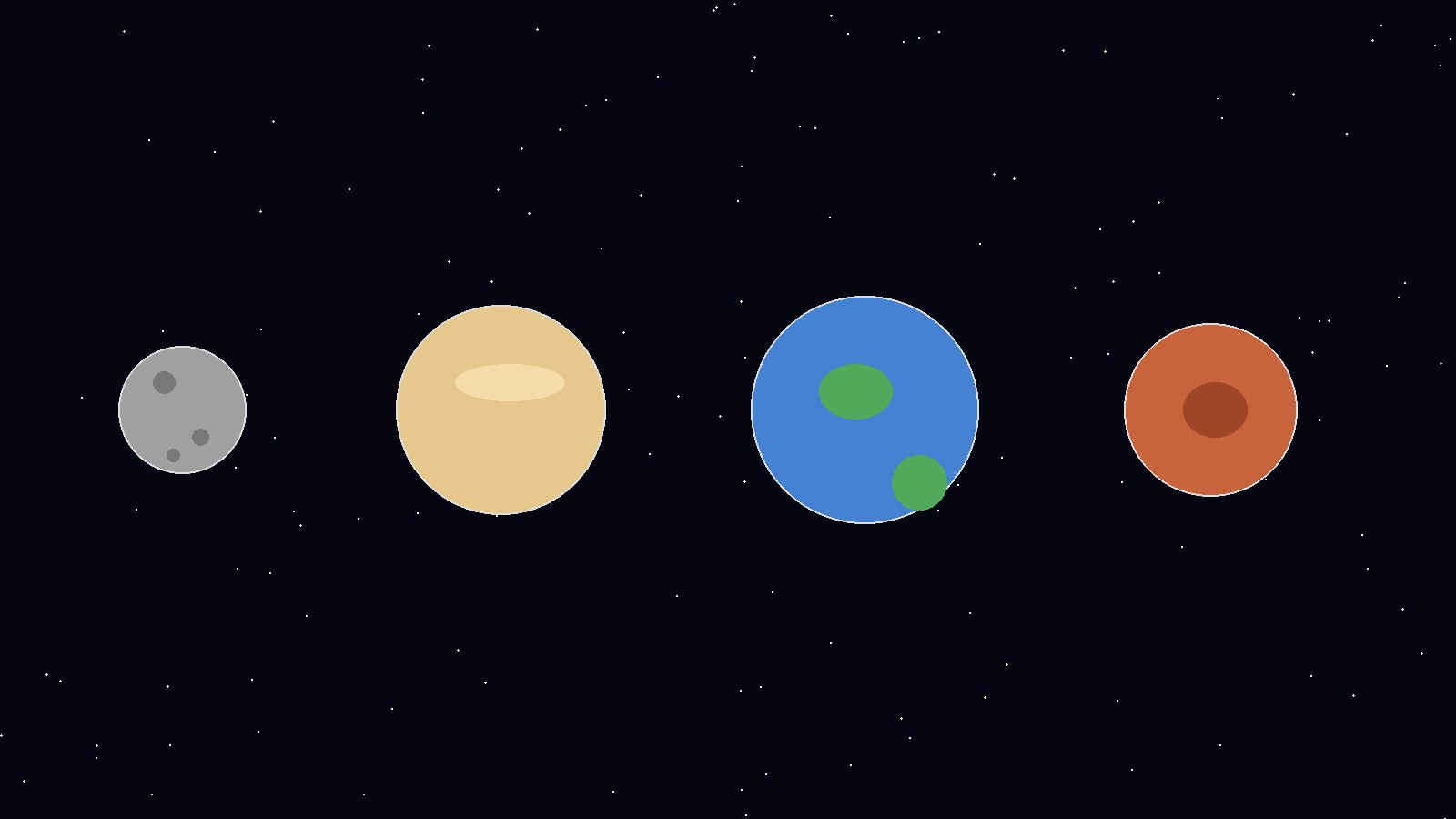
- The planets that are terrestrial, in our solar system, are Mercury, Venus, Earth and Mars. Those four are the innermost planets, the ones closest to the Sun, and they are the only planets in our solar system built mainly from rock and metal with a solid surface you could, in principle, stand on. The word terrestrial comes from Latin words for Earth, Terra and Tellus, and it means Earthlike in structure. A terrestrial planet is also called a rocky planet, a tellurian planet or a telluric planet. All three names describe the same class: a planet whose bulk is silicate rock and metal, arranged in a layered interior with a metallic core, a rocky mantle and a thin crust, rather than a deep envelope of hydrogen and helium gas. The four terrestrial planets are far from identical, and that is much of the interest in them. Mercury is a scorched, cratered world with almost no atmosphere. Venus is nearly Earth's twin in size yet hides under crushing heat. Earth is the only planet known to support life. Mars is a cold desert world with the largest volcano in the solar system. Same category, four very different outcomes, shaped by where each planet formed, what atmosphere it kept, how much internal heat it still has, and whether liquid water ever shaped its surface.
What Makes a Planet Terrestrial
Three tests, taken together, decide whether a planet counts as terrestrial. A world should pass all three, not just one of them.
First, composition. A terrestrial planet is composed primarily of silicate rock and metal, above all iron. NASA describes terrestrial planets as rocky worlds composed of rock, silicate, water and/or carbon, and says that in general their bulk composition is dominated by rock or iron. That is a statement about what most of the planet is made of, not about its thin outer skin. Earth is still a terrestrial planet even though about seven tenths of its surface is covered by ocean, because the ocean is a thin veneer over a rocky planet, not the planet itself.
Second, a solid surface. A terrestrial planet has a solid or liquid surface, in NASA’s wording, meaning there is a definite boundary where you stop falling through atmosphere and start standing on rock. Gas and ice giants have no such boundary. Descend into Jupiter and the atmosphere simply grows denser and hotter until it grades into liquid and exotic fluid states, with no surface to touch. That absence of a landable surface is the clearest practical difference between a terrestrial planet and a giant planet.
Third, a layered, differentiated interior. When a young rocky planet heats up, heavy material sinks and light material rises, a process called differentiation. Iron sinks to form a metallic core, silicate rock forms the mantle around it, and the lightest rock rises to form a thin crust. All four terrestrial planets have this core, mantle and crust structure, although the proportions differ sharply. Mercury has an unusually large core for its size, while Mars has a smaller core relative to its mantle.
Size and density follow from those three tests, but they are clues rather than the definition itself. Terrestrial planets are smaller and denser than giants, with densities from about 3.9 grams per cubic centimeter for Mars to about 5.5 for Earth, while the giant planets range from about 0.7 for Saturn to about 1.6 for Neptune. A high density is what you expect from rock and iron rather than hydrogen, helium and ice, but density alone cannot settle borderline cases, because a small icy world could have a middling density too.
One more point of language matters. In our solar system, “terrestrial planet” and “inner planet” happen to name the same four worlds, because the four rocky planets are also the four closest to the Sun. The two terms are not synonyms, though. “Inner” describes position, while “terrestrial” describes composition and structure. Around another star, a rocky planet could orbit farther out and a gas giant closer in, and the labels would follow composition, not distance.
The Four Terrestrial Planets at a Glance
The table below collects the headline figures for the four planets, rounded for readability. Diameters, densities and orbital figures come from NASA’s planetary fact sheet and the Jet Propulsion Laboratory’s physical parameters table, which agree on the headline values while differing in later decimal places.
| Planet | Order from the Sun | Mean distance from the Sun | Diameter | Density | Year length | Moons |
|---|---|---|---|---|---|---|
| Mercury | 1st | 0.39 AU | 4,878 km | 5.4 g/cm3 | 88 days | 0 |
| Venus | 2nd | 0.72 AU | 12,104 km | 5.2 g/cm3 | 225 days | 0 |
| Earth | 3rd | 1.00 AU | 12,756 km | 5.5 g/cm3 | 365.25 days | 1 |
| Mars | 4th | 1.52 AU | 6,787 km | 3.9 g/cm3 | 687 days | 2 |
Mercury: The Scorched Iron World
Mercury is the smallest planet in the solar system and the closest to the Sun, orbiting at a mean distance of 0.39 AU, or about 58 million kilometers. Its diameter of 4,878 kilometers makes it larger than Earth’s Moon, and its density of 5.4 grams per cubic centimeter is nearly as high as Earth’s, which tells astronomers something striking: Mercury must have a very large iron core taking up a large fraction of its interior.
Mercury is heavily cratered, its surface scarred by impacts and marked by long cliffs formed as the planet cooled and shrank. It has almost no atmosphere, only a vanishingly thin exosphere of atoms kicked off its surface, so there is nothing to soften temperature swings. Daytime temperatures climb above 400 degrees Celsius while nighttime temperatures plunge far below freezing. That extreme range is itself a lesson in what an atmosphere does: Venus, at nearly twice Mercury’s distance from the Sun, is far hotter on average, because it kept a thick atmosphere and Mercury did not.
Mercury also has the most stretched out orbit of the eight planets, with an eccentricity of about 0.206, meaning its distance from the Sun varies much more in proportionate terms than any other planet’s. It has no moons and no rings.
Venus: Earth’s Twin That Went Wrong
Venus is the second planet from the Sun, orbiting at 0.72 AU, or about 108 million kilometers, and at 12,104 kilometers in diameter it is nearly as big as Earth. NASA calls it Earth’s closest planetary neighbor and sometimes Earth’s twin, because the two planets are similar in size and internal structure yet could hardly be more different at the surface.
The difference is the atmosphere. Venus is wrapped in a thick atmosphere of mostly carbon dioxide, with clouds of sulfuric acid, and that atmosphere traps heat in a runaway greenhouse effect. NASA gives the surface temperature as about 872 degrees Fahrenheit, or 467 degrees Celsius, hot enough to melt lead, making Venus the hottest planet in the solar system, hotter even than Mercury despite Mercury being closer to the Sun. Surface pressure is about 93 times the pressure at sea level on Earth. No lander has survived there for long: Soviet Venera probes that reached the surface functioned only briefly, the longest for about two hours, before the heat and pressure ended them.
Beneath the clouds, radar mapping by NASA’s Magellan spacecraft, which ended its five year mission in 1994, revealed a land of extreme volcanism: thousands of volcanoes, vast lava plains, and highland regions such as Ishtar Terra near the north pole and Aphrodite Terra across the equator. Except for Earth, Venus has by far the fewest impact craters of any rocky planet, which suggests its surface was largely resurfaced by volcanism in geologically recent time, with the average age of surface features possibly as young as 150 million years.
Venus also spins backward compared with most planets, and very slowly. A day on Venus, one full spin, takes 243 Earth days, which is longer than its year of 225 Earth days, and the Sun rises in the west and sets in the east. Venus has no moons and no rings. Its story is a warning built into the terrestrial class: two planets can start alike and end up utterly different, depending on whether their atmosphere and geology trap heat or release it.
Earth: The Terrestrial Planet We Know Best
Earth is the third planet from the Sun, at 1.00 AU by definition, about 149.6 million kilometers, and the largest of the terrestrial planets at 12,756 kilometers in diameter. It is also the densest planet in the solar system at about 5.5 grams per cubic centimeter, a result of its large iron core compressed by its own gravity.
Earth is the reference point for the whole class, which is why the class is named after it, but it is also the exception in almost every way that matters. It is the only planet known to support life, the only one with liquid water oceans covering most of its surface, and the only known planet with active plate tectonics, the slow movement of crustal plates that builds mountains, opens ocean basins and recycles crust back into the mantle.
Earth’s atmosphere is also unusual among the terrestrial planets. Where Venus and Mars have atmospheres dominated by carbon dioxide, Earth’s is mostly nitrogen with about a fifth oxygen, oxygen produced and maintained by living things over billions of years. That oxygen rich air, together with liquid water and a magnetic field generated by Earth’s liquid iron outer core, shields surface life from much of the Sun’s harmful radiation and from the solar wind.
Earth has one moon, large relative to its planet, which stabilizes Earth’s axial tilt and drives the tides. Its year lasts 365.25 days. None of that is typical of terrestrial planets in general, which is worth remembering when the term is used for exoplanets: calling a distant world “terrestrial” says it is rocky, not that it has oceans, oxygen or life.
Mars: The Cold Desert With Giant Volcanoes
Mars is the fourth planet from the Sun, at 1.52 AU, or about 228 million kilometers, and at 6,787 kilometers in diameter it is about half the width of Earth. Its density of 3.9 grams per cubic centimeter is the lowest of the four terrestrial planets, consistent with a smaller iron core and a more iron rich, less dense mantle rock. Its red color comes from iron oxide, rust, in its soil and dust.
Mars today is cold and dry, with a thin atmosphere made mostly of carbon dioxide at only about one hundredth of Earth’s surface pressure. Yet Mars carries clear evidence that liquid water once flowed there: dried river channels, lake beds, minerals that form in water, and polar ice caps of water ice and frozen carbon dioxide. Understanding when Mars lost most of its water is one of the main reasons spacecraft keep visiting it.
Mars is also the most geologically dramatic of the terrestrial planets in one respect: it hosts Olympus Mons, the largest volcano in the solar system, a shield volcano whose base covers an area about the size of the state of Arizona and which rises more than 20 kilometers above the surrounding plains, roughly two and a half times the height of Mount Everest above sea level. Mars could grow a volcano that large partly because it lacks Earth’s plate tectonics: on Earth, a moving plate carries a volcano away from the hot spot feeding it, limiting its growth, while on Mars the crust stayed put and the lava kept piling up.
Mars has two small moons, Phobos and Deimos, both irregularly shaped and far smaller than Earth’s Moon. A day on Mars lasts about 24 hours and 37 minutes, close to an Earth day, and its axial tilt of about 25 degrees gives it seasons much like Earth’s, though each season lasts nearly twice as long because the Martian year is 687 Earth days. Mars has no rings.
Inside a Terrestrial Planet
Slice any of the four terrestrial planets open, in imagination, and you find the same three layer pattern. At the center sits a metallic core made mostly of iron, with some nickel. Around it lies a rocky mantle made of silicate minerals. On the outside lies a crust of solid rock, thin compared with the layers below it: on Earth the crust is only a few tens of kilometers thick under the oceans and somewhat thicker under continents, a skin on a planet more than 12,000 kilometers across.
Those layers did not start out separated. Early in each planet’s history, heating from impacts, from the decay of radioactive elements and from gravitational compression melted much of the interior, allowing dense iron to sink and light rock to float. That sorting, differentiation, is what made the core, mantle and crust. Mercury’s story shows how far the proportions can vary: its core is so large relative to its mantle that some scientists think a giant impact may have stripped away much of its outer rocky layer early on, while others argue it simply formed from metal rich material close to the Sun.
What a core does after it forms shapes the planet’s later life. Earth’s outer core is liquid iron in motion, and that motion generates Earth’s magnetic field, which deflects the solar wind. Mars once had a magnetic field too, recorded in magnetized rocks in its southern highlands, but its smaller core cooled and the dynamo shut down, leaving Mars exposed to the solar wind stripping away its atmosphere. Venus, despite having a similar sized iron core to Earth’s, has no internally generated magnetic field today, probably because its slow spin and the state of its core do not drive the same kind of dynamo.
How Terrestrial Planets Formed
The four terrestrial planets formed about 4.6 billion years ago from the same spinning disk of gas and dust around the young Sun, the solar nebula. Close to the Sun, temperatures were high, so only materials that could survive the heat, rock and metal, could condense into solid grains. Farther out, beyond a boundary called the frost line, it was cold enough for water, ammonia and methane to freeze into ices as well, giving the outer planets far more solid building material to work with. Rock and metal made up only a small fraction of the nebula’s mass, so the inner planets grew by the slow collision and sticking together of rocky planetesimals, kilometer sized bodies that gradually accreted into planets. The outer planets, with ice added to rock and metal, grew massive cores quickly, and once a core reached a critical mass its gravity pulled in vast amounts of hydrogen and helium gas from the nebula, ballooning into a giant. The terrestrial planets never reached that threshold, so they stayed rocky and modest.
Terrestrial Planets Compared With Gas Giants and Ice Giants
The cleanest way to keep the solar system’s eight planets straight is a three way split, not the older two way split that lumps all four outer planets together as gas giants.
| Group | Planets | Main composition | Solid surface? | Typical density |
|---|---|---|---|---|
| Terrestrial | Mercury, Venus, Earth, Mars | Rock and metal | Yes | 3.9 to 5.5 g/cm3 |
| Gas giant | Jupiter, Saturn | Hydrogen and helium | No | 0.7 to 1.3 g/cm3 |
| Ice giant | Uranus, Neptune | Water, ammonia and methane ices plus hydrogen and helium | No | 1.3 to 1.6 g/cm3 |
Gas giants are the true giants: Saturn is so low in density, about 0.7 grams per cubic centimeter, that it would float in water if a large enough ocean existed. Both have small rocky cores buried under enormous envelopes of hydrogen and helium, and both have extensive ring systems and dozens of moons.
Ice giants are smaller than gas giants but still much larger than Earth, and their blue and blue green colors come from methane in their atmospheres. The “ice” in their name refers to the chemical composition of their building materials, water, ammonia and methane, which astronomers call ices because they freeze at low temperatures, not to frozen surfaces: deep inside Uranus and Neptune those materials exist as hot, dense fluids under extreme pressure. Calling Uranus and Neptune gas giants is common in casual writing but it blurs a real compositional difference.
Borderline Cases: What Is Not a Terrestrial Planet
A definition is only useful if it also says what does not count, and the terrestrial class has several instructive borderline cases.
Pluto is not a terrestrial planet, even though it is rocky and icy and smaller than Mercury. Pluto is a dwarf planet, a separate category the International Astronomical Union created in 2006 for bodies that orbit the Sun and are massive enough to be rounded by their own gravity but have not cleared their orbital neighborhood of other objects. Composition alone does not make a planet, and Pluto also contains a large fraction of ice, which puts it outside the rock and metal dominated terrestrial class in any case.
Earth’s Moon, Jupiter’s moon Io and sometimes Europa are sometimes described as terrestrial in structure, because they have rocky, differentiated interiors similar to the terrestrial planets. That usage comes from a geophysical definition of “planet” that counts any rounded, differentiated body, rather than the IAU definition that reserves “planet” for bodies orbiting the Sun directly. Under the standard IAU usage followed in this article, moons are not planets at all, terrestrial or otherwise, so the Moon and Io are best described as terrestrial-like bodies, not terrestrial planets.
The large asteroids Pallas and Vesta are likewise sometimes mentioned as terrestrial-like, because Vesta in particular has a differentiated interior with a core, mantle and crust. But asteroids are not planets under either common definition, and their inclusion in lists of terrestrial bodies is rare. The safe statement is the standard one: in our solar system, the terrestrial planets are Mercury, Venus, Earth and Mars, four and no more.
Terrestrial Planets Beyond Our Solar System
The term terrestrial does not stop at the Sun’s family. NASA applies it to exoplanets, planets orbiting other stars, and gives a working size rule: for planets outside our solar system, those between half of Earth’s size and twice its radius are considered terrestrial, while larger terrestrial worlds at least twice as massive as Earth are classified as super-Earths. The wording is deliberately approximate, because astronomers usually know an exoplanet’s size and sometimes its mass, but rarely its composition directly.
The most famous example is TRAPPIST-1, a system announced by NASA in 2017 as hosting seven Earth-size planets around a single small star, the most Earth-size planets found in the habitable zone of one star at that time. All seven are thought to be rocky, and NASA’s later density measurements suggested a range of compositions, from TRAPPIST-1e, slightly denser than Earth and the most similar to Earth in size, density and radiation received, to lighter planets that may hold substantial water as vapor, liquid or ice.
Two cautions belong with every exoplanet claim. First, a rocky planet in the habitable zone, the distance range where liquid water could exist on a surface given a suitable atmosphere, is not thereby a habitable planet. NASA is explicit that such characteristics do not guarantee a habitable world, because whether the planet actually has an atmosphere or oceans is usually unknown. Venus is the cautionary tale inside our own system: it sits near the inner edge of the Sun’s habitable zone and is utterly uninhabitable at its surface.
NASA’s terrestrial exoplanet page notes there could be more than 10 billion terrestrial planets across our galaxy, and a Kepler based study it cites estimated about 300 million potentially habitable worlds, planets of the right size and distance that could support liquid water. Those are estimates from surveys and models, not counts of confirmed worlds, and they should be read that way. There is also a strange gap in exoplanet sizes, the Fulton gap between about 1.5 and 2 times Earth’s size, where planets are rare, possibly marking the boundary between rocky and gas dominated formation. What is confirmed is more modest and still remarkable: rocky planets are common, they come in systems of many at a time, and our four are not a fluke of one star.
Frequently Asked Questions
Which planets are terrestrial?
Mercury, Venus, Earth and Mars are the terrestrial planets of our solar system. They are the four innermost planets, built mainly from rock and metal, with solid surfaces and layered interiors of core, mantle and crust.
How many terrestrial planets are there?
There are four terrestrial planets in our solar system. The other four planets, Jupiter, Saturn, Uranus and Neptune, are giant planets, divided into two gas giants and two ice giants.
What is the difference between a terrestrial planet and a gas giant?
A terrestrial planet is small, dense, rocky and has a solid surface, while a gas giant is huge, low in density, made mostly of hydrogen and helium, and has no solid surface to land on. Terrestrial planets also have few or no moons and no rings, while gas giants have many moons and ring systems.
Is Earth a terrestrial planet?
Yes. Earth is the planet the class is named after, from the Latin Terra. It is made mainly of silicate rock and iron, has a solid rocky crust beneath its oceans, and a layered core, mantle and crust structure. Its oceans and oxygen rich atmosphere make it unusual among terrestrial planets, but they do not change its classification.
Why is Venus hotter than Mercury if Mercury is closer to the Sun?
Venus has a thick carbon dioxide atmosphere that traps heat in a runaway greenhouse effect, giving it a surface temperature of about 467 degrees Celsius. Mercury has almost no atmosphere, so its heat escapes to space at night even though it receives more sunlight. Atmosphere, not just distance, sets a planet’s temperature.
Are there terrestrial planets outside our solar system?
Yes. NASA classifies exoplanets between about half and twice Earth’s radius as terrestrial, with larger rocky worlds called super-Earths. The TRAPPIST-1 system, announced in 2017, contains seven Earth-size rocky planets around one star. Being rocky and in the habitable zone does not guarantee that such a planet is habitable, because its atmosphere and surface conditions are usually unknown.
Is Pluto a terrestrial planet?
No. Pluto is a dwarf planet, not a planet, and it is an icy body rather than a rock and metal dominated world. The dwarf planet category is separate from both the terrestrial and giant planet groups.
What is the largest terrestrial planet?
Earth is the largest terrestrial planet in our solar system, at 12,756 kilometers in diameter, slightly larger than Venus at 12,104 kilometers. Among exoplanets, the terrestrial class extends up to about twice Earth’s radius, with still larger rocky worlds classified as super-Earths.
Does terrestrial mean Earthlike?
No. Terrestrial means rocky, not Earthlike in climate, air or life. Mercury and Venus are terrestrial, and neither could host a human visitor on its surface without protection. When a news story calls a distant world Earthlike, check whether it means similar in size, similar in composition, in the habitable zone, or actually similar in conditions. Those are different claims, and usually only the first one is known.
Sources & references
- National Aeronautics and Space Administration, NASA Science, Terrestrial exoplanet page. In our solar system, Earth, Mars, Mercury and Venus are terrestrial, or rocky, planets; for exoplanets, those between half of Earth's size and twice its radius are considered terrestrial; larger terrestrial exoplanets at least twice as massive as Earth are classified as super-Earths; terrestrial planets have bulk composition dominated by rock or iron and a solid or liquid surface; TRAPPIST-1 system of seven rocky worlds announced in 2017; estimate of more than 10 billion terrestrial planets across the galaxy; Fulton gap between 1.5 and 2 times Earth's size. https://science.nasa.gov/exoplanets/terrestrial/
- National Aeronautics and Space Administration, NASA Science, Venus Facts. Venus is the second planet from the Sun; hottest planet at about 872 degrees Fahrenheit (467 degrees Celsius); surface pressure about 93 times sea level pressure on Earth; diameter about 7,521 miles (12,104 kilometers); day 243 Earth days, year 225 Earth days; no moons; no rings; Magellan mapped the surface by radar; surface features including Ishtar Terra and Aphrodite Terra. https://science.nasa.gov/venus/venus-facts/
- National Aeronautics and Space Administration, National Space Science Data Center, Planetary Fact Sheet. Diameters, densities, orbital periods, distances, temperatures, surface pressures and moon counts for all eight planets, including Mercury 4,878 kilometers, Venus 12,104 kilometers, Earth 12,756 kilometers, Mars 6,787 kilometers, and densities 5.4, 5.2, 5.5 and 3.9 grams per cubic centimeter respectively. http://nssdc.gsfc.nasa.gov/planetary/factsheet/planet_table_british.html
- National Aeronautics and Space Administration, Jet Propulsion Laboratory, Planetary Physical Parameters table. Equatorial radii, masses, bulk densities, rotation periods and orbital periods, including Mercury bulk density 5.4289 grams per cubic centimeter, Venus 5.243, Earth 5.5134 and Mars 3.9340. https://ssd.jpl.nasa.gov/?planet_phys_par
- OpenStax, Astronomy, Overview of Our Planetary System. Table of planet distances, diameters, masses and densities; terrestrial planets described as the inner planets composed mostly of silicate minerals and a dense iron core; giant planets described as larger and composed primarily of lighter ices, liquids and gases without solid surfaces. https://openstax.org/books/astronomy/pages/7-1-overview-of-our-planetary-system
- National Aeronautics and Space Administration, Jet Propulsion Laboratory, Photojournal, Inner Planets Diagram PIA17303. The terrestrial planets are the four innermost planets: Mercury, Venus, Earth and Mars, called terrestrial because they have a compact, rocky surface like Earth's; Venus, Earth and Mars have significant atmospheres while Mercury has almost none. https://photojournal.jpl.nasa.gov/catalog/PIA17303
- National Aeronautics and Space Administration, Jet Propulsion Laboratory, Top of Olympus Mons image release MOC2-455. Olympus Mons is considered the largest and tallest volcano in the solar system. https://jpl.nasa.gov/images/pia04689-top-of-olympus-mons
- Wikipedia, Rocky planet article, used only as a secondary source for the terminology and the geophysical definition note. Terrestrial, tellurian, telluric and rocky planet as synonyms; terms derived from Latin Terra and Tellus; note that under a geophysical definition of planet, Earth's Moon, Io and sometimes Europa may also count as terrestrial planets, and the large rocky asteroids Pallas and Vesta are sometimes included, albeit rarely. https://en.wikipedia.org/wiki/Rocky_planet


