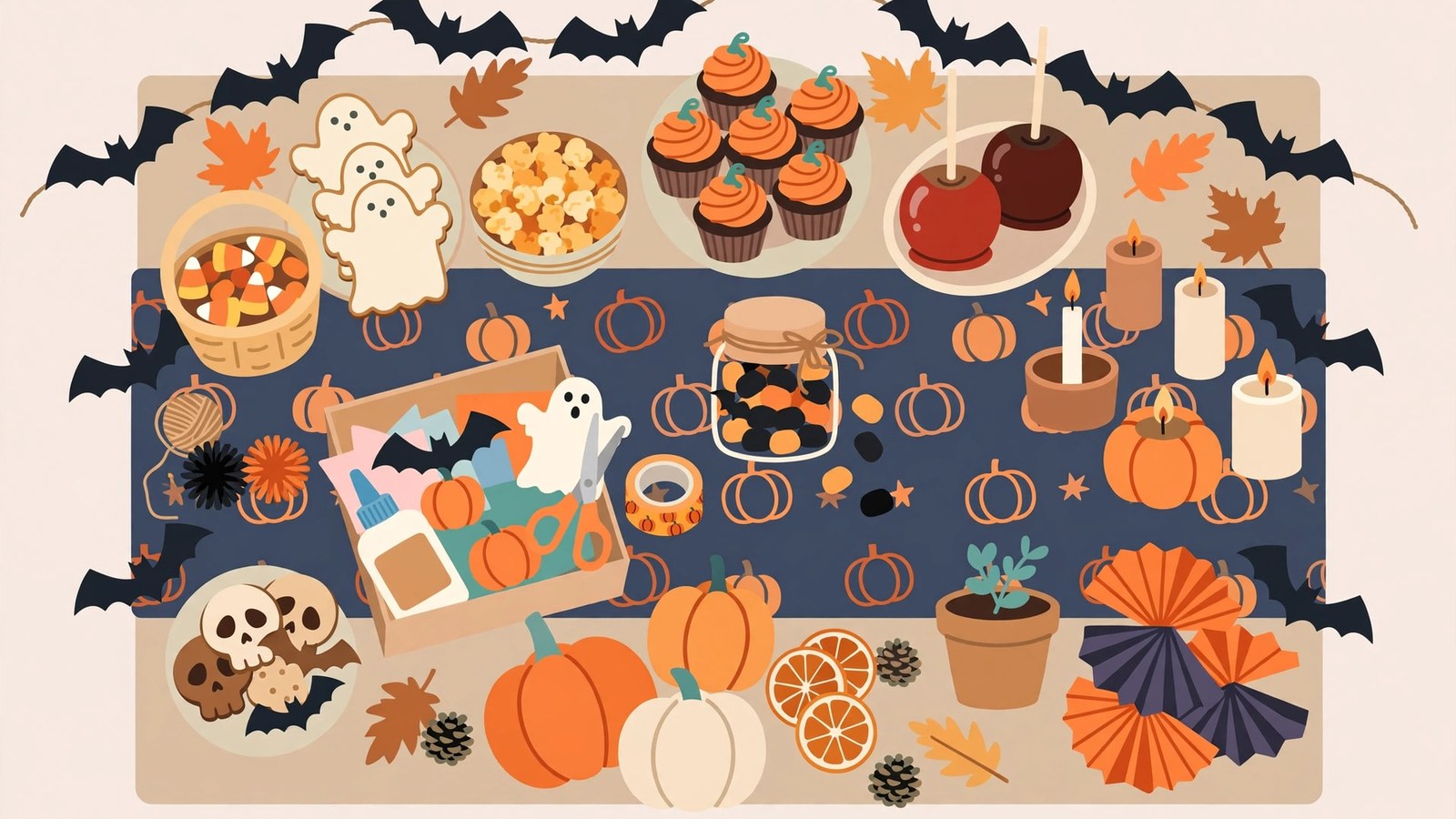
Short answer
- The simplest Halloween party plan has five parts: a fixed start and finish time, familiar food with a spooky twist served in small batches, one or two crafts laid out in advance, decor built around lighting rather than quantity, and a short safety check before guests arrive. Add a boo basket if you want a gift guests or neighbors can take away, and use a single theme trunk if you are joining a trunk or treat event at short notice. Ask about allergies on the invitation, label dishes, keep perishable food out for no more than two hours, use battery operated lights instead of real candles near children and costumes, and keep a calmer corner for adults at a mixed age party. None of that needs specialist equipment, and most of it can be prepared before the day itself.
Introduction
A good Halloween party does not need a big budget or professional decorations. It needs a clear plan, food that suits the crowd, a couple of activities that keep children busy, and an atmosphere that feels spooky without feeling chaotic. This guide covers Halloween party ideas from start to finish: planning, food and treats, crafts for kids, boo baskets, last-minute trunk or treat ideas, decor, games, and the safety notes that matter most when children are involved.
It is written for a home host, whether the party is a short children’s party in the afternoon, a mixed age gathering in the evening, or a trunk or treat event in a parking lot. Where guidance differs between sources, this article says so and follows the stricter option. That matters most for food safety, where leaving a buffet out too long is an easy mistake to make while guests are busy elsewhere.
Planning a Halloween Party
Start with the basics: who is coming, where it will happen, and how long it will last. A children’s party of two hours is usually plenty. An adult or mixed age evening party can run longer, but food and activities should still be planned around a clear start and finish time, so guests know when to arrive and hosts know when food needs to go out and come back in.
Decide early whether the party is indoors or outdoors. Indoor parties are easier to control for weather, lighting and food safety. Outdoor parties need a wet weather fallback and a plan for keeping food at safe temperatures, such as a cool box with ice and a covered table out of direct sun.
A simple planning timeline helps:
| When | What to do |
|---|---|
| Three to four weeks before | Set the date, venue and guest list. Send invitations, including any dress code or costume note and a question about allergies. |
| Two weeks before | Plan the menu, buy nonperishable decorations and craft supplies, and confirm any help you need. |
| One week before | Buy perishable food, prepare anything that can be frozen or made ahead, and set up the main decorations. |
| The day before | Lay out the craft table, check batteries for lights, and write food labels. |
| On the day | Put food out as close to serving time as possible, set up activity stations, and do a final safety check of the space. |
Ask guests about allergies and dietary needs on the invitation, not on the day. Halloween food is heavy on nuts, dairy, gluten and gelatin, so knowing in advance lets you label dishes and provide safe alternatives without a last-minute scramble. Keep a note of the ingredients in each homemade dish, so guests with allergies can check them. Food Standards Scotland gives the same advice for food served at community events: keep a note of allergen ingredients and provide allergen information to the people attending.
For a mixed age party, plan two zones if space allows: a louder area for children, and a calmer corner for adults. Put the food table where adults pass it often, so someone notices when a dish needs topping up, chilling again, or throwing away.
A workable order for a children’s party is arrival and costumes first, a craft or game, food in the middle, a second short activity, and then party favors or boo baskets at the door. That order stops food sitting out for the whole party while children are distracted.
Food and Treats
Halloween food ideas work best when they are familiar food with a spooky twist, rather than complicated recipes that take all day. Guests want to recognize what they are eating, and children in particular prefer food that looks fun but tastes normal.
Reliable Halloween treats include:
- Mummy hot dogs or sausages: Wrap sausages in strips of pastry, leaving a gap near the top, and add two small dots for eyes after baking.
- Ghost pizzas: Cut pita breads or tortillas into ghost shapes, top with tomato sauce and cheese, and add olive or pepper pieces for eyes.
- Pumpkin soup: A smooth pumpkin or butternut squash soup served in small cups works well as a warming starter for an evening party.
- Monster sandwiches: Use cookie cutters to shape sandwiches, and add cheese teeth or olive eyes.
- Witches’ fingers: Breadsticks with an almond “nail” pressed into one end. Skip these for nut allergies, and label them clearly if you serve them.
- Ghost cookies: Plain round cookies iced white, with two chocolate chip eyes.
- Jelly worms and eyeballs: Set jelly in bowls with gummy sweets, or serve peeled grapes as “eyeballs” in a bowl of jelly.
- Pumpkin cupcakes: Orange iced cupcakes with a small pretzel stick as a stalk.
Plan the menu by balance, not just by theme. Add at least one savory main item, one plain option for a cautious eater, fruit or vegetables, and water alongside any punch or soda. Serve a hot dish early, while it is still properly hot.
For drinks, a punch bowl with fruit juice, lemonade and floating jelly “eyeballs” is simple and effective. Offer water prominently too, especially at children’s parties, and label any alcoholic drinks clearly and keep them separate from children’s drinks, in a different place and, if possible, in different cups. That separation avoids the most common drinks mistake at a mixed age party.
If guests bring dishes, agree who brings what in advance and ask for a list of ingredients, so the allergen note stays complete.
Keeping Party Food Safe
Food safety matters at any party, and Halloween is no exception, particularly when food sits out while guests are busy with activities.
FoodSafety.gov advises throwing out perishable food that has been sitting at room temperature for more than two hours, or more than one hour if it has been exposed to temperatures above 90 degrees Fahrenheit. It also advises keeping hot foods at 140 degrees Fahrenheit or warmer and cold foods at 40 degrees Fahrenheit or colder, using chafing dishes, slow cookers or warming trays for hot food, and small serving trays or dishes nested in bowls of ice for cold food.
Food Standards Scotland gives a longer limit for party food, saying food put out for a party should not be left out for more than four hours, and that chilled buffet foods such as cold meats and sandwich fillings should be out of the fridge for the shortest time possible. The two sources differ. The safest approach for a home party is to follow the stricter two hour rule: put food out in small batches, top up from the fridge, and discard anything perishable that has been sitting out too long.
Other habits that help:
- Wash hands with soap and running water for at least 20 seconds before, during and after preparing food and before eating, and after handling raw meat, fish or poultry.
- Keep raw and ready to eat foods apart, using separate boards, plates and utensils for produce and for raw meat, poultry, seafood and eggs.
- Cook food to a safe internal temperature and check it with a food thermometer where practical. FoodSafety.gov gives at least 165 degrees Fahrenheit for poultry and for reheated food, and at least 160 degrees Fahrenheit for ground beef and egg dishes.
- Wash boards, dishes, utensils and countertops with hot, soapy water after each food item, and wash fruit and vegetables under running water.
- Refrigerate leftovers promptly in shallow containers, dividing large pots of soup or stew into smaller portions so they cool evenly. FoodSafety.gov says cooked food and leftovers should be refrigerated for three to four days at most, and frozen if they will not be eaten soon.
If you are unsure whether something has been out too long, throw it away. It is not worth the risk.
Allergen handling deserves its own step. Food Standards Scotland notes that allergens cannot be removed by cooking, that even a tiny trace can cause a reaction, and that taking an item off a plate is not enough for someone with an allergy. Clean surfaces and equipment thoroughly before cooking for a guest with an allergy, keep allergen free dishes separate, and do not let serving spoons move between dishes.
Crafts for Kids
Halloween crafts for kids are the easiest way to keep children entertained, and they double as party favors to take home. Set up a craft table with everything laid out in advance, cover it with a wipeable cloth or old newspaper, and let children move between crafts at their own pace.
Ideas that work well for a range of ages:
- Paper plate ghosts and pumpkins: Paper plates, paint or crayons, and black paper shapes for faces. Simple, quick and satisfying for younger children.
- Cardboard tube bats: Paint cardboard tubes black, add paper wings and googly eyes. A classic that needs little supervision beyond the painting stage.
- Spider webs: Paper plates with the center cut out, strung with yarn in a web pattern, plus a small paper spider.
- Pumpkin decorating without carving: Small pumpkins, paint pens, stickers and googly eyes. This avoids sharp tools entirely and suits younger children.
- Haunted house collages: Colored card, tissue paper and stickers, with children designing their own haunted house scene.
- Monster masks: Precut mask shapes, elastic, feathers, sequins and glue, so children can design a monster to wear.
For older children, add a slightly more challenging craft such as painting small wooden shapes, making beaded spider bracelets, or designing a spooky jar lantern with tissue paper and a battery operated tea light. Never use real candles inside children’s crafts or lanterns. Battery lights give the same glow without the fire risk.
Supervise glue guns, scissors and paint, and match the craft to the age group. An adult should do any cutting, away from children. A craft that is too fiddly frustrates younger children; one that is too simple bores older ones, so offer two or three choices at different difficulty levels. Put a finished example at each station, and provide a named bag where each child can keep finished work to take home.
Beads, sequins and small googly eyes are choking hazards for very young children, so give toddlers larger items, stickers and paint instead.
Boo Baskets
A boo basket is a small gift basket, usually given to a friend, neighbor or family member in the run up to Halloween, filled with seasonal treats and small gifts. The idea is a friendly surprise: you leave the basket anonymously, or not, often with a note saying “You’ve been booed,” and the recipient is invited to pass the fun on to someone else.
What to put in a boo basket depends on the recipient, but a good mix includes:
- Something sweet: Wrapped sweets, a chocolate bar, or a small bag of popcorn.
- Something cozy: Fuzzy socks, a small candle for adults only, or a packet of hot chocolate.
- Something seasonal: A mini pumpkin, a Halloween mug, or a small decoration.
- Something fun: A face mask, a puzzle, a small toy, or a Halloween activity book for children.
- Something personal: A handwritten note explaining why you chose them.
Build the basket around the recipient. For a neighbor you do not know well, keep food sealed and shop bought, and include a note listing what is inside, so they can judge allergies for themselves. Keep the total small: a boo basket works because it is a surprise gesture, not because it is expensive.
For children’s boo baskets, skip anything with small parts for very young children, avoid food that could trigger common allergies unless you know the child, and keep the basket light enough for a child to carry. For adults, a boo basket can lean more toward comfort: a candle, a cozy pair of socks, a favorite snack and a good book or film suggestion.
Boo baskets also work as party favors. Instead of a traditional party bag, give each child a small basket or bag with a few treats and a craft they made at the party. It feels more special than a handful of sweets and costs about the same. If you do this, prepare the baskets before the party and add the craft at the end, so no child leaves with someone else’s work.
Leave an anonymous basket when the recipient is likely to find it soon, rather than leaving perishable food on a doorstep for hours. If it contains anything chilled or perishable, hand it over in person instead.
Trunk or Treat Last-Minute Ideas
Trunk or treat is an event where cars are decorated in their trunks and children collect treats by walking from car to car, usually in a parking lot or school ground. It suits families who want a contained, social alternative to door to door trick or treating, and it is a great option if you only hear about the event at the last minute.
Check the event rules first. Organizers may set a theme, a setup time, a rule about scary displays, or a requirement for individually wrapped treats or a nonfood option. Then pick one simple theme and commit to it:
- Pumpkin patch: Orange and black cloth, a few pumpkins, and hay or straw colored fabric. Fast and instantly recognizable.
- Spider’s lair: Stretch fake cobwebs across the open trunk, add a few plastic spiders, and drape black cloth over the edges.
- Ghost graveyard: White sheets as ghosts on sticks, cardboard tombstones, and gray fabric over the trunk.
- Monster’s mouth: A large sheet of colored card with teeth cut into it, draped over the trunk opening so children reach toward the monster’s mouth to collect treats, without climbing into the vehicle.
- Witch’s kitchen: A cauldron, meaning a black bucket or pot, green fabric, and potion bottles made from old jars with food coloring and water.
Keep the setup to items you already own plus one or two bought decorations. One large focal point reads better from a distance than many small items. Arrive early, keep the area tidy, and bring a flashlight so your trunk is well lit after dark. Keep treats in a bowl at ground level, so children do not need to climb into the trunk.
If you are giving out treats, keep them individually wrapped, and consider a nonfood option such as stickers or small toys for children with allergies, kept in a separate bowl from food treats so it stays free of crumbs. Test any game once before the event starts, keep games short and at ground level, and give every child a treat whether they win or not. Remove every outside decoration before you drive home.
Decor and Atmosphere
Halloween decor does not need to be expensive to create a convincing Halloween look. Lighting does most of the work: dim the main lights, use orange or purple string lights, and place battery operated candles in jars around the room. A few well chosen larger pieces, such as a skeleton by the door, cobwebs across a doorway, and a pumpkin on the table, have more impact than a room crammed with small decorations.
A simple decorating plan:
- Entrance: A pumpkin, a welcome sign with a spooky twist, and a bowl of treats for arrivals.
- Main room: String lights, paper bats on the walls, cobwebs in corners, and a table centerpiece such as a pumpkin arrangement.
- Food table: A dark tablecloth, themed labels for dishes, and a few plastic spiders or small pumpkins scattered between plates.
- Activity area: Bright enough for children to craft safely, with decorations kept away from paint and glue.
Pick two colors and repeat them. Black and orange is the classic pairing; black, purple and green suits a witch theme; white and gray with one orange accent suits a ghost theme.
Music helps too: a Halloween playlist at low volume sets the mood without overwhelming conversation. For children’s parties, keep music and decorations fun rather than frightening. Most young children enjoy spooky, not scary, so put any scarier item where younger children do not have to pass it to reach food or the bathroom.
Safety Notes
A few safety checks make the difference between a good party and a stressful one.
- Costumes: Choose costumes, wigs and accessories that are fire resistant where possible, and prefer nontoxic face paint over masks that can obscure vision. The National Safety Council advises testing makeup in a small area first, fastening reflective tape to costumes and bags if children will be out after dark, or giving them glow sticks, and removing all makeup before children go to bed to prevent skin and eye irritation.
- Trick or treating: Young children should be accompanied by a responsible adult. Older children going alone should agree a route and a return time with an adult, stick to familiar, well lit areas and stay with their friends, and never enter a stranger’s home or car. The National Safety Council notes that children are more than twice as likely to be hit by a car and killed on Halloween than on any other day of the year, which is why visibility and familiar routes matter. Children should not eat treats until they return home and an adult has checked them, with particular care around food allergies.
- Candles and flames: Use battery operated candles wherever possible, especially near costumes, paper decorations and children. Keep real flames well away from doorways, curtains and craft tables.
- Allergies: Label food, keep allergen information available, and provide nonfood treat options.
- Choking hazards: Keep small sweets, toys and decorations away from very young children, and supervise younger children while they eat.
- Paths and lighting: Keep walkways clear, light steps and entrances, tape down or move trailing cables, and tidy up spills promptly.
With those checks done, the rest is about enjoying the party. Plan the food, set out a craft or two, put on some music, and let the costumes do the rest.
Frequently Asked Questions
How far in advance should I plan a Halloween party?
Start three to four weeks ahead with the date, guest list and invitations, plan the menu and buy nonperishable supplies two weeks ahead, and buy perishable food in the final week. That order matters more than the exact dates: invitations and allergy information come first, because the answers change the menu.
How long should a children’s Halloween party last?
Two hours is usually plenty for young children. It allows time for arrival, a craft or game, food, and one more short activity without food sitting out too long or children getting overtired. Put the finish time on the invitation so parents can plan pickup.
What food can I leave out at a Halloween party, and for how long?
Perishable food should not sit at room temperature for more than two hours, or more than one hour in temperatures above 90 degrees Fahrenheit, according to FoodSafety.gov. Serve perishable dishes in small batches, keep cold food on ice and hot food hot, top up from the fridge, and throw away anything perishable that has passed the limit.
What should I do with rice left over from a party?
Treat rice like other cooked leftovers. FoodSafety.gov advises refrigerating leftovers promptly in shallow containers and eating refrigerated cooked food and leftovers within three to four days at most, and reheating food to at least 165 degrees Fahrenheit. Food Standards Scotland advises reheating food only once. If you cannot refrigerate rice promptly, do not serve it as a make ahead party dish.
How do I handle food allergies at a Halloween party?
Ask about allergies on the invitation, keep a written note of the ingredients in each homemade dish, label dishes on the table, keep allergen free food separate with its own serving utensil, and offer a nonfood treat option in a separate bowl. Even a tiny trace of an allergen can cause a reaction, so do not rely on removing an item from a plate.
What can young children make at a Halloween party without sharp tools?
No carve pumpkin decorating with paint pens and stickers, paper plate ghosts and pumpkins, cardboard tube bats, spider webs strung with yarn, haunted house collages, and monster masks all avoid sharp tools. An adult should do any cutting in advance, and very young children should get stickers and paint rather than beads or other small parts.
What should go in a boo basket?
A small mix works best: something sweet, something cozy such as fuzzy socks or hot chocolate, something seasonal such as a mini pumpkin, something fun such as a puzzle or activity book, and a handwritten note. Keep food sealed if the recipient is a neighbor you do not know well, list what is inside, and avoid common allergens and small parts in a basket for a young child.
How can I decorate a trunk or treat car at the last minute?
Pick one theme, use one large focal point, and set treats in a bowl at ground level. A pumpkin patch with cloth and pumpkins, a spider’s lair with cobwebs and black cloth, and a monster’s mouth made from one large sheet of card can all be built from items at home plus one or two bought decorations. Check the event rules first, arrive early, and remove outside decorations before driving home.
Are real candles safe at a Halloween party with children?
Battery operated candles and tea lights are the safer choice near children, costumes and paper decorations, and they are essential inside children’s craft lanterns. If you use any real flame, keep it away from doorways, curtains, craft tables and costume fabric, and never leave it unattended.
Keep reading: Halloween Activities and Crafts for Kids
Keep reading: Best Pumpkin Carving Ideas for 2026: Creative, Cool, and Contest Ready Designs
Keep reading: Healthy Halloween Snacks and Treats for Kids
Keep reading: Easy Last-Minute Halloween Costumes
Keep reading: Pumpkin Carving Ideas: Easy, Cute, Funny and Scary Designs for Every Skill Level
Keep reading: Halloween Costume Ideas: Easy, Funny, Cute, Simple, DIY and Last-Minute
Sources & references
- FoodSafety.gov, "Game Day Food Safety Tips." Guidance on handwashing for at least 20 seconds, separating raw meat from ready to eat food, keeping hot food at 140 degrees Fahrenheit or warmer and cold food at 40 degrees Fahrenheit or colder, discarding perishable food after more than two hours at room temperature (more than one hour above 90 degrees Fahrenheit), reheating to at least 165 degrees Fahrenheit, and refrigerating cooked food and leftovers for three to four days at most. Page opened and read for this adaptation.
- Food Standards Scotland, "Providing food at community and charity events." Guidance that party food should not be left out for more than four hours, chilled buffet food should be out of the fridge for the shortest time possible, hot held food should be kept above 63 degrees Celsius, reheated food should only be reheated once, and hosts should keep a note of allergen ingredients and provide allergen information. Page opened and read for this adaptation.
- National Safety Council, "Halloween Safety." Guidance on fire resistant costumes, reflective tape and glow sticks after dark, nontoxic makeup in place of masks, removing makeup before bed, adults accompanying young children, agreed routes and return times, never entering a stranger's home or car, and not eating treats until they are checked at home. Page opened and read for this adaptation.


