Short answer
- The wave-particle duality means that light and matter can exhibit both wave-like and particle-like properties, depending on the experiment. Wave-like behavior includes interference, in which overlapping waves create bright and dark bands, and diffraction, in which waves spread and bend around obstacles or through openings. Particle-like behavior includes interactions that happen in discrete units, such as a photon transferring a fixed amount of energy to an electron, and detections that register as individual dots or counts rather than as a smooth, continuous smear. Light was first shown to interfere, which supported a wave picture. Later, the photoelectric effect showed that light also transfers energy in packets called photons, which supported a particle picture. Louis de Broglie then proposed in 1924 that matter might also have a wavelength, and in 1927 Clinton Davisson and Lester Germer found that electrons scattered from a nickel crystal in a diffraction pattern consistent with that proposal. The behavior observed depends on the experimental arrangement. No single experiment in the classical sense shows both pictures at once in full, and no experiment shows a particle deciding which picture to use.
Introduction
Light can make an interference pattern, the striped result that appears when waves overlap and strengthen or cancel each other. Light can also knock electrons out of a metal in discrete packets of energy, as if it arrived in small, countable units. Electrons, long treated as particles, can diffract from a crystal in the same patterned way that X rays do. None of these results fits neatly into a single everyday picture, and that tension is the subject of this guide.
The wave-particle duality is the name physicists give to this situation: light and matter can show wave-like behavior in some experiments and particle-like behavior in others. The word duality does not mean that a photon or an electron flips between two different kinds of object, or that it is half wave and half particle at the same time. It means that the classical categories of wave and particle, which work well for ocean waves and thrown balls, are each incomplete at the quantum scale. Each category captures part of what an experiment can reveal, and neither category alone captures all of it.
This article explains the idea in plain language, follows the historical path from early wave experiments to electron diffraction, and is careful about what each experiment actually showed. It separates experimental results from interpretation, because the results are much more settled than any single story about what happens between measurements. It also corrects common misunderstandings, including the idea that a particle makes a choice, and the idea that observation means human consciousness. This article is about duality itself, not a focused account of photon energy alone, and not a focused account of mechanical waves, which are different topics even when they share some vocabulary.
What Wave-Particle Duality Means, in Plain Terms
A classical wave is a disturbance that spreads out. It has a wavelength, the distance between matching points in the pattern, and a frequency, which counts how many cycles pass a point in a given time. Waves can overlap. Where a crest meets a crest, the result is stronger. Where a crest meets a trough, the result is weaker or canceled. That overlap is called interference, and it is the signature of wave behavior.
A classical particle is a localized object. It has a position that can be tracked, a mass, and a momentum, which is mass times velocity for an object moving at an ordinary speed. A particle arrives somewhere, transfers energy and momentum in an interaction, and can be counted. A stream of classical particles passing through two slits would be expected to pile up in two bands, one behind each slit, with no interference bands in between.
Quantum objects do not fit either template on its own. A photon is the discrete unit of light, with energy linked to frequency by the relation E equals h times f, where h is Planck constant and f is frequency. A photon is detected as a single unit, yet a large number of photons passing through a double slit can build up an interference pattern. An electron has mass and charge and is detected as a single unit, yet electrons scattered from a crystal can form a diffraction pattern that depends on wavelength. The duality label is a reminder that wave language and particle language are both models drawn from everyday experience, and that quantum behavior can require both models in different experimental contexts.
It helps to keep three levels separate: the mathematical description, which predicts probabilities for measurement outcomes; the experiment, which is the arrangement of source, slits or crystal, and detector; and the everyday picture in the mind, such as a tiny ball or a rippling wave. Agreement is strongest on the first two levels. The third level is where language most often misleads, because neither a ball nor a ripple is a faithful portrait of a photon or an electron.
The Wave Picture and the Particle Picture, Side by Side
The wave picture is strongest when the question is about patterns over space. Interference and diffraction are spatial patterns. They depend on wavelength, on the spacing of slits or crystal planes, and on the geometry of the setup. If the wavelength is changed, the pattern changes in a predictable way. If one path is blocked, the pattern changes, because the pattern depends on overlap from more than one path.
The particle picture is strongest when the question is about single interactions and counting. In the photoelectric effect, light above a threshold frequency can eject electrons from a metal, while light below that threshold cannot, no matter how bright it is made. Brightness changes the number of photons, and therefore the number of ejected electrons, but it does not change the energy carried by each photon. That distinction, between how many units arrive and how much energy each unit carries, is the heart of the particle evidence for light.
The Historical Path, Step by Step
The story did not begin with a single discovery. It developed as wave evidence and particle evidence accumulated, and as each new result forced a revision of the previous picture.
Thomas Young and interference, 1801
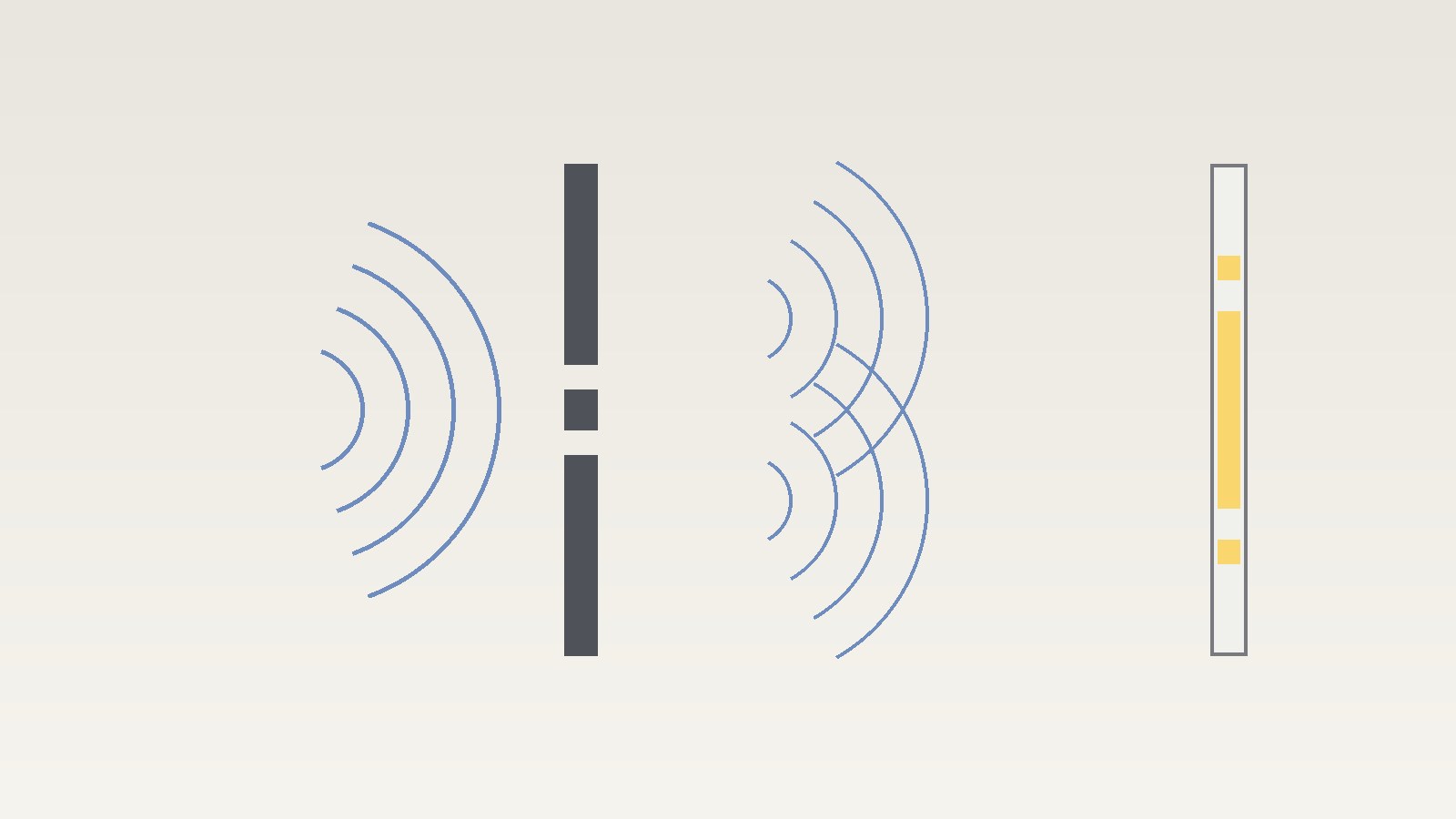
Thomas Young presented interference experiments in 1801 that supported a wave account of light. In the idealized double slit version taught today, light passes through two narrow, closely spaced slits and then overlaps on a screen. The result is a series of bright and dark bands, called fringes. Bright bands appear where waves from the two slits reinforce each other. Dark bands appear where they cancel each other. A stream of classical particles would not be expected to produce that alternating pattern, so the pattern was strong evidence that light spreads and overlaps like a wave.
Modern teaching simplifies Young’s original arrangement, which used a card edge and a single beam in the demonstration from his 1803 lecture (published 1804) rather than the clean two slit diagram now common in textbooks. The essential point survives: interference is a wave signature. It does not follow from Young alone that light is only a wave, only that any adequate account of light must explain interference.
Max Planck and energy quanta, 1900
In 1900, Max Planck introduced the idea that energy could be emitted and absorbed in discrete amounts, called quanta, in work on radiation from heated bodies. Planck related the energy of a quantum to frequency through Planck constant. At first, this was a way to make calculations match measurements of radiation. It was not yet a claim that light itself traveled as particles. The distinction matters, because Planck’s step showed that discrete energy could be mathematically necessary, while the later step by Einstein applied discreteness to light itself.
Planck constant, written as h, has the exact SI value 6.62607015 times 10 to the power of negative 34 joule seconds. That tiny value is one reason quantum effects are easy to miss in everyday life. Planck constant appears in both key relations here, photon energy and de Broglie wavelength, so the same constant sets the scale for both kinds of duality.
Albert Einstein and the photoelectric effect, 1905
In 1905, Albert Einstein proposed that light itself consists of discrete packets of energy, later called photons. In the photoelectric effect, light shines on a metal surface and electrons are ejected from that surface. A wave account predicted that brighter light would give ejected electrons more energy, and that even dim light would eventually eject electrons if given enough time to build up energy. The measurements did not match those predictions.
Einstein’s explanation matched the measurements. Each photon carries energy E equals h times f. An electron can leave the metal only if a photon supplies at least the minimum energy needed to free it, called the work function. If the photon energy is below that minimum, no electrons are ejected, however bright the light is. If the photon energy is above that minimum, the leftover energy appears as kinetic energy of the ejected electron, given by kinetic energy equals h times f minus the work function. Brighter light means more photons and therefore more ejected electrons, but it does not raise the energy of any single photon.
The Nobel Prize organization educational material states that Einstein received the Nobel Prize in Physics in 1921 for this work, and that the photoelectric effect was studied in detail by Robert Millikan, who was awarded the Nobel Prize in Physics in 1923. Einstein paper did not by itself prove that light is only a particle. It proved that a particle account was needed for this interaction, alongside the wave account already needed for interference. That is the beginning of duality for light in its modern form: two kinds of experiment, two kinds of result, one entity.
Louis de Broglie and matter waves, 1924
In 1924, Louis de Broglie proposed that the duality might run in the other direction as well. If light, long treated as a wave, could behave as particles, then matter, long treated as particles, might behave as waves. He proposed that every moving particle has an associated wavelength, now called the de Broglie wavelength, given by wavelength equals h divided by momentum, or lambda equals h divided by p. Momentum, p, is mass times velocity for an object moving at an ordinary speed.
De Broglie’s proposal extended duality from light to all matter, and it made a testable prediction: electrons should diffract, just as X rays diffract from crystals. For electrons at suitable speeds, the predicted wavelength is comparable to the spacing between atoms in a crystal, so a crystal can act as a grating for electrons. For a person walking across a room, the predicted wavelength is far smaller than any structure that could reveal it, so no visible diffraction is expected.
Davisson and Germer and electron diffraction, 1927
In 1927, Clinton Davisson and Lester Germer published results showing that electrons scattered from a nickel crystal produced a diffraction pattern. The American Physical Society account notes that their work began as electron scattering research, not as a planned test of de Broglie, and that an accident in 1925, in which heating recrystallized the nickel target into a few large crystals, changed the results in a way that later proved crucial. When Davisson learned of de Broglie theory during a visit to England in 1926, he recognized that the scattering peaks might be diffraction, and a deliberate search found peaks that agreed with de Broglie theory and with X ray diffraction.
George Paget Thomson independently demonstrated electron diffraction by passing electrons through thin films in the same period, and Davisson and Thomson shared the Nobel Prize in Physics in 1937. The result was decisive in one specific sense: electrons, the textbook example of particles, could produce a wave signature. It did not show that electrons are waves in the everyday sense, or that they stop being detected as individual units. Detectors still registered electrons one by one; what changed was the pattern formed by many detections, which followed wave rules for overlap and cancellation.
Niels Bohr and complementarity, 1927
In 1927, Niels Bohr presented the idea of complementarity in public, first at a conference in Como, Italy, in late summer 1927, and then at the Solvay Conference later that year. The Niels Bohr Archive account at the University of Copenhagen summarizes complementarity as the view that a physical phenomenon may appear in two different, complementary ways depending on the experimental arrangement, and that both pictures may be necessary for a full description even though they are mutually exclusive in classical terms. Light, for example, could appear sometimes as a wave and sometimes as a particle.
Complementarity is a framework for interpreting the results, not an additional experiment: the question which picture applies cannot be separated from the question which experiment was performed. The Niels Bohr Archive also notes that this interpretation is still disputed today. Readers should not treat it as a settled everyday picture, or as a claim that nature keeps two separate identities ready to switch between. It is better understood as a discipline for language: describe the experiment, describe the result, and do not claim more about the unmeasured interval than the experiment supports.
How Duality Applies to Light
For light, duality is most clearly seen by pairing two experiments. In an interference experiment, light behaves as a wave. The pattern depends on wavelength and geometry, and blocking one slit changes the pattern because the overlap is removed. In a photoelectric experiment, light behaves as particles. The result depends on photon energy, which depends on frequency, and on the work function of the metal. The same light can be described by wave quantities such as wavelength and frequency, and by particle quantities such as photon energy and momentum, and the two descriptions are linked by Planck constant.
It is a mistake to picture a photon as sometimes turning into a wave and sometimes turning into a particle, as if it changed substance. A better habit is to picture an experimental setup and ask what it is designed to measure: interference, or counted electrons and their maximum energy. The property revealed is a property of the interaction between the entity and the setup, not a free-standing label that the photon carries alone. OpenStax College Physics makes a related point directly: observations yield either particle or wave-like properties, but never both simultaneously in the classical sense.
How Duality Applies to Matter
For matter, the direction of surprise is reversed. Light started as a wave in classical teaching and gained particle evidence. Matter started as particles in classical teaching and gained wave evidence. Electrons, atoms, and molecules can all show interference or diffraction under suitable conditions, provided their de Broglie wavelength is comparable to the spacing of the slits, grating, or crystal used.
The de Broglie relation explains why this is easy for electrons and hard for everyday objects. Wavelength equals Planck constant divided by momentum. Momentum grows with mass and speed, so a heavier or faster object has a shorter wavelength. For an electron moving at 1,000,000 meters per second, using an electron mass of 9.11 times 10 to the power of negative 31 kilograms, the momentum is about 9.11 times 10 to the power of negative 25 kilogram meters per second. Dividing Planck constant by that momentum gives a wavelength of about 7.3 times 10 to the power of negative 10 meters, which is about 0.73 nanometers. That scale is comparable to atomic spacing, which is why electron diffraction from crystals is observable.
For a person with a mass of 70 kilograms walking at 1 meter per second, the momentum is 70 kilogram meters per second. Dividing Planck constant by 70 gives a wavelength of about 9.5 times 10 to the power of negative 36 meters, far smaller than an atom and far below any practical detection. The wave description still applies mathematically, but its observable consequences are negligible at that scale, which is why duality does not mean that people should expect to diffract through doorways. Electron diffraction is used to study crystal structure, and electron microscopes use the short wavelength of fast electrons to resolve details far smaller than visible light can resolve.
The Double Slit, One Particle at a Time
The most striking version of the double slit experiment sends particles through the apparatus one at a time. Textbook accounts describe the result as follows: each particle is detected as a single dot, yet after many particles have arrived, the dots build up into an interference pattern, provided both slits are open and no arrangement records which slit each particle passed through. If one slit is closed, the pattern changes to the single slit result. If an arrangement is added that records path information in a way that distinguishes the slits, the interference pattern is also lost or reduced, because the experimental arrangement has changed.
This result is often described in dramatic language, and the drama creates misunderstandings. The pattern does not appear because each particle knows about the other slit, or because it plans a destination. The pattern appears because the probability for detection at each point on the screen depends on the whole arrangement, including both open slits, and that probability follows wave rules for overlap. A single detection does not reveal the pattern. The pattern is a statistical result, visible only after many detections are combined.
It is also important to be precise about the word observation. In physics, observation usually means interaction with a measuring device, such as a detector, a screen, or a crystal, not a human mind watching the experiment. A detector can record a result that is read later. When popular writing says observation changes the result, it usually means that changing the measuring arrangement changes the outcome, because a different arrangement measures a different property or disturbs the system in a different way. It does not mean that human consciousness creates the result.
Common Misconceptions, Corrected
First, particles do not choose or decide. Those words are metaphors borrowed from human action, and they smuggle in a picture of a tiny agent making a decision at a slit. The experiments show probabilities and patterns, not decisions. A better sentence is: the experimental arrangement determines which pattern of results is possible, and the observed distribution follows from that arrangement.
Second, observation does not mean a conscious mind. As noted above, observation in this context means measurement by a physical device. A camera, a photodetector, or a crystal lattice can play the role of observer in the technical sense. No evidence in the experiments discussed here shows that consciousness itself causes a physical collapse, and this article does not present that claim as fact. Interpretations of quantum mechanics differ on what measurement means in fundamental terms, but none of the standard textbook results requires a human mind to be present at the moment of detection.
Third, duality does not mean everything is both at once, in the same experiment, in the same way. Duality means that different experiments reveal different aspects. A single classical experiment that is set up to show interference will not also show the full particle counting pattern in the same display, and a single experiment set up to count discrete interactions will not also show the full interference pattern. The full description may require both kinds of experiment, taken together, not a single blurred picture that tries to show both at once.
Fourth, quantum effects do not mean everyday rules are wrong for everyday objects. Quantum rules include classical behavior as a limiting case at large scales. A ball, a car, and a person have de Broglie wavelengths so small that wave effects are undetectable in ordinary settings, and their motion is well described by classical mechanics. Duality changes the picture at atomic and subatomic scales. It does not license claims that large objects routinely tunnel through walls, diffract through doors, or behave like waves in daily life.
Fifth, wave-particle duality is not a mystery that science cannot describe. Quantum mechanics predicts interference patterns, threshold frequencies, and diffraction peaks with great precision, and those predictions have been tested in many settings. What remains debated is interpretation: how to talk about what, if anything, is happening between preparation and measurement. A debate about interpretation is not the same as a lack of predictive success.
Frequently Asked Questions
What is the wave-particle duality in simple terms?
The wave-particle duality is the finding that light and matter can show wave-like behavior, such as interference and diffraction, in some experiments, and particle-like behavior, such as discrete energy transfer and individual detections, in others. It does not mean that a photon or an electron is two different objects, or that it switches identity by choice. It means that the classical labels wave and particle are each incomplete, and that the observed behavior depends on the experimental arrangement.
Who discovered wave-particle duality?
No single person discovered it in one step. Thomas Young showed interference for light in 1801, Max Planck introduced energy quanta in 1900, and Albert Einstein applied the quantum idea to light itself in his 1905 explanation of the photoelectric effect. Louis de Broglie proposed in 1924 that matter also has a wavelength. Clinton Davisson and Lester Germer demonstrated electron diffraction in 1927, with independent work by George Paget Thomson in the same period. Niels Bohr offered complementarity in 1927 as a framework for talking about the two kinds of result.
What is the de Broglie wavelength formula?
The de Broglie wavelength is given by wavelength equals Planck constant divided by momentum, written as lambda equals h divided by p. For an object moving at an ordinary speed, momentum is mass times velocity, so wavelength equals h divided by mass times velocity. A larger momentum gives a shorter wavelength, which is why electrons can show diffraction at atomic scales while everyday objects have wavelengths too small to observe.
Does the double slit experiment prove that particles can be in two places at once?
No, not in the everyday sense of that phrase. The double slit experiment shows that the distribution of many detections follows wave rules when both slits are open, and that the pattern changes when the arrangement changes. A single detection is still recorded at one place. Saying a particle is in two places at once is a popular shorthand for the fact that the probability pattern depends on both paths, but it should not be read as a claim that a tiny ball is literally split between two locations and then recombined.
Does observation require a human observer?
No. In physics, observation means measurement by a device, such as a detector or a screen. A detector can record a result that is read later, and changing the detector arrangement can change the result because it changes what is measured or how the system is disturbed. This article does not present human consciousness as a cause of quantum results, and readers should treat any claim of that kind as interpretation or speculation, not as an established experimental fact.
Why do everyday objects not show wave-particle duality in visible form?
Everyday objects do have a de Broglie wavelength in the mathematical sense, but it is extremely small because their momentum is large compared with Planck constant. For a 70 kilogram person walking at 1 meter per second, the calculated wavelength is about 9.5 times 10 to the power of negative 36 meters, far below atomic size. No practical slit or crystal could reveal a pattern at that scale, so wave effects are negligible for ordinary motion, even though the same relation governs electrons at atomic scales.
Is wave-particle duality the same as the uncertainty principle?
No, although the two ideas are related. Wave-particle duality is about which kind of behavior an experiment reveals: interference and diffraction on one side, discrete interactions and counting on the other. The uncertainty principle, associated with Werner Heisenberg, is about limits on how precisely certain pairs of quantities, such as position and momentum, can be known together from measurements. Complementarity connects them in Bohr’s framework, but the two concepts are not interchangeable.
How is wave-particle duality different from photon energy and mechanical waves?
Photon energy is a narrower topic: it concerns how much energy a single photon carries, how that energy depends on frequency, and how it is transferred in interactions such as the photoelectric effect. Mechanical waves are a different category altogether: they are disturbances in a material medium, such as sound in air or waves on water, and they are described by medium, speed, and displacement rather than by photon counting or electron diffraction. Wave-particle duality is broader than either topic, because it asks how light and matter can show both wave patterns and particle interactions, and it draws on both kinds of evidence to answer that question.
Keep reading: Energy of Light Definition
Keep reading: What Are Mechanical Waves?
Sources & references
- Nobel Prize organization, Waves or Particles? Educational material on the photoelectric effect. Page opened and read 29 October 2026. Covers photon energy as E equals h times f, transfer of photon energy to electrons in a metal, the minimum energy requirement for ejection, Einstein Nobel Prize in Physics in 1921 for this work, and Millikan Nobel Prize in Physics in 1923.
- American Physical Society, Physics Magazine, Quantum Milestones, 1927: Electrons Act Like Waves. Page opened and read 29 October 2026. Covers de Broglie proposal in 1924, Davisson and Germer electron scattering from nickel, the 1925 recrystallization accident, the 1927 publications, Thomson independent work, and the shared 1937 Nobel Prize in Physics for Davisson and Thomson.
- Niels Bohr Archive, University of Copenhagen, The Copenhagen Interpretation. Page opened and read 29 October 2026. Covers matrix mechanics in 1925, wave mechanics in 1926, complementarity as appearance in complementary ways depending on experimental arrangement, Bohr public presentation at Como in late summer 1927 and at Solvay later in 1927, and the note that the interpretation is still disputed today.
- OpenStax, College Physics, section 29.5, The Particle-Wave Duality. Page opened and read 29 October 2026. Covers interference and diffraction as wave properties, photons as massless particles with discrete energy, the point that observations yield either particle or wave-like properties but never both simultaneously in the classical sense, and the extension of the question to matter.
- Britannica background, used only for general orientation on Young interference, Planck quanta, and the double slit as an interference demonstration, checked against the institutional sources above for all dates and formulas used in this article. No date or formula in this article rests on Britannica alone.


