Short answer
- The periodic table organizes all 118 recognized chemical elements by atomic number, the number of protons in an atom of the element.
- Horizontal rows are called periods, and vertical columns are called groups. Groups are also called families, because elements in the same group tend to share chemical behavior.
- The table has 7 periods and 18 groups in the numbering system used by the International Union of Pure and Applied Chemistry, known as IUPAC.
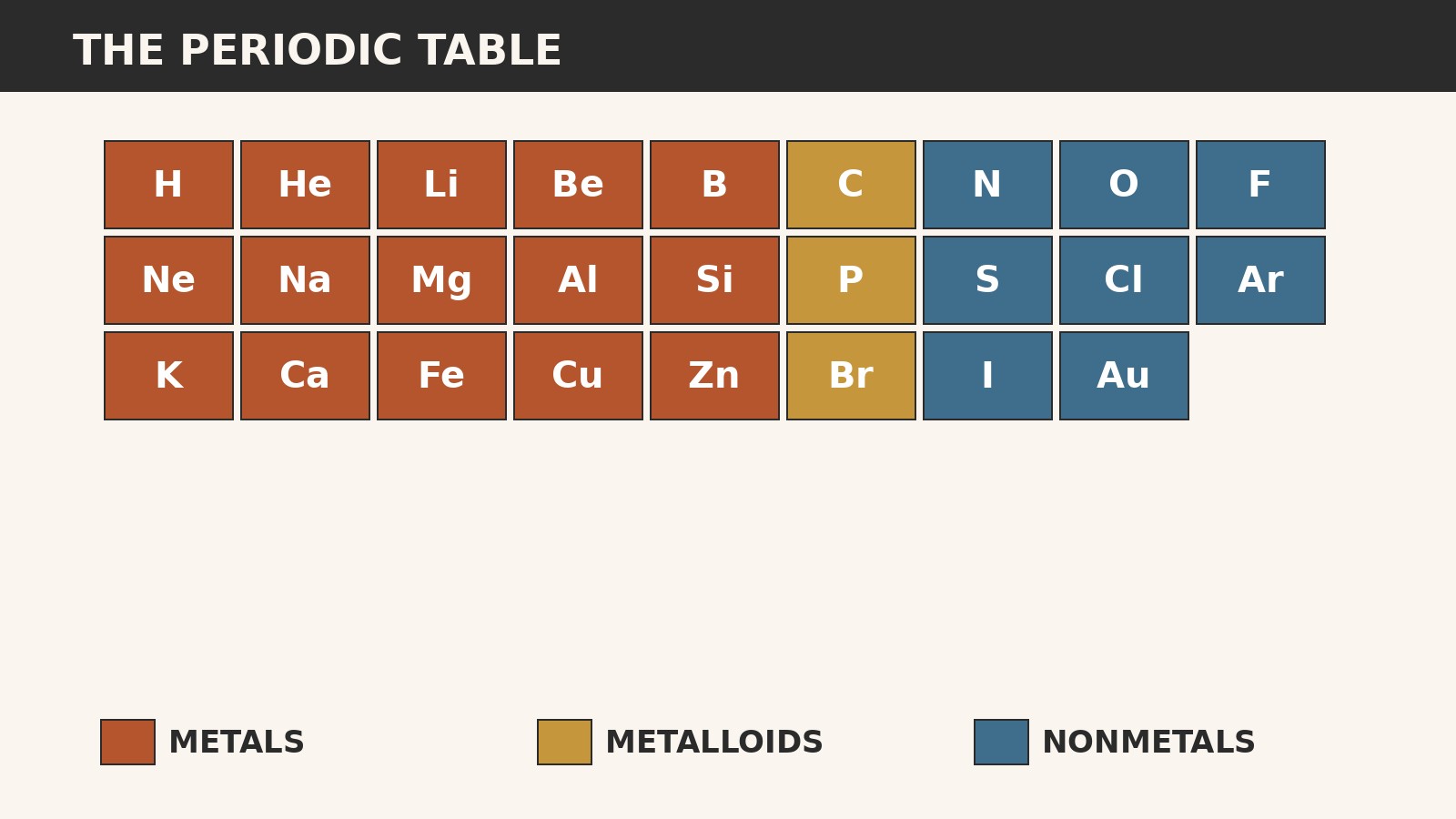
- Metals sit mainly on the left and in the center, nonmetals sit mainly on the upper right, and metalloids form a narrow staircase between them, with properties of both sides.
- The best known families are the alkali metals in Group 1, the alkaline earth metals in Group 2, the transition metals in Groups 3 to 12, the halogens in Group 17, and the noble gases in Group 18.
- Each element entry gives, at minimum, the element name, its chemical symbol, and its atomic number, and many also give a standard atomic weight, an average over naturally occurring isotopes.
- Periodic trends are patterns, not rigid rules: atomic size, ionization energy, and electronegativity change in broadly predictable ways, with exceptions, especially among transition metals and the heaviest elements.
What an Element Is, and What the Table Is For
An element is a substance made of only one kind of atom. Hydrogen, oxygen, and iron are elements. Water is not an element, because it is a compound made of hydrogen and oxygen joined chemically. Salt is not an element either, because it is a compound of sodium and chlorine. The Royal Society of Chemistry makes this distinction in its teaching material: the periodic table contains only elements, while compounds are built from those elements joined together.
That distinction explains why the table is so useful. Chemistry has an enormous number of substances, but they are all built from a limited set of elements, so knowing how the elements behave and combine gives a map for a large part of chemistry. The table does not list every compound or reaction: it organizes the building blocks so patterns in their behavior become visible. The modern table orders elements by atomic number, from hydrogen at 1 to oganesson at 118. Atomic number is the number of protons in the nucleus, and it defines the element: change the number of protons and you change the element itself. Adding or removing electrons makes an ion, and changing the number of neutrons makes a different isotope, but neither turns one element into another. That is why atomic number, not atomic mass, organizes the modern table: an older table ordered by atomic mass ran into problems where mass order and chemical behavior disagreed, and atomic number order resolved them.
How the Table Is Organized: Periods, Groups, and Blocks
Periods are the horizontal rows. There are 7 periods. Moving left to right across a period, atomic number rises by one at each step. Elements in the same period have their outermost electrons in the same highest energy level in the simple shell picture taught in school chemistry, although the full picture is more complex for transition metals. Across a period, properties change gradually: sodium, magnesium, aluminum, silicon, phosphorus, sulfur, chlorine, and argon sit in Period 3, yet they range from a reactive metal to a gas that barely reacts at all. That gradual change across a row is one half of periodicity.
Groups are the vertical columns. There are 18 groups, numbered 1 to 18 in the IUPAC system. Elements in the same group have similar arrangements of electrons in their outermost shell, and that similarity is why they tend to behave alike chemically. Moving down a group, each step adds a new electron shell, so atoms generally get larger and their outer electrons sit farther from the nucleus. That shared pattern down a column is the other half of periodicity, and it is why group membership is such a good first predictor of behavior.
Groups are also called families, and the two words mean the same thing here. Some groups have widely used family names, and some do not. Groups 1, 2, 17, and 18 have the most familiar names. Groups 3 to 12 are known collectively as the transition metals. Groups 13 to 16 are often described by their first element, as the boron, carbon, nitrogen, and oxygen groups, while Groups 15 and 16 also have the less common names pnictogens and chalcogens. A table that names every column usually mixes formal group numbers with informal labels, and the numbered groups are the safer reference.
The table is also divided into blocks, named for the type of orbital being filled. The s block covers Groups 1 and 2 plus helium, the p block covers Groups 13 to 18, the d block covers Groups 3 to 12, and the f block covers the two rows shown separately at the bottom, the lanthanides and the actinides. Two placements often cause confusion. Hydrogen sits above Group 1 in most tables, but it is not an alkali metal: it is a gas that can gain an electron as well as lose one, and it behaves very differently from lithium, sodium, or potassium. Helium sits in Group 18, even though its electron configuration puts it in the s block, because its outer shell is full and it behaves like a noble gas.
How to Read an Element Entry
First, find the atomic number, usually the small number at the top of the box: it tells you the number of protons. Second, find the chemical symbol, usually one or two letters in large type. Symbols come from the element name or, in several cases, from an older Latin name: Na for sodium from natrium, K for potassium from kalium, Fe for iron from ferrum, and Pb for lead from plumbum. Third, find the element name in full. Fourth, look for the atomic weight figure, usually below the symbol. For most elements this is a standard atomic weight, an average over the mix of isotopes found in nature. For the most unstable synthetic elements, tables often show a bracketed whole number instead, the mass number of the most stable known isotope, not an average.
Carbon shows how the parts fit together. Carbon has atomic number 6, symbol C, and a standard atomic weight near 12.011: a carbon atom has 6 protons, and a neutral carbon atom has 6 electrons, while most carbon atoms have 6 neutrons, giving mass number 12. Sodium, with atomic number 11 and symbol Na, sits in Group 1 and Period 3, which tells you at a glance that it is an alkali metal that will tend to lose one electron and form a singly charged positive ion. Color coding varies by publisher, so read it from the key on the table in front of you: group and period numbers are the stable reference, and colors are a display choice.
The First 20 Elements
The first 20 elements, from hydrogen to calcium, are the ones most readers meet first. Learning them in atomic number order shows how the table fills across Periods 1, 2, and 3, then into Period 4.
| Atomic number | Element | Symbol | Group | Category in brief |
|---|---|---|---|---|
| 1 | Hydrogen | H | 1, by convention | Nonmetal, distinct from the alkali metals |
| 2 | Helium | He | 18 | Noble gas |
| 3 | Lithium | Li | 1 | Alkali metal |
| 4 | Beryllium | Be | 2 | Alkaline earth metal |
| 5 | Boron | B | 13 | Metalloid |
| 6 | Carbon | C | 14 | Nonmetal |
| 7 | Nitrogen | N | 15 | Nonmetal |
| 8 | Oxygen | O | 16 | Nonmetal |
| 9 | Fluorine | F | 17 | Halogen |
| 10 | Neon | Ne | 18 | Noble gas |
| 11 | Sodium | Na | 1 | Alkali metal |
| 12 | Magnesium | Mg | 2 | Alkaline earth metal |
| 13 | Aluminum | Al | 13 | Metal |
| 14 | Silicon | Si | 14 | Metalloid |
| 15 | Phosphorus | P | 15 | Nonmetal |
| 16 | Sulfur | S | 16 | Nonmetal |
| 17 | Chlorine | Cl | 17 | Halogen |
| 18 | Argon | Ar | 18 | Noble gas |
| 19 | Potassium | K | 1 | Alkali metal |
| 20 | Calcium | Ca | 2 | Alkaline earth metal |
In Period 2, from lithium to neon, and in Period 3, from sodium to argon, character shifts from reactive metal, through intermediate elements, to reactive nonmetal, and finally to a noble gas. This article uses US spellings, aluminum and sulfur, because Amberaisle uses US English; the symbols, Al and S, are the same under either spelling.
Metals, Nonmetals, and Metalloids
Every element falls in one of three broad classes: metal, nonmetal, or metalloid. This split is a useful first sort, but it summarizes tendencies, and the boundary is a zone rather than a fence, especially around the metalloids.
Metals are the majority of elements, dominating the left side and the center. In general, they are shiny when freshly cut, good conductors of heat and electricity, malleable, and ductile, and chemically they tend to lose electrons and form positive ions. Iron, copper, aluminum, gold, and silver are familiar examples. Not every metal fits the image equally well: mercury is a liquid at room temperature, and sodium is soft enough to cut with a knife.
Nonmetals sit mainly on the upper right, plus hydrogen at the top left. In general, they are poor conductors, brittle as solids, and dull rather than shiny, and chemically they tend to gain or share electrons rather than lose them. Oxygen, nitrogen, carbon, sulfur, phosphorus, fluorine, and chlorine are the best known nonmetals. Their forms vary widely: oxygen, nitrogen, fluorine, and chlorine are gases at room temperature, bromine is a liquid, and carbon, sulfur, and phosphorus are solids. What unites them is position and electron behavior, not appearance.
Metalloids sit between the two classes, along a staircase boundary from boron down through silicon, germanium, arsenic, antimony, and tellurium. Those six are the commonly recognized metalloids. They look metallic, but they conduct less well than metals, and they are brittle like nonmetals. Several are semiconductors, and that behavior can be tuned by adding tiny amounts of other elements. Silicon is the central example, as the base material of most computer chips and solar cells. The boundary is not fixed by IUPAC as group numbers are: polonium and astatine are sometimes added to metalloid lists, so tables listing six and tables listing eight use different conventions for a genuinely fuzzy boundary. Exact counts for the three classes are therefore convention dependent. The safe general statement is that metals are the large majority, nonmetals are a smaller group on the right, and metalloids are the smallest group, on the boundary.
The Families, Group by Group
This survey covers the table from left to right with representative elements, not a full catalogue of all 118 elements: learning a few members well lets you predict the rest.
Group 1: The Alkali Metals, and Hydrogen
Group 1 contains lithium, sodium, potassium, rubidium, cesium, and francium, with hydrogen placed above the group by convention. The alkali metals are soft, reactive metals with one outer electron, which they lose readily to form ions with a single positive charge. Reactivity increases down the group, because larger atoms hold their single outer electron less tightly. Sodium and potassium are the everyday members, essential in the human body and common in salts, while francium is extremely rare and radioactive, a textbook endpoint rather than a practical material. Hydrogen is not counted as an alkali metal despite its position, because it does not share their metallic character or simple electron loss behavior.
Group 2: The Alkaline Earth Metals
Group 2 contains beryllium, magnesium, calcium, strontium, barium, and radium. These metals have two outer electrons, typically losing both to form ions with a double positive charge. They are less reactive than the alkali metals, but reactivity generally increases down the group, because larger atoms hold outer electrons less tightly. Magnesium and calcium are the familiar members, and calcium is a major component of bones, teeth, shells, and limestone. Beryllium breaks the pattern: it is much less reactive than the rest of the group in many compounds, and it is toxic. Radium, like francium, is radioactive and known mainly from its place in the group.
Groups 3 to 12: The Transition Metals
Groups 3 to 12 form the central block, known collectively as the transition metals. Iron, copper, zinc, nickel, chromium, manganese, silver, gold, platinum, and titanium are all transition metals. They are typically hard, strong, shiny, good conductors, able to form colored compounds, and able to show more than one oxidation state: iron can form ions with a double or triple positive charge, and copper with a single or double positive charge, while a Group 1 metal normally shows only one common charge. That flexibility comes from inner d orbitals taking part in bonding as well as outer s orbitals. Group 3 membership is conventional: scandium and yttrium are in Group 3 in all common tables, but the third member is lanthanum and actinium in some tables and lutetium and lawrencium in others. IUPAC has not imposed a single version, and readers will meet both.
Groups 13 to 16: From the Boron Group to the Chalcogens
Group 13, the boron group, starts with boron, a metalloid, then moves through aluminum, gallium, indium, and thallium, which are metals, with nihonium at the bottom as a synthetic element. Aluminum is the practical star: light, protected by a thin oxide layer, and used in aircraft, packaging, and construction. Group 14, the carbon group, contains carbon, silicon, germanium, tin, and lead, with flerovium at the bottom: carbon is the backbone of organic chemistry, silicon and germanium are semiconductors, and tin and lead are metals. Group 15, the nitrogen group or pnictogens, contains nitrogen, phosphorus, arsenic, antimony, and bismuth, with moscovium at the bottom: nitrogen makes up most of the air yet is unreactive as a gas because of its very strong triple bond, while phosphorus is essential in DNA, bones, and energy transfer in cells. Group 16, the oxygen group or chalcogens, contains oxygen, sulfur, selenium, tellurium, and polonium, with livermorium at the bottom: oxygen is essential for respiration and combustion, sulfur is known from sulfuric acid, and polonium is radioactive and sits on the metalloid boundary discussed earlier.
Group 17: The Halogens
Group 17 contains fluorine, chlorine, bromine, iodine, and astatine, with tennessine at the bottom as a synthetic element. The halogens are reactive nonmetals with seven outer electrons, one short of a full shell, so they strongly tend to gain one electron and form ions with a single negative charge. Reactivity decreases down the group, the opposite direction from the alkali metals: fluorine is the most reactive, chlorine very reactive, bromine less so, and iodine the least reactive of the familiar four. Fluorine is also the most electronegative element. Chlorine disinfects water, iodine is essential in small amounts for thyroid function, and bromine is a liquid at room temperature. The halogen pattern mirrors the alkali metal pattern: one family eager to lose an electron, one eager to gain one, both driven toward a full outer shell.
Group 18: The Noble Gases
Group 18 contains helium, neon, argon, krypton, xenon, and radon, with oganesson at the bottom as a synthetic element. The noble gases have full outer shells, making them very stable and very unreactive under normal conditions. Helium fills balloons, neon gives the familiar reddish orange glow in signs, argon fills light bulbs and provides an inert atmosphere for welding, and xenon is used in some lamps and in ion engines for spacecraft. Radon breaks the harmless image: it is radioactive, can accumulate in buildings from soil and rock, and is a health concern because it is a gas that can be breathed in. Oganesson is synthetic, extremely short lived, and known from only a handful of atoms, so its chemistry is predicted from its expected electron structure, not observed in the ordinary sense.
The Rows Below the Table: Lanthanides and Actinides
The two rows below the main table are the lanthanides and the actinides, also called the lanthanoids and actinoids in IUPAC spelling. They are the f block, placed below only to keep the table a practical width: inserted in place, Periods 6 and 7 would each be 32 elements wide. The lanthanides run from lanthanum at 57 to lutetium at 71, and the actinides from actinium at 89 to lawrencium at 103, subject to the Group 3 convention noted earlier. Lanthanides are often called rare earth elements, but that name misleads: several are more abundant in the crust than lead or tin, and they are called rare because they are hard to separate from each other, not because all are scarce. Neodymium magnets are the best known example. Actinides are mostly radioactive, with thorium and uranium important in nuclear energy. The bottom rows are not a footnote: they are part of Periods 6 and 7, moved down for layout, in the same atomic number order as the rest of the table.
Periodic Trends: What Changes, and Why
Periodic trends are the patterns that repeat across periods and down groups: once you know where an element sits, you can make a first guess about several properties without looking them up. Three trends matter most, and a fourth, metallic character, ties them together.
Atomic radius measures atom size, usually from the distance between nuclei in a bonded or solid form, because an atom has no sharp edge. In general, it decreases across a period and increases down a group. Across a period, electrons are added to the same shell while protons are added to the nucleus, so stronger nuclear pull draws the electron cloud inward. Down a group, each step adds a new shell, so outer electrons sit farther out, shielded by inner electrons. That is why lithium is larger than fluorine in the same period, and potassium larger than lithium in the same group.
Ionization energy is the energy needed to remove an electron from an atom in the gas phase. In general, it increases across a period and decreases down a group, the mirror image of atomic radius. Across a period, atoms get smaller and outer electrons are held more tightly. Down a group, atoms get larger and outer electrons are farther from the nucleus and better shielded. That is why the single outer electron of potassium is easy to remove, while an electron of neon, which already has a full shell, is hard to remove.
Electronegativity measures how strongly an atom in a bond attracts shared electrons toward itself. In general, it increases across a period and decreases down a group, for the same reason as ionization energy. Fluorine has the highest electronegativity, and noble gases are usually left out of electronegativity scales because they rarely form bonds in which sharing can be measured. In water, oxygen pulls shared electrons toward itself, giving the molecule its polar character.
Metallic character is a summary trend, not a single measured property. It increases down a group and decreases across a period, from metals on the left to nonmetals on the right. Elements that lose electrons easily behave as metals, while elements that hold electrons tightly or gain them behave as nonmetals. Reactivity follows the same logic in opposite directions for Groups 1 and 17.
| Trend | Across a period, left to right | Down a group, top to bottom |
|---|---|---|
| Atomic radius | Generally decreases | Generally increases |
| Ionization energy | Generally increases | Generally decreases |
| Electronegativity | Generally increases | Generally decreases |
| Metallic character | Generally decreases | Generally increases |
The word generally appears in every row on purpose: trends summarize many measurements, and individual elements depart from them. A trend should never be quoted as a law with no exceptions.
Using the Table to Predict Behavior, and Common Mistakes
To predict an unknown main group element, locate its group, then its period, then its neighbors and class. Rubidium, in Group 1 below potassium, is predicted to be a soft, reactive metal forming ions with a single positive charge and reacting with water more vigorously than potassium. Bromine, in Group 17 below chlorine and above iodine, is predicted to be a reactive nonmetal gaining one electron, less reactive than chlorine and more reactive than iodine. The method has limits: transition metals do not follow the simple group charge rules, because their d electrons take part in bonding, and the heaviest elements are known from so few atoms that their chemistry is predicted from position rather than measured directly. Common mistakes are confusing atomic number with atomic mass, reversing periods and groups, treating color as a universal code, and assuming every group has a family name. The table is also not finished: its total has grown over time, and future confirmed elements would extend it, with properties first predicted from position.
Frequently Asked Questions
How many elements are on the periodic table?
There are 118 recognized elements, from hydrogen at atomic number 1 to oganesson at atomic number 118. The heaviest elements are synthetic, exist only briefly, and their chemistry is largely predicted from position rather than measured in the usual way.
What is the difference between a period and a group?
A period is a horizontal row, and there are 7 periods. A group is a vertical column, and there are 18 groups in the IUPAC numbering system. Elements in the same period show gradual change across the row, while elements in the same group tend to share chemical behavior because of similar outer electron arrangements.
What is a family on the periodic table?
A family is another name for a group. The best known families are the alkali metals in Group 1, the alkaline earth metals in Group 2, the transition metals in Groups 3 to 12, the halogens in Group 17, and the noble gases in Group 18. Some groups have no single common family name, and there the group number is safest.
Why are the lanthanides and actinides shown below the main table?
They are the f block, belonging in Periods 6 and 7, moved below only to keep the table a practical width: inserted in place, each period would be 32 elements wide. Their atomic numbers run in order, from 57 to 71 for the lanthanides and from 89 to 103 for the actinides, following the Group 3 convention used by the table.
What is a metalloid?
A metalloid is an element with properties between those of metals and nonmetals. The commonly recognized metalloids are boron, silicon, germanium, arsenic, antimony, and tellurium, on a staircase boundary between metals and nonmetals. They look metallic but conduct less well than metals, and several are semiconductors. Polonium and astatine sit on the edge of this boundary and are counted differently by different sources.
Why is hydrogen placed in Group 1 if it is not a metal?
Hydrogen sits above Group 1 because it has one electron, like the alkali metals, but its placement is a convention, not a classification. It is a nonmetal gas that can lose or gain an electron, and it does not share the metallic character or simple reactivity of lithium, sodium, or potassium.
Which element is the most reactive?
There is no single answer, because reactivity depends on the kind of reaction. Among metals, the alkali metals are the most reactive group, and reactivity increases down Group 1, with francium limited by rarity and radioactivity. Among nonmetals, fluorine is the most reactive and the most electronegative element. The useful answer is therefore given by family and trend, not by one element for all chemistry.
Keep reading: What Is an Ionic Compound? Electron Transfer, Lattices, and Properties Explained
Sources & references
- Royal Society of Chemistry, Periodic Table and RSC Education, How to Read the Periodic Table: elements as substances containing only one type of atom, the table as a list of elements only rather than compounds, and the reading of element entries.
- International Union of Pure and Applied Chemistry (IUPAC), Periodic Table of the Elements: the 18 group and 7 period layout, element order by atomic number from hydrogen to oganesson, and the lanthanide and actinide rows from atomic numbers 57 to 71 and 89 to 103 in the table version checked.


