Short answer
- Gravity is the attraction between masses. Every object with mass attracts every other object with mass. The effect is usually too small to notice unless at least one object is very massive, like a planet or a star.
- Two things control how strong gravity is: mass and distance. More mass means stronger gravity. Greater distance means weaker gravity, and the weakening happens fast: doubling the distance cuts the force to one quarter of its value.
- Newton described gravity as a force. His law of universal gravitation says the force between two masses depends on their masses and on the square of the distance between them. It predicts falling objects, tides, and planetary orbits with great accuracy in everyday conditions.
- Einstein described gravity as curved spacetime. In general relativity, mass and energy curve space and time, and objects follow the straightest possible paths through that curved spacetime. Near Earth the two descriptions agree closely, so Newton is still used for most practical calculations.
- An orbit is continuous falling with enough sideways motion to keep missing the ground. That is why astronauts in orbit float even though Earth's gravity is still strong where they are: they are falling around Earth, not floating free of gravity.
- Weight is not the same as mass. Mass is how much matter an object contains, and it does not change when the object moves. Weight is the gravitational force on that object, and it changes with the mass pulling on it and with distance from that mass.
- There is gravity in space. Space is mostly empty, but it is not free of gravity. The Sun's gravity holds Earth in orbit across about 150 million kilometers of nearly empty space, and Earth's gravity holds the Moon and its satellites.
Introduction
Drop a pen and it falls. Jump and you come back down. The Moon stays near Earth, and Earth stays near the Sun, year after year, without ropes or rails. One phenomenon explains all of these events: gravity.
Gravity is easy to notice and surprisingly hard to describe well. For centuries, the best description said that masses pull on each other across empty space. Then, in the early twentieth century, a second description replaced the pull with a curve in the fabric of space and time. Both descriptions are still taught, because each one is useful, and because they agree in most everyday situations.
This guide explains how gravity works in plain language. It starts with the short answer, then works through the two rules that control gravitational strength, the difference between mass and weight, why orbits are really a kind of falling, and what Einstein changed about the picture. It also clears up the common idea that there is no gravity in space. This guide answers the question: how does gravity work?
What Gravity Is, in Plain Language
At its simplest, gravity is the mutual attraction of all masses. NASA’s space flight training material puts it this way: gravitation is the mutual attraction of all masses in the universe, and because its effect decreases in proportion to distance squared, it never quite disappears completely. That last point matters. Gravity does not switch off at the edge of the atmosphere, or at some boundary in space. It weakens with distance, but it keeps reaching.
This universality is what makes gravity different from a force that only acts on contact. You do not need to touch Earth for Earth to pull on you. NASA’s Glenn Research Center makes the same distinction when it describes gravity as a field force: the source of the force does not have to be in physical contact with the object. A thrown ball, a satellite, and the Moon are all responding to Earth’s gravity without touching Earth at all.
Gravity also pulls both ways. Earth pulls on you, and you pull on Earth, with exactly the same size of force. The reason you move and Earth does not appear to move is the difference in mass. Your pull on Earth is real, but Earth is so massive that the resulting motion is far too small to notice. The same two way pull holds for Earth and the Moon: Earth pulls the Moon, and the Moon pulls Earth back.
The Two Rules: Mass and Distance
Every gravitational interaction follows two rules, and together they explain most of what people observe about gravity.
The first rule is that more mass means more gravity. The American Museum of Natural History states it as the first of two ideas needed to understand gravity: the more massive an object is, the more gravity it has. A planet pulls harder than a pebble because it contains far more matter. A star pulls harder than a planet for the same reason. This is why you feel Earth’s gravity so strongly and never notice the gravity of a book, a car, or another person: their masses are tiny compared with Earth’s.
The second rule is that greater distance means weaker gravity. The museum states this as its second idea: the closer two objects are, the stronger the gravitational pull between them. The weakening is not gradual in a straight line. It follows an inverse square pattern, which means the force falls off with the square of the distance. Double the distance, and the force drops to one quarter. Triple the distance, and it drops to one ninth. Move ten times farther away, and it drops to one hundredth.
Newton’s law turns these two rules into one equation:
F = G x m1 x m2 / d squared
Here F is the gravitational force, G is a universal constant, m1 and m2 are the two masses, and d is the distance between their centers. NASA’s Glenn Research Center gives this equation and explains that, for objects near Earth, the distance is measured from Earth’s center. That detail explains why standing on a mountaintop changes your weight only slightly: the mountaintop is only a few kilometers farther from Earth’s center than sea level, while Earth’s radius is about 6,400 kilometers, so the change in distance is tiny in proportion.
Mass Is Not Weight
People often use mass and weight as if they were the same thing, but in physics they are different, and the difference explains several puzzles about gravity.
Mass is a measure of how much matter an object contains. It also measures how much an object resists changes in motion. Your mass is the same on Earth, on the Moon, and floating in deep space, as long as nothing is added or removed.
Weight is the force of gravity acting on a mass. NASA’s Glenn Research Center defines weight as the force generated by the gravitational attraction of Earth on an object, and gives the simple relation W = m x g, where m is mass and g is the gravitational acceleration at that place. On Earth’s surface, g is about 9.8 meters per second squared. A person with a mass of 70 kilograms therefore weighs about 686 newtons on Earth, since 70 times 9.8 equals 686. The newton is the unit of force.
Move that same person somewhere else and the mass stays 70 kilograms, but the weight changes. On a smaller, less massive world, g is smaller, so the weight is smaller. Far from any planet, where no single mass dominates, weight can approach zero even though mass is unchanged. That is why astronauts can be described as weightless without being massless: their mass is still there, and it still takes effort to push them around, but the gravitational force acting on them is balanced by their orbital motion, as explained in the section on orbits below.
Why Everything Falls at the Same Rate
One of the most surprising facts about gravity is that, without air resistance, a heavy object and a light object fall at the same rate. This seems wrong to everyday intuition, which expects a bowling ball to fall faster than a feather. In air, the feather does fall more slowly, but that is because air resistance pushes against the feather much more strongly relative to its weight, not because gravity pulls it less strongly.
The reason follows from Newton’s two laws working together. The gravitational force on an object is proportional to its mass: double the mass, and gravity pulls twice as hard. But Newton’s second law says that acceleration equals force divided by mass, so the doubled force acting on the doubled mass produces the same acceleration. The mass cancels out. Near Earth’s surface, that acceleration is about 9.8 meters per second squared for every object, regardless of its mass, as long as air resistance is negligible.
Newton and the Idea of Universal Gravitation
Before Newton, many thinkers treated the heavens and Earth as separate realms with separate rules. Newton proposed that one rule covers both. Britannica’s account of his theory states that he proposed the force of gravity experienced on Earth is the same force that acts throughout the universe, and that every object in the universe attracts every other object.
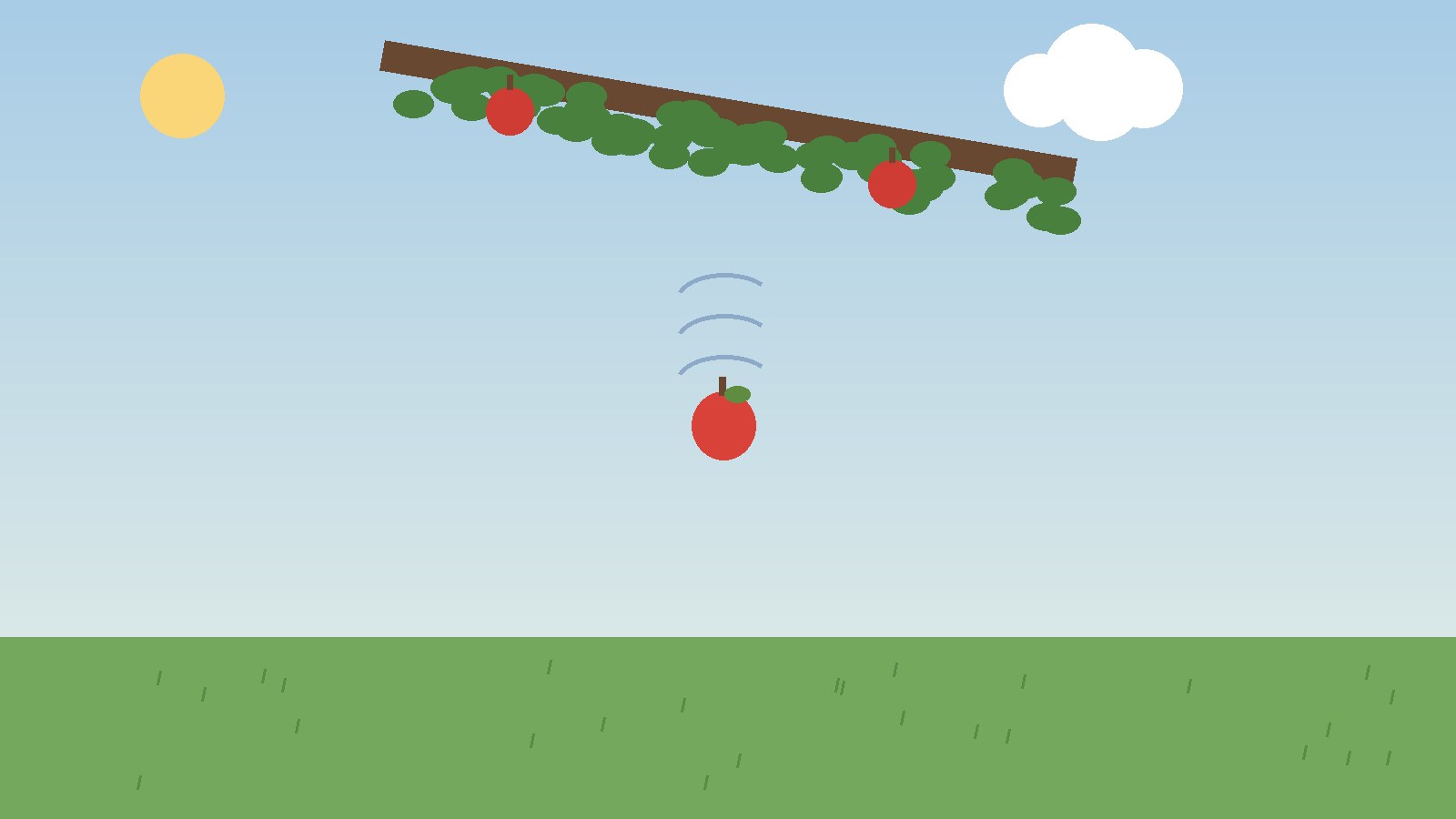
The familiar apple story is often told as the spark for this idea, and it should be treated as a story rather than a documented experiment. What is documented is the theory itself: Newton published the first quantitative theory of gravitation in 1687, according to Britannica. Quantitative matters here. Earlier thinkers had ideas about why things fall, but Newton gave a mathematical law that could predict how strongly, and that could be tested against the motions of the Moon and the planets.
The theory also explained work done earlier by Johannes Kepler, who had described the shapes and timing of planetary orbits without explaining why they moved that way. NASA’s space flight material notes that Kepler described the positions and motions of objects in the solar system, and that Newton later explained why Kepler’s laws worked, by showing they depend on gravitation. In Newton’s picture, the same force that pulls an apple to the ground also holds the Moon in its path around Earth and Earth in its path around the Sun.
Orbits: Falling Without Ever Landing
An orbit is the idea in this guide most likely to change how a reader pictures space. A satellite does not stay up because it has escaped gravity, and it does not hover like a balloon. It stays up because it is falling, continuously, while moving sideways fast enough to keep missing Earth.
NASA’s Glenn Research Center explains this with the example of a shuttle in low Earth orbit. On the ground, the orbiter weighed about 250,000 pounds. In orbit, about 200 miles above the surface, it still weighed about 226,757 pounds by the same calculation, roughly 91 percent of its ground weight. The center stresses the point directly: the weight is not zero, and the shuttle is not weightless in orbit. Weightlessness in orbit is caused by speed, not by absence of gravity. The shuttle is pulled toward Earth, but its high orbital speed, tangent to Earth’s surface, causes its fall toward the surface to be matched by the curvature of Earth away from the shuttle. In essence, the shuttle is constantly falling all around Earth.
The same reasoning explains why the Moon does not fall to Earth and why Earth does not fall into the Sun. Britannica’s account describes the Moon as falling toward Earth while its forward motion continually balances the gravitational effect to create an orbit. Picture throwing a ball: a gentle throw lands nearby, a harder throw lands farther away, and at a high enough sideways speed, the ball’s fall curves at the same rate as Earth’s surface curves away beneath it. It never lands, because the ground keeps dropping away at the same rate. That is an orbit.
This also explains why astronauts float inside the International Space Station. The station, the astronauts, and everything inside it are all falling around Earth together, at the same rate. With no floor pushing back against their feet, they feel weightless, even though Earth’s gravity at that altitude is still most of its surface strength. Weight, as felt, is the push back against gravity; remove that push in free fall and the feeling disappears while gravity remains.
Tides and the Pull of the Moon
Tides are a visible, everyday effect of gravity beyond falling objects. They are caused mainly by the Moon’s gravity acting on Earth’s oceans, with the Sun contributing as well. Britannica’s account explains that the Moon’s gravitational force pulls the oceans upward, and that as Earth rotates and the Moon revolves around Earth, the oceans rise and fall in response to the shifting force of the Moon’s gravity.
Gravity on the Moon itself is a separate topic, covered in the companion article on gravity on the Moon. For this guide, the one point that matters is the comparison: the pull of gravity felt by a person standing on the Moon is weaker than on Earth, because Earth is more massive, bigger, and more dense, as NASA’s GRACE mission material explains. The Moon still has gravity, and it still pulls objects toward its surface. It simply pulls less strongly.
Einstein: Gravity as Curved Spacetime
In 1915, Albert Einstein published his general theory of relativity, which gave a new account of how gravity works. NASA’s space flight material introduces it simply: Einstein posed an explanation of how gravitation works in his General Theory of Relativity. Where Newton described gravity as a force pulling masses together across space, Einstein described it as the shape of spacetime itself.
Spacetime is the combination of the three dimensions of space with time as a fourth dimension. In Einstein’s account, mass and energy curve spacetime, and objects moving through spacetime follow the straightest possible paths available in that curved geometry. A planet orbiting a star is not being pulled by an invisible rope in this picture. It is following a path through spacetime that has been curved by the star’s mass and energy.
The trampoline analogy is the most common way to picture this. Imagine a stretched rubber sheet with a heavy ball in the middle. The sheet dips, and a marble rolled across the sheet curves toward the ball. The dip stands for curved spacetime, and the marble’s curved path stands for an orbit. The analogy has limits: a real trampoline curves in two dimensions and relies on Earth’s gravity, while spacetime curvature involves four dimensions. It shows the idea of following a curved path; it is not a literal picture of spacetime.
Einstein’s account also predicts effects that Newton’s law does not describe. One is that gravity affects time itself: clocks run at different rates depending on the strength of gravity where they sit. Another is that massive objects bend the path of light passing near them. A third is that violent events involving very massive objects send ripples through spacetime, called gravitational waves. Each of these predictions has been tested, and the gravitational wave prediction was confirmed directly in 2015, as described in the next section.
A note on Einstein’s Nobel Prize helps avoid a common error. Einstein is famous for relativity, but his Nobel Prize in Physics, for 1921, was awarded for his discovery of the law of the photoelectric effect, not for relativity. The Nobel Prize organization’s own facts page gives the prize motivation in those words and notes that he received the prize one year later, in 1922. Relativity earned its standing through tests and observations, not through that prize.
Gravitational Waves: Ripples in Spacetime
If spacetime can curve, then a violent change in a massive system should send ripples through it, much as a disturbance sends ripples across water. Einstein’s theory predicted such gravitational waves in 1915. For a century they remained a prediction, because the ripples expected from distant events are extraordinarily small by the time they reach Earth.
That changed in September 2015. The LIGO Laboratory’s press release reports that gravitational waves were detected on September 14, 2015, by both of the twin Laser Interferometer Gravitational-Wave Observatory detectors, in Livingston, Louisiana, and Hanford, Washington. The waves came from the merger of two black holes, estimated at about 29 and 36 times the mass of the Sun, in an event that took place about 1.3 billion years ago. The release states plainly that the observation confirms a major prediction of Einstein’s 1915 general theory of relativity.
The detection worked by measuring changes in distance far smaller than an atom. Each LIGO detector uses laser light traveling along arms about 4 kilometers long, and a passing gravitational wave changes those arm lengths by an infinitesimal amount. The release notes that a change smaller than one ten thousandth of the diameter of a proton can be detected. That precision is what allowed a ripple from more than a billion light years away to be measured on Earth.
When to Use Newton and When to Use Einstein
Readers sometimes ask which theory is correct, as if one must be discarded. The honest answer is that Newton is a very good approximation that works within limits, and Einstein is a deeper account that covers more situations, including those limits.
For launching a satellite, aiming a spacecraft at Mars, or calculating how long an object takes to fall from a rooftop, Newton’s law is more than good enough. NASA’s Glenn Research Center says that for an object the size of an airplane flying near Earth, the descriptions given by Newton work quite well. Engineers use Newton’s equations for such work because they are simpler and because the difference from Einstein’s predictions is far below what matters for the task.
Einstein’s account becomes necessary where gravity is strong, where speeds approach the speed of light, or where measurements are extremely precise. The bending of light near the Sun, the behavior of clocks in different gravitational fields, and the merger of black holes are all cases where Newton’s law gives the wrong answer or no answer at all. The two theories agree where their ranges overlap, which is why physics kept Newton rather than throwing it away.
What Physicists Still Do Not Fully Understand
A good explainer should say where knowledge stops. NASA’s Glenn Research Center notes that the nature of the gravitational force has been studied for many years and is still being investigated by theoretical physicists. That sentence is a useful warning against pretending the story is finished.
The largest open question is how gravity fits with quantum physics, the theory of matter and forces at very small scales. General relativity works superbly for stars, planets, and black holes. Quantum physics works superbly for atoms and subatomic particles. No tested theory yet unites the two descriptions into one account. Physicists call the missing account quantum gravity, and it remains an active research area, not a settled fact.
Frequently Asked Questions
Why do things fall down instead of up?
Things fall toward the center of the nearest dominant mass, which on Earth is Earth itself. Down is defined by that pull, not by an absolute direction in space. An object released near Earth’s surface accelerates toward Earth’s center, which is why it moves down from the point of view of someone standing on the surface.
Is there gravity in space?
Yes. Space is mostly empty, but gravity reaches across empty space and weakens with distance rather than stopping. Earth’s gravity holds the Moon and satellites in orbit, and the Sun’s gravity holds the planets in orbit. Astronauts in orbit feel weightless because they are in free fall around Earth, not because gravity has disappeared.
Why do astronauts float if gravity is still there?
Astronauts float because they and their spacecraft are falling around Earth together at the same rate. Nothing is pushing back against their feet the way a floor does on Earth, so they do not feel weight. NASA’s orbital example makes the point numerically: a shuttle in low orbit still retained about 91 percent of its ground weight, so the floating is explained by orbital free fall, not by zero gravity.
What causes gravity?
In Newton’s account, gravity is a force of attraction between masses, described by a law but not explained by a deeper mechanism. In Einstein’s account, mass and energy curve spacetime, and objects follow paths through that curved spacetime. Physics does not yet have a tested deeper account that unites gravity with quantum physics, so the honest answer names the model being used and its limits.
Does the Moon have gravity?
Yes. Every object with mass has gravity, including the Moon. The pull felt on the Moon’s surface is weaker than on Earth’s surface, because Earth is more massive, bigger, and more dense, as NASA’s GRACE material explains. Objects dropped on the Moon still fall to its surface. The full comparison is covered in the companion article on gravity on the Moon.
How does gravity hold planets in orbit?
A planet in orbit is falling toward its star while moving sideways fast enough that its fall curves at the same rate as the star’s surroundings curve away. The balance of forward motion and gravitational pull produces a stable path. Too little sideways speed and the planet would spiral inward. Too much and it would escape into a wider path or leave the star altogether.
Why are planets round?
Gravity pulls matter toward the center of a body from all directions. Over time, that inward pull smooths out large irregularities, and the body settles into a roughly spherical shape. Small bodies with weak gravity, such as small asteroids, can stay irregular, because their gravity is too weak to reshape them. Large bodies with strong gravity cannot.
Can gravity be turned off or blocked?
No known material blocks gravity, and no device switches it off. Gravity can be countered by other forces, as when an airplane’s wings generate lift or a rocket’s thrust pushes upward, but the gravitational attraction itself remains. Free fall and orbit create the feeling of weightlessness without removing gravity, which is why those cases are sometimes mistaken for gravity being switched off.
Keep reading: Gravity on the Moon
Keep reading: What Is Centripetal Force?
Sources & references
- NASA Glenn Research Center, "Weight Equation" (gravitational force equation, weight as mass times gravitational acceleration, surface value of g as 9.8 meters per second squared, orbital weight example, and the statement that the nature of the gravitational force is still being investigated). https://www1.grc.nasa.gov/beginners-guide-to-aeronautics/weight-gravitational-force/
- NASA Science, "Chapter 3: Gravity and Mechanics" (gravitation as the mutual attraction of all masses, Kepler's descriptions, Newton explaining Kepler's laws through gravitation, and Einstein's general theory of relativity as an explanation of how gravitation works). https://science.nasa.gov/learn/basics-of-space-flight/chapter3-1/
- NASA Jet Propulsion Laboratory, GRACE Tellus, "Gravity 101" (gravity as an attraction varying with mass and distance, weaker pull on the Moon than on Earth because Earth is more massive, bigger, and more dense, and GRACE twin satellite measurements). https://grace.jpl.nasa.gov/mission/gravity-101/
- Britannica, "How Gravity Works on Earth and in the Universe" (Newton publishing the first quantitative theory of gravitation in 1687, gravity as a universal force of attraction depending on mass and distance, the Moon's orbit through forward motion balancing gravity, and tides). https://www.britannica.com/video/Explanation-gravitational-force-Isaac-Newton-1687/-158977
- American Museum of Natural History, "Gravity: The Universe's Main Attraction" (the two rules that more massive objects have more gravity and closer objects feel a stronger pull, and the Sun's gravity keeping Earth in orbit). https://www.amnh.org/explore/ology/astronomy/meet-the-universes-main-attraction-gravity
- Nobel Prize organization, "Albert Einstein: Facts" (Nobel Prize in Physics 1921, prize motivation for the discovery of the law of the photoelectric effect, and receipt of the prize one year later, in 1922). https://www.nobelprize.org/prizes/physics/1921/einstein/facts/
- LIGO Laboratory, Caltech, "GW150914 Press Release" (first observation of gravitational waves on September 14, 2015, from merging black holes of about 29 and 36 solar masses, confirmation of a major prediction of Einstein's 1915 general theory of relativity, and detector arm length changes smaller than one ten thousandth of a proton diameter). https://www.ligo.caltech.edu/page/press-release-gw150914
- NIST, "Putting Einstein to the Test" (tests confirming Einstein's predictions that clocks in higher gravity tick more sluggishly than ones in lower gravity). https://www.nist.gov/atomic-clocks/a-powerful-tool-for-science/putting-einstein-test
- OpenStax, "Physics 7.2, Newton's Law of Universal Gravitation and Einstein's Theory of General Relativity" (first verification of general relativity in 1919, when starlight passing near the Sun was observed during a solar eclipse and the amount of bending was precisely what Einstein predicted). https://openstax.org/books/physics/pages/7-2-newtons-law-of-universal-gravitation-and-einsteins-theory-of-general-relativity


