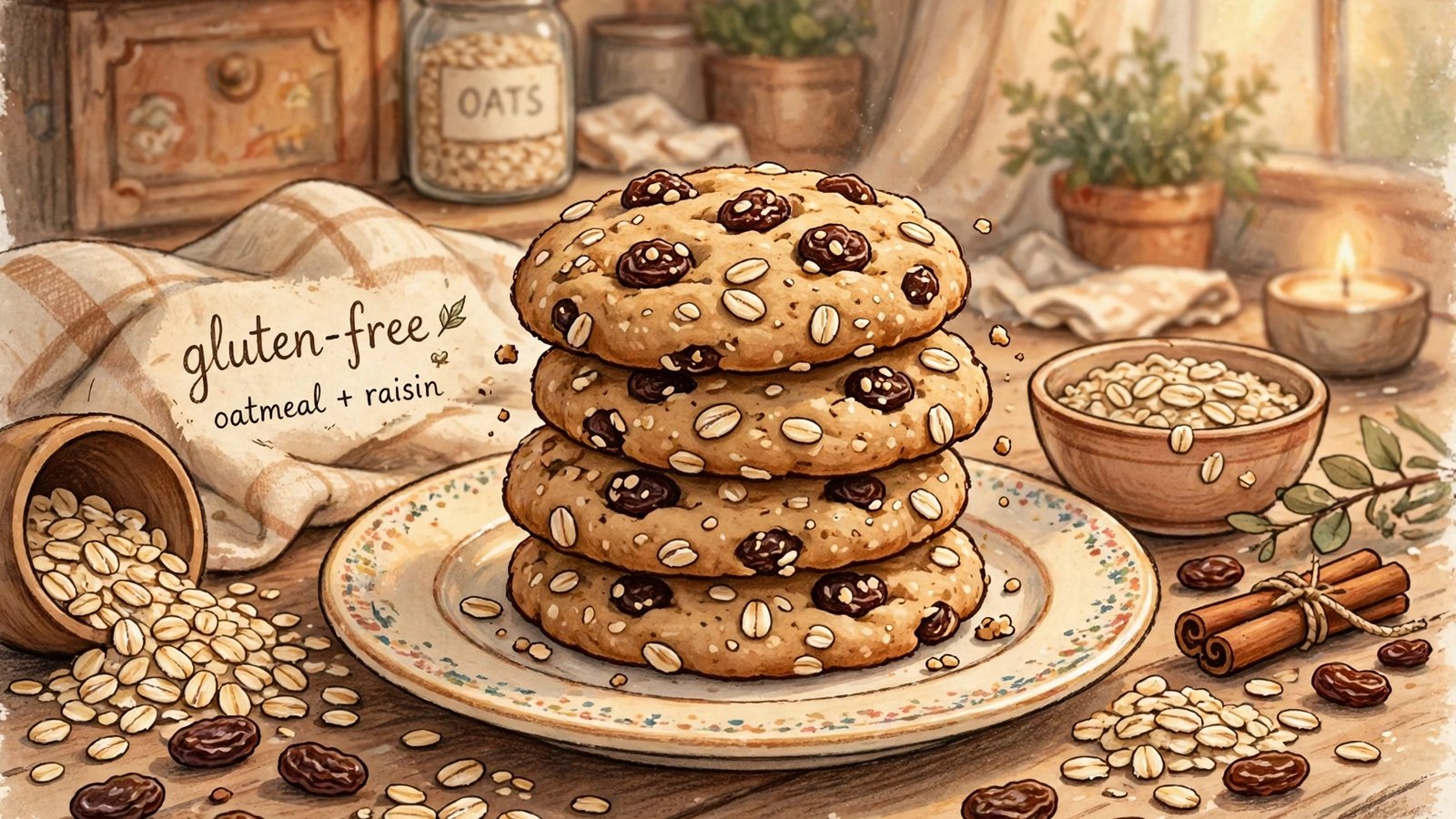
Short answer
- Use oats and flour labeled gluten-free, and choose certified gluten-free oats for a celiac guest. For about 24 cookies, whisk 1 1/2 cups certified gluten-free old-fashioned rolled oats with 1 cup gluten-free all-purpose flour blend containing xanthan gum, 1/2 teaspoon baking soda, 1/2 teaspoon ground cinnamon, and 1/4 teaspoon salt. Beat 3/4 cup softened unsalted butter with 3/4 cup packed light brown sugar and 1/4 cup granulated sugar, then beat in 1 large egg and 1 teaspoon vanilla extract. Mix the dry ingredients into the butter mixture, fold in 1 cup raisins, rest the dough for 15 to 30 minutes, then scoop, flatten slightly, and bake at 350 degrees F, about 175 degrees C, for 11 to 13 minutes, until the edges are set and lightly golden and the centers still look slightly soft. Cool 5 minutes on the sheet before moving the cookies to a rack. Home baking cannot guarantee zero gluten, so tell a celiac guest which ingredients you used and how you prepared them, and let that guest decide.
Introduction
A good oatmeal raisin cookie should not need an apology, and a good gluten-free oatmeal raisin cookie should not need one either. Too many gluten-free versions bake up dry, gritty, or so fragile they break before they reach the plate. This recipe is built to avoid all three failures: certified gluten-free rolled oats for chew, a gluten-free flour blend with xanthan gum for structure, enough brown sugar and butter for moisture, and a bake that stops while the centers still look slightly soft.
The harder part of this recipe is not the mixing. It is the oats. Oats themselves do not contain gluten, but ordinary oats are so often mixed with wheat, barley, or rye on the way from field to bag that they are not considered safe for a person with celiac disease unless the package carries a gluten-free label. This article explains that distinction plainly, states the United States labeling standard accurately, and gives a careful home kitchen routine for reducing cross-contact. It does not promise what no home kitchen can promise: a guarantee of zero gluten. Labeling, storage, and allergen statements were checked against the United States Food and Drug Administration (FDA), the Celiac Disease Foundation, Beyond Celiac, and the United States Department of Agriculture Food Safety and Inspection Service (USDA FSIS) on 30 October 2026.
One honesty note before the recipe. This is original working guidance, not a tested-kitchen result. Ovens vary, flour blends vary, and the first batch is a calibration batch. Watch the edges and the centers, not only the clock.
What Gluten-Free Means on a Label: The 20 Parts per Million Rule
Gluten is a mixture of proteins that occurs naturally in wheat, rye, barley, and crossbreeds of those grains. For a person with celiac disease, an autoimmune condition the FDA estimates affects up to 3 million Americans, eating gluten damages the lining of the small intestine and limits the ability to absorb nutrients. The wording on a package is therefore a health matter, not a marketing detail.
In the United States, gluten-free is a defined labeling term. The FDA issued its final rule defining it on 2 August 2013, codified at 21 CFR 101.91, with compliance required from August 2014. The claim is voluntary: no manufacturer has to use it, but any food that carries it must meet the rule. A food may be labeled gluten-free only if it is inherently gluten-free, or it contains no ingredient that is a gluten-containing grain, no ingredient derived from such a grain that has not been processed to remove gluten, and no ingredient derived from such a grain and processed to remove gluten where that use results in 20 parts per million or more of gluten in the finished food. Any unavoidable presence of gluten must be less than 20 parts per million. The phrases no gluten, free of gluten, and without gluten carry the same meaning and requirements.
Two misunderstandings are worth correcting. First, gluten-free does not mean zero gluten. The FDA explains that it adopted less than 20 parts per million in part because, when the rule was written, scientifically validated methods could not reliably detect gluten at a lower level, and because evidence suggested most people with celiac disease can tolerate the trace amounts below that level. Second, wheat-free does not necessarily mean gluten-free. The Celiac Disease Foundation makes this point directly: a wheat-free food can still contain rye, barley, or a barley-based ingredient such as malt. Look for gluten-free on the package, not wheat-free, on every grain ingredient. A voluntary advisory line such as made in a facility that also processes wheat does not cancel a gluten-free claim; the FDA allows it alongside the claim, provided it is truthful and not misleading, and the food must still comply.
Why Oats Are the Hard Part
Pure, uncontaminated oats are gluten-free. Beyond Celiac states that plainly, and the FDA treats oats as a grain that may be labeled gluten-free when the finished food contains less than 20 parts per million of gluten. The problem is everything that happens to oats before they reach your kitchen.
The FDA describes cross-contact here as the unavoidable presence of gluten from contact with a gluten-containing food, caused by ordinary grain handling: crop rotation and shared harvesting, transport, storage, and manufacturing equipment can all bring gluten-containing grains into contact with grains that are naturally free of gluten. The Celiac Disease Foundation describes the same route in kitchen terms: oats are often harvested and processed with the same equipment used for wheat, and often grown, processed, and transported alongside wheat, barley, and rye. Beyond Celiac adds that mills that process oats also handle gluten-containing grains, creating a substantial risk of cross-contact, and concludes that oats without a gluten-free label are not considered safe for people who have celiac disease.
That is why this recipe specifies labeled gluten-free oats, for every oat ingredient, including any oat flour. The Celiac Disease Foundation also advises against buying grains from bulk bins because of the possibility of cross-contact, which applies with special force to oats, where the scoop and the neighboring bins are outside your control. Check the label every time you buy, even a familiar brand, because facilities, suppliers, and formulations change.
Choosing Oats: Labeled, Certified, Sorted, and Purity Protocol
Packages differ in how the oats were produced. The Celiac Disease Foundation sets out two main routes. Mechanically or optically sorted oats are sorted by a combination of machines and people to remove stray gluten-containing grains. Purity protocol oats are produced under standards designed by the company to prevent contact with gluten at all stages of production; the Foundation notes there is no standard definition for purity protocol and the standards vary by company. Beyond Celiac notes that specialty gluten-free oats are grown, harvested, and processed away from other grains, and that debate exists about whether mechanically sorted oats are safe for people with celiac disease. This article takes the more careful practical line: oats labeled gluten-free meet the federal standard for everyday baking, while certified gluten-free oats are the more conservative choice for a celiac guest, and the guest, not the baker, has the final say.
Certification needs one clarification. Oats do not have to be certified to be labeled gluten-free. The FDA states that directly, and the Foundation repeats it: a certification label is not required, because every product carrying a gluten-free label must already meet the FDA rule. A certification mark means a private organization has applied its own program on top of that rule. It is not a federal guarantee, and its absence does not make a properly labeled product noncompliant.
A further caution belongs here. A small number of people with celiac disease react to avenin, the protein naturally present in oats. The Foundation notes that some people with celiac disease have an immune reaction to avenin and should avoid all oats, even those labeled gluten-free, while also reporting that pure, uncontaminated oats do not cause an immune response leading to intestinal damage in the studies it cites. Beyond Celiac describes avenin sensitivity as a separate sensitivity whose symptoms can resemble a gluten reaction. Introducing gluten-free oats should therefore be individualized, with input from a doctor and a dietitian. If a guest has reacted to oats before, do not serve them these cookies. For readers who tolerate oats, the Foundation gives a moderation reference: up to 1/2 cup of dry rolled oats daily is tolerated by most people with celiac disease. That is a general diet reference, not a serving instruction.
Preventing Cross-Contact in a Home Kitchen
Cross-contact, as Beyond Celiac defines it, is when a food is transferred from one surface to another: a gluten-free food exposed to a gluten-containing food is no longer safe for a person with celiac disease, even if the visible source is removed afterward. Gluten is a protein, not a bacterium, so it cannot be killed off with heat or disinfectants. It has to be kept away, or physically cleaned away.
Before you start, wash your hands and wipe down counters, handles, and surfaces. Beyond Celiac notes that even a refrigerator door handle can carry sticky gluten residue from flour-dusted hands, as can aprons and dish towels. Take the airborne warning seriously: Beyond Celiac states that flour can stay airborne for 12 to 24 hours depending on ventilation and quantity, that particles settle on exposed food and surfaces, and that it is safest not to prepare gluten-free food where that risk is current. Baking the gluten-free batch first, before any wheat flour comes out, is the simplest home version of that rule.
Clean equipment as if crumbs matter, because they do. Beyond Celiac gives a five-step washing routine for shared kitchens: dry wipe to remove crumbs and residue, wash thoroughly with warm, soapy water, rinse, run items through the dishwasher where possible, and air dry or dry with a clean towel that has not contacted gluten. Use separate sponges and dishrags for gluten-free cookware, or disposable towels for cleanup. Store gluten-free ingredients on a top shelf, in a dedicated labeled area, so crumbs do not fall into them. Cutting boards can trap gluten in knife cuts, so use a dedicated or color-coded board. Condiment jars pick up crumbs from knives that touched bread, so use a clean utensil every time, or keep labeled separate containers. Use clean water and clean, preferably dedicated, tools wherever water or oil is shared; Beyond Celiac is explicit that water used for gluten-containing pasta must not be reused, that a shared fryer is not safe for gluten-free items, and that high heat makes neither safe. In a convection oven, keep gluten-free food covered, because the fan can move particles, and use foil or a clean tray as a barrier. None of this turns a home kitchen into a certified facility. It reduces risk, and the remaining risk is why the conversation with your guest in the allergen section matters.
Ingredients
For about 24 cookies:
- 1 1/2 cups certified gluten-free old-fashioned rolled oats, labeled gluten-free
- 1 cup gluten-free all-purpose flour blend that contains xanthan gum, or 1 cup blend plus 1/2 teaspoon xanthan gum if the blend has none
- 1/2 teaspoon baking soda
- 1/2 teaspoon ground cinnamon
- 1/4 teaspoon salt
- 3/4 cup unsalted butter, softened
- 3/4 cup packed light brown sugar
- 1/4 cup granulated sugar
- 1 large egg, at room temperature
- 1 teaspoon vanilla extract
- 1 cup raisins, plumped in warm water for 10 minutes and drained well if they are dry
Old-fashioned rolled oats give the chew that defines this cookie. Quick oats make a softer, more uniform cookie and can be used if that is what you have, but reduce them by about 2 tablespoons because they pack more densely, and expect less chew. Steel-cut oats do not belong here; they stay hard and gritty through a short cookie bake. If you grind oat flour for any variation, grind it only from labeled gluten-free oats. Beyond Celiac makes the same point for purchased oat flour: home-ground flour inherits the status of the oats you started with, no better and no worse.
Plumping the raisins matters. Dry raisins draw moisture from the dough and can finish as hard pellets; plumped, well drained raisins stay soft. Drain them thoroughly, because standing water thins the dough. Check every packaged ingredient label as you set out the ingredients, including the flour blend, oats, baking soda, vanilla, and raisins.
Method, Step by Step
1. Prepare the oven and the pans
Heat the oven to 350 degrees F, about 175 degrees C. Line two baking sheets with parchment paper, which prevents sticking and gives the cookies a clean surface that has not carried a previous wheat-based bake.
2. Mix the dry ingredients
In a medium bowl, whisk together the oats, flour blend, baking soda, cinnamon, and salt. Whisking matters here, because there is no gluten network to even out a pocket of baking soda later.
3. Cream the butter and sugars, then add the egg
In a large bowl, beat the softened butter with the brown sugar and granulated sugar until light and fluffy, about 2 to 3 minutes with an electric mixer or about 4 minutes by hand. Softened butter should dent when pressed and hold its shape; melted butter is the most common cause of flat cookies. Beat in the egg and vanilla until combined.
4. Combine, fold in the raisins, and rest the dough
Add the dry ingredients in two additions, mixing on low just until no flour streaks remain. Fold in the drained raisins. The dough will be soft and slightly sticky, which is correct. Cover and rest it for 15 to 30 minutes, or refrigerate it if the kitchen is warm or the bake will wait.
5. Scoop, flatten, and bake
Scoop rounded tablespoons of dough onto the sheets, about 2 inches apart, and flatten each scoop slightly with damp fingers. Gluten-free cookies spread less than wheat cookies, and a tall mound can leave an underdone center. Bake one sheet at a time for 11 to 13 minutes, until the edges are set and lightly golden and the centers still look slightly soft. That soft center is the doneness cue: the cookies firm as they cool, and one that looks fully done in the oven will usually be dry on the plate.
6. Cool before moving
Cool the cookies on the sheet for 5 minutes, then move them to a wire rack to cool completely. They are most fragile while warm. Do not stack warm cookies. Treat the first sheet as the calibration sheet: if the cookies spread too much, chill the remaining dough for 30 minutes; if they stay too thick, flatten the next scoops a little more.
Dough Rest, Hydration, and Why the Texture Works
Three features do most of the texture work. The first is the rest. Gluten-free flour blends, commonly built on rice flour and starches, absorb moisture more slowly than wheat flour, so a dough baked at once can taste gritty and spread unpredictably. A 15 to 30 minute rest lets the flour and oats take up moisture, reduces grittiness, and firms the butter slightly. An overnight covered rest in the refrigerator works too; bake chilled dough with 1 to 2 extra minutes. Scoop the dough into balls before a long chill or freeze if you plan to bake in small batches.
The second feature is the sugar balance. Brown sugar carries most of the chew, because its moisture and molasses content keep the crumb soft, while granulated sugar helps the edges set. That is why the lower-sugar variation cuts the granulated sugar first; cutting brown sugar changes the texture of the whole cookie.
The third feature is binding. Wheat dough gets structure from gluten; this dough gets it from the egg, the butter as it cools, and the xanthan gum in the blend. A blend without xanthan gum, or a small egg in place of the large egg called for, leaves too little binding. Spoon the blend into the cup and level it, rather than scooping from the bag, which packs in extra flour and dries the cookie out.
Variations
For a dairy-free version, use a dairy-free baking stick alternative and check that the flour blend is also dairy-free; the texture will be slightly softer, so chill the dough before baking. For a nutty version, add 1/2 cup chopped toasted walnuts or pecans with the raisins, and treat the addition as an allergen announcement, not a garnish: tell every guest, because nuts are not reliably visible in a finished cookie. For a spiced version, add 1/4 teaspoon ground nutmeg and a pinch of ground cloves with the cinnamon. For a chocolate version, replace half the raisins with chocolate chips, regular or dairy-free to suit your table, and check the chip label with the same care as the oat label. For a lower-sugar version, reduce the granulated sugar to 2 tablespoons and keep the brown sugar at the full amount, for the texture reason given above.
Every variation reopens the label check. A new brand of chips or a different flour blend can carry a different facility warning or allergen statement.
Storage, Freezing, and Food Safety
Cool the cookies completely before storing. In an airtight container at room temperature, the baked cookies hold their quality for up to 4 days. A slice of bread in the container is the traditional trick for keeping cookies soft; replace it daily, and skip it entirely for a celiac serving, because ordinary bread defeats the purpose of the batch. For longer keeping, freeze the baked cookies in a single layer until firm, then transfer them to a freezer bag or airtight container for up to 2 months for best quality, and thaw at room temperature for about 30 minutes.
USDA FSIS advises that bacteria grow rapidly between 40 degrees F and 140 degrees F, that perishable leftovers must be refrigerated within 2 hours of cooking, or within 1 hour if the temperature is over 90 degrees F, and that perishable food left out longer should be thrown away. FSIS gives refrigerated leftovers 3 to 4 days and frozen leftovers 3 to 4 months, notes that frozen leftovers remain safe indefinitely while frozen but lose moisture and flavor, lists the refrigerator, cold water, and the microwave as safe thawing methods, with thawed food to be used within 3 to 4 days, and advises reheating leftovers to 165 degrees F. Plain baked cookies are a low-moisture food stored at room temperature on the recipe guidance above; the FSIS frame governs the perishable parts of this bake, above all the raw dough, which contains egg and butter. Refrigerate dough that will not be baked the same day, do not leave it out beyond the 2 hour window, and apply the same rule to any variation with a perishable filling or topping. Frozen scoops of dough bake from frozen with 2 to 3 extra minutes.
Allergy and Ingredient Notes
As written, this recipe contains milk and egg, from the butter and the egg. It contains tree nuts only if you add the walnut or pecan variation. Milk and egg are two of the nine major food allergens in the United States. The FDA lists the nine as milk, egg, fish, Crustacean shellfish, tree nuts, wheat, peanuts, soybeans, and sesame. Federal law requires the labels of most packaged foods marketed in the United States to disclose when they are made with a major food allergen. Sesame became the ninth in 2021 with the signing of the Food Allergy Safety, Treatment, Education and Research (FASTER) Act, and sesame labeling has been required as of 1 January 2023.
Two FDA label points decide how carefully you shop. First, a Contains statement, if present, must list all the major allergens used as ingredients, but not every product carries one, so read the entire ingredient list. Second, a may contain advisory statement is voluntary. A manufacturer may use it when shared equipment creates a chance that an allergen could be present, but not all manufacturers use it, so its absence is not a guarantee that shared equipment was not used. The FDA advises checking the label every time you buy, because ingredients can change, and if you are unsure about an ingredient a guest is sensitive to, do not serve it until you have checked with the manufacturer.
Gluten-free and wheat-free answer different questions. A wheat allergy and celiac disease are different conditions with different label rules, and only the gluten-free label speaks to the 20 parts per million standard above. When you serve these cookies to a guest with celiac disease, name the oat brand and flour blend you used, note the clean equipment and fresh parchment, and say plainly if your kitchen also handles wheat. The guest decides whether to eat it.
Troubleshooting
| Problem | Likely cause | Fix for the next batch |
|---|---|---|
| Cookies are dry | Overbaking, or too much flour from scooping from the bag | Pull the cookies 1 minute earlier; spoon and level the flour |
| Cookies taste gritty | Coarse rice flour in the blend, or dough baked before the flour hydrated | Rest the dough 15 to 30 minutes before baking; try a finer blend |
| Cookies crumble apart | Blend without xanthan gum, a small egg, or cookies moved while still hot | Check the blend for xanthan gum, use a full large egg, and cool 5 minutes on the sheet before moving |
| Cookies spread into flat discs | Butter too warm or melted, or raisins added dripping wet | Use softened butter that holds its shape, drain raisins well, and chill the dough for 30 minutes |
| Cookies stay thick with raw centers | Scoops left as tall mounds, which gluten-free dough does not flatten on its own | Flatten each scoop slightly with damp fingers before baking |
| Raisins are hard and overly sweet | Dry raisins baked without plumping, drawing moisture from the dough | Plump dry raisins in warm water for 10 minutes and drain well before folding in |
Change one variable at a time and keep the bake that produces set golden edges and a center that still looks slightly soft. That appearance, repeated across two batches, is a more reliable standard than any single timer setting, because ovens, pans, and flour blends all differ.
Frequently Asked Questions
Are oats gluten-free?
Pure, uncontaminated oats are gluten-free, and oats may be labeled gluten-free when the finished food contains less than 20 parts per million of gluten. Ordinary commercial oats often are not safe for a person with celiac disease, because they are commonly grown, harvested, transported, and milled alongside wheat, barley, and rye, on shared equipment. Use oats labeled gluten-free here.
Do oats have to be certified gluten-free?
No. The FDA states that oats do not have to be certified to be labeled gluten-free; oats carrying the claim must meet the same standard as every other gluten-free food, less than 20 parts per million. Certification is a private program on top of the rule, not what makes the label legal, though it can inform a careful choice for a celiac guest.
Can I use quick oats or steel-cut oats?
Quick oats can be used, with a softer, less chewy result; reduce the amount by about 2 tablespoons because they pack more densely. Steel-cut oats should not be used: they hydrate far more slowly and stay hard and gritty through an 11 to 13 minute bake.
Why did my cookies fall apart?
Usually a flour blend without xanthan gum, a small egg, or cookies moved before they set. Gluten-free cookies firm as they cool, which is why the method holds them on the hot sheet for 5 minutes. If the blend has no xanthan gum, add 1/2 teaspoon to the dry ingredients next time.
Can I make the dough ahead?
Yes. Refrigerate scooped dough balls, covered, and bake within 3 days, adding 1 to 2 minutes if they go in cold. Or freeze the scooped balls until firm, bag them for up to 2 months, and bake from frozen with 2 to 3 extra minutes. Keep dough refrigerated while it waits, and never leave it out beyond 2 hours.
Are these cookies safe for a person with celiac disease?
They are made with ingredients labeled gluten-free and with the cross-contact routine in this article, and that is the most a home recipe can honestly say. A home kitchen cannot guarantee the absence of cross-contact, and no baker should promise zero gluten. Tell your guest which oat brand and flour blend you used and how you prepared the kitchen, and let the guest decide. One exception is not a matter of kitchen care: a small number of people with celiac disease react to avenin, the protein in oats themselves, and should avoid all oats, even certified gluten-free oats. Anyone in that position, or who develops symptoms after eating gluten-free oats, should follow their own doctor or dietitian rather than this recipe.
Keep reading: Gluten-Free Almond Flour Banana Bread: Moist, Tender, and Sliceable
Keep reading: Make-Ahead Christmas Appetizers, Desserts, and Cookies: A Calmer Way to Feed a Crowd
Sources & references
- United States Food and Drug Administration, Gluten-Free Labeling of Foods. Used for the final rule defining gluten-free issued on 2 August 2013, the claim being voluntary for manufacturers that meet the requirements of the regulations, and an estimated 3 million people in the United States having celiac disease, in whom gluten damages the lining of the small intestine and limits nutrient absorption.
- United States Food and Drug Administration, Questions and Answers on the Gluten-Free Food Labeling Final Rule. Used for the definition at 21 CFR 101.91 (inherently gluten-free, or no gluten-containing grain ingredient, no ingredient derived from such a grain that has not been processed to remove gluten, and no such processed ingredient whose use results in 20 parts per million or more of gluten, with any unavoidable presence of gluten below 20 parts per million), no gluten, free of gluten, and without gluten being equivalent claims, oats not having to be certified to be labeled gluten-free provided they contain less than 20 parts per million of gluten, cross-contact arising from crop rotation and shared harvesting, transport, storage, and manufacturing equipment, less than 20 parts per million being adopted because validated methods could not reliably detect a lower level and because most people with celiac disease tolerate trace amounts below it, and voluntary advisory statements being permitted alongside a gluten-free claim provided the food still complies.
- United States Food and Drug Administration, Gluten and Food Labeling. Used for gluten occurring naturally in wheat, rye, barley, and crossbreeds of those grains, and the less than 20 parts per million level reflecting the lowest level reliably detectable with scientifically validated analytical methods when the rule was written.
- Celiac Disease Foundation, Gluten-Free Oats: What Is the Deal? Used for oats themselves not containing gluten while often being grown, processed, and transported alongside wheat, barley, and rye, several studies indicating that pure, uncontaminated oats do not cause an immune response leading to intestinal damage, a gluten-free label ensuring the product meets the FDA rule at less than 20 parts per million, mechanically or optically sorted oats being sorted by machines and people to remove stray gluten-containing grains, purity protocol oats being produced under company-designed standards with no standard definition and standards varying by company, certification not being required, and including gluten-free oats being individualized with input from a doctor and a dietitian.
- Celiac Disease Foundation, Gluten-Free Foods. Used for wheat-free not necessarily meaning gluten-free, grains not being recommended for purchase from bulk bins because of the possibility of cross-contact, oats often being harvested and processed with the same equipment used for wheat and therefore easily contaminated, pure, uncontaminated oats consumed in moderation up to 1/2 cup of dry rolled oats daily being tolerated by most people with celiac disease, and some people with celiac disease having an immune reaction to avenin and needing to avoid all oats, even those labeled gluten-free.
- Beyond Celiac, Are Oats Gluten-Free? Used for pure, uncontaminated oats being gluten-free, the FDA requiring packaged products with oats as an ingredient to contain less than 20 parts per million of gluten overall, mills that process oats also handling gluten-containing grains and creating a substantial risk for cross-contact, oats without a gluten-free label not being considered safe for people with celiac disease, specialty gluten-free oats being grown, harvested, and processed in a way that keeps them away from other grains, debate existing over mechanically cleaned and separated oats, a small portion of people with celiac disease reacting to avenin as a separate sensitivity with similar symptoms, and oat flour taking its gluten-free status from the oats it is made from.
- Beyond Celiac, Cross-Contact. Used for cross-contact being when a food is transferred from one surface to another and a gluten-free food exposed to a gluten-containing food no longer being safe for a person with celiac disease, gluten being a protein that cannot be killed off with heat or disinfecting agents, the five-step dishwashing routine for shared kitchens, separate sponges and dishrags for gluten-free cookware, clean utensils and labeled separate containers to prevent condiment crumb transfer, water used for gluten-containing food not being reused for gluten-free food, shared fryer oil not being safe for gluten-free items, cutting boards trapping gluten in knife cuts, convection oven fans moving particles so gluten-free food should stay tightly covered with foil or a clean tray as a barrier, refrigerator and other handles carrying gluten residue, gluten-free items being stored on the top shelf in a dedicated labeled area, and flour staying airborne for 12 to 24 hours depending on ventilation and quantity so gluten-free food should not be prepared in a space with an airborne flour risk.
- United States Food and Drug Administration, Have Food Allergies? Read the Label. Used for the nine major food allergens (milk, egg, fish, Crustacean shellfish, tree nuts, wheat, peanuts, soybeans, and sesame), federal law requiring labels of most packaged foods marketed in the United States to disclose a major food allergen in simple terms, a Contains statement if present having to list all allergens in the product while not all products carry one so the entire ingredient list should be read, may contain advisory statements being voluntary and used for shared equipment risk with not all manufacturers using them, checking the label every time because ingredients can change, not buying or serving a product when unsure about an ingredient, and sesame becoming the ninth major allergen in 2021 under the FASTER Act with labeling required as of 1 January 2023.
- USDA Food Safety and Inspection Service, Leftovers and Food Safety. Used for bacteria growing rapidly between 40 degrees F and 140 degrees F, refrigerating perishable leftovers within 2 hours of cooking and discarding perishable food left at room temperature longer (1 hour if the temperature is over 90 degrees F), leftovers keeping 3 to 4 days in the refrigerator or 3 to 4 months frozen while remaining safe indefinitely frozen but losing moisture and flavor, safe thawing in the refrigerator, cold water, or the microwave with thawed food used within 3 to 4 days, and reheating leftovers to 165 degrees F.


