Short answer
- Choose the coat for your coldest regular day, not your coldest possible day, and choose the insulation for your moisture first. In dry cold, down gives the most warmth for the least weight: read fill power and fill weight together, because a coat with more ounces of 600 fill down can be warmer than a coat with fewer ounces of 850 fill down. In damp cold, synthetic insulation is usually the safer buy because it keeps insulating when wet, and wool is the polished option for cold that is not extreme. Then test fit over the layers you actually wear, check that the shell matches your rain and snow, and read the care label before you pay. Length, a sealed neck and cuffs, and a fit that does not compress the insulation matter as much as the insulation itself.
Introduction
A winter coat is one of the most expensive items in most wardrobes, and one of the most worn. Choosing well matters, because a coat that is not warm enough, does not fit over layers, or is made from the wrong fabric for your climate will be a daily frustration all winter. Choosing badly is also expensive, since a coat bought in a hurry is often replaced sooner than one chosen carefully.
This guide walks through the three decisions that matter most: how warm you need to be, how the coat should fit, and which fabric and insulation suit your weather. It also teaches you how to read the numbers on a label, because coat warmth has no single universal rating. Fill power, fill weight, clo, fabric weight, and shell ratings each measure one part of warmth, and none of them means much alone. Once you can read them together, you can compare two coats fairly instead of trusting a marketing word like warmest.
Start by being honest about your winter. A coat for a mild, damp winter with temperatures rarely below freezing is different from a coat for a cold, dry winter with snow and wind. A coat for a short walk to a car is different from a coat for a long commute on foot or waiting for public transport. Your climate, your commute, and how much time you spend outdoors determine warmth needs far more than fashion trends do.
How Warmth Actually Works in a Coat
Warmth comes from still air. Insulation works by trapping air in small pockets close to your body, and still air is a poor conductor of heat, so a coat that holds that layer in place keeps you warm. Anything that collapses those pockets or lets cold air flush them out makes the coat feel colder: water soaking the insulation, wind pushing through the shell, a gaping neck, or a fit so tight over a sweater that the insulation is squeezed flat.
That is why two coats with the same insulation can feel very different. A coat with excellent insulation but a loose, drafty fit will feel colder than a slightly less insulated coat that seals well at the neck, cuffs, and hem. Baffle construction matters too: sewn through baffles create thin spots along the stitch lines, while box baffles and bonded baffles keep insulation at a more even thickness and reduce those cold lines.
There is no standard temperature rating for coats. Retailers use their own scales, such as warm, warmer, and warmest, and those words only rank coats inside one store or brand. The honest comparison is the insulation specification itself: fill power and fill weight for down, clo and weight for synthetic insulation, and fabric weight for wool.
Down Insulation: Read Fill Power and Fill Weight Together
Down is the soft plumage under the outer feathers of ducks and geese. It offers excellent warmth for its weight and packs down small, which is why it is the default choice for very cold, dry conditions. Its weakness is water: untreated down loses much of its loft when wet, insulates poorly while damp, and dries slowly.
Fill power measures the quality of the down, not the warmth of the coat. It is the volume in cubic inches that one ounce of down occupies when allowed to loft under a standard test: an 800 fill power ounce fills about 800 cubic inches, a 550 fill power ounce about 550 cubic inches. Higher fill power means larger, more resilient clusters that trap more air per ounce, so a maker needs less of it, by weight, to reach the same loft.
The test also explains why brand numbers are close but not perfectly interchangeable. The International Down and Feather Laboratory describes a conditioned sample placed in a measuring cylinder, with a piston lowered onto it and the reading taken where the piston stops. Steam conditioning is the official international method of the International Down and Feather Bureau, because steam returns down closest to its original loft. Each standard sets its own cylinder and piston, so compare fill power within one testing method, not as an absolute score.
Fill weight is the second number, and it is the one many labels hide. It is simply how much down is in the coat, usually given in grams or ounces. Total loft is fill power multiplied by fill weight, and that product is a far better warmth guide than fill power alone:
- Coat A holds 3 ounces of 850 fill power down. Total loft is 850 multiplied by 3, which equals 2,550 cubic inches.
- Coat B holds 5 ounces of 600 fill power down. Total loft is 600 multiplied by 5, which equals 3,000 cubic inches.
Coat B has about 450 cubic inches more loft, even though its fill power number is much lower. It will usually be warmer, as well as heavier and less compressible. Coat A will pack smaller, which matters for travel. Neither is better in the abstract. They are answers to different winters.
As a working guide, down around 550 to 650 fill power is the everyday range, down around 700 to 800 fill power is the premium range with a better warmth to weight ratio, and down at 850 fill power and above is the lightest and most compressible, and usually the most expensive. Patagonia, for example, describes its 600 and 700 fill power garments as best for everyday use and its 800 fill power garments as made for technical outdoor sports where weight and compressibility matter most. If a label gives fill power but no fill weight, treat the warmth claim as incomplete and judge the coat in person by loft: how thick the baffles sit once they have had a minute to expand on the hanger.
Two further details are worth checking. Hydrophobic treated down absorbs water more slowly and dries faster than untreated down. It buys time in damp air and light snow, but it does not make a down coat waterproof. If animal welfare matters to you, look for down certified to the Responsible Down Standard. Textile Exchange, which owns the standard, states that it prohibits live plucking and force feeding, requires chain of custody tracking from farm to final product, and allows only products with 100 percent certified down and feathers to carry its logo.
Synthetic Insulation: Read Clo and Grams Per Square Meter
Synthetic insulation is made from polyester fibers designed to mimic down. It is slightly heavier and bulkier for the same warmth, and it usually loses loft faster over years of hard compression than good down. In exchange, it retains warmth when wet, dries much faster, is often easier to wash, and suits anyone who prefers an animal free product. For damp climates and for coats worn in rain as well as cold, those advantages often outweigh the weight penalty.
Synthetic insulation has no fill power, so it is measured two other ways. The first is weight, stated as grams per square meter of insulation sheet, often shortened to grams on a product page. A light insulated jacket might use 60 grams in the body, a warm everyday parka 100 to 133 grams, and heavy winter products 170 or 200 grams, sometimes with less in the sleeves so the arms can still move. Within one maker and one insulation type, more grams means more warmth. Across insulation types the comparison is rougher, because fiber design changes how much warmth each gram delivers.
The second measure is clo, the textile unit of thermal resistance. One clo is the insulation needed to keep a resting person comfortable in a room at about 70 degrees Fahrenheit, or about 21 degrees Celsius. Higher clo means more insulation. Widely published manufacturer figures for the best known synthetic family, PrimaLoft, put Gold at about 0.92 per ounce per square yard, Silver at about 0.79, and Black at about 0.65. On that scale, Gold delivers roughly the warmth to weight of a 500 to 550 fill power down in dry conditions, while keeping the synthetic advantage in the wet.
Hybrid coats combine the two insulations by zone. Makers place down where warmth matters most and moisture is least likely, typically the core, and synthetic insulation where damp collects: the hood, shoulders, cuffs, lower hem, and under the arms. If you like a hybrid coat, check that map on the product page. A coat with synthetic only in token panels is mostly a down coat, with down coat weaknesses.
Wool: Warmth From Fabric Weight and Structure
Wool coats work differently, because the fabric itself is the insulation. Wool fibers have a natural crimp that traps pockets of still air. Wool is also hygroscopic: it absorbs moisture vapor into the fiber rather than leaving it on the surface. The Woolmark Company states that wool can absorb up to 35 percent of its own weight in moisture before it feels wet, and that absorption releases a small amount of heat, which is one reason wool feels warm rather than clammy in damp cold. A heavy wool coat can be very warm and looks polished, suiting formal or office wear in cold that is not extreme. Wool is heavier than down or synthetic for the same warmth and requires more care, but it drapes well, resists odor, breathes, and lasts for years if stored clean and dry.
Because there is no fill to rate, judge a wool coat by fabric weight. Weight is measured in grams per square meter, or GSM. Light coatings around 220 to 350 GSM are transitional fabrics, better for fall and spring than for a freezing winter. Proper winter coatings sit around 400 GSM and above, and heavy melton and pea coat fabrics run from about 450 to 650 GSM, dense and felted, which is also what makes them wind resistant. Labels rarely print GSM, so use proxies: the coat should feel substantial, should not show light through it when held up, and should show a tight weave. A lined coat will outperform an unlined, loosely woven one of similar weight.
Blend percentages matter too. A blend with only 30 or 40 percent wool is mostly a synthetic coat with a wool look. Look for a shell that is mostly wool, and treat a small synthetic share as a durability choice rather than a flaw.
Coat Styles and What They Are Best For
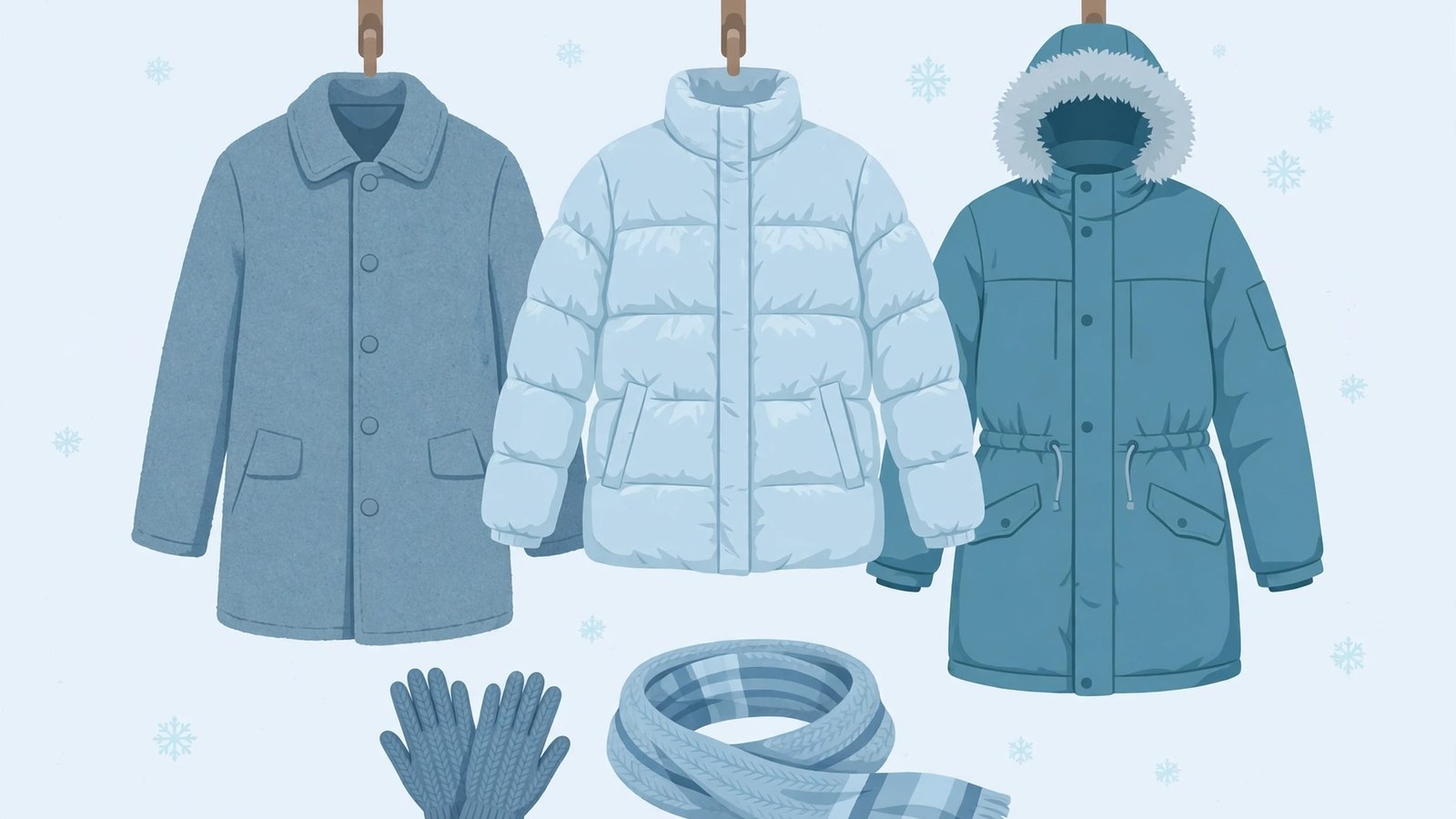
A puffer coat, with quilted sections filled with down or synthetic insulation, is one of the warmest and most practical options for cold weather. It is lightweight, often water resistant, and available in lengths from cropped to long. A long puffer covering the hips and thighs is warmer than a short one, since it protects more of the body and reduces drafts. Puffers are casual, but they are excellent for everyday winter wear.
A parka is similar but usually longer, with a hood, often fur trimmed or faux fur trimmed, and designed for harsh weather. Parkas often have a water resistant or waterproof shell, multiple pockets, a two way front zip, and adjustable cuffs and hems. They suit very cold, snowy, or windy climates. The hood matters even if you usually wear a hat, because it seals the neck gap a hat leaves open.
A wool overcoat or pea coat is more formal and structured. An overcoat falls below the hip, often to the knee, looks polished over work clothes, and can be very warm if the wool is heavy and the coat is well lined. A pea coat is shorter, double breasted, and traditionally made from heavy wool, with a broad collar that can be turned up against wind. Both are less waterproof than a parka, so they suit drier winters or short exposures to rain and snow.
A trench coat with a warm lining, or a waxed jacket, can work for milder winters, but neither is usually warm enough alone for very cold weather. If your winter is mild and damp, one of these with layers underneath may be more versatile than a heavy puffer you rarely need.
Shell Fabric: Denier, DWR, and What Waterproof Really Means
The outer fabric decides how the coat handles wind and water, and it protects the insulation from the soaking that destroys its loft. Nylon and polyester shells are common on puffers and parkas. Wool shells offer warmth and a polished look but less water resistance.
On technical shells you will see a denier number, such as 20D or 75D. Denier describes the thickness and weight of the yarn the fabric is woven from. Low denier fabrics, roughly 7D to 30D, are light and packable but snag and abrade more easily. Higher denier face fabrics are heavier and noticeably tougher. For a daily coat, durability at the shoulders, cuffs, and pocket edges usually matters more than saving an ounce.
Most insulated coats are water resistant, not waterproof. A durable water repellent finish, usually shortened to DWR, makes water bead and roll off the face fabric instead of soaking in. It sheds drizzle and dry snow well, but it does not stop sustained rain, and it wears down with abrasion, dirt, and washing. That is why an older coat can wet out: the face fabric darkens and soaks through even though nothing has torn, and the coat feels heavier and colder. Many DWR finishes can be partly revived by washing the coat as the label directs and tumble drying it if the label allows, or by applying a fresh treatment.
A coat can only honestly be called waterproof when it has a waterproof membrane or coating and sealed or taped seams, because needle holes at every seam will otherwise leak. Waterproof ratings are given as a hydrostatic head figure in millimeters, the height of a water column the fabric can support before it leaks. As general industry guidance, fabrics under about 5,000 millimeters suit brief, light rain, fabrics around 10,000 to 15,000 millimeters handle sustained moderate rain, and fabrics at 20,000 millimeters and above are built for prolonged, heavy exposure. Most city winter coats publish no such figure. If your winter is wet as well as cold, treat a coat with no membrane and no sealed seams as one that needs a rain shell over it on the wettest days.
Fit: Room for Layers Without Bulk
Fit is critical for warmth. A winter coat should fit comfortably over the layers you will actually wear underneath, such as a sweater and possibly a blazer. Try it on with those layers, not just over a T shirt. You should be able to move your arms freely and close the coat without strain. Too tight over layers compresses the insulation and reduces warmth. Far too loose lets cold air circulate inside, with the hem and cuffs acting as vents.
Run a short fit protocol before you remove any tags. Wear your thickest regular layer and close the coat fully. Raise both arms overhead, then reach forward as if holding a rail or a steering wheel: the cuffs should still cover your wrists. Sit down, opening the lower part of a two way zip first if the coat has one, and check that the coat does not pull hard across the hips. Bend and turn as if lifting a bag into a car. Check the closures in motion: buttons should not gape, and a zip should not feel strained at the chest or hips. A coat that fails two or more of these checks in your normal layers is the wrong size or cut, and no insulation rating will rescue it.
Shoulders should sit at your natural shoulder line. Sleeves should cover your wrists at rest and when you reach forward, since short sleeves leave a gap above your gloves. Cuffs that can be tightened, or knit inner cuffs, help seal warmth in. At the neck, look for a collar that closes high or a hood that cinches, and a draft flap behind the front zip, because the front closure is the largest single leak in most coats.
Length affects both warmth and style. A longer coat is warmer, especially in wind, but can bunch when seated and be awkward for frequent driving. Mid thigh is a good compromise for many people. Knee length is warmer and more formal. A cropped coat leaves hips and thighs exposed and needs warmer layers underneath. Check pockets too: large enough for gloves and a phone, where your hands naturally fall, and preferably lined.
Fabric Care, Labels, and How Long a Coat Lasts
Check the care label before buying, not after the first spill. In the United States, the Federal Trade Commission Care Labeling Rule requires clothing to carry care instructions, with either a washing instruction or a dry cleaning instruction, meant to be reliable for the useful life of the garment. The label is the maker stating, on the record, what the coat can survive. A coat whose label you cannot live with is the wrong coat, however good it looks on the rail.
Down coats often require careful washing, a low residue detergent made for down, and thorough tumble drying, sometimes with clean dryer balls, to break up clumps and restore loft. A down coat put away still damp can lose loft and develop odor. Synthetic coats are often machine washable on a gentle cycle and dry faster, which suits daily wear. Wool coats usually require dry cleaning, which adds cost over the life of the coat, though many need cleaning only once or twice a season if they are aired, brushed, and spot cleaned between wearings. A coat that is difficult or expensive to clean may be worn less often, so factor care into the decision, not just the purchase price.
Also consider longevity. A well made coat in a classic style will last several winters, a better investment than a trendy coat that feels dated after one season. Check seams, zippers, buttons, and lining, and favor replaceable buttons and a zip a tailor can service. Store any insulated coat hanging or loose, not compressed, because months of compression slowly flatten the fill.
Buying Checklist and Budget
Before buying, list your needs: your typical temperature range, how much rain or snow you face, how long you spend outdoors at a stretch, your workplace dress code, and your budget. Use that list to narrow styles, rather than starting with a style you like and hoping it suits your winter. Then record the same five facts for every coat you seriously consider: insulation type, its rating and amount (fill power and fill weight, or synthetic grams and clo if given), shell fabric and any waterproof rating, length, and care method. Two coats compared on those five facts will separate quickly. Two coats compared on price and a warmth adjective will not.
Budget wisely. A higher price often reflects better insulation, fabric, and construction, but it does not always mean better warmth for your needs. A mid priced synthetic parka may be warmer and more practical for a damp climate than an expensive wool coat that is not waterproof. Conversely, a cheap puffer with thin insulation and a poor fit may need replacing after one winter. Prioritize fit and fabric over brand name.
Buy at the right time if you can. End of season sales offer good value but limited sizes. Buying early offers more choice at higher prices. Either way, do not rush: a coat you wear daily for months deserves a careful choice.
Frequently Asked Questions
Is higher fill power always warmer?
No. Fill power measures how much space one ounce of down fills, not how much down is in the coat. Warmth follows total loft, fill power multiplied by fill weight. Five ounces of 600 fill power down gives about 3,000 cubic inches of loft, more than 3 ounces of 850 fill power down at about 2,550 cubic inches. Higher fill power buys the same warmth at less weight and bulk. It does not by itself buy more warmth.
Is down or synthetic insulation better for a wet winter?
Synthetic, for most people. Down loses loft when wet and dries slowly, while synthetic insulation keeps insulating when damp and dries much faster. Hydrophobic treated down narrows the gap and suits cold winters with occasional damp days. For a winter built on rain, wet snow, and long damp commutes, synthetic insulation, or a hybrid with synthetic at the hood, shoulders, and hem, is the safer and usually cheaper choice.
How warm is a wool coat compared with a puffer?
A heavy wool coat, in a dense fabric of roughly 400 grams per square meter or more, is warm enough for most city winters around and somewhat below freezing, especially over a sweater, and it handles damp cold well because wool absorbs moisture vapor without feeling wet. It will not match a well filled long puffer or parka in severe cold or strong wind, because it carries less trapped air for its weight. Choose wool for polish and durability, the puffer for maximum warmth per pound.
How should a winter coat fit over layers?
It should close easily over your thickest regular layer, let you raise your arms and reach forward without the cuffs leaving your wrists, and let you sit without pulling hard across the hips. Too tight compresses the insulation and reduces warmth. Too loose lets cold air circulate. Check buttons and zips in motion, not just standing in front of a mirror.
What does water resistant mean on a coat label?
It means the shell, usually with a durable water repellent finish, sheds light rain and snow for a while, but is not built to keep sustained rain out. A truly waterproof coat needs a membrane or coating plus sealed seams, and it will usually publish a hydrostatic head rating in millimeters. If a coat gives no rating and has ordinary stitched seams, plan on it for cold and drizzle, and add a rain shell for prolonged wet weather.
How do I make a winter coat last longer?
Follow the care label, clean the coat before storing it, and store it hanging or loose rather than compressed, so the insulation keeps its loft. Fix small failures early: a loose button, a catching zip, or a small seam split is a cheap repair now and a reason to replace the coat if left until midwinter.
Sources & references
- Arc'teryx, Warmest Winter Coat: Jacket Buyer's Guide. Used for how jackets keep a wearer warm by trapping a layer of warm air, insulation creating tiny air pockets that trap body heat, down delivering maximum warmth with minimal bulk and losing its properties when wet, synthetic insulation retaining warmth when wet with quicker dry times, fill power described as a warmth to weight measure, and hybrid insulation with strategic placement for different uses.
- Patagonia, Down vs. Synthetic Insulation for Outdoor Gear. Used for down being ideal for lightweight packability in cold to freezing dry conditions, synthetic insulation staying warm even when wet and suiting cold, rainy environments, fill power defined as the amount of space one ounce of down takes up in cubic inches, a higher fill power trapping more air and giving more loft and better insulation for the same weight, 600 and 700 fill power garments being best for everyday use, 800 fill power garments being made for technical outdoor sports where performance, weight, and compressibility matter most, and virgin down being certified to the Responsible Down Standard.
- International Down and Feather Laboratory, Explanation of Down and Feather Tests. Used for fill power measuring the loft or insulation properties of down products, the four conditioning methods, steam conditioning being the official international standard of the International Down and Feather Bureau and effective for returning fill power to its original value, measurement by placing down in a fill power measuring cylinder and lowering a piston onto it and reading where the piston stops, each international standard having its own cylinder size, piston weight, amount of down, and units, and extremely high quality down having a fill power of 700 plus cubic inches under the USA standard.
- PrimaLoft insulation figures as published in manufacturer product literature and summarized in insulation guides. Used for clo as the measure of thermal resistance, one clo keeping a resting person comfortable at about 70 degrees Fahrenheit, PrimaLoft Gold at a clo value of about 0.92, Silver at about 0.79, and Black at about 0.65 per unit weight, and Gold delivering roughly the warmth to weight of a 500 to 550 fill power down in dry conditions.
- The Woolmark Company, Wool Is Naturally Breathable. Used for wool fibers absorbing large quantities of moisture vapor and allowing it to evaporate, wool natural crimp trapping pockets of still air and insulating the skin from the cold, wool absorbing up to 35 percent of its weight in moisture before feeling wet, and absorption releasing heat so the wearer feels warmer and drier in cold, damp conditions.
- Textile Exchange, Quick Guide to the Responsible Down Standard. Used for the standard aiming to ensure down and feathers come from animals that have not been subjected to unnecessary harm, live plucking and force feeding being prohibited, chain of custody certification, and only products with 100 percent certified down and feathers being permitted to carry the Responsible Down Standard logo.
- Federal Trade Commission, Care Labeling Rule, as summarized in United States labeling guidance. Used for clothing sold in the United States being required to carry care instructions, a label needing a washing instruction or a dry cleaning instruction, and care instructions being required to be reliable for the useful life of the garment.
- Industry waterproof rating guidance on hydrostatic head testing. Used for the hydrostatic head test measuring the height of a water column in millimeters that a fabric withstands before leaking, and the general bands in which fabrics under about 5,000 millimeters suit brief light rain, fabrics around 10,000 to 15,000 millimeters handle sustained moderate rain, and fabrics at 20,000 millimeters and above suit prolonged heavy exposure. These bands are industry guidance, not a single legal standard.
- Wool coating weight guidance from fabric suppliers and coat making references. Used for wool coating weights in grams per square meter, lightweight coatings around 220 to 350 grams per square meter suiting transitional weather, winter coatings sitting around 400 grams per square meter and above, and heavy melton and pea coat fabrics running from about 450 to 650 grams per square meter with a dense, felted, wind resistant structure. Supplier ranges vary, and the article presents them as guidance rather than as a standard.


