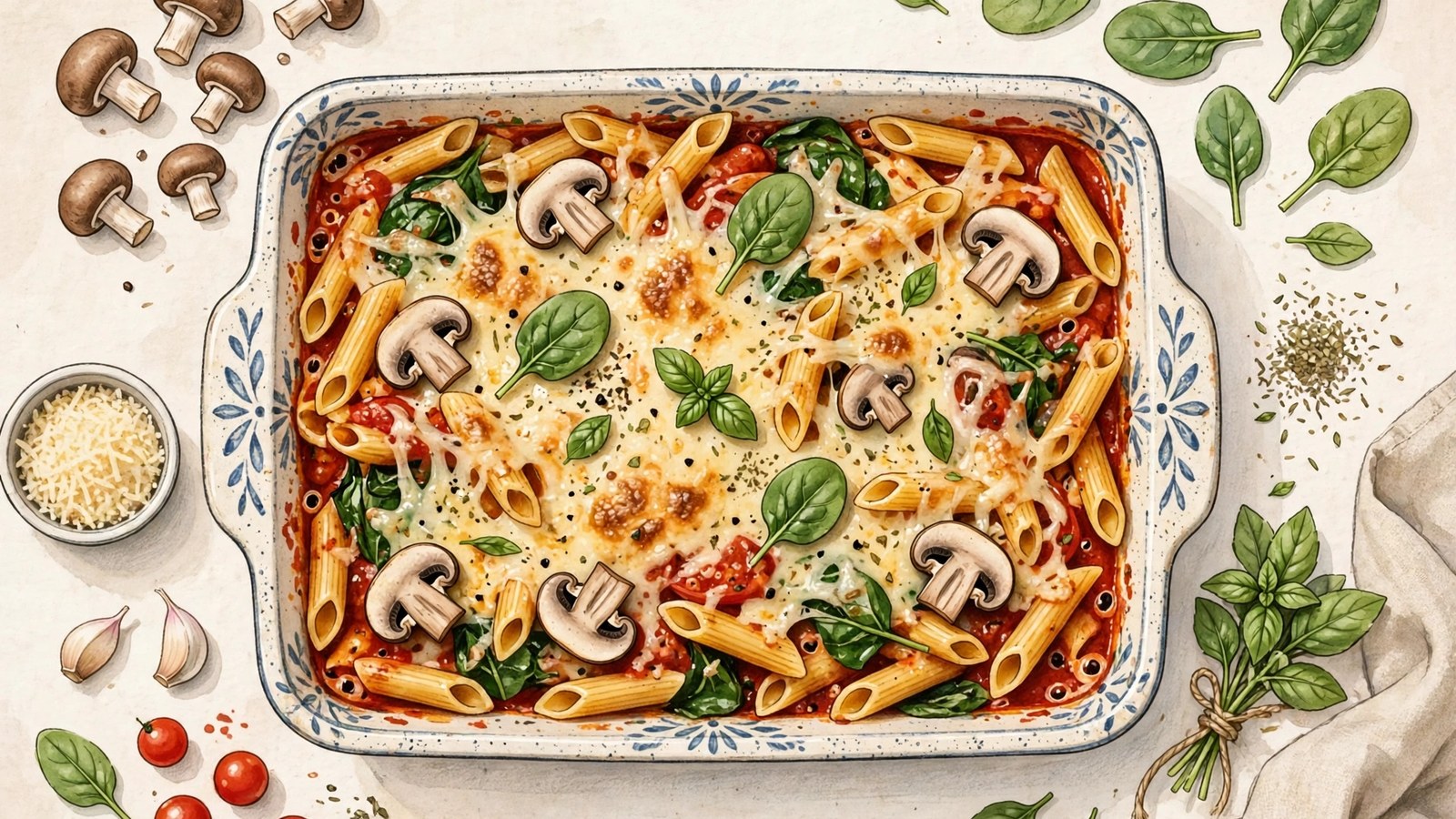
Short answer
- Use 1 pound of dried penne or rigatoni, one 24 ounce jar of marinara, one 28 ounce can of crushed tomatoes, and 1 cup of water or vegetable broth, plus spinach, mushrooms, onion, garlic, and cheese, in a 9 by 13 inch dish. Stir the uncooked pasta into the sauce until it is coated and mostly submerged, cover the dish tightly, and bake at 375 degrees Fahrenheit for 40 minutes. Stir, add the remaining cheese, and bake uncovered for 15 to 20 minutes more, until the pasta is tender and the center is hot. Rest the bake for 10 to 15 minutes before serving. Refrigerate leftovers within 2 hours, use them within 3 to 4 days, and reheat them to 165 degrees Fahrenheit.
Introduction
A dump and bake vegetarian pasta bake solves a familiar weeknight problem: a meatless pasta bake that is neither bland nor watery, and that does not ask you to boil pasta, build a separate sauce, and wash two pans before dinner reaches the table. In this method the dried pasta goes into the dish uncooked, surrounded by tomato sauce and a measured amount of extra liquid, and it cooks in the oven while the sauce thickens around it. Done carelessly, that shortcut produces hard edges, mushy centers, and a thin sauce pooling at the bottom. Done with the right pasta shape, the right liquid ratio, and a tight cover for the first part of the bake, it produces tender pasta, a sauce that clings, and a golden cheese top.
This guide gives the full recipe for six servings, then explains why each part works, so you can adapt it without breaking it. It covers the cooking science behind cooking pasta in sauce, the exact liquid arithmetic, how to judge doneness, how to make a jar of sauce taste deliberate, what the pasta itself contributes nutritionally, and how to store and reheat leftovers safely. Storage and reheating temperatures follow guidance from the USDA Food Safety and Inspection Service and FoodSafety.gov, checked on 30 October 2026. Nothing here requires specialty equipment beyond a 9 by 13 inch baking dish, a cover or foil, and, for checking leftovers, a food thermometer.
Why Dump and Bake Works for Pasta
Traditional pasta bakes boil the pasta first, combine it with sauce, and then bake. The boiling step creates the main risk: pasta fully cooked before it enters the oven will be overcooked by the time the bake is bubbling. Dump and bake removes that step. The pasta hydrates in the sauce, and the dish needs only one pan.
Pasta cooking research explains why the method can work, and why it is unforgiving. A study from Latvia University of Agriculture describes hydration during cooking as a diffusion controlled process: water moves into the pasta gradually, from the outside toward the center. As it arrives and the temperature rises, the starch gelatinizes, and gelatinization moves toward the center as cooking time increases. The outer layer swells strongly while the center is still only slightly swollen, which is why a piece can be soft outside and chalky inside if pulled too early. The same study notes that water uptake softens the pasta, that the protein network encapsulates the starch granules, and that a weak network lets more material escape during gelatinization, forming surface starch that makes pasta sticky.
A 2023 study in the journal Foods, from researchers at the University of Parma and other Italian institutions, adds the manufacturing half. Extrusion and drying create a highly compact protein network in dried pasta, which encapsulates the starch, and that protein structure strengthens during cooking and is preserved even after prolonged cooking times. In plain terms, good dried pasta is built to hold together through a long, moist cook, which is exactly what a covered bake provides, provided every piece stays in contact with liquid long enough for hydration to reach its center.
The starch that does escape is not wasted here. In boiled pasta it clouds the water and is drained away. In a bake it stays in the sauce and thickens it as the dish cooks and rests. That is why a correctly proportioned bake has a sauce that coats instead of runs, and why the liquid ratio matters so much. Too little liquid and the centers never hydrate. Too much and even the released starch cannot rescue a thin result.
The trade off is control: in a covered bake you cannot taste and adjust halfway through, so the shape, the ratio, the seal, and the timing have to be right from the start.
The Liquid Ratio, Worked Out in Full
Protect this ratio and the dish is flexible. Break it and no seasoning will fix the texture. For 1 pound of dried pasta, the recipe uses three liquid sources: the marinara contributes 24 ounces, the crushed tomatoes contribute 28 ounces, and the water or broth contributes 1 cup, which is 8 ounces. The total is 24 plus 28 plus 8, which equals 60 ounces for 16 ounces of dried pasta, or 60 divided by 16, which equals 3.75 ounces of sauce and liquid for every 1 ounce of pasta.
That may look like a flooded dish at the start, and it should. The pasta absorbs a large share of that liquid as it hydrates, the spinach wilts into the sauce rather than adding loose water, and some liquid is lost as steam once the cover comes off. What remains is a thick sauce, not a soup, because part of the liquid is now inside the pasta and part of the free liquid has been thickened by released starch.
Two rules follow. First, if you scale the recipe, scale all three liquid sources together. Half a recipe is 8 ounces of pasta with 12 ounces of marinara, 14 ounces of crushed tomatoes, and half a cup, or 4 ounces, of water or broth, which keeps the same 3.75 to 1 ratio. Second, treat watery additions as part of the ratio: undrained frozen spinach or watery fresh tomatoes add uncounted liquid, and the usual result is a bake that stays thin no matter how long it rests.
Choosing the Pasta Shape
Short, sturdy shapes work best: penne, rigatoni, ziti, or rotini. Their tubes and ridges hold sauce, their walls are thick enough to hydrate evenly in the time the bake allows, and they do not clump the way long pasta does in a dish. Rigatoni is the most forgiving choice for a first attempt because its wide tube holds a generous amount of sauce and its thick wall tolerates a few extra minutes. Penne is the easiest to find and works just as reliably. Rotini holds sauce in its spirals but softens a little faster, so check it at the early end of the uncovered time.
Avoid long shapes such as spaghetti or fettuccine, which tangle in a dish and cook unevenly, with exposed ends that dry out. Avoid very small shapes such as orzo or ditalini, whose centers hydrate so quickly that a long covered bake turns them soft. Avoid fresh pasta, which cooks far too quickly for an hour in the oven and can disintegrate, and avoid pasta sold as no boil or oven ready, which is made for layered dishes with their own specified liquid amounts and behaves unpredictably stirred loose into sauce.
Use standard dried pasta made from durum wheat semolina where you can. The compact protein network described above is a property of that kind of dried pasta, and it is part of why the pieces stay distinct instead of collapsing into the sauce. Whole wheat versions of the same shapes also work, though they can taste slightly firmer. Gluten free shapes need separate handling, covered below.
Ingredients
The list below serves six as a main dish. Amounts are given in US measures, with the package weights that matter for the liquid ratio stated in ounces.
- 1 pound dried penne or rigatoni
- 1 jar marinara or tomato basil sauce, 24 ounces
- 1 can crushed tomatoes, 28 ounces
- 1 cup water or vegetable broth
- 8 ounces mushrooms, sliced
- 5 ounces baby spinach, about 5 cups loosely packed
- 1 small onion, finely diced
- 3 cloves garlic, minced
- 1 tablespoon olive oil
- 1 teaspoon dried Italian seasoning
- Half a teaspoon kosher salt, plus more to taste
- Half a teaspoon black pepper
- Quarter of a teaspoon red pepper flakes, optional
- 2 cups shredded low moisture mozzarella, divided
- Half a cup grated Parmesan cheese, divided
- 1 cup ricotta cheese, in dollops, optional but recommended
- Fresh basil leaves, for serving, optional
Three notes matter most. First, use low moisture mozzarella, in a block or as firm shreds, not fresh mozzarella packed in water, which releases liquid as it melts and can leave pools on top. Second, jarred sauces vary widely in salt and sweetness, so taste the sauce mixture before the pasta goes in and adjust the salt then. Third, the spinach looks excessive before baking, but five cups of loose leaves wilt down to a small volume in the heat.
Method
Preheat the oven to 375 degrees Fahrenheit. Lightly grease a 9 by 13 inch baking dish.
In the dish itself, combine the marinara, the crushed tomatoes, the water or broth, the onion, the garlic, the olive oil, the Italian seasoning, the salt, the pepper, and the red pepper flakes if using. Stir well and taste for salt. Add the uncooked pasta and stir until every piece is coated and mostly submerged. This step matters more than any other: pasta above the sauce line has no liquid to absorb, and it will stay hard and dry no matter how long the dish bakes around it.
Fold in the mushrooms and spinach, pressing them lightly into the sauce. Dollop the ricotta, if using, over the surface in spoonfuls. Sprinkle 1 cup of the mozzarella and half of the Parmesan over the top. Cover tightly with a lid or a double layer of foil, pressing the foil firmly around the edges. The seal is functional, not decorative: steam that escapes is liquid the pasta no longer has.
Bake, covered, for 40 minutes. Remove the cover and stir gently. The stir redistributes the sauce and gives you your one reliable progress check: the pasta should be nearly tender, with a little firmness left in the center, because it still has the uncovered bake ahead of it. Sprinkle the remaining mozzarella and Parmesan over the top.
Bake uncovered for 15 to 20 minutes more, until the cheese is melted and golden in spots and the pasta is tender. For a measured check as well as a texture check, FoodSafety.gov lists casseroles, meat and meatless, at a safe minimum internal temperature of 165 degrees Fahrenheit, measured with a food thermometer in the center, which heats last.
Let the bake rest for 10 to 15 minutes before serving. During the rest the sauce finishes thickening and the cheese sets enough that portions hold together. A bake cut into immediately will look soupy even when the ratio was right, and the same bake ten minutes later will serve cleanly.
Making the Sauce Taste Like More Than a Jar
Jarred sauce is a practical starting point, not a flavor ceiling, and the recipe already contains the first correction: the crushed tomatoes. They add body and a fresher tomato taste, and they pull an overly sweet jar back toward balance. The onion and garlic go in raw, which is correct here: over a long covered bake they mellow and deepen the sauce instead of staying sharp, so there is no need to cook them separately first.
A spoonful of tomato paste, if you have it, adds concentrated richness: stir it fully in before the pasta, because lumps will not distribute later. The red pepper flakes add warmth rather than obvious heat, and can be doubled or left out without affecting the ratio.
Finish with fresh basil after baking, not before: basil added at the start turns dark and loses its fragrance, while torn leaves over the rested bake taste bright against the cheese and tomato. If the sauce tastes flat, add a pinch of salt first, then a splash of red wine vinegar or lemon if it still tastes dull. If the jar was acidic to begin with, a pinch of sugar before baking can round it out, but taste first, because many jarred sauces are already sweet enough.
What the Pasta Itself Contributes Nutritionally
A full nutrition label for the finished dish would depend on the exact sauce, cheese, and broth you choose, and those labels vary too much by brand for one honest set of totals. What can be stated reliably is the pasta itself, using USDA FoodData Central data for pasta, dry, enriched, penne as reproduced in secondary presentations of that entry. Per 100 grams of dry pasta, those reproductions give 371 calories, 13.04 grams of protein, 74.67 grams of carbohydrate, 3.2 grams of dietary fiber, and 1.51 grams of fat. The values were not read on the live FoodData Central detail page in the writer or QA passes, so they are qualified here and are to be rechecked on the live FoodData Central portal at publication.
The recipe uses 1 pound of pasta, which is 454 grams, for six servings, so each serving starts with 454 divided by 6, which is about 76 grams of dry pasta. At the values above, that portion provides about 282 calories, because 371 multiplied by 0.76 is about 282, and about 9.9 grams of protein, because 13.04 multiplied by 0.76 is about 9.9, plus about 56.7 grams of carbohydrate and about 2.4 grams of fiber, before any sauce, vegetables, or cheese are counted. The cheese and ricotta add further protein and fat, the spinach and mushrooms add fiber and volume for very few calories, and the sauce adds most of the sodium, which is why its label is the one worth reading if sodium concerns you. Treat these figures as a grounded estimate for the pasta base, not a dietary prescription, and use your own product labels for a precise total.
Variations That Keep the Structure
Change the vegetables, beans, and seasonings freely. Do not change the pasta weight, the total liquid, the cover, or the timing without expecting the texture to change with them. Every variation below keeps the 1 pound of pasta and the 60 ounces of sauce and liquid.
For the spinach and mushroom version, use the recipe exactly as written. It is the reference version the ratio was built around.
For a Mediterranean version, add one can of chickpeas, drained and rinsed, a handful of pitted olives, and a teaspoon of dried oregano, and finish with crumbled feta in place of the Parmesan. Chickpeas are the easiest protein addition in any version: they need no precooking, hold their shape through the full bake, and release little liquid. Canned white beans work the same way. Tofu is possible, but it needs pressing and cubing first and changes the dish more than beans do.
For a roasted vegetable version, add a diced zucchini and a diced bell pepper with the mushrooms, cut small so they cook through in the same time. Keep the added volume modest, because a dish crowded with watery vegetables releases extra liquid and drifts away from the ratio. If you add a full extra layer of vegetables, leave out a quarter cup of the added water to compensate.
For a richer version, add an extra half cup of ricotta in dollops and a handful of shredded provolone to the topping, and give it the full uncovered time to brown.
Frozen spinach can replace fresh. Thaw it and squeeze out as much water as you can, then use about 10 ounces of frozen in place of the 5 ounces of fresh. This substitution fails in one direction: undrained frozen spinach makes the bake watery. Squeezing is what keeps it inside the ratio.
Gluten Free and Dairy Free Notes
For a gluten free version, use a gluten free penne or rigatoni and confirm that your sauce and broth are labeled gluten free as well. Then watch the timing more closely: gluten free pasta has no gluten network holding it together, so it can move from tender to mushy quickly. Start checking during the uncovered phase about 5 minutes earlier than the base recipe suggests, and serve it promptly.
For a dairy free version, use a plant based mozzarella style shred made to melt and a plant based Parmesan style topping, or skip the cheese topping and finish with toasted breadcrumbs tossed in olive oil and nutritional yeast. The breadcrumb finish keeps the contrast the dish wants, something crisp and savory over soft pasta. The sauce and vegetables still carry the dish, though it will be less rich.
Read labels on every substitution, especially if you are cooking for someone with a food allergy rather than a preference. Standard pasta is a wheat food, the cheeses are milk foods, and some plant based cheeses and broths contain soy or tree nuts. The ingredient list and allergen statement on your own packages are the authority for the meal you are serving.
Making It Ahead, Storing It, and Reheating It
You can assemble the dish ahead, up to a day in advance. Assemble everything except the final topping cheese, cover, and refrigerate. Add about 10 minutes to the covered baking time because the dish starts cold. One caution: uncooked pasta sitting in sauce begins absorbing liquid in the refrigerator, so a dish assembled a full day ahead may need up to a quarter cup of extra water stirred in before baking if the surface looks dry.
Leftovers are where official guidance matters most, because this dish is perishable even though it contains no meat: the cheese, ricotta, and cooked vegetables all need refrigeration. The USDA Food Safety and Inspection Service, in its Leftovers and Food Safety guidance, states that bacteria grow rapidly between 40 and 140 degrees Fahrenheit, the danger zone, and that leftovers must be refrigerated within 2 hours of cooking, or within 1 hour if the temperature is over 90 degrees Fahrenheit. To cool food rapidly, divide large amounts into shallow containers rather than refrigerating one deep dish. Hot food can go directly into the refrigerator. Cover leftovers or seal them in containers, which keeps bacteria out, retains moisture, and prevents odors from other foods.
The same guidance gives the windows: leftovers keep in the refrigerator for 3 to 4 days, or frozen for 3 to 4 months. Frozen leftovers remain safe indefinitely but lose moisture and flavor over time, so the freezer window is about quality. Thaw frozen leftovers in the refrigerator, in cold water in a leak proof package, or in the microwave, and use thawed leftovers within 3 to 4 days. It is also safe to reheat frozen leftovers without thawing, though it takes longer.
Reheat leftovers to 165 degrees Fahrenheit, measured with a food thermometer in the center, which heats last. FoodSafety.gov gives the same figure for leftovers of any type and for casseroles, meat and meatless. Cover the dish while it reheats. Add a splash of water or broth first, because the pasta keeps absorbing sauce during storage, which is why day old pasta bake is drier than fresh. A stir halfway through reheating helps it heat evenly.
To freeze the bake as a made ahead dish, bake it fully, cool it promptly, and freeze portions in airtight containers, which thaw and reheat more evenly than one large block. Thaw overnight in the refrigerator, then reheat to 165 degrees Fahrenheit. Expect a slightly softer texture than fresh.
What to Serve With It
A pasta bake is a complete meal, so sides should add freshness rather than more weight. A green salad with lemon and olive oil, or a cucumber and tomato salad, adds crunch and acidity that cut through the cheese. Garlic bread is a natural companion and stretches the meal for a crowd, but it is optional: the bake, one salad, and bread if you want it need nothing else cooked.
Common Problems and Fixes
If the pasta is still hard after the covered bake, work through three causes: the cover was loose and steam escaped, the pasta was not fully stirred into the sauce so some pieces sat above the liquid line, or the oven runs cool. Press the foil tightly, stir until every piece is submerged, and check the oven with an oven thermometer if hard pasta keeps happening.
If the bake is watery, the likely causes are undrained frozen vegetables, watery additions never counted in the ratio, fresh mozzarella releasing liquid, or serving before the rest. Rest the full 10 to 15 minutes before concluding it is too thin, because a rested bake is noticeably thicker. Squeeze frozen vegetables thoroughly, and drain beans and jarred additions packed in liquid.
If the top cheese burns before the pasta is tender, move the dish to the center rack, check the pasta before the final cheese goes on, and tent loosely with foil during the uncovered phase if browning runs ahead of tenderness. If the cheese is pale and unmelted instead, return the dish to the oven for a few more minutes rather than serving it lukewarm.
If the dish tastes flat, it usually needs salt or acid, in that order. Flatness is rarely a reason to add more cheese, which makes a dull sauce richer without making it clearer.
If the pasta is mushy, the bake ran long, the shape was too small or delicate, or a gluten free pasta was checked too late. Pull the dish when the pasta is just tender rather than fully soft, because it softens further during the rest and again during reheating.
Frequently Asked Questions
Do I really not need to boil the pasta?
Correct. The pasta cooks in the sauce under a tight cover, absorbing liquid as it hydrates, and the starch it releases thickens the sauce. Boiling it first would leave it overcooked after an hour in the oven. The conditions that replace boiling are a sturdy short shape, enough liquid to absorb, every piece stirred under the surface, and a sealed cover for the first 40 minutes.
Can I assemble this pasta bake ahead of time?
Yes, up to a day ahead. Assemble everything except the final topping cheese, cover, and refrigerate. Add about 10 minutes to the covered baking time because the dish starts cold. Because the dry pasta begins absorbing sauce while it sits, stir in up to a quarter cup of extra water before baking if the surface looks dry. Confirm the pasta is tender and the center is hot before serving.
Can I freeze this pasta bake?
Yes. Bake it fully, cool it promptly, and freeze portions in airtight containers. USDA FSIS guidance keeps frozen leftovers at their best quality for 3 to 4 months, though food frozen continuously remains safe beyond that and mainly loses moisture and flavor. Thaw a portion in the refrigerator overnight and reheat to 165 degrees Fahrenheit, adding a splash of water or broth if needed. The texture will be slightly softer than fresh.
How long do leftovers keep, and how should I reheat them?
Refrigerate leftovers within 2 hours of cooking, or within 1 hour when the room is above 90 degrees Fahrenheit, in shallow covered containers, and use them within 3 to 4 days. Reheat to 165 degrees Fahrenheit, measured with a food thermometer in the center, adding a splash of water or broth first because the pasta keeps absorbing sauce in the refrigerator. Cover the dish while it reheats so it heats evenly and stays moist.
Can I use a different pasta shape?
Yes, within one family. Penne, rigatoni, ziti, and rotini all work, because they hydrate evenly and hold sauce. Long shapes tangle and cook unevenly in a dish, and very small shapes such as orzo turn mushy in a long covered bake. Fresh pasta and no boil pasta are not substitutes: fresh pasta disintegrates over this cooking time, and no boil pasta is made for layered dishes with different liquid amounts.
How do I know when the bake is done?
Use texture and temperature together. After the covered bake, the pasta should be nearly tender with slight firmness left in the center. After the uncovered bake, it should be fully tender, the cheese melted and golden in spots, and the sauce bubbling at the edges. For a measured check, FoodSafety.gov lists meatless casseroles at 165 degrees Fahrenheit in the center. Then rest the dish for 10 to 15 minutes: a bake that looks slightly loose will set during the rest.
Can I add protein to make it more filling?
Yes. Canned chickpeas or white beans, drained and rinsed, are the simplest addition: no precooking, they hold up through the full bake, and they add little extra liquid. Add one can, or two if the bake is the only dish. Tofu also works if pressed and cubed first, but unpressed tofu adds water that pushes against the liquid ratio.
Keep reading: Dump-and-Bake Chicken Broccoli Rice Casserole: The No-Stir Supper That Earns Its Place
Sources & references
- USDA Food Safety and Inspection Service, Leftovers and Food Safety. Used for bacteria growing rapidly between 40 and 140 degrees Fahrenheit, refrigerating leftovers within 2 hours of cooking or within 1 hour when the temperature is over 90 degrees Fahrenheit, cooling food rapidly by dividing large amounts into shallow containers, hot food being placeable directly in the refrigerator, covering or sealing leftovers, keeping refrigerated leftovers for 3 to 4 days and frozen leftovers for 3 to 4 months with frozen food remaining safe indefinitely but losing moisture and flavor over time, thawing in the refrigerator, in cold water, or in the microwave, reheating frozen leftovers without thawing being safe, reheating leftovers to 165 degrees Fahrenheit as measured with a food thermometer, and using thawed leftovers within 3 to 4 days.
- FoodSafety.gov, Cook to a Safe Minimum Internal Temperature, safe minimum internal temperature chart, reviewed 21 November 2024. Used for casseroles, meat and meatless, at 165 degrees Fahrenheit, leftovers of any type at 165 degrees Fahrenheit, and using a food thermometer to check whether food has reached a temperature hot enough to kill harmful germs.
- USDA FoodData Central, entry for pasta, dry, enriched, penne, as reproduced in secondary presentations of that entry. The live detail page was not rendered or read directly in the writer or QA passes. Used, on a qualified basis, for the values per 100 grams of dry pasta: 371 calories, 13.04 grams of protein, 74.67 grams of carbohydrate, 3.2 grams of dietary fiber, and 1.51 grams of fat, to be rechecked on the live FoodData Central portal at publication. Per serving figures in this article are arithmetic from those values and the recipe quantities, as shown in the text.
- Kalnina, S., and Rakcejeva, T., Investigation of Physicochemical, Sensory Characteristics, Cooking and Texture Properties of Whole Grain Pasta, Latvia University of Agriculture, Faculty of Food Technology, published in Chemine Technologija, 2015. Used for pasta hydration during cooking being a diffusion controlled process, temperature and moisture inducing gelatinization of starch, gelatinization proceeding toward the center of the pasta as cooking time increases with strong swelling in the outer layer and slight swelling in the center, water uptake promoting softening, the protein network encapsulating starch granules, a weak or discontinuous protein matrix permitting more exudate to escape during gelatinization, and that exudate forming surface starch and stickiness.
- Foods, 2023, Effect of the Pasta Making Process on Slowly Digestible Starch Content, researchers at the University of Parma, Universita Cattolica del Sacro Cuore, and Barilla research. Used for extrusion and the subsequent drying step ensuring the formation of a highly compact protein network in pasta, that network leading to more intense starch encapsulation, and the protein structure strengthening during cooking and being preserved even after prolonged cooking times.


