Short answer
- Place thawed chicken thighs in a slow cooker with onion, carrots, celery, garlic, stock, bay leaves, thyme, parsley, salt, and pepper. Cover and cook on low for 4 to 5 hours, or on high for 2 to 3 hours, until the chicken reaches 165 degrees Fahrenheit in the thickest part. Shred the chicken, return it to the broth, and stir in cream and peas if using. Drop dumpling dough by heaping tablespoonfuls onto the simmering stew, replace the lid, and cook on high for 50 to 60 minutes without lifting the lid, until the dumplings are puffed with no doughy center. Serve at once. Refrigerate leftovers within 2 hours, use them within 3 to 4 days, and reheat them on the stove, in a microwave, or in an oven to 165 degrees Fahrenheit, bringing the stew to a rolling boil. Do not reheat leftovers in the slow cooker. The dish contains wheat, milk, and egg.
Introduction
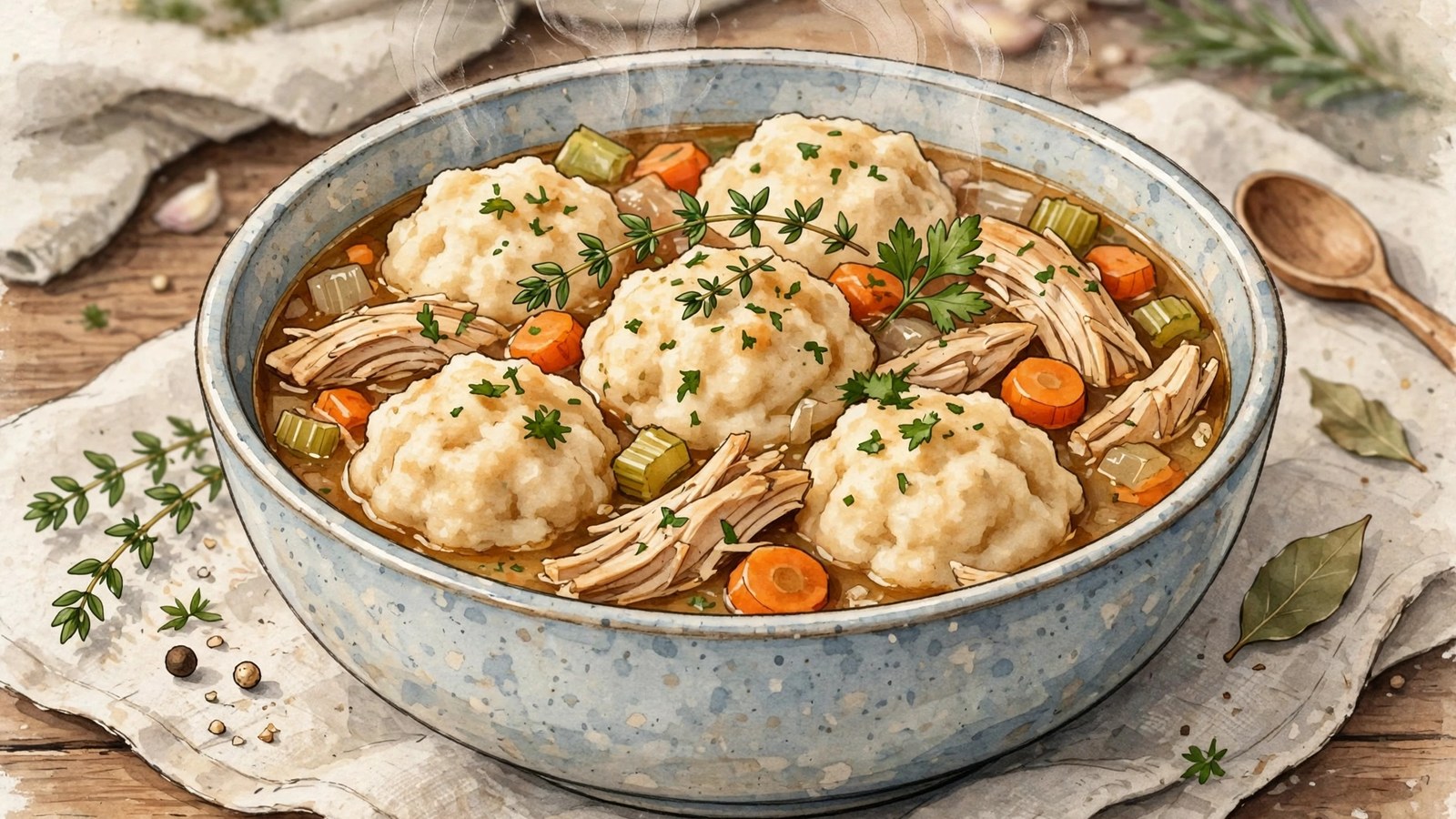
Chicken and dumplings is a complete supper from a single pot: tender chicken, soft vegetables, and a savory broth, topped with dumplings that steam in the last hour of cooking. The work in the morning is brief. The slow cooker does the patient work after that, holding the stew at a gentle simmer for hours so the chicken becomes tender and the flavors meld. In the body of this article the appliance is called a slow cooker, which is the generic name for this type of cooker. The brand name in the title is the registered title only and is not an endorsement.
This version uses drop dumplings, the most forgiving kind. Spoonfuls of soft dough are dropped onto the surface of the simmering stew, where they steam into tender, pillowy mounds. They need no rolling and no cutting. A rolled version, and other variations, are covered below for cooks who prefer them.
Three rules decide whether the dish works. Start with thawed chicken, never frozen chicken added straight to the cooker. Add the dumplings only in the last hour, on a stew that is already simmering, and keep the lid on while they cook. Add cream, if you use it, near the end so it does not curdle during a long cook. This article gives the full recipe, explains the chicken and dumpling choices, and covers storage, reheating, and allergen notes in plain factual terms. The food safety guidance was checked against FoodSafety.gov, the United States Department of Agriculture Food Safety and Inspection Service, and the Food and Drug Administration on 31 October 2026.
How a Slow Cooker Cooks This Dish
A slow cooker cooks by gentle, sustained heat. The Food Safety and Inspection Service explains that a slow cooker cooks foods slowly at a low temperature, generally between 170 degrees Fahrenheit and 280 degrees Fahrenheit, and that the direct heat from the pot, the lengthy cooking time, and the steam created inside the tightly covered container combine to destroy bacteria and make the process safe. For this stew, low and slow is the better choice for the base, because it gives the chicken and vegetables time to become tender and the flavors time to meld without boiling the broth hard. The typical time is 4 to 5 hours on low, or 2 to 3 hours on high, for the stew base, plus about 1 hour on high for the dumplings.
Cookers vary in size and heat output, so times are guidelines, not guarantees. The Food Safety and Inspection Service advises filling the cooker no less than half full and no more than two thirds full. Check the stew at the low end of the time range: the chicken should be tender and easy to shred, the vegetables should be soft, and the broth should be simmering gently. Vegetables cook slower than meat and poultry in a slow cooker, so put them in the cooker first, under the chicken.
Slow Cooker Safety Before You Start
Begin with a clean cooker, utensils, and work area. FoodSafety.gov organizes home food safety into four steps: clean, separate, cook, and chill. Wash your hands with plain soap and water for at least 20 seconds before, during, and after preparing food, and after handling raw poultry or eggs. Wash boards, dishes, utensils, and countertops with hot soapy water after raw poultry or eggs, use separate boards and plates for produce and for raw poultry, and use separate plates for raw and cooked chicken. Do not wash the chicken itself, because washing poultry can spread germs.
Keep perishable foods refrigerated until preparation time. The Food Safety and Inspection Service notes that a slow cooker may take several hours to reach a safe, bacteria killing temperature, and that constant refrigeration assures that bacteria do not get a head start during the first hours of cooking. If you cut up meat and vegetables in advance, store them separately in the refrigerator. Keep the refrigerator at 40 degrees Fahrenheit or below.
Always thaw meat or poultry before putting it into a slow cooker. Frozen pieces may not reach 140 degrees Fahrenheit quickly enough and can spend too long thawing while bacteria multiply. The safest way to thaw chicken is in the refrigerator overnight. Other safe methods are cold water and the microwave. Never thaw chicken on the counter, and do not add frozen chicken to this recipe. Keep the lid in place during cooking, removing it only to stir the food or check doneness. Food stays safe while the cooker is operating. If the power goes out while you are away and you do not know how long it was out, throw the food away, even if it looks done.
Check the finished chicken with a food thermometer in the thickest part, not touching bone, fat, or gristle. FoodSafety.gov lists all poultry, including breasts, thighs, legs, and wings, at 165 degrees Fahrenheit. Checking is still wise, especially for bone in pieces or large breasts.
Choosing Chicken: Thighs Versus Breasts
Boneless, skinless chicken thighs are the best choice for a slow cooker. They contain more fat and connective tissue than breasts, which keeps them moist and tender over a long cook. They are also more forgiving: an extra half hour will not ruin them, whereas breasts can dry out and turn stringy if they cook too long. Thighs shred easily into bite size pieces, which suits a stew, and their richer flavor stands up to a long simmer.
Chicken breasts can be used if you prefer them, but they need more care. Use whole large breasts rather than small pre cut pieces, and check them at the low end of the cooking time. Once they reach 165 degrees Fahrenheit and are tender, remove them, shred or dice them, and return them to the stew near the end. Some cooks cook breasts for a shorter time on high, about 2 hours, to protect their texture. Either way, use the thermometer rather than color or texture alone.
Bone in chicken, such as bone in thighs, gives a richer broth, because bones and skin add flavor and body during a long cook. If you use it, allow extra cooking time, remove the bones and skin before serving, and shred the meat back into the stew. For a weeknight version, boneless thighs are simpler.
The Dumplings: Drop Dumplings Done Right
Drop dumplings are made from a soft dough of flour, baking powder, salt, butter, milk, and egg, with herbs for flavor. The dough should be thick enough to hold its shape when dropped from a spoon, but soft enough to steam into a tender mound rather than a dense ball. If the dough is too wet, the dumplings spread and dissolve. If it is too dry, they are tough and heavy. The recipe below gives a soft, slightly sticky dough that is easy to drop with two spoons or a small scoop.
Baking powder is the leavening that makes dumplings puff. Use fresh baking powder, because old baking powder loses its strength and gives flat, dense dumplings. If you are unsure, test a little in hot water: it should fizz vigorously. Do not substitute baking soda for baking powder, because they are not interchangeable in this dough.
Herbs in the dough add flavor that plain dough lacks. Fresh parsley and thyme are classic. Dried herbs work if fresh are unavailable, but use about a third of the quantity, because dried herbs are more concentrated. Season the dough itself with salt and black pepper, not just the stew, so the dumplings taste seasoned rather than bland.
The most important dumpling rule is to keep the lid on. Dumplings cook by steam, and every lift lets steam escape and drops the temperature, adding 10 minutes or more. After the full time, check one dumpling by cutting it open: it should be puffed and cooked through, with no wet, doughy center. If it is still raw inside, replace the lid and cook for another 15 to 20 minutes.
Ingredients
This recipe makes about six servings in a 6 quart slow cooker. Have the stew ingredients ready before you load the cooker. Make the dumpling dough later, while the stew finishes, because baking powder begins to act once it meets liquid.
For the stew:
- 2 pounds boneless, skinless chicken thighs, or breasts, see notes above, trimmed of excess fat, thawed completely
- 2 tablespoons olive oil or butter, optional, for cooking the vegetables first, see method
- 1 large yellow onion, diced
- 3 carrots, peeled and sliced into rounds or half rounds
- 3 stalks celery, sliced
- 4 cloves garlic, minced
- 6 cups low sodium chicken stock
- 2 bay leaves
- 1 teaspoon dried thyme, or 1 tablespoon fresh thyme leaves
- 1 teaspoon dried parsley, or 2 tablespoons fresh parsley, chopped
- 1 teaspoon fine sea salt, plus more to taste
- 1/2 teaspoon black pepper, freshly ground
- 1/2 cup heavy cream or half and half, optional, added at the end
- 2 tablespoons cornstarch mixed with 2 tablespoons cold water, optional, for thickening
- 1 cup frozen peas, optional, added at the end
- Chopped fresh parsley, for serving
For the drop dumplings:
- 2 cups all purpose flour
- 1 tablespoon baking powder, check freshness
- 1 teaspoon fine sea salt
- 1/2 teaspoon black pepper
- 2 tablespoons chopped fresh parsley, or 1 teaspoon dried parsley
- 1 tablespoon chopped fresh thyme leaves, or 1 teaspoon dried thyme
- 4 tablespoons cold butter, cut into small pieces, or 4 tablespoons olive oil
- 1 large egg, lightly beaten
- 3/4 cup whole milk, plus more as needed
Method: Step by Step
Step 1: Prepare the stew base
If you have time, cook the onion, carrots, and celery in olive oil or butter in a skillet over medium heat for 5 to 6 minutes, until the onion softens, then add the garlic for 1 minute. This step is optional and adds a rounded, savory base. If you skip it, add the raw vegetables directly to the slow cooker, putting them in first, because vegetables cook slower than poultry.
Place the thawed chicken in the slow cooker. Add the onion, carrots, celery, garlic, chicken stock, bay leaves, thyme, parsley, salt, and pepper. Stir gently. The liquid should mostly cover the chicken and vegetables; if it does not, add a little more stock. Cover and cook on low for 4 to 5 hours, or on high for 2 to 3 hours, until the chicken is very tender, the vegetables are soft, and the chicken has reached 165 degrees Fahrenheit in the thickest part. Do not lift the lid unnecessarily.
Step 2: Shred the chicken and finish the broth
Remove the chicken with a slotted spoon to a clean plate. Remove and discard the bay leaves. Shred the chicken into bite size pieces with two forks, or dice it. Return the chicken to the broth. Taste and adjust the salt and pepper. For a thicker broth, stir in the cornstarch mixture, cover, and cook on high for 15 minutes. Stir in the cream and the peas if using, and warm through for about 10 minutes. Season well before the dumplings go in, because the dumplings are mild.
Step 3: Make the dumpling dough
Whisk the flour, baking powder, salt, pepper, parsley, and thyme in a large bowl. Cut in the cold butter until the mixture resembles coarse crumbs. If you use olive oil, drizzle it in and stir until combined. Whisk the egg and milk in a small bowl, pour it into the flour mixture, and stir with a fork just until a soft, slightly sticky dough forms. Do not overmix. Add milk or flour a tablespoon at a time if the dough is very dry or very wet.
Step 4: Add the dumplings and cook
Make sure the stew is simmering gently. If it cooled while you shredded the chicken, cook it on high for 10 to 15 minutes until it bubbles. Drop the dough by heaping tablespoonfuls onto the stew, spacing them slightly apart. You should get about 12 dumplings. Replace the lid promptly and cook on high for 50 to 60 minutes, without lifting the lid, until the dumplings are puffed and firm on top. Check one by cutting it open: it should be light, with no raw, doughy center. If it is not done, replace the lid and cook for another 15 to 20 minutes.
Step 5: Serve
Ladle the stew into warmed bowls, making sure each serving gets chicken, vegetables, broth, and one or two dumplings. Garnish with chopped fresh parsley and black pepper. Serve immediately, while the dumplings are still fluffy. Dumplings soften and absorb broth as they sit, so this dish is at its best freshly served.
Variations That Keep the Method Intact
A rolled dumpling version rolls the dough out thinly on a floured surface, cuts it into strips or squares, and drops them into the simmering stew in the same way, cooking for about 30 to 40 minutes with the lid on. Rolled dumplings are denser and more noodle like than drop dumplings, and they thicken the broth more as they cook.
A cheesy dumpling version adds 1/2 cup of grated cheddar or Parmesan style cheese to the dough, reducing the salt slightly. A herb and lemon version adds lemon zest to the dough and a squeeze of lemon juice to the stew at the end, which brightens the dish.
A vegetable packed version adds diced potatoes, parsnips, or mushrooms to the stew base, increasing the stock slightly if needed. Add denser vegetables at the beginning with the other vegetables, so they have time to soften.
A gluten free version uses a gluten free flour blend for the dumplings, with about an extra 1/2 teaspoon of baking powder to help them puff, because gluten free flours do not rise as readily. The texture will be slightly denser, but still pleasant. Check that your chicken stock and cornstarch are gluten free if that matters for your household, and test a small batch first if you are serving guests, because flour blends vary. This variation is discussed again in the allergen note, because a gluten free blend is not automatically safe for a guest with a wheat allergy.
Troubleshooting
Dumplings that dissolve usually mean the stew was not simmering when they were added, the dough was too wet, or the lid was lifted too often. Make sure the stew bubbles gently first, make the dough thick enough to hold its shape, and keep the lid on. If dumplings have already dissolved, the stew will still taste good, though thicker.
Dense, heavy dumplings usually mean overmixing, old baking powder, or dough that was too dry. Mix just until combined, check the baking powder freshness, and add milk a little at a time until the dough is soft and slightly sticky.
Broth that is too thin can be thickened with the cornstarch mixture, or by mashing a few cooked vegetables into the broth before adding the dumplings. Broth that is too thick can be thinned with a splash of stock or water. Dumplings absorb broth as they sit, so a slightly thin broth before the dumplings go in will often be just right afterward.
Chicken that is dry usually means breasts were overcooked. Next time, use thighs, or check breasts earlier and remove them as soon as they reach 165 degrees Fahrenheit.
Stew that tastes bland usually needs more salt, more herbs, or a little acid. Add salt in small pinches, tasting after each, add fresh parsley at the end, and consider a squeeze of lemon juice. Taste and fix the broth before the dumplings go in, when it is easy to adjust.
Serving Ideas and a Simple Timing Plan
For a weeknight supper, this dish needs little else, though a simple salad of bitter leaves with a sharp vinaigrette cuts the richness nicely. For a larger gathering, serve it with crusty bread for dipping and a plate of pickled vegetables. The dish is filling, so modest portions with a light side are often enough.
Plan the timing backwards from serving. Load the base in the morning or early afternoon, finish the broth about an hour and a quarter before serving, mix the dough while the broth returns to a simmer, and allow a full undisturbed hour for the dumplings. Set the table and warm the bowls during that hour.
If you are holding the finished dish, keep it hot rather than letting it sit at room temperature. Keep hot food at 140 degrees Fahrenheit or above, measured with a food thermometer, in a preheated slow cooker. Do not use the warm setting to cook food, and do not hold the dish for many hours, because the dumplings will soften.
Storage, Reheating, and Food Safety
Bacteria grow rapidly between 40 degrees Fahrenheit and 140 degrees Fahrenheit, so refrigerate leftovers within 2 hours of cooking, or within 1 hour if the food has been exposed to temperatures above 90 degrees Fahrenheit. Keep the refrigerator at 40 degrees Fahrenheit or below and the freezer at 0 degrees Fahrenheit or below. Divide the stew into shallow, covered containers so it cools quickly. A large pot of stew left whole will take a long time to cool. Cover leftovers well to keep bacteria out and retain moisture.
Leftovers keep for 3 to 4 days in the refrigerator, or 3 to 4 months frozen, although frozen leftovers lose moisture and flavor over longer storage. Dumplings suffer most in the freezer: they become dense and soggy on thawing. A better approach is to freeze the stew without dumplings, thaw it in the refrigerator, reheat it to a simmer, and make fresh dumplings to cook on top. Label containers with the date and contents.
Thaw frozen leftovers in the refrigerator, in cold water in a leak proof package, or in the microwave, never on the counter. After refrigerator thawing, use the food within 3 to 4 days.
Do not reheat leftovers in the slow cooker. The Food Safety and Inspection Service states that reheating leftovers in a slow cooker is not recommended, because the cooker heats too slowly. Reheat on the stove, in a microwave, or in an oven instead, to 165 degrees Fahrenheit throughout, measured with a food thermometer, bringing this stew to a rolling boil on the stove. Cover leftovers to reheat. In a microwave, cover and rotate the food, check the temperature in several places, and allow a resting time. Once fully reheated, the stew may be transferred to a preheated slow cooker for holding at least 140 degrees Fahrenheit.
Allergen and Dietary Notes
This section is factual information for planning and serving, not medical advice. This dish as written contains wheat, in the flour in the dumplings, milk, in the butter, milk, and optional cream and in any cheese variation, and egg, in the egg in the dumpling dough. All three are major food allergens in the United States. The Food and Drug Administration lists nine foods, and ingredients containing their proteins, as major food allergens: milk, egg, fish, crustacean shellfish, tree nuts, wheat, peanuts, soybeans, and sesame. Sesame became the ninth major food allergen under the Food Allergy Safety, Treatment, Education, and Research Act, with labeling required from 1 January 2023.
Check labels on the chicken stock, cornstarch, baking powder, and any cheese each time you buy them, because the Food and Drug Administration notes that recipes can change and advises reading the entire ingredient list.
If you are cooking for guests, ask about food allergy before you plan this dish, not at the table. Do not assume that picking the dumplings out of a shared pot makes the remaining stew safe for a guest with a wheat, milk, or egg allergy, because the dumplings cooked in the same broth as everything else. Cook a separate dish with clean utensils and a clean pot, or choose a different menu. The recipe as written is not gluten free, because of the wheat flour dumplings. The gluten free variation above changes the flour blend, but wheat allergy and gluten avoidance are not the same thing, and only a blend whose label confirms it fits the guest’s needs should be used for that guest.
No nutrition total, calorie count, or health claim is made for a home cooked serving, which will vary with the cut of chicken, the amount of cream, the dumpling size, and portion size.
Frequently Asked Questions
Can I use frozen chicken?
No. Always thaw meat or poultry before putting it into a slow cooker. Frozen chicken can spend too long below a safe temperature while bacteria multiply. Thaw chicken in the refrigerator overnight. Other safe methods are cold water and the microwave, with prompt cooking afterward. Never thaw chicken on the counter.
Can I cook this on high the whole time?
Yes. Cook the base on high for 2 to 3 hours, then add the dumplings and cook on high for about 1 hour. The result will be slightly less melded, but still good. The chicken must still reach 165 degrees Fahrenheit in the thickest part.
Do I have to cook the vegetables first?
No. The skillet step adds depth, but the slow cooker will cook raw vegetables well. If you are short on time, skip it and add everything raw, with the vegetables in first, because vegetables cook slower than meat and poultry in a slow cooker.
Why did my dumplings not cook through?
The likely causes are a stew that was not simmering when the dumplings were added, a lid lifted too often, or a cooker that runs cool. Keep the lid on for the full time, and allow another 15 to 20 minutes if a cut dumpling still shows a wet, doughy center.
Can I make the dumpling dough ahead?
You can mix the dry ingredients ahead and store them, but mix the wet ingredients in just before cooking, because baking powder begins to act once it meets liquid. Dough made ahead and left standing will lose its lift and give dense dumplings.
Is this recipe gluten free?
As written, no, because of the wheat flour dumplings. With a gluten free flour blend and careful label checking, it can be adapted, as described above, though the texture will differ slightly. A gluten free adaptation is not automatically suitable for a guest with a wheat allergy.
How long do leftovers keep, and how should I reheat them?
Refrigerate leftovers in shallow covered containers within 2 hours, or within 1 hour above 90 degrees Fahrenheit. Use them within 3 to 4 days, or freeze them for 3 to 4 months, freezing the stew without dumplings for the best result. Reheat on the stove, in a microwave, or in an oven, not in the slow cooker, to 165 degrees Fahrenheit, bringing the stew to a rolling boil.
Can I reheat leftovers in the slow cooker if I turn it to high?
No. Reheating leftovers in a slow cooker is not recommended on any setting, because the cooker heats too slowly. Reheat first on the stove, in a microwave, or in an oven to 165 degrees Fahrenheit and a rolling boil, then transfer the hot stew to a preheated slow cooker for holding at least 140 degrees Fahrenheit.
Sources & references
- FoodSafety.gov, Cook to a Safe Minimum Internal Temperature. Last reviewed 21 November 2024. Used for always using a food thermometer to check whether food has reached a safe minimum internal temperature, all chicken, turkey, and other poultry, including whole bird, breasts, legs, thighs, wings, and ground poultry, at 165 degrees Fahrenheit, egg dishes at 160 degrees Fahrenheit, casseroles at 165 degrees Fahrenheit, and leftovers of any type at 165 degrees Fahrenheit.
- United States Department of Agriculture, Food Safety and Inspection Service, Slow Cookers and Food Safety. Last updated 8 August 2013. Used for a slow cooker cooking foods slowly at a low temperature, generally between 170 degrees Fahrenheit and 280 degrees Fahrenheit, direct heat, lengthy cooking, and steam inside the tightly covered container combining to destroy bacteria, beginning with a clean cooker, utensils, and work area, keeping perishable foods refrigerated until preparation time and storing cut up meat and vegetables separately in the refrigerator, a slow cooker taking several hours to reach a safe, bacteria killing temperature, always thawing meat or poultry before putting it into a slow cooker, vegetables cooking slower than meat and poultry so they go in first, filling the cooker no less than half full and no more than two thirds full, keeping the lid in place and removing it only to stir food or check doneness, food staying safe while the cooker is operating and throwing food away if the power goes out while you are away, storing leftovers in shallow covered containers and refrigerating within two hours after cooking is finished, reheating leftovers in a slow cooker not being recommended, reheating cooked food on the stove, in a microwave, or in a conventional oven until it reaches 165 degrees Fahrenheit, and then placing hot food in a preheated slow cooker to keep it hot for serving at least 140 degrees Fahrenheit as measured with a food thermometer.
- United States Department of Agriculture, Food Safety and Inspection Service, Leftovers and Food Safety. Last updated 31 July 2020. Used for cooking food to a safe minimum internal temperature with a food thermometer, bacteria growing rapidly between 40 degrees Fahrenheit and 140 degrees Fahrenheit, refrigerating leftovers within 2 hours of cooking or 1 hour if the temperature is above 90 degrees Fahrenheit, keeping cold perishable food at 40 degrees Fahrenheit or below and hot food at 140 degrees Fahrenheit or warmer, cooling food rapidly by dividing large amounts into shallow containers, covering and sealing leftovers, leftovers keeping for 3 to 4 days in the refrigerator or 3 to 4 months frozen with loss of moisture and flavor over longer freezer storage, safe thawing in the refrigerator, cold water, or the microwave, reheating leftovers to 165 degrees Fahrenheit as measured with a food thermometer, reheating sauces, soups, and gravies by bringing them to a rolling boil, covering leftovers during reheating, and, for microwave reheating, covering and rotating the food, checking the temperature in several places, and allowing a resting time.
- FoodSafety.gov, 4 Steps to Food Safety. Last updated 18 September 2023. Used for the four steps clean, separate, cook, and chill, washing hands with plain soap and water for at least 20 seconds before, during, and after preparing food and after handling raw meat, poultry, seafood, or eggs, washing cutting boards, dishes, utensils, and countertops with hot soapy water after raw meat, poultry, seafood, or eggs, not washing meat, poultry, eggs, or seafood, using separate cutting boards and plates for produce and for raw meat, poultry, and seafood and separate plates and utensils for cooked and raw foods, using a food thermometer placed in the thickest part of the food without touching bone, fat, or gristle, keeping food hot at 140 degrees Fahrenheit or above after cooking with a heat source such as a slow cooker, bacteria that cause food poisoning multiplying quickest between 40 degrees Fahrenheit and 140 degrees Fahrenheit, keeping a refrigerator at 40 degrees Fahrenheit or below and a freezer at 0 degrees Fahrenheit or below, refrigerating perishable foods within 2 hours or within 1 hour above 90 degrees Fahrenheit, placing leftovers in shallow containers and refrigerating promptly, and never thawing or marinating foods on the counter, with the refrigerator given as the safest place to thaw meat, poultry, and seafood.
- Food and Drug Administration, Have Food Allergies? Read the Label. Used for the nine major food allergens accounting for the large majority of severe food allergic reactions: milk, egg, fish, crustacean shellfish, tree nuts, wheat, peanuts, soybeans, and sesame, for allergen food sources having to be identified on packaged food labels either in parentheses following an ingredient or in a Contains statement, for a Contains statement, if present, having to list all allergens in the product, for the advice to read the entire ingredient list every time a product is bought because ingredients can change at any time, and for sesame becoming the ninth major food allergen under the Food Allergy Safety, Treatment, Education, and Research Act, with labeling required from 1 January 2023.


