Short answer
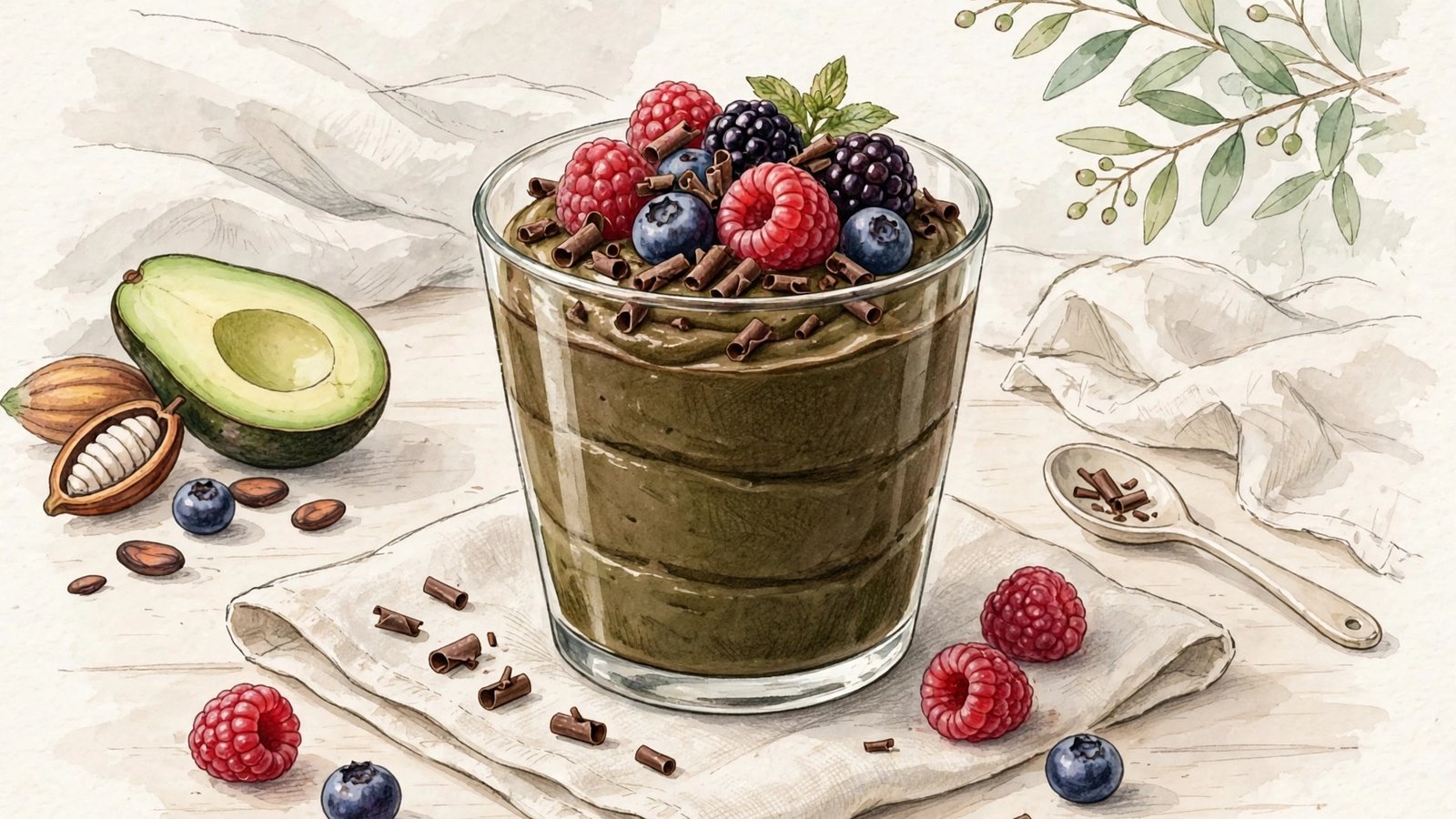
- Blend 2 large ripe avocados with 1/3 cup unsweetened cocoa powder, 1/4 cup maple syrup, a little plant based milk, 1 teaspoon vanilla extract and a pinch of fine salt until completely smooth, scraping the sides at least twice. Taste, adjust the sweetness, then spoon the mousse into small glasses, cover it and chill it for at least 1 hour. The avocado must be ripe and soft enough to yield to gentle pressure in your palm: an underripe avocado will not blend smooth, will taste grassy, and extra cocoa cannot fix that. Serve the mousse the day you make it for the best color, and eat refrigerated leftovers within 1 to 2 days.
Introduction
The first time most people hear about chocolate avocado mousse, the reaction is doubt. Avocado belongs in guacamole, not dessert, and blending it with cocoa sounds like a health food trick that will taste like a compromise. The surprise is that a ripe avocado, blended until completely smooth with cocoa, sweetener and vanilla, does not taste like avocado in the finished dessert. It becomes a neutral, buttery base that carries chocolate flavor the way cream does in a traditional mousse. The result is thick, silky and genuinely dessert-like.
This mousse also earns its place for practical reasons. It needs no cooking, no eggs and no dairy, it takes only a few minutes of blending, and it firms up in the refrigerator while you make dinner. The catch is that it depends almost entirely on two variables: the ripeness of the avocado and the thoroughness of the blending. Get those right and the mousse is luxurious. Get them wrong and it can be grainy or grassy, which is why this article spends real time on both.
This recipe is working kitchen guidance, not a tested laboratory formula, so taste and adjust the sweetness and cocoa level to your own preference. Cocoa brands vary in bitterness and avocados vary in size. The amounts below are a reliable starting point for four servings, and the troubleshooting section covers what to change if your first batch needs help.
Why Avocado Works as a Mousse Base
Mousse needs fat for body and smoothness. Traditional chocolate mousse gets that body from cream and egg yolks. Avocado supplies a similar richness from its own natural fats, and when fully blended it loses its fibrous texture and becomes a smooth puree. Cocoa provides the dominant flavor and covers the mild taste of ripe avocado almost completely. Sweetener rounds out cocoa bitterness, vanilla adds depth, and a pinch of salt sharpens the chocolate.
The fat profile helps explain the texture. USDA FoodData Central lists raw California avocado at about 15.4 grams of total fat per 100 grams of flesh, with about 9.8 grams of that as monounsaturated fat. That fat coats the cocoa particles as you blend, which is part of why the mousse feels creamy rather than watery.
Ripeness is the make or break factor. An underripe avocado will not blend smooth no matter how long you run the blender, and it will taste grassy and astringent. An overripe avocado can taste off and carry brown, bitter areas. The right avocado yields gently to pressure and shows green flesh with no large brown patches when cut.
Choosing a Ripe Avocado: Selection and Testing
Because this dessert has nowhere to hide a bad avocado, shopping deserves more care than most recipes give it. The California Avocado Commission gives a simple primary test: gently squeeze the fruit in the palm of your hand. Ripe, ready to eat fruit will be firm but will yield to gentle pressure. Use your whole palm rather than your fingertips, which create bruises: the Commission notes that a fruit with isolated soft pockets is likely bruised and is a poor choice.
Color is a supporting clue, not the verdict. The Commission cautions that color alone may not tell the whole story: a Hass avocado turns dark green or black as it ripens, but some other varieties keep light green skin even when ripe. For Hass fruit, trust a deep, even dark color combined with a gentle yield in the palm, and avoid fruit with dark skin blemishes or fruit that feels very soft all over.
Timing matters too: very firm fruit typically ripens in about 3 to 5 days at room temperature, while fruit just beginning to soften is usually ready within 2 to 3 days, so buy ready fruit for today and firmer fruit for later in the week. At the cutting board, check the flesh before you scoop: good flesh is even green to yellow green, small bruised spots can be cut away, and mostly brown or sour smelling flesh should be discarded, as the Commission advises.
Ripening Avocados at Home Without Ruining Them
If your avocados are hard, leave them on the counter and check them daily with the palm test. To speed the process, the California Avocado Commission recommends placing the fruit in a plain brown paper bag at room temperature with a banana, an apple or a kiwi. Those fruits give off ethylene gas, a natural plant hormone that triggers ripening, and the bag holds the gas around the avocados. Fruit can ripen in as little as 1 to 2 days this way, depending on how firm it was at the start.
Two shortcuts do not work. The Commission advises against using a microwave or an oven to speed ripening: heat may soften the flesh a little, but it does not ripen the fruit, which will still taste unripe. Refrigeration is the opposite tool. Put ripe avocados in the refrigerator to hold them, and keep hard avocados out, because a hard avocado chilled too early may never soften properly.
Wash the fruit before you cut it, even though you will not eat the skin: Cleveland Clinic guidance notes that dirt and bacteria on the skin can be carried into the flesh by the knife. Rinse under running water, dry, cut on a board, and scoop the seed out with a spoon.
Ingredients
For four servings, you will need:
- 2 large ripe avocados, halved, pitted and scooped
- 1/3 cup unsweetened cocoa powder, plus extra for dusting if desired
- 1/4 cup maple syrup, plus more to taste
- 1/4 cup plant based milk, such as oat, soy or almond, added a little at a time
- 1 teaspoon vanilla extract
- 1 pinch fine salt
- Optional toppings: fresh berries, coconut whipped cream, chocolate shavings, chopped toasted nuts or a sprinkle of flaky salt
| Ingredient | Amount for 4 servings |
|---|---|
| Ripe avocado | 2 large |
| Unsweetened cocoa powder | 1/3 cup |
| Maple syrup | 1/4 cup, plus more to taste |
| Plant based milk | Up to 1/4 cup, as needed |
| Vanilla extract | 1 teaspoon |
| Fine salt | 1 pinch |
Large avocados vary, so treat the count as a flesh amount in disguise. If your avocados are small, use 3. If the flesh looks scant next to the cocoa, the mousse will taste thin and bitter, and the fix is more avocado, not more sweetener.
Choosing Cocoa: Natural Compared With Dutch Process
Cocoa choice changes both color and flavor, and this no bake recipe is a forgiving place to use either main type. Iowa State University Extension and Outreach explains the difference. Natural cocoa, also sold simply as unsweetened cocoa, is the roasted, ground and pressed cocoa solid with no further treatment. It has an acidic pH of about 5 to 6, a sharp and bitter flavor, and a reddish brown color. Dutch process cocoa, also called Dutched, European style or alkalized cocoa, is treated with an alkaline solution that neutralizes that acidity. It has a pH of about 7, a smoother flavor, and a darker color.
In baked goods that acidity difference matters because it interacts with leavening. This mousse uses no leavening at all, and the Extension notes that either cocoa may be used where cocoa provides flavor and color rather than leavening chemistry, as in hot cocoa, fudge sauce and frosting. Mousse belongs in that category. Use natural cocoa for a brighter, sharper flavor, or Dutch process for a darker color and mellower flavor, and adjust sweetness after blending.
Check the label: the product should be unsweetened cocoa powder, not a cocoa drink mix, which already contains sugar and often milk solids. FoodData Central lists plain unsweetened cocoa at only about 1.75 grams of total sugars per 100 grams, which is why the sweetener here does almost all of the sweetening work.
Sweetener and Milk Choices
Maple syrup is the sweetener here because it blends smoothly into a cold mixture and adds a subtle caramel note. Agave syrup or another liquid sweetener works in the same quantity. Granulated sugar does not dissolve well in a cold blend and can leave the mousse faintly gritty, so avoid it. Add most of the sweetener up front and reserve the final adjustment for after blending, when you can taste the true balance.
Maple syrup is still a sugar sweetener, not a health ingredient. It sweetens, it flows, and it dissolves cold: those are kitchen reasons, not nutrition claims. If you reduce it, expect cocoa bitterness to come forward quickly, so reduce by 1 tablespoon at a time and taste after each change.
For the milk, choose an unsweetened plant based milk for full control of sweetness. Thicker options such as oat and soy milk give a slightly richer result, while thinner almond milks loosen the mixture faster. The milk is a blending aid first: start with half the amount and add more only by the tablespoon. Too much liquid turns mousse into sauce, and you cannot take it back out.
Method, Step by Step
First, prepare the avocados. Halve, pit and scoop the flesh, cutting away any bruised or brown areas, and put the good flesh straight into a food processor or a high powered blender. Do not let scooped flesh sit exposed while you measure everything else: the less air time it gets before blending and covering, the better its color will hold.
Second, add the cocoa powder, maple syrup, vanilla and salt, plus about half of the plant based milk. Adding the cocoa before blending matters: the avocado fat coats the dry powder during blending, which prevents dry pockets and dusty streaks.
Third, blend until completely smooth, and be patient. Blend on high for 1 to 2 minutes in total, stopping to scrape down the sides at least twice. What looks smooth from above may still hide flecks on the sides or under the blade, so scrape and blend again. Add milk by the tablespoon only if the vortex stalls.
Fourth, taste before you chill. Add maple syrup a teaspoon at a time until the chocolate tastes rich rather than sharp. If the flavor feels flat, add a tiny extra pinch of salt before adding more sweetener: salt does more for chocolate depth than extra sugar does at that point.
Fifth, portion and chill. Spoon the mousse into 4 small glasses or ramekins, cover each portion, and refrigerate for at least 1 hour. Chilling firms the texture and lets the flavors settle. The mousse after an hour in the refrigerator is noticeably better than the same mousse straight from the blender, and after 2 hours it is at its best for guests.
Sixth, serve chilled with simple toppings added at serving time, not before chilling, so berries stay fresh. Fresh berries add brightness, coconut whipped cream adds a second creamy layer, and chocolate shavings make the dessert look finished. Keep toppings modest: a mountain of garnish competes with the rich mousse.
Blending Method and Texture Science
Texture is where this recipe succeeds or fails. Ripe avocado flesh is soft, but it still contains fibrous strands and small firmer pieces near the skin and around the seed cavity. Blending has to break those down completely and distribute the avocado fat evenly through the cocoa, sweetener and milk. Until that happens, the mousse will feel grainy or flecked, no matter how good the ingredients are. Long blending with scraping is the step that turns a puree into a mousse.
Equipment changes the technique, not the standard. A food processor is the most forgiving tool because its wide bowl gathers thick mixtures well. A high powered blender gives the smoothest result fastest, but the thick mixture can form an air pocket over the blade, so stop and stir if the sound changes to a hollow whine. A standard blender usually needs two smaller batches.
Finally, judge smoothness by feel, not by sight. Press a little mousse against the roof of your mouth with your tongue. If you feel distinct lumps or stringy bits, blend again. If it feels uniformly smooth and holds soft peaks on the spoon, it is ready to portion. Cold avocado blends less smoothly than avocado at cool room temperature, so let refrigerated flesh sit for about 15 minutes before blending, and do not warm it: warmth dulls the flavor and accelerates browning.
Chilling, Setting and Serving
This mousse does not set with gelatin, eggs or starch: its firmness comes from cold avocado fat and the thickness of the puree, so chilling is structural, not optional. One hour is the minimum, and 2 hours gives a cleaner spoonful and a more settled flavor. For guests, make it on serving day, ideally 2 to 4 hours ahead, and keep glasses refrigerated until serving.
Nutrition Context, Without the Hype
It is reasonable to ask what is in this dessert, and equally important not to oversell the answer. USDA FoodData Central lists raw California avocado at about 167 calories, 15.4 grams of total fat, 6.8 grams of fiber and about 507 milligrams of potassium per 100 grams of flesh. Its defined NLEA serving of Hass avocado is 50 grams, about one third of a medium avocado, providing about 80 calories, 8 grams of total fat and 3 grams of fiber. A mousse serving contains considerably more avocado than that, because the batch uses 2 large avocados across 4 portions, so treat these figures as ingredient context, not as a per serving label.
The cocoa contributes flavor with very little sugar of its own. FoodData Central lists unsweetened cocoa powder at about 228 calories, 13.7 grams of total fat, 37 grams of fiber and 19.6 grams of protein per 100 grams, with about 12 calories and 2 grams of fiber in a tablespoon of about 5.4 grams. Cocoa also naturally contains caffeine and theobromine. FoodData Central lists about 230 milligrams of caffeine per 100 grams of unsweetened cocoa powder, which works out, by simple arithmetic, to roughly 12 milligrams in a tablespoon and roughly 60 to 70 milligrams across the whole batch before it is divided into 4 servings. Brands vary, so treat that as an approximate calculation, not a measured value for your batch. Readers sensitive to caffeine may want to keep portions small for that reason alone.
In short: this is a rich, sweetened dessert made from whole ingredients, not a health food, and modest portions are the right call.
Oxidation and Browning: Why the Top Turns Brown and How to Slow It
If the mousse turns brown on top, that is oxidation, the same process that browns guacamole and cut avocado. Cleveland Clinic explains that an enzyme in the fruit creates brown spots once the flesh is exposed to air and oxygen. Blending exposes a large amount of flesh to air at once, which is why a mousse can dull on the surface even while the flavor underneath remains fine. A thin browned layer can be stirred back in for family servings, but for guests a fresh surface matters.
Three habits slow browning by limiting oxygen or slowing the enzyme. First, press wrap directly onto the surface of the mousse before refrigerating, a method the California Avocado Commission also recommends for mashed avocado and guacamole. Second, keep the mousse cold: refrigeration slows the reaction, though it does not stop it. Third, use a little acidity where it fits: the Commission recommends lemon juice on leftover flesh, and Cleveland Clinic likewise advises lemon or lime juice on cut avocado. In chocolate mousse, surface contact and cold are the main tools, and citrus belongs in the lemon variation below.
Do not store avocados or mousse in water. The FDA does not recommend the viral submersion method, and Cleveland Clinic, reporting the FDA position, notes that FDA researchers found Listeria monocytogenes could move from the skin into the pulp when fruit was held in water.
Texture Troubleshooting
Most problems with this mousse have a specific cause and a specific fix. Use this table before you change the base recipe.
| Problem | Most likely cause | Fix |
|---|---|---|
| Tastes like avocado | Avocado was underripe, or cocoa was too mild | Use riper fruit next time. For this batch, blend in 1 extra tablespoon of cocoa and more vanilla, then chill well |
| Grainy or flecked | Blending stopped too early, or avocado was too firm | Blend longer and scrape twice more |
| Too thick to blend | Not enough liquid for your machine | Add milk by the tablespoon, not by the quarter cup |
| Too thin or sauce like | Too much milk was added | Chill longer, or blend in a tablespoon of melted dairy free dark chocolate, which sets as it cools |
| Flat chocolate flavor | Too little salt, or cocoa is mild | Add a tiny pinch of salt first, taste, then add sweetener or cocoa |
| Brown surface | Oxygen reached the surface during chilling | Press wrap onto the surface, chill promptly, serve the same day |
| Bitter finish | Too little sweetener for your cocoa | Add maple syrup a teaspoon at a time, retasting each time |
Change one thing at a time, and taste after each change, so you know which fix worked.
Variations Worth Making
For a peanut butter version, add 2 tablespoons of smooth peanut butter and top with chopped peanuts, noting the peanut allergen clearly for guests. For a mint version, add 1/4 teaspoon peppermint extract in place of half the vanilla. For a mocha version, add 1 teaspoon of instant espresso powder with the cocoa: coffee deepens chocolate flavor without making the mousse taste like coffee at that amount. For a spiced version, add 1/4 teaspoon ground cinnamon and a small pinch of cayenne.
For a lemon version that also helps color, add 1 teaspoon each of finely grated lemon zest and lemon juice, and present it honestly as a lemon chocolate mousse. For a richer, firmer mousse, melt 3 ounces of dairy free dark chocolate, cool it slightly, and blend it in, reducing the maple syrup by about 1 tablespoon: the chocolate sets in the refrigerator and gives a texture closer to a traditional mousse. Read its label carefully, since some dark chocolate contains milk or is made on shared equipment with milk and nuts. For a lighter version, fold in 1/2 cup of coconut whipped cream after blending for a fluffier dessert serving 6 small portions. Fold gently with a spatula, so you keep the air you just added.
Storage and Food Safety
Avocado mousse is best eaten the day it is made, and within 2 days at most for quality. Store it covered in the refrigerator, with wrap pressed onto the surface where practical, at 40 degrees F or below. USDA Food Safety and Inspection Service guidance on leftovers gives the outer limits: bacteria grow rapidly between 40 degrees F and 140 degrees F, perishable food left at room temperature for more than 2 hours should be thrown away (1 hour above 90 degrees F), and refrigerated leftovers in general keep for 3 to 4 days. Treat that 3 to 4 day figure as a general safety outer limit, not a quality promise: this mousse loses color and freshness well before that, so 1 to 2 days is the practical window.
Whole fruit follows a different clock. USDA FoodKeeper guidance is to ripen avocados at room temperature until tender, then keep ripe avocados in the refrigerator for 3 to 4 days, and it does not recommend freezing whole avocados. Plan accordingly: ripen ahead, blend close to serving day, and do not expect either the fruit or the mousse to wait a week.
Do not freeze this mousse for serving as mousse: freezing makes the thawed texture icy and grainy. Frozen cubes can be blended into smoothies later, where that change does not matter.
Allergy and Ingredient Notes
This mousse is vegan, dairy free and egg free as written, but it is not automatically safe for every allergy. The FDA lists nine major food allergens in the United States: milk, egg, fish, Crustacean shellfish, tree nuts, wheat, peanuts, soybeans and sesame. Sesame became the ninth major allergen under the FASTER Act, with labeling required as of January 1, 2023. None of those nine is an intended ingredient in the base recipe, but several can arrive through your choices: soy milk brings soybean, and almond milk and nut toppings bring tree nut or peanut concerns. Some plant based milks, whipped toppings and dark chocolates are made with, or on shared equipment with, milk, soy or nuts. The FDA advises reading the entire ingredient list every time you buy a product, because formulations change and a voluntary may contain statement is not used by every manufacturer.
Coconut deserves a careful sentence of its own. Coconut can itself be an allergen for some people, whatever category a given label places it in, so ask guests directly rather than assuming a coconut whipped topping is safe for someone with a nut allergy. If you add nut or peanut toppings, keep them in a separate bowl so guests can choose. When in doubt about a product for an allergic guest, leave it out or check with the manufacturer, which is the FDA closing advice on its allergen page.
Frequently Asked Questions
Can you taste the avocado?
When the avocado is ripe and the mousse is blended smooth with enough cocoa, most people cannot identify avocado as an ingredient. They taste chocolate. Underripe avocado is the usual reason the flavor shows through, followed by too little cocoa for a large amount of flesh.
Can I make this without a food processor?
Yes. A high powered blender works well and often gives the smoothest result. A standard blender may need a little more liquid, more scraping and two smaller batches. An immersion blender in a narrow, deep container can work for a small batch. Mashing by hand or with a fork does not work well: it leaves lumps that chilling will not remove, and the dessert reads as chocolate guacamole rather than mousse.
Is chocolate avocado mousse healthy?
It is made from whole ingredients with no dairy or eggs, and the avocado and cocoa both provide fiber, as the nutrition section shows. It is still a rich, sweetened dessert, and this article makes no health claim for it beyond that description. Serve modest portions, and judge it by its full ingredient list, not by the word vegan in the title.
Can children eat this?
Yes, in ordinary dessert portions, and many children enjoy it without knowing the base ingredient. Cocoa naturally contains a small amount of caffeine, roughly 12 milligrams per tablespoon by the calculation in the nutrition section, so an evening serving contains a modest share of the batch total. If you prefer not to keep the base a secret, tell them after the first taste.
How do I know my avocado is ripe enough?
Use the palm test from the California Avocado Commission: ripe fruit is firm but yields to gentle pressure in your palm. Do not judge by color alone and do not use the microwave to fake softness. If the fruit feels hard, give it 1 to 2 days in a paper bag with a banana or apple and test again daily.
Can I double the recipe?
Yes, in a large food processor or in two blender batches. Blend in batches rather than overfilling the machine, because an overfull blender leaves chunks unblended at the top. Chill in serving glasses rather than one deep bowl, since individual portions chill faster and firm more evenly.
Can I make it ahead?
Yes, with a color trade off. Make it the morning of serving day, portion it, cover the glasses tightly, and refrigerate for 2 to 4 hours for the firmest texture and freshest color. A full day ahead is possible, but expect some surface dulling to cover with toppings or a dusting of cocoa.
Sources & references
- USDA FoodData Central, Avocados, raw, California. Used for the nutrition context for avocado flesh, including about 167 calories, 15.4 grams of total fat, 9.8 grams of monounsaturated fat, 6.8 grams of fiber and about 507 milligrams of potassium per 100 grams, and the NLEA serving definition of 50 grams providing about 80 calories, 8 grams of total fat and 3 grams of fiber, as also summarized in the Hass avocado composition review in Foods (PMC10340145), which reproduces the FoodData Central values.
- USDA FoodData Central, Cocoa, dry powder, unsweetened (FDC ID 169593). Used for unsweetened cocoa powder at about 228 calories, 13.7 grams of total fat, 37 grams of fiber, 19.6 grams of protein and 1.75 grams of total sugars per 100 grams, about 12 calories and 2 grams of fiber per tablespoon of 5.4 grams, and about 230 milligrams of caffeine per 100 grams, from which the per tablespoon and per batch caffeine figures in this article were calculated and qualified as approximate.
- California Avocado Commission, California Avocado How-to Guide and How to Ripen Avocados. Used for the palm squeeze ripeness test (ripe fruit is firm but yields to gentle pressure), color not telling the whole story and Hass skin darkening as it ripens, avoiding fruit with soft pockets or bruises, very firm fruit ripening in about 3 to 5 days at room temperature and fruit beginning to soften being ready in about 2 to 3 days, the brown paper bag method with a banana, apple or kiwi giving off ethylene gas and ripening fruit in as little as 1 to 2 days, the advice not to microwave or oven heat avocados to ripen them, refrigerating only ripe fruit to slow ripening, and storing leftover or mashed avocado with lemon juice and wrap pressed on the surface in an airtight container to help prevent oxidation.
- Iowa State University Extension and Outreach, AnswerLine, Natural vs Dutch-processed Cocoa. Used for natural cocoa having a pH of 5 to 6 with a sharp, bitter flavor and reddish brown color, Dutch process cocoa being treated with an alkaline solution to a pH of about 7 with a smoother, softer flavor and dark color, and either cocoa being usable in recipes with no leavening where cocoa provides flavor and color, such as hot cocoa, fudge sauce and frosting.
- USDA Food Safety and Inspection Service, Leftovers and Food Safety. Used for bacteria growing rapidly between 40 degrees F and 140 degrees F, refrigerating leftovers within 2 hours, discarding perishable food left at room temperature for more than 2 hours (1 hour above 90 degrees F), and refrigerated leftovers keeping for 3 to 4 days as a general limit.
- USDA FoodKeeper data, as summarized in the Listonic FoodKeeper guide to storing avocados. Used for ripening avocados at room temperature until tender and ready to eat, keeping ripe avocados in the refrigerator for 3 to 4 days, freezing whole avocados not being recommended, and perishable fresh produce being kept in a clean refrigerator at 40 degrees F or below per FDA produce guidance cited there.
- FDA, Have Food Allergies? Read the Label. Used for the nine major food allergens (milk, egg, fish, Crustacean shellfish, tree nuts, wheat, peanuts, soybeans and sesame), sesame becoming the ninth major allergen with labeling required as of January 1, 2023, the advice to read the entire ingredient list every time because formulations change, voluntary may contain statements not being used by every manufacturer, and the closing advice to leave a product out or check with the manufacturer when in doubt.
- Cleveland Clinic, How to Store Avocados Safely (Not in Water!). Used for an enzyme in avocado flesh creating brown spots on contact with air and oxygen, lemon or lime juice and tight wrapping limiting browning, washing avocado before cutting, cutting on a board and scooping the seed out with a spoon, and the FDA position against storing avocados submerged in water because Listeria monocytogenes could move from skin to pulp.


