Short answer
- A bird with a red chest is most often, in North America, an American robin, a northern cardinal, a house finch, or an eastern bluebird, but no single answer fits every sighting. The chest color alone does not settle the identification, because the shade can range from brick red to orange red, rose red, or rusty cinnamon, and because males, females, and young birds of the same species can look very different. To make a reliable identification, note where you saw the bird, the time of year, its size, the shape of its bill, the color and pattern of its back, wings, head, and belly, and what it was doing. If you can, take a photograph and write down those details at once. Identification depends on location, season, and other marks together, not on chest color by itself.
How to Use This Guide
Start with the chest, then move away from it as fast as you can. A red chest narrows a long list of birds to a handful. The second mark is what names the bird. That second mark might be a crest, a thick seed cracking bill, a blue back, a black mask, streaks along the sides, a white belly, or a habit such as running across a lawn and stopping to listen.
Work through four questions in order. First, where are you, and what kind of place is it? A lawn, a feeder, a dense thicket, an open field, a conifer forest, and a desert wash each favor different species. Second, what time of year is it? Some red breasted birds stay all year in much of their range, while others are mainly spring and summer visitors. Third, how big is the bird compared with a sparrow, a robin, or a crow? Fourth, what else can you see besides the chest? The back, the head pattern, the bill, and the behavior often matter more than the exact shade of red.
Light can mislead you. A bird against bright sky can look darker than it is, and a bird in warm evening light can look redder than it is. If the bird is far away, do not trust a fine shade difference. Trust shape, pattern, and behavior first, and treat color as supporting evidence.
Age and sex matter a great deal here. In many species below, the adult male wears the brightest red, while the female is brown, olive, or gray with only a wash of red. Young birds often lack the adult pattern altogether. A spotted brown bird on a lawn in summer may be a young robin, and a brown streaked bird at a feeder may be a female or young finch.
This guide covers the most likely candidates in North America, plus the European robin, because the same English name causes frequent confusion. It is an identification guide, not a guarantee. If marks point in different directions, leave the identification open and compare your notes and photograph with a field guide or a trusted source.
At a Glance: The Most Likely Candidates
| Bird | Chest in adult male | Best second mark | Where and when to expect it |
|---|---|---|---|
| American robin | Warm orange red | Gray brown back, yellow bill, run and pause on lawns | Lawns and parks across much of North America |
| Northern cardinal | Bright red over most of the body | Pointed crest, black mask, thick bill | Thickets and gardens in the East and central United States, all year |
| House finch | Red on head and upper chest | Streaked sides, conical bill, feeder visitor | Towns, suburbs, and feeders across much of the United States |
| Purple finch | Raspberry wash over head, chest, and back | Little belly streaking, larger head | Forests and feeders, mainly northern and eastern areas |
| Eastern bluebird | Rusty red orange | Bright blue upperparts in the male | Open fields and woodland edges in eastern North America |
| Rose-breasted grosbeak | Rose triangle on a white chest | Black and white body, very thick pale bill | Forest edges and feeders in spring and summer in the East |
| Scarlet tanager | Scarlet red body | Black wings and tail in the breeding male | Leafy forest canopy in eastern North America in summer |
| Summer tanager | Red over most of the body | No crest, no black wings | Woodlands in warmer parts of the United States in summer |
| Vermilion flycatcher | Bright red head and underparts | Dark wings and mask, darting flights | Open country in the Southwest |
| Red-breasted nuthatch | Rusty cinnamon | Black and white head, blue gray back, creeps on trunks | Conifer forest and feeders |
| Pine grosbeak | Rosy red on head, chest, and back | Large finch, gray body, white wing bars | Northern forests, occasional winter movements south |
| European robin | Orange red face and breast | Small and round, brown back, pale belly | Gardens and woodland in Europe |
Read the table as a starting point, not as a verdict. A female cardinal will not match the bright red row at all, and a young robin will not match the clean orange breast row.
American Robin
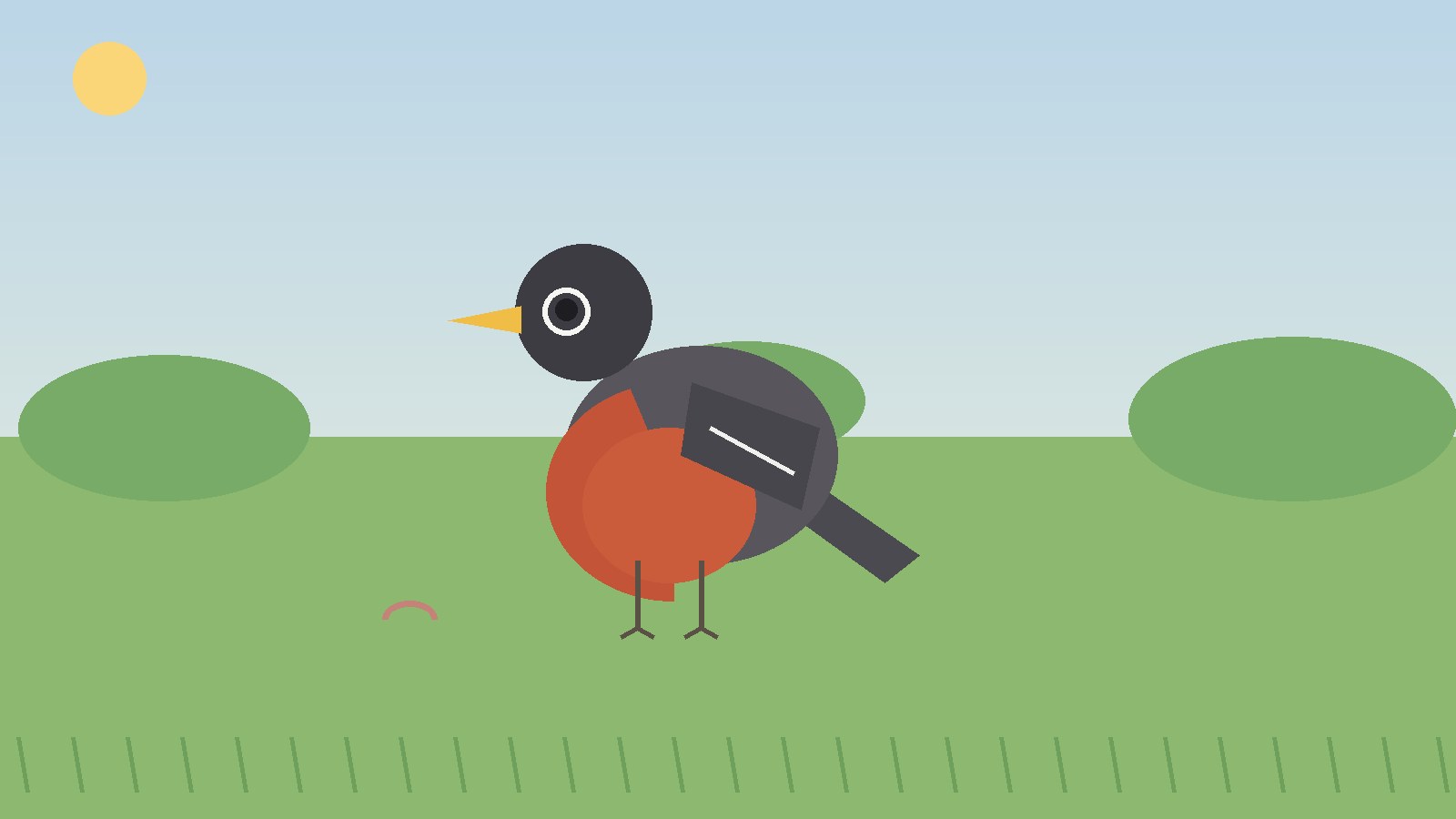
The American robin is the bird most North American readers picture first, and often it is the right answer, especially on a lawn. Cornell Lab of Ornithology describes robins as common sights on lawns across North America, where they are often seen tugging earthworms out of the ground, and notes their warm orange breast and cheery song. The adult has a dark head, a gray brown back, a warm orange red breast, a white lower belly, a yellow bill, and broken white arcs around the eye. The throat is white with dark streaks. Males tend to be richer in color than females, but the difference can be small.
Behavior is a strong clue. Robins run across open ground, stop suddenly, and tilt the head before pecking at the ground. They also perch upright and sing clear, lilting whistles. In winter, robins may leave an open lawn but still be nearby in flocks in treetops or around fruiting trees, so absence from a lawn in winter does not rule out a robin in the area.
Young robins are a classic source of confusion. A juvenile has a speckled breast, with dark spots over an orange wash, and a speckled back. Do not look for a clean red chest on a young bird. Look for the shape, the upright posture, the lawn behavior, and the adult nearby.
Possible confusion: a varied thrush in the West also has orange underparts, but it shows a dark breast band and bold wing bars that a robin lacks. A robin is also much larger than a finch, and it does not normally crack seeds at a feeder in the way finches do.
Northern Cardinal
The northern cardinal is unmistakable when it is an adult male in good light. The male is bright red over almost the whole body, including the chest, with a pointed crest, a black mask around the bill and throat, and a thick orange red bill built for cracking seeds. Audubon Everglades notes that the male sings loudly from a conspicuous perch with its crest flared. Both sexes sing, although the female often sings less insistently and may answer a male in a duet.
The female causes most cardinal confusion. She is mainly warm brown or olive brown, with red tinges on the crest, wings, and tail, and a smaller, less dark face mask. Her bill is still thick and orange red, and her crest is still pointed. Young cardinals are brownish and duller, with a dark bill that turns orange red as they mature.
Cardinals favor dense shrubs, thickets, woodland edges, hedgerows, and well planted gardens. They are often year round residents in much of their range, so a cardinal in winter is normal. Their song is a series of clear whistles, often written as cheer, cheer, cheer or birdy, birdy, birdy, and they also give a sharp chip call.
Possible confusion: a summer tanager male is also all red, but it has no crest and a smaller bill. A scarlet tanager male is red with black wings and tail, not red all over. A vermilion flycatcher is smaller, lacks a crest, and has dark wings. Size, crest, and bill together separate the cardinal from all three.
House Finch, Purple Finch, and Cassin’s Finch
Finches cause more red chest arguments than any other group, because three similar species overlap, and because females and young males are brown and streaked with no red at all. Start with the house finch, the most widespread feeder finch in much of the United States. The adult male has red concentrated on the head and upper breast, often with red on the rump, and bold brown streaking along the flanks. Cornell Bird Academy describes the house finch male as having a rounded head, red concentrated on head and breast, and bold brown streaking on the flanks. The female has a uniformly brown head with no strong facial pattern and long, thin, blurry streaks on the breast.
The purple finch male looks as if it has been dipped in raspberry juice. Cornell Bird Academy describes a pink wash on the wings and belly, no distinct streaks on the belly or flanks, and a larger head in proportion to the body than the house finch. The female purple finch has a bold facial pattern, with a white eyebrow stripe and a dark stripe trailing away from the bill, plus short, thick, smudged streaks on the breast. That facial pattern is the fastest way to separate a female purple finch from a female house finch.
Cassin’s finch, found mainly in western mountains, is the third member of this trio. Cornell Bird Academy notes a raspberry crown that stands out more than pink brows, a crown that often peaks or sticks up, and minimal streaking on the flanks in the male. The female has a less defined white eyebrow stripe and sharply defined streaks on the breast. Range helps here. If you are in the East and you think you see a Cassin’s finch, check the house finch and purple finch possibilities first, and be ready to leave the record as uncertain unless the marks are clear.
All three finches visit feeders and eat seeds with a short, conical bill. Behavior at a feeder, small size, streaked sides in the house finch, and the distribution of red are more reliable than the exact shade of red, which varies with diet and age and can look orange, yellow, or dull red in some males.
Eastern Bluebird
The eastern bluebird is not a fully red bird, and that is the point. The male has bright blue upperparts, a rusty red orange chest and sides, and a white belly. The female is grayer above with a blue wash on wings and tail and a paler rusty chest. Both sexes have a fairly slender bill compared with a finch or a cardinal, and they often perch upright on a fence or low branch in open country, then drop to the ground for insects.
Habitat is a strong clue. Eastern bluebirds favor open fields, pastures, orchards, and woodland edges with scattered trees and nest cavities or nest boxes. If your red chested bird is perched in the open, shows blue on the back, and drops to the ground rather than hopping through shrubs, an eastern bluebird is a strong candidate in eastern North America. In the West, check the western bluebird and mountain bluebird instead, since range, not chest color, decides among bluebirds.
Possible confusion: a robin is larger, has a gray brown back rather than blue, and a yellow bill rather than a dark slender bill. If the back is not blue, do not call it a bluebird on chest color alone.
Rose-Breasted Grosbeak
The rose-breasted grosbeak is a spring and summer bird that stops many watchers in their tracks, because the male looks black and white except for a rose red triangle on the chest. The female is a different bird to the eye: warm brown above, heavily streaked below, with a bold white eyebrow stripe and a pale bill. The very thick, pale bill is a key mark in both sexes, and it is much heavier than a finch bill or a tanager bill.
Look for this species at forest edges, in parks, and at feeders during migration and the breeding season in the eastern United States and parts of Canada. Its song is often described as like a robin song but richer and more musical. The male’s rose triangle can look smaller when the bird is hunched, so watch for the black head and back, white belly, and white wing patches as well.
Possible confusion: no other common eastern bird combines a black and white body with a single rose chest patch. A scarlet tanager is red with black wings, not black and white with a rose patch. If the chest patch is triangular and the rest of the bird is black and white, the grosbeak is the likely answer, provided the season and range fit.
Scarlet Tanager and Summer Tanager
Tanagers are canopy birds, and canopy birds are easy to misjudge from below. The breeding male scarlet tanager is scarlet red with jet black wings and tail. The female is yellow green above and yellow below, with darker olive wings, and she shows no red chest at all. In autumn, the male molts out of red into a yellow green plumage similar to the female, so a scarlet tanager in autumn will not match a red chest description. Look for scarlet tanagers high in leafy deciduous forest in summer, often heard before they are seen. Their song is a burry, robin like series of phrases, and they give a distinctive chick burr call.
The summer tanager male is red all over, without black wings and without a crest. The female is mustard yellow to olive yellow, again with no red chest. Summer tanagers live in warmer woodlands, including pine and oak woods in the South and parts of the West, and they are summer visitors in much of their range.
To separate the two males, look at the wings. Black wings plus a red body point to scarlet tanager. Red wings plus a red body, with no crest and a moderate bill, point to summer tanager. To separate summer tanager from cardinal, look for the crest and the heavy bill. A cardinal has both. A summer tanager has neither.
Vermilion Flycatcher
The vermilion flycatcher is a small, striking bird of open country in the Southwest. The adult male has a bright red head and underparts, including the chest, with dark wings and tail and a dark mask through the eye. The female is less colorful, with a white breast marked with brown streaks and reddish orange feathers on the belly, and she does not show the male’s vivid red chest. The bird often perches in the open, then darts out to catch insects and returns to the same perch.
Range is decisive here. A vermilion flycatcher in the Northeast or Midwest would be a rare event and would need careful documentation. In Arizona, New Mexico, Texas, and southward, it is a regular bird of desert washes, ranchland, parks, and open areas near water. If you are outside the Southwest and you think you have one, first recheck cardinal, summer tanager, and scarlet tanager.
Red-Breasted Nuthatch and Pine Grosbeak
Two northern birds round out the common list, and both reward attention to the head and the back rather than the chest alone. The red-breasted nuthatch is a small, compact bird with a blue gray back, a black and white head pattern with a bold black eye stripe, and rusty cinnamon underparts. The chest color is cinnamon rather than bright red, and the bird’s habit gives it away: it creeps along tree trunks and branches, often headfirst down a trunk, and it visits feeders for seeds and suet. It lives mainly in conifer forest, and in some years it moves farther south in larger numbers when food is scarce in the North.
The pine grosbeak is a large finch of northern forests. The male is gray with rosy red on the head, chest, flanks, and back, plus two white wing bars. The female is gray with warm yellow or orange tones on the head and rump rather than red. Pine grosbeaks are often seen in small flocks eating buds and fruit in winter. Size helps: a pine grosbeak is noticeably larger than a house finch or purple finch, and its bill is short and stubby.
European Robin: A Different Bird With the Same English Name
Readers outside North America usually mean a different bird when they say robin. The European robin is a small, round bird with an orange red face and breast edged with gray, a brown back, and a pale belly. Males and females look alike. The bird is common in gardens, parks, and woodland across Europe.
Young European robins look nothing like adults. They are mottled brown and gold with no red breast, and they can be mistaken for a different species in summer. As they molt, the orange red breast grows in. The European robin is not the same species as the American robin, and it is much smaller. It does not occur as a regular wild bird in North America, so a small red breasted bird in a North American garden is not a European robin.
This naming trap matters. Search engines mix the two robins because both carry the word robin and both have red breasts. Always check which robin a source means. If it describes a small garden bird in Britain, it means the European robin. If it describes a large thrush on a North American lawn, it means the American robin.
Common Lookalikes and Misidentifications
Many red chest reports turn out to be a different pattern seen badly. A red-winged blackbird male is black with red shoulder patches, not a red chest, but a quick side view in poor light can suggest a red breast. A Baltimore oriole male is bright orange below with a black head and back, and its orange can read as red in warm light.
A painted bunting male has red underparts, a blue head, and a green back, and it is a small, finch like bird of the Southeast and south central United States. Its combination of blue, green, and red is unique. If your bird shows only a red chest and a brown back, it is not a painted bunting.
Lighting and partial views create other errors. A robin seen from below against bright sky can look dark headed with a glowing chest and no visible back color. A cardinal seen through leaves can look patchy red and brown. When a view is partial, record it as partial, and note which parts you saw clearly rather than filling gaps from memory later.
Sex and age create a second set of errors. A female cardinal is often reported as a different species because she is brown. A female scarlet tanager is often missed because she is yellow green. Before you settle on a rare species, ask whether a female or young bird of a common species fits the marks you actually saw.
What to Note for a Reliable Identification
A good field note does not need to be long, but it does need to be specific. Write down the date, the place, and the habitat. Note the size in relation to a familiar bird, the shape of the bill, the color of the back, wings, head, belly, and tail, and any pattern such as a crest, mask, eyebrow stripe, wing bars, or streaks. Note the behavior and the sound, if you heard it, in your own words.
Photographs help most when they show more than the chest. A side view showing bill, back, and tail is more useful than a front view showing only a red patch. If you use a sound or photograph identification app, treat its suggestion as a starting point, not as proof. Compare it against the marks in this guide, and check whether the suggested species is expected in your area at that season.
If you cannot reach a firm identification, that is normal, especially with females, young birds, and distant birds. Record the bird as an unidentified red breasted bird with your notes, and keep the notes for a later comparison.
Do not disturb the bird to get a better view. Keep a respectful distance, especially near a nest, and do not play recorded songs repeatedly to lure a bird closer.
Frequently Asked Questions
What is the most common bird with a red chest?
In much of North America, the American robin is the most common answer, especially on lawns and in parks, followed by the northern cardinal in gardens and the house finch at feeders. The right answer still depends on where you are and the time of year.
Is a bird with a red chest always male?
No. In many species the male is brighter, but females can show red tones as well, and in the European robin males and females look alike. In the northern cardinal, the female is brown with red tinges on wings, tail, and crest rather than bright red all over. Always check bill shape, crest, back color, and pattern, not brightness alone.
Why does my robin have spots on its chest?
A spotted chest in summer usually means a young American robin. Juvenile robins have dark spots over an orange wash on the breast and a speckled back, and they lose that pattern as they mature.
How do I tell a house finch from a purple finch?
A male house finch has red concentrated on the head and upper breast with bold brown streaks along the flanks. A male purple finch has a raspberry wash over head, chest, wings, and belly with little or no strong streaking on the belly. A female purple finch has a bold white eyebrow stripe, while a female house finch has a plainer brown head and long, thin, blurry breast streaks.
Can a cardinal and a summer tanager be confused?
Yes, because both males are mainly red. The cardinal has a pointed crest, a black face mask, and a very thick orange red bill, and it is often a year round garden bird. The summer tanager has no crest, no black mask, and a smaller bill, and it is a summer bird of warmer woodlands.
What if the bird has a red chest but a blue back?
That combination points to a bluebird, most often an eastern bluebird in eastern North America, where the male has bright blue upperparts and a rusty red orange chest. A robin has a gray brown back, not a blue back.
Is the European robin the same as the American robin?
No. They are different species with the same English name. The European robin is a small garden bird in Europe with an orange red face and breast, a brown back, and a pale belly. The American robin is a larger North American thrush with a warm orange red breast, a gray brown back, and a yellow bill.
What should I do if I cannot identify the bird?
Keep your notes and photographs, note the date, place, habitat, size, bill shape, back color, and behavior, and compare them with a field guide or a trusted source. Leave the identification open if the marks do not fit one species clearly.
Keep reading: Black and White Birds: How to Recognize the Species You See Most Often
Keep reading: Where Do Birds Go at Night
Sources & references
- Cornell Lab of Ornithology, All About Birds, American Robin overview. Accessed 1 November 2026. https://www.allaboutbirds.org/guide/American_Robin/overview
- Cornell Lab of Ornithology, Bird Academy, House Finches, Purple Finches, and Cassin's Finches. Accessed 1 November 2026. https://academy.allaboutbirds.org/finches-with-red-id-quiz/
- Audubon Everglades, Bird of the Month, March 2008: Northern Cardinal. Accessed 1 November 2026. https://www.auduboneverglades.org/bird-of-the-month-march-2008-northern-cardinal/
- Cornell Lab of Ornithology, All About Birds, Rose-breasted Grosbeak overview. Accessed 1 November 2026. https://www.allaboutbirds.org/guide/Rose-breasted_Grosbeak
- Birds and Blooms, How to Identify a Vermilion Flycatcher, citing Cornell Lab of Ornithology and National Audubon Society. Accessed 1 November 2026. https://www.birdsandblooms.com/birding/bird-species/songbirds/vermilion-flycatcher/
- New York State Department of Environmental Conservation, Eastern Bluebird, Watchable Wildlife, and Birds and Blooms, How to Identify an Eastern Bluebird, consulted through search results 1 November 2026, for eastern bluebird field marks.
- Royal Society for the Protection of Birds, Robin species account, as summarized in sources consulted 1 November 2026, for European robin field marks. Scarlet tanager, summer tanager, red-breasted nuthatch, and pine grosbeak field marks are stated in qualified form in this draft and are flagged in the writer ledger for QA verification against Cornell Lab species accounts before approval.


