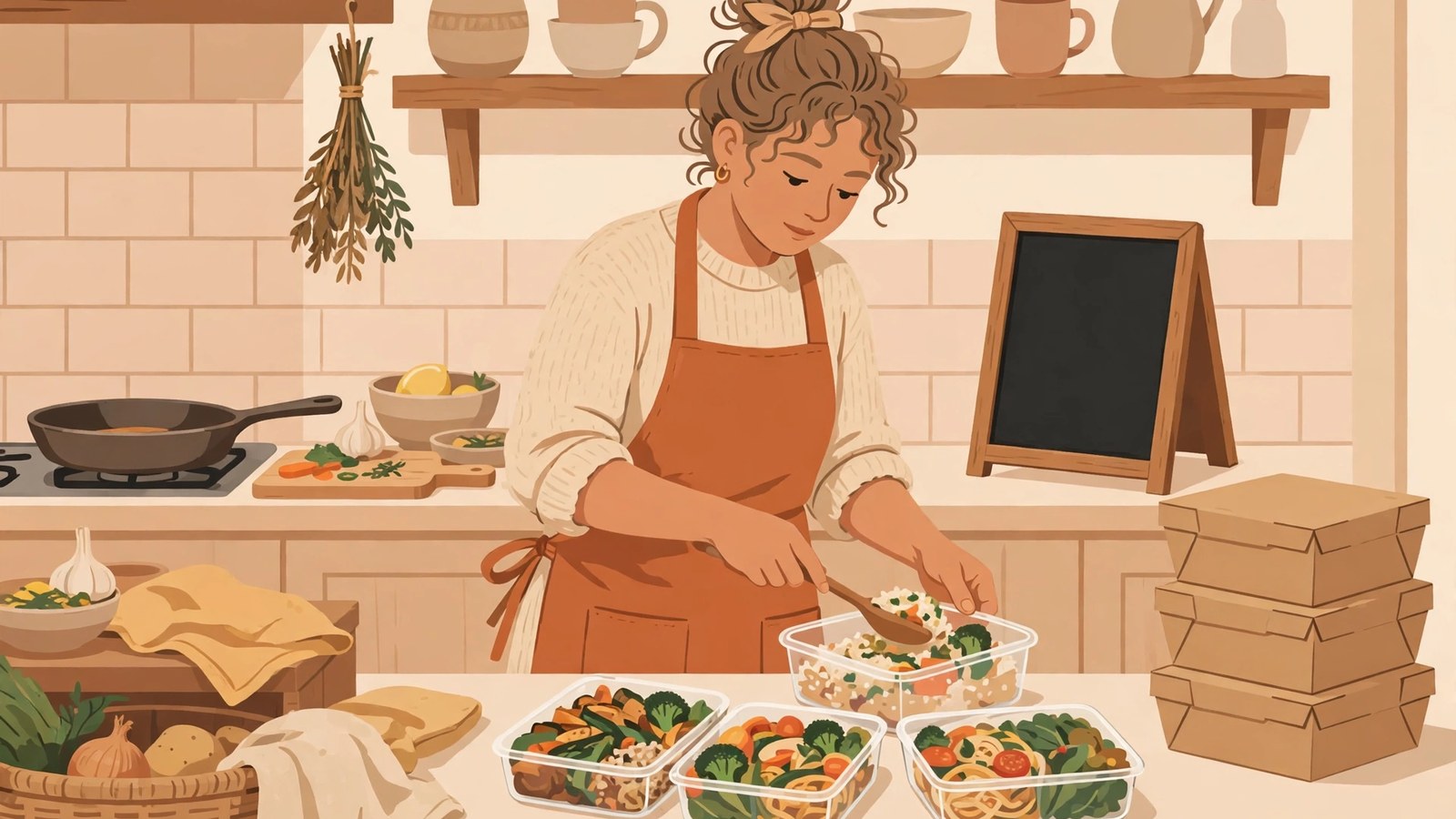
Short answer
- To get paid to cook, pick one route first: sell food you make, sell what you know through classes or recipes, sell your time as a personal or event cook, or build an audience that earns from content. Before your first sale, check the food safety, permit, and cottage food rules that apply in your state and county, learn safe temperatures and allergen labeling, cost each dish so price covers ingredients, packaging, labor, and overhead, and keep records for tax. Start small, test with paying customers for a few weeks, and only expand a route that covers its costs.
Introduction
If you are the person friends text when they need a dinner idea, or the one whose weeknight meals get requested by name, you have probably wondered whether that skill could pay. It can, but not in the vague, overnight way social media suggests. People who get paid to cook earn money through a handful of clear business models, each with its own rules, costs, and limits. This guide walks through those models, the food safety and legal groundwork that comes first, and a realistic plan for picking one route and testing it.
The honest headline first: income from cooking is variable. It depends on your prices, your costs, your location, how many customers you can reach, and how consistently you show up. Nothing here promises a set amount per week or month, because no honest source can. What you can control is choosing a model that fits your life, pricing it so it actually covers your costs, and staying on the right side of food safety rules.
The Four Ways Cooking Turns Into Income
Almost every cooking income stream fits into one of four models. Naming the model matters, because it tells you what you are really selling and what can go wrong.
| Model | What you sell | Examples | Main risk |
|---|---|---|---|
| Sell the food | Finished dishes and baked goods | Home meal sales, farmers market stalls, meal prep clients | Food safety rules, permits, and spoilage |
| Sell what you know | Knowledge and tested recipes | Classes, ebooks, freelance recipe writing | Slow audience building and copying of digital files |
| Sell your time | Cooking labor in someone else’s kitchen | Personal chef work, event cooking | Scheduling, travel, and physical burnout |
| Sell attention | An audience that brands want to reach | Video channels, blogs, newsletters, brand videos | Platform rules change, and income lags effort by months |
Most successful home cooks eventually combine two models, for instance selling meals locally while teaching one online class a month. But start with one. Spreading yourself across four models at once is the fastest way to do all of them badly.
Before You Charge Anyone: Safety and the Law
Cooking for your family and cooking for paying customers are different activities in the eyes of regulators, and treating them the same is the most common beginner mistake. This section is general information, not legal advice, and the details vary by state, county, and city. Check your local rules before your first sale.
The Food Safety Basics Every Seller Needs
The U.S. Food and Drug Administration publishes the FDA Food Code, a model set of food safety provisions for retail and food service. It is not itself a federal law. State, local, tribal, and territorial agencies adopt versions of it into their own rules. That is why requirements differ from place to place even though the underlying principles are consistent: keep hands and surfaces clean, prevent cross-contamination between raw and ready-to-eat foods, cook to safe temperatures, and hold foods out of the temperature danger zone.
For home cooks, the U.S. Department of Agriculture’s consumer guidance is the most useful everyday reference. The USDA defines the temperature danger zone as 40°F to 140°F, the range in which bacteria on perishable food can multiply rapidly. Its consumer rule is simple: refrigerate perishable food within two hours of cooking, or within one hour if the surrounding temperature is above 90°F, and keep cold food at 40°F or below and hot food at 140°F or above. A probe thermometer is not optional equipment for a seller. Color, smell, and touch cannot confirm a safe temperature.
Allergen handling deserves its own line in your routine. Sesame is the ninth major food allergen under the FASTER Act of 2021, alongside milk, eggs, fish, crustacean shellfish, tree nuts, peanuts, wheat, and soybeans. Label your ingredients, ask clients about allergies before you cook for them, and never guess about an ingredient you cannot verify.
Cottage Food Rules Are Local, Not National
In the United States, many states let residents sell certain low-risk, shelf-stable foods made in a home kitchen under what are commonly called cottage food laws. Typical examples include baked goods without cream fillings, jams, candies, and dry mixes. The catch is that every state writes its own version. Allowed foods, annual sales caps, labeling requirements, and permitted sales channels all differ, and some states require registration, training, or a home kitchen inspection while others require less. Some states restrict sales to direct, in-person channels. Interstate shipping of cottage food products is generally not permitted, because these exemptions are state-level permissions.
That variation is exactly why this guide states no single national rule. The reliable move is to check your state department of agriculture or health website and your county health department for the current allowed product list, sales cap, and labeling rules before you sell anything. If your plan involves hot, perishable meals rather than shelf-stable goods, expect stricter requirements. Many jurisdictions require a licensed commercial kitchen or a special permit for that kind of sale, and a marketplace platform may require you to cook in a commercial kitchen where home cooking laws do not apply.
Insurance and the Paper Trail
Talk to an insurer about general liability and product liability coverage before selling food to strangers. A homeowners policy typically does not cover a food business. Keep a simple paper trail from day one: ingredient suppliers, batch dates, labels, customer allergy notes, and every sale. If a customer ever reports feeling ill, that record is your only defense, and it also makes tax time far easier.
Route 1: Sell the Food Itself
This is the most direct route, where someone pays you and you hand them food, and it is the one with the heaviest rules. Anyone planning to sell homemade food should start with the safety and permit checks in the previous section, because they apply before the first order, not after. It suits cooks who enjoy production: cooking in batches, packing neatly, and repeating a small menu well.
Home Meal Sales Through a Marketplace
Platforms such as Shef connect home cooks with local customers who order meals in advance. Cooks on such platforms typically set their menus and cooking days, pass a food safety certification, and meet the licensing requirements of their jurisdiction. Meals are usually cooked in advance, cooled, and packed for delivery or pickup, which means your dishes need to travel and reheat well. Saucy braises, stews, and grain bowls tend to survive this better than crisp fried foods. Platform terms, payouts, and fee structures change over time, so read the current terms on the platform itself before signing up rather than trusting any third-party summary, including this one.
Baked Goods and Shelf-Stable Products
Baking is the classic entry point for a reason: the products are shelf-stable, the startup cost is low, and in many states the rules are the lightest of any food sale. For many beginners, a single baked good is also the most manageable first cooking side hustle, because production can be batched into one or two days a week. The winning strategy is narrow. One excellent product, such as a sourdough loaf, a brownie box, or a spice blend, beats a sprawling menu that is hard to cost, pack, and keep consistent. Test your product with paying strangers, not just supportive friends, and price it using the costing method in the pricing section below before you commit to a market stall.
Markets, Pop-Ups, and Meal Prep Clients
Farmers markets and pop-ups let you meet customers face-to-face and build repeat buyers, but they add costs: booth fees, a tent and tables, packaging, transport, and often a separate market permit on top of your food permit. Meal prep clients sit at the other end of the spectrum. You cook a week’s worth of portioned meals for a small number of households, usually in their kitchen or yours, and the work is steadier but more personal. You need to handle dietary restrictions, portion sizes, and weekly scheduling. Both routes reward reliability more than novelty. Customers return because the food is good every single time, not because the menu changes weekly.
Route 2: Sell What You Know
If you would rather teach or write than produce food for sale, this model trades kitchen labor for knowledge products. It has fewer food safety hurdles and lower startup costs, but income usually arrives more slowly.
Teach Cooking, Live or Recorded
Live online classes need only a video call app, a camera angle that shows your hands and your pan, and a dish that can genuinely be finished inside the class time. Teach one dish extremely well before you build a course catalog. A single confident class that students can repeat at home earns better reviews than five rushed ones. In-person classes through local community centers, kitchen stores, and experience marketplaces follow the same logic. Price by the seat, cap the class size at a number you can actually help, and send students home with a written recipe so the lesson survives after the call ends.
Write and Sell Recipes
There are three distinct ways to earn from written recipes, and they pay differently. First, freelance food writing: blogs, magazines, and brands hire writers to develop or write up recipes, and some hire home cooks to add personal tips and serving ideas to existing recipe roundups. Second, recipe testing: cookbook authors and food brands occasionally hire everyday cooks to cook unpublished recipes and report honestly on timing, clarity, and results. These openings are sporadic rather than steady work. One cookbook project publicly offered $2,000 plus an ingredient stipend to three testers who each cooked five recipes over two weeks, so treat testing as a bonus, not a paycheck you can plan around. Third, self-published collections: grouping your own tested recipes into an ebook or printable pack and selling it through a marketplace or your own site. This is the most hands-on way to sell recipes online, and it works best when the collection solves one specific problem, such as weeknight dinners or lunchbox meals. For a paid collection to feel worth its price, every recipe must be tested more than once, written with exact quantities, and accompanied by storage and reheating notes.
A note on originality: a list of ingredients is a set of facts, but your headnotes, instructions, tips, and photos are your creative work. Do not copy another cook’s wording, and do not republish recipes you do not have the right to use. When you adapt a classic dish, write the method in your own words from your own testing.
Route 3: Sell Your Time in Someone Else’s Kitchen
Personal chef work and event cooking pay for your labor, skill, and reliability rather than for a product you made in advance. It is the best fit for cooks who like people and variety, and the worst fit for anyone who wants a fixed schedule.
A personal chef typically cooks for several clients on a rotating schedule, preparing a set of meals in the client’s home or delivering them for the week, while a private chef works full-time for a single household. There is no single legally required path to personal chef work in the United States, but clients and platforms commonly expect food safety certification, a business license, and liability insurance, and a culinary degree is helpful rather than required. Practical experience matters more than credentials. Cook for friends and family first, photograph everything, collect honest reviews, and build a small portfolio before approaching paying clients. If you want the full checklist for this path, search for how to become a personal chef and compare several current guides, because expectations differ by city and clientele.
Event cooking for birthdays, small gatherings, retreats, and community events works similarly but in bursts. Clarify the menu, headcount, dietary restrictions, equipment, serving, and cleanup in writing before the day. The most common dispute in event cooking is not about flavor. It is about who was supposed to bring the serving dishes and who was supposed to stay and clean up. Put both answers in the agreement.
Route 4: Build an Audience, Then Earn From It
Blogs, video channels, and newsletters earn money indirectly through advertising, sponsorships, and your own products. The work is real and the payoff is slow, which makes this the route most often abandoned too early.
A food blog earns through advertising and related revenue once it has traffic, and through selling its own products once it has trust. A video channel earns through the YouTube Partner Program once it meets the eligibility thresholds: 1,000 subscribers plus either 4,000 valid public watch hours in the past 12 months or 10 million valid public Shorts views in the past 90 days, along with a linked AdSense account and a clean compliance record. A newsletter earns through sponsorships and product sales once its open rate and niche are clear enough for a sponsor to value. In all three cases, the asset is not any single post. It is a library of tested, trustworthy content that keeps working while you sleep.
Short brand videos are a faster variant of audience work. Brands pay everyday cooks to film short cooking videos featuring their products, and a large following is not always required. Read the usage terms carefully. A video sold for one social post and a video licensed for paid advertising everywhere are different deals and should be priced differently. Get the scope, duration, and exclusivity in writing.
Pricing: The Math That Decides Whether This Works
Most new food sellers underprice. They count ingredients and forget packaging, platform fees, delivery time, and the hour spent shopping. Use this simple formula for every item you sell:
Price = (ingredient cost + packaging cost + labor cost + overhead share) divided by (1 minus target margin)
Worked example: a family-size tray costs $14 in ingredients and $2 in packaging, and takes one hour of your time, which you value at $20. Your overhead share, covering market fees, payment processing, and transport averaged across the week, comes to $4 per tray. Total cost is $40. If you want a 20 percent margin, divide $40 by 0.8, giving a price of $50. If customers will not pay $50, the answer is not to absorb the loss. It is to change the dish, the portion, or the channel until the math works. Track actual costs for a month, because the first version of any food budget is a guess.
Two pricing habits protect beginners. First, charge separately for delivery where possible, because folding delivery into the dish price hides your most variable cost. Second, review prices quarterly. Ingredient prices move, and a menu priced a year ago is quietly losing money.
Taxes and Record Keeping
Cooking income is taxable income, and this section is general information, not tax advice. The Internal Revenue Service treats gig and self-employment income as reportable even when no tax form is issued. You must report income from part-time, temporary, or side work, whether or not it appears on a 1099, and whether it was paid in cash, by card, or in goods. You must file a tax return if you have net earnings from self-employment of $400 or more from gig work, even if it is a side job. Platforms and clients may send you forms such as a 1099-NEC or 1099-K, but the absence of a form does not remove the obligation to report the income.
Keep records that make this painless: a simple spreadsheet of income and expenses, receipts for ingredients and equipment, mileage for market and delivery trips, and platform payout statements. Business expenses such as ingredients, packaging, a food safety course, and market fees generally reduce taxable profit, but the exact rules depend on your situation, so check the IRS gig economy guidance or talk to a tax professional before your first filing. Set aside a portion of each payment for taxes rather than discovering the bill in April.
Choosing Your First Route
Use this decision guide instead of trying to rank the routes by income, because income figures you see online rarely describe your city, your costs, or your schedule.
| If this sounds like you | Start here | First milestone |
|---|---|---|
| You love batch cooking and your neighbors already ask for your food | Home meal or baked goods sales | Ten paying customers outside your circle of friends |
| You love explaining techniques and people ask you to teach them | One live online class | A full class of paying students who finish the dish |
| You enjoy other people’s kitchens and varied days | Personal chef or event cooking | Three repeat clients or two paid events |
| You enjoy writing, filming, and building something slowly | Blog, video, or newsletter | Thirty published pieces on a consistent schedule |
| You want low commitment and flexible hours | Recipe testing and freelance food writing | Two paid assignments completed on deadline |
Whichever route you pick, run it as a test for a fixed period of four to six weeks, with a clear question: can I find paying customers, at a price that covers my costs, without burning out? If the answer is no, the test taught you something valuable. Change the route, the dish, or the price, and test again.
A 30-Day Starter Plan
Days 1 to 7: Foundations. Pick one route. Check your state and county food rules, complete a food safety course if your route requires one, and set up a simple spreadsheet for income and expenses. Cook your chosen dish three times and write down exact quantities, timings, and costs.
Days 8 to 14: Proof. Give the dish to five people outside your household and ask for specific feedback on flavor, portion, packaging, and price. Adjust once based on what you hear. Photograph the final version in natural light.
Days 15 to 21: First sales. Offer the dish to a small audience, such as a neighborhood group, a market stall, a class listing, or a freelance pitch, depending on your route. Take payment properly, keep receipts, and record every cost.
Days 22 to 30: Review. Compare actual income against actual costs. Decide whether to continue, adjust the price, narrow the menu, or switch routes. Write down what you will change next month. One honest review month beats a year of guessing.
Mistakes That Cost New Food Sellers Money
- Selling before checking the rules. A single complaint can close a home food operation faster than slow sales ever will.
- Pricing from feeling instead of costing. If you cannot state your cost per portion, you cannot know whether you made money.
- A menu that is too wide. Every extra dish adds shopping, storage, and waste. One excellent dish builds a reputation faster than twelve average ones.
- Skipping allergy questions. Ask every client, every time, and write the answer down.
- Giving food away to build exposure. Free samples at a market are marketing. Cooking full orders for free is unpaid labor, and it rarely converts.
- Mixing business and personal money. A separate account and a simple spreadsheet prevent most tax-season panic.
The Bottom Line
Getting paid to cook is not one job. It is a set of different businesses that happen to share a kitchen. The cooks who make it work pick one model, learn the rules that apply to it, price their work so it covers real costs, and give the route enough weeks to produce honest evidence. Start small, keep records, ask about allergies, and let your first customers, not your enthusiasm, tell you whether the dish, the price, and the route are right. If they are, you have something worth growing. If they are not, you have spent a month learning exactly what to change, which is a better outcome than a year of guessing.
Frequently Asked Questions
Do I need to be a professional chef to earn money cooking?
No. Clients and customers pay for reliable, tasty food and clear communication, not for a diploma. Food safety knowledge, consistency, and honest labeling matter more than formal training for most of the routes in this guide, though private households hiring a full-time chef often expect professional experience.
Can I make money cooking at home without a commercial kitchen?
It depends on what you sell and where you live. Shelf-stable baked goods and similar products are often allowed from a home kitchen under state cottage food rules, while hot perishable meals frequently require a licensed kitchen or a special permit. Check your state department of agriculture or health and your county rules for your exact product before you start, because the rules vary by state and change over time.
What is the easiest way to start?
For most beginners, the lowest-friction start is either a single baked good sold locally under your state’s home food rules or a single live online class. Both let you test demand with small upfront costs. Easiest still includes real work: costing, labeling, and finding customers are part of the job.
How do I price food I sell from home?
Add ingredient cost, packaging cost, the value of your labor, and a share of overhead such as fees and transport, then divide by one minus your target margin. The worked example in this guide turns $40 in total costs into a $50 price at a 20 percent margin. Charge for delivery separately where you can, track real costs for a month, and review prices quarterly.
How do I find my first customers?
Start where trust already exists: neighbors, coworkers, parent groups, and local social media groups. Markets and platforms extend that reach, but your first ten customers usually come from people who have already tasted your food. Ask satisfied customers for reviews and referrals directly. Most happy customers will help if asked.
Is recipe testing steady work?
No. Testing openings appear when a cookbook, brand, or publication has a project, and they go to cooks who apply promptly and give detailed, honest feedback. Treat testing as occasional bonus income alongside a steadier route, not as a replacement for one.
When should I quit my day job for cooking?
When a cooking route has covered its costs and paid you consistently for several months, when you have savings to cover a slow stretch, and when demand is limited by your available hours rather than by a lack of customers. Until all three are true, keep cooking income as a second stream and let it prove itself.
Sources & references
- U.S. Food and Drug Administration, FDA Food Code. Model food safety provisions for retail and food service, adopted in versions by state, local, tribal, and territorial agencies.
- U.S. Department of Agriculture, consumer food safety guidance. Temperature danger zone, safe holding temperatures, and refrigeration timing for perishable food.
- U.S. Food and Drug Administration, food allergen guidance and the FASTER Act of 2021. Sesame as the ninth major food allergen, alongside milk, eggs, fish, crustacean shellfish, tree nuts, peanuts, wheat, and soybeans.
- State departments of agriculture and health and county health departments, cottage food and home food sale rules. State specific allowed foods, labeling, sales channels, and permit requirements, to be checked for the reader's own state.
- Internal Revenue Service, guidance on managing taxes for gig work and filing tips for gig economy workers. Reporting of self-employment and gig income and the $400 net earnings filing threshold.
- YouTube and Google, YouTube Partner Program eligibility requirements. Subscriber, watch hour, and Shorts view thresholds, AdSense linking, and compliance requirements.
- Culinary Institute of America, career guidance on personal and private chefs. Distinction between a personal chef serving several clients and a private chef working full time for one household.


