Short answer
- One foot equals 12 inches exactly. To convert feet to inches, multiply the number of feet by 12. To convert inches to feet, divide the number of inches by 12. That is the whole conversion, and it works for whole feet, fractional feet, and measurements written as feet and inches together. Three answers show the pattern. The common search 3 ft to inches is 3 x 12 = 36 inches. Five feet is 5 x 12 = 60 inches, and six feet is 6 x 12 = 72 inches. Going the other way, 100 inches divided by 12 is 8.333 feet, which is usually written more usefully as 8 feet 4 inches. For a measurement written as feet and inches together, convert the feet part first and then add the inches part: total inches = (feet x 12) + inches. So 5 ft 7 in is (5 x 12) + 7 = 67 inches. That one method handles heights, room dimensions, lumber lengths, and doorway clearances.
By Emma Hudson
Feet and inches are the pair of length units most people in the United States meet first, whether they are measuring a room, checking a person’s height, or reading a building plan. The two units often appear side by side, so a measurement given one way regularly has to be restated the other way before it can be compared, added, or used.
This is one of the simplest conversions in everyday measurement. The factor is exact, the arithmetic is a single multiplication or division, and every example in this guide is built from the same verified constants, so the method can be checked at each step.
Why the Factor Is 12
The foot is defined as 12 inches in the imperial and US customary systems. The factor is not 10, and it is not a rounded approximation. It is part of the definition of the units, so it does not change from one measurement to the next.
The inch has an exact metric definition as well: one inch equals 2.54 centimeters exactly, so one foot equals 12 x 2.54 = 30.48 centimeters, or 0.3048 meters, exactly. Those values were settled by the International Yard and Pound Agreement of 1959, which fixed the yard at 0.9144 meters exactly and so fixed the foot and the inch at the same time.
One older term sometimes causes confusion. The US survey foot, formerly used in land surveying, differed from the international foot by about two parts per million. NIST records that the US survey foot was deprecated on December 31, 2022, and that from January 1, 2023 it is superseded by the international foot definition, 1 foot = 0.3048 meter exactly, in all applications. For everyday measuring, and for every conversion in this article, the international foot of exactly 12 inches is the one to use.
The Two Formulas
Inches = feet x 12
Feet = inches / 12
Total inches = (feet x 12) + inches
Everything else in this guide is one of those formulas applied carefully. To go from total inches back to feet and inches, divide by 12: the whole number is the feet, and the remainder is the inches.
A reverse check works in both directions: divide an inches answer by 12, or multiply and add a feet and inches answer, and confirm that you return to the starting value. The check takes seconds and catches most slips.
Feet to Inches Conversion Table
This table is recomputed from 1 foot = 12 inches exactly. Each row multiplies the feet value by 12, and the centimeters column multiplies the feet value by 30.48, so the two result columns can be checked against each other.
| Feet | Inches | Centimeters |
|---|---|---|
| 1 | 12 | 30.48 |
| 2 | 24 | 60.96 |
| 3 | 36 | 91.44 |
| 4 | 48 | 121.92 |
| 5 | 60 | 152.4 |
| 6 | 72 | 182.88 |
| 7 | 84 | 213.36 |
| 8 | 96 | 243.84 |
| 9 | 108 | 274.32 |
| 10 | 120 | 304.8 |
| 11 | 132 | 335.28 |
| 12 | 144 | 365.76 |
| 13 | 156 | 396.24 |
| 14 | 168 | 426.72 |
| 15 | 180 | 457.2 |
| 16 | 192 | 487.68 |
| 17 | 204 | 518.16 |
| 18 | 216 | 548.64 |
| 19 | 228 | 579.12 |
| 20 | 240 | 609.6 |
| 25 | 300 | 762.0 |
| 30 | 360 | 914.4 |
| 40 | 480 | 1,219.2 |
| 50 | 600 | 1,524.0 |
| 100 | 1,200 | 3,048.0 |
Three anchors are worth remembering: a 6 ft person is 72 inches, an 8 ft ceiling is 96 inches, and a 12 ft room is 144 inches. Every added foot adds exactly 12 inches and 30.48 centimeters.
Fractional and Decimal Feet
Feet do not have to be whole numbers. A fractional or decimal foot converts with the same multiplication, applied to the whole decimal value.
| Decimal feet | Inches | Working |
|---|---|---|
| 0.25 | 3 | 0.25 x 12 = 3 |
| 0.5 | 6 | 0.5 x 12 = 6 |
| 0.75 | 9 | 0.75 x 12 = 9 |
| 1.5 | 18 | 1.5 x 12 = 18 |
| 2.5 | 30 | 2.5 x 12 = 30 |
| 3.25 | 39 | 3.25 x 12 = 39 |
| 3.5 | 42 | 3.5 x 12 = 42 |
| 4.5 | 54 | 4.5 x 12 = 54 |
| 5.5 | 66 | 5.5 x 12 = 66 |
| 5.75 | 69 | 5.75 x 12 = 69 |
| 6.5 | 78 | 6.5 x 12 = 78 |
| 7.5 | 90 | 7.5 x 12 = 90 |
| 8.5 | 102 | 8.5 x 12 = 102 |
| 9.5 | 114 | 9.5 x 12 = 114 |
| 10.5 | 126 | 10.5 x 12 = 126 |
The fractions of a single foot appear constantly on plans and cutting lists: a quarter foot is 3 inches, half a foot is 6 inches, and three quarters of a foot is 9 inches. Eighth parts also convert cleanly: 0.125 ft is 1.5 inches, 0.375 ft is 4.5 inches, 0.625 ft is 7.5 inches, and 0.875 ft is 10.5 inches.
The key warning is not to read decimal feet as feet and inches. A measurement of 5.5 feet does not mean 5 feet 5 inches. The decimal part, 0.5, is half of a foot, and half of 12 inches is 6 inches, so 5.5 feet is 5 feet 6 inches, or 66 inches in total. Likewise, 5.25 feet is 5 feet 3 inches, because 0.25 x 12 = 3, and 5.75 feet is 5 feet 9 inches, because 0.75 x 12 = 9.
To turn decimal feet into feet and inches, keep the whole number as feet and multiply only the decimal part by 12. The reverse also checks: 5 ft 9 in is 5 + (9 / 12) = 5.75 feet.
Inches to Feet Conversion Table
Dividing by 12 gives the reverse table. Where the division is not exact, the feet and inches form is usually the clearer way to write the answer.
| Inches | Decimal feet | Feet and inches |
|---|---|---|
| 1 | 0.0833 | 0 ft 1 in |
| 3 | 0.25 | 0 ft 3 in |
| 6 | 0.5 | 0 ft 6 in |
| 9 | 0.75 | 0 ft 9 in |
| 12 | 1 | 1 ft 0 in |
| 18 | 1.5 | 1 ft 6 in |
| 24 | 2 | 2 ft 0 in |
| 30 | 2.5 | 2 ft 6 in |
| 36 | 3 | 3 ft 0 in |
| 42 | 3.5 | 3 ft 6 in |
| 48 | 4 | 4 ft 0 in |
| 54 | 4.5 | 4 ft 6 in |
| 60 | 5 | 5 ft 0 in |
| 66 | 5.5 | 5 ft 6 in |
| 72 | 6 | 6 ft 0 in |
| 78 | 6.5 | 6 ft 6 in |
| 84 | 7 | 7 ft 0 in |
| 90 | 7.5 | 7 ft 6 in |
| 96 | 8 | 8 ft 0 in |
| 100 | 8.3333 | 8 ft 4 in |
| 108 | 9 | 9 ft 0 in |
| 120 | 10 | 10 ft 0 in |
| 144 | 12 | 12 ft 0 in |
| 200 | 16.6667 | 16 ft 8 in |
The 100 inch row shows how to handle a remainder. The exact division is 100 / 12 = 8.3333 feet, with the threes repeating. The remainder method gives the same length in tape measure form: 8 x 12 = 96, and 100 - 96 = 4, so 100 inches is 8 feet 4 inches. The 200 inch row works the same way: 16 x 12 = 192, and 200 - 192 = 8, so it is 16 feet 8 inches. Decimal feet here are rounded for display only.
Feet and Inches Notation
Heights and room dimensions are often written with both units together, such as 5 ft 7 in. The prime mark can stand for feet and the double prime mark for inches in technical writing, but the plain forms, ft and in, are clearer for most readers and are used in this guide. Both parts must be labeled: a bare pair of numbers, such as 5 7, is ambiguous, and ambiguity causes more measuring errors than arithmetic does.
Converting a mixed measurement follows one order: multiply the feet by 12, then add the inches already there. Never add the two numbers first, because 5 ft 7 in is 67 inches, not 12 of anything. Converting back, divide by 12: the whole number is feet and the remainder is inches, so 67 inches is 5 ft 7 in again.
Adding and subtracting mixed measurements is safest in total inches. To add 4 ft 3 in and 2 ft 9 in: (4 x 12) + 3 = 51 inches, and (2 x 12) + 9 = 33 inches, giving 51 + 33 = 84 inches, exactly 7 feet. To subtract 2 ft 9 in from 7 ft 0 in: 84 - 33 = 51 inches, which is 4 ft 3 in. Working in inches avoids borrowing across the 12 inch boundary.
Height Conversions, With Centimeters
Height is the most common reason people convert feet and inches. The United States usually states height in feet and inches, while many international forms ask for centimeters. Total inches is the bridge, because centimeters come from multiplying total inches by 2.54.
| Height | Total inches | Centimeters |
|---|---|---|
| 4 ft 8 in | 56 | 142.24 |
| 4 ft 10 in | 58 | 147.32 |
| 5 ft 0 in | 60 | 152.4 |
| 5 ft 1 in | 61 | 154.94 |
| 5 ft 2 in | 62 | 157.48 |
| 5 ft 3 in | 63 | 160.02 |
| 5 ft 4 in | 64 | 162.56 |
| 5 ft 5 in | 65 | 165.1 |
| 5 ft 6 in | 66 | 167.64 |
| 5 ft 7 in | 67 | 170.18 |
| 5 ft 8 in | 68 | 172.72 |
| 5 ft 9 in | 69 | 175.26 |
| 5 ft 10 in | 70 | 177.8 |
| 5 ft 11 in | 71 | 180.34 |
| 6 ft 0 in | 72 | 182.88 |
| 6 ft 1 in | 73 | 185.42 |
| 6 ft 2 in | 74 | 187.96 |
| 6 ft 3 in | 75 | 190.5 |
| 6 ft 4 in | 76 | 193.04 |
| 6 ft 5 in | 77 | 195.58 |
| 6 ft 6 in | 78 | 198.12 |
Each centimeter value is the total inches multiplied by 2.54, with no rounding before the final step. Read the 5 ft 7 in row as a check: 60 + 7 = 67 inches, and 67 x 2.54 = 170.18 centimeters. The rows rise by exactly 2.54 centimeters per added inch, which makes a typing error easy to spot.
For a height with a fraction of an inch, include the fraction in the total before multiplying: 5 ft 7.5 in is 67.5 inches, and 67.5 x 2.54 = 171.45 centimeters. Round only at the end if a form asks for whole centimeters.
Worked Examples
Example 1: 3 feet to inches
One foot is 12 inches, so three feet are 3 x 12 = 36 inches. Three feet is also one yard, which cross checks the answer, because one yard is 36 inches by definition.
Example 2: A room dimension
A room is 12 feet long and 10 feet wide, which is 144 inches by 120 inches. Flooring planks 6 inches wide divide into the 120 inch width exactly 20 times, because 120 / 6 = 20. A rug listed as 96 inches fits the length with 48 inches, or 4 feet, to spare.
Example 3: A shelf height and a clearance
A shelf unit is 42 inches high. In feet, that is 42 / 12 = 3.5 feet, or 3 feet 6 inches, because 3 x 12 = 36 and 42 - 36 = 6. If a plan gives a clearance of 3.5 feet, the shelf fits exactly. A second shelf at 45 inches would be 3 ft 9 in, because 45 - 36 = 9, and it would not fit the same clearance.
Example 4: A fractional board length
A board is 2.5 feet long, which is 2.5 x 12 = 30 inches. Cutting it in half gives two pieces of 15 inches, and 15 inches is 1 ft 3 in. Longer boards sold as 8 feet and 12 feet are 96 and 144 inches, so a cutting list written in inches can be checked against the feet printed on the label before anything is cut.
Example 5: A doorway and a furniture delivery
A doorway is 6 ft 8 in high, which is (6 x 12) + 8 = 80 inches. A bookcase at 78 inches passes with 2 inches to spare, before allowing for the moving angle and any door stop. One at 82 inches does not pass upright.
Example 6: A ceiling and a product listing
A ceiling is 8 feet high, which is 96 inches, so a 72 inch floor lamp leaves exactly 2 feet above it. Product listings switch units without warning: a curtain panel at 84 inches is exactly 7 feet, one at 95 inches is 7 ft 11 in, because 7 x 12 = 84 and 95 - 84 = 11, and one at 108 inches is exactly 9 feet.
Feet, Inches, Yards, and Metric Units Together
Feet and inches sit inside a small family of related units, and the same exact definitions connect all of them.
- 1 foot = 12 inches = 30.48 centimeters = 0.3048 meters
- 1 yard = 3 feet = 36 inches = 91.44 centimeters = 0.9144 meters
- 1 inch = 2.54 centimeters = 25.4 millimeters
- 1 meter = 100 centimeters, which is 39.3701 inches rounded, or about 3.2808 feet
- 1 mile = 5,280 feet = 63,360 inches
To convert feet to centimeters, multiply by 30.48. To convert feet to meters, multiply by 0.3048, so 10 feet is 3.048 meters and 20 feet is 6.096 meters. To convert inches to millimeters, multiply by 25.4, so 10 inches is 254 millimeters. To convert yards to inches, multiply by 36, so 5 yards is 180 inches and 10 yards is 360 inches.
For a feet and inches measurement going to metric, convert to total inches first, then multiply by 2.54; doing the two parts separately is a common source of small errors. Going the other way, divide centimeters by 2.54, then divide by 12. A length of 200 centimeters is 78.7402 inches rounded, which is about 6 ft 6.74 in. Keep the unrounded figure until the final step for a cut or a fitted product.
Where This Conversion Shows Up
Height. Medical records, sports profiles, and identity documents in the United States usually give height in feet and inches, while many international forms ask for centimeters. Total inches is the bridge between the two, as the height table shows.
Home improvement. Room sizes are often quoted in feet, while tiles, boards, blinds, and fittings are sold in inches. Converting the room to inches lets you divide by the product size directly and see whether the fit is exact.
Lumber and boards. Boards are sold by the foot, in lengths such as 6, 8, 10, and 12 feet, which are 72, 96, 120, and 144 inches. Cutting lists are written in inches, so converting first confirms that the list fits the board.
Furniture and delivery. Sofa lengths, table heights, and doorway clearances mix feet and inches freely. A doorway of 6 ft 8 in is 80 inches, which is the figure to compare with a furniture measurement given in inches.
Construction plans. Plans may dimension a wall in feet and inches, while a cutting list uses inches only. An error of a factor of 12 is serious for a cut, so the reverse check matters more here than the conversion itself.
Screens and pictures. Television and picture sizes are quoted as diagonal inches, while the wall or stand is often measured in feet. A 65 inch diagonal is 5 ft 5 in as a diagonal length, because 65 - 60 = 5. A diagonal is not a width, so it should only be compared with other diagonals.
How to Read a Tape Measure in Feet and Inches
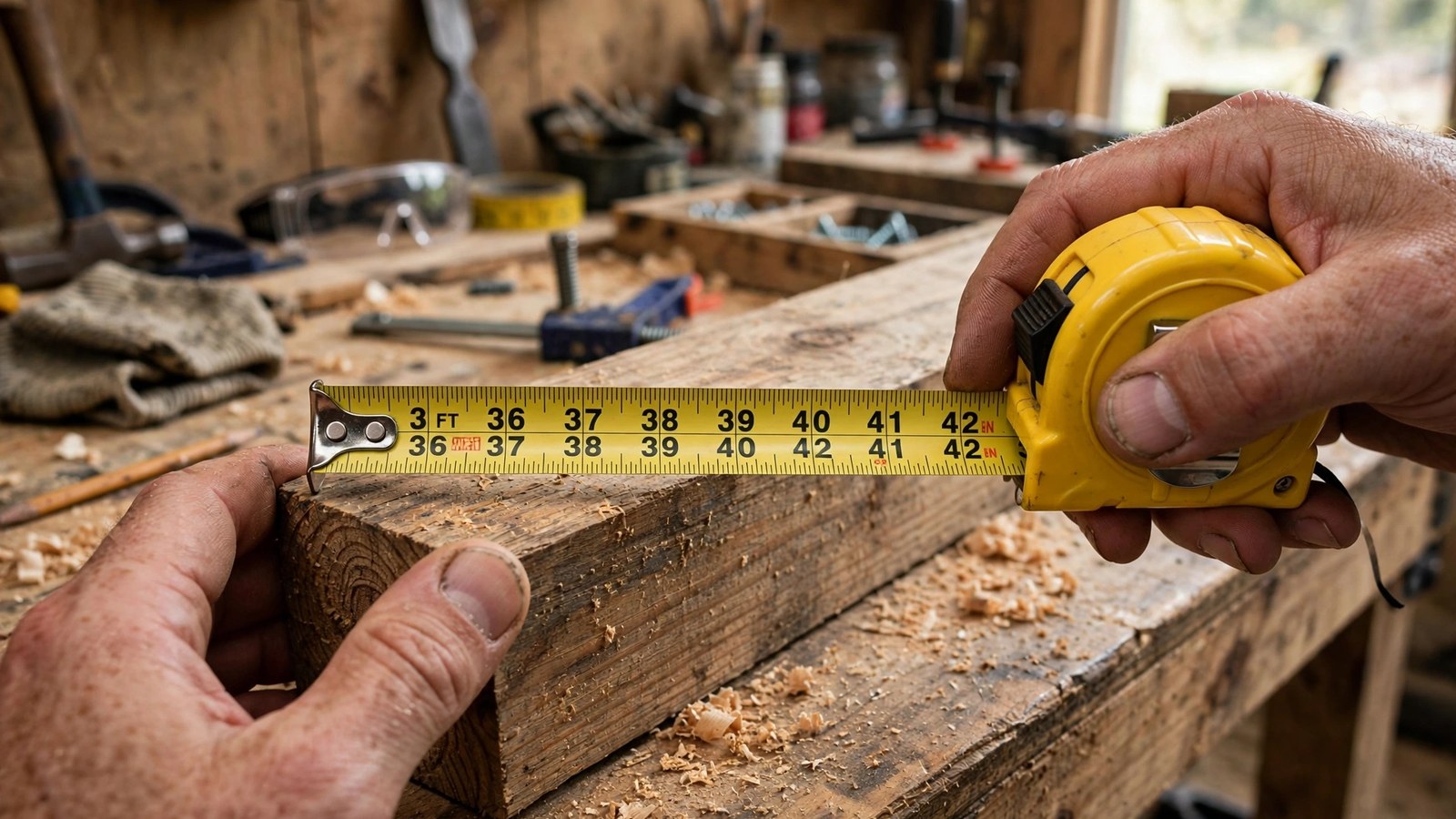
Most long tape measures mark each foot with a larger number and mark the inches between foot marks from 1 to 11. To read a long length, find the last whole foot mark before the end point, then count the additional inches: 7 ft 5 in is (7 x 12) + 5 = 89 inches in total.
For short lengths, reading in inches alone avoids a conversion. Fractions of an inch are marked with shorter lines: half inches have the longest fraction marks, then quarters, then eighths and sixteenths. A reading of 29 and one half inches is 29.5 inches, which is 2 ft 5.5 in, or 2.4583 feet rounded.
Measuring Tips
- Read the tape in inches for short lengths. Counting inches avoids a conversion and removes one chance to slip.
- Use the foot marks on a long tape. Count whole feet from the larger foot numbers, then add the remaining inches.
- Write mixed measurements in full. Write 5 ft 7 in, not a bare 5 7. Labels prevent the most common errors in this topic.
- Convert before you add or subtract. Turn every measurement into total inches, do the arithmetic, then convert back if needed.
- Check with the reverse conversion. Divide an inches answer by 12, or multiply and add a feet and inches answer, and confirm that you return to the starting value.
- Keep fractions until the end. Round a final answer if a form requires it, but do not round halfway through a chain of conversions.
Common Mistakes
- Using 10 instead of 12. A foot is 12 inches, not 10. Ten inches is not a foot, and 10 feet is 120 inches, not 100.
- Reading decimal feet as feet and inches. 5.5 feet is 5 ft 6 in, not 5 ft 5 in. Multiply the decimal part by 12 to get its inches.
- Confusing feet with yards. A yard is 3 feet, or 36 inches. If an answer looks about three times too big or too small, check whether yards and feet were swapped.
- Forgetting the remainder. One hundred inches is 8 feet 4 inches, not 8 feet. The remainder after dividing by 12 is inches, not a decimal to discard.
- Adding feet to inches directly. Four feet plus 6 inches is not 10 of anything. Convert first: 4 feet is 48 inches, plus 6 inches is 54 inches, or 4 feet 6 inches.
- Comparing a diagonal with a width. Screen sizes are diagonals, and a diagonal converted to feet is still a diagonal. It cannot be compared directly with the width of a wall or a stand.
- Worrying about the survey foot at home. The retired US survey foot differed by about two parts per million. It matters in surveying history, not in a room, a board, or a height.
Frequently Asked Questions
How many inches are in a foot?
There are 12 inches in one foot, exactly. The factor is part of the definition of the foot, so it is the same for every measurement.
How many inch in one feet?
One foot contains 12 inches. Feet is the plural of foot, so the question asks for the inches in a single foot, and the answer is 12. Two feet contain 24 inches, and three feet contain 36 inches.
What is 3 ft to inches?
Three feet convert to 36 inches, because 3 x 12 = 36. Three feet is also one yard, and one yard is 36 inches, so the two definitions agree.
How do I convert feet to inches?
Multiply the number of feet by 12. For example, 5 feet x 12 = 60 inches, and 7.5 feet x 12 = 90 inches. The method is the same for whole and decimal feet.
How do I convert inches to feet?
Divide the number of inches by 12. For example, 72 inches / 12 = 6 feet. If there is a remainder, it is the leftover inches: 70 inches is 5 feet 10 inches, because 5 x 12 = 60 and 70 - 60 = 10.
How many inches are in 6 feet?
Six feet are 72 inches, because 6 x 12 = 72. In metric units, 72 inches is 182.88 centimeters, because 72 x 2.54 = 182.88.
What is 5.5 feet in inches?
5.5 feet is 66 inches, because 5.5 x 12 = 66. It is also written 5 ft 6 in, because 0.5 is half a foot, and half of 12 inches is 6 inches. It does not mean 5 ft 5 in.
How many feet are in 100 inches?
One hundred inches are 8.3333 feet, with the threes repeating, or 8 feet 4 inches in mixed form, from 8 x 12 = 96 and 100 - 96 = 4.
How do I convert a height in feet and inches to centimeters?
Convert the height to total inches first, then multiply by 2.54. For 5 ft 7 in, the total is 67 inches, and 67 x 2.54 = 170.18 centimeters.
How many inches are in a yard?
One yard is 36 inches, because a yard is 3 feet and each foot is 12 inches, so 3 x 12 = 36. Five yards are 180 inches, and ten yards are 360 inches.
Is the feet to inches conversion exact?
Yes. One foot is exactly 12 inches, one inch is exactly 2.54 centimeters, and one foot is exactly 0.3048 meters. Any approximation in an answer comes from rounding a repeating decimal, not from the conversion factors.
What is 12 feet in inches?
Twelve feet are 144 inches, because 12 x 12 = 144. The same length is 365.76 centimeters, because 144 x 2.54 = 365.76.
Keep reading: How Many Inches Are in a Yard? The Exact Answer, With Worked Examples
Keep reading: Meters in a Foot
Keep reading: How Many Centimeters Are in an Inch? The Exact Answer and How to Use It
Keep reading: Kilometers to Miles: The Conversion, and the Distances People Actually Ask About
Sources & references
- National Institute of Standards and Technology (NIST), Guide for the Use of the International System of Units (SI), Special Publication 811, Appendix B.9, Length factors. Used for the exact length factors, shown in boldface as exact in that appendix: foot to meter 0.3048, inch to meter 0.0254, inch to centimeter 2.54, yard to meter 0.9144, and mile to meter 1,609.344. The 12 inches in a foot follows exactly from the foot and inch factors, 0.3048 / 0.0254 = 12. https://www.nist.gov/physical-measurement-laboratory/nist-guide-si-appendix-b9
- National Institute of Standards and Technology (NIST), U.S. Survey Foot, and U.S. Survey Foot: Revised Unit Conversion Factors. Used for the statements that in 1959 the relationship of the foot to the meter was refined as 1 foot = 0.3048 meter exactly, that the US survey foot is obsolete and superseded by the international foot from January 1, 2023, that a mile is 5,280 feet, and that exact equivalents based on the international foot are published in NIST Handbook 44, Appendix C. https://www.nist.gov/pml/us-surveyfoot and https://www.nist.gov/pml/us-surveyfoot/revised-unit-conversion-factors
- National Institute of Standards and Technology (NIST), Metric Policy. Used for the statement that the final decision to retire the US survey foot was published in the Federal Register on October 5, 2020, announcing the deprecation date of December 31, 2022. https://www.nist.gov/pml/owm/metric-si/metric-policy


